Commercial Refrigeration Equipment Market (2026 - 2035)

Commercial Refrigeration Equipment Market Research Report By Product Type (Refrigerated Display Cases, Refrigerators and Freezers, Blast Chillers, Refrigerated Vending Machines, Others), By Application (Retail, Food and Beverage, Healthcare and Pharmaceuticals, Chemicals, Others), By Refrigerant Type (Fluorocarbons, Hydrocarbons, Inorganics), By System Configuration (Plug-In or Self-Contained Units, Remote Condensing Units, Multiplex Rack Systems, Others) and By Regional (North America, Europe, South America, Asia Pacific, Middle East and Africa) - Forecast to 2035
ID: MRFR/Equip/0216-CR
88 Pages
Harshita Gorde
Last Updated: August 24, 2026
Commercial Refrigeration Equipment Market
Market Size
Forecast Period2026-2035
CAGR (2026-2035)5.21%
2025 Market SizeUSD 47.92 Billion
2035 Market SizeUSD 79.65 Billion
Key Players
Carrier Global Corporation
Daikin Industries
Emerson Electric Co.
Hussmann Corporation
Danfoss A/S
Johnson Controls International
Opportunities
  • Refrigeration-as-a-Service Business Models
  • Emerging-Market Cold-Chain Infrastructure
  • Data Monetization through Connected Equipment

Commercial Refrigeration Equipment Market Summary

The Commercial Refrigeration Equipment Market stood at USD 47.92 billion in 2025 and is projected to reach USD 50.42 billion in 2026 before climbing to USD 79.65 billion by 2035, expanding at a 5.21% CAGR during the 2026–2035 forecast period. Two regulatory forces are reshaping capital allocation across the industry: Europe's revised F-Gas Regulation 2024/573, which is compressing hydrofluorocarbon quotas faster than original timelines anticipated, and the United States Technology Transitions rule that slashed HFC allocations by 40% between 2024 and 2025 [2]. These twin pressures are funneling equipment buyers toward low global-warming-potential alternatives and igniting a replacement cycle that will sustain above-trend growth through the early 2030s.

Technology transformation in the Commercial Refrigeration Equipment Market centers on the migration from legacy synthetic-refrigerant systems to natural-refrigerant architectures paired with embedded telemetry. Manufacturers are redesigning product lines around carbon dioxide and hydrocarbon circuits, modular rack configurations, and IoT-enabled diagnostics that cut unplanned downtime by an estimated 25–30% [3]. California's Title 24 mandate requiring doors on open display cases is driving large-scale retrofits across North American grocery chains, a trend that the will save 1.2 TWh of electricity annually once fully adopted [4].

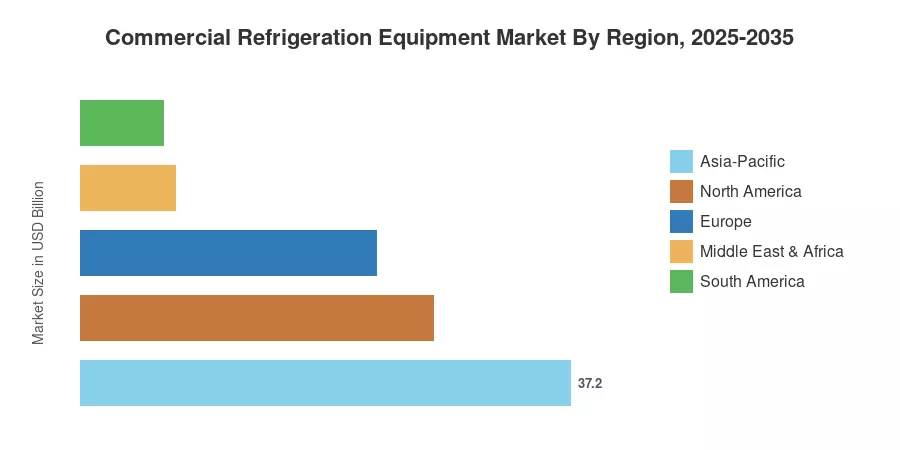
Asia-Pacific commands the largest share of the Commercial Refrigeration Equipment Market at 37.2% of 2025 global revenue, buoyed by rapid supermarket expansion across China, India, and ASEAN nations. The Middle East & Africa region registered the fastest regional CAGR at 8.72%, propelled by cold-chain investments tied to food security programs in Saudi Arabia and the UAE [5]. Europe, the second-largest region at 22.5%, continues to anchor demand through stringent sustainability mandates. As organized retail penetration deepens in emerging economies and refrigerant regulations tighten worldwide, the Commercial Refrigeration Equipment Market is positioned for a decade of sustained, policy-driven expansion.


Key Report Takeaways

• By Product Type

  • Refrigerated display cases captured 30.5% of the Commercial Refrigeration Equipment Market revenue in 2025, reflecting their central role in organized retail and food-service channels.
  • Refrigerated vending machines are projected to grow at the fastest product-type CAGR of 6.89% through 2035, driven by automated retail expansion in transit hubs and campuses.


• By System Configuration

  • Plug-in or self-contained units held a 44.4% system-configuration share in 2025, favored by convenience stores and quick-service restaurants for their installation simplicity.

• By Application

  • Retail accounted for 40.5% of the Commercial Refrigeration Equipment Market in 2025, with hypermarket and supermarket chains in Asia-Pacific and Latin America scaling cold-chain infrastructure.
  • Healthcare and pharmaceuticals advanced at a 7.65% CAGR through 2035, fueled by vaccine cold-chain buildouts and biologics storage requirements.


• By Refrigerant Type

  • Inorganic refrigerants recorded the strongest refrigerant-type CAGR at 8.49%, reflecting accelerated adoption of carbon dioxide and ammonia systems.

• By Region

  • Asia-Pacific generated 37.2% of global Commercial Refrigeration Equipment Market revenue in 2025.
  • The Middle East & Africa region posted the highest regional CAGR at 8.72% through 2035.


Market Size and Forecast (2021–2035)

Market Research Future derives historical estimates from trade-association shipment data, company filings, and customs records, calibrated against bottom-up demand models for retail, food-service, healthcare, and industrial cold-storage end uses. Forecast projections layer regulatory scenario analysis, refrigerant-price trajectories, and capital-expenditure surveys onto the historical trend.
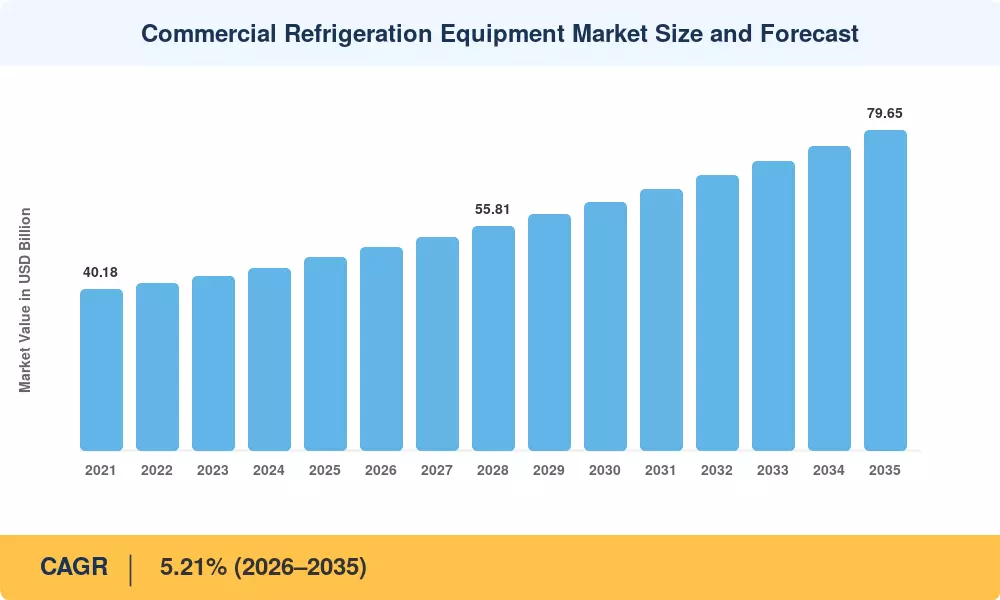
Commercial Refrigeration Equipment Market Size and Forecast
Our Impact
Enabled $4.3B Revenue Impact for Fortune 500 and Leading Multinationals
Partnering with 2000+ Global Organizations Each Year
30K+ Citations by Top-Tier Firms in the Industry

Driver Impact Analysis

Driver ~% Impact on CAGR Geographic Relevance Impact Timeline
HFC phase-down regulations ~22% Global Short-term (≤2 yr)
Organized retail expansion in emerging economies ~20% Asia-Pacific, MEA, South America Medium-term (2–4 yr)
IoT diagnostics and predictive maintenance ~16% North America, Europe Medium-term (2–4 yr)
Vaccine and biologics cold-chain investment ~14% Global Long-term (≥4 yr)
Energy-efficiency mandates (Title 24, EU EcoDesign) ~12% North America, Europe Short-term (≤2 yr)
Food-safety and traceability standards ~9% Global Long-term (≥4 yr)
Urbanization and convenience-store proliferation ~7% Asia-Pacific, South America Long-term (≥4 yr)


HFC Phase-Down Regulations

National-level regulations are front-loading the Kigali Amendment to the Montreal Protocol, which requires signatory countries to reduce HFC consumption by 80–85% by the mid-2040s [2]. The U.S. EPA's Technology Transitions rule lowered the national HFC production-and-consumption baseline by 40% between 2024 and 2025, while Europe's F-Gas Regulation 2024/573 prohibits HFCs with a GWP exceeding 150 in new commercial refrigeration systems starting in 2025 [2]. Growing costs for refrigerants—R-404Spot prices, which increased by around 60% in Europe in 2024- are hastening cost-conscious shops' plans to replace their equipment, making new low-GWP units financially appealing despite their higher initial costs [6].


Organized Retail Expansion in Emerging Economies

According to the India Brand Equity Foundation [5], India's organized food-retail penetration surpassed 12%, up from 9% in 2020, while China built over 4,800 new supermarket and hypermarket locations in 2023 alone. Similar trends are being seen in Southeast Asian markets, which are dominated by Indonesia, Vietnam, and the Philippines, as local and international grocery chains install centralized rack systems, walk-in cold rooms, and multi-deck display cases to satisfy cold-chain compliance requirements [10]. This structural change creates long-term first-installation demand for the commercial refrigeration equipment market by converting informal, ambient-temperature retail into refrigerated modern trade.


IoT Diagnostics and Predictive Maintenance

Embedded sensors, cloud-based dashboards, and machine-learning algorithms now enable operators to monitor compressor health, evaporator coil cleanliness, and door-seal integrity in real time [3]. According to the U.S. Department of Energy, predictive maintenance programs can reduce unplanned refrigeration downtime by 25–30% and lower energy consumption by 10–15% relative to reactive service models [4]. Equipment manufacturers are increasingly bundling telemetry hardware into base-model pricing to secure recurring service-contract revenue, reshaping competitive dynamics within the Commercial Refrigeration Equipment Market.

Vaccine and Biologics Cold-Chain Investment

Global biologics sales exceeded USD 420 billion in 2024, and the WHO estimates that roughly 50% of vaccines are wasted annually in developing countries due to cold-chain failures [8]. Governments and multilateral organizations are channeling capital into ultra-low-temperature storage, pharmaceutical-grade walk-in freezers, and temperature-monitored transport systems. The U.S. BARDA alone committed USD 1.7 billion between 2021 and 2024 to domestic cold-chain resilience programs, directly benefiting the Commercial Refrigeration Equipment Market [8].


Restraints Impact Analysis

Restraint ~% Impact on CAGR Geographic Relevance Impact Timeline
High upfront cost of natural-refrigerant systems ~−8% Global Short-term (≤2 yr)
Skilled-technician shortage for CO₂ and ammonia systems ~−6% North America, Europe Medium-term (2–4 yr)
Fragmented regulatory landscape across regions ~−5% Global Long-term (≥4 yr)
Supply-chain bottlenecks for specialty components ~−4% Global Short-term (≤2 yr)
Energy-price volatility raising operating costs ~−3% Europe, Asia-Pacific Medium-term (2–4 yr)


High Upfront Cost of Natural-Refrigerant Systems

Because they require specialized manufacturing and higher-pressure-rated components, transcritical carbon dioxide booster systems have a 20–35% higher capital cost than traditional HFC direct-expansion units [6]. Even in cases where lifetime operating benefits are evident, this cost gap can discourage adoption for small and mid-sized food service firms by extending payback periods beyond five years. A sizable chunk of the potential base of the commercial refrigeration equipment market is under-penetrated because financing mechanisms like green-equipment leasing programs are just starting to grow [14].


Skilled-Technician Shortage

Technicians with certain pressure-safety certifications and controls-integration training are required for the switch to ammonia and CO2 systems. As of 2024, the Air-Conditioning, Heating, and Refrigeration Institute (AHRI) forecasted a 22% discrepancy between the number of certified natural-refrigerant specialists on the market and the anticipated demand in North America [11]. Because of this labor shortage, end users who adopt next-generation technology before workforce preparedness face operational risk, longer installation times, and higher servicing costs.


Commercial Refrigeration Equipment Market Opportunities

Refrigeration-as-a-Service Business Models

Equipment-as-a-service offerings convert capital expenditure into predictable operating expense, lowering adoption barriers for small and mid-sized retailers [14]. By bundling hardware, remote monitoring, and preventive maintenance into a monthly fee, OEMs can capture recurring revenue while end users gain guaranteed uptime SLAs. This model is especially attractive in the Commercial Refrigeration Equipment Market's fastest-growing segments — convenience stores and quick-service restaurants — where operators prefer operational simplicity over asset ownership.

Emerging-Market Cold-Chain Infrastructure

India's National Centre for Cold-chain Development targets a 35% increase in cold-storage capacity by 2028, while Saudi Arabia's National Food Security Strategy earmarks USD 8.5 billion for agricultural and food-logistics infrastructure through 2030 [5]. These government-backed programs create sizeable addressable markets for walk-in coolers, blast chillers, and centralized refrigeration systems in regions where penetration remains low.

Data Monetization through Connected Equipment

Connected refrigeration units generate continuous streams of temperature, humidity, energy-consumption, and compressor-performance data [3]. Equipment manufacturers and facility operators can monetize this data through energy benchmarking, predictive-analytics dashboards, and insurance-risk-reduction partnerships. As installed-base connectivity rates climb above 40%, the Commercial Refrigeration Equipment Market will see data-enabled services become a meaningful margin contributor.

Electrification of Transport Refrigeration

The transition from diesel-powered transport refrigeration units to electric and cryogenic alternatives is gaining regulatory tailwinds, with California's Advanced Clean Fleets rule mandating zero-emission truck refrigeration by 2035 [15]. This convergence of stationary and transport cold-chain electrification opens adjacent revenue pools for OEMs that already serve the Commercial Refrigeration Equipment Market.

Pharmaceutical and Life-Sciences Expansion

The biologics pipeline — including mRNA therapeutics, cell and gene therapies, and biosimilars — requires ultra-low-temperature storage at −80 °C and below [8]. Equipment suppliers that develop modular, validated pharmaceutical cold-storage solutions can access a premium-priced segment growing at roughly twice the overall market rate.


Commercial Refrigeration Equipment Market Future Outlook

AI-Driven Autonomous Refrigeration Management

By the late 2020s, artificial intelligence will move beyond predictive maintenance into autonomous load optimization, where systems dynamically adjust compressor staging, defrost cycles, and door-heater duty cycles without human intervention [3]. The IEA projects that AI-managed commercial HVAC-R systems could reduce electricity consumption in the retail sector by 18–22% by 2032, compressing operating costs and strengthening the total-cost-of-ownership argument for premium equipment in the Commercial Refrigeration Equipment Market [16].

Platform Economics and Equipment-as-a-Service

The shift from transactional equipment sales to platform-based service models will reshape vendor economics across the Commercial Refrigeration Equipment Market during the 2028–2033 window [14]. OEMs that control the data layer — collecting and analyzing performance telemetry from tens of thousands of connected units — will be positioned to bundle energy management, compliance reporting, and spare-parts logistics into subscription packages, generating predictable recurring revenue streams that command higher valuation multiples.

Natural-Refrigerant Supercycle

The cumulative impact of global HFC phase-down schedules points toward a natural-refrigerant supercycle peaking between 2030 and 2034 [2]. Reports estimate that the installed base of CO₂ transcritical systems in commercial refrigeration will triple from 2025 levels by 2033, driven by regulatory mandates in Europe, North America, and Oceania [17]. Hydrocarbon-based self-contained units will simultaneously capture share in small-format retail, where charge-size limits permit safe deployment.

ESG Reporting and Scope-3 Emissions Pressure

Starting in 2026, the EU Corporate Sustainability Reporting Directive requires large food retailers and food-service companies to disclose Scope-3 refrigerant-leakage emissions [18]. This reporting obligation converts refrigerant-management decisions from operational choices into boardroom-level ESG commitments, accelerating procurement of ultra-low-leakage and zero-GWP systems within the Commercial Refrigeration Equipment Market.


Commercial Refrigeration Equipment Market Segmentation

By Product Type

Segment Key Metric Primary Demand Driver
Refrigerated Display Cases 30.5% share (2025) Supermarket and convenience-store expansion
Refrigerators and Freezers USD 13.08 Billion (2025) Food-service and institutional demand
Blast Chillers 4.85% CAGR (2026–2035) HACCP compliance in commercial kitchens
Refrigerated Vending Machines 6.89% CAGR (2026–2035) Automated micro-retail proliferation
Others 11.2% share (2025) Specialty and industrial applications


Refrigerated display cases anchor the Commercial Refrigeration Equipment Market's product landscape, serving as the primary interface between chilled inventory and the consumer in supermarkets, convenience outlets, and food-service delicatessens. Demand is bifurcating between open multi-deck cases in high-turnover grocery environments and doored cases mandated by energy codes such as California's Title 24. Refrigerated vending machines, though smaller in absolute terms, represent the fastest-growing product category as operators deploy unattended retail points in offices, hospitals, universities, and transit stations.

By Application

Segment Key Metric Primary Demand Driver
Retail 40.5% share (2025) Hypermarket and supermarket penetration
Food and Beverage USD 13.76 Billion (2025) Restaurant and food-service chain growth
Healthcare and Pharmaceuticals 7.65% CAGR (2026–2035) Vaccine and biologics storage mandates
Chemicals 4.42% CAGR (2026–2035) Temperature-sensitive chemical storage
Others 7.8% share (2025) Floral, horticultural, and laboratory uses


Retail remains the dominant application within the Commercial Refrigeration Equipment Market, as global grocery chains invest heavily in cold-aisle infrastructure to meet consumer demand for fresh, chilled, and frozen products. Healthcare and pharmaceuticals constitute the fastest-growing application segment, propelled by expanding biologics production pipelines and post-pandemic cold-chain resilience programs that require validated storage environments [8].

By Refrigerant Type

Segment Key Metric Primary Demand Driver
Fluorocarbons 49.2% share (2025) Legacy installed base and retrofit demand
Hydrocarbons USD 10.73 Billion (2025) Self-contained unit adoption
Inorganics 8.49% CAGR (2026–2035) CO₂ transcritical and ammonia system growth


Fluorocarbons retain the largest refrigerant-type share in the Commercial Refrigeration Equipment Market due to the massive legacy installed base, though their trajectory is declining as regulatory bans take effect. Inorganic refrigerants — principally carbon dioxide and ammonia — are expanding at the fastest pace, with CO₂ transcritical booster systems now the default specification for new-build European supermarkets exceeding 2,000 m² of sales area [6].

By System Configuration

Segment Key Metric Primary Demand Driver
Plug-In or Self-Contained Units 44.4% share (2025) Convenience retail and QSR simplicity
Remote Condensing Units USD 14.75 Billion (2025) Mid-format store centralization
Multiplex Rack Systems 6.61% CAGR (2026–2035) Large-format supermarket efficiency
Others 10.2% share (2025) Custom industrial configurations


Plug-in units dominate system-configuration share owing to their low installation complexity and suitability for small-format outlets. Multiplex rack systems are the fastest-growing configuration segment as large retailers transition to centralized architectures that reduce total refrigerant charge, simplify leak detection, and enable heat-recovery for store heating — a triple benefit driving specification preference in the Commercial Refrigeration Equipment Market.


Regional Market Share Analysis

Region Revenue Share (2025) Primary Investment Themes
Asia-Pacific 37.2% Supermarket proliferation, cold-chain compliance
North America 26.8% Retrofit mandates, IoT service models
Europe 22.5% F-Gas compliance, energy-efficiency standards
South America 6.3% Organized retail growth, food-safety regulation
Middle East & Africa 7.2% Food-security infrastructure, mega-project development
Total 100.0%

The Commercial Refrigeration Equipment Market exhibits meaningful regional variation in growth trajectories, driven by differences in retail modernization pace, refrigerant regulation stringency, and cold-chain infrastructure maturity.


North America

Country Key Metric Key Driver
United States 78.4% of regional share Title 24 retrofit mandates, EPA Technology Transitions
Canada 13.2% of regional share Carbon-pricing incentives for low-GWP equipment
Mexico 8.4% of regional share Organized retail expansion in Tier-2 cities


North America's Commercial Refrigeration Equipment Market is defined by a regulatory-led replacement cycle. The U.S. EPA's phasedown schedule and California's energy codes are compelling grocery and food-service chains to upgrade existing fluorocarbon-based systems, while federal tax incentives under the Inflation Reduction Act provide capital offsets for energy-efficient commercial equipment purchases [4]. Canada's carbon-pricing framework further strengthens the business case for natural-refrigerant adoption.

Europe

Country Key Metric Key Driver
Germany 5.28% CAGR (2026–2035) F-Gas enforcement, Energiewende alignment
United Kingdom USD 3.14 Billion (2025) Post-Brexit refrigerant regulations
France 15.8% of regional share Hypermarket chain modernization
Italy 12.4% of regional share Food-service sector digitization
Spain 4.92% CAGR (2026–2035) Tourism-driven hospitality expansion
Nordic Countries 8.6% of regional share Early natural-refrigerant adoption
Russia 6.1% of regional share Domestic cold-chain investment programs
Rest of Europe 14.7% of regional share EU-wide EcoDesign directive compliance


Europe's Commercial Refrigeration Equipment Market is anchored by the continent's aggressive decarbonization agenda. The F-Gas Regulation 2024/573 sets binding HFC consumption caps that tighten annually through 2030, effectively mandating a full-fleet transition to natural refrigerants for new installations [2]. German and Nordic retailers have led early adoption of transcritical CO₂ systems, with over 35,000 such installations operational across the continent by end-2024 [6].

Asia-Pacific

Country Key Metric Key Driver
China 38.6% of regional share Modern-trade supermarket expansion
India 7.84% CAGR (2026–2035) Cold-chain infrastructure programs
Japan USD 4.82 Billion (2025) Energy-efficiency innovation leadership
South Korea 7.8% of regional share Convenience-store density growth
ASEAN 6.95% CAGR (2026–2035) Food-safety regulation tightening
Rest of Asia-Pacific 9.3% of regional share Agricultural cold-storage expansion


Asia-Pacific leads the Commercial Refrigeration Equipment Market in absolute revenue, driven by China's continued supermarket build-out and India's government-backed cold-chain capacity expansion [5]. Japan's market, while mature, generates premium demand for energy-efficient systems and advanced IoT-integrated units. ASEAN nations — particularly Vietnam, Indonesia, and the Philippines — represent high-growth frontier markets as modern grocery retail displaces traditional wet markets.

South America

Country Key Metric Key Driver
Brazil 62.7% of regional share Agribusiness cold-chain modernization
Argentina 5.18% CAGR (2026–2035) Retail sector formalization
Rest of South America 17.4% of regional share Food-export cold-chain compliance


Brazil dominates South America's Commercial Refrigeration Equipment Market, with large-format retailers and agribusiness processors investing in centralized refrigeration systems to reduce post-harvest losses, which the FAO estimates at 12–15% of perishable production across the region [9].

Middle East & Africa

Country Key Metric Key Driver
Saudi Arabia 31.5% of regional share Vision 2030 food-security investments
UAE 8.72% CAGR (2026–2035) Hospitality and tourism infrastructure
South Africa 18.9% of regional share Retail modernization in urban centers
Egypt 6.48% CAGR (2026–2035) Population-driven food-demand growth
Rest of MEA 22.8% of regional share Humanitarian cold-chain programs


The Middle East & Africa region posts the highest CAGR in the Commercial Refrigeration Equipment Market, propelled by Saudi Arabia's National Food Security Strategy and the UAE's rapid hospitality-sector expansion [5]. South Africa serves as the gateway market for sub-Saharan Africa, where retail chains are scaling refrigerated store formats in Johannesburg, Cape Town, and Nairobi-adjacent markets.


Commercial Refrigeration Equipment Market By Region, 2025-2035

Competitive Benchmarking

The Commercial Refrigeration Equipment Market exhibits medium concentration, with the top five players accounting for an estimated 32–38% of global revenue. The Herfindahl-Hirschman Index falls in the 600–900 range, indicating a moderately fragmented competitive field where scale advantages in component sourcing and service-network density coexist with regional specialists and niche innovators.

Company Est. Revenue Share Range Key Offerings Strategic Positioning
Carrier Global Corporation ~7–10% Display cases, condensing units, CO₂ transcritical systems Full-line provider with global service network
Daikin Industries ~6–9% Inverter compressors, self-contained units, VRV-R systems Technology leader in energy-efficient refrigeration
Emerson Electric Co. ~5–8% Compressors, controls, monitoring platforms Component and controls ecosystem integrator
Hussmann Corporation (Panasonic) ~5–7% Display merchandisers, refrigeration systems, store solutions North American grocery-channel specialist
Danfoss A/S ~4–7% Compressors, valves, electronic controllers Natural-refrigerant component innovator
Johnson Controls International ~4–6% Integrated building and refrigeration management Building-systems convergence strategy
Dover Corporation (Hillphoenix) ~4–6% CO₂ transcritical racks, display cases, cold-room solutions Pioneer in natural-refrigerant rack systems
Hoshizaki Corporation ~3–5% Ice machines, reach-in refrigerators, freezers Premium food-service equipment specialist
True Manufacturing ~2–4% Reach-in and under-counter refrigeration U.S.-manufactured food-service solutions
Electrolux Professional ~2–4% Blast chillers, refrigerated counters, cold rooms European food-service and hospitality focus


Recent News & Developments

  • Carrier Global Corporation (September 2024): Launched the CO₂OLtec EvoLine transcritical CO₂ booster system for warm-climate supermarkets, featuring adiabatic gas-cooling technology that extends efficient CO₂ operation to ambient temperatures above 43 °C [17].
  • European Commission (March 2024): Published the final text of F-Gas Regulation 2024/573, establishing a 2025 ban on HFCs above 150 GWP in new commercial refrigeration systems and setting a full HFC production phase-out by 2050 [2].
  • Danfoss A/S (June 2024): Acquired a minority stake in a German IoT start-up specializing in cloud-based refrigeration analytics, signaling deeper integration of predictive maintenance capabilities into its controls portfolio [3].
  • Hussmann Corporation (January 2025): Unveiled a modular micro-fulfillment refrigeration system designed for grocery retailers, adding automated order-picking capabilities to existing store footprints [7].


  • Hoshizaki Corporation (April 2024): Expanded its manufacturing facility in Peachtree City, Georgia, adding 80,000 sq. ft. of production capacity dedicated to hydrocarbon-refrigerant reach-in units for the North American food-service channel [11].
  • Daikin Industries (November 2024): Announced a strategic partnership with a leading European grocery chain to deploy AI-managed refrigeration across 1,200 stores, targeting a 20% reduction in energy consumption by 2028 [16].


Commercial Refrigeration Equipment Market Report Scope

Parameter Detail
Market Scope Global Commercial Refrigeration Equipment Market
Study Period 2021–2035
CAGR (Forecast) 5.21% (2026–2035)
Market Size (2025) USD 47.92 Billion
Market Size (2035) USD 79.65 Billion
Fastest Growing Segment (Product Type) Refrigerated Vending Machines (6.89% CAGR)
Fastest Growing Segment (Application) Healthcare and Pharmaceuticals (7.65% CAGR)
Companies Profiled 10
Valuation Currency USD Billion

FAQs

What payback period should buyers expect when switching from HFC to CO₂ transcritical systems?
Payback typically ranges from 3.5 to 5.5 years depending on energy costs and store size, with operators in high-electricity-cost regions recovering capital faster. Government rebate programs in the EU and select U.S. states can shorten this by 12–18 months [6].
How does refrigerant leakage rate compare between centralized rack and self-contained configurations?
Centralized racks average 15–20% annual leakage rates due to longer piping runs, while self-contained units typically stay below 2% [6]. This difference increasingly influences total-cost-of-ownership calculations as refrigerant prices rise under phase-down rules.
Which certification standards matter most when procuring pharmaceutical-grade refrigeration?
GDP (Good Distribution Practice) and WHO PQS (Performance, Quality, Safety) prequalification are the primary benchmarks for pharmaceutical cold-chain procurement. Equipment meeting both standards commands a 15–25% price premium but ensures regulatory acceptance across markets [8].
How are smart-grid demand-response programs affecting commercial refrigeration operations?
Utilities in the U.S. and Europe now offer demand-response incentives that pay commercial refrigeration operators to curtail compressor loads during peak grid stress. Thermal-mass strategies allow 15–30-minute load deferrals without compromising product temperatures [16].
What role do hydrocarbon refrigerants play in small-format retail?
Hydrocarbons such as R-290 (propane) dominate self-contained units below 150-gram charge limits, offering low GWP and strong energy performance. IEC 60335-2-89 revisions expanding allowable charge sizes are broadening their addressable equipment range [6].
How should multi-site operators approach fleet-wide refrigeration standardization?
Standardizing on a single refrigerant platform and control architecture across all locations reduces spare-parts inventory costs and technician training complexity. Operators with 50-plus sites typically achieve 8–12% lower maintenance costs through fleet standardization [14].
What financing mechanisms exist for small retailers upgrading refrigeration systems?
Green-equipment leasing, utility on-bill financing, and multilateral development-bank credit lines are the three primary mechanisms available. The European Investment Bank's green-asset finance program, for example, covers up to 75% of eligible commercial refrigeration upgrade costs [14].    
Author
Author
Author Profile
Harshita Gorde LinkedIn
Research Analyst
Harshita Post graduate MBA in Business Administration from Welingkar Institute, Mumbai and 5 years of experience in the field of product market research. As a Research Analyst, I have cross-domain experience in packaging, and industrial Automation & Equipment. I am currently looking after the research process of packaging, logistics & transportation, and industrial automation & equipment at Market Research Future Reports. My responsibilities at the organization involve handling syndicate and custom reports as well as responding to client inquiries, and organize, co-ordinate with a group of 5 to 6 persons to manage all workflows.

Research Approach


Secondary Research

The secondary research process involved comprehensive analysis of regulatory databases, industry standards publications, HVAC-R technical journals, food safety guidelines, and authoritative energy efficiency organizations. Key sources included the US Department of Energy (DOE) Appliance and Equipment Standards Program, Environmental Protection Agency (EPA) SNAP Program, European Commission F-Gas Regulation Portal, Air-Conditioning, Heating, and Refrigeration Institute (AHRI), American Society of Heating, Refrigerating and Air-Conditioning Engineers (ASHRAE), European Committee of Manufacturers of Air Handling and Refrigeration Equipment (Eurovent), US Food and Drug Administration (FDA) Food Code, European Food Safety Authority (EFSA), National Restaurant Association (NRA), Foodservice Equipment & Supplies (FE&S) Association, North American Association of Food Equipment Manufacturers (NAFEM), International Institute of Refrigeration (IIR), US Department of Agriculture (USDA) Cold Storage Reports, International Trade Centre (ITC) trade databases, Eurostat Structural Business Statistics, and national energy efficiency registries from key markets. These sources were used to collect equipment shipment data, energy efficiency standard compliance metrics, refrigerant transition timelines, foodservice industry growth statistics, cold chain infrastructure developments, and regulatory landscape analysis for vapor compression systems, thermoelectric cooling, absorption refrigeration, and emerging magnetic refrigeration technologies.


Primary Research

To gather both qualitative and quantitative insights, supply-side and demand-side stakeholders were interviewed during the primary research phase. CEOs, VPs of manufacturing, chief sustainability officers, heads of regulatory compliance, and directors of product development from compressor manufacturers, component suppliers, and OEMs of commercial refrigeration equipment were examples of supply-side sources. Facilities managers, food safety compliance officers, directors of procurement, and operations managers from full-service restaurant chains, quick-service restaurants (QSRs), supermarket and hypermarket operators, convenience store chains, pharmaceutical cold storage facilities, hospitality organizations, and institutional foodservice operators were among the demand-side sources. In addition to confirming product development timelines for low-GWP refrigerant transitions and gathering information on adoption patterns for smart refrigeration technologies, lifecycle cost analysis, and maintenance outsourcing dynamics, primary research also validated market segmentation across refrigerator, freezer, chiller, and display case categories.

Primary Respondent Breakdown:

• By Designation: C-level Primaries (28%), Director Level (42%), Others (30%)

• By Region: North America (32%), Europe (35%), Asia-Pacific (25%), Rest of World (8%)


Market Size Estimation

Global market valuation was derived through manufacturer revenue mapping and equipment shipment volume analysis. The methodology included:

• Identification of 50+ key manufacturers across North America, Europe, Asia-Pacific, and Latin America, including major players such as Carrier Global, Thermo King (Trane Technologies), Hoshizaki Electric, Daikin Industries, True Manufacturing, Electrolux Professional, Liebherr Group, and Manitowoc Company

• Product mapping across refrigerators, freezers, chillers, ice makers, display cases, and beverage coolers by cooling technology (vapor compression, thermoelectric, absorption) and end-use application (food service, retail, pharmaceutical, hospitality)

• Analysis of reported and modeled annual revenues specific to commercial refrigeration portfolios, including aftermarket service revenues and parts sales

• Coverage of manufacturers representing 75-80% of global market share in 2024

• Extrapolation using bottom-up (unit shipments × average selling price by country/region, adjusted for installation and maintenance revenues) and top-down (manufacturer revenue validation against industry association shipment data) approaches to derive segment-specific valuations for foodservice equipment, retail display systems, and industrial cold storage solutions

Download Free Sample

Kindly complete the form below to receive a free sample of this Report

* Please use a valid business email

Download PDF ×

We do not share your information with anyone. However, we may send you emails based on your report interest from time to time. You may contact us at any time to opt-out.
















