×
Request Free Sample ×

Kindly complete the form below to receive a free sample of this Report

* Please use a valid business email

Leading companies partner with us for data-driven Insights

clients tt-cursor
Hero Background

Composite Roller Market

ID: MRFR/CnM/8009-HCR
111 Pages
Chitranshi Jaiswal
October 2025

Composite Roller Market Research Report By Application (Textiles, Paper Packaging, Automotive, Aerospace, Industrial Equipment), By Material Type (Polymer Composites, Metal Matrix Composites, Ceramic Composites, Hybrid Composites), By End Use Industry (Manufacturing, Construction, Electronics, Marine, Energy), By Roller Type (Smooth Rollers, Textured Rollers, Drum Rollers, Segmented Rollers) and By Regional (North America, Europe, South America, Asia Pacific, Middle East and Africa) - Forecast to 2035

Share:
Download PDF ×

We do not share your information with anyone. However, we may send you emails based on your report interest from time to time. You may contact us at any time to opt-out.

Composite Roller Market Infographic
Purchase Options

Composite Roller Market Summary

As per MRFR analysis, the Composite Roller Market Size was estimated at 3585.01 USD Million in 2024. The Composite Roller industry is projected to grow from 3758.96 USD Million in 2025 to 6037.2 USD Million by 2035, exhibiting a compound annual growth rate (CAGR) of 4.85 during the forecast period 2025 - 2035.

Key Market Trends & Highlights

The Composite Roller Market is experiencing a dynamic shift towards sustainability and technological innovation.

  • North America remains the largest market for composite rollers, driven by robust industrial applications.
  • Asia-Pacific is emerging as the fastest-growing region, fueled by increasing investments in infrastructure and manufacturing.
  • The material handling segment dominates the market, while the agriculture segment is witnessing rapid growth due to rising demand for efficient farming solutions.
  • Key market drivers include the rising demand for lightweight materials and an increased focus on energy efficiency.

Market Size & Forecast

2024 Market Size 3585.01 (USD Million)
2035 Market Size 6037.2 (USD Million)
CAGR (2025 - 2035) 4.85%

Major Players

Dunlop Conveyor Belting (NL), ContiTech AG (DE), Martin Engineering (US), Flexco (US), C.C. Eastern (US), Gates Corporation (US), Rudolph Libbe Group (US), Sparks Belting Company (US), Bando Chemical Industries, Ltd. (JP)

Composite Roller Market Trends

The Composite Roller Market is currently experiencing a dynamic evolution, driven by advancements in material science and increasing demand across various industries. The integration of composite materials into roller manufacturing has led to enhanced performance characteristics, such as improved durability and reduced weight. This shift appears to be fostering greater efficiency in applications ranging from manufacturing to transportation, where the need for reliable and lightweight components is paramount. Furthermore, the growing emphasis on sustainability is prompting manufacturers to explore eco-friendly materials, which may reshape product offerings in the near future. In addition, the Composite Roller Market is witnessing a surge in innovation, with companies investing in research and development to create high-performance solutions tailored to specific industry needs. This trend suggests a potential for customization, allowing businesses to optimize their operations while minimizing costs. As industries continue to evolve, the demand for advanced composite rollers is likely to expand, indicating a robust future for this market segment. The interplay between technological advancements and market needs is expected to drive growth, making the Composite Roller Market a focal point for stakeholders seeking to capitalize on emerging opportunities.

Sustainability Initiatives

The Composite Roller Market is increasingly influenced by sustainability initiatives, as manufacturers seek to reduce their environmental footprint. This trend involves the adoption of eco-friendly materials and production processes, which may appeal to environmentally conscious consumers and businesses alike.

Technological Advancements

Ongoing technological advancements are reshaping the Composite Roller Market, with innovations in material properties and manufacturing techniques. These developments could lead to enhanced performance and efficiency, allowing for broader applications across various sectors.

Customization and Specialization

There is a growing trend towards customization and specialization within the Composite Roller Market. Manufacturers are focusing on creating tailored solutions that meet the specific needs of different industries, potentially improving operational efficiency and customer satisfaction.

Composite Roller Market Drivers

Rising Demand from Emerging Economies

Emerging economies are witnessing a rapid industrialization process, which significantly impacts the Global Composite Roller Market Industry. Countries in Asia-Pacific and Latin America are increasingly investing in infrastructure development, manufacturing, and transportation, leading to a heightened demand for composite rollers. These regions are expected to contribute substantially to the market growth, with projections indicating a market value of 6.04 USD Billion by 2035. The rising industrial activities in these economies create opportunities for manufacturers to expand their reach and cater to the growing needs of various sectors, thereby driving the overall market forward.

Growing Demand for Lightweight Materials

The Global Composite Roller Market Industry experiences a surge in demand for lightweight materials across various sectors, including aerospace, automotive, and manufacturing. As industries increasingly prioritize efficiency and performance, composite rollers, known for their reduced weight and enhanced durability, become a preferred choice. This shift is evident as the market is projected to reach 3.59 USD Billion in 2024, driven by the need for materials that can withstand high stress while minimizing energy consumption. The adoption of composite rollers not only improves operational efficiency but also aligns with sustainability goals, making them a vital component in modern manufacturing processes.

Regulatory Support for Advanced Materials

Regulatory frameworks worldwide increasingly support the use of advanced materials, including composites, in various applications. Governments are implementing policies that encourage the adoption of lightweight and durable materials to enhance energy efficiency and reduce environmental impact. This regulatory support is particularly evident in sectors such as transportation and construction, where composite rollers are gaining traction. The Global Composite Roller Market Industry stands to benefit from these initiatives, as they create a favorable environment for innovation and investment. As the market evolves, compliance with these regulations will likely drive further advancements in composite roller technology.

Technological Advancements in Manufacturing

Technological innovations play a crucial role in shaping the Global Composite Roller Market Industry. Advanced manufacturing techniques, such as automated fiber placement and 3D printing, enhance the production of composite rollers, allowing for greater precision and customization. These advancements facilitate the development of rollers with superior mechanical properties and longer lifespans, which are essential for high-performance applications. As a result, the market is expected to grow significantly, with a projected CAGR of 4.84% from 2025 to 2035. This growth reflects the industry's commitment to integrating cutting-edge technologies that improve product quality and operational efficiency.

Increasing Adoption in Renewable Energy Sector

The Global Composite Roller Market Industry benefits from the increasing adoption of composite materials in the renewable energy sector, particularly in wind turbine manufacturing. Composite rollers are utilized in the production of wind turbine blades, where their lightweight and high-strength characteristics contribute to improved energy efficiency and performance. As the global push for renewable energy intensifies, the demand for composite rollers is anticipated to rise, supporting the industry's growth trajectory. This trend aligns with the broader goal of achieving sustainable energy solutions, further solidifying the role of composite rollers in the renewable energy landscape.

Market Segment Insights

By Application: Material Handling (Largest) vs. Agriculture (Fastest-Growing)

In the Composite Roller Market, the application segment is primarily dominated by Material Handling, which holds the largest share due to its extensive use in logistics and warehousing solutions. This segment benefits from the increasing demand for efficient material transport mechanisms across various industries. Following closely is the construction segment, which also represents a significant portion of the market, largely attributed to its utilization in various construction machinery and equipment that require durability and reliability. The growth trends within the application segment indicate a strong upward trajectory for Agriculture, recognized as the fastest-growing application due to the rising adoption of advanced agricultural equipment. The increasing focus on sustainable farming practices and efficiency is driving the demand within this segment. As technology continues to evolve, the need for composite rollers in specialized agricultural machinery will enhance their growth prospects in the coming years.

Material Handling: Dominant vs. Agriculture: Emerging

Material Handling remains the dominant application in the Composite Roller Market, heavily relied upon for the effective and safe movement of materials across diverse sectors. The versatility and durability of composite rollers in various material handling equipment have led to their widespread adoption. In contrast, Agriculture represents an emerging segment that is gaining traction due to the heightened emphasis on agricultural efficiency and sustainability. The increasing reliance on mechanized farming solutions is fostering demand for high-performance composite rollers. The difference in characteristics between the two applications highlights how Material Handling caters to traditional industrial needs, while Agriculture is evolving with smart technology integration, requiring rollers that can withstand diverse operational stresses and provide better performance under varied environmental conditions.

By End Use: Industrial (Largest) vs. Residential (Fastest-Growing)

In the Composite Roller Market, the end-use distribution reveals that the industrial segment holds the largest market share, driven by extensive applications in manufacturing and heavy-duty operations. Industries such as automotive and aerospace heavily utilize composite rollers for their durability and strength. The commercial segment follows, catering to a diverse client base including logistics and warehousing needs, while the residential segment, though the smallest, is gaining momentum as home improvement trends rise. Growth trends in the Composite Roller Market are significantly influenced by innovation in material technology and increased demand from various sectors. The residential segment is seeing rapid growth spurred by DIY home projects and renovations, positioned to become a key player within the market. Furthermore, the push towards sustainability is enhancing the appeal of composite rollers constructed from eco-friendly materials, benefiting all segments as green practices become more prevalent.

Industrial (Dominant) vs. Residential (Emerging)

In the Composite Roller Market, the industrial segment is the dominant force, characterized by its robust application in sectors that require high-load bearing solutions such as manufacturing and construction. These rollers are designed for longevity and efficiency, helping industries optimize their operations. In contrast, the residential segment is emerging, attributed to the growing trend of home renovations and an increase in amateur construction projects. This segment values affordability and lightweight options, appealing to homeowners wanting to improve functionality while remaining budget-friendly. As DIY culture thrives, the residential segment’s acceptance of composite rollers is set to rise, indicating a shift in market dynamics that may favor both durability and cost-effective solutions.

By Type: Polymer Composite (Largest) vs. Metal Composite (Fastest-Growing)

In the Composite Roller Market, the distribution of market share among the types reveals that Polymer Composites hold a substantial lead, thanks to their versatility and wide-ranging applications. They are widely preferred in several industries due to their lightweight properties, corrosion resistance, and overall durability. Metal Composites, while holding a smaller share, are gaining traction due to their strength and ability to withstand extreme conditions, making them essential for specific industrial applications. The growth trends within this segment indicate a robust uptake of Metal Composites, which are becoming the fastest-growing option. Driven by advancements in manufacturing technologies and an increasing demand for high-performance materials, these composites are making significant inroads. Meanwhile, Polymer Composites continue to secure their position as the go-to choice for diverse applications, bolstered by innovations that enhance their performance characteristics.

Polymer Composite (Dominant) vs. Ceramic Composite (Emerging)

Polymer Composites are currently the dominant force in the Composite Roller Market, characterized by their exceptional lightweight nature and resistance to various environmental factors. They are widely utilized across diverse sectors, from automotive to construction, due to their adaptability and efficiency. Their manufacturing processes are continuously evolving, leading to improvements in performance and cost-effectiveness. Meanwhile, Ceramic Composites represent an emerging alternative, valued for their heat resistance and durability in demanding environments. Although they have a smaller market presence, designers are increasingly exploring their applications in specialized areas. As industries seek longer-lasting, high-performance materials, Ceramic Composites are gaining recognition, reflecting a shift in consumer preferences and technological advancements.

By Load Capacity: Heavy Duty (Largest) vs. Light Duty (Fastest-Growing)

In the Composite Roller Market, the load capacity segment is divided into Light Duty, Medium Duty, and Heavy Duty categories. Among these, the Heavy Duty segment holds the largest market share, favored for its robustness and capability to handle substantial loads in industrial applications. While Medium Duty continues to maintain a steady position, it is the Light Duty segment that is capturing attention lately, as it caters to a growing demand for lightweight solutions in various sectors.

Heavy Duty (Dominant) vs. Light Duty (Emerging)

The Heavy Duty segment is characterized by its strength and reliability, making it suitable for demanding environments and heavy industrial use. This segment is essential in applications where resistance to wear and durability are critical. Conversely, the Light Duty segment is emerging rapidly, driven by innovations in materials that enhance performance while keeping weight low. It appeals particularly to industries focused on efficiency and cost-effectiveness, offering flexible solutions for lighter loads. As industries evolve, both segments are adapting, with Heavy Duty retaining dominance while Light Duty positions itself as a competitive alternative for modern manufacturing needs.

By Manufacturing Process: Molding (Largest) vs. Extrusion (Fastest-Growing)

Within the Composite Roller Market, the manufacturing process segment showcases a diverse range of methodologies, with molding currently holding the largest share. This traditional technique has been favored due to its effectiveness in producing complex shapes and consistent material properties. Meanwhile, extrusion is gaining traction and is recognized as the fastest-growing segment, driven by the demand for continuous production and the ability to achieve high precision in roller profiles. As manufacturers seek more efficient and cost-effective methods, the market is witnessing a shift that supports extrusion processes alongside established molding practices.

Molding (Dominant) vs. Extrusion (Emerging)

Molding remains the dominant manufacturing process in the Composite Roller Market, appreciated for its versatility and capability to meet large-scale production demands. This method allows for a wide range of material formulations, ensuring high performance and durability in the end products. On the other hand, extrusion is emerging as a crucial process, characterized by its efficiency in producing uniform cross-sections and customization options. The growing trend towards automation and improved manufacturing technologies supports extrusion's expansion, making it an attractive choice for manufacturers aiming to meet rising consumer expectations for quality and performance.

Get more detailed insights about Composite Roller Market

Regional Insights

North America : Market Leader in Composite Rollers

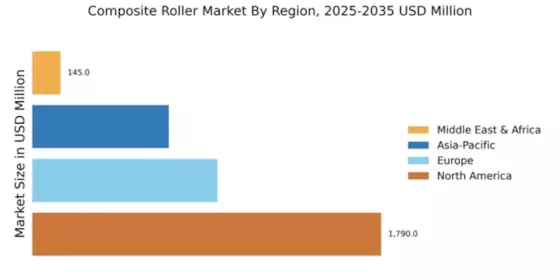
North America is poised to maintain its leadership in the Composite Roller Market, holding a significant market share of 1790.0. The region's growth is driven by increasing demand from industries such as mining, construction, and manufacturing, alongside stringent regulations promoting safety and efficiency. The adoption of advanced materials and technologies further fuels market expansion, making it a hub for innovation and investment. The competitive landscape in North America is robust, featuring key players like Martin Engineering, Flexco, and Gates Corporation. These companies leverage their technological expertise and extensive distribution networks to capture market share. The U.S. stands out as the leading country, supported by a strong industrial base and a focus on sustainable practices. This dynamic environment positions North America as a critical player in The Composite Roller.

Europe : Emerging Market with Growth Potential

Europe is witnessing a growing interest in the Composite Roller Market, with a market size of 900.0. The region benefits from a strong emphasis on sustainability and innovation, driving demand for high-performance composite materials. Regulatory frameworks aimed at reducing environmental impact are catalyzing the adoption of advanced roller technologies, enhancing operational efficiency across various sectors. Leading countries in Europe include Germany, France, and the UK, where major players like ContiTech AG and Dunlop Conveyor Belting are actively expanding their market presence. The competitive landscape is characterized by strategic partnerships and technological advancements, positioning Europe as a key player in the global market. The region's focus on research and development further supports its growth trajectory in the composite roller sector.

Asia-Pacific : Rapid Growth in Emerging Markets

Asia-Pacific is emerging as a significant player in the Composite Roller Market, with a market size of 650.0. The region's growth is driven by rapid industrialization, urbanization, and increasing investments in infrastructure projects. Countries like China and India are leading this growth, supported by government initiatives aimed at enhancing manufacturing capabilities and promoting technological advancements in various sectors. The competitive landscape in Asia-Pacific features key players such as Bando Chemical Industries and local manufacturers who are increasingly adopting innovative technologies. The presence of a large consumer base and rising demand for efficient material handling solutions further bolster market growth. As the region continues to develop, it is expected to play a crucial role in The Composite Roller.

Middle East and Africa : Emerging Market with Untapped Potential

The Middle East and Africa region is gradually emerging in the Composite Roller Market, with a market size of 245.01. The growth is primarily driven by increasing investments in infrastructure and mining sectors, alongside a growing awareness of the benefits of composite materials. Regulatory support for industrial development is also fostering a conducive environment for market expansion, making it an attractive region for investment. Leading countries in this region include South Africa and the UAE, where local and international players are beginning to establish a foothold. The competitive landscape is evolving, with companies exploring partnerships and collaborations to enhance their market presence. As the region continues to develop its industrial capabilities, it presents significant opportunities for growth in the composite roller market.

Key Players and Competitive Insights

The Composite Roller Market is currently characterized by a dynamic competitive landscape, driven by increasing demand for efficient material handling solutions across various industries. Key players are focusing on innovation, sustainability, and strategic partnerships to enhance their market positions. Companies such as Dunlop Conveyor Belting (NL), ContiTech AG (DE), and Martin Engineering (US) are at the forefront, leveraging their technological expertise and extensive distribution networks to capture market share. Their operational focus on developing advanced composite materials and optimizing production processes appears to be shaping a competitive environment that emphasizes quality and performance.

In terms of business tactics, many companies are localizing manufacturing to reduce lead times and enhance supply chain efficiency. The market structure is moderately fragmented, with several players competing on both quality and service. This fragmentation allows for niche players to thrive, while larger companies consolidate their positions through strategic acquisitions and partnerships. The collective influence of these key players is significant, as they drive innovation and set industry standards that smaller competitors often strive to meet.

In November 2025, ContiTech AG (DE) announced the launch of a new line of eco-friendly composite rollers designed to reduce energy consumption by up to 15%. This strategic move not only aligns with global sustainability trends but also positions ContiTech as a leader in environmentally conscious manufacturing. The introduction of these rollers is likely to attract clients who prioritize sustainability in their supply chains, thereby enhancing ContiTech's competitive edge.

Similarly, in October 2025, Martin Engineering (US) unveiled a partnership with a leading AI technology firm to integrate smart monitoring systems into their composite roller products. This initiative aims to provide real-time performance data, enabling clients to optimize their operations. The strategic importance of this partnership lies in its potential to revolutionize maintenance practices, reducing downtime and operational costs for customers, which could significantly enhance customer loyalty and market penetration.

Moreover, in September 2025, Dunlop Conveyor Belting (NL) expanded its manufacturing capabilities by investing €5 million in a new facility in Eastern Europe. This expansion is expected to increase production capacity and improve service delivery in a region experiencing rapid industrial growth. The strategic importance of this investment is multifaceted; it not only enhances Dunlop's operational efficiency but also positions the company to better serve emerging markets, thereby solidifying its competitive stance.

As of December 2025, the Composite Roller Market is witnessing trends that emphasize digitalization, sustainability, and the integration of advanced technologies such as AI. Strategic alliances are increasingly shaping the competitive landscape, allowing companies to pool resources and expertise to innovate more effectively. Looking ahead, competitive differentiation is likely to evolve from traditional price-based competition to a focus on innovation, technological advancements, and supply chain reliability. This shift suggests that companies that prioritize these aspects will be better positioned to thrive in an increasingly competitive environment.

Key Companies in the Composite Roller Market market include

Industry Developments

Recent developments in the  Composite Roller Market emphasize advancements in material technology and increased demand across various sectors. Companies like Teijin, Toray Industries, and DuPont are actively enhancing their composite materials to improve performance and durability. Notably, BASF and Arkema have also been focusing on expanding their product offerings, reflecting a trend towards higher efficiency and lower environmental impact. As the market continues to grow, Wacker Chemie and SABIC are exploring collaborations to innovate and leverage sustainable practices.

In recent news, Cytec Industries and Henkel announced strategic partnerships aimed at developing new resin systems for composite rollers, which is expected to significantly impact market dynamics. While no recent mergers or acquisitions involving the primary companies have been reported, there is an observable growth in market valuation for key players, driven by increased application in industries such as automotive and aerospace. The rise in demand for lightweight materials is influencing market strategies, prompting companies such as 3M, Mitsubishi Chemical, and Huntsman to invest in research and development efforts that align with evolving consumer needs and technological advancements.

This creates a competitive landscape beneficial for all stakeholders involved.

Future Outlook

Composite Roller Market Future Outlook

The Composite Roller Market is projected to grow at 4.85% CAGR from 2024 to 2035, driven by advancements in materials, increasing demand in manufacturing, and sustainability initiatives.

New opportunities lie in:

  • Development of lightweight composite materials for enhanced performance
  • Expansion into emerging markets with tailored product offerings
  • Integration of smart technology for predictive maintenance solutions

By 2035, the Composite Roller Market is expected to achieve robust growth and increased market penetration.

Market Segmentation

Composite Roller Market Type Outlook

  • Polymer Composite
  • Metal Composite
  • Ceramic Composite

Composite Roller Market End Use Outlook

  • Industrial
  • Commercial
  • Residential

Composite Roller Market Application Outlook

  • Material Handling
  • Mining
  • Construction
  • Agriculture

Composite Roller Market Load Capacity Outlook

  • Light Duty
  • Medium Duty
  • Heavy Duty

Composite Roller Market Manufacturing Process Outlook

  • Molding
  • Extrusion
  • Machining

Report Scope

MARKET SIZE 20243585.01(USD Million)
MARKET SIZE 20253758.96(USD Million)
MARKET SIZE 20356037.2(USD Million)
COMPOUND ANNUAL GROWTH RATE (CAGR)4.85% (2024 - 2035)
REPORT COVERAGERevenue Forecast, Competitive Landscape, Growth Factors, and Trends
BASE YEAR2024
Market Forecast Period2025 - 2035
Historical Data2019 - 2024
Market Forecast UnitsUSD Million
Key Companies ProfiledDunlop Conveyor Belting (NL), ContiTech AG (DE), Martin Engineering (US), Flexco (US), C.C. Eastern (US), Gates Corporation (US), Rudolph Libbe Group (US), Sparks Belting Company (US), Bando Chemical Industries, Ltd. (JP)
Segments CoveredApplication, End Use, Type, Load Capacity, Manufacturing Process
Key Market OpportunitiesIntegration of advanced materials enhances performance and sustainability in the Composite Roller Market.
Key Market DynamicsTechnological advancements and sustainability concerns drive innovation and competition in the Composite Roller Market.
Countries CoveredNorth America, Europe, APAC, South America, MEA

Leave a Comment

FAQs

What is the estimated market size of the Composite Roller Market in 2024?

The Composite Roller Market is expected to be valued at 3.59 USD Billion in 2024.

What is the expected CAGR for the Composite Roller Market from 2025 to 2034?

Composite Roller Market is expected to grow with a CAGR of 4.85% in the period 2025-2035

What are the key applications within the Composite Roller Market?

The key applications in the Composite Roller Market include Textiles, Paper Packaging, Automotive, Aerospace, and Industrial Equipment.

Which region is projected to have the largest market share in 2035?

In 2035, North America is projected to have the largest market share, valued at 1.58 USD Billion.

What is the market value for the Industrial Equipment segment in 2035?

The Industrial Equipment segment of the Composite Roller Market is expected to be valued at 1.75 USD Billion by 2035.

Who are the major players in the Composite Roller Market?

Some of the major players in the Composite Roller Market include Teijin, Toray Industries, DuPont, and BASF.

What will be the market size of the Aerospace application by 2035?

The Aerospace application of the Composite Roller Market is expected to be valued at 0.536 USD Billion by 2035.

How much is the market for Paper Packaging projected to be worth in 2035?

The market for Paper Packaging within the Composite Roller Market is projected to be worth 0.857 USD Billion in 2035.

What challenges and opportunities exist in the Composite Roller Market?

The Composite Roller Market faces challenges such as market competition but presents opportunities driven by increasing demand in various industrial applications.

Download Free Sample

Kindly complete the form below to receive a free sample of this Report

Compare Licence

×
Features License Type
Single User Multiuser License Enterprise User
Price $4,950 $ $7,250
Maximum User Access Limit 1 User Upto 10 Users Unrestricted Access Throughout the Organization
Free Customization
Direct Access to Analyst
Deliverable Format
Platform Access
Discount on Next Purchase 10% 15% 15%
Printable Versions