×
Request Free Sample ×

Kindly complete the form below to receive a free sample of this Report

* Please use a valid business email

Leading companies partner with us for data-driven Insights

clients tt-cursor
Hero Background

Construction Demolition Waste Market

ID: MRFR/PCM/27945-HCR
111 Pages
Snehal Singh
October 2025

Construction And Demolition Waste Market Research Report By Waste Type (Inert Waste, Non-Inert Waste, Recyclable Waste, Hazardous Waste), By Source (Residential, Commercial, Industrial, Infrastructure), By Processing Method (Landfilling, Incineration, Recycling, Composting), By End-Use (Construction Materials, Soil Amendments, Waste-to-Energy, Landfill Cover) and By Regional (North America, Europe, South America, Asia Pacific, Middle East and Africa) - Forecast to 2035

Share:
Download PDF ×

We do not share your information with anyone. However, we may send you emails based on your report interest from time to time. You may contact us at any time to opt-out.

Construction Demolition Waste Market Infographic
Purchase Options

Construction Demolition Waste Market Summary

As per MRFR analysis, the Construction And Demolition Waste Market was estimated at 73.61 USD Billion in 2024. The Construction And Demolition Waste industry is projected to grow from 78.43 USD Billion in 2025 to 147.95 USD Billion by 2035, exhibiting a compound annual growth rate (CAGR) of 6.55 during the forecast period 2025 - 2035.

Key Market Trends & Highlights

The Construction and Demolition Waste Market is poised for growth driven by regulatory enhancements and sustainability efforts.

  • North America remains the largest market for construction and demolition waste, driven by robust infrastructure projects.
  • The Asia-Pacific region is emerging as the fastest-growing market, fueled by rapid urbanization and economic expansion.
  • Inert waste continues to dominate the market, while recyclable waste is experiencing the fastest growth due to increasing environmental awareness.
  • Key market drivers include regulatory framework enhancements and a heightened focus on sustainability, which are shaping industry practices.

Market Size & Forecast

2024 Market Size 73.61 (USD Billion)
2035 Market Size 147.95 (USD Billion)
CAGR (2025 - 2035) 6.55%

Major Players

Waste Management Inc (US), Republic Services Inc (US), Veolia Environnement SA (FR), SUEZ SA (FR), Biffa plc (GB), Clean Harbors Inc (US), Stericycle Inc (US), FCC Environment (GB), GFL Environmental Inc (CA)

Construction Demolition Waste Market Trends

The Construction And Demolition Waste Market is currently experiencing a notable transformation driven by various factors, including regulatory changes, technological advancements, and increasing environmental awareness. Governments across the globe are implementing stricter regulations aimed at minimizing waste generation and promoting recycling practices. This shift is encouraging construction companies to adopt sustainable practices, thereby reducing their environmental footprint. Furthermore, innovations in waste management technologies are enhancing the efficiency of recycling processes, allowing for a greater percentage of materials to be reused in new construction projects. In addition to regulatory and technological influences, the rising public consciousness regarding sustainability is shaping the Construction And Demolition Waste Market. Stakeholders, including consumers and investors, are increasingly prioritizing eco-friendly practices, which compels companies to integrate sustainable waste management solutions into their operations. This trend not only aligns with global sustainability goals but also presents opportunities for businesses to differentiate themselves in a competitive landscape. As the market evolves, it appears poised for growth, driven by a combination of regulatory support, technological innovation, and shifting consumer preferences.

Regulatory Framework Enhancements

Governments are tightening regulations surrounding waste management, which compels construction firms to adopt more sustainable practices. This trend is likely to drive innovation in recycling and waste reduction strategies.

Technological Innovations in Waste Management

Advancements in technology are improving the efficiency of waste processing and recycling. New methods and equipment are emerging, enabling higher recovery rates of materials from construction and demolition debris.

Increased Focus on Sustainability

There is a growing emphasis on sustainable practices within the construction sector. Stakeholders are increasingly demanding eco-friendly solutions, which is influencing companies to prioritize waste reduction and recycling initiatives.

Construction Demolition Waste Market Drivers

Increased Focus on Sustainability

The growing emphasis on sustainability is significantly influencing the Construction And Demolition Waste Market. Stakeholders, including construction companies and policymakers, are increasingly recognizing the environmental impact of waste generated during construction and demolition activities. This awareness has led to the adoption of sustainable building practices, such as the use of recycled materials and waste reduction strategies. According to recent data, the recycling rate for construction and demolition waste has reached approximately 70% in some regions, indicating a positive trend towards sustainability. This focus on eco-friendly practices is expected to drive demand for sustainable solutions within the Construction And Demolition Waste Market.

Regulatory Framework Enhancements

The Construction And Demolition Waste Market is experiencing a notable shift due to enhanced regulatory frameworks. Governments are increasingly implementing stringent regulations aimed at minimizing waste generation and promoting recycling. For instance, many regions have established mandatory recycling targets for construction and demolition materials, which has led to a rise in the adoption of sustainable practices. This regulatory push not only encourages responsible waste management but also fosters innovation in recycling technologies. As a result, the market is likely to witness a surge in demand for recycling facilities and services, thereby driving growth in the Construction And Demolition Waste Market.

Urbanization and Infrastructure Development

Rapid urbanization and ongoing infrastructure development are key drivers of the Construction And Demolition Waste Market. As cities expand and new infrastructure projects emerge, the volume of construction and demolition activities increases, consequently generating substantial waste. For instance, the construction of new residential and commercial buildings, along with transportation infrastructure, contributes significantly to waste generation. This trend necessitates effective waste management solutions to handle the increasing volumes of debris. Consequently, the demand for services related to the collection, recycling, and disposal of construction and demolition waste is likely to rise, further propelling growth in the Construction And Demolition Waste Market.

Technological Innovations in Waste Management

Technological advancements are playing a pivotal role in shaping the Construction And Demolition Waste Market. Innovations such as automated sorting systems and advanced recycling techniques are enhancing the efficiency of waste management processes. For example, the integration of artificial intelligence in sorting facilities has improved the accuracy of material separation, leading to higher recycling rates. Furthermore, the development of mobile applications for tracking waste generation and disposal is empowering stakeholders to make informed decisions. These technological innovations not only streamline operations but also contribute to the overall sustainability of the Construction And Demolition Waste Market.

Economic Growth and Investment in Construction

Economic growth and increased investment in the construction sector are driving forces behind the Construction And Demolition Waste Market. As economies expand, there is a corresponding rise in construction activities, including residential, commercial, and industrial projects. This surge in construction leads to higher volumes of waste generation, necessitating efficient waste management solutions. Recent statistics indicate that construction spending has seen a steady increase, with projections suggesting continued growth in the coming years. This economic momentum is expected to create opportunities for waste management companies, thereby enhancing the overall landscape of the Construction And Demolition Waste Market.
Market Segment Insights

By Waste Type: Inert Waste (Largest) vs. Recyclable Waste (Fastest-Growing)

In the Construction and Demolition Waste Market, the distribution among waste types highlights the significance of Inert Waste, which constitutes a substantial portion of the market. This category encompasses materials like concrete and bricks that do not pose environmental risks and can be reused in construction projects. On the other hand, Recyclable Waste, which includes metal, wood, and plastics, is rapidly gaining traction due to increased emphasis on sustainability and circular economy principles. The growing focus on reducing landfill waste is driving innovations and investments in recycling technologies to reclaim value from construction debris.

Inert Waste (Dominant) vs. Non-Inert Waste (Emerging)

Inert Waste remains a dominant player in the Construction and Demolition Waste Market, representing a significant volume of the total waste generated. Characterized by its non-reactive nature, Inert Waste is primarily composed of materials like concrete, soil, and stones. This waste type is highly regarded for its potential for reuse in various construction applications. Conversely, Non-Inert Waste includes a range of materials that can harm the environment, such as metals and contaminated materials. While it is currently classified as emerging, the management of Non-Inert Waste is crucial due to regulatory pressures and the push for safer disposal methods. The evolution of waste processing technologies is contributing to a more efficient handling and recycling of Non-Inert materials.

By Source: Residential (Largest) vs. Commercial (Fastest-Growing)

In the Construction and Demolition Waste Market, the 'Source' segment exhibits a diverse distribution among its key players. The Residential sector holds the largest market share, significantly contributing to the overall waste generated from construction and demolition activities. This is largely attributed to the numerous residential projects being undertaken globally, reflecting the increasing demand for housing and infrastructure improvements. Conversely, the Commercial segment is emerging as the fastest-growing segment, driven by heightened construction activities for commercial spaces like offices, retail centers, and hospitality industry developments. This sector's rapid expansion is indicative of urbanization and investments in commercial real estate, which are vital to economic growth.

Residential (Dominant) vs. Infrastructure (Emerging)

The Residential segment remains the dominant force in the Construction and Demolition Waste Market, characterized by a large volume of waste generated from housing projects, renovations, and demolitions. This sector benefits from a steady demand for new homes and remodels, driven by population growth and urban migration. In contrast, the Infrastructure segment is emerging, with increasing investments in public works like roads, bridges, and utilities. This growth is spurred by government initiatives aimed at improving infrastructure to support urban expansion and enhance economic activity. While Residential leads in volume, Infrastructure is poised for significant growth as construction focuses on sustainable and resilient infrastructure solutions.

By Processing Method: Recycling (Largest) vs. Landfilling (Fastest-Growing)

In the Construction and Demolition Waste Market, recycling is the largest processing method, significantly dominating the market landscape. This method not only helps in minimizing waste but also promotes the circular economy by reusing valuable materials. Landfilling, while a traditional method, is currently experiencing a rising trend as it offers a quick solution for waste disposal, particularly in areas lacking advanced recycling facilities.

Recycling (Dominant) vs. Landfilling (Emerging)

Recycling stands out as the dominant processing method in the Construction and Demolition Waste Market, thanks to its effectiveness in resource recovery and waste reduction. It emphasizes sustainability and has gained traction due to increasing regulations and public awareness regarding waste management. On the other hand, landfilling, while historically viewed as a less favorable option, is emerging as a fast-growing method due to its convenience and the rising amount of waste generated from construction activities. This segment offers a more straightforward, albeit less sustainable, solution, catering to immediate waste disposal needs.

By End-Use: Construction Materials (Largest) vs. Waste-to-Energy (Fastest-Growing)

In the Construction And Demolition Waste Market, the segment values showcase diverse applications, with Construction Materials holding the largest share. The dominance of Construction Materials can be attributed to the relentless demand for new buildings and infrastructure projects. In contrast, Waste-to-Energy is emerging as the fastest-growing segment, driven by increasing awareness of waste management solutions and energy recovery processes. This rapid growth in Waste-to-Energy is indicative of a broader trend towards sustainable practices within the industry. The market for Construction Materials continues to thrive, as recycling and repurposing of materials enhance sustainability. Waste-to-Energy, on the other hand, leverages technological advancements which streamline processing and energy conversion. The shift towards renewable energy sources correlates directly with the increasing investments in Waste-to-Energy technologies, confirming its position as a future-oriented market segment.

Construction Materials (Dominant) vs. Soil Amendments (Emerging)

Construction Materials are characterized by their essential role in new construction and infrastructure projects, often leading to their classification as a dominant segment in the Construction And Demolition Waste Market. Their pivotal role reinforces the need for efficient recycling practices to minimize waste. Conversely, Soil Amendments have emerged as an important segment, primarily fueled by the agricultural industry's growing preference for organic methods. These amendments enhance soil fertility and are increasingly recognized for their environmental benefits. Their emergence is marked by innovative products that not only recycle construction waste but also improve agricultural outcomes. This presents a dual benefit, aligning with sustainability goals while diversifying the end-uses of construction and demolition waste.

Get more detailed insights about Construction Demolition Waste Market

Regional Insights

North America : Sustainable Waste Management Leader

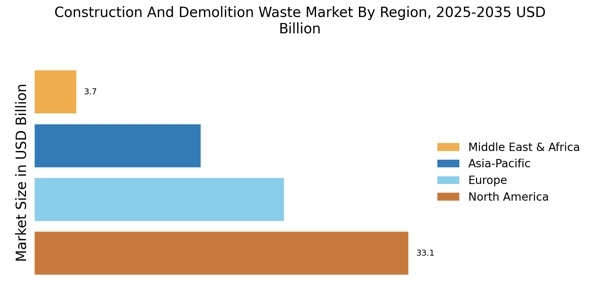
North America is the largest market for construction and demolition (C&D) waste management, holding approximately 45% of the global market share. The region's growth is driven by stringent regulations promoting recycling and waste reduction, alongside increasing urbanization and infrastructure development. The U.S. and Canada are the primary contributors, with a rising demand for sustainable waste management solutions and innovative recycling technologies. The competitive landscape in North America is characterized by major players such as Waste Management Inc., Republic Services Inc., and Clean Harbors Inc. These companies are investing in advanced waste processing technologies and expanding their service offerings to meet the growing demand. The presence of robust regulatory frameworks further supports market growth, ensuring compliance and promoting environmentally friendly practices.

Europe : Regulatory Frameworks Enhance Recycling

Europe is the second-largest market for construction and demolition waste, accounting for approximately 30% of the global market share. The region's growth is significantly influenced by the European Union's Circular Economy Action Plan, which emphasizes waste reduction and recycling. Countries like Germany and the UK are leading in implementing innovative waste management practices, driven by increasing construction activities and stringent environmental regulations. Leading countries in Europe include Germany, France, and the UK, where key players like Veolia Environnement SA and SUEZ SA are prominent. The competitive landscape is marked by a focus on sustainable practices, with companies investing in advanced recycling technologies and infrastructure. The regulatory environment encourages collaboration among stakeholders to enhance recycling rates and reduce landfill dependency.

Asia-Pacific : Emerging Markets Fuel Growth

Asia-Pacific is witnessing rapid growth in the construction and demolition waste market, holding approximately 20% of the global market share. The region's expansion is driven by urbanization, population growth, and increasing infrastructure projects, particularly in countries like China and India. Government initiatives promoting sustainable waste management practices and recycling are also significant growth catalysts, enhancing market dynamics and demand for innovative solutions. China and India are the leading countries in this region, with a competitive landscape featuring local and international players. Companies are focusing on developing efficient waste management systems and technologies to address the rising waste generation. The presence of key players like FCC Environment and GFL Environmental is notable, as they adapt to the region's unique challenges and opportunities in waste management.

Middle East and Africa : Resource-Rich Market Potential

The Middle East and Africa region is emerging as a significant player in the construction and demolition waste market, holding approximately 5% of the global market share. The growth is driven by rapid urbanization, infrastructure development, and increasing awareness of environmental sustainability. Countries like the UAE and South Africa are at the forefront, implementing regulations to promote waste recycling and management practices, which are crucial for market expansion. In this region, the competitive landscape is evolving, with local companies and international players entering the market. Key players are focusing on innovative waste management solutions to cater to the growing demand. The presence of regulatory frameworks is gradually improving, encouraging investment in sustainable practices and technologies to enhance waste management efficiency.

Construction Demolition Waste Market Regional Image

Key Players and Competitive Insights

The Construction and Demolition Waste Market is currently characterized by a dynamic competitive landscape, driven by increasing urbanization, stringent environmental regulations, and a growing emphasis on sustainability. Key players such as Waste Management Inc (US), Republic Services Inc (US), and Veolia Environnement SA (FR) are strategically positioning themselves through innovation and regional expansion. Waste Management Inc (US) focuses on enhancing its recycling capabilities, while Republic Services Inc (US) emphasizes digital transformation to optimize waste collection and processing. Veolia Environnement SA (FR) is actively pursuing partnerships to bolster its service offerings, collectively shaping a competitive environment that prioritizes efficiency and sustainability.

In terms of business tactics, companies are increasingly localizing their operations to better serve regional markets and optimize supply chains. The market appears moderately fragmented, with several key players exerting considerable influence. This structure allows for a diverse range of services and innovations, as companies strive to differentiate themselves in a competitive arena.

In August 2025, Waste Management Inc (US) announced a significant investment in advanced recycling technologies aimed at increasing the recovery rates of construction materials. This strategic move is likely to enhance their operational efficiency and align with the growing demand for sustainable waste management solutions. By focusing on technological advancements, Waste Management Inc (US) positions itself as a leader in the transition towards a circular economy.

In September 2025, Republic Services Inc (US) launched a new digital platform designed to streamline waste collection processes and improve customer engagement. This initiative reflects a broader trend towards digitalization within the industry, suggesting that Republic Services Inc (US) is keen on leveraging technology to enhance service delivery and operational efficiency. Such advancements may provide a competitive edge in an increasingly tech-driven market.

In July 2025, Veolia Environnement SA (FR) entered into a strategic partnership with a leading construction firm to develop innovative waste management solutions tailored for large-scale projects. This collaboration underscores Veolia's commitment to sustainability and positions the company to capitalize on the growing demand for environmentally responsible waste management practices. The partnership may also facilitate knowledge sharing and resource optimization, further enhancing Veolia's market presence.

As of October 2025, the competitive trends within the Construction and Demolition Waste Market are increasingly defined by digitalization, sustainability, and the integration of artificial intelligence. Strategic alliances are becoming pivotal in shaping the landscape, as companies seek to enhance their service offerings and operational capabilities. Looking ahead, competitive differentiation is likely to evolve from traditional price-based competition towards a focus on innovation, technological advancements, and supply chain reliability, reflecting the industry's shift towards more sustainable practices.

Key Companies in the Construction Demolition Waste Market market include

Industry Developments

This growth is attributed to the increasing construction activities and the growing awareness about the environmental impact of C&D waste. Furthermore, government regulations and initiatives aimed at promoting sustainable waste management practices are expected to drive market expansion. Recent developments include the launch of innovative technologies for C&D waste recycling and the establishment of partnerships between construction companies and waste management firms to improve waste management efficiency. Additionally, the increasing demand for recycled materials in construction is expected to create new opportunities for C&D waste management companies.

Future Outlook

Construction Demolition Waste Market Future Outlook

The Construction and Demolition Waste Market is projected to grow at a 6.55% CAGR from 2024 to 2035, driven by urbanization, regulatory frameworks, and sustainability initiatives.

New opportunities lie in:

  • Development of advanced recycling technologies for concrete and metals.
  • Implementation of digital waste tracking systems for efficiency.
  • Expansion of partnerships with construction firms for waste management solutions.

By 2035, the market is expected to be robust, driven by innovation and strategic collaborations.

Market Segmentation

Construction Demolition Waste Market Source Outlook

  • Residential
  • Commercial
  • Industrial
  • Infrastructure

Construction Demolition Waste Market End-Use Outlook

  • Construction Materials
  • Soil Amendments
  • Waste-to-Energy
  • Landfill Cover

Construction Demolition Waste Market Waste Type Outlook

  • Inert Waste
  • Non-Inert Waste
  • Recyclable Waste
  • Hazardous Waste

Construction Demolition Waste Market Processing Method Outlook

  • Landfilling
  • Incineration
  • Recycling
  • Composting

Report Scope

MARKET SIZE 202473.61(USD Billion)
MARKET SIZE 202578.43(USD Billion)
MARKET SIZE 2035147.95(USD Billion)
COMPOUND ANNUAL GROWTH RATE (CAGR)6.55% (2024 - 2035)
REPORT COVERAGERevenue Forecast, Competitive Landscape, Growth Factors, and Trends
BASE YEAR2024
Market Forecast Period2025 - 2035
Historical Data2019 - 2024
Market Forecast UnitsUSD Billion
Key Companies ProfiledMarket analysis in progress
Segments CoveredMarket segmentation analysis in progress
Key Market OpportunitiesAdoption of advanced recycling technologies enhances resource recovery in the Construction And Demolition Waste Market.

Key Market DynamicsRising regulatory pressures drive innovation in recycling technologies within the Construction and Demolition Waste Market.
Countries CoveredNorth America, Europe, APAC, South America, MEA

Leave a Comment

FAQs

What is the current valuation of the Construction and Demolition Waste Market?

As of 2024, the market valuation was 73.61 USD Billion.

What is the projected market size for the Construction and Demolition Waste Market by 2035?

The market is projected to reach 147.95 USD Billion by 2035.

What is the expected CAGR for the Construction and Demolition Waste Market during the forecast period?

The expected CAGR for the market from 2025 to 2035 is 6.55%.

Which waste type segment holds the highest valuation in the Construction and Demolition Waste Market?

The Non-Inert Waste segment is projected to range from 25.0 to 50.0 USD Billion.

What are the key processing methods for construction and demolition waste?

The primary processing methods include Recycling, Landfilling, Incineration, and Composting.

Which end-use segment is expected to generate the most revenue in the market?

The Construction Materials segment is anticipated to range from 30.0 to 60.0 USD Billion.

Who are the leading companies in the Construction and Demolition Waste Market?

Key players include Waste Management Inc, Republic Services Inc, and Veolia Environnement SA.

What is the projected valuation range for the Recycling processing method?

The Recycling processing method is expected to range from 30.0 to 60.0 USD Billion.

How does the market size for Infrastructure waste source compare to others?

The Infrastructure source segment is projected to range from 28.61 to 57.95 USD Billion.

Download Free Sample

Kindly complete the form below to receive a free sample of this Report

Compare Licence

×
Features License Type
Single User Multiuser License Enterprise User
Price $4,950 $ $7,250
Maximum User Access Limit 1 User Upto 10 Users Unrestricted Access Throughout the Organization
Free Customization
Direct Access to Analyst
Deliverable Format
Platform Access
Discount on Next Purchase 10% 15% 15%
Printable Versions