Download Free Sample
Kindly complete the form below to receive a free sample of this Report
Continuing Education and Certification Services Market Research Report By Industry (Information Technology, Healthcare, Finance, Education, Engineering), By Application (Professional Development, Skill Enhancement, Licensure And Certification, Compliance Training, Personal Enrichment), By Delivery Method (Online Learning, In-Person Training, Blended Learning, Self-Paced Courses, Workshops), By Target Audience (Corporate Employees, Healthcare Professionals, Educators, Technical Professionals, General Public), By Certification Type (Professional Certification, Academic Certification, Trade Certification, Continuing Education Units, Micro-Credentials) And By Region (North America, Europe, Asia-Pacific, And Rest Of The World) – Market Forecast Till 2035.
As per MRFR analysis, the Continuing Education and Certification Services Market was estimated at 40.0 USD Billion in 2024. The Continuing Education and Certification Services industry is projected to grow from 42.09 USD Billion in 2025 to 70.0 USD Billion by 2035, exhibiting a compound annual growth rate (CAGR) of 5.22% during the forecast period 2025 - 2035.
The Continuing Education and Certification Services Market is experiencing robust growth driven by digital transformation and evolving learner needs.
| 2024 Market Size | 40.0 (USD Billion) |
| 2035 Market Size | 70.0 (USD Billion) |
| CAGR (2025 - 2035) | 5.22% |
Coursera (US), edX (US), Udacity (US), LinkedIn Learning (US), Skillshare (US), Pluralsight (US), Khan Academy (US), FutureLearn (GB), Alison (IE)
Our Impact
Enabled $4.3B Revenue Impact for Fortune 500 and Leading Multinationals
Partnering with 2000+ Global Organizations Each Year
30K+ Citations by Top-Tier Firms in the Industry
The Continuing Education and Certification Services Market is currently experiencing a dynamic evolution, driven by the increasing demand for lifelong learning and professional development. As industries continue to transform, professionals seek to enhance their skills and knowledge to remain competitive. This market encompasses a wide array of offerings, including online courses, workshops, and certification programs, catering to diverse fields such as technology, healthcare, and business management. The rise of digital platforms has facilitated access to educational resources, enabling individuals to pursue learning at their own pace and convenience. Furthermore, organizations are recognizing the value of investing in employee development, which further propels the growth of this sector. In addition to the growing emphasis on skill enhancement, the Continuing Education and Certification Services Market is also influenced by technological advancements. Innovations such as artificial intelligence and data analytics are being integrated into educational frameworks, providing personalized learning experiences. This trend not only improves engagement but also enhances the effectiveness of training programs. As the market continues to expand, it appears poised to adapt to the evolving needs of learners and employers alike, fostering a culture of continuous improvement and adaptability in the workforce. The future of this market seems promising, with potential for further growth and diversification in offerings.
The integration of technology into educational frameworks is reshaping the Continuing Education and Certification Services Market. Online learning platforms and digital resources are becoming increasingly prevalent, allowing learners to access courses and certifications from anywhere. This trend indicates a shift towards more flexible and personalized learning experiences, catering to the diverse needs of professionals.
There is a growing emphasis on skill enhancement within the Continuing Education and Certification Services Market. As industries evolve, professionals are seeking targeted training to stay relevant. This trend suggests that organizations are prioritizing employee development, recognizing the importance of continuous learning in maintaining a competitive edge.
Micro-credentials are gaining traction in the Continuing Education and Certification Services Market, offering bite-sized learning opportunities that focus on specific skills. This trend reflects a shift towards more modular and flexible education, allowing individuals to acquire relevant competencies without committing to lengthy programs. It appears that micro-credentials may become a preferred option for many learners.
The Continuing Education and Certification Services Market experiences a notable surge in demand for lifelong learning. As industries evolve and technology advances, professionals seek to enhance their skills and knowledge continuously. This trend is driven by the need to remain competitive in the job market, where employers increasingly value ongoing education. According to recent data, approximately 70% of employees express a desire for further training and development opportunities. This growing appetite for skill enhancement propels the Continuing Education and Certification Services Market forward, as educational institutions and training providers adapt their offerings to meet these needs. Furthermore, the rise of remote work has made it easier for individuals to pursue additional certifications and courses, thereby expanding the market's reach and accessibility.
Regulatory requirements and compliance standards significantly influence the Continuing Education and Certification Services Market. Many professions mandate ongoing education to maintain licensure or certification, creating a steady demand for relevant training programs. For instance, healthcare professionals are often required to complete continuing education units to uphold their licenses. This regulatory landscape compels individuals to seek out educational opportunities that fulfill these requirements, thereby driving growth in the market. Additionally, organizations are increasingly investing in compliance training to mitigate risks and ensure adherence to industry standards. As regulations evolve, the Continuing Education and Certification Services Market must adapt to provide up-to-date training solutions that meet these compliance needs, further solidifying its role in professional development.
The Continuing Education and Certification Services Market is witnessing a pronounced focus on industry-specific certifications. As sectors become more specialized, professionals are increasingly seeking credentials that align closely with their career paths. This trend is particularly evident in fields such as healthcare, information technology, and finance, where specialized knowledge is paramount. Data suggests that certification programs tailored to specific industries can enhance employability and career advancement opportunities. Consequently, educational providers are developing targeted programs that address the unique requirements of various sectors. This emphasis on industry relevance not only benefits individuals seeking to enhance their qualifications but also supports employers in identifying skilled candidates. As a result, the Continuing Education and Certification Services Market is likely to expand, driven by the demand for specialized training and certification.
The Continuing Education and Certification Services Market is increasingly recognizing the importance of soft skills development. In today's dynamic work environment, employers prioritize interpersonal skills, communication, and emotional intelligence alongside technical expertise. As a result, educational institutions and training providers are incorporating soft skills training into their curricula. Data indicates that nearly 90% of employers consider soft skills essential for workplace success. This growing emphasis on holistic skill development is reshaping the offerings within the Continuing Education and Certification Services Market. By equipping individuals with both hard and soft skills, educational programs enhance employability and career progression. Consequently, the market is likely to expand as more professionals seek comprehensive training that addresses the multifaceted demands of the modern workforce.
Technological advancements play a pivotal role in shaping the Continuing Education and Certification Services Market. The integration of online learning platforms, mobile applications, and virtual classrooms has transformed how education is delivered. These innovations facilitate flexible learning environments, allowing individuals to access courses from anywhere at any time. Data indicates that the online education market is projected to grow significantly, with a compound annual growth rate of over 20% in the coming years. This shift towards digital learning not only enhances accessibility but also caters to diverse learning styles, making education more inclusive. As educational institutions and organizations leverage technology to deliver high-quality content, the Continuing Education and Certification Services Market is likely to witness substantial growth, driven by the increasing adoption of e-learning solutions.
In the Continuing Education and Certification Services Market, the application segment is diversified across Professional Development, Skill Enhancement, Licensure and Certification, Compliance Training, and Personal Enrichment. However, Professional Development stands out as the largest application, accounting for a significant share of the market. Skill Enhancement follows closely behind, gaining momentum with a growing emphasis on personal growth within the workforce. The diverse needs of professionals across various industries contribute to a balanced distribution among these segments, showcasing the market's adaptability to different educational requirements.
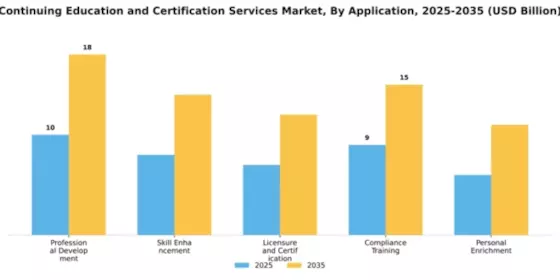
Professional Development (Dominant) vs. Skill Enhancement (Emerging)
The Professional Development segment is characterized by its focus on equipping individuals with essential skills and knowledge required for career advancement. It includes a plethora of courses ranging from leadership training to industry-specific certifications, making it the dominant force in the market. In contrast, Skill Enhancement has emerged as a vibrant segment, driven by the rapid pace of technological changes and the collective need to remain competitive in an evolving job landscape. This segment emphasizes continuous learning and accessibility, catering to those looking to upgrade their practical skills in real-time, thus fueling its growth.
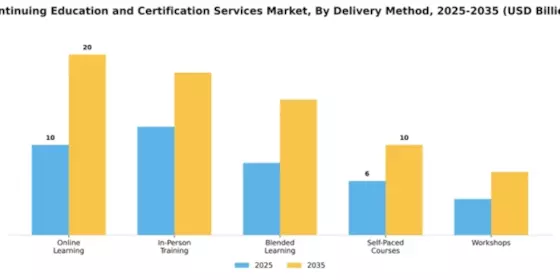
In the Continuing Education and Certification Services Market, Online Learning is the largest segment, reflecting a significant shift towards digital platforms. This mode of delivery accommodates a diverse audience, allowing for a wider reach and accessibility, making it the preferred choice for many learners. In-Person Training, while smaller in comparison, is the fastest-growing segment, driven by the demand for hands-on experiences and personal interaction which enhances the learning process and fosters better networking opportunities among professionals.
Online Learning (Dominant) vs. In-Person Training (Emerging)
Online Learning has established itself as the dominant delivery method in the Continuing Education and Certification Services Market, primarily due to its flexibility and accessibility. It offers learners the ability to engage with content at their own pace and convenience. Conversely, In-Person Training, although currently smaller, is witnessing rapid growth as organizations and individuals recognize the value of real-time interactions, feedback, and practical engagement in learning experiences. This segment thrives on the appeal of networking and personal mentorship opportunities, appealing especially to professionals seeking to advance their skills and careers.
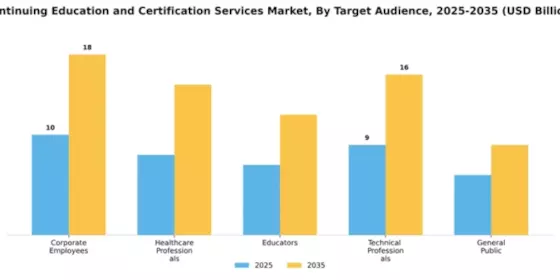
The Continuing Education and Certification Services Market showcases a diverse target audience, with corporate employees commanding the largest market share. This segment comprises individuals who seek to enhance their skills and qualifications through various continuing education programs offered by companies. In recent years, there has been a substantial focus on talent development and upskilling within corporate environments to meet evolving business demands. Conversely, healthcare professionals represent the fastest-growing segment as they continually pursue certifications to stay updated with medical advancements and regulatory changes. This drive for professional development is pivotal in ensuring the provision of quality healthcare services. Market growth trends indicate a noticeable shift towards specialization in the healthcare sector, intensifying the demand for targeted educational programs. With technology evolving rapidly, healthcare professionals are inclined towards certifications that enable them to adapt efficiently. Additionally, the increasing emphasis on lifelong learning among corporate employees stems from the need for competitive advantage in a globalized economy, further enhancing the growth dynamics of this market segment.
Corporate Employees: Dominant vs. Healthcare Professionals: Emerging
Corporate employees represent the dominant force in the Continuing Education and Certification Services Market, with their demand primarily driven by company initiatives aimed at fostering skill enhancement and career growth. Organizations increasingly prioritize employee development to retain talent and remain competitive. On the other hand, healthcare professionals are emerging as a vital segment due to the growing necessity for certifications that support clinical competence and compliance with regulatory standards. This segment is characterized by a strong commitment to ongoing education, which is crucial in a field that demands accuracy and up-to-date knowledge. As regulatory requirements elevate, healthcare professionals are engaging more intensely in continuous learning to improve patient outcomes, thus driving considerable growth in this area.
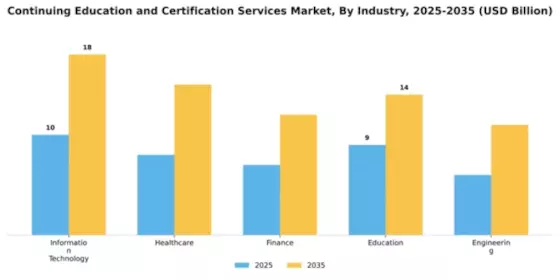
In the Continuing Education and Certification Services Market, the distribution of market share among various industries highlights significant variations in demand. Information Technology holds the largest market share, showcasing its crucial role in adapting to rapid technological changes. On the other hand, the Healthcare sector emerges as a strong contender, reflecting the growing need for ongoing training and certification in the face of unprecedented challenges and advancements in medical practices. As industries evolve, the healthcare sector is experiencing the fastest growth due to increasing regulatory requirements and a heightened focus on patient care and technology integration. Information Technology continues to dominate, driven by the ongoing digital transformation across sectors. The demand for certified professionals in emerging technologies and cybersecurity initiatives significantly propels growth in IT, while healthcare’s dynamic landscape promises to sustain its rapid expansion.
Information Technology: Dominant vs. Healthcare: Emerging
The Information Technology sector in the Continuing Education and Certification Services Market is characterized by its robust demand for specialized training in technologies such as cloud computing, data analytics, and cybersecurity. IT certifications are essential for professionals seeking to stay competitive in an evolving digital landscape, which solidifies its position as a dominant segment. Conversely, the Healthcare sector is marked by its rapid growth, driven by increased investments in healthcare technologies and the necessity for ongoing professional development to meet regulatory standards. The rising complexity of healthcare services necessitates a skilled workforce, thus providing ample opportunities for certification programs. Together, these segments illustrate the essential nature of continuous education across industries.
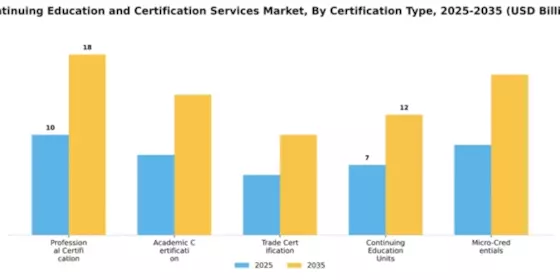
In the Continuing Education and Certification Services Market, Professional Certifications hold the largest share, representing a significant portion of the market due to their established value in enhancing career prospects and meeting industry standards. Academic Certifications follow closely, appealing to individuals pursuing formal education and degrees. Trade Certifications and Continuing Education Units also contribute to the market by addressing specific vocational needs and specialized training, while Micro-Credentials emerge as a newer segment, attracting learners interested in short, focused courses that enhance specific skills.
Professional Certification (Dominant) vs. Micro-Credentials (Emerging)
Professional Certifications are well-recognized qualifications that validate an individual's expertise and skills in a particular field, making them the dominant segment in the Continuing Education and Certification Services Market. They are essential for career advancement and often a requirement in many professions. However, Micro-Credentials are rapidly emerging as a new alternative, encapsulating shorter, more flexible courses that offer specialized skills in a fast-evolving job market. Their appeal lies in their ability to provide learners with rapid skill acquisition in light of advancing technology and changing job requirements, thus aligning perfectly with today’s dynamic learning needs.
Get more detailed insights about Continuing Education and Certification Services Market Request Free Sample
North America continues to lead the Continuing Education and Certification Services Market, holding a significant market share of 20.0 in 2024. The growth is driven by increasing demand for skill enhancement and professional development, particularly in technology and business sectors. Regulatory support for online education and corporate training initiatives further catalyzes this growth, making it a robust market for educational platforms. The competitive landscape is characterized by major players such as Coursera, edX, and LinkedIn Learning, which dominate the market with diverse offerings. The U.S. remains the primary contributor, with a strong emphasis on digital learning solutions. The presence of established institutions and innovative startups fosters a dynamic environment, ensuring continuous evolution in educational services.
Europe's Continuing Education and Certification Services Market is expanding, with a market size of 10.0 in 2024. The region benefits from a strong emphasis on lifelong learning and upskilling, driven by changing job market demands and technological advancements. Government initiatives promoting digital education and accessibility are key regulatory catalysts, enhancing the appeal of online learning platforms across member states. Leading countries such as Germany, the UK, and France are at the forefront, with a competitive landscape featuring platforms like FutureLearn and Alison. The presence of diverse educational institutions and a growing number of online learners contribute to a vibrant market. The European Union's commitment to education and training further supports this growth, ensuring a robust framework for continuing education services.
The Asia-Pacific region is witnessing a rapid expansion in the Continuing Education and Certification Services Market, with a market size of 8.0 in 2024. This growth is fueled by increasing internet penetration, a young population eager for skill development, and a rising demand for flexible learning solutions. Regulatory frameworks promoting digital education and partnerships between governments and educational institutions are pivotal in driving this trend. Countries like China, India, and Australia are leading the charge, with a competitive landscape that includes local and international players. Platforms such as Udacity and Skillshare are gaining traction, catering to diverse learning needs. The region's focus on technology-driven education solutions positions it as a key player in the global market, ensuring sustained growth in the coming years.
The Middle East and Africa region is gradually developing its Continuing Education and Certification Services Market, with a market size of 2.0 in 2024. The growth is driven by increasing awareness of the importance of education and skill development, alongside government initiatives aimed at enhancing educational access. Regulatory support for online learning platforms is also emerging, creating new opportunities for growth in this sector. Countries like South Africa and the UAE are leading the market, with a competitive landscape that includes both local and international educational providers. The presence of platforms like Khan Academy is helping to bridge the educational gap. As the region invests in education and technology, the potential for growth in continuing education services is significant, paving the way for future advancements.
The Continuing Education and Certification Services Market is characterized by a dynamic competitive landscape, driven by the increasing demand for upskilling and reskilling in a rapidly evolving job market. Key players such as Coursera (US), edX (US), and Udacity (US) are strategically positioned to leverage their extensive course offerings and partnerships with leading universities and organizations. These companies focus on innovation and digital transformation, enhancing their platforms to provide personalized learning experiences. Their collective strategies contribute to a moderately fragmented market, where competition is fierce yet collaborative, as companies often engage in partnerships to expand their reach and improve service delivery.In terms of business tactics, companies are increasingly localizing their content to cater to diverse learner demographics, optimizing their supply chains to ensure timely delivery of educational resources. The market structure remains moderately fragmented, with several players vying for market share. The influence of key players is substantial, as they set trends in course offerings and pricing strategies, which smaller entities often follow. This competitive structure fosters an environment where innovation is paramount, as companies strive to differentiate themselves through unique value propositions.In November Coursera (US) announced a partnership with a leading technology firm to integrate AI-driven analytics into its platform, enhancing the learning experience by providing personalized recommendations based on user behavior. This strategic move is likely to position Coursera as a frontrunner in the market, as it aligns with the growing trend of utilizing AI to improve educational outcomes and learner engagement. The integration of such technology could potentially redefine how learners interact with content, making it more relevant and tailored to individual needs.Similarly, in October 2025, edX (US) launched a new initiative aimed at expanding its offerings in the field of cybersecurity, responding to the increasing demand for skilled professionals in this area. This initiative not only broadens edX's course catalog but also reinforces its commitment to addressing critical skills gaps in the workforce. By focusing on high-demand sectors, edX is likely to attract a larger audience, thereby enhancing its competitive position in the market.In December Udacity (US) unveiled a new subscription model that allows learners to access all courses for a flat monthly fee. This strategic shift aims to increase accessibility and attract a broader audience, particularly among those who may have been deterred by high upfront costs. By adopting this model, Udacity appears to be responding to market demands for more flexible and affordable learning options, which could significantly impact its market share and customer loyalty.As of December the competitive trends in the Continuing Education and Certification Services Market are increasingly defined by digitalization, sustainability, and the integration of AI technologies. Strategic alliances among key players are shaping the landscape, fostering innovation and enhancing service delivery. The shift from price-based competition to a focus on technological advancement and supply chain reliability is evident, suggesting that future competitive differentiation will hinge on the ability to innovate and adapt to changing learner needs.






The Continuing Education and Certification Services Market is projected to grow at a 5.22% CAGR from 2025 to 2035, driven by technological advancements, workforce skill demands, and regulatory changes.
New opportunities lie in:
By 2035, the market is expected to be robust, reflecting diverse growth opportunities and increased global participation.
| MARKET SIZE 2024 | 40.0(USD Billion) |
| MARKET SIZE 2025 | 42.09(USD Billion) |
| MARKET SIZE 2035 | 70.0(USD Billion) |
| COMPOUND ANNUAL GROWTH RATE (CAGR) | 5.22% (2025 - 2035) |
| REPORT COVERAGE | Revenue Forecast, Competitive Landscape, Growth Factors, and Trends |
| BASE YEAR | 2024 |
| Market Forecast Period | 2025 - 2035 |
| Historical Data | 2019 - 2024 |
| Market Forecast Units | USD Billion |
| Key Companies Profiled | Coursera (US), edX (US), Udacity (US), LinkedIn Learning (US), Skillshare (US), Pluralsight (US), Khan Academy (US), FutureLearn (GB), Alison (IE) |
| Segments Covered | Application, Delivery Method, Target Audience, Industry, Certification Type |
| Key Market Opportunities | Integration of digital platforms enhances accessibility and personalization in the Continuing Education and Certification Services Market. |
| Key Market Dynamics | Rising demand for online learning platforms drives innovation and competition in the Continuing Education and Certification Services Market. |
| Countries Covered | North America, Europe, APAC, South America, MEA |
The market valuation stands at 40.0 USD Billion as of 2024.
The market is expected to reach 70.0 USD Billion by 2035.
The market is projected to grow at a CAGR of 5.22% from 2025 to 2035.
Key players include Coursera, edX, Udacity, LinkedIn Learning, Skillshare, Pluralsight, Khan Academy, FutureLearn, and Alison.
The Professional Development segment is anticipated to reach 18.0 USD Billion by 2035.
Online Learning is expected to grow to 20.0 USD Billion, surpassing In-Person Training, which is projected at 18.0 USD Billion by 2035.
The Corporate Employees segment is likely to reach 18.0 USD Billion by 2035.
The Information Technology industry is expected to grow to 18.0 USD Billion by 2035.
Micro-Credentials are anticipated to reach 16.0 USD Billion by 2035.
Key applications include Professional Development, Skill Enhancement, and Compliance Training, with valuations expected to reach 18.0, 14.0, and 15.0 USD Billion respectively by 2035.


Kindly complete the form below to receive a free sample of this Report

“This is really good guys. Excellent work on a tight deadline. I will continue to use you going forward and recommend you to others. Nice job”


“Thanks. It’s been a pleasure working with you, please use me as reference with any other Intel employees.”


“Thanks for sending the report it gives us a good global view of the Betaïne market.”


“Thank you, this will be very helpful for OQS.”


“We found the report very insightful! we found your research firm very helpful. I'm sending this email to secure our future business.”


“I am very pleased with how market segments have been defined in a relevant way for my purposes (such as "Portable Freezers & refrigerators" and "last-mile"). In general the report is well structured. Thanks very much for your efforts.”


“I have been reading the first document or the study, ,the Global HVAC and FP market report 2021 till 2026. Must say, good info! I have not gone in depth at all parts, but got a good indication of the data inside!”


“We got the report in time, we really thank you for your support in this process. I also thank to all of your team as they did a great job.”


“The Automotive 48V ECU Components Procurement Intelligence Study” was a complex project, but the Market Research Future (MRFR) team handled it with quality, agility, and customer-centricity. They delivered all requested data on time and within the agreed scope. The team, including Shubhendra Anand and Rahul Gotadki, was always readily available to clarify questions and swiftly implement necessary adjustments, driving the project to a successful conclusion within a very demanding timeframe.
I would also like to specifically commend Akshay Agarwal for his responsiveness and support at every stage—from our initial inquiry on May 6th through to final delivery on June 18th. His dedication made the entire process seamless.”



