Request Free Sample ×

Kindly complete the form below to receive a free sample of this Report

* Please use a valid business email

Leading companies partner with us for data-driven Insights

clients tt-cursor
Hero Background

Contract Management Software Market

ID: MRFR/ICT/40447-HCR
200 Pages
Aarti Dhapte
Last Updated: May 28, 2026
Contract Management Software Market Size, Share and Research Report: By Deployment Type (Cloud-Based, On-Premises, Hybrid), By Enterprise Size (Small Enterprises, Medium Enterprises, Large Enterprises), By Industry Vertical (Healthcare, Financial Services, Information Technology, Manufacturing, Retail), By Functionality (Contract Creation, Contract Execution, Contract Analysis, Contract Renewal, Contract Compliance) and By Regional (North America, Europe, South America, Pacific, Middle East and Africa) - Industry Forecast to 2035
Download PDF ×

We do not share your information with anyone. However, we may send you emails based on your report interest from time to time. You may contact us at any time to opt-out.


Market Summary

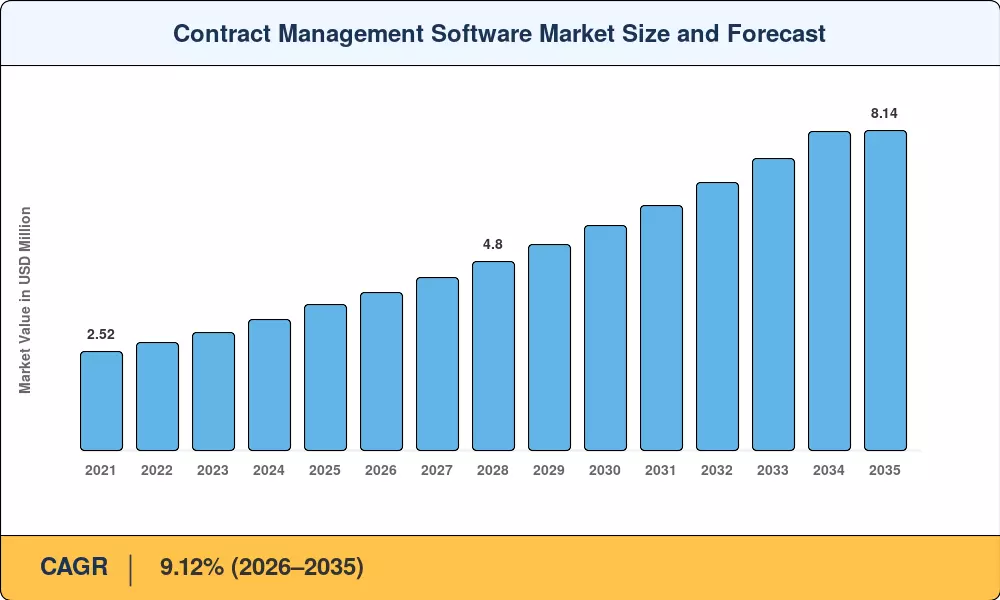
The contract management software market was valued at USD 3.71 billion in 2025 and is projected to reach USD 4.03 billion in 2026, expanding to USD 8.14 billion by 2035 at a CAGR of 9.12% during the forecast period. This upward momentum is anchored in the EU Data Act's mandate that cloud providers enable contract portability within 30 days, alongside enterprise spending on AI-powered contract review and extraction tools that exceeded USD 1.2 billion globally in 2024. Organizations navigating tightening ESG disclosure rules and cross-border compliance frameworks are accelerating procurement of CLM software for contract lifecycle automation, converting what was once a back-office administrative tool into a strategic governance platform.

Legacy paper-based and spreadsheet-driven contracting workflows are giving way to SaaS contract repository and search platforms that centralize every agreement across business units. The shift gained urgency after the SEC's May 2024 climate-disclosure rules forced enterprises to map supply-chain obligations at the clause level, driving demand for contract risk analytics and obligation tracking capabilities [2]. Gartner projects that by 2027, 60% of enterprise legal departments will embed AI-native CLM into their core tech stacks, up from roughly 25% in 2024.

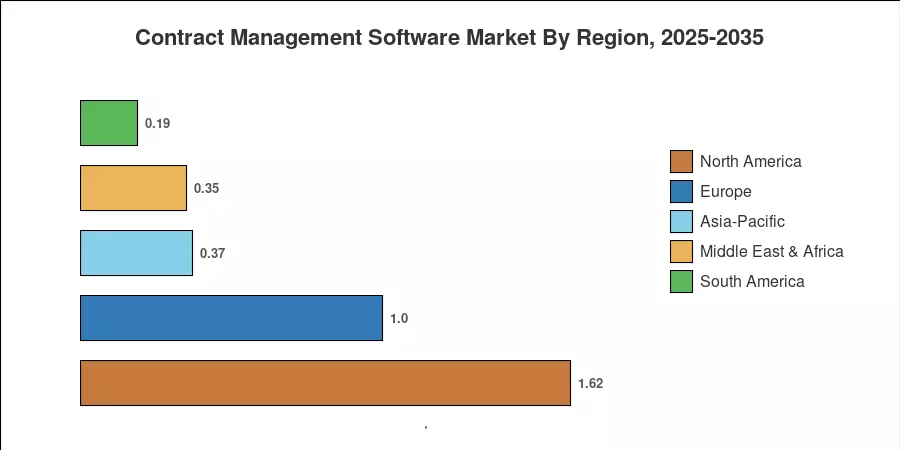
North America commands approximately 43.8% of the contract management software market, propelled by early enterprise adoption and a dense vendor ecosystem. Asia-Pacific represents the fastest-growing region at a 10.02% CAGR, fueled by Japan's digitization mandates and India's expanding IT services sector. Europe holds the second-largest share at roughly 27%, driven by GDPR-linked data governance and verticalised CLM template adoption. The decade ahead will reward vendors that unify e-signature and contract approval workflows with ERP, CRM, and procurement analytics inside a single pane of glass.


Key Report Takeaways

• By Technology

  • Cloud deployment dominated with over 82% of contract management software market revenue in 2025, as elastic scaling and API-first architectures outpaced on-premise alternatives
  • Services are expanding at a 13.10% CAGR through 2035, driven by consulting, data migration, and AI model tuning engagements that accompany platform rollouts
  • Integrated CLM suites are growing at a 14.85% CAGR as enterprises unify e-signature and contract approval workflows with broader SaaS ecosystems

• By Component

  • Services are expanding at a 13.10% CAGR through 2035, driven by consulting, data migration, and AI model tuning engagements that accompany platform rollouts


• By Sector

  • IT & telecom generated the largest end-user share of the contract management software market in 2025 at approximately 19.5%, reflecting high vendor-agreement volumes
  • SMEs are the fastest-growing organization segment at a 14.12% CAGR, enabled by subscription-based SaaS contract repository and search platforms with freemium entry points
  • Healthcare and life sciences show a 11.62% CAGR, driven by clinical trial documentation and compliance-intensive supplier agreements

• By Organization

  • SMEs are the fastest-growing organization segment at a 14.12% CAGR, enabled by subscription-based SaaS contract repository and search platforms with freemium entry points


• By Region

  • North America contributed over 43.8% of contract management software market share in 2025
  • Asia-Pacific posts a 10.02% CAGR through 2035, with Japan and India leading enterprise CLM adoption
  • Europe accounted for roughly 27% share, bolstered by GDPR and EU Data Act adoption mandates


MRFR's estimates are built on a bottom-up methodology combining vendor revenue disclosures, enterprise software spending surveys, procurement channel analysis, and triangulation against comparable industry benchmarks. Historical figures (2021–2024) reflect reported outcomes; 2025 is the base year with validated primary data; 2026–2035 figures are projected at a 9.12% CAGR.
Market Size Chart
Our Impact
Enabled $4.3B Revenue Impact for Fortune 500 and Leading Multinationals
Partnering with 2000+ Global Organizations Each Year
30K+ Citations by Top-Tier Firms in the Industry
 

Driver Impact Analysis

Driver ~% Impact on CAGR Geographic Relevance Impact Timeline
Unified buy-side and sell-side CLM demand across regulated sectors +1.9% Global, concentrated in North America & EU Medium term (2–4 yr)
AI-powered contract review and extraction for risk management +1.6% North America, spillover to APAC Short term (≤2 yr)
E-signature and contract approval workflows driven by hybrid work +1.3% Global Short term (≤2 yr)
Verticalised CLM templates for European regulatory compliance +1.0% Europe, expanding globally Medium term (2–4 yr)
ESG-linked supplier compliance mandates in global procurement +0.9% Global, early adoption in EU & North America Long term (≥4 yr)
Integration of CLM with enterprise SaaS lowering switching costs in APAC +0.8% APAC, spillover to MEA Medium term (2–4 yr)
Generative AI for automated clause drafting and negotiation assist +0.7% North America & Europe Short term (≤2 yr)


Unified Buy-Side and Sell-Side CLM Across Regulated Industries

Deloitte’s contract excellence research estimates that enterprises lose 8–9% of contract value through fragmented management processes. Unified platforms that connect procurement, sales and legal remove duplicate reviews and expose cross-clause interdependence. Financial institutions that cross-reference trading agreements with their customer-onboarding documents and healthcare organizations that manage both clinical-supplier and payer contracts have the steepest adoption curve. The contract management software industry directly benefits as these firms integrate siloed repositories into a single CLM software for contract lifecycle automation solution.


AI-Powered Contract Review and Extraction for Risk Management

Generative AI transforms SaaS contract repository and search platforms from passive document stores into active decision engines. DocuSign's Intelligent Agreement Management platform contributed to USD 776 million in Q4 2025 revenue, beating analyst estimates and signaling robust demand for AI-powered contract review and extraction [7]. Japanese conglomerate Sojitz Tech Innovation reclaimed 7,000 analyst hours annually via automated clause analysis [8]. With only 55% of legal departments formally deploying CLM today, the addressable whitespace remains significant [9].

E-Signature-Native CLM Adoption in Hybrid Workforces

The shift to remote and hybrid work transformed e-signature and contract approval operations from conveniences into practical necessities. Platforms incorporating signature into negotiating workflows avoid the security gaps produced when legal teams rely on isolated tools. This secular need is seen in DocuSign’s 1.6-million-customer base and the rapid rise of Adobe Sign, while SMEs receive equal rigor without on-premise infrastructure.


ESG-Linked Supplier Compliance Mandates

Over 50,000 enterprises will need to disclose supply-chain environmental and social impact by 2026 under the EU Corporate Sustainability Reporting Directive (CSRD), boosting demand for contract risk analytics and obligation tracking modules that automatically detect non-compliant supplier clauses [10]. Procurement teams need to see, in real-time, the carbon obligations, labor standards and circular-economy measures baked into vendor agreements.


Restraints Impact Analysis

Restraint ~% Impact on CAGR Geographic Relevance Impact Timeline
Fragmented legacy contract data silos limiting AI accuracy -1.5% Global, particularly large enterprises Medium term (2–4 yr)
Low digital maturity among Tier-2 suppliers in emerging markets -0.9% South America & Africa Long term (≥4 yr)
Complex change-management costs in government agencies -0.7% North America & EU Long term (≥4 yr)
Data-residency restrictions delaying cross-border cloud CLM -0.5% MEA, regulatory spillover to APAC Medium term (2–4 yr)
Integration fatigue from overlapping SaaS procurement tools -0.4% Global Short term (≤2 yr)


Fragmented Legacy Contract Data Silos

The EU Corporate Sustainability Reporting Directive (CSRD) will require over 50,000 enterprises to disclose supply-chain environmental and social impact by 2026, driving demand for contract risk analytics and obligation tracking modules that automatically detect non-compliant supplier clauses [10]. Procurement teams need to see in real time the carbon commitments, labor standards and circular-economy strategies built into vendor agreements.


Low Digital Maturity in Emerging Market Supply Chains

Multinational firms that use CLM software for contract lifecycle automation cannot reap full network effects when their subcontractors in South America and Africa are still dependent on paper-based processes. The Asian Development Bank estimates that funding to MSMEs accounts for only 9% of GDP in Central and West Asia and this aligns with wider differences in technology adoption [14]. Such gaps compel firms to operate parallel manual operations, therefore delaying the full potential expansion of the contract management software industry.


Opportunities

Generative AI for Autonomous Contract Drafting

Large language models now draft standard procurement clauses, NDAs, and licensing terms in seconds, reducing legal team involvement to exception-based review. Vendors embedding autonomous drafting into SaaS contract repository and search platforms will capture premium pricing, as organizations shift legal staff toward strategic advisory roles rather than repetitive redlining

Vertical CLM Platforms for Healthcare and Life Sciences

Clinical trial agreements, pharmaceutical distribution contracts, and medical-device supply chains involve clause structures that generic platforms struggle to template. Purpose-built CLM solutions embedding FDA 21 CFR Part 11 compliance, clinical-protocol tracking, and pharmacovigilance obligation alerts represent a high-margin niche poised to grow at over 11% CAGR through 2035

SME-Focused Freemium and Usage-Based Pricing Models

Cloud-native pricing models remove infrastructure barriers for small businesses. Japan recorded a record number of start-up incorporations in 2024, and India's MSME sector—contributing 30% of GDP—represents enormous whitespace for the contract management software market Vendors offering freemium tiers that convert to paid subscriptions at scale will unlock millions of first-time CLM users.

Data Monetization Through Contract Intelligence Benchmarks

Aggregated and anonymized clause-level data creates opportunities for benchmarking services—average payment terms by industry, indemnity cap norms, or renewal-rate corridors. Vendors operating large SaaS contract repository and search platforms can monetize these insights through tiered analytics subscriptions, adding a recurring revenue layer beyond core e-signature and contract approval workflows

Expansion in Middle East & Africa Through Government Digitization Programs

Saudi Arabia's Vision 2030 and UAE's Smart Government Strategy are mandating electronic procurement across public agencies. Contract risk analytics and obligation tracking tools aligned with Arabic-language processing and Sharia-compliant clause libraries will differentiate first movers in a region growing from a small base


Future Outlook

AI-Autonomous Contract Workflows

By 2030, AI-powered contract review and extraction will advance beyond highlighting clauses to end-to-end autonomous drafting-to-execution pipelines for low-complexity agreements. Gartner predicts that by 2032, 40% of normal procurement contracts will be written, agreed and signed without human interaction. The contract management software market will split into high-touch platforms for complex negotiations and automated engines for routine agreements.


Platform Economics and Ecosystem Lock-In

Vendors that implement CLM software for contract lifecycle automation directly into the SAP, Salesforce and Microsoft ecosystems will take outsized share. For example, SAP’s business network has processed over USD 6.2 trillion in commerce, demonstrating the compound effect of spend visibility when contracts are fed to procurement analytics [11]. In the coming decade, the focus will shift from custom integration of standalone technologies to platforms with pre-built connectors.

Contract Intelligence as a Compliance Utility

Regulators around the world are moving to real-time disclosure. All three – the SEC, EU CSRD and Singapore’s ISSB-aligned framework – demand detailed contract-level reporting. Contract risk analytics and obligation monitoring will be mandatory compliance utilities incorporated in every enterprise tech stack, just like ERP became mandatory for public-company financial reporting a generation ago.


Sustainability-Linked Contract Clauses

By 2030, ESG-linked procurement terms (carbon offsets, livable wages, circular economy pledges) will be standard. The contract management software industry will need to accommodate automated monitoring, penalty triggers and audit trails for these requirements. E-signature and contract approval workflows will be extended to incorporate sustainability attestation steps, bringing new touchpoints to the contract lifecycle.


Market Segmentation

By Deployment Mode

Segment Key Metric Primary Demand Driver
Cloud 82.0% share (2025) Elastic scaling; API-first integration
On-Premise 4.38% CAGR Defense and sovereignty mandates


Cloud solutions dominate the contract management software market because enterprises demand elastic capacity during M&A surges and seamless connectivity with ERP and CRM stacks. The EU Data Act's portability mandate reduced vendor lock-in fears, accelerating cloud migration among mid-market firms previously hesitant to leave on-premise environments. On-premise and hybrid models persist in defense, intelligence, and certain government agencies where air-gapped infrastructure and FedRAMP/ITAR compliance are non-negotiable.

By Component

Segment Key Metric Primary Demand Driver
Software 67.0% share (2025) Core platform licensing and subscriptions
Services 13.10% CAGR Implementation consulting; AI model tuning


Software captures the majority of the contract management software market by revenue, but services are the faster-growing component as organizations invest in consulting engagements to harmonize processes, migrate legacy data, and train end users. Managed services including clause-library curation, ongoing compliance updates, and AI-powered contract review and extraction model fine-tuning represent a high-margin recurring revenue stream for vendors.

By Contract Type

Segment Key Metric Primary Demand Driver
Buy-Side 58.9% share (2025) Procurement spend control
Sell-Side USD 0.98 Billion (2025) Revenue-cycle optimization
Non-Commercial 9.90% CAGR ESG and internal-policy documentation


Buy-side agreements command the largest share because procurement teams rely on pricing, delivery, and quality clauses to control enterprise spend. Non-commercial contracts—covering internal policies, HR agreements, and ESG disclosures—grow fastest as regulatory mandates expand documentation requirements across departments.

By Business Function

Segment Key Metric Primary Demand Driver
Procurement and Supply Chain 36.1% share (2025) Vendor agreement volumes
Legal 10.28% CAGR AI-powered clause redlining
Sales USD 0.52 Billion (2025) CPQ-to-contract integration
Finance 8.75% CAGR Revenue recognition automation
HR 7.92% CAGR Employment and confidentiality agreements


Legal departments record the fastest adoption velocity within the contract management software market because AI-powered contract review and extraction tools free attorneys from manual redlining, elevating lawyers into strategic advisors. Sales departments integrate CLM software for contract lifecycle automation with configure-price-quote systems to compress quote-to-cash cycles.

By Pricing Model

Segment Key Metric Primary Demand Driver
Subscription (SaaS) 93.8% share (2025) Predictable opex budgeting; continuous updates
Perpetual License 3.82% CAGR Certification-freeze requirements


Subscription pricing reinforces SaaS dominance within the contract management software market, as organizations prefer incremental seat-based expansion over capital-intensive perpetual licenses.

By Integration Level

Segment Key Metric Primary Demand Driver
Standalone CLM 70.5% share (2025) Rapid deployment; lower initial cost
Integrated Suites 14.85% CAGR End-to-end data flow across ERP/CRM/SCM


Integrated suites surge as enterprises demand that contract data feed directly into sourcing, planning, and cash-management systems, eliminating swivel-chair work and providing CFOs a consolidated risk dashboard.

By Organization Size

Segment Key Metric Primary Demand Driver
Large Enterprises 68.4% share (2025) Complex multi-entity agreement portfolios
SMEs 14.12% CAGR Cloud freemium tiers; low infrastructure barriers


SMEs represent the fastest-growing segment of the contract management software market as SaaS contract repository and search platforms remove infrastructure hurdles. Large enterprises continue to dominate absolute spend due to complex multi-subsidiary agreement portfolios requiring advanced contract risk analytics and obligation tracking.

By End-User Industry

Segment Key Metric Primary Demand Driver
IT & Telecom 19.5% share (2025) High vendor-agreement volumes
BFSI 17.8% share (2025) Regulatory compliance intensity
Healthcare and Life Sciences 11.62% CAGR Clinical trial and pharma supply-chain contracts
Government USD 0.41 Billion (2025) E-procurement mandates
Manufacturing 8.95% CAGR Supply-chain resilience initiatives
Retail 8.48% CAGR Franchise and supplier agreement management


Healthcare and life sciences exhibit the highest growth trajectory, as clinical trial documentation, pharmacovigilance obligations, and FDA compliance requirements demand specialized e-signature and contract approval workflows embedded within CLM platforms.


Regional Market Share Analysis

Region Key Metric Primary Investment Themes
North America 43.8% share (2025) AI-powered contract review and extraction; regulatory compliance
Europe 27.0% share (2025) GDPR/CSRD-driven CLM adoption; vertical templates
Asia-Pacific 10.02% CAGR (2026–2035) Digitization mandates; IT services expansion
South America USD 0.19 Billion (2025) Government procurement modernization
Middle East & Africa 9.45% CAGR (2026–2035) Vision 2030; smart-government programs
**Total** **USD 3.71 Billion (2025)**

The contract management software market exhibits distinct regional patterns shaped by regulatory environments, digital maturity, and enterprise concentration. North America leads on absolute spending, while Asia-Pacific outpaces all regions on growth velocity.


North America

Country Key Metric Key Driver
United States 78.5% of regional share Enterprise CLM standardization; legal tech investment
Canada 12.8% of regional share Financial-services compliance; bilingual clause requirements
Mexico 8.7% of regional share Nearshoring-driven procurement digitization


The contract management software market in North America benefits from a mature SaaS ecosystem and heavy enterprise spending on AI-powered contract review and extraction. The United States alone houses the headquarters of five of the ten largest CLM vendors, and federal agencies are modernizing procurement through FedRAMP-certified cloud solutions [15].

Europe

Country Key Metric Key Driver
Germany 22.4% of regional share Manufacturing supply-chain CLM
United Kingdom 20.1% of regional share Financial-services regulation
France 15.3% of regional share Public-sector procurement mandates
Italy 9.28% CAGR SME digitization incentives
Spain 8.95% CAGR EU-funded digital transformation programs
Nordic Countries 11.2% of regional share ESG-first procurement culture
Russia 3.1% of regional share Domestic software substitution policies
Rest of Europe 8.8% of regional share Cross-border compliance needs


European adoption of CLM software for contract lifecycle automation accelerated after the EU Data Act mandated cloud portability. CSRD compliance requirements are pushing enterprises to embed contract risk analytics and obligation tracking directly into supplier onboarding workflows, expanding CLM beyond legal into procurement and sustainability departments [6].

Asia-Pacific

Country Key Metric Key Driver
China 28.5% of regional share State-enterprise procurement modernization
India 10.45% CAGR IT-services outsourcing contract volumes
Japan 24.2% of regional share e-Stamp law and bulk digitization mandates
South Korea 13.8% of regional share Semiconductor and electronics supply-chain CLM
ASEAN 9.78% CAGR Cross-border trade agreement management
Rest of Asia-Pacific 8.5% of regional share Emerging enterprise SaaS adoption


Japan's revised e-Stamp Act and India's Digital India programme are powerful catalysts for the contract management software market across Asia-Pacific. Japanese enterprises reclaimed thousands of analyst hours through automated contract digitization, while Indian IT services firms deploy e-signature and contract approval workflows to manage high-volume outsourcing agreements [8].

South America

Country Key Metric Key Driver
Brazil 58.2% of regional share Banking and fintech contract volumes
Argentina 8.72% CAGR Regulatory modernization
Rest of South America 19.5% of regional share Mining and energy supply-chain CLM


Brazil's expanding fintech sector drives SaaS contract repository and search platforms adoption, as digital banks require automated onboarding and vendor agreements at scale. Government procurement reforms in Argentina and Chile are gradually formalizing electronic contracting standards.

Middle East & Africa

Country Key Metric Key Driver
Saudi Arabia 32.5% of regional share Vision 2030 procurement digitization
UAE 28.8% of regional share Smart-government and free-zone initiatives
South Africa 10.15% CAGR Financial-services compliance
Egypt 8.92% CAGR Public-sector modernization programs
Rest of MEA 18.4% of regional share Oil & gas supply-chain management


Saudi Arabia and the UAE lead MEA adoption of the contract management software market, with sovereign-wealth-funded digital infrastructure programs mandating e-procurement across government agencies. Data-residency requirements remain a challenge, but hyperscaler investments in regional cloud zones are rapidly closing the compliance gap [16].


Regional Market Share
 

Competitive Benchmarking

The contract management software market exhibits medium concentration, with the top five vendors holding an estimated 35–42% combined revenue share. The HHI index sits in the 600–900 range, characteristic of a competitive landscape where established enterprise-software providers compete alongside specialized CLM pure-plays. Innovation in AI-powered contract review and extraction is the primary differentiator, with vendors racing to embed generative-AI capabilities into core platforms.

Company Est. Revenue Share Range Key Offerings Strategic Positioning
DocuSign 8–12% Intelligent Agreement Management; e-signature platform E-signature-native CLM leader with 1.6M customer base
SAP SE 6–9% Ariba Contracts; Business Network integration ERP-embedded CLM for procurement-heavy enterprises
Icertis 5–8% Contract Intelligence Platform; AI Studio Enterprise CLM pure-play with Fortune 500 focus
Agiloft 4–7% No-code CLM platform; AI Core Configurable workflows for mid-market and enterprise
Conga 4–6% Revenue Lifecycle Cloud; CLM templates CRM-integrated revenue and contract automation
Sirion 3–5% AI-native CLM; supplier performance analytics Contract risk analytics and obligation tracking specialist
Ironclad 3–5% Workflow Designer; AI Assist Legal-workflow-first CLM for in-house counsel
ContractPodAi 2–4% AI-powered CLM; legal workspace Mid-market AI-native CLM with Microsoft integration
Concord 2–3% Collaborative contract editor; approval workflows SME-focused e-signature and contract approval workflows
Juro 1–3% Browser-native contract collaboration; data-rich agreements Modern UI targeting commercial and legal teams


Recent News & Developments


  • European Commission (January 2024): EU Data Act entered force, mandating cloud-provider switching within 30 days and lowering barriers for SaaS contract repository and search platforms migration [6].


Report Scope

Parameter Detail
Market Scope Global contract management software market including CLM platforms, e-signature integration, contract analytics, and related services
Study Period 2021–2035
CAGR (Forecast Period) 9.12% (2026–2035)
Market Size (2025) USD 3.71 Billion
Market Size (2035) USD 8.14 Billion
Fastest Growing Segment SMEs by organization size (14.12% CAGR); Healthcare & Life Sciences by end-user (11.62% CAGR)
Companies Profiled DocuSign, SAP SE, Icertis, Agiloft, Conga, Sirion, Ironclad, ContractPodAi, Concord, Juro
Valuation Currency USD Billion


FAQs

How does AI-powered contract review and extraction differ from basic OCR scanning in CLM platforms?

AI-powered contract review and extraction uses natural-language processing to interpret clause intent, flag risk patterns, and suggest redlines—unlike OCR, which merely digitizes text without contextual understanding [12]. This capability reduces legal review cycles by up to 70%.

What integration challenges do enterprises face when connecting CLM software for contract lifecycle automation with legacy ERP systems?

Older ERP platforms often lack modern APIs, forcing middleware layers that add latency and maintenance costs. Organizations typically budget 15–20% of total CLM implementation cost for integration engineering alone.

How does the contract management software market address multilingual contract obligations in cross-border deals?

Leading platforms support 30+ languages with clause-level translation and jurisdiction-specific template libraries [9]. Vendors increasingly embed AI translation that preserves legal terminology rather than relying on generic machine translation.

What pricing benchmarks should procurement teams expect when evaluating SaaS contract repository and search platforms?

Enterprise CLM subscriptions typically range from USD 30 to USD 80 per user per month, with volume discounts above 500 seats. Total cost of ownership should include implementation services, which often equal first-year license fees.

How do e-signature and contract approval workflows comply with varying national electronic-signature laws?

Platforms map approval chains to jurisdiction-specific standards such as ESIGN (US), eIDAS (EU), and IT Act Section 5 (India) [6]. Vendors embed geo-aware routing that auto-selects the legally recognized signature format.

What role does contract risk analytics and obligation tracking play in M&A due diligence?

Acquirers use obligation-tracking modules to scan target-company portfolios for change-of-control triggers, auto-renewal traps, and hidden indemnity exposures [13]. This capability compresses due-diligence timelines from weeks to days.

How will the contract management software market evolve for public-sector procurement by 2030?

Government agencies are shifting toward FedRAMP- and SOC-2-certified CLM clouds that satisfy data-sovereignty requirements [15]. Adoption will accelerate as sovereign-cloud zones expand in MEA and APAC.


Author
Author
Author Profile
Aarti Dhapte LinkedIn
AVP - Research
A consulting professional focused on helping businesses navigate complex markets through structured research and strategic insights. I partner with clients to solve high-impact business problems across market entry strategy, competitive intelligence, and opportunity assessment. Over the course of my experience, I have led and contributed to 100+ market research and consulting engagements, delivering insights across multiple industries and geographies, and supporting strategic decisions linked to $500M+ market opportunities. My core expertise lies in building robust market sizing, forecasting, and commercial models (top-down and bottom-up), alongside deep-dive competitive and industry analysis. I have played a key role in shaping go-to-market strategies, investment cases, and growth roadmaps, enabling clients to make confident, data-backed decisions in dynamic markets.
Download Free Sample

Kindly complete the form below to receive a free sample of this Report