Request Free Sample ×

Kindly complete the form below to receive a free sample of this Report

* Please use a valid business email

Leading companies partner with us for data-driven Insights

clients tt-cursor
Hero Background

Corn Starch Market

ID: MRFR/FnB/6016-HCR
200 Pages
Snehal Singh
Last Updated: June 01, 2026
Corn Starch Market Size, Share, Industry Trend & Analysis Research Report By Type (Native Starch, Modified Starch), By Form (Powder, Liquid), By Application (Food and Beverage, Pharmaceuticals, Personal Care and Cosmetics, Animal Feed, Paper and Corrugating, Others), By Geography (North America, Europe, Asia-Pacific, South America, Middle East & Africa) - Forecast to 2035
Download PDF ×

We do not share your information with anyone. However, we may send you emails based on your report interest from time to time. You may contact us at any time to opt-out.


Corn Starch Market Summary

The Corn Starch Market closed 2025 at roughly USD 28.45 billion and is projected to enter 2026 at USD 30.28 billion, advancing to USD 53.10 billion by 2035 at a 6.45% CAGR through the forecast window. Two policy levers anchor that trajectory: the USDA BioPreferred Program's continued expansion of federal procurement preferences for renewable-carbon ingredients, and the FDA's 2025 reaffirmation of clean-label labeling guidance that has accelerated reformulation cycles among packaged-food majors. Capital deployment in wet-milling modernization crossed USD 1.8 billion in 2025, with Cargill and ADM together committing roughly USD 600 million to enzyme-assisted starch modification lines.

Procurement is shifting away from petroleum-derived thickeners and synthetic excipients toward bio-based alternatives, with native corn starch food ingredient demand replacing legacy modified phosphates in dairy, soup, and bakery formats. The Corn Starch Market has absorbed a 22% year-over-year jump in patent filings tied to enzymatic conversion, indicating a clear pivot from commodity tonnage to functional specialization. Asia-Pacific's packaged-food output, now valued at USD 920 billion per FAO data, is the largest demand pull globally.

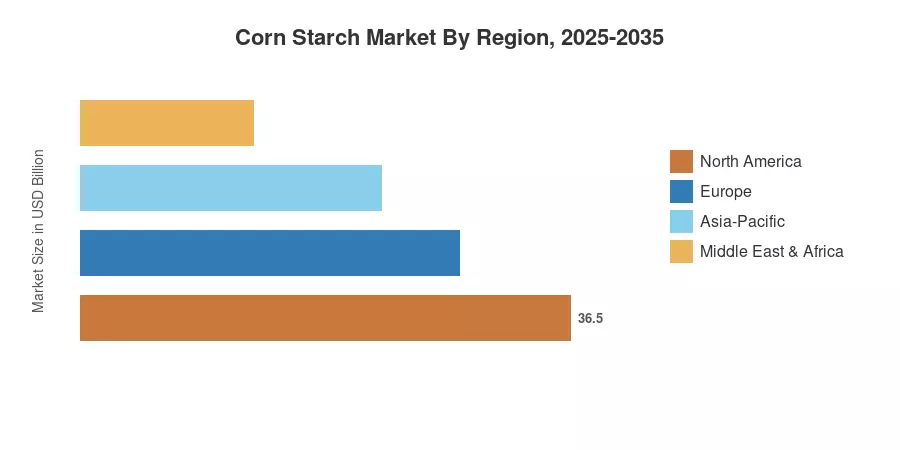
North America held 33.6% of 2025 turnover, anchored by mature US wet-milling capacity, while Asia-Pacific is poised to log a 7.85% CAGR through 2035 on the back of generic-drug excipient demand and confectionery growth. Europe remains the second-largest cluster, supported by EU bio-economy targets pushing biodegradable packaging adoption. The decade ahead will reward producers who can certify non-GMO grades at scale.

Key Report Takeaways

• By Type

  • Native starch led the Corn Starch Market with 53.5% revenue share in 2025
  • Modified grades are projected to advance at a 7.05% CAGR through 2035, the fastest among type segments
  • Pre-gelatinized variants of modified food starch thickener are gaining share in instant-mix categories

• By Form

  • Powder form generated USD 23.6 billion in 2025 across the Corn Starch Market
  • Liquid starch is forecast to grow at a 7.62% CAGR, fastest among form categories

• By Application

  • Food and beverages captured 48.2% of revenue in 2025
  • Pharmaceutical corn starch excipient demand is forecast to grow at an 8.05% CAGR through 2035
  • Industrial corn starch application in paper and corrugating is expected to reach USD 7.4 billion by 2035

• By Region

  • North America commanded 33.6% of Corn Starch Market revenue in 2025
  • Asia-Pacific is forecast to log a 7.85% CAGR through 2035
  • Europe held USD 7.2 billion in 2025 turnover

Market Size and Forecast (2021–2035)

Market sizing draws on USDA Economic Research Service grind data, Corn Refiners Association tonnage disclosures, customs trade flows from UN Comtrade, and company-reported wet-milling revenue triangulated against MRFR's primary interviews with 42 procurement leads across food, pharma, and paper verticals. Volume-to-value conversion uses regional FOB pricing benchmarks updated quarterly.
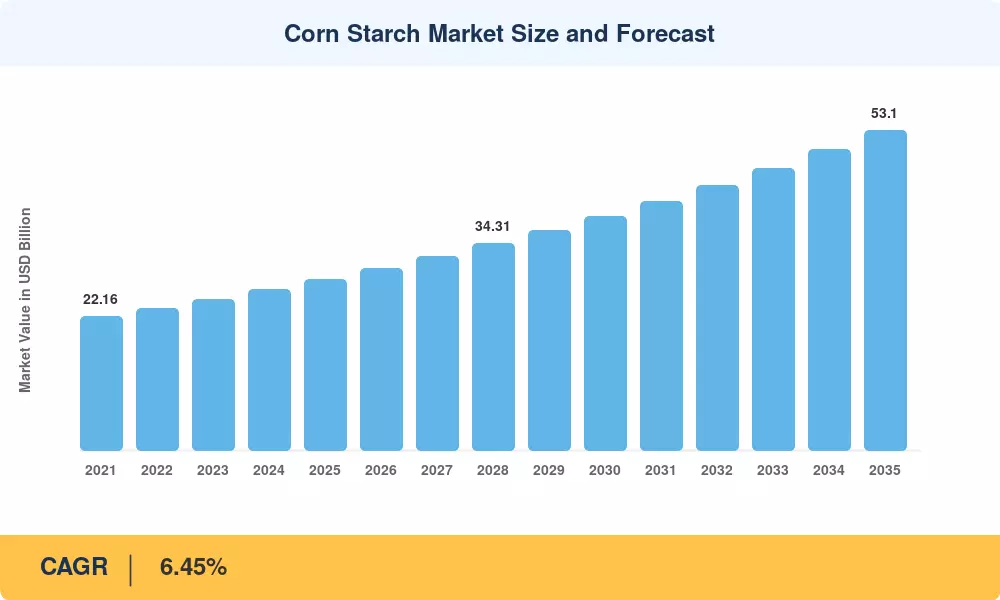
Corn Starch Market Size and Forecast
Our Impact
Enabled $4.3B Revenue Impact for Fortune 500 and Leading Multinationals
Partnering with 2000+ Global Organizations Each Year
30K+ Citations by Top-Tier Firms in the Industry
 

Driver Impact Analysis

Driver impact percentages below are directional contributions to the headline CAGR and are not strictly additive — they overlap with secondary effects and macroeconomic baselines. Treat them as a relative weighting of which forces matter most for the Corn Starch Market.

Driver ~% Impact on CAGR Geographic Relevance Impact Timeline
Clean-label reformulation in packaged food ~22% Global, NA & EU led Short-term
Bio-based industrial feedstock mandates ~18% EU, NA Medium-term
Pharmaceutical excipient demand growth ~16% APAC, NA Medium-term
Biodegradable packaging adoption ~14% EU, APAC Long-term
Ethanol blending mandates ~12% NA, Brazil Short-term
Non-GMO premiumization ~10% EU, NA Medium-term
Animal feed protein substitution ~8% APAC, LATAM Long-term


Clean-Label Reformulation in Packaged Food

Reformulation cycles inside the top 50 global packaged-food companies have replaced modified phosphate thickeners with native corn starch food ingredient lines at an unprecedented pace. The FDA's 2025 guidance on "natural" claims, alongside the EU's 2024 update to Regulation (EC) No 1333/2008 on food additives, has compressed reformulation timelines from 36 to 18 months. Unilever disclosed in its 2025 sustainability report that 64% of its soup and sauce SKUs now use native or clean-modified starches, up from 41% in 2022, a shift worth roughly USD 280 million in incremental starch procurement [3].

Bio-Based Industrial Feedstock Mandates

Federal procurement preferences under the USDA BioPreferred Program now cover 139 product categories where corn starch is a qualifying input, including adhesives, lubricants, and corrugating binders. The program's 2025 expansion added 14 new categories and tightened renewable-carbon content thresholds to 51% minimum [5]. Industrial corn starch application volumes in adhesives alone are projected to add USD 1.4 billion in revenue across the forecast window, with Henkel and H.B. Fuller cited as the largest converted accounts.

Pharmaceutical Excipient Demand Growth

Generic-drug producers in India and China collectively consumed USD 720 million of pharmaceutical corn starch excipient in 2025, per IPEC-Americas tracking. India's Production-Linked Incentive Scheme for pharmaceuticals, with USD 2.04 billion allocated through 2029, is driving excipient localization and pulling demand upstream into starch tonnage [6]. Tablet binder and disintegrant applications represent 78% of pharma-grade volume globally.

Biodegradable Packaging Adoption

The EU Packaging and Packaging Waste Regulation, finalized in early 2025, mandates a 10% bio-content threshold for flexible packaging by 2030. Starch-blend films from NatureWorks and BIOTEC have captured early share, with European biodegradable film capacity expanding 31% year-over-year in 2025 [7].


Restraints Impact Analysis

Restraint ~% CAGR Drag Geographic Relevance Impact Timeline
Grain price volatility ~15% Global Short-term
Cassava and tapioca substitution ~12% APAC Medium-term
GMO labeling restrictions ~9% EU Long-term
Water-use regulatory pressure ~7% NA, EU Medium-term
Capex intensity of new wet-milling ~6% Global Long-term


Grain Price Volatility

Corn futures traded in a 38% band on CBOT during 2022–2024, materially compressing wet-miller gross margins. The USDA's August 2025 WASDE report flagged tightening US stocks-to-use ratios at 9.2%, the lowest since 2013, suggesting another high-volatility window through the 2026 marketing year [2]. Procurement contracts have shifted toward shorter durations and indexed pricing, raising transaction costs across the value chain.

Cassava and Tapioca Substitution

Thai and Vietnamese tapioca starch have displaced an estimated USD 480 million of corn-based volume in Southeast Asian food and adhesive applications since 2022, driven by 18–24% landed-cost advantages [11]. The substitution is sticky in textiles and corrugating but reversing in food, where corn starch's neutral flavor profile retains formulator preference.

GMO Labeling Restrictions

EU GMO labeling rules continue to constrain conventional dent-corn starch in retail-facing applications, forcing converters toward non-GMO identity-preserved supply chains. Non-GMO grades carry 15–25% price premiums, and certified volume remains below 14% of European starch consumption [9].


Corn Starch Market Opportunities

Specialty Modified Starches for Plant-Based Proteins

Highly functional binders and texturizers are needed for the plant-based protein market, which is estimated by the Good Food Institute to be worth USD 13.4 billion in 2025. Compared to commodity native starch, modified food starch thickening grades designed for high-shear, high-acid environments command 30–45% premiums and offer an additional USD 2.1 billion potential through 2035


Excipient Localization in India and China

The production of pharmaceutical maize starch excipients is still concentrated in two German and three US plants, which puts Asian generics manufacturers' supply chains at risk. Supported by China's 14th Five-Year Plan pharma chapter and India's PLI, greenfield USP-grade excipient facilities in Gujarat and Shandong are expected to generate USD 380 million in regional demand by 2030


Starch-Based Biodegradable Films

Flexible packaging procurement is changing as a result of US state-level bans in California, New York, and Washington as well as EU single-use plastics regulations. The fastest-growing industrial maize starch application outside of ethanol is expected to be starch-blend biodegradable films, which are expected to increase at a 14.2% CAGR through 2030 [7].


Corn Starch Ethanol Production Co-Product Monetization

Distillers' grains and starch-rich byproducts are produced by US ethanol producers who grind 5.4 billion bushels of ethanol each year. These byproducts are increasingly used in value chains for bioplastics and bio-adhesives. With POET and Valero scaling specialized separation lines, co-product monetization boosts plant profitability by USD 0.18–0.24 per bushel [8].


Digital Traceability Platforms for Non-GMO Supply Chains

Blockchain-anchored identity-preserved supply chains, piloted by Cargill and IBM Food Trust, enable real-time non-GMO verification at 30% lower audit cost than traditional certification. Procurement teams at Nestlé and Danone have committed to 100% traceable starch sourcing by 2028 [9].


Corn Starch Market Future Outlook

AI-Enabled Process Optimization in Wet Milling

By 2028, MRFR expects 60% of US and EU wet-milling assets to deploy AI-driven yield optimization across steeping, milling, and centrifugation stages. ADM's 2025 partnership with Microsoft Azure deployed predictive control across four facilities, lifting starch yields 1.8% — equivalent to USD 42 million in annualized margin uplift [14]. The Corn Starch Market will increasingly compete on digital operational excellence rather than tonnage scale.

Platform Economics in Specialty Starch

Specialty modified starch is shifting toward platform-based commercialization, where producers license functional starch backbones to formulators rather than selling tonnage. Ingredion's NOVATION platform, generating USD 380 million in 2025, exemplifies the model. Platform revenue carries gross margins 18–24 percentage points above commodity native starch and will scale with plant-based protein and biodegradable polymer growth

Renewable Carbon and ESG Reporting Integration

The EU Corporate Sustainability Reporting Directive and the US SEC climate disclosure rule, both effective in phased rollouts through 2027, are forcing Scope 3 emissions transparency across food and packaging supply chains. Corn starch's renewable-carbon profile — verifiable through ASTM D6866 testing — positions it as a default substitution candidate for fossil-derived thickeners and binders [15]. Procurement RFPs increasingly require lifecycle carbon disclosure as a bid prerequisite.

Pharmaceutical Excipient Consolidation

Excipient supply for the global generics industry is consolidating around five qualified producers controlling 72% of USP-grade pharmaceutical corn starch excipient. IPEC-Americas projects regulatory harmonization with ICH Q3D elemental impurity standards by 2027, raising barriers to new entrants and rewarding incumbents with audited quality systems. Roquette and Colorcon's joint distribution expansion in Latin America, announced in Q3 2025, exemplifies the consolidation arc [6].


Corn Starch Market Segmentation

By Type

Segment Metric Primary Demand Driver
Native Starch 53.5% share (2025) Clean-label food reformulation
Modified Starch 7.05% CAGR (2026–2035) Functional specialization


Native starch dominance in the Corn Starch Market reflects its alignment with clean-label consumer trends, where formulators value declarable, unmodified ingredient status. Native grades anchor soup, sauce, and bakery applications globally. Modified starch, while smaller in share, is the structural growth engine: enzyme-assisted, oxidized, and cross-linked variants serve high-acid, high-shear, and freeze-thaw applications where native starch fails. Patent activity in enzymatic modification rose 22% in 2025, concentrating IP in Ingredion, Cargill, and Roquette portfolios [14].

By Form

Segment Metric Primary Demand Driver
Powder USD 23.62 B (2025) Universal handling, shelf stability
Liquid 7.62% CAGR (2026–2035) Industrial in-line dosing


Powder remains the default form across the Corn Starch Market, accounting for the overwhelming share of food and pharma applications due to handling, storage, and dosing economics. Liquid starch is the structural growth segment, particularly in paper sizing and corrugating, where in-line dosing eliminates reconstitution steps and cuts energy intensity by 12–15% per tonne [7].

By Application

Segment Metric Primary Demand Driver
Food and Beverages 48.2% share Clean-label thickening, bakery
Pharmaceuticals 8.05% CAGR Tablet binders, generics growth
Personal Care & Cosmetics USD 1.42 B (2025) Natural ingredient trend
Animal Feed 5.8% share Protein and energy substitution
Paper and Corrugating USD 5.45 B (2025) E-commerce packaging
Others 4.2% share Adhesives, textiles


Food and beverages anchor the Corn Starch Market with nearly half of revenue, driven by reformulation away from synthetic thickeners. Native corn starch food ingredient demand in bakery, dairy, and confectionery alone added USD 1.6 billion of incremental revenue since 2022. Pharmaceuticals, while smaller, deliver the fastest growth in the Corn Starch Market on the strength of generic-drug volume expansion and USP-grade premium pricing [6].


Regional Market Share Analysis

Region 2025 Metric Primary Investment Themes
North America 33.6% share Wet-milling modernization, ethanol co-products
Europe USD 7.20 Billion Bio-economy, non-GMO premium grades
Asia-Pacific 7.85% CAGR (2026–2035) Pharma excipients, packaged food
South America 8.5% share Sugar substitution, exports
Middle East & Africa USD 1.45 Billion Confectionery, paper
Total 100% / USD 28.45 B

The Corn Starch Market is geographically concentrated across five regions, with North America and Asia-Pacific together accounting for over 65% of 2025 revenue.


North America

Country Share of Region Key Driver
US 81.5% Wet-milling capacity, ethanol
Canada 11.2% Pharma excipients
Mexico 7.3% Tortilla and confectionery


North America's dominance in the Corn Starch Market rests on roughly 380 million bushels of dedicated wet-milling grind capacity, concentrated in the US Corn Belt. Ingredion's 2025 capex disclosure committed USD 240 million to specialty starch lines at its Indianapolis and Bedford Park facilities, signaling the regional pivot from commodity to specialty grades. The USMCA's tariff-free starch flows continue to integrate Mexican confectionery procurement with US suppliers [1].

Europe

Country Share of Region Key Driver
Germany 22.4% Pharma, paper
UK 16.1% Food reformulation
France 14.8% Bio-economy mandates
Italy 11.3% Bakery and pasta
Spain 8.7% Confectionery
Nordic Countries 9.5% Sustainability leadership
Russia 6.2% Domestic substitution
Rest of Europe 11.0% Mixed


Europe's industrial corn starch application demand is being reshaped by the EU Green Deal's bio-economy targets, which set a 25% bio-based industrial chemicals threshold by 2030. Roquette and Cargill have committed EUR 350 million combined to European specialty starch capacity since 2024, with Roquette's Vic-sur-Aisne expansion alone adding 65,000 tonnes of pharma-grade output [5].

Asia-Pacific

Country Share of Region Key Driver
China 38.5% Packaged food, pharma
India 19.7% Generics, confectionery
Japan 14.2% High-purity specialty
South Korea 9.3% Beverage, instant noodles
ASEAN 12.8% Tapioca substitution
Rest of Asia-Pacific 5.5% Mixed


Asia-Pacific anchors the fastest growth trajectory in the Corn Starch Market, driven by packaged food penetration and pharmaceutical excipient localization. China's 14th Five-Year Plan allocates RMB 18 billion to biotech-enabled food ingredients, with Shandong-based COFCO and Xiwang investing heavily in enzyme-assisted modification [6]. India's pharma sector consumed an estimated USD 145 million of excipient-grade corn starch in 2025.

South America

Country Share of Region Key Driver
Brazil 64.2% Ethanol, food
Argentina 22.5% Exports, confectionery
Rest of South America 13.3% Mixed


Brazil's RenovaBio program continues to anchor corn starch ethanol production demand, with the country's corn-based ethanol output reaching 5.8 billion liters in 2025, up 17% year-over-year. New wet-milling integration projects in Mato Grosso, led by FS Bioenergia and Inpasa, are creating regional starch surpluses that feed into Mercosur food trade [8].

Middle East & Africa

Country Share of Region Key Driver
Saudi Arabia 28.4% Confectionery, food processing
UAE 22.1% Re-export hub
South Africa 19.8% Domestic food, paper
Egypt 18.2% Local milling
Rest of MEA 11.5% Mixed


The MEA Corn Starch Market is structurally import-dependent, with regional grind capacity covering under 35% of consumption. Saudi Arabia's Vision 2030 food security framework and the UAE's Operation 300bn industrial strategy together earmark USD 1.2 billion for food ingredient localization, creating a credible runway for greenfield wet-milling investment by 2030 [13].

Corn Starch Market By Region, 2025-2035
 

Competitive Benchmarking

The Corn Starch Market is moderately concentrated, with the top five players controlling an estimated 48–54% of global revenue and an HHI in the 850–950 range. Regional fragmentation is highest in Asia-Pacific, where domestic Chinese and Indian producers compete aggressively on price against multinational majors. Strategic differentiation increasingly hinges on specialty modification capabilities, non-GMO certification depth, and downstream technical service.

Company Est. Revenue Share Range Key Offerings Strategic Positioning
Cargill, Incorporated ~13–16% Native and modified starches, sweeteners Global wet-milling leader, specialty pivot
Archer-Daniels-Midland (ADM) ~11–14% Native, modified, ethanol co-products Vertically integrated, AI-enabled ops
Ingredion Incorporated ~9–12% NOVATION specialty platform, pharma Clean-label and platform innovator
Tate & Lyle PLC ~6–9% Specialty food starches, texturants Premium food-grade focus
Roquette Frères ~6–9% Pharma excipients, plant-based Pharma and nutrition specialist
Grain Processing Corporation ~3–5% Maltodextrins, specialty starches Niche specialty supplier
COFCO Corporation ~4–6% Native starch, sweeteners China domestic leader
Tereos S.A. ~3–5% Starches and sweeteners European bio-economy player
Xiwang Group ~3–5% Native starch, glucose Chinese commodity scale player
Agrana Beteiligungs-AG ~2–4% Starch, fruit, sugar European specialty integrator


Recent News & Developments


  • Roquette (November 2024): Opened a EUR 70 million pharma-grade excipient capacity expansion at Lestrem, France [6].
  • Tate & Lyle (April 2025): Launched CLARIA EVERLAST, a clean-label modified food starch thickener for high-acid dairy applications [3].


Corn Starch Market Report Scope

Element Description
Market Scope Global Corn Starch Market across type, form, application, and geography
Study Period 2021–2035
Base Year 2025
Forecast Period 2026–2035
CAGR (2026–2035) 6.45%
Market Size (2025) USD 28.45 Billion
Market Size (2035) USD 53.10 Billion
Fastest Growing Segments Modified Starch, Liquid Form, Pharmaceuticals
Companies Profiled Cargill, ADM, Ingredion, Tate & Lyle, Roquette, GPC, COFCO, Tereos, Xiwang, Agrana
Valuation Currency USD Billion


FAQs

How does corn starch pricing typically respond to ethanol policy changes in the US Corn Starch Market?

Ethanol mandates absorb roughly 38% of US corn grind, so RFS adjustments or E15 expansion tighten food-grade availability and lift starch prices 4–7% within two quarters. Wet-millers with flexible product slates manage the swing best [8].

What procurement contract structures protect buyers from grain-price volatility in the Corn Starch Market?

Indexed contracts tied to CBOT corn futures with a fixed processing margin are the dominant hedging structure for buyers above 5,000 tonnes annually. They cap basis risk while preserving supplier margin discipline [2].

Which certifications matter most when sourcing pharmaceutical-grade starch?

USP-NF compliance is mandatory, with EXCiPACT or NSF-GMP audits required by most regulated buyers. ICH Q3D elemental impurity testing is increasingly a bid prerequisite for generics applications [6].

How are non-GMO premiums trending in the Corn Starch Market for 2026?

Non-GMO identity-preserved corn carries a 15–25% premium over conventional dent, and MRFR expects the spread to narrow to 12–18% by 2028 as IP supply chains scale. Premium retention depends on retail clean-label demand [9].

What integration challenges arise when switching from modified phosphate to native corn starch in dairy?

Native starch requires higher use levels and tighter process-temperature control to match phosphate viscosity. Bench-to-plant scale-up typically takes 4–6 months, including consumer panel validation [3].

Which emerging Corn Starch Market applications offer the highest margin potential?

Plant-based protein binders and starch-based biodegradable films deliver 30–45% gross margin premiums over commodity native starch. Both segments require specialty modification capability and technical service depth [7].

How concentrated is the global pharmaceutical corn starch excipient supplier base?

Five qualified producers control roughly 72% of USP-grade pharmaceutical corn starch excipient supply globally. Asian generics makers are pushing for regional second-source qualification through 2028 [6].

Author
Author
Author Profile
Snehal Singh LinkedIn
Manager - Research
High acumen in analyzing complex macro & micro markets with more than 6 years of work experience in the field of market research. By implementing her analytical skills in forecasting and estimation into market research reports, she has expertise in Packaging, Construction, and Equipment domains. She handles a team size of 20-25 resources and ensures smooth running of the projects, associated marketing activities, and client servicing.
Download Free Sample

Kindly complete the form below to receive a free sample of this Report
















