×
Request Free Sample ×

Kindly complete the form below to receive a free sample of this Report

* Please use a valid business email

Leading companies partner with us for data-driven Insights

clients tt-cursor
Hero Background

Cosmetic Dye Market

ID: MRFR/CnM/8348-HCR
100 Pages
Garvit Vyas
October 2025

Cosmetic Dye Market Research Report By Application (Hair Coloring, Skin Care Products, Makeup Products, Nail Products), By Form (Liquid, Powder, Gel, Cream), By Nature (Organic, Synthetic), By Distribution Channel (Online Retail, Offline Retail, Direct Sales) and By Regional (North America, Europe, South America, Asia Pacific, Middle East and Africa) - Forecast to 2035

Share:
Download PDF ×

We do not share your information with anyone. However, we may send you emails based on your report interest from time to time. You may contact us at any time to opt-out.

Cosmetic Dye Market Infographic
Purchase Options

Cosmetic Dye Market Summary

As per MRFR analysis, the Cosmetic Dye Market Size was estimated at 4397.01 USD Million in 2024. The Cosmetic Dye industry is projected to grow from 4504.39 in 2025 to 5733.47 by 2035, exhibiting a compound annual growth rate (CAGR) of 2.44 during the forecast period 2025 - 2035.

Key Market Trends & Highlights

The Cosmetic Dye Market is experiencing a dynamic shift towards sustainability and personalization.

  • The market is witnessing a notable shift towards natural dyes, particularly in North America, which remains the largest market.
  • Customization and personalization are becoming increasingly important, especially in the hair color segment, which is the largest in the industry.
  • Technological advancements in dyeing techniques are driving innovation, particularly in the Asia-Pacific region, recognized as the fastest-growing market.
  • Rising demand for sustainable products and the influence of social media and beauty trends are key drivers propelling market growth.

Market Size & Forecast

2024 Market Size 4397.01 (USD Million)
2035 Market Size 5733.47 (USD Million)
CAGR (2025 - 2035) 2.44%

Major Players

BASF SE (DE), Clariant AG (CH), Dystar GmbH (DE), Kraton Corporation (US), Sensient Technologies Corporation (US), Huntsman Corporation (US), Lanxess AG (DE), Ferro Corporation (US), Eastman Chemical Company (US), Solvay SA (BE)

Cosmetic Dye Market Trends

The Cosmetic Dye Market is currently experiencing a dynamic evolution, driven by a confluence of consumer preferences and regulatory changes. As individuals increasingly seek products that align with their values, there is a noticeable shift towards natural and organic dyes. This trend appears to be fueled by a growing awareness of the potential health implications associated with synthetic alternatives. Consequently, manufacturers are adapting their formulations to incorporate plant-based and biodegradable options, which may enhance their appeal to environmentally conscious consumers. Furthermore, the rise of social media and influencer culture seems to amplify the demand for vibrant and diverse color palettes, prompting brands to innovate continuously in their offerings. In addition to the shift towards natural ingredients, the Cosmetic Dye Market is witnessing a surge in customization and personalization. Consumers are increasingly drawn to products that allow them to express their individuality, leading to a proliferation of bespoke cosmetic solutions. This trend indicates a potential for brands to engage more deeply with their clientele, fostering loyalty through tailored experiences. Moreover, advancements in technology are likely to facilitate the development of new dyeing techniques, which could further diversify the market landscape. Overall, the Cosmetic Dye Market appears poised for substantial growth, driven by evolving consumer expectations and innovative product development.

Shift Towards Natural Dyes

There is a growing inclination among consumers towards natural and organic cosmetic dyes. This trend reflects a heightened awareness of health and environmental concerns, prompting manufacturers to explore plant-based alternatives.

Customization and Personalization

The demand for personalized cosmetic products is on the rise, as consumers seek unique solutions that reflect their individual preferences. This trend encourages brands to innovate and offer tailored experiences.

Technological Advancements in Dyeing Techniques

Innovations in technology are likely to enhance dyeing processes, enabling the creation of new and diverse color options. This development may further stimulate market growth and attract a broader consumer base.

Cosmetic Dye Market Drivers

Rising Demand for Natural Ingredients

The Global Cosmetic Dye Market Industry experiences a notable shift towards natural and organic ingredients. Consumers increasingly prefer products that are free from synthetic chemicals, prompting manufacturers to innovate with plant-based dyes. This trend aligns with a broader movement towards sustainability and health consciousness. As a result, the market for natural cosmetic dyes is projected to grow significantly, contributing to the overall market value of 4.4 USD Billion in 2024. Companies that adapt to these preferences may capture a larger share of the market, as consumers are willing to pay a premium for products perceived as safer and more environmentally friendly.

Growing Awareness of Personal Grooming

The Global Cosmetic Dye Market Industry benefits from the increasing awareness of personal grooming and self-expression among consumers. As individuals seek to enhance their appearance, the demand for cosmetic products, including those containing dyes, continues to rise. This trend is particularly pronounced among younger demographics who view cosmetics as essential tools for self-identity. The market's growth is further supported by social media and influencer culture, which promotes cosmetic usage. Consequently, the industry is poised for expansion, with projections indicating a market value of 4.4 USD Billion in 2024, driven by this heightened consumer engagement.

Regulatory Compliance and Safety Standards

The Global Cosmetic Dye Market Industry is heavily influenced by stringent regulatory frameworks that govern the use of dyes in cosmetic products. Regulatory bodies worldwide enforce safety standards to ensure consumer protection, which compels manufacturers to invest in compliant formulations. This focus on safety not only enhances consumer trust but also drives innovation in dye production. As the market evolves, companies that prioritize compliance are likely to thrive, contributing to the market's projected growth to 5.74 USD Billion by 2035. The emphasis on safety and transparency may also lead to increased demand for certified organic and natural dyes.

Technological Advancements in Dye Production

Technological advancements play a crucial role in the Global Cosmetic Dye Market Industry, enabling the development of more efficient and sustainable dye production processes. Innovations such as biotechnology and nanotechnology are being leveraged to create dyes that are not only vibrant but also environmentally friendly. These advancements may reduce production costs and improve the quality of cosmetic dyes, making them more appealing to manufacturers. As the industry embraces these technologies, the market is expected to grow at a CAGR of 2.44% from 2025 to 2035, reflecting the potential for enhanced product offerings and increased market competitiveness.

Diverse Applications Across Cosmetic Segments

The Global Cosmetic Dye Market Industry is characterized by its diverse applications across various cosmetic segments, including hair care, skincare, and makeup. Each segment presents unique opportunities for growth, as manufacturers develop specialized dyes tailored to specific products. For instance, the hair dye segment has seen a surge in demand for vibrant and long-lasting colors, while skincare products increasingly incorporate dyes for aesthetic appeal. This diversification not only broadens the market's scope but also enhances its resilience against economic fluctuations. As a result, the industry is expected to reach a value of 5.74 USD Billion by 2035, reflecting the potential for sustained growth.
Market Segment Insights

By Application: Hair Color (Largest) vs. Fragrance (Fastest-Growing)

In the Cosmetic Dye Market, the application segment showcases diverse areas of use, with Hair Color leading the market as the largest segment. This segment captures significant attention from consumers, driven by the increasing trend toward personal grooming and self-expression through hair coloring. Following closely are Skin Care and Makeup segments, which also play a vital role in the market, contributing to the overall adoption of cosmetic products featuring dyes. Nail Products, while notable, remain a smaller segment within the industry. The growth trends within the Cosmetic Dye Market indicate a shift toward more innovative and sustainable dye solutions, particularly in the Fragrance segment, which has emerged as the fastest-growing area. Consumers are increasingly seeking products that not only enhance appearance but also adhere to environmentally friendly practices. This trend is complemented by a rise in interest toward organic and natural dyes that cater to a health-conscious consumer base, ultimately reshaping the market landscape as brands adapt to these evolving preferences.

Hair Color (Dominant) vs. Fragrance (Emerging)

The Hair Color segment remains the dominant force in the Cosmetic Dye Market, characterized by its broad range of shades and formulations that accommodate various trends, from bold colors to more subtle hues. This segment has benefited greatly from social media trends and celebrity endorsements, fostering an environment where consumers are eager to experiment with their hair color choices. Brands are continually innovating, introducing products that integrate care elements such as conditioning agents alongside the dye. In contrast, the Fragrance segment is emerging notably, responding to consumers’ desires for multi-functional products that offer more than olfactory appeal. This segment is attracting attention due to the growing demand for fragrances that are not only pleasant but also incorporate cosmetic benefits, such as skin-hydrating properties. Additionally, the rise in popularity of niche and artisanal fragrance options is pushing brands to explore unique combinations of scent and color, setting the stage for future market development.

By Type: Natural Dyes (Largest) vs. Synthetic Dyes (Fastest-Growing)

In the Cosmetic Dye Market, the segment distribution showcases a significant inclination towards Natural Dyes, which hold the largest market share among consumers who prioritize safety and environmental sustainability. According to recent trends, Natural Dyes appeal to a growing demographic that values clean beauty products, thus solidifying their position as the primary choice in cosmetic formulations. In contrast, Synthetic Dyes are rapidly gaining traction due to their versatility and ability to provide vibrant colors at a lower cost, appealing to manufacturers who seek budget-friendly options without compromising quality. The growth of these segments reflects broader industry trends toward eco-consciousness and innovation in cosmetic formulations. Natural Dyes remain popular due to increasing awareness of harmful chemicals and a push toward biodegradable ingredients. Meanwhile, the Synthetic Dyes segment is anticipated to expand swiftly, propelled by advancements in dyeing technologies and the demand for unique and long-lasting colors in personal care products. These trends indicate both segments will be critical in shaping the future of cosmetic dyes.

Natural Dyes (Dominant) vs. Synthetic Dyes (Emerging)

Natural Dyes are characterized by their organic origins and eco-friendly appeal, making them the dominant force in the Cosmetic Dye Market. These dyes are derived from plants, minerals, and other natural sources, aligning with the increasing consumer demand for sustainable and non-toxic beauty products. Their growth is further supported by regulations favoring clean ingredients in formulations. In contrast, Synthetic Dyes represent an emerging trend, offering exceptional color vibrancy and stability that meet contemporary consumer expectations for performance. They are often more cost-effective and versatile, allowing manufacturers to explore a vast array of shades and formulations. The ongoing development of safer synthetic alternatives positions this segment for rapid expansion, appealing to brands focusing on innovation while navigating the balance between efficacy and safety in cosmetic products.

By Formulation: Liquid (Largest) vs. Powder (Fastest-Growing)

In the Cosmetic Dye Market, the formulation segment is dominated by liquid dyes, which hold the largest market share. Their versatility and ease of application make them a preferred choice among manufacturers. Powder formulations, however, are emerging rapidly, gaining traction due to their unique properties and eco-friendly appeal. This diverse market structure indicates a healthy competition between traditional and innovative product categories. The growth of liquid dyes is primarily driven by their widespread use in various cosmetic products, including foundations and hair colors. On the other hand, the powder segment is witnessing significant growth thanks to a rising consumer interest in natural products and sustainable packaging. As brands innovate and adapt to consumer preferences, both segments are likely to witness dynamic changes in market share in the coming years.

Liquid (Dominant) vs. Gel (Emerging)

Liquid dyes are the dominant formulation in the Cosmetic Dye Market, largely favored for their ease of use and application. They provide consistent results and range widely in color offerings, catering to diverse beauty needs. Liquid formulations are ideal for a variety of products, especially in the segments of hair and skin care, allowing for smooth application and blending. Conversely, gel formulations are seen as emerging contenders, praised for their innovative textures and potential for longer-lasting color. Although they currently hold a smaller market share, gels are gaining popularity among consumers seeking unique product experiences and formulations that offer both performance and sensory appeal. As consumer preferences evolve, the gel segment is poised to carve out a significant niche.

By End Use: Cosmetics (Largest) vs. Personal Care (Fastest-Growing)

The Cosmetic Dye Market exhibits a diverse distribution among its end-use segments. The largest share is attributed to the Cosmetics segment, which has established a solid foundation due to the increasing demand for innovation in beauty products. This segment includes a variety of colorants utilized in makeup and skincare products, making it pivotal for industry growth. The Personal Care segment, while taking the second position, showcases a promising trajectory driven by more consumers focusing on quality and organic ingredients in their personal grooming products.

Cosmetics (Dominant) vs. Personal Care (Emerging)

The Cosmetics segment of the market remains the dominant force, characterized by a broad application range including color cosmetics, foundations, and lip products. This segment is highly influenced by fashion trends and consumer preferences, leading to continuous product innovation and development. Conversely, the Personal Care segment is emerging rapidly as consumers increasingly prioritize self-care regimens, leading to a rise in demand for natural and synthetic dyes. As brands cater to these needs, the Personal Care segment is anticipated to experience higher growth rates, allowing it to carve a significant niche in the broader market.

Get more detailed insights about Cosmetic Dye Market

Regional Insights

North America : Market Leader in Cosmetic Dyes

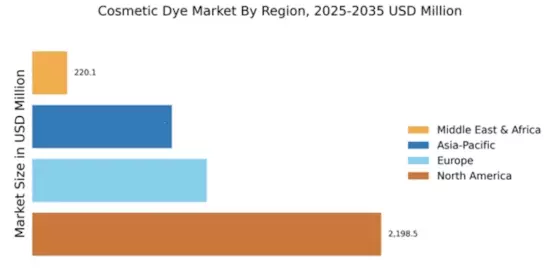
North America is poised to maintain its leadership in the cosmetic dye market, holding a significant share of 2198.5 million in 2024. The region's growth is driven by increasing consumer demand for innovative cosmetic products and stringent regulations promoting safety and quality. The rise in e-commerce and the popularity of organic and natural dyes are also contributing to market expansion. Regulatory bodies are emphasizing the need for compliance with safety standards, further boosting market growth. The United States is the primary market within North America, hosting key players such as BASF SE, Clariant AG, and Sensient Technologies Corporation. The competitive landscape is characterized by continuous innovation and strategic partnerships among leading companies. The presence of advanced manufacturing facilities and a robust supply chain enhances the region's market position, making it a hub for cosmetic dye production and distribution.

Europe : Emerging Trends in Cosmetic Dyes

Europe is witnessing a dynamic shift in the cosmetic dye market, with a market size of 1099.25 million in 2024. The region's growth is fueled by increasing consumer awareness regarding product safety and environmental sustainability. Regulatory frameworks, such as REACH, are driving manufacturers to innovate and develop safer, eco-friendly dyes. The demand for organic and natural cosmetic products is also on the rise, aligning with consumer preferences for sustainable options. Leading countries in Europe include Germany, France, and the UK, where major players like Dystar GmbH and Huntsman Corporation are actively engaged in research and development. The competitive landscape is marked by collaborations and mergers aimed at enhancing product offerings. The presence of stringent regulations ensures that companies prioritize safety and quality, further solidifying Europe's position in the global market.

Asia-Pacific : Rapid Growth in Emerging Markets

Asia-Pacific is emerging as a significant player in the cosmetic dye market, with a market size of 879.2 million in 2024. The region's growth is driven by rising disposable incomes, urbanization, and a growing middle class that is increasingly investing in personal care products. Additionally, the demand for vibrant and diverse cosmetic options is propelling market expansion. Regulatory initiatives aimed at ensuring product safety are also influencing market dynamics positively. Countries like China, India, and Japan are leading the charge in this region, with a mix of local and international players such as Lanxess AG and Ferro Corporation. The competitive landscape is characterized by rapid innovation and the introduction of new products tailored to local preferences. As the market continues to grow, companies are focusing on enhancing their distribution networks to reach a broader consumer base, further driving market potential.

Middle East and Africa : Untapped Potential in Cosmetic Dyes

The Middle East and Africa region is gradually establishing itself in the cosmetic dye market, with a market size of 220.06 million in 2024. The growth is primarily driven by increasing urbanization, a young population, and rising beauty consciousness among consumers. Additionally, the region is witnessing a surge in demand for high-quality cosmetic products, which is encouraging manufacturers to invest in innovative dye solutions. Regulatory bodies are also beginning to implement stricter guidelines to ensure product safety and quality. Leading countries in this region include South Africa and the UAE, where local and international companies are vying for market share. The competitive landscape is evolving, with key players like Eastman Chemical Company and Solvay SA focusing on expanding their presence. As the market matures, there is a growing emphasis on sustainability and compliance with international standards, which will shape future growth trajectories.

Key Players and Competitive Insights

The Cosmetic Dye Market is currently characterized by a dynamic competitive landscape, driven by innovation, sustainability, and strategic partnerships. Key players such as BASF SE (DE), Clariant AG (CH), and Sensient Technologies Corporation (US) are actively shaping the market through their distinct operational focuses. BASF SE (DE) emphasizes sustainable product development, aligning with global trends towards eco-friendly solutions. Clariant AG (CH) has positioned itself as a leader in innovation, particularly in the realm of natural dyes, while Sensient Technologies Corporation (US) is leveraging digital transformation to enhance customer engagement and streamline operations. Collectively, these strategies contribute to a competitive environment that is increasingly focused on sustainability and technological advancement.

In terms of business tactics, companies are increasingly localizing manufacturing to reduce lead times and enhance supply chain efficiency. The market structure appears moderately fragmented, with several key players holding substantial market shares. This fragmentation allows for a diverse range of products and innovations, yet the influence of major companies remains significant, as they set trends and standards that smaller firms often follow.

In November 2025, Clariant AG (CH) announced a strategic partnership with a leading cosmetics brand to develop a new line of sustainable cosmetic dyes. This collaboration is expected to enhance Clariant's market presence and reinforce its commitment to sustainability, potentially setting a new benchmark for eco-friendly products in the industry. The strategic importance of this partnership lies in its alignment with consumer demand for environmentally responsible products, which is increasingly becoming a decisive factor in purchasing decisions.

In October 2025, BASF SE (DE) launched a new range of bio-based cosmetic dyes, marking a significant step in its sustainability journey. This initiative not only broadens BASF's product portfolio but also positions the company as a frontrunner in the sustainable cosmetic dye segment. The introduction of bio-based options is likely to attract environmentally conscious consumers and strengthen BASF's competitive edge in a market that is progressively leaning towards sustainability.

In September 2025, Sensient Technologies Corporation (US) unveiled a digital platform aimed at enhancing customer interaction and product customization. This platform allows clients to tailor cosmetic dye solutions to their specific needs, thereby fostering greater customer loyalty and satisfaction. The strategic importance of this digital initiative lies in its potential to revolutionize customer engagement, making Sensient a more agile player in a rapidly evolving market.

As of December 2025, the Cosmetic Dye Market is witnessing trends that emphasize digitalization, sustainability, and the integration of advanced technologies such as AI. Strategic alliances are increasingly shaping the competitive landscape, enabling companies to pool resources and expertise to innovate more effectively. Looking ahead, competitive differentiation is likely to evolve from traditional price-based competition to a focus on innovation, technological advancements, and supply chain reliability. This shift underscores the importance of adaptability and forward-thinking strategies in maintaining a competitive edge in the market.

Key Companies in the Cosmetic Dye Market market include

Industry Developments

  • Q1 2024: L'Oréal launches new natural dye line for hair and skin care L'Oréal announced the launch of a new range of natural cosmetic dyes designed for hair and skin care products, emphasizing plant-based ingredients and compliance with stricter safety standards.
  • Q2 2024: Estée Lauder unveils multifunctional dye technology for color cosmetics Estée Lauder introduced a new dye technology that combines vibrant color with skincare benefits, targeting the premium segment of the cosmetic dye market.
  • Q2 2024: FDA approves new synthetic dye for use in cosmetic products The U.S. Food and Drug Administration approved a new synthetic dye for use in cosmetic formulations, following a comprehensive safety review and public comment period.
  • Q3 2024: Unilever opens new cosmetic dye R&D facility in the Netherlands Unilever inaugurated a state-of-the-art research and development center focused on sustainable cosmetic dye innovation, aiming to accelerate eco-friendly product launches.
  • Q3 2024: Beiersdorf announces partnership with biotech firm for natural dye development Beiersdorf entered a strategic partnership with a leading biotech company to co-develop natural dyes for use in its skincare and personal care product lines.
  • Q4 2024: L'Oréal acquires startup specializing in organic cosmetic dyes L'Oréal completed the acquisition of a startup focused on organic dye technology, expanding its portfolio of sustainable and natural colorants for cosmetics.
  • Q1 2025: ECHA updates regulations on cosmetic dye safety standards The European Chemicals Agency released updated safety standards for cosmetic dyes, impacting product formulations and labeling requirements across the EU.
  • Q2 2025: Shiseido launches vegan-certified dye range for Asian markets Shiseido introduced a new line of vegan-certified cosmetic dyes, targeting growing demand for cruelty-free and plant-based beauty products in Asia.
  • Q2 2025: Henkel signs supply contract for sustainable dye ingredients Henkel secured a multi-year supply agreement with a sustainable dye manufacturer to source eco-friendly ingredients for its hair and skin care products.
  • Q3 2025: Procter & Gamble announces executive appointment to lead cosmetic dye innovation Procter & Gamble appointed a new head of cosmetic dye innovation, signaling increased investment in research and development for advanced color technologies.
  • Q3 2025: FDA issues recall for non-compliant cosmetic dye batches The FDA announced a recall of several cosmetic products containing dye batches that failed to meet updated safety standards, prompting reformulation efforts by affected brands.
  • Q4 2025: Cosmetic dye startup secures $30M Series B funding for global expansion A leading cosmetic dye startup raised $30 million in Series B funding to expand its manufacturing capacity and accelerate international market entry.

Future Outlook

Cosmetic Dye Market Future Outlook

The Cosmetic Dye Market is projected to grow at a 2.44% CAGR from 2024 to 2035, driven by increasing consumer demand for natural ingredients and innovative product formulations.

New opportunities lie in:

  • Expansion into sustainable dye production methods
  • Development of customizable color solutions for brands
  • Strategic partnerships with eco-friendly packaging suppliers

By 2035, the market is expected to achieve robust growth, reflecting evolving consumer preferences and sustainability trends.

Market Segmentation

Cosmetic Dye Market Type Outlook

  • Natural Dyes
  • Synthetic Dyes
  • Mineral Dyes
  • Organic Dyes

Cosmetic Dye Market End Use Outlook

  • Personal Care
  • Cosmetics
  • Professional Use
  • Retail

Cosmetic Dye Market Application Outlook

  • Hair Color
  • Skin Care
  • Makeup
  • Nail Products
  • Fragrance

Cosmetic Dye Market Formulation Outlook

  • Liquid
  • Powder
  • Gel
  • Cream

Report Scope

MARKET SIZE 20244397.01(USD Million)
MARKET SIZE 20254504.39(USD Million)
MARKET SIZE 20355733.47(USD Million)
COMPOUND ANNUAL GROWTH RATE (CAGR)2.44% (2024 - 2035)
REPORT COVERAGERevenue Forecast, Competitive Landscape, Growth Factors, and Trends
BASE YEAR2024
Market Forecast Period2025 - 2035
Historical Data2019 - 2024
Market Forecast UnitsUSD Million
Key Companies ProfiledBASF SE (DE), Clariant AG (CH), Dystar GmbH (DE), Kraton Corporation (US), Sensient Technologies Corporation (US), Huntsman Corporation (US), Lanxess AG (DE), Ferro Corporation (US), Eastman Chemical Company (US), Solvay SA (BE)
Segments CoveredApplication, Type, Formulation, End Use
Key Market OpportunitiesGrowing demand for natural and sustainable cosmetic dyes presents significant opportunities in the Cosmetic Dye Market.
Key Market DynamicsRising consumer demand for natural cosmetic dyes drives innovation and regulatory scrutiny in the cosmetic dye market.
Countries CoveredNorth America, Europe, APAC, South America, MEA

Leave a Comment

FAQs

What is the anticipated CAGR for the Cosmetic Dye Market from 2025 to 2034?

Cosmetic Dye Market is projected to register a CAGR of 2.44% from 2025-2035

Which application segment is projected to dominate the Cosmetic Dye Market in 2035?

Hair Coloring is projected to dominate the market with an expected value of 1.85 USD Billion in 2035.

What is the value of the Skin Care Products segment in the Cosmetic Dye Market by 2035?

The Skin Care Products segment is expected to be valued at 1.5 USD Billion in 2035.

Which region is expected to have the largest market share of the Cosmetic Dye Market in 2035?

North America is expected to have the largest market share, valued at 1.89 USD Billion in 2035.

What is the projected market value for Europe in the Cosmetic Dye Market by 2035?

Europe is projected to have a market value of 1.5 USD Billion in 2035.

How much is the Nail Products segment expected to grow by 2035?

The Nail Products segment is expected to grow to 0.15 USD Billion by 2035.

Who are the key players in the Cosmetic Dye Market?

Key players in the market include Rudolf GmbH, BASF, Solvay, DIC Corporation and Kemira, among others.

What is the estimated market size for the South America region in 2035?

The South America region is estimated to have a market size of 0.27 USD Billion in 2035.

Download Free Sample

Kindly complete the form below to receive a free sample of this Report

Compare Licence

×
Features License Type
Single User Multiuser License Enterprise User
Price $4,950 $5,950 $6,250
Maximum User Access Limit 1 User Upto 10 Users Unrestricted Access Throughout the Organization
Free Customization
Direct Access to Analyst
Deliverable Format
Platform Access
Discount on Next Purchase 10% 15% 15%
Printable Versions