×
Request Free Sample ×

Kindly complete the form below to receive a free sample of this Report

* Please use a valid business email

Leading companies partner with us for data-driven Insights

clients tt-cursor
Hero Background

Cosmetic Preservative Market

ID: MRFR/CnM/8350-HCR
111 Pages
Chitranshi Jaiswal
October 2025

Cosmetic Preservative Market Research Report By Application (Skin Care, Hair Care, Makeup Products, Fragrances, Personal Care), By Type (Natural Preservatives, Synthetic Preservatives, Organic Preservatives, Antimicrobial Preservatives), By Formulation Type (Water-Based Formulations, Oil-Based Formulations, Emulsion Formulations), By End Use (Commercial, Household) and By Regional (North America, Europe, South America, Asia Pacific, Middle East and Africa) - Forecast to 2035

Share:
Download PDF ×

We do not share your information with anyone. However, we may send you emails based on your report interest from time to time. You may contact us at any time to opt-out.

Cosmetic Preservative Market Infographic
Purchase Options

Cosmetic Preservative Market Summary

As per MRFR analysis, the Cosmetic Preservative Market Size was estimated at 3178.71 USD Million in 2024. The Cosmetic Preservative industry is projected to grow from 3308.15 in 2025 to 4930.89 by 2035, exhibiting a compound annual growth rate (CAGR) of 4.07 during the forecast period 2025 - 2035.

Key Market Trends & Highlights

The Cosmetic Preservative Market is experiencing a notable shift towards natural and sustainable solutions, driven by consumer preferences and regulatory demands.

  • The market is witnessing a significant shift towards natural preservatives as consumers increasingly prioritize eco-friendly products.
  • North America remains the largest market for cosmetic preservatives, while Asia-Pacific is emerging as the fastest-growing region.
  • In the skin care segment, parabens continue to dominate, whereas the hair care segment is rapidly adopting phenoxyethanol as a preferred preservative.
  • Key market drivers include rising consumer awareness of product safety and the growing demand for anti-aging products, which are influencing formulation innovations.

Market Size & Forecast

2024 Market Size 3178.71 (USD Million)
2035 Market Size 4930.89 (USD Million)
CAGR (2025 - 2035) 4.07%

Major Players

BASF (DE), Dow (US), Evonik Industries (DE), Lonza (CH), Kraton Corporation (US), Clariant (CH), Ashland Global Holdings (US), Symrise (DE), Innospec (GB)

Cosmetic Preservative Market Trends

The Cosmetic Preservative Market is currently experiencing a notable evolution, driven by increasing consumer awareness regarding product safety and the demand for longer shelf life in cosmetic formulations. As consumers become more discerning, they seek products that not only enhance their beauty but also ensure safety and efficacy. This shift in consumer behavior is prompting manufacturers to innovate and reformulate their products, leading to a heightened focus on the selection of preservatives that are both effective and compliant with regulatory standards. Furthermore, the rise of clean beauty trends is influencing the market, as brands strive to eliminate harmful ingredients and adopt more natural alternatives. In addition, the Cosmetic Preservative Market is witnessing a growing emphasis on sustainability. Companies are increasingly exploring eco-friendly preservatives derived from natural sources, which align with the broader movement towards environmentally responsible practices. This trend is not merely a response to consumer preferences but also reflects a proactive approach to regulatory pressures and environmental concerns. As the market continues to evolve, it appears that the integration of innovative preservation technologies and sustainable practices will play a crucial role in shaping the future landscape of cosmetic products.

Shift Towards Natural Preservatives

There is a discernible trend towards the adoption of natural preservatives in the Cosmetic Preservative Market. This shift is largely influenced by consumer demand for clean and safe beauty products, prompting brands to explore alternatives that minimize synthetic ingredients.

Regulatory Compliance and Safety Standards

The Cosmetic Preservative Market is increasingly shaped by stringent regulatory frameworks aimed at ensuring product safety. Manufacturers are compelled to adhere to these regulations, which influences their choice of preservatives and formulation strategies.

Sustainability and Eco-Friendly Practices

Sustainability is becoming a pivotal focus within the Cosmetic Preservative Market. Companies are actively seeking eco-friendly preservatives and sustainable sourcing practices, reflecting a commitment to environmental stewardship and consumer expectations.

Cosmetic Preservative Market Drivers

Market Growth Projections

The Global Cosmetic Preservative Market Industry is projected to experience substantial growth in the coming years. With a market value expected to reach 3.18 USD Billion in 2024 and further increase to 4.93 USD Billion by 2035, the industry is poised for a promising trajectory. This growth is underpinned by a compound annual growth rate of 4.07% from 2025 to 2035, indicating a robust demand for cosmetic preservatives. Factors such as rising consumer awareness, regulatory compliance, and technological advancements are likely to contribute to this upward trend. The market's expansion reflects the evolving landscape of cosmetic products and the increasing importance of effective preservation methods.

Increasing Awareness of Skin Health

The Global Cosmetic Preservative Market Industry is witnessing a surge in consumer awareness regarding skin health and the importance of using safe cosmetic products. As consumers become more informed about the potential risks associated with certain preservatives, there is a growing demand for products that prioritize skin safety. This shift is prompting brands to reformulate their offerings, incorporating safer preservatives that align with consumer expectations. The industry's response to this trend is crucial, as it not only influences product development but also impacts market dynamics. The increasing focus on skin health is expected to play a pivotal role in shaping the future of the Global Cosmetic Preservative Market.

Rising Demand for Natural Ingredients

The Global Cosmetic Preservative Market Industry experiences a notable shift towards natural and organic ingredients, driven by consumer preferences for safer and environmentally friendly products. As awareness of synthetic chemicals increases, brands are reformulating products to include natural preservatives, which are perceived as less harmful. This trend is reflected in the projected market growth, with the industry expected to reach 3.18 USD Billion in 2024. Companies are investing in research to identify effective natural alternatives, which could potentially enhance product safety and appeal to eco-conscious consumers. This demand for natural preservatives is likely to shape the future landscape of the Global Cosmetic Preservative Market.

Expansion of E-commerce and Online Retail

The Global Cosmetic Preservative Market Industry is benefiting from the rapid expansion of e-commerce and online retail platforms. As consumers increasingly turn to online shopping for cosmetics, brands are leveraging digital channels to reach a broader audience. This shift has led to an increase in the availability of diverse cosmetic products, including those with innovative preservatives. E-commerce platforms provide consumers with access to detailed product information, enabling informed purchasing decisions. This trend is likely to drive market growth, as the convenience of online shopping continues to attract consumers, thereby enhancing the overall demand for cosmetic products and their preservatives.

Regulatory Compliance and Safety Standards

The Global Cosmetic Preservative Market Industry is significantly influenced by stringent regulatory frameworks aimed at ensuring consumer safety. Governments worldwide are enforcing regulations that require cosmetic products to be free from harmful preservatives, thereby pushing manufacturers to adopt safer alternatives. Compliance with these regulations not only protects consumers but also enhances brand reputation. As a result, the market is adapting to these changes, with an increasing focus on developing preservatives that meet safety standards. This regulatory environment is expected to contribute to the market's growth, with projections indicating a rise to 4.93 USD Billion by 2035, reflecting the industry's commitment to safety and compliance.

Technological Advancements in Preservation Techniques

Innovations in preservation technologies are reshaping the Global Cosmetic Preservative Market Industry. Advances in formulation science and preservation methods are enabling the development of more effective and longer-lasting preservatives. These technological improvements not only enhance product stability but also reduce the need for higher concentrations of preservatives, addressing consumer concerns about ingredient safety. As a result, manufacturers are increasingly adopting these advanced techniques to improve product quality and shelf life. This trend is likely to drive market growth, with a projected compound annual growth rate of 4.07% from 2025 to 2035, indicating a robust future for the industry.
Market Segment Insights

By Application: Skin Care (Largest) vs. Hair Care (Fastest-Growing)

The cosmetic preservative market is significantly influenced by the application segments, with Skin Care leading in market share. This segment encompasses a wide range of products designed to maintain the integrity and safety of skincare formulations, making it the largest category in the market. Skin Care products, such as creams, lotions, and serums, demand high-performance preservatives to ensure long shelf life and efficacy. Meanwhile, Hair Care is emerging as the fastest-growing segment, driven by rising consumer awareness about hair health and the increasing demand for innovative and effective products. In terms of growth trends, the Hair Care segment is experiencing a surge, attributed to the shift towards organic and clean beauty products. Consumers are actively seeking hair care solutions that are free from harmful chemicals, leading to the development of natural preservatives. Additionally, the growing trend of personalized beauty and hair treatments is expected to further propel this segment. Market players are focusing on research and development to create new formulations that cater to these evolving consumer preferences, ensuring sustainable growth in this sector.

Skin Care (Dominant) vs. Hair Care (Emerging)

Skin Care is characterized by a diverse range of products that require effective preservatives to ensure stability and safety for consumers. The segment is dominated by established brands that prioritize innovation in formulation and safety compliance. On the other hand, Hair Care is recognized as an emerging segment with a dynamic market landscape. This category is driven by trends such as personalized hair care products and natural formulations. Brands focusing on clean beauty are increasingly using safe and effective preservatives without compromising product integrity. As consumer preferences shift towards sustainability and wellness, both segments are poised for distinct yet intertwined growth trajectories.

By Type: Parabens (Largest) vs. Phenoxyethanol (Fastest-Growing)

In the Cosmetic Preservative Market, the type segment exhibits distinct variations in market share distribution among its constituents. Parabens, being the most widely employed preservatives, command a significant share. Their effectiveness and low cost have made them a staple in many cosmetic formulations. Conversely, Phenoxyethanol is gaining traction among manufacturers, increasingly preferred for its broad-spectrum efficacy and perceived safety compared to traditional preservatives like parabens and formaldehyde releasers, indicating a shift in consumer preferences. Growth trends reveal a dual narrative, with parabens facing scrutiny from consumers favoring natural alternatives, which may hinder their future growth. Meanwhile, Phenoxyethanol is rapidly emerging due to its aligning with clean beauty trends and stricter regulations against harmful preservatives. As consumers demand transparency and safety, Phenoxyethanol's appeal rises, marking it as a key growth driver in this segment.

Parabens (Dominant) vs. Formaldehyde Releasers (Emerging)

Parabens hold a dominant position in the Cosmetic Preservative Market due to their historical usage and consistent effectiveness in preventing microbial growth, which fosters product longevity. Though they have faced considerable backlash related to safety concerns, their cost-effectiveness keeps them favored among manufacturers. On the other hand, formaldehyde releasers are positioned as emerging preservatives in response to the tightening regulations surrounding parabens. While they may be perceived as controversial, their ability to offer prolonged shelf life and compliance with certain regulatory frameworks drives interest. The contrasting consumer perceptions and regulatory landscapes shape how each preservative type will navigate market dynamics, making it essential for stakeholders to adapt to evolving consumer preferences.

By End Use: Cosmetics (Largest) vs. Hair Products (Fastest-Growing)

The cosmetic preservatives market is characterized by a diverse array of end-use applications. Cosmetics lead this segment, commanding a significant share due to the consistent demand from consumers for makeup and skincare products. Toiletries and fragrances also contribute substantially, but with relatively smaller shares. Sunscreens and hair products reflect a balanced market distribution, with hair products showing increasing popularity due to rising awareness of hair care benefits.

Cosmetics: Dominant vs. Hair Products: Emerging

Cosmetics, as a dominant segment in the cosmetic preservative market, are primarily driven by a wide range of products including foundations, lipsticks, and moisturizers, necessitating effective preservatives to ensure product stability and safety for consumers. Hair products, on the other hand, are emerging rapidly, fueled by a growing focus on hair health, innovative haircare solutions, and an increase in the variety of styling products available. As consumers become more ingredient-conscious, hair products are evolving with natural preservatives that appeal to eco-conscious buyers, signifying a shift in market dynamics toward sustainable options.

Get more detailed insights about Cosmetic Preservative Market

Regional Insights

North America : Market Leader in Preservatives

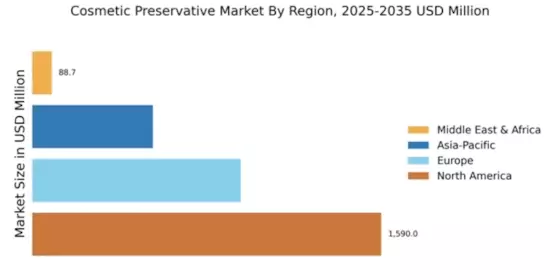
North America is poised to maintain its leadership in the cosmetic preservative market, holding a significant share of $1590.0M in 2024. The region's growth is driven by increasing consumer awareness regarding product safety and the rising demand for natural and organic cosmetics. Regulatory frameworks, such as the FDA's guidelines on cosmetic safety, further bolster market growth by ensuring compliance and safety standards. The United States stands as the largest market, with key players like BASF, Dow, and Lonza leading the charge. The competitive landscape is characterized by innovation and strategic partnerships, as companies strive to meet evolving consumer preferences. The presence of established manufacturers and a robust distribution network enhances market accessibility, ensuring a steady supply of cosmetic preservatives across various segments.

Europe : Regulatory Focus on Safety

Europe's cosmetic preservative market is valued at $950.0M, driven by stringent regulations and a growing demand for safe, effective products. The European Commission's REACH regulation emphasizes the need for safety assessments, which propels innovation in preservative formulations. This regulatory environment fosters consumer trust and encourages brands to invest in high-quality ingredients, aligning with the trend towards sustainability and natural products. Leading countries such as Germany, France, and the UK dominate the market, with major players like Evonik Industries and Clariant at the forefront. The competitive landscape is marked by a focus on research and development, as companies seek to create innovative solutions that comply with regulatory standards. The presence of a diverse range of manufacturers ensures a dynamic market, catering to various consumer needs and preferences.

Asia-Pacific : Emerging Market Potential

The Asia-Pacific cosmetic preservative market, valued at $550.0M, is experiencing rapid growth due to increasing disposable incomes and a rising middle class. The demand for personal care products is surging, driven by changing lifestyles and beauty standards. Regulatory bodies are also becoming more active in ensuring product safety, which is crucial for market expansion and consumer confidence in cosmetic products. Countries like China, Japan, and India are leading the charge, with a growing number of local and international brands entering the market. Key players such as Ashland Global Holdings and Symrise are focusing on innovative preservative solutions tailored to regional preferences. The competitive landscape is evolving, with companies investing in marketing and distribution channels to capture the growing consumer base in this dynamic region.

Middle East and Africa : Untapped Market Opportunities

The Middle East and Africa cosmetic preservative market, valued at $88.71M, is gradually gaining traction as the beauty and personal care sector expands. Factors such as urbanization, increased consumer spending, and a growing interest in personal grooming are driving demand for cosmetic products. Regulatory frameworks are also evolving, with governments focusing on safety and quality standards to protect consumers and promote market growth. Countries like South Africa and the UAE are at the forefront of this emerging market, with local and international brands vying for market share. The competitive landscape is characterized by a mix of established players and new entrants, creating a dynamic environment. Companies are increasingly focusing on product innovation and marketing strategies to cater to the unique preferences of consumers in this diverse region.

Key Players and Competitive Insights

The Cosmetic Preservative Market is characterized by a dynamic competitive landscape, driven by increasing consumer demand for safe and effective products. Key players are focusing on innovation, sustainability, and strategic partnerships to enhance their market positions. Companies such as BASF (DE), Dow (US), and Evonik Industries (DE) are at the forefront, leveraging their extensive research and development capabilities to introduce advanced preservative solutions. These firms are not only enhancing product efficacy but also addressing regulatory challenges and consumer preferences for natural ingredients, thereby shaping the competitive environment.

In terms of business tactics, companies are increasingly localizing manufacturing to reduce lead times and optimize supply chains. The market appears moderately fragmented, with several players vying for market share. However, the collective influence of major companies like Lonza (CH) and Clariant (CH) is notable, as they implement strategies that enhance operational efficiencies and foster innovation. This competitive structure allows for a diverse range of products, catering to various consumer needs while maintaining a focus on quality and safety.

In November 2025, BASF (DE) announced the launch of a new line of bio-based preservatives aimed at the personal care sector. This strategic move underscores the company's commitment to sustainability and innovation, aligning with the growing consumer preference for environmentally friendly products. By investing in bio-based solutions, BASF not only enhances its product portfolio but also positions itself as a leader in sustainable practices within the industry.

Similarly, in October 2025, Dow (US) expanded its partnership with a leading natural ingredient supplier to develop preservative systems that utilize plant-derived components. This collaboration is significant as it reflects Dow's strategy to integrate more natural ingredients into its offerings, catering to the increasing demand for clean beauty products. Such partnerships are likely to enhance Dow's competitive edge by diversifying its product range and appealing to environmentally conscious consumers.

In September 2025, Evonik Industries (DE) unveiled a new preservative technology that utilizes advanced encapsulation techniques to enhance product stability and efficacy. This innovation is crucial as it addresses the challenges of preserving cosmetic formulations without compromising their quality. Evonik's focus on technological advancements not only strengthens its market position but also sets a benchmark for competitors in terms of product performance and safety.

As of December 2025, the Cosmetic Preservative Market is witnessing trends such as digitalization, sustainability, and the integration of AI in product development. Strategic alliances are increasingly shaping the competitive landscape, enabling companies to pool resources and expertise. The shift from price-based competition to a focus on innovation and technology is evident, as firms prioritize supply chain reliability and product differentiation. Looking ahead, it seems that the competitive dynamics will continue to evolve, with an emphasis on sustainable practices and advanced technologies driving future growth.

Key Companies in the Cosmetic Preservative Market market include

Industry Developments

  • Q2 2024: BASF launches new natural-based preservative for cosmetics under the brand name Neolone BioG BASF announced the launch of Neolone BioG, a new natural-based preservative for personal care and cosmetic products, expanding its portfolio to meet the growing demand for sustainable and eco-friendly ingredients.
  • Q1 2024: Evonik opens new production facility for cosmetic ingredients in Slovakia Evonik inaugurated a new manufacturing plant in Slovakia dedicated to the production of specialty ingredients for the cosmetics industry, including advanced preservative systems, to strengthen its supply chain in Europe.
  • Q2 2024: Ashland introduces new multifunctional preservative for personal care market Ashland launched a new multifunctional preservative designed for use in skin and hair care products, targeting formulators seeking alternatives to traditional parabens and formaldehyde donors.
  • Q2 2024: Clariant partners with Beraca to develop natural preservative solutions for cosmetics Clariant announced a strategic partnership with Beraca, a Brazilian supplier of natural ingredients, to co-develop and commercialize new natural preservative systems for the global cosmetics market.
  • Q3 2024: Symrise expands cosmetic preservative production capacity in Germany Symrise completed an expansion of its German facility to increase production of its SymSave and Hydrolite preservative lines, responding to rising demand from European and global cosmetic manufacturers.
  • Q1 2024: Lonza divests personal care preservatives business to private equity firm Lonza announced the sale of its personal care preservatives division to a private equity group, as part of a strategic refocus on core life sciences operations.
  • Q2 2024: Croda launches new plant-based preservative for clean beauty segment Croda introduced a new plant-derived preservative ingredient aimed at the clean beauty market, emphasizing efficacy and consumer safety for natural cosmetic formulations.
  • Q2 2024: DSM-Firmenich receives regulatory approval for new broad-spectrum cosmetic preservative in the EU DSM-Firmenich announced that its latest broad-spectrum preservative for cosmetics has received regulatory approval in the European Union, enabling its use in a wide range of personal care products.
  • Q3 2024: IFF launches new preservative blend for sensitive skin applications IFF unveiled a new preservative blend specifically formulated for sensitive skin cosmetic products, addressing consumer demand for gentle and hypoallergenic solutions.
  • Q2 2024: Dow Chemical announces $50 million investment in cosmetic preservative R&D Dow Chemical revealed a $50 million investment to expand research and development of next-generation cosmetic preservatives, focusing on safer and more sustainable alternatives.
  • Q1 2025: Shiseido partners with Japanese biotech startup to develop bio-based cosmetic preservatives Shiseido entered a partnership with a Tokyo-based biotech startup to co-develop bio-based preservatives for use in its global cosmetics portfolio, aiming to reduce reliance on synthetic chemicals.
  • Q2 2025: L'Oréal acquires minority stake in natural preservative technology firm L'Oréal acquired a minority stake in a European startup specializing in natural preservative technologies, signaling its commitment to innovation and sustainability in cosmetic formulations.

Future Outlook

Cosmetic Preservative Market Future Outlook

The Cosmetic Preservative Market is projected to grow at a 4.07% CAGR from 2024 to 2035, driven by increasing consumer demand for safe and effective products, regulatory changes, and innovation in formulations.

New opportunities lie in:

  • Development of bio-based preservatives to meet sustainability demands.
  • Expansion into emerging markets with tailored product lines.
  • Investment in advanced preservation technologies to enhance product shelf life.

By 2035, the market is expected to be robust, driven by innovation and sustainability initiatives.

Market Segmentation

Cosmetic Preservative Market Type Outlook

  • Parabens
  • Formaldehyde Releasers
  • Phenoxyethanol
  • Sorbic Acid
  • Benzoic Acid

Cosmetic Preservative Market End Use Outlook

  • Cosmetics
  • Toiletries
  • Fragrances
  • Sunscreens
  • Hair Products

Cosmetic Preservative Market Application Outlook

  • Skin Care
  • Hair Care
  • Makeup
  • Fragrance
  • Personal Hygiene

Report Scope

MARKET SIZE 20243178.71(USD Million)
MARKET SIZE 20253308.15(USD Million)
MARKET SIZE 20354930.89(USD Million)
COMPOUND ANNUAL GROWTH RATE (CAGR)4.07% (2024 - 2035)
REPORT COVERAGERevenue Forecast, Competitive Landscape, Growth Factors, and Trends
BASE YEAR2024
Market Forecast Period2025 - 2035
Historical Data2019 - 2024
Market Forecast UnitsUSD Million
Key Companies ProfiledBASF (DE), Dow (US), Evonik Industries (DE), Lonza (CH), Kraton Corporation (US), Clariant (CH), Ashland Global Holdings (US), Symrise (DE), Innospec (GB)
Segments CoveredApplication, Type, End Use
Key Market OpportunitiesGrowing demand for natural preservatives driven by consumer preference for clean beauty products in the Cosmetic Preservative Market.
Key Market DynamicsRising consumer demand for natural ingredients drives innovation and regulatory scrutiny in the cosmetic preservative market.
Countries CoveredNorth America, Europe, APAC, South America, MEA

Leave a Comment

FAQs

What is the expected CAGR for the Cosmetic Preservative Market from 2025 to 2034?

Cosmetic Preservative Market is projected to grow at a CAGR of 4.07% during the forecast period, 2025-2035

Which region is projected to have the largest market share in 2035?

North America is projected to have the largest market share, valued at 1.6 billion USD in 2035.

What will be the market size for the Skin Care segment in 2035?

The Skin Care segment is expected to be valued at 1.56 billion USD in 2035.

Who are the key players in the Cosmetic Preservative Market?

Key players include Kraton Corporation, BASF, Dow, and Lonza, among others.

What is the anticipated market size for the Hair Care segment by 2035?

The Hair Care segment is anticipated to reach a market size of 1.25 billion USD by 2035.

What market size is expected for the Personal Care segment in 2035?

The Personal Care segment is expected to achieve a market size of 0.39 billion USD by 2035.

What is the expected growth rate for the European market from 2024 to 2035?

Cosmetic Preservative Market crossed a valuation of USD 3.18 Billion in 2024

What is the market size projected for the Fragrances segment in 2035?

The Fragrances segment is projected to reach a market size of 0.55 billion USD in 2035.

What challenges might the Cosmetic Preservative Market face in the coming years?

The market may face challenges related to regulatory changes and formulation innovations.

Download Free Sample

Kindly complete the form below to receive a free sample of this Report

Compare Licence

×
Features License Type
Single User Multiuser License Enterprise User
Price $4,950 $ $6,250
Maximum User Access Limit 1 User Upto 10 Users Unrestricted Access Throughout the Organization
Free Customization
Direct Access to Analyst
Deliverable Format
Platform Access
Discount on Next Purchase 10% 15% 15%
Printable Versions