×
Request Free Sample ×

Kindly complete the form below to receive a free sample of this Report

* Please use a valid business email

Leading companies partner with us for data-driven Insights

clients tt-cursor
Hero Background

Cottonseed Processing Market

ID: MRFR/Agri/34803-HCR
128 Pages
Snehal Singh
October 2025

Cottonseed Processing Market Research Report: By Product Type (Cottonseed Oil, Cottonseed Meal, Cottonseed Hulls, Cottonseed Cake), By Application (Food Industry, Animal Feed, Cosmetics, Biofuels), By Process Technology (Mechanical Pressing, Solvent Extraction, Pre-Press Extraction), By End Use (Direct Consumption, Industrial Applications, Agricultural Applications) and By Regional (North America, Europe, South America, Asia Pacific, Middle East and Africa) - Forecast to 2035

Share:
Download PDF ×

We do not share your information with anyone. However, we may send you emails based on your report interest from time to time. You may contact us at any time to opt-out.

Cottonseed Processing Market  Infographic
Purchase Options

Cottonseed Processing Market Summary

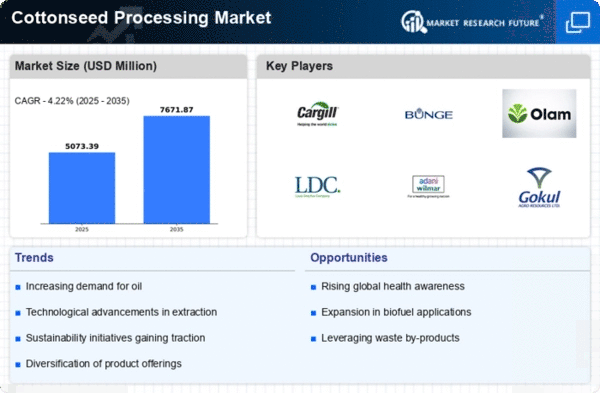
As per MRFR analysis, the Cottonseed Processing Market Size was estimated at 4867.96 USD Million in 2024. The Cottonseed Processing industry is projected to grow from 5073.49 USD Million in 2025 to 7671.87 USD Million by 2035, exhibiting a compound annual growth rate (CAGR) of 4.22 during the forecast period 2025 - 2035.

Key Market Trends & Highlights

The Cottonseed Processing Market is experiencing robust growth driven by health trends and sustainability initiatives.

  • The demand for healthier oils is propelling the Cottonseed Processing Market, particularly in North America, which remains the largest market.
  • Sustainability initiatives are gaining traction, influencing processing techniques and consumer preferences across the Asia-Pacific region, the fastest-growing market.
  • Innovation in processing techniques is enhancing efficiency and product quality, especially in the oil extraction segment, which is currently the largest.
  • The increasing demand for cottonseed oil and the expansion of the animal feed market are key drivers fueling market growth.

Market Size & Forecast

2024 Market Size 4867.96 (USD Million)
2035 Market Size 7671.87 (USD Million)
CAGR (2025 - 2035) 4.22%

Major Players

Cargill (US), Bunge (US), Louis Dreyfus Company (US), Olam International (SG), Adani Wilmar (IN), Gokul Refoils and Solvent (IN), Sime Darby Oils (MY), Shree Renuka Sugars (IN), Ruchi Soya Industries (IN)

Cottonseed Processing Market Trends

The Cottonseed Processing Market is currently experiencing a dynamic phase characterized by evolving consumer preferences and technological advancements. The demand for cottonseed oil, a key product derived from cottonseed processing, is on the rise due to its applications in food, cosmetics, and biofuels. This trend is further fueled by a growing awareness of health benefits associated with cottonseed oil, which is perceived as a healthier alternative to other cooking oils. Additionally, the increasing utilization of cottonseed meal as a protein source in animal feed is contributing to the market's expansion. As sustainability becomes a focal point for industries, the Cottonseed Processing Market is likely to adapt by implementing eco-friendly practices and enhancing production efficiency. Moreover, The Cottonseed Processing is witnessing a shift towards value-added products. Innovations in processing techniques are enabling manufacturers to extract more from cottonseed, leading to the development of high-quality by-products. This diversification not only enhances profitability but also meets the rising demand for specialty oils and protein-rich feeds. The integration of advanced technologies, such as automation and data analytics, is streamlining operations and improving product quality. As the market continues to evolve, stakeholders must remain vigilant to emerging trends and consumer demands to maintain competitiveness and drive growth in this sector.

Rising Demand for Healthier Oils

The Cottonseed Processing Market is seeing an increased preference for cottonseed oil, which is recognized for its health benefits. Consumers are gravitating towards oils that are perceived as healthier alternatives, thus driving demand for cottonseed oil in various applications.

Sustainability Initiatives

Sustainability is becoming a crucial aspect of the Cottonseed Processing Market. Companies are likely to adopt eco-friendly practices and enhance production efficiency to meet the growing consumer demand for sustainable products.

Innovation in Processing Techniques

Advancements in processing technologies are enabling the Cottonseed Processing Market to produce high-quality by-products. This innovation not only increases profitability but also caters to the demand for specialty oils and protein-rich feeds.

Cottonseed Processing Market Drivers

Rising Demand for Edible Oils

The Global Cottonseed Processing Market Industry experiences a notable increase in demand for edible oils, driven by the growing health consciousness among consumers. Cottonseed oil, known for its light flavor and high smoke point, is gaining popularity in cooking and food processing. In 2024, the market is valued at 4.87 USD Billion, reflecting the rising preference for vegetable oils over animal fats. This trend is expected to continue, with projections indicating that by 2035, the market could reach 7.67 USD Billion. The anticipated compound annual growth rate (CAGR) of 4.21% from 2025 to 2035 further underscores the potential for growth in this segment.

Increased Utilization in Animal Feed

The Global Cottonseed Processing Market Industry benefits from the increased utilization of cottonseed meal in animal feed. As livestock production expands globally, the demand for high-protein feed ingredients rises. Cottonseed meal, a byproduct of oil extraction, is rich in protein and is increasingly incorporated into feed formulations for cattle, poultry, and aquaculture. This trend is particularly evident in regions with significant livestock farming, where the nutritional value of cottonseed meal is recognized. The growing livestock sector not only supports the cottonseed processing industry but also enhances the overall sustainability of animal agriculture.

Expansion of Cotton Cultivation Areas

The Global Cottonseed Processing Market Industry is positively influenced by the expansion of cotton cultivation areas in various regions. As cotton production increases, the availability of raw materials for processing also rises. Countries such as India, China, and the United States are expanding their cotton farming practices, driven by favorable climatic conditions and advancements in agricultural techniques. This expansion not only supports the supply chain for cottonseed processing but also contributes to the overall growth of the industry. The increased availability of cottonseed is expected to enhance processing capacities and meet the rising global demand for cottonseed oil and meal.

Growing Awareness of Sustainable Practices

The Global Cottonseed Processing Market Industry is witnessing a shift towards sustainable practices, driven by consumer awareness and regulatory pressures. Stakeholders are increasingly focusing on environmentally friendly processing methods and sustainable sourcing of cotton. This trend is reflected in the adoption of practices that minimize waste and energy consumption during processing. Companies that prioritize sustainability are likely to gain a competitive edge, as consumers increasingly prefer products that align with their values. This growing emphasis on sustainability not only enhances the reputation of the industry but also opens new market opportunities for cottonseed-derived products.

Technological Advancements in Processing Techniques

Technological advancements in cottonseed processing techniques are transforming the Global Cottonseed Processing Market Industry. Innovations such as solvent extraction and cold pressing are enhancing oil yield and quality, making cottonseed oil more competitive with other vegetable oils. These advancements also contribute to improved efficiency and reduced waste in processing operations. As processors adopt modern technologies, they can meet the increasing demand for high-quality cottonseed oil and meal. This shift towards more efficient processing methods is likely to attract investments and foster growth within the industry, further solidifying its position in the global market.


Market Segment Insights

By Application: Oil Extraction (Largest) vs. Animal Feed (Fastest-Growing)

In the Cottonseed Processing Market, the application segment is diverse, comprising Oil Extraction, Animal Feed, Food Products, Textiles, and Cosmetics. Among these, Oil Extraction holds the largest market share due to its well-established presence and the high demand for cottonseed oil in culinary and industrial applications. This segment has been traditionally favored for its contributions to healthy fats and various culinary oils, making it a staple in markets worldwide. Meanwhile, Animal Feed has emerged as the fastest-growing segment, driven by the rising global demand for livestock feed and the increasing focus on sustainable agricultural practices. The growth trends indicate a shifting focus towards more sustainable and effective applications of cottonseed byproducts, particularly in animal nutrition. Factors such as the increasing demand for protein-rich feed and consumer preferences moving towards organic products have significantly influenced the growth of the Animal Feed segment. Additionally, innovation in processing technologies and the exploration of cottonseeds in food products, textiles, and cosmetics are also expected to drive growth, making this segment dynamic and multifaceted.

Oil Extraction: Dominant vs. Animal Feed: Emerging

Oil Extraction remains the dominant application in the Cottonseed Processing Market, primarily due to its extensive use in cooking oils, margarine, and industrial lubricants. It offers a valuable source of oil, rich in unsaturated fats and vitamins, appealing to health-conscious consumers and industries alike. The established supply chains and processing technologies further solidify its market position. In contrast, the Animal Feed segment is rapidly emerging, attributed to the rising demand for high-quality livestock feed. Cottonseed meal, a byproduct, is recognized for its nutritional composition, including proteins and essential amino acids, becoming a preferred choice among farmers and feed manufacturers. This emerging segment is also characterized by innovation, with ongoing research aiming to enhance the nutritional value and digestibility of cottonseed-based feed, creating a competitive edge in the market.

By End Use: Food Industry (Largest) vs. Agriculture (Fastest-Growing)

The Cottonseed Processing Market exhibits diverse end-use applications, with the food industry taking the lead in market share. Different products derived from cottonseed, including oils and meals, are extensively utilized in various food applications, contributing significantly to the market's expansion. Other segments, such as agriculture, personal care, pharmaceuticals, and industrial, also hold considerable shares but are overshadowed by the food industry's dominance.

Food Industry: Dominant vs. Agriculture: Emerging

The food industry remains the dominant sector in the cottonseed processing market, primarily due to the high demand for cottonseed oil, which is valued for its light flavor, high smoke point, and health benefits. The demand for processed cottonseed products in snack foods, sauces, and salad dressings drives this sector. Meanwhile, agriculture is emerging rapidly, as cottonseed meals are increasingly recognized for their nutritional profile, serving as high-protein animal feed, which elevates this segment's significance. As sustainable practices become more important in farming, the utilization of cotton by-products in agriculture shows promising growth.

By Processing Method: Solvent Extraction (Largest) vs. Mechanical Extraction (Fastest-Growing)

In the Cottonseed Processing Market, the distribution of market share among processing methods reveals that Solvent Extraction holds the largest share due to its efficiency and yield advantages. This method is widely favored in large-scale operations, providing a high recovery rate of oil from cottonseed. Mechanical Extraction, while currently smaller in share relative to solvent extraction, is rapidly gaining traction as producers look for more sustainable and reduced-chemical processes in response to consumer demand for natural products. The growth trends indicate a continued shift towards Mechanical Extraction, driven by increasing regulatory pressures and consumer preference for cleaner processing methods. Solvent Extraction remains dominant but faces competition from Mechanical Extraction and Cold Pressing. Moreover, the market is seeing innovations in Dehulling practices as processors seek to enhance oil quality and extraction efficiency.

Solvent Extraction (Dominant) vs. Cold Pressing (Emerging)

Solvent Extraction dominates the Cottonseed Processing Market due to its established efficiency and high extraction rates. This method employs chemical solvents to extract oil, resulting in an optimal yield, which is particularly beneficial for large processors aiming for high output. In contrast, Cold Pressing is emerging as a popular alternative, appealing to health-conscious consumers and those seeking organic products. Cold Pressing maintains the oil's natural properties, leading to a higher perceived quality. While it currently holds a smaller market position compared to Solvent Extraction, Cold Pressing is gaining traction, particularly in niche markets focused on natural and minimally processed oils.

By Product Type: Cottonseed Oil (Largest) vs. Cottonseed Meal (Fastest-Growing)

In the Cottonseed Processing Market, the product type segment is primarily dominated by Cottonseed Oil, which holds the largest market share due to its widespread use in cooking and food production. Its versatile applications, including as an ingredient in salad dressings and margarine, contribute significantly to its demand. Following closely is Cottonseed Meal, a byproduct of oil extraction, which is gaining traction due to its increasing use in animal feed and as a protein source in various applications.

Cottonseed Oil (Dominant) vs. Cottonseed Meal (Emerging)

Cottonseed Oil is recognized for its light flavor, high smoke point, and health benefits, making it a preferred choice for consumers and food manufacturers alike. It plays a crucial role in the food industry, particularly in cooking oils and processed food products. Conversely, Cottonseed Meal is an emerging product, gaining momentum mainly in the animal feed sector due to its rich protein content. With the rise in livestock production and emphasis on sustainable agriculture, Cottonseed Meal is increasingly being adopted as a cost-effective feed alternative, positioning it as a valuable player in this market.

Get more detailed insights about Cottonseed Processing Market

Regional Insights

North America : Market Leader in Cottonseed Processing

North America is poised to maintain its leadership in the cottonseed processing market, holding a significant share of 2433.98 million. The region benefits from advanced agricultural practices, high demand for cottonseed oil, and a robust regulatory framework that supports sustainable farming. The increasing focus on biofuels and plant-based products further drives market growth, with government incentives promoting eco-friendly practices. The United States stands out as the leading country in this sector, with major players like Cargill, Bunge, and Louis Dreyfus Company dominating the landscape. These companies leverage technological advancements and extensive distribution networks to enhance their market presence. The competitive environment is characterized by strategic partnerships and innovations aimed at improving processing efficiency and product quality.

Europe : Emerging Market with Growth Potential

Europe's cottonseed processing market is on the rise, with a market size of 1216.98 million. The region is witnessing increased demand for healthy oils and plant-based products, driven by changing consumer preferences and regulatory support for sustainable agriculture. The European Union's policies promoting organic farming and reducing carbon footprints are significant catalysts for growth in this sector. Leading countries such as Germany, France, and Italy are at the forefront of this market, with key players like Olam International and Adani Wilmar expanding their operations. The competitive landscape is marked by innovation in processing technologies and a focus on quality. As the market evolves, collaborations between local producers and international firms are expected to enhance market dynamics and product offerings.

Asia-Pacific : Rapidly Growing Market Dynamics

The Asia-Pacific region is experiencing rapid growth in the cottonseed processing market, with a size of 1033.99 million. This growth is fueled by rising population demands, increasing health consciousness, and a shift towards plant-based diets. Additionally, government initiatives aimed at boosting agricultural productivity and sustainability are significant drivers of market expansion in this region. Countries like India and China are leading the charge, with major players such as Gokul Refoils and Solvent and Ruchi Soya Industries making substantial contributions. The competitive landscape is characterized by a mix of local and international firms, focusing on innovation and efficiency in processing methods. As the market matures, investments in technology and infrastructure are expected to play a crucial role in shaping its future.

Middle East and Africa : Emerging Market with Challenges

The Middle East and Africa region, with a market size of 183.01 million, presents a unique landscape for cottonseed processing. The growth is driven by increasing agricultural activities and a rising demand for edible oils. However, challenges such as limited infrastructure and regulatory hurdles can impede market expansion. Governments are beginning to recognize the potential of this sector, leading to initiatives aimed at improving agricultural practices and processing capabilities. Countries like South Africa and Egypt are key players in this market, with local firms striving to enhance their processing capabilities. The competitive environment is evolving, with both regional and international companies exploring opportunities for growth. As investments in technology and infrastructure increase, the region is expected to unlock its full potential in cottonseed processing.

Key Players and Competitive Insights

The Cottonseed Processing Market is characterized by a competitive landscape that is increasingly shaped by innovation, sustainability, and strategic partnerships. Key players such as Cargill (US), Bunge (US), and Olam International (SG) are actively pursuing strategies that emphasize technological advancements and operational efficiencies. Cargill (US), for instance, has focused on enhancing its supply chain capabilities, which appears to be a critical driver of its competitive edge. Meanwhile, Bunge (US) has been investing in digital transformation initiatives to optimize its processing operations, thereby improving productivity and reducing waste. These collective strategies suggest a market that is not only moderately fragmented but also increasingly influenced by the operational focus of these major players.

In terms of business tactics, companies are localizing manufacturing and optimizing supply chains to enhance responsiveness to market demands. The competitive structure of the Cottonseed Processing Market is moderately fragmented, with several key players exerting significant influence. This fragmentation allows for a diverse range of operational strategies, which can lead to both competition and collaboration among firms. The emphasis on local production and supply chain optimization indicates a shift towards more resilient operational frameworks, which are essential in navigating the complexities of global trade.

In November 2025, Cargill (US) announced a partnership with a leading technology firm to develop AI-driven solutions for its cottonseed processing operations. This strategic move is likely to enhance efficiency and reduce operational costs, positioning Cargill (US) as a frontrunner in the adoption of advanced technologies within the sector. The integration of AI into processing operations could potentially revolutionize how cottonseed is processed, leading to higher yields and better quality products.

In October 2025, Bunge (US) expanded its processing capacity in the Americas by acquiring a state-of-the-art facility. This acquisition is indicative of Bunge's commitment to increasing its market share and enhancing its operational capabilities. By bolstering its processing capacity, Bunge (US) is likely to improve its competitive positioning, allowing it to meet the growing demand for cottonseed products more effectively.

In September 2025, Olam International (SG) launched a sustainability initiative aimed at reducing its carbon footprint across its cottonseed processing operations. This initiative underscores Olam's commitment to sustainable practices, which are becoming increasingly important in the market. By prioritizing sustainability, Olam International (SG) not only enhances its brand reputation but also aligns itself with the growing consumer demand for environmentally friendly products.

As of December 2025, the Cottonseed Processing Market is witnessing trends that emphasize digitalization, sustainability, and the integration of advanced technologies. Strategic alliances among key players are shaping the competitive landscape, fostering innovation and collaboration. The shift from price-based competition to a focus on technological advancements and supply chain reliability is becoming evident. Companies that prioritize innovation and sustainability are likely to differentiate themselves in this evolving market, suggesting a future where competitive advantage is increasingly tied to operational excellence and environmental stewardship.

Key Companies in the Cottonseed Processing Market market include

Industry Developments

Recent developments in the cottonseed processing Processing Market have seen significant advancements, with companies like American Cottonseed and Nuziveedu Seeds focusing on enhancing their production capabilities to meet rising demand.

Bharat Seed has been launching new varieties of cottonseed with increased resilience to pests, while Louis Dreyfus Company and Syngenta are investing in sustainable processing technologies. Cargill and DowDuPont have made strides in research and development to improve oil extraction efficiency and product quality.

In terms of mergers and acquisitions, GreenSeed and BASF have formed strategic alliances to leverage each other's strengths in research initiatives, creating synergies for more innovative solutions in cottonseed processing. The Adani Group's recent expansion of its processing facilities signals strong growth in market valuation, further fueling the industry's expansion.

Companies like Olam International and Bunge are also reported to be exploring joint ventures to enhance their market reach. This evolution is reflective of an increasingly competitive landscape driven by technological advancements and sustainability initiatives within the  Cottonseed Processing Market, highlighting a robust interest in enhancing product offerings while maintaining ecological balance.

Future Outlook

Cottonseed Processing Market Future Outlook

The Cottonseed Processing Market is projected to grow at a 4.22% CAGR from 2024 to 2035, driven by increasing demand for plant-based oils and sustainable agricultural practices.

New opportunities lie in:

  • Expansion into bio-based lubricants from cottonseed oil
  • Development of high-protein cottonseed meal for animal feed
  • Investment in advanced extraction technologies for higher oil yield

By 2035, the market is expected to solidify its position as a key player in sustainable agriculture.

Market Segmentation

Cottonseed Processing Market End Use Outlook

  • Food Industry
  • Agriculture
  • Personal Care
  • Pharmaceuticals
  • Industrial

Cottonseed Processing Market Application Outlook

  • Oil Extraction
  • Animal Feed
  • Food Products
  • Textiles
  • Cosmetics

Cottonseed Processing Market Product Type Outlook

  • Cottonseed Oil
  • Cottonseed Meal
  • Cottonseed Hulls
  • Cottonseed Cake
  • Cottonseed Flour

Cottonseed Processing Market Processing Method Outlook

  • Mechanical Extraction
  • Solvent Extraction
  • Cold Pressing
  • Refining
  • Dehulling

Report Scope

MARKET SIZE 20244867.96(USD Million)
MARKET SIZE 20255073.49(USD Million)
MARKET SIZE 20357671.87(USD Million)
COMPOUND ANNUAL GROWTH RATE (CAGR)4.22% (2024 - 2035)
REPORT COVERAGERevenue Forecast, Competitive Landscape, Growth Factors, and Trends
BASE YEAR2024
Market Forecast Period2025 - 2035
Historical Data2019 - 2024
Market Forecast UnitsUSD Million
Key Companies ProfiledCargill (US), Bunge (US), Louis Dreyfus Company (US), Olam International (SG), Adani Wilmar (IN), Gokul Refoils and Solvent (IN), Sime Darby Oils (MY), Shree Renuka Sugars (IN), Ruchi Soya Industries (IN)
Segments CoveredApplication, End Use, Processing Method, Product Type
Key Market OpportunitiesAdoption of sustainable processing technologies enhances efficiency in the Cottonseed Processing Market.
Key Market DynamicsTechnological advancements and regulatory changes are reshaping competitive dynamics in the cottonseed processing market.
Countries CoveredNorth America, Europe, APAC, South America, MEA

Leave a Comment

FAQs

What is the expected market size of the Cottonseed Processing Market in 2034?

The Cottonseed Processing Market is expected to reach a value of 7.36 USD billion by 2034.

What is the projected compound annual growth rate (CAGR) for the Cottonseed Processing Market from 2025 to 2034?

The market is expected to grow at a CAGR of 4.2% from 2025 to 2034.

Which region is expected to have the largest market share in the Cottonseed Processing Market by 2034?

North America is projected to hold the largest market share, valued at 1.8 USD billion by 2034.

What will be the market value of Cottonseed Oil in 2034?

The market value of Cottonseed Oil is expected to be 2.4 USD billion by 2034.

Which company is considered a major player in the Cottonseed Processing Market?

Companies like Cargill, Syngenta, and Louis Dreyfus Company are recognized as key players in the market.

What is the estimated market value for Cottonseed Meal in 2034?

The estimated market value for Cottonseed Meal is expected to be 1.8 USD billion by 2034.

What is the projected market value for Cottonseed Hulls in 2034?

The projected market value for Cottonseed Hulls is anticipated to reach 1.2 USD billion by 2034.

How much was the Cottonseed Processing Market valued in 2024?

The market was valued at 4.48 USD billion in 2024.

What challenges exist in the Cottonseed Processing Market?

Challenges include fluctuating raw material prices and regulatory changes impacting processing operations.

What will the market value for Cottonseed Cake be by 2034?

The market value for Cottonseed Cake is projected to be 1.1 USD billion by 2034.

Download Free Sample

Kindly complete the form below to receive a free sample of this Report

Compare Licence

×
Features License Type
Single User Multiuser License Enterprise User
Price $4,950 $ $7,250
Maximum User Access Limit 1 User Upto 10 Users Unrestricted Access Throughout the Organization
Free Customization
Direct Access to Analyst
Deliverable Format
Platform Access
Discount on Next Purchase 10% 15% 15%
Printable Versions