×
Request Free Sample ×

Kindly complete the form below to receive a free sample of this Report

* Please use a valid business email

Leading companies partner with us for data-driven Insights

clients tt-cursor
Hero Background

Crude Sulfate Turpentine Market

ID: MRFR/CnM/8356-HCR
100 Pages
Varsha More
October 2025

Crude Sulfate Turpentine Market Research Report By Application (Paints and Coatings, Chemicals, Pharmaceuticals, Flavors and Fragrances, Others), By Grade (Gum Turpentine, Sulfate Turpentine, Wood Turpentine), By End-use Industry (Automotive, Construction, Furniture, Paper and Pulp, Textiles), By Distribution Channel (Direct Sales, Distributors, E-commerce Platforms) and By Regional (North America, Europe, South America, Asia Pacific, Middle East and Africa) - Forecast to 2035

Share:
Download PDF ×

We do not share your information with anyone. However, we may send you emails based on your report interest from time to time. You may contact us at any time to opt-out.

Crude Sulfate Turpentine Market Infographic
Purchase Options

Crude Sulfate Turpentine Market Summary

As per MRFR analysis, the Crude Sulfate Turpentine Market Size was estimated at 2354.13 USD Million in 2024. The Crude Sulfate Turpentine industry is projected to grow from 2510.97 USD Million in 2025 to 4785.63 USD Million by 2035, exhibiting a compound annual growth rate (CAGR) of 6.66 during the forecast period 2025 - 2035.

Key Market Trends & Highlights

The Crude Sulfate Turpentine Market is experiencing a dynamic shift driven by sustainability and technological advancements.

  • The market is increasingly influenced by sustainability initiatives, reflecting a broader trend towards eco-friendly products.
  • Technological advancements in extraction methods are enhancing the efficiency and yield of crude sulfate turpentine production.
  • North America remains the largest market, while the Asia-Pacific region is emerging as the fastest-growing area for crude sulfate turpentine applications.
  • Rising demand in paints and coatings, along with innovations in extraction technologies, are key drivers propelling market growth.

Market Size & Forecast

2024 Market Size 2354.13 (USD Million)
2035 Market Size 4785.63 (USD Million)
CAGR (2025 - 2035) 6.66%

Major Players

Georgia-Pacific LLC (US), Kraton Corporation (US), Pine Chemical Group, Inc. (US), Resin & Pigment Solutions (US), DRT (FR), Forestry and Agricultural Biotechnology Institute (ZA), Sundarban Biotech (IN), Weyerhaeuser Company (US)

Crude Sulfate Turpentine Market Trends

The Crude Sulfate Turpentine Market is currently experiencing a dynamic phase characterized by evolving consumer preferences and increasing applications across various industries. This natural resin, derived from pine trees, is gaining traction due to its versatility in sectors such as paints, coatings, and fragrances. The growing emphasis on sustainable and eco-friendly products appears to drive demand, as manufacturers seek alternatives to synthetic chemicals. Furthermore, the market seems to benefit from rising awareness regarding the environmental impact of traditional solvents, prompting a shift towards more sustainable options. In addition, the Crude Sulfate Turpentine Market is likely to witness innovations in extraction and processing techniques, enhancing product quality and efficiency. As industries continue to prioritize sustainability, the potential for growth in this market remains promising. The increasing focus on renewable resources and the circular economy may further bolster the market's expansion. Overall, the Crude Sulfate Turpentine Market is poised for a transformative journey, reflecting broader trends in sustainability and innovation.

Sustainability Focus

The emphasis on eco-friendly products is reshaping the Crude Sulfate Turpentine Market. Consumers and industries alike are increasingly prioritizing sustainable alternatives, leading to a surge in demand for natural resins. This trend reflects a broader societal shift towards environmentally responsible practices.

Technological Advancements

Innovations in extraction and processing methods are enhancing the efficiency and quality of crude sulfate turpentine. These advancements may lead to improved yield and reduced environmental impact, positioning the market favorably in a competitive landscape.

Diverse Applications

The versatility of crude sulfate turpentine is expanding its applications across various sectors, including paints, coatings, and fragrances. This diversification indicates a growing recognition of its potential, which could drive further market growth.

Crude Sulfate Turpentine Market Drivers

Rising Demand in End-Use Industries

The Global Crude Sulfate Turpentine Market Industry experiences a robust demand from various end-use sectors, including paints, coatings, and adhesives. These industries utilize crude sulfate turpentine for its solvent properties and as a raw material for producing various chemicals. The increasing focus on eco-friendly products has further propelled the demand for natural solvents, with crude sulfate turpentine being a prominent choice. As a result, the market is projected to reach 2.35 USD Billion in 2024, reflecting the growing inclination towards sustainable materials in industrial applications.

Market Segment Insights

By Application: Solvent (Largest) vs. Adhesive (Fastest-Growing)

In the crude sulfate turpentine market, the application segment is diverse, comprising solvents, adhesives, fragrances, paints and coatings, and chemical intermediates. Among these, solvents hold the largest market share, primarily due to their widespread use in various industrial applications. Adhesives, while smaller in share, have been gaining traction as manufacturers increasingly seek sustainable and eco-friendly bonding solutions, contributing to the dynamics of the overall market share distribution.

Solvent (Dominant) vs. Adhesive (Emerging)

Solvents dominate the crude sulfate turpentine application segment, largely attributed to their versatility and significant use in the paint, varnish, and coatings industries, where their characteristics enhance product performance. On the other hand, adhesives are emerging as a vital segment within this market, driven by increasing demand for sustainable and versatile bonding agents across various applications, including woodworking and packaging. This emphasis on eco-friendly formulations is propelling adhesive technologies forward, thus presenting new opportunities in the crude sulfate turpentine market.

By End Use: Automotive (Largest) vs. Pharmaceuticals (Fastest-Growing)

In the Crude Sulfate Turpentine Market, the distribution among end-use segments reflects the dynamic nature of various industries. The automotive sector stands out as the largest end-use segment, driven by the demand for eco-friendly solutions in manufacturing processes. Following closely, pharmaceuticals, agriculture, construction, and consumer goods show varying levels of consumption, with each segment playing a pivotal role in the overall market landscape. As we look towards growth trends, the pharmaceuticals segment is poised to be the fastest-growing. This is attributed to an increasing focus on sustainable raw materials in drug formulations and the rising healthcare expenditure globally. Meanwhile, the automotive and agriculture sectors are also expected to see stable growth due to continuous innovation in product applications.

Automotive (Dominant) vs. Agriculture (Emerging)

The automotive segment is characterized by its significant share in the Crude Sulfate Turpentine Market, driven by a shift towards sustainable manufacturing alternatives. Due to increasing regulations and consumer preferences for eco-friendly products, automotive manufacturers are increasingly seeking natural resins derived from turpentine as substitutes for synthetic chemicals. On the other hand, the agriculture segment is emerging, propelled by the use of turpentine in organic farming and pest control solutions. While it currently holds a smaller market share, the agriculture sector is gaining momentum as the demand for sustainable agricultural practices escalates. This shift presents tremendous potential for growth, particularly as consumers increasingly advocate for naturally sourced products that promote eco-friendliness and sustainability.

By Source: Pine Trees (Largest) vs. Sustainable Forestry (Fastest-Growing)

The Crude Sulfate Turpentine Market is primarily driven by the sourcing of raw materials, with significant contributions from Pine Trees, Other Coniferous Trees, Sustainable Forestry, and Recycled Materials. Among these, Pine Trees hold the largest market share due to their wide availability and efficiency in terpene extraction. Other Coniferous Trees also contribute meaningfully but remain behind in market dominance. In contrast, Sustainable Forestry and Recycled Materials are gradually increasing their share as the market shifts towards more environmentally-friendly practices.

Pine Trees (Dominant) vs. Sustainable Forestry (Emerging)

Pine Trees represent the dominant source in the Crude Sulfate Turpentine market, largely due to their high resin yield and extensive cultivation across regions. Their established supply chain enables consistent production, making them the preferred raw material for turpentine manufacturing. On the other hand, Sustainable Forestry is rapidly emerging as a key source, attracting interest due to its eco-friendly approach and growing consumer preference for sustainable products. This shift reflects broader trends in environmental responsibility, driving innovation and investments in sourcing methods that leverage sustainable practices and materials.

By Purity Level: Technical Grade (Largest) vs. Food Grade (Fastest-Growing)

In the Crude Sulfate Turpentine Market, the purity level segment is characterized by distinct categories: Technical Grade, Industrial Grade, and Food Grade. Currently, Technical Grade holds the largest market share due to its wide-ranging applications in chemical synthesis and manufacturing processes. Industrial Grade also has a notable share, catering primarily to the production of paints, inks, and adhesives, while Food Grade, although smaller in comparison, is making strides toward broader recognition, especially in natural food additives and flavoring. The growth trends within this segment are propelled by the increasing demand for high-purity turpentine in various industries. The Food Grade category is recognized as the fastest-growing segment, driven by the rising consumer preference for natural products. Advances in extraction and purification processes are also facilitating higher yields of Food Grade turpentine, propelling its market presence further as a viable alternative for synthetic flavors and fragrances.

Technical Grade (Dominant) vs. Food Grade (Emerging)

Technical Grade turpentine is recognized for its high purity levels, which make it suitable for industrial applications, including the manufacture of solvents, resins, and odorants. This segment dominates the market, primarily due to its established infrastructure and widespread utilization in various industrial processes. On the other hand, Food Grade turpentine represents an emerging market segment, driven by increasing health consciousness among consumers seeking natural food ingredients. While still developing, Food Grade turpentine is gaining traction for its application in natural additives, which align with the clean label trend in food production. This duality in purity levels presents both opportunities and challenges, highlighting the need for robust quality assurance in production processes for both grades.

By Distribution Channel: Direct Sales (Largest) vs. Online Sales (Fastest-Growing)

The Crude Sulfate Turpentine market exhibits a varied distribution channel landscape, with Direct Sales holding the largest share. This channel caters to manufacturers and end-users directly, ensuring that customers receive products with minimal intermediary involvement. Distributors also play a significant role by enhancing reach and accessibility, though they command a smaller market share compared to Direct Sales. Online Sales, meanwhile, are capturing attention as they facilitate easier access to products, particularly in regions where traditional sales networks may be limited.

Direct Sales: Dominant vs. Online Sales: Emerging

Direct Sales channels are characterized by strong relationships between suppliers and customers, allowing for tailored solutions and quicker response times. This model is prevalent among large-scale manufacturers who require consistent and reliable supplies. Conversely, Online Sales are emerging rapidly due to the digital shift in consumer behavior, providing convenience and 24/7 access to products. While Direct Sales remain dominant, the growing trend towards e-commerce platforms is fostering greater competition and innovation in service delivery, leading to faster response times and tailored offerings in the market.

Get more detailed insights about Crude Sulfate Turpentine Market

Regional Insights

North America : Market Leader in Turpentine

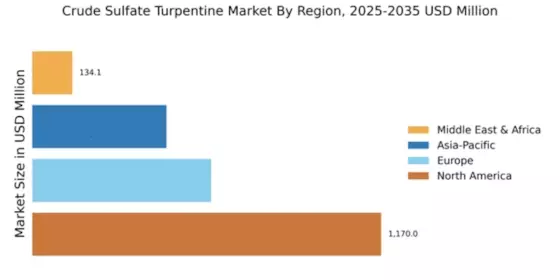
North America is the largest market for crude sulfate turpentine, holding a significant share of 1170.0 in 2024. The region's growth is driven by increasing demand in various applications, including adhesives, paints, and coatings. Regulatory support for sustainable forestry practices further enhances market potential, as companies seek eco-friendly solutions. The presence of established players and innovation in product development are key catalysts for growth. The competitive landscape in North America is robust, featuring major companies like Georgia-Pacific LLC, Kraton Corporation, and Pine Chemical Group, Inc. These firms leverage advanced technologies and sustainable practices to maintain their market positions. The U.S. leads in production and consumption, while Canada and Mexico also contribute to the regional dynamics. The focus on R&D and strategic partnerships is expected to drive further growth in this sector.

Europe : Emerging Market Opportunities

Europe is witnessing a growing interest in crude sulfate turpentine, with a market size of 600.0 in 2024. The demand is fueled by the increasing use of natural solvents in various industries, including cosmetics and pharmaceuticals. Regulatory frameworks promoting the use of renewable resources and sustainable practices are significant growth drivers. The European market is adapting to consumer preferences for eco-friendly products, enhancing its appeal. Leading countries in this region include Germany, France, and the UK, where companies like DRT are making significant strides. The competitive landscape is characterized by a mix of established players and emerging startups focusing on innovation. The European market is also seeing collaborations aimed at enhancing product offerings and expanding distribution channels. This dynamic environment is expected to foster further growth in the crude sulfate turpentine market.

Asia-Pacific : Rapid Growth and Demand

The Asia-Pacific region is experiencing rapid growth in the crude sulfate turpentine market, with a size of 450.0 in 2024. The increasing demand for natural solvents in industries such as automotive and construction is a key driver. Additionally, government initiatives promoting sustainable practices and the use of renewable resources are catalyzing market expansion. The region's diverse industrial base supports a growing appetite for eco-friendly products, enhancing market potential. Countries like China and India are leading the charge, with significant contributions from local players such as Sundarban Biotech. The competitive landscape is evolving, with both multinational corporations and regional firms vying for market share. The focus on innovation and sustainability is shaping the future of the crude sulfate turpentine market in this region, making it a focal point for investment and development.

Middle East and Africa : Emerging Market Potential

The Middle East and Africa (MEA) region is emerging as a potential market for crude sulfate turpentine, with a market size of 134.13 in 2024. The growth is driven by increasing industrial activities and a rising demand for natural products in various applications. Regulatory support for sustainable practices is also fostering market development, as countries in the region seek to diversify their economies and reduce reliance on fossil fuels. Key players in the MEA market include the Forestry and Agricultural Biotechnology Institute in South Africa, which is focusing on sustainable sourcing and production. The competitive landscape is characterized by a mix of local and international companies, with a growing emphasis on innovation and sustainability. As the region continues to develop, the crude sulfate turpentine market is expected to gain traction, presenting new opportunities for investment and growth.

Key Players and Competitive Insights

The Crude Sulfate Turpentine Market is characterized by a dynamic competitive landscape, driven by increasing demand for natural solvents and the growing emphasis on sustainable products. Key players such as Georgia-Pacific LLC (US), Kraton Corporation (US), and Pine Chemical Group, Inc. (US) are at the forefront, each adopting distinct strategies to enhance their market positioning. Georgia-Pacific LLC (US) focuses on innovation in product development, particularly in creating eco-friendly alternatives, while Kraton Corporation (US) emphasizes strategic partnerships to expand its product offerings and market reach. Pine Chemical Group, Inc. (US) is actively pursuing regional expansion, particularly in emerging markets, which collectively shapes a competitive environment that is increasingly focused on sustainability and innovation.

In terms of business tactics, companies are localizing manufacturing to reduce costs and enhance supply chain efficiency. The market structure appears moderately fragmented, with several players vying for market share, yet the influence of major companies is substantial. This competitive structure allows for a diverse range of products and innovations, fostering a healthy environment for growth and development.

In November 2025, Kraton Corporation (US) announced a strategic partnership with a leading biotechnology firm to develop bio-based solvents, which is expected to enhance its product portfolio and align with sustainability trends. This move is significant as it not only diversifies Kraton's offerings but also positions the company as a leader in the transition towards greener alternatives in the industry.

In October 2025, Georgia-Pacific LLC (US) launched a new line of Crude Sulfate Turpentine products derived from sustainably sourced pine trees. This initiative underscores the company's commitment to environmental stewardship and responds to the increasing consumer demand for sustainable products. The launch is likely to strengthen Georgia-Pacific's market presence and appeal to eco-conscious consumers.

In September 2025, Pine Chemical Group, Inc. (US) expanded its production facility in the southeastern US, aiming to increase output capacity by 30%. This expansion is crucial as it not only meets the rising demand for Crude Sulfate Turpentine but also enhances the company's competitive edge by improving supply chain reliability and reducing lead times.

As of December 2025, the Crude Sulfate Turpentine Market is witnessing trends such as digitalization and AI integration, which are reshaping competitive dynamics. Strategic alliances are becoming increasingly important, allowing companies to leverage shared resources and expertise. The competitive differentiation is likely to evolve from traditional price-based competition towards a focus on innovation, technology, and supply chain reliability, indicating a shift in how companies will compete in the future.

Key Companies in the Crude Sulfate Turpentine Market market include

Industry Developments

The crude sulfate turpentine market growth is attributed to increasing demand from the paints and coatings industry, growth in the construction sector, and rising disposable income in developing countries. Recent news developments in the market include the expansion of production capacity by major players such as Georgia-Pacific Chemicals LLC and Kraton Corporation. Strategic partnerships and acquisitions are also shaping the market landscape. For instance, in 2023, Ingevity acquired Arizona Chemical's paper chemicals business, strengthening its position in the crude sulfate turpentine market.

Future Outlook

Crude Sulfate Turpentine Market Future Outlook

The Crude Sulfate Turpentine Market is projected to grow at a 6.66% CAGR from 2024 to 2035, driven by increasing demand in various industrial applications and sustainable practices.

New opportunities lie in:

  • Expansion into bio-based product lines for eco-conscious consumers.
  • Development of advanced extraction technologies to enhance yield efficiency.
  • Strategic partnerships with manufacturers in the fragrance and flavor industries.

By 2035, the market is expected to solidify its position as a key player in sustainable industrial solutions.

Market Segmentation

Crude Sulfate Turpentine Market Source Outlook

  • Pine Trees
  • Other Coniferous Trees
  • Sustainable Forestry
  • Recycled Materials

Crude Sulfate Turpentine Market End Use Outlook

  • Automotive
  • Construction
  • Consumer Goods
  • Pharmaceuticals
  • Agriculture

Crude Sulfate Turpentine Market Application Outlook

  • Solvent
  • Adhesive
  • Fragrance
  • Paints and Coatings
  • Chemical Intermediate

Crude Sulfate Turpentine Market Purity Level Outlook

  • Technical Grade
  • Industrial Grade
  • Food Grade

Crude Sulfate Turpentine Market Distribution Channel Outlook

  • Direct Sales
  • Distributors
  • Online Sales

Report Scope

MARKET SIZE 20242354.13(USD Million)
MARKET SIZE 20252510.97(USD Million)
MARKET SIZE 20354785.63(USD Million)
COMPOUND ANNUAL GROWTH RATE (CAGR)6.66% (2024 - 2035)
REPORT COVERAGERevenue Forecast, Competitive Landscape, Growth Factors, and Trends
BASE YEAR2024
Market Forecast Period2025 - 2035
Historical Data2019 - 2024
Market Forecast UnitsUSD Million
Key Companies ProfiledGeorgia-Pacific LLC (US), Kraton Corporation (US), Pine Chemical Group, Inc. (US), Resin & Pigment Solutions (US), DRT (FR), Forestry and Agricultural Biotechnology Institute (ZA), Sundarban Biotech (IN), Weyerhaeuser Company (US)
Segments CoveredApplication, End Use, Source, Purity Level, Distribution Channel
Key Market OpportunitiesGrowing demand for bio-based solvents presents opportunities in the Crude Sulfate Turpentine Market.
Key Market DynamicsRising demand for eco-friendly solvents drives innovation and competition in the Crude Sulfate Turpentine Market.
Countries CoveredNorth America, Europe, APAC, South America, MEA

Leave a Comment

FAQs

What is the expected overall valuation of the Crude Sulphate Turpentine Market in 2024?

The Crude Sulphate Turpentine Market is expected to be valued at 2.35 (USD Billion) in 2024.

What is the expected CAGR of the Crude Sulphate Turpentine Market from 2025 to 2034?

Crude Sulfate Turpentine Market is projected to register a CAGR of 6.66% from 2025-2035

What is the expected overall valuation of the Crude Sulphate Turpentine Market in 2034?

The Crude Sulphate Turpentine Market is expected to be valued at 4.49 (USD Billion) in 2034.

Which application segment is expected to have the largest market share in the Crude Sulphate Turpentine Market in 2024?

This information is not available in the context.

Who are some of the key competitors in the Crude Sulphate Turpentine Market?

This information is not available in the context.

What are some of the key trends driving the growth of the Crude Sulphate Turpentine Market?

This information is not available in the context.

What are some of the challenges facing the Crude Sulphate Turpentine Market?

This information is not available in the context.

What is the expected impact of government regulations on the Crude Sulphate Turpentine Market?

This information is not available in the context.

What are some of the opportunities for growth in the Crude Sulphate Turpentine Market?

This information is not available in the context.

Download Free Sample

Kindly complete the form below to receive a free sample of this Report

Compare Licence

×
Features License Type
Single User Multiuser License Enterprise User
Price $4,950 $5,950 $7,250
Maximum User Access Limit 1 User Upto 10 Users Unrestricted Access Throughout the Organization
Free Customization
Direct Access to Analyst
Deliverable Format
Platform Access
Discount on Next Purchase 10% 15% 15%
Printable Versions