Request Free Sample ×

Kindly complete the form below to receive a free sample of this Report

* Please use a valid business email

Leading companies partner with us for data-driven Insights

clients tt-cursor
Hero Background

Customer Data Platform Market

ID: MRFR/ICT/29849-HCR
100 Pages
Nirmit Biswas, Aarti Dhapte
Last Updated: May 28, 2026
Customer Data Platform Market Size, Share and Research Report: By Deployment Model (Cloud-Based, On-Premises, Hybrid), By System Type (Integrated Customer Data Platforms, Stand-Alone Customer Data Platforms), By End User Industry (Retail, Healthcare, Banking and Financial Services, Media and Entertainment, Travel and Hospitality), By Key Functionality (Data Integration, Data Management, Data Analysis, Customer Insights, Personalization), By User Level (Small and Medium Enterprises, Large Enterprises) and By Regional (North America, Europe, South America, Asia Pacific, Middle East and Africa) - Industry Forecast to 2035
Download PDF ×

We do not share your information with anyone. However, we may send you emails based on your report interest from time to time. You may contact us at any time to opt-out.


Customer Data Platform Market Summary

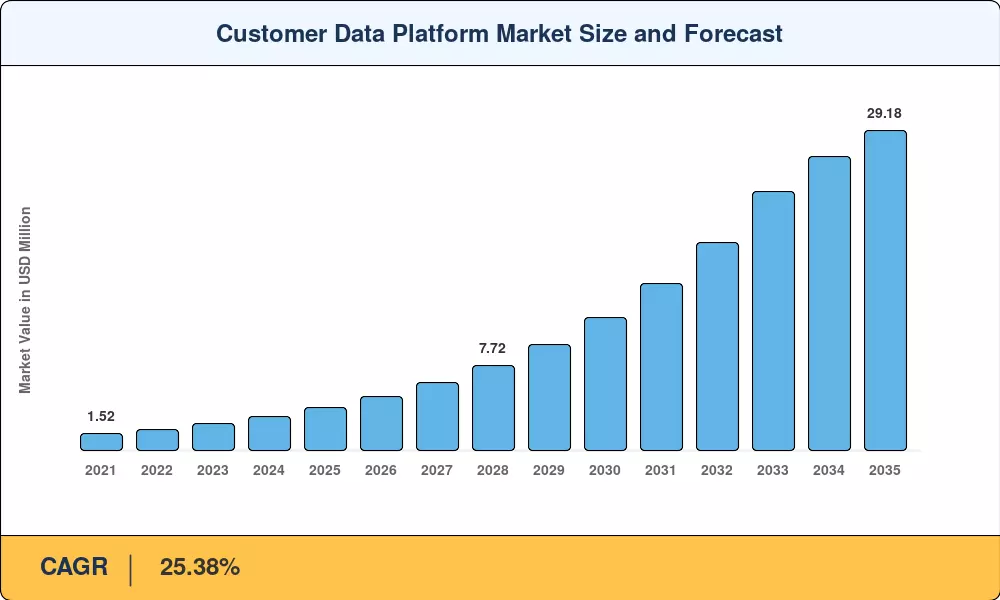
The customer data platform market reached an estimated USD 3.89 billion in 2025 and is projected to grow from USD 4.93 billion in 2026 to USD 29.18 billion by 2035, registering a CAGR of 25.38% during the forecast period. The phase-out of third-party cookies across major browsers and the enforcement of stricter data privacy mandates — including GDPR amendments in the EU and emerging US state-level privacy statutes — have pushed enterprises to invest aggressively in GDPR-compliant customer data management infrastructure that centralizes first-party data assets [2]. These twin pressures have turned what was once a martech luxury into a boardroom-level data infrastructure priority.

Legacy marketing clouds and siloed CRM systems are rapidly giving way to composable, warehouse-native architectures that support real-time customer data unification platforms. Enterprises allocated an estimated USD 12.6 billion globally to first-party data stack modernization projects in 2024, a figure expected to climb 18% annually through 2028 as AI-driven audience segmentation in CDP environments moves from pilot programs into production workloads [3]. Generative AI agents demanding sub-second profile access have further accelerated the shift toward event-driven, streaming-first data topologies.

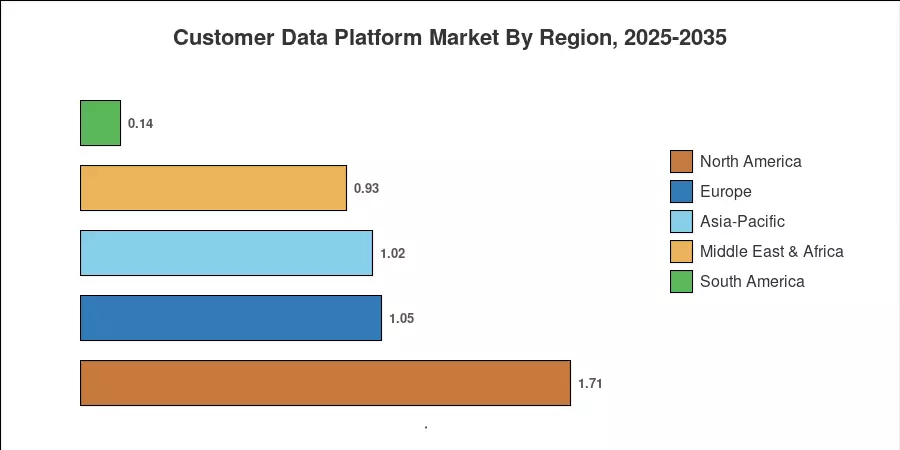
North America commands a leading position in the customer data platform market with approximately 44% of global revenue in 2025, propelled by early enterprise adoption and a mature SaaS ecosystem. Asia-Pacific is the fastest-growing region at a projected CAGR of 26.31%, fueled by rapid digital commerce expansion across India, Southeast Asia, and China. Europe holds the second-largest share at roughly 27%, where stringent GDPR enforcement continues to accelerate first-party data activation with CDP solutions across banking, retail, and telecom verticals. The decade ahead will reward vendors who embed privacy-by-design principles alongside composable integration layers.


Key Report Takeaways

• By Component

  • Platforms accounted for approximately 74% of total customer data platform market revenue in 2025, reflecting enterprise preference for unified, out-of-the-box identity resolution and activation capabilities
  • Services are forecast to expand at a CAGR of 25.72% through 2035, driven by rising demand for implementation consulting, data migration, and AI-driven audience segmentation in CDP deployments

• By Deployment Mode

  • Cloud deployment represented roughly USD 4.19 billion in 2025, as organizations favor elastic scalability and warehouse-native architectures for real-time customer data unification platforms
  • On-premise deployment retains traction among regulated industries requiring GDPR-compliant customer data management within sovereign data boundaries

• By End-User Industry

  • Retail and e-commerce led the customer data platform market with an estimated 33% share in 2025, leveraging CDP for personalized omnichannel campaigns that unify in-store and digital touchpoints
  • Healthcare is projected to post the fastest sectoral CAGR of 26.65% through 2035, driven by patient journey orchestration and first-party data activation with CDP in telehealth workflows

• By Region

  • North America captured the largest regional share in 2025, underpinned by early-mover enterprise adoption and robust venture investment in CDP startups
  • Asia-Pacific is expected to grow at a CAGR of 26.31%, as rapid digital transformation across India, China, and ASEAN economies accelerates demand


Market Size and Forecast (2021–2035)

MRFR's market sizing integrates bottom-up revenue analysis of over 85 CDP vendors, validated against enterprise IT spending surveys and top-down macroeconomic modeling. Historical data (2021–2024) relies on audited vendor disclosures; forecast figures (2026–2035) apply a calibrated compound growth model anchored to the 2025 base year.
Market Size Chart
Our Impact
Enabled $4.3B Revenue Impact for Fortune 500 and Leading Multinationals
Partnering with 2000+ Global Organizations Each Year
30K+ Citations by Top-Tier Firms in the Industry
 

Driver Impact Analysis

Driver ~% Impact on CAGR Geographic Relevance Impact Timeline
Third-party cookie deprecation 18–22% Global Short-term (≤2 yr)
GDPR and global privacy regulation expansion 14–18% Europe, North America Medium-term (2–4 yr)
AI and GenAI integration into CDP workflows 16–20% North America, Asia-Pacific Medium-term (2–4 yr)
Omnichannel retail personalization mandates 10–14% Global Short-term (≤2 yr)
Healthcare digital patient journey adoption 8–12% North America, Europe Long-term (≥4 yr)
Warehouse-native and zero-copy architectures 12–15% North America, Europe Medium-term (2–4 yr)
SME cloud migration and affordable SaaS CDPs 7–10% Asia-Pacific, South America Long-term (≥4 yr)


Third-Party Cookie Deprecation and First-Party Data Imperative

Google's phased restriction of third-party cookies in Chrome — covering roughly 65% of global browser traffic — has forced brands to build proprietary first-party data graphs. A 2024 IAB study found that 72% of digital advertisers increased their CDP budget by at least 30% in direct response to cookie deprecation timelines [2]. This structural shift makes first-party data activation with CDP the default strategy for any brand spending more than USD 5 million annually on programmatic media, effectively locking in demand for the customer data platform market through the decade.

Global Privacy Regulation Expansion

Beyond GDPR, as of 2025, at least 17 US states have implemented comprehensive consumer privacy laws, and Brazil's LGPD, India's DPDP Act, and China's PIPL together cover more than 4 billion customers [3]. All of the regulations require consent-based data acquisition that produces a compliance cost that organizations are increasingly solving through centralized GDPR-compliant customer data management platforms instead of point solutions. The regulatory penalty for non-compliance amounted to about USD 4.2 billion globally from 2022 to 2024, so offering a tangible cost-avoidance rationale for CDP investment [14].


AI-Driven Audience Segmentation and Generative AI Agents

Enterprise adoption of AI-driven audience segmentation in CDP environments jumped from 18% penetration in 2023 to an estimated 41% in 2025, according to a Forrester survey of 650 marketing technology leaders. Generative AI agents now require sub-second access to unified customer profiles to deliver real-time personalization, pushing vendors toward streaming ingestion architectures. Microsoft, Salesforce, and Adobe each launched embedded AI copilots within their CDP suites during 2024, signaling that intelligent segmentation is transitioning from a differentiator to table stakes in the customer data platform market.

Omnichannel Retail Personalization

Retailers deploying CDP for personalized omnichannel campaigns report a median 14% lift in conversion rates and a 22% reduction in customer acquisition cost, based on a 2024 McKinsey analysis of 120 global retailers. Unified customer profiles that bridge in-store POS, mobile app, loyalty, and web behavioral data allow real-time trigger-based offers — a capability that siloed martech stacks cannot replicate at scale.


Restraints Impact Analysis

The restraint impacts below are directional estimates reflecting headwinds that partially offset growth momentum. These figures are not subtractive from the headline CAGR and should be read as qualitative severity indicators.

Restraint ~% Drag on CAGR Geographic Relevance Impact Timeline
Data integration complexity across legacy systems –3 to –5% Global Short-term (≤2 yr)
Talent shortage in data engineering and CDP ops –2 to –4% North America, Europe Medium-term (2–4 yr)
Vendor lock-in concerns and interoperability gaps –2 to –3% Global Medium-term (2–4 yr)
Budget constraints among SMEs in emerging markets –1 to –3% Asia-Pacific, South America Long-term (≥4 yr)
Data sovereignty and cross-border transfer restrictions –1 to –2% Europe, Asia-Pacific Long-term (≥4 yr)


Data Integration Complexity

A 2024 Gartner survey found that 58% of CDP implementations exceed their initial timeline by at least 40%, primarily due to the difficulty of ingesting, deduplicating, and unifying data from 15+ siloed source systems. Legacy ERP and on-premise CRM environments often lack modern API layers, forcing costly custom connector development that can erode the ROI case for real-time customer data unification platforms, particularly in large enterprises with decades of technical debt.

Talent Shortage in Data Engineering

The global shortage of qualified data engineers — estimated at 340,000 unfilled roles in 2025 according to LinkedIn Workforce Analytics — directly constrains how quickly organizations can stand up and maintain CDP environments [16]. The specialized skill set required to manage identity resolution graphs, streaming pipelines, and AI-driven audience segmentation in CDP platforms commands median salaries exceeding USD 165,000 in the US, pricing out many mid-market buyers and slowing the adoption curve.

Vendor Lock-In and Interoperability Gaps

Despite the push toward composable architectures, many CDP vendors still rely on proprietary data models that make migration expensive. A 2024 CDP Institute benchmark found that switching costs average 3.2× the initial annual license fee, creating friction that tempers competitive dynamics and slows innovation cycles across the customer data platform market [6].


Customer Data Platform Market Opportunities

Warehouse-Native CDP and Zero-Copy Architectures

The emergence of cloud data warehouses (Snowflake, Databricks, BigQuery) has created a structural opportunity for CDP vendors who can activate customer profiles directly in the warehouse, without data egress. This methodology saves duplicate costs, enforces data governance, and allows petabyte-scale real-time customer data unification systems, a combination that powerfully resonates with enterprise data teams [6].


Healthcare Patient Journey Orchestration

[11] Healthcare providers using CDP for targeted omnichannel campaigns for patient intake, telehealth, and post-care follow-up show 19% improvement in appointment adherence rates. As value-based care models are being adopted around the world, CDPs that can combine EHR, claims, and behavioral data within HIPAA and GDPR compliant customer data management frameworks are a high-growth vertical potential


Emerging-Market SME Adoption in Asia-Pacific and Latin America

Below USD 500/month, affordable, usage-based SaaS CDP tiers are opening up the SME segment in India, Indonesia, Brazil, and Mexico. These markets have more than 45 million digitally active SMEs, yet the prevalence of CDP is still less than 3%. Vendors who can provide localized onboarding and pre-built integrations with regional payment and messaging systems (UPI, PIX, WhatsApp Business) can tap into large greenfield demand


Data Clean Rooms and Privacy-Safe Collaboration

Second-party data partnerships conducted through clean-room environments represent a USD 1.8 billion adjacent market by 2027, and CDPs that embed clean-room connectors can serve as the orchestration layer for first-party data activation with CDP across co-marketing and retail media networks.

Real-Time Identity Resolution for Connected TV and Streaming

As connected TV ad spending surpasses USD 42 billion globally in 2025, advertisers need deterministic identity graphs that bridge streaming viewership with purchase behavior. CDPs equipped with AI-driven audience segmentation in CDP pipelines can deliver household-level personalization across CTV, mobile, and web — a cross-screen capability that walled-garden platforms cannot offer independently [18].


Customer Data Platform Market Future Outlook

Agentic AI and Autonomous Customer Engagement

By 2028, an estimated 35% of enterprise CDP deployments will integrate autonomous AI agents capable of executing multi-step customer interactions — from personalized offer generation to complaint resolution — without human intervention. This shift demands that real-time customer data unification platforms deliver sub-100ms profile lookups, pushing the customer data platform market toward edge-compute-enabled architectures.

Composable and Warehouse-Native Platform Economics

The composable CDP model — where identity resolution, segmentation, and activation modules are independently deployable atop existing data warehouses — is projected to account for over 40% of new CDP deployments by 2030 [6]. This architecture reduces the total cost of ownership by 25–35% compared to monolithic suites, favoring vendors that support zero-copy data sharing and first-party data activation with CDP without data duplication.

Privacy-First Personalization at Scale

By 2030, global privacy laws are anticipated to reach 75% of the world’s population, and as such, CDP suppliers must bake consent orchestration, data minimization, and purpose limitation into their platforms [14]. GDPR-compliant customer data management will move from being a European legislative need to a universal product expectation, with suppliers that approach privacy as a feature and not a constraint gaining a disproportionate share in the consumer data platform market.


Convergence of CDP, Data Clean Rooms, and Retail Media

The boundaries between CDPs, data clean rooms, and retail media platforms are blurring. By 2032, Gartner projects that 60% of large retailers will operate unified first-party data platforms that serve both internal personalization and external advertiser monetization use cases. This convergence creates a winner-take-most dynamic where CDP for personalized omnichannel campaigns becomes inseparable from advertising monetization infrastructure.


Customer Data Platform Market Segmentation

By Component

Segment Key Metric Primary Demand Driver
Platform ~74% share (2025) Unified identity resolution and real-time activation
Services 25.72% CAGR (2026–2035) Implementation, integration, and managed services


Platforms dominate the customer data platform market because enterprises prioritize turnkey identity resolution, profile unification, and activation capabilities that reduce time-to-value. The platform segment encompasses both standalone CDPs and embedded CDP modules within larger marketing cloud suites. Services are growing faster as deployment complexity increases — organizations integrating 20+ data sources typically require 6–12 months of professional services for AI-driven audience segmentation in CDP configuration, data mapping, and custom connector development.

By Deployment Mode

Segment Key Metric Primary Demand Driver
Cloud USD 4.19 Billion (2025) Elastic scalability and warehouse-native integration
On-Premise ~12% share (2025) Data sovereignty requirements in regulated industries


Cloud deployment overwhelmingly dominates, accounting for the vast majority of customer data platform market revenue. Real-time customer data unification platforms require elastic compute for burst workloads during peak campaign periods, making cloud infrastructure the natural choice. On-premise deployments persist among defense, government, and select financial institutions where data residency mandates prohibit public cloud storage [3].

By Organization Size

Segment Key Metric Primary Demand Driver
Large Enterprises ~59% share (2025) Complex multi-brand, multi-geography data unification
Small and Medium Enterprises 25.86% CAGR (2026–2035) Affordable SaaS tiers and template-driven onboarding


Large enterprises account for the majority of current spending, driven by the complexity of unifying customer data across dozens of brands, channels, and geographies. SMEs represent the faster-growing segment as vendors introduce usage-based pricing, pre-built integrations, and low-code configuration that make first-party data activation with CDP accessible to organizations with limited data engineering resources.

By End-User Industry

Segment Key Metric Primary Demand Driver
Retail & E-Commerce ~33% share (2025) Omnichannel personalization and retail media monetization
BFSI USD 0.72 Billion (2025) Open banking, fraud detection, and cross-sell optimization
Media & Entertainment 24.90% CAGR (2026–2035) Streaming subscriber retention and ad personalization
Healthcare 26.65% CAGR (2026–2035) Patient journey orchestration and telehealth engagement
Other End-User Industries ~12% share (2025) Travel, telecom, and government digital services


Retail and e-commerce remain the anchor vertical for the customer data platform market, where CDP for personalized omnichannel campaigns directly translates into measurable revenue uplift. BFSI is the second-largest vertical, deploying CDPs to unify account, transaction, and behavioral data for hyper-personalized cross-sell recommendations under strict GDPR-compliant customer data management protocols. Healthcare's rapid trajectory reflects the sector's shift toward value-based care models that require longitudinal patient profiles spanning clinical, claims, and engagement data.


Regional Market Share Analysis

Region Key Metric Primary Investment Themes
North America ~44% share (2025) Enterprise CDP consolidation, AI copilots, retail media networks
Europe ~27% share (2025) GDPR-compliant customer data management, banking personalization
Asia-Pacific 26.31% CAGR (2026–2035) E-commerce scale, SME SaaS adoption, digital payments
South America USD 0.14 Billion (2025) Fintech-led CDP adoption, retail loyalty modernization
Middle East & Africa 23.89% CAGR (2026–2035) Government digital transformation, telecom personalization
Total USD 3.89 Billion (2025)

The customer data platform market exhibits strong geographic concentration, with North America and Europe together accounting for over 70% of global revenue. Growth momentum, however, is shifting toward Asia-Pacific and select emerging economies.


North America

Country Key Metric Key Driver
US ~81% of regional revenue Enterprise SaaS maturity and retail media network expansion
Canada 22.94% CAGR Federal privacy bill modernization and banking CDP adoption
Mexico USD 0.05 Billion (2025) E-commerce growth and fintech digital onboarding


The US dominates the customer data platform market in North America, home to the headquarters of six of the ten largest CDP vendors globally. Retail media networks operated by Amazon, Walmart, and Kroger are driving first-party data activation with CDP at unprecedented scale, with combined retail media ad revenue exceeding USD 62 billion in 2025. Canada's proposed Consumer Privacy Protection Act is accelerating enterprise CDP procurement cycles, while Mexico's expanding middle-class digital commerce base is creating a nascent but fast-growing demand corridor.

Europe

Country Key Metric Key Driver
Germany ~22% of regional share Automotive and manufacturing CDP use cases
UK 24.87% CAGR Open banking and financial services personalization
France USD 0.15 Billion (2025) Luxury retail and GDPR-compliant customer data management
Italy 23.52% CAGR SME digital transformation incentives
Spain USD 0.06 Billion (2025) Tourism and hospitality personalization
Nordic Countries ~9% of regional share Advanced digital infrastructure and sustainability reporting
Russia 21.40% CAGR Domestic platform substitution
Rest of Europe USD 0.09 Billion (2025) EU-funded digitalization programs


European adoption of the customer data platform market is shaped heavily by GDPR enforcement, which has made consent-based data unification a legal requirement rather than a competitive advantage. The UK's post-Brexit data adequacy framework and open banking regulations have turned financial services into the fastest-adopting vertical, with major banks deploying real-time customer data unification platforms to power hyper-personalized product recommendations across mobile and branch channels [3].

Asia-Pacific

Country Key Metric Key Driver
China ~38% of regional share Super-app ecosystems and domestic CDP vendors
India 28.15% CAGR UPI-linked commerce and D2C brand proliferation
Japan USD 0.09 Billion (2025) Retail loyalty program modernization
South Korea 25.78% CAGR K-commerce and social commerce personalization
ASEAN ~14% of regional share Cross-border e-commerce and mobile-first CDP adoption
Rest of Asia-Pacific 24.30% CAGR Government digital ID programs


Asia-Pacific represents the most dynamic growth frontier for the customer data platform market, with India and Southeast Asia leading adoption among digital-native D2C brands. China's privacy law (PIPL) has catalyzed investment in domestic CDP solutions from vendors like Convertlab and Sensors Data, while Japan's retailers are modernizing decades-old loyalty infrastructure through AI-driven audience segmentation in CDP environments. The region's mobile-first consumer behavior naturally favors CDP architectures optimized for real-time event streaming.

South America

Country Key Metric Key Driver
Brazil ~62% of regional share PIX-enabled fintech and retail personalization
Argentina 24.10% CAGR Digital banking expansion
Rest of South America USD 0.02 Billion (2025) Early-stage e-commerce growth


Brazil's fintech boom — powered by PIX instant payments and open finance regulations — is creating a strong pull for CDP for personalized omnichannel campaigns in banking and retail. Argentine digital banks are following a similar trajectory, deploying CDPs to unify customer interactions across mobile, web, and branch channels.

Middle East & Africa

Country Key Metric Key Driver
Saudi Arabia ~31% of regional share Vision 2030 digital transformation programs
UAE 25.12% CAGR Smart city and tourism personalization
South Africa USD 0.02 Billion (2025) Telecom and mobile money CDP use cases
Egypt 23.45% CAGR Government digitalization and youth demographics
Rest of MEA ~18% of regional share Telecom subscriber management


Saudi Arabia's Vision 2030 initiative is channeling significant investment into digital infrastructure, including enterprise-grade CDP deployments across government services, hospitality, and retail. The UAE's tourism and real estate sectors are early adopters of first-party data activation with CDP to deliver personalized visitor experiences, while South African telecom operators are using CDPs to reduce subscriber churn through real-time behavioral triggers [19].


Regional Market Share
 

Competitive Benchmarking

The customer data platform market exhibits medium concentration, with the top five vendors collectively holding an estimated 35–42% of global revenue. The Herfindahl-Hirschman Index (HHI) sits in the moderate range (~800–1,200), reflecting a competitive field that includes both established marketing cloud incumbents and fast-growing pure-play specialists. Competitive intensity is rising as reverse-ETL and warehouse-native startups challenge legacy vendors on total cost of ownership and architectural flexibility.

Company Est. Revenue Share Range Key Offerings Strategic Positioning
Salesforce (Data Cloud) ~9–12% Unified profiles, Einstein AI segmentation, MuleSoft integration Enterprise marketing cloud incumbent with CRM-native advantage
Adobe (Real-Time CDP) ~7–10% Experience Platform, real-time profiles, cross-channel activation Creative-to-analytics suite integration
Twilio Segment ~6–9% Event streaming, 400+ integrations, warehouse sync Developer-first composable architecture
Treasure Data ~4–6% Enterprise CDP with IoT data ingestion, AI-driven audience segmentation in CDP Multi-vertical enterprise focus
Tealium ~3–5% Tag management + CDP, real-time customer data unification platforms Data supply chain and consent orchestration
Microsoft (Dynamics 365 Customer Insights) ~4–7% Azure-native CDP, Copilot AI, Power Platform integration Enterprise IT stack lock-in advantage
Oracle (Unity CDP) ~3–5% Advertising and CX data unification, B2B account profiles Legacy CX suite modernization
SAP (Customer Data Platform) ~2–4% ERP-to-CDP integration, commerce data unification Back-office-to-front-office data bridge
Bloomreach ~2–3% E-commerce CDP, product discovery AI, and content personalization Retail and D2C specialization
ActionIQ ~1–3% Composable CDP, warehouse-native activation, enterprise governance Large enterprise data team focus


Recent News & Developments

  • Salesforce (September 2024): Launched Data Cloud for Industries with pre-built data models for healthcare, financial services, and retail, accelerating time-to-value for first-party data activation with CDP [Ref 20].
  • Twilio Segment (November 2024): Introduced Linked Profiles, enabling warehouse-native identity resolution without data egress, directly challenging traditional CDP architectures [Ref 6].


Customer Data Platform Market Report Scope

Parameter Detail
Market Scope Global customer data platform market covering platforms and services
Study Period 2021–2035
Historical Period 2021–2024
Base Year 2025
Forecast Period 2026–2035
CAGR (Forecast Period) 25.38%
Market Size (2025) USD 3.89 Billion
Market Size (2035) USD 29.18 Billion
Fastest Growing Segment Healthcare (by end-user); Services (by component)
Companies Profiled 10 (Salesforce, Adobe, Twilio Segment, Treasure Data, Tealium, Microsoft, Oracle, SAP, Bloomreach, ActionIQ)
Valuation Currency USD Billion


FAQs

How does a composable CDP differ from a traditional bundled CDP in terms of total cost of ownership?

A composable CDP activates data directly inside a cloud warehouse, eliminating data duplication and egress fees that typically add 20–35% to a bundled CDP's annual cost [6]. Organizations with existing Snowflake or Databricks investments realize the largest savings.

What identity resolution accuracy benchmarks should buyers evaluate before selecting a CDP vendor?

Leading vendors achieve deterministic match rates above 85% and probabilistic rates near 92% across channels. Buyers should request blinded accuracy tests using their own dataset before contract finalization.

How are reverse-ETL tools reshaping the competitive dynamics of the CDP vendor landscape?

Reverse-ETL players like Census and Hightouch push activation closer to the warehouse, forcing traditional CDP vendors to unbundle and open their architectures [6]. This pressure is compressing platform margins by an estimated 8–12% annually.

What integration timeline should a mid-market retailer expect for a full CDP deployment?

Mid-market retailers connecting 10–15 data sources typically complete deployment in 14–20 weeks, including data mapping, identity graph configuration, and initial campaign activation. Phased rollouts focusing on two high-value use cases reduce risk.

How do CDPs handle consent management across jurisdictions with conflicting privacy regulations?

Modern CDPs embed consent orchestration layers that enforce jurisdiction-specific rules at the profile level, dynamically adjusting data availability based on each consumer's consent state [14]. This approach satisfies GDPR, CCPA, and LGPD simultaneously.

What measurable KPI improvements can B2B enterprises expect within the first year of CDP adoption?

B2B adopters typically see 15–25% improvement in marketing-qualified lead conversion and a 30% reduction in audience build time within twelve months. Account-based marketing programs benefit most from unified firmographic and intent data.

How will the convergence of CDPs and data clean rooms affect enterprise data monetization strategies?

Enterprises with CDP-integrated clean rooms can monetize first-party audience segments through retail media and co-marketing partnerships without exposing raw data. Early adopters report incremental annual revenue of USD 2–5 million from these partnerships.


Author
Author
Author Profile
Nirmit Biswas LinkedIn
Senior Research Analyst
With 5+ years of expertise in Market Intelligence and Strategic Research, Nirmit Biswas specializes in ICT, Semiconductors, and BFSI. Backed by an MBA in Financial Services and a Computer Science foundation, Nirmit blends technical depth with business acumen. He has successfully led 100+ projects for global enterprises and startups, including Amazon, Cisco, L&T and Huawei, delivering market estimations, competitive benchmarking, and GTM strategies. His focus lies in transforming complex data into clear, actionable insights that drive growth, innovation, and investment decisions. Recognized for bridging engineering innovation with executive strategy, Nirmit helps businesses navigate dynamic markets with confidence.
Co-Author
Co-Author Profile
Aarti Dhapte LinkedIn
AVP - Research
A consulting professional focused on helping businesses navigate complex markets through structured research and strategic insights. I partner with clients to solve high-impact business problems across market entry strategy, competitive intelligence, and opportunity assessment. Over the course of my experience, I have led and contributed to 100+ market research and consulting engagements, delivering insights across multiple industries and geographies, and supporting strategic decisions linked to $500M+ market opportunities. My core expertise lies in building robust market sizing, forecasting, and commercial models (top-down and bottom-up), alongside deep-dive competitive and industry analysis. I have played a key role in shaping go-to-market strategies, investment cases, and growth roadmaps, enabling clients to make confident, data-backed decisions in dynamic markets.
Download Free Sample

Kindly complete the form below to receive a free sample of this Report