×
Request Free Sample ×

Kindly complete the form below to receive a free sample of this Report

* Please use a valid business email

Leading companies partner with us for data-driven Insights

clients tt-cursor
Hero Background

Cytology Brushes Market

ID: MRFR/MED/7788-HCR
128 Pages
Rahul Gotadki
October 2025

Cytology Brush Market Research Report By Type (Endocervical Brushes, Bronchial Brushes, Salivary Brushes, Gastric Brushes), By Material (Polypropylene, Nylon, Silicone, Stainless Steel), By Application (Cancer Screening, Diagnostics, Research, Therapeutic Applications), By End Use (Hospitals, Diagnostic Laboratories, Research Institutes) and By Regional (North America, Europe, South America, Asia Pacific, Middle East and Africa) - Forecast to 2035

Share:
Download PDF ×

We do not share your information with anyone. However, we may send you emails based on your report interest from time to time. You may contact us at any time to opt-out.

Cytology Brushes Market Infographic
Purchase Options

Cytology Brushes Market Summary

As per MRFR analysis, the Cytology Brushes Market Size was estimated at 1532.73 USD Million in 2024. The Cytology Brushes industry is projected to grow from 1644.93 USD Million in 2025 to 3333.99 USD Million by 2035, exhibiting a compound annual growth rate (CAGR) of 7.32 during the forecast period 2025 - 2035.

Key Market Trends & Highlights

The Cytology Brushes Market is experiencing robust growth driven by technological advancements and increasing demand for preventive healthcare.

  • Technological advancements are enhancing the efficacy and precision of cytology brushes, thereby expanding their applications.
  • North America remains the largest market for cytology brushes, while the Asia-Pacific region is emerging as the fastest-growing market.
  • The cytological examination segment dominates the market, whereas the diagnostic testing segment is witnessing rapid growth.
  • Key market drivers include technological innovations in cytology brushes and the rising incidence of cancer, which is propelling demand for advanced diagnostic tools.

Market Size & Forecast

2024 Market Size 1532.73 (USD Million)
2035 Market Size 3333.99 (USD Million)
CAGR (2025 - 2035) 7.32%

Major Players

BD (US), Thermo Fisher Scientific (US), Hologic (US), Medtronic (IE), Cardinal Health (US), Epredia (US), Sakura Finetek (JP), Fisher Scientific (US), Rudolf Riester (DE)

Cytology Brushes Market Trends

The Cytology Brushes Market is currently experiencing a notable evolution, driven by advancements in medical technology and an increasing emphasis on early disease detection. These brushes, utilized primarily for collecting cellular samples, are integral in various diagnostic procedures, particularly in oncology and gynecology. The growing awareness regarding the importance of preventive healthcare is propelling demand for cytology brushes, as healthcare providers seek efficient tools for accurate diagnosis. Furthermore, the rise in outpatient procedures and minimally invasive techniques is likely to enhance the adoption of these devices, as they offer convenience and improved patient outcomes. In addition, the Cytology Brushes Market is witnessing a shift towards innovative designs and materials that enhance performance and usability. Manufacturers are focusing on developing brushes that provide better sample collection and preservation, which could lead to more reliable test results. The increasing prevalence of chronic diseases and the aging population are also contributing factors, as they necessitate regular screening and monitoring. Overall, the market appears poised for growth, with ongoing research and development efforts aimed at improving the efficacy and safety of cytology brushes, thereby addressing the evolving needs of healthcare professionals and patients alike.

Technological Advancements

The Cytology Brushes Market is influenced by continuous technological innovations that enhance the functionality and efficiency of these devices. New materials and designs are being developed to improve sample collection and minimize contamination, which may lead to more accurate diagnostic results.

Rising Demand for Preventive Healthcare

There is a growing trend towards preventive healthcare, which is driving the need for effective diagnostic tools. Cytology brushes are increasingly recognized for their role in early disease detection, prompting healthcare providers to adopt these devices more widely.

Shift Towards Minimally Invasive Procedures

The market is experiencing a shift towards minimally invasive techniques, which are favored for their reduced recovery times and lower risk of complications. Cytology brushes align well with this trend, as they facilitate sample collection with minimal discomfort to patients.

Cytology Brushes Market Drivers

Rising Incidence of Cancer

The increasing prevalence of cancer globally drives the demand for cytology brushes, which are essential for obtaining cellular samples for diagnostic purposes. The Global Cytology Brush Market Industry is witnessing heightened utilization of these brushes in various cancer screening programs. For instance, the World Health Organization reports that cancer cases are expected to rise significantly, necessitating improved diagnostic tools. This trend is reflected in the projected market value of 1.53 USD Billion in 2024, indicating a robust growth trajectory as healthcare systems prioritize early detection and intervention.

Market Segment Insights

By Application: Cytological Examination (Largest) vs. Diagnostic Testing (Fastest-Growing)

In the Cytology Brushes Market, the application segment is predominantly led by Cytological Examination, which accounts for the largest share due to its critical role in disease diagnosis and monitoring. Following this, Diagnostic Testing is gaining momentum, supported by the increasing demand for accurate and quick testing methods in clinical settings. Research and Development and Screening Procedures also occupy important portions of the market, but their share remains comparatively smaller as they are more specialized segments used in specific settings. The growth trends within this segment indicate a significant focus on the enhancement of Cytological Examination methods driven by technological advancements. There is a robust push toward improving the efficacy and precision of Diagnostic Testing, leading it to emerge as the fastest-growing application. Factors such as increasing awareness of preventive health measures and the growing prevalence of various diseases are key drivers fueling the market expansion in this sector.

Cytological Examination (Dominant) vs. Screening Procedures (Emerging)

Cytological Examination stands out as the dominant application in the Cytology Brushes Market, significantly influencing overall market dynamics due to its widespread use in diagnosing various health conditions. Its established presence in both clinical and research settings allows for effective disease detection, paving the way for innovations in brush design and functionality. On the other hand, Screening Procedures are emerging as a vital segment as awareness of early detection continues to rise. Although currently secondary to Cytological Examination, Screening Procedures are gaining traction due to their essential role in preventive care strategies and public health initiatives. Their evolving methodology and integration with advanced technologies are expected to enhance their market share over the coming years.

By End Use: Hospitals (Largest) vs. Diagnostic Laboratories (Fastest-Growing)

In the Cytology Brushes Market, hospitals currently lead the segment in terms of market share, benefitting from their extensive patient base and the high demand for cytological assessments. Diagnostic laboratories follow closely, emerging as a vital part of the healthcare system that specializes in disease diagnosis and monitoring. Research institutions and academic institutions hold smaller market shares, reflecting their supportive roles in advancing cytology methodologies rather than direct patient care.

End Use: Hospitals (Dominant) vs. Diagnostic Laboratories (Emerging)

Hospitals serve as the dominant end-use segment in the Cytology Brushes Market, characterized by their comprehensive facilities and resources to handle a high volume of patient samples. They utilize cytology brushes in numerous diagnostic procedures, contributing significantly to patient outcomes. Conversely, diagnostic laboratories represent the emerging segment, fueled by technological advancements and an increasing focus on precision medicine. These labs are specializing in cytological evaluations, leading to faster turnaround times and improved accuracy in diagnoses. Their growth is propelled by increasing case volumes and a collaborative approach with hospitals, enhancing overall diagnostic capabilities.

By Material Type: Plastic (Largest) vs. Metal (Fastest-Growing)

The Cytology Brushes Market witnesses significant distribution among various material types. Plastic brushes hold the largest market share due to their cost-effectiveness and widespread applicability in laboratory settings. In contrast, metal brushes have emerged as a fast-growing segment, valued for their durability and enhanced performance in certain specialized applications. The versatility and reliability of plastic materials continue to make them a preferred choice for many users, while the innovation and increasing demand for metal brushes are compelling factors contributing to their growth. Growth trends in the Cytology Brushes Market are significantly influenced by advancements in material technology and the rising need for precise diagnostic tools. The push towards automation in laboratories is escalating the demand for high-quality brushes made from materials like metal, known for their longevity and efficiency. Moreover, increasing awareness and adoption of cytological testing across various healthcare frameworks are steering the market towards materials that provide enhanced user experience and better performance results.

Plastic (Dominant) vs. Metal (Emerging)

Plastic brushes dominate the Cytology Brushes Market largely due to their affordability and convenience of use. They are lightweight, easily disposable, and capable of catering to a variety of laboratory needs, making them indispensable in routine cytological procedures. Metal brushes, on the other hand, are considered an emerging segment; these are recognized for their robustness and ability to withstand repeated sterilization processes without degrading. Users in specialized fields benefit from metal brushes as they offer precision and reliability in testing, addressing specific needs that necessitate enhanced durability. As demand trends evolve, both plastic and metal brushes are expected to find their respective places in the market, driving further innovation in material development.

By Brush Type: Cytology Brush (Largest) vs. Broom Brush (Fastest-Growing)

In the cytology brushes market, the Cytology Brush segment holds the largest share, widely recognized for its effectiveness in various cytological applications. Following closely is the Endocervical Brush, which is gaining traction due to its specialized design targeting cervical sampling. The Spatula Brush, while important, represents a smaller share but plays an essential role in specific applications. Each brush type serves distinct purposes, creating a diverse landscape where market dynamics vary significantly based on clinical requirements and user preferences.

Cytology Brush (Dominant) vs. Broom Brush (Emerging)

The Cytology Brush segment continues to dominate the market due to its broad application across numerous cytological tests. Its specific design facilitates optimal cell collection from various anatomical sites, making it the preferred choice for many clinicians. Conversely, the Broom Brush, characterized by its unique bristle design allowing for collection from multiple sites simultaneously, is emerging rapidly within the market. As healthcare providers increasingly seek efficient and reliable sampling tools, the Broom Brush's versatility and effectiveness in obtaining high-quality cellular samples are driving its growth momentum, positioning it as a viable alternative in the cytology brush landscape.

Get more detailed insights about Cytology Brushes Market

Regional Insights

North America : Market Leader in Cytology Brushes

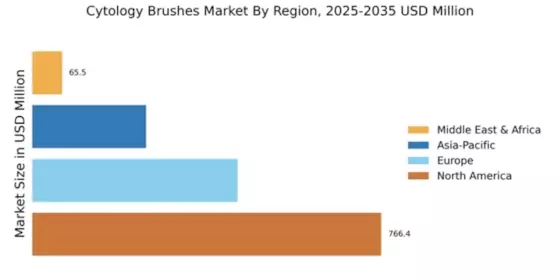
North America is poised to maintain its leadership in the Cytology Brushes Market, holding a significant market share of $766.37M in 2024. The region's growth is driven by increasing healthcare expenditure, advancements in medical technology, and a rising prevalence of chronic diseases. Regulatory support from agencies like the FDA further catalyzes market expansion, ensuring high standards for product quality and safety. The competitive landscape in North America is robust, featuring key players such as BD, Thermo Fisher Scientific, and Hologic. These companies are investing heavily in R&D to innovate and enhance product offerings. The U.S. remains the largest market, supported by a well-established healthcare infrastructure and a growing demand for diagnostic tools. This environment fosters collaboration among industry leaders, enhancing market dynamics.

Europe : Emerging Market with Growth Potential

Europe's Cytology Brushes Market is valued at $450.82M, reflecting a growing demand driven by an aging population and increasing awareness of early disease detection. Regulatory frameworks, such as the EU Medical Device Regulation, are pivotal in shaping market dynamics, ensuring that products meet stringent safety and efficacy standards. This regulatory environment encourages innovation and boosts consumer confidence in cytology products. Leading countries in this region include Germany, France, and the UK, where healthcare investments are on the rise. Major players like Hologic and Rudolf Riester are expanding their presence, focusing on product development and strategic partnerships. The competitive landscape is characterized by a mix of established firms and emerging startups, fostering a dynamic market environment.

Asia-Pacific : Rapidly Growing Market Segment

The Asia-Pacific Cytology Brushes Market, valued at $250.0M, is experiencing rapid growth due to increasing healthcare investments and rising awareness of preventive healthcare. Countries like China and India are witnessing a surge in demand for cytology products, driven by a growing population and advancements in healthcare infrastructure. Regulatory bodies are also enhancing guidelines to ensure product safety and efficacy, further propelling market growth. In this region, key players such as Sakura Finetek and Epredia are expanding their operations to meet the rising demand. The competitive landscape is evolving, with both multinational corporations and local manufacturers vying for market share. This dynamic environment is fostering innovation and improving access to cytology brushes across various healthcare settings.

Middle East and Africa : Emerging Market with Challenges

The Middle East and Africa (MEA) Cytology Brushes Market is valued at $65.54M, reflecting a nascent but growing segment. The market is driven by increasing healthcare investments and a rising focus on disease prevention and early diagnosis. However, challenges such as regulatory hurdles and varying healthcare standards across countries can impede growth. Efforts to standardize regulations are underway, which may enhance market conditions in the future. Leading countries in this region include South Africa and the UAE, where healthcare infrastructure is improving. Key players like Cardinal Health are establishing a foothold, focusing on expanding their product offerings. The competitive landscape is characterized by a mix of international and local companies, striving to meet the unique needs of the region's healthcare systems.

Key Players and Competitive Insights

The Cytology Brushes Market is currently characterized by a dynamic competitive landscape, driven by increasing demand for diagnostic procedures and advancements in medical technology. Key players such as BD (US), Thermo Fisher Scientific (US), and Hologic (US) are strategically positioned to leverage innovation and expand their market presence. BD (US) focuses on enhancing its product portfolio through continuous research and development, while Thermo Fisher Scientific (US) emphasizes strategic partnerships to bolster its technological capabilities. Hologic (US) appears to be concentrating on regional expansion, particularly in emerging markets, thereby shaping a competitive environment that is increasingly collaborative and innovation-driven.

In terms of business tactics, companies are localizing manufacturing to reduce costs and optimize supply chains, which is particularly relevant in the context of global economic fluctuations. The market structure is moderately fragmented, with several key players exerting influence over various segments. This fragmentation allows for niche players to thrive, while larger companies consolidate their positions through strategic acquisitions and partnerships.

In November 2025, BD (US) announced the launch of a new line of cytology brushes designed to enhance sample collection efficiency. This strategic move is significant as it not only addresses the growing demand for high-quality diagnostic tools but also reinforces BD's commitment to innovation in the healthcare sector. The introduction of these brushes is likely to strengthen BD's competitive edge in the market, appealing to healthcare providers seeking reliable and effective solutions.

In October 2025, Thermo Fisher Scientific (US) entered into a collaboration with a leading biotechnology firm to develop advanced cytology brush technologies. This partnership is indicative of a broader trend towards integrating cutting-edge technology into traditional medical devices, potentially enhancing diagnostic accuracy and patient outcomes. Such collaborations may position Thermo Fisher as a frontrunner in the market, as they align with the increasing emphasis on technological advancement in healthcare.

In September 2025, Hologic (US) expanded its manufacturing capabilities in Asia, aiming to meet the rising demand for cytology brushes in the region. This strategic expansion not only enhances Hologic's operational efficiency but also allows for quicker response times to market needs. By establishing a stronger foothold in Asia, Hologic is likely to capitalize on the growing healthcare investments in the region, further solidifying its market position.

As of December 2025, current competitive trends in the Cytology Brushes Market are increasingly defined by digitalization, sustainability, and the integration of artificial intelligence (AI). Strategic alliances are becoming more prevalent, as companies recognize the value of collaboration in driving innovation. The competitive differentiation is expected to evolve, shifting from price-based competition to a focus on technological advancements and supply chain reliability. This transition suggests that companies that prioritize innovation and sustainability will likely emerge as leaders in the market.

Key Companies in the Cytology Brushes Market market include

Industry Developments

Recent developments in the Cytology Brush Market have been significantly influenced by advancements in healthcare technology and the ongoing pandemic, which has heightened emphasis on effective diagnostics. Companies such as Hologic and Thermo Fisher Scientific are focusing on innovative product designs and enhanced functionalities to meet the growing demand for cytology brushes. The market has witnessed increased investment from major players like GE Healthcare and 3M in research and development, fostering new product launches aimed at improving biopsy procedures.

Furthermore, notable mergers and acquisitions have reshaped the competitive landscape, with companies like Merck Group and BD pursuing strategic alignments to broaden their product portfolios and distribution networks. The increasing prevalence of cancers worldwide is propelling the growth of the cytology brush market, with firms like Sakura Finetek and Agilent Technologies capitalizing on this trend to expand their market share. Additionally, advancements in materials and manufacturing processes have led to improved product efficacy, boosting overall market valuation. These factors collectively have stimulated increased competition and investment in the Cytology Brush Market, reflecting its crucial role in contemporary medical diagnostics.


Future Outlook

Cytology Brushes Market Future Outlook

The Cytology Brushes Market is projected to grow at a 7.32% CAGR from 2024 to 2035, driven by technological advancements, increasing healthcare expenditure, and rising demand for early disease detection.

New opportunities lie in:

  • Development of specialized cytology brushes for niche applications
  • Expansion into emerging markets with tailored product offerings
  • Partnerships with diagnostic laboratories for co-branded products

By 2035, the Cytology Brushes Market is expected to achieve substantial growth and innovation.

Market Segmentation

Cytology Brushes Market End Use Outlook

  • Hospitals
  • Diagnostic Laboratories
  • Research Institutions
  • Academic Institutions

Cytology Brushes Market Brush Type Outlook

  • Cytology Brush
  • Endocervical Brush
  • Broom Brush
  • Spatula Brush

Cytology Brushes Market Application Outlook

  • Cytological Examination
  • Diagnostic Testing
  • Research and Development
  • Screening Procedures

Cytology Brushes Market Material Type Outlook

  • Plastic
  • Metal
  • Glass
  • Silicone

Report Scope

MARKET SIZE 20241532.73(USD Million)
MARKET SIZE 20251644.93(USD Million)
MARKET SIZE 20353333.99(USD Million)
COMPOUND ANNUAL GROWTH RATE (CAGR)7.32% (2024 - 2035)
REPORT COVERAGERevenue Forecast, Competitive Landscape, Growth Factors, and Trends
BASE YEAR2024
Market Forecast Period2025 - 2035
Historical Data2019 - 2024
Market Forecast UnitsUSD Million
Key Companies ProfiledBD (US), Thermo Fisher Scientific (US), Hologic (US), Medtronic (IE), Cardinal Health (US), Epredia (US), Sakura Finetek (JP), Fisher Scientific (US), Rudolf Riester (DE)
Segments CoveredApplication, End Use, Material Type, Brush Type
Key Market OpportunitiesAdvancements in minimally invasive procedures drive demand in the Cytology Brushes Market.
Key Market DynamicsRising demand for minimally invasive procedures drives innovation and competition in the cytology brushes market.
Countries CoveredNorth America, Europe, APAC, South America, MEA

Leave a Comment

FAQs

What is the projected growth of the Cytology Brush market?

The Cytology Brush market is the expected increase in total market value of 3.33 USD billion over a defined forecast period 2025–2035. It is driven by factors such as demand trends, technological advances, regulatory changes, and geographic expansion.

What is the size of the Cytology Brush market?

Cytology Brush market size was valued at approximately 1.53 billion USD in 2024. This figure will reach 3.33 billion USD covering all regions (America, Europe, Asia, MEA and ROW), focusing its segments / services / distribution channels till 2035.

What is the CAGR of the Cytology Brush market?

Cytology Brush market is expected to grow at a CAGR of 7.32% between 2025 and 2035.

How much will the Cytology Brush market be worth by 2035?

Cytology Brush market is expected to be worth of 3.33 billion USD, reflecting growth driven by usage, technology and global demands by the end of 2035.

How will the Cytology Brush market perform over the next 10 years?

Over the next 10 years the Cytology Brush market is expected to shift from usd billion 1.53 to 3.33 billion USD, led by adoption of advanced tech, demographic trends, regulatory approvals, with potential headwinds from 2025 to 2035.

Which region holds the largest market share in the Cytology Brush Market in 2024?

North America holds the largest market share, valued at 0.55 USD Billion in 2024.

What is the market value of Endocervical Brushes in the Cytology Brush Market by 2035?

The market value of Endocervical Brushes is expected to reach 0.9 USD Billion by 2035.

Who are the key players in the Cytology Brush Market?

Key players in the market include Sakura Finetek, 3M, GE Healthcare, Hologic, and Thermo Fisher Scientific.

What is the expected market size of Bronchial Brushes by 2035?

The market size for Bronchial Brushes is projected to be 0.75 USD Billion by 2035.

How much is the Cytology Brush Market valued in the APAC region in 2024?

The Cytology Brush Market is valued at 0.25 USD Billion in the APAC region in 2024.

Download Free Sample

Kindly complete the form below to receive a free sample of this Report

Compare Licence

×
Features License Type
Single User Multiuser License Enterprise User
Price $4,950 $5,950 $7,250
Maximum User Access Limit 1 User Upto 10 Users Unrestricted Access Throughout the Organization
Free Customization
Direct Access to Analyst
Deliverable Format
Platform Access
Discount on Next Purchase 10% 15% 15%
Printable Versions