Request Free Sample ×

Kindly complete the form below to receive a free sample of this Report

* Please use a valid business email

Leading companies partner with us for data-driven Insights

clients tt-cursor
Hero Background

Dark Analytics Market

ID: MRFR/ICT/6526-HCR
111 Pages
Apoorva Priyadarshi, Aarti Dhapte
Last Updated: May 27, 2026
Dark Analytics Market Research Report By Application (Fraud Detection, Risk Management, Customer Insights, Predictive Maintenance), By Deployment Mode (Cloud, On-Premises, Hybrid), By End User (Financial Services, Healthcare, Retail, Telecommunications), By Data Source (Social Media, Web Analytics, IoT Devices, Transaction Data) and By Regional (North America, Europe, South America, Asia Pacific, Middle East and Africa) - Forecast to 2035
Download PDF ×

We do not share your information with anyone. However, we may send you emails based on your report interest from time to time. You may contact us at any time to opt-out.


Market Summary

The Dark Analytics Market was valued at USD 2.82 billion in 2025 and is projected to reach USD 3.42 billion in 2026 before climbing to USD 18.74 billion by 2035, registering a CAGR of 22.8% during the forecast period (2026–2035). Enterprises are waking up to the reality that roughly 80% of their stored information sits untouched — log files, sensor feeds, legacy email archives, scanned documents — and regulatory frameworks such as the EU AI Act and the US Executive Order on AI (October 2023) are now compelling organizations to audit and govern these dormant assets [1][2]. That regulatory pressure, paired with corporate AI budgets that exceeded USD 154 billion globally in 2024, is channeling capital directly into dark data discovery and classification platforms.

A technology shift is replacing conventional ETL and warehouse pipelines with AI-native architectures. Large language models, vector databases, and retrieval-augmented generation (RAG) stacks can now ingest unstructured dark data processing solutions at scale, converting archived PDFs, call-center recordings, and IoT telemetry into queryable intelligence within hours rather than months. Cloud hyperscalers have slashed object-storage costs by more than 30% since 2022, lowering the economic barrier that historically discouraged enterprises from even retaining dark data, let alone analyzing it [5].

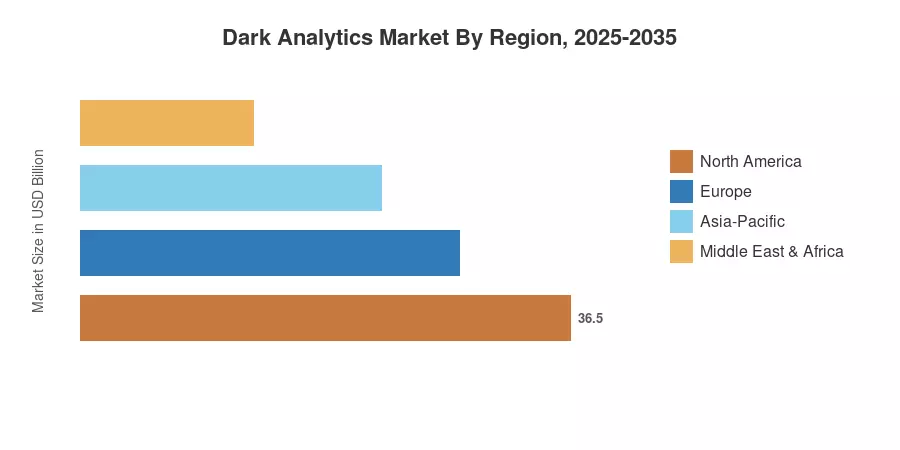
Early-mover financial institutions and federal data-governance laws have driven North America’s share of the Dark Analytics Market to roughly 39.2%. The Asia-Pacific is the fastest-growing market with a projected CAGR of 25.6%, driven by India’s Digital Personal Data Protection Act and the growth of smart city sensor networks in China. The second greatest proportion is Europe, with a little less than 26%, due to the regulatory measures of the GDPR, which are leading companies to list the hitherto unstructured processing of dark data across subsidiaries [6][7]. The next decade will reward vendors that combine hidden data mining, machine learning, privacy-preserving analytics, and real-time edge inference into a single commercial platform.


Key Report Takeaways

• By Analytics Type

  • Predictive analytics captured a 45.1% share of the Dark Analytics Market in 2025, reflecting strong demand for forecasting models trained on previously unused enterprise datasets
  • Prescriptive analytics is anticipated to register a 29.4% CAGR through 2035, as organizations move beyond prediction toward automated, AI-driven decision-making fueled by dark data discovery and classification

• By Deployment Model

  • Cloud deployment retained a USD 2.00 billion revenue base in 2025, underscoring the dominance of scalable, multi-tenant platforms for AI extraction from unused enterprise data
  • Edge and hybrid environments are projected to grow at a 27.2% CAGR to 2035, driven by latency-sensitive use cases in manufacturing and healthcare

• By End-User Vertical

  • Financial services accounted for 29.3% of the Dark Analytics Market in 2025, led by anti-money-laundering and fraud-detection workloads running on hidden data mining with machine learning
  • Healthcare is set to register the fastest vertical CAGR of 26.1% through 2035, as hospital systems unlock insights from archived enterprise data stored across legacy EHR platforms

• By Geography

  • North America represented 39.2% of the Dark Analytics Market in 2025
  • Asia-Pacific is poised to expand at a 25.6% CAGR through 2035, the fastest among all regions


Market sizing integrates bottom-up revenue analysis from vendor filings and top-down macroeconomic modeling calibrated against enterprise IT spending benchmarks published by Gartner, IDC, and national statistics bureaus. Historical figures (2021–2024) reflect audited revenues; 2025 is the base-year estimate; 2026–2035 values are forecast projections.
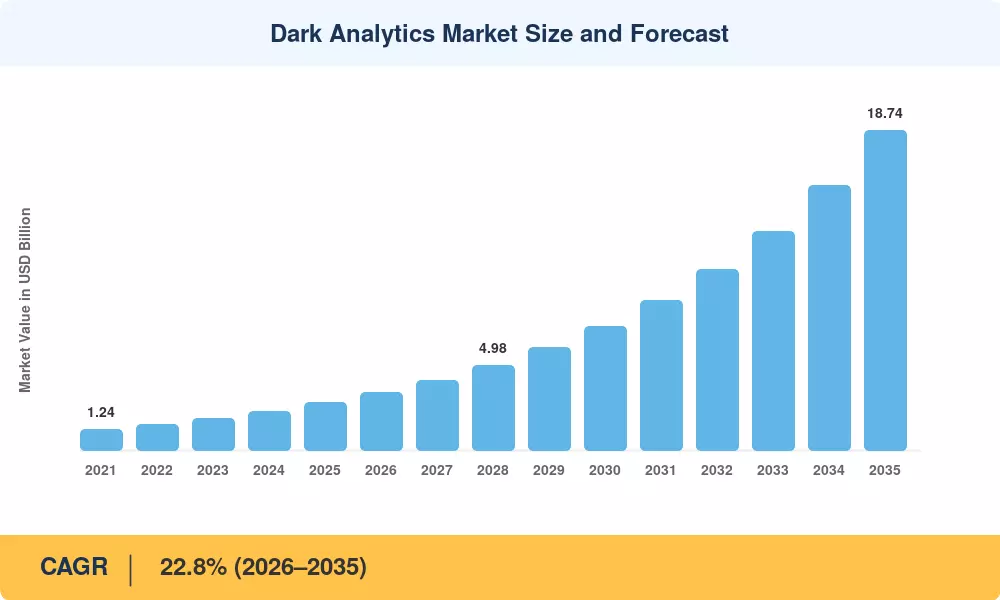
Market Size Chart
Our Impact
Enabled $4.3B Revenue Impact for Fortune 500 and Leading Multinationals
Partnering with 2000+ Global Organizations Each Year
30K+ Citations by Top-Tier Firms in the Industry
 

Driver Impact Analysis

Driver ~% Impact on CAGR Geographic Relevance Impact Timeline
Exponential growth of unstructured enterprise data 25% Global Short-term (≤2 yr)
AI / LLM integration for dark data discovery and classification 22% NA, Europe Short-term (≤2 yr)
Declining cloud-storage costs 15% Global Medium-term (2–4 yr)
Regulatory data-governance mandates 14% Europe, APAC Medium-term (2–4 yr)
IoT device proliferation 12% APAC, NA Long-term (≥4 yr)
Privacy-preserving analytics and synthetic data generation 7% Europe, NA Long-term (≥4 yr)
ESG and sustainability reporting requirements 5% Europe, Global Long-term (≥4 yr)


Exponential Growth of Unstructured Enterprise Data

IDC projects global data creation will exceed 180 zettabytes annually by 2026, yet Gartner estimates that fewer than 15% of enterprises have cataloged more than half their data assets. This gap is the single largest accelerator for the Dark Analytics Market. Telecom operators alone generate over 5 petabytes of call-detail records and network telemetry per day, and financial institutions accumulate millions of unstructured PDF contracts annually. Unstructured dark data processing solutions that automate ingestion and tagging are therefore moving from innovation budgets to core IT line items.

AI and LLM Integration

Since 2023, the cost of developing domain-specific AI extraction from idle enterprise data pipelines has decreased by up to 60% with the introduction of open-weight LLMs like Llama 3, Mistral, and Qwen. Millisecond retrieval over billions of document embeddings is now possible thanks to vector-search indexes, transforming hitherto unseen archives into real-time knowledge bases. Dark-data intake is expressly targeted by IBM's Watsonx and Microsoft's Copilot for Security, indicating that Tier-1 vendors view hidden data mining with machine learning as a legitimate product category rather than a feature.

Declining Cloud-Storage Costs

Amazon S3 Glacier Deep Archive dropped its per-gigabyte monthly price below USD 1 in late 2024, making long-term retention of raw dark data economically trivial [5]. This price trajectory incentivizes enterprises to keep — rather than delete — legacy datasets that can later be mined for patterns. Lower storage costs also feed the feedback loop for AI model training, because organizations now retain the training corpora that power unlocking insights from archived enterprise data at negligible marginal cost.

Regulatory Data-Governance Mandates

Organizations implementing high-risk AI systems must prove the traceability of training data, including any dark data utilized, in accordance with the data-quality provisions of the EU AI Act (effective August 2025) [1]. The SEC's cybersecurity disclosure regulations, which were approved in 2023, require businesses in the US to categorize and evaluate stored data, hence expanding the market for addressable dark analytics [2]. These compliance requirements turn optional analytics initiatives into required infrastructure expenditures.


Restraints Impact Analysis

Restraint-impact percentages below are directional estimates reflecting how each barrier dampens market growth relative to an unconstrained scenario. They are not directly subtracted from the CAGR.

Restraint ~% Negative Impact on CAGR Geographic Relevance Impact Timeline
Data privacy and sovereignty regulations –20% Europe, APAC Short-term (≤2 yr)
High upfront integration costs –25% Global Medium-term (2–4 yr)
Talent scarcity in data engineering –20% Global Medium-term (2–4 yr)
Poor data quality in legacy repositories –20% NA, Europe Long-term (≥4 yr)
Organizational resistance to data transparency –15% Global Long-term (≥4 yr)


High Upfront Integration Costs

Deploying an enterprise-grade dark data discovery and classification platform can require USD 1.5–4 million in initial licensing, connectors, and professional services, according to Forrester's 2024 TEI benchmarks [16]. Mid-market firms with annual IT budgets under USD 10 million frequently defer purchases, restricting the addressable Dark Analytics Market to large enterprises in the near term. Managed-service and consumption-based pricing models are emerging to ease this barrier, but penetration among SMBs remains below 8%.

Talent Scarcity

The World Economic Forum's 2024 Future of Jobs report flagged data engineering as one of the five fastest-growing yet hardest-to-fill skill categories globally [18]. Organizations that cannot recruit specialists capable of orchestrating AI extraction from unused enterprise data pipelines face multi-quarter implementation delays, stretching time-to-value beyond executive patience thresholds. Vendor-led certification programs — such as Databricks' Data Intelligence Professional track — are partially closing the gap but have graduated only ~120,000 practitioners worldwide [19].

Data-Privacy and Sovereignty Regulations

. GDPR and its offspring fuel the need for dark-data governance, but they also limit how businesses may handle and move that data internationally. APAC deployment durations are projected to be delayed by 6–12 months in comparison to North America because of cross-border data-flow constraints in Vietnam, Indonesia, and India [1][7]. While privacy-preserving compute techniques are helpful, they can increase architectural complexity, which prevents smaller customers from unlocking insights from stored business data.


Opportunities

Generative AI–Powered Data Cataloging

Generative AI can auto-tag, classify, and summarize dark data repositories at 10× the throughput of rule-based systems, according to McKinsey's 2024 AI-at-scale survey. Vendors that embed foundation-model pipelines into their platforms will capture enterprises seeking rapid dark data discovery and classification without manual schema design

Healthcare Records Digitization

Hospitals across APAC and Latin America are digitizing decades of paper-based patient records under national eHealth mandates, creating vast pools of unstructured clinical data [11]. This represents a greenfield opportunity for the Dark Analytics Market, as hidden data mining with machine learning can extract diagnostic patterns from scanned images and handwritten physician notes

ESG and Climate-Risk Analytics

Over 60 countries now mandate climate-risk disclosures aligned with ISSB or TCFD frameworks [14]. Companies must mine dormant operational data — energy-consumption logs, supply-chain audit trails, Scope 3 emissions estimates — to comply. AI extraction from unused enterprise data is the only scalable approach to assembling these datasets within disclosure deadlines

Emerging-Market Digital Infrastructure

Sub-Saharan Africa and Southeast Asia are investing over USD 25 billion collectively in data-center capacity through 2028 [7]. As cloud infrastructure expands, previously offline enterprise datasets become accessible for the first time, creating net-new demand for unstructured dark data processing solutions across banking, government, and agriculture

Data Monetization and Analytics-as-a-Service

Telecom operators and logistics firms sit on petabytes of location, mobility, and transaction data they have never analyzed. Licensing anonymized, enriched datasets derived from dark data repositories through analytics-as-a-service models can generate incremental revenue streams estimated at USD 12–18 billion globally by 2030 [17]. This business model accelerates the Dark Analytics Market by converting cost centers into profit pools


Future Outlook

Autonomous Data Governance via Agentic AI

By 2030, agentic AI systems will continuously crawl enterprise repositories, auto-classifying dormant files and flagging compliance risks without human prompts. Gartner predicts that 40% of data-governance tasks will be fully autonomous by 2028. This evolution shifts the Dark Analytics Market from project-based engagements toward always-on platform subscriptions, fundamentally altering vendor revenue models and expanding the total addressable market.

Platform Consolidation and Ecosystem Economics

The current landscape of point solutions for ingestion, classification, and analytics will consolidate into integrated platforms by 2029, mirroring the trajectory of the broader data-platform sector. Vendors combining hidden data mining with machine learning, data-catalog capabilities, and BI visualization into a single SKU will capture a disproportionate share. IDC forecasts that platform-based analytics spending will grow 2.3× faster than best-of-breed tooling through 2032.

Privacy-Preserving Dark-Data Analytics

Differential privacy, federated learning, and confidential computing are converging to enable organizations to extract value from sensitive dark data without exposing raw records. The European Data Act (effective September 2025) enshrines data-sharing obligations that will accelerate demand for privacy-preserving unstructured dark data processing solutions [12]. By 2033, privacy-compliant analytics will represent the default deployment mode, not a premium add-on.

Sustainability-Driven Data Intelligence

ISSB's IFRS S1 and S2 standards are compelling listed companies worldwide to report climate-related financial data sourced from operational archives [14]. Mining Scope 3 emissions data buried in supplier contracts, logistics logs, and procurement systems requires purpose-built dark-data extraction pipelines. The Dark Analytics Market will increasingly overlap with ESG software, creating cross-sell opportunities for vendors that position unlocking insights from archived enterprise data as a compliance prerequisite.


Market Segmentation

By Analytics Type

Segment Key Metric Primary Demand Driver
Predictive Analytics 45.1% share (2025) Demand forecasting and fraud detection on dark datasets
Prescriptive Analytics 29.4% CAGR (2026–2035) Automated decision-making powered by AI recommendations
Descriptive Analytics USD 0.54 Billion (2025) Compliance-driven data cataloging and reporting
Diagnostic Analytics 19.8% CAGR (2026–2035) Root-cause analysis in manufacturing and IT operations


Predictive analytics dominates the Dark Analytics Market because enterprise buyers prioritize ROI-linked use cases — churn prediction, credit-risk scoring, and predictive maintenance — where training models on previously unused data delivers measurable lift over existing approaches. Financial institutions alone spent an estimated USD 3.4 billion on predictive-AI workloads in 2024, and a growing share of that budget targets dark data discovery and classification for model enrichment [6]. Prescriptive analytics, meanwhile, is the segment with the steepest growth trajectory. As AI extraction from unused enterprise data matures, organizations are moving beyond "what will happen" toward "what should we do," feeding prescriptive engines with dark-data signals to automate procurement, staffing, and supply-chain decisions.

By Deployment Model

Segment Key Metric Primary Demand Driver
Cloud USD 2.00 Billion (2025) Elastic Compute for large-scale unstructured data ingestion
On-Premises 14.6% share (2025) Highly regulated verticals requiring data residency
Edge / Hybrid 27.2% CAGR (2026–2035) Latency-sensitive IoT and manufacturing workloads


Cloud deployment leads the Dark Analytics Market by a wide margin, because dark-data workloads are inherently bursty — organizations may need to process terabytes of archived records during a compliance sprint, then scale back. Hyperscaler platforms from AWS, Azure, and GCP offer pay-per-query economics ideally suited to this pattern [5]. Edge and hybrid models, however, are gaining ground in sectors where hidden data mining with machine learning must occur at the data source — factory floors generating vibration-sensor data or hospital imaging labs processing DICOM files locally before federating insights to a central lake [10].

By End-User Vertical

Segment Key Metric Primary Demand Driver
Financial Services (BFSI) 29.3% share (2025) AML, fraud detection, regulatory data cataloging
Healthcare 26.1% CAGR (2026–2035) EHR archive mining, clinical-trial data enrichment
Government & Defense USD 0.32 Billion (2025) Intelligence-data triage, FOIA compliance
Retail & E-Commerce 23.7% CAGR (2026–2035) Customer-behavior mining from transactional archives
Manufacturing USD 0.27 Billion (2025) Predictive maintenance on legacy sensor logs
Telecom & Media 22.4% CAGR (2026–2035) Network-log analytics, subscriber-data monetization


Financial services remain the anchor vertical for the Dark Analytics Market because compliance costs keep rising — global AML fines exceeded USD 6.6 billion in 2024 — and regulators now expect institutions to demonstrate they have mined their full data estate for suspicious patterns [6][12]. Healthcare, on the other hand, represents the most explosive growth vector; the sheer volume of unstructured clinical data — imaging studies, pathology reports, wearable-device feeds — dwarfs structured EHR fields, creating enormous demand for unlocking insights from archived enterprise data [11].


Regional Market Share Analysis

Region Key Metric Primary Investment Themes
North America 39.2% share (2025) Financial compliance, federal AI mandates, cloud-native architectures
Europe USD 0.73 Billion (2025) GDPR enforcement, ESG data cataloging, sovereign cloud
Asia-Pacific 25.6% CAGR (2026–2035) Smart-city IoT, healthcare digitization and digital-economy regulation
South America USD 0.17 Billion (2025) Open-banking data, fintech growth, public-sector modernization
Middle East & Africa 24.3% CAGR (2026–2035) National AI strategies, oil & gas data analytics, data-center buildout
Total USD 2.82 Billion (2025)

The Dark Analytics Market exhibits meaningful regional variation in maturity, regulatory posture, and vertical adoption. North America leads in absolute spend, while Asia-Pacific outpaces all regions in growth velocity. Below, each region is analyzed for structural drivers and country-level dynamics.


North America

Country Key Metric Key Driver
US 72.4% of regional share Federal AI Executive Order; Fortune 500 AI capex [2]
Canada 18.1% CAGR (2026–2035) PIPEDA modernization; banking dark-data audits [6]
Mexico USD 0.04 Billion (2025) Nearshoring data ops; fintech expansion [7]


The US accounts for the bulk of North America's contribution to the Dark Analytics Market, driven by mature cloud ecosystems and aggressive enterprise AI adoption. Canada's Office of the Superintendent of Financial Institutions has issued guidance requiring federally regulated banks to inventory and govern all stored data by 2026, directly stimulating demand for dark data discovery and classification solutions [6].

Europe

Country Key Metric Key Driver
Germany 22.3% of regional share Industrie 4.0 sensor-data backlog [10]
UK 20.8% CAGR (2026–2035) FCA data-mapping mandates for financial firms [12]
France USD 0.09 Billion (2025) Sovereign-cloud strategy; defense data analytics [14]
Italy 18.5% CAGR (2026–2035) SME digitization grants under PNRR
Spain USD 0.04 Billion (2025) Healthcare records modernization [11]
Nordic Countries 21.2% CAGR (2026–2035) Green-data-center policies; ESG cataloging [14]
Russia USD 0.03 Billion (2025) Import-substitution technology mandates [16]
Rest of Europe 17.8% CAGR (2026–2035) EU cohesion-fund digital transformation programs [1]


GDPR's enforcement wave — fines exceeded EUR 4.2 billion cumulatively through 2024 — has made dark-data governance a boardroom priority across Europe [1]. German manufacturers are investing heavily in unlocking insights from archived enterprise data generated by decades of industrial automation. At the same time, the UK's Financial Conduct Authority now requires firms to demonstrate AI extraction from unused enterprise data for consumer-duty compliance [12].

Asia-Pacific

Country Key Metric Key Driver
China 34.8% of regional share National data-element strategy; smart-city telemetry [7]
India 28.4% CAGR (2026–2035) DPDP Act; Aadhaar-linked public-sector data volumes [1]
Japan USD 0.06 Billion (2025) Society 5.0 industrial-data integration [10]
South Korea 24.1% CAGR (2026–2035) MyData initiative; semiconductor fab telemetry analytics [13]
ASEAN USD 0.05 Billion (2025) Cross-border e-commerce data growth; digital-banking licenses [7]
Rest of Asia-Pacific 22.7% CAGR (2026–2035) Emerging digital-economy regulations


Asia-Pacific is the fastest-growing arena for the Dark Analytics Market. China's 2024 "Data Twenty Articles" policy treats data as a factor of production on par with land and capital, spurring provincial governments to build dark-data exchanges [7]. India's rapidly digitizing healthcare and banking sectors generate massive volumes of unstructured dark data processing solutions requirements, while South Korea's MyData ecosystem mandates that financial institutions expose dormant customer data for portability — effectively creating a regulatory floor for hidden data mining with machine learning adoption [13].

South America

Country Key Metric Key Driver
Brazil 62.5% of regional share Open-banking data governance; LGPD compliance [6]
Argentina 19.7% CAGR (2026–2035) Fintech-led data modernization
Rest of South America USD 0.03 Billion (2025) Public-sector digitization programs [17]


Brazil's central bank–led open-banking framework, now in Phase 4, requires participating institutions to catalog all customer data assets, including those previously classified as dark data. This regulatory pull, combined with LGPD enforcement, is building a foundation for AI extraction from unused enterprise data across the region's largest economy [6].

Middle East & Africa

Country Key Metric Key Driver
Saudi Arabia 31.4% of regional share Vision 2030 digital transformation; NEOM data infrastructure [14]
UAE 26.5% CAGR (2026–2035) AI Strategy 2031; financial free-zone data mandates [7]
South Africa USD 0.02 Billion (2025) POPIA compliance; mining-sector telemetry [16]
Egypt 22.1% CAGR (2026–2035) National AI strategy; banking-sector modernization [17]
Rest of MEA USD 0.01 Billion (2025) Early-stage digital infrastructure investment [7]


Gulf Cooperation Council states are directing portions of their sovereign-wealth reserves into AI and analytics infrastructure, with Saudi Arabia's SDAIA allocating over USD 1.2 billion to national data platforms [14]. The Dark Analytics Market in this sub-region benefits from greenfield deployments where legacy constraints are minimal, enabling organizations to adopt cloud-native dark data discovery and classification architectures from day one.


Regional Market Share
 

Competitive Benchmarking

The Dark Analytics Market exhibits medium concentration, with the top five vendors commanding an estimated 35–42% of global revenue. The competitive field spans enterprise-software incumbents extending their data platforms, pure-play analytics specialists, and cloud hyperscalers embedding dark-data features into existing services. Barriers to entry are moderate — proprietary connectors, pre-trained NLP models, and industry-specific compliance modules create switching costs — but open-source alternatives (Apache Spark, LangChain, Haystack) prevent any single vendor from locking down the stack[13].

Company Est. Revenue Share Range Key Offerings for Dark Analytics Market Strategic Positioning
IBM ~7–10% watsonx.data, Cloud Pak for Data, Watson Discovery Full-stack AI + hybrid-cloud integration
Microsoft ~6–9% Azure Purview, Copilot for Security, Synapse Analytics Embedded dark-data cataloging across the M365 ecosystem
Google Cloud ~5–8% Dataplex, Document AI, BigQuery Omni Serverless analytics with LLM-powered classification
SAP ~4–7% SAP Datasphere, SAP AI Core ERP-adjacent dark-data governance for manufacturing
Oracle ~4–6% Oracle Data Catalog, Autonomous Database Integrated database + analytics for BFSI
Palantir Technologies ~3–5% Foundry, AIP Mission-critical data fusion for government and defense
Splunk (Cisco) ~3–5% Splunk Enterprise, Splunk AI Assistant IT-ops and security-log dark data analytics
Databricks ~3–5% Unity Catalog, Lakehouse Platform, Mosaic AI Open lakehouse with built-in ML for unstructured data
Informatica ~2–4% CLAIRE AI, Intelligent Data Management Cloud Data-catalog and governance specialist
Teradata ~2–3% VantageCloud, ClearScape Analytics High-performance analytics for telco and retail


Recent News & Developments


Report Scope

Parameter Details
Market Scope Global Dark Analytics Market covering analytics platforms, services, and infrastructure for processing unstructured, semi-structured, and archived enterprise data
Study Period 2021–2035
CAGR (Forecast) 22.8% (2026–2035)
Base Year Market Size USD 2.82 Billion (2025)
Forecast Endpoint USD 18.74 Billion (2035)
Fastest Growing Segment Healthcare (by vertical); Prescriptive Analytics (by type); Asia-Pacific (by region)
Companies Profiled IBM, Microsoft, Google Cloud, SAP, Oracle, Palantir, Splunk (Cisco), Databricks, Informatica, Teradata
Valuation Currency USD Billion


FAQs

What differentiates dark analytics platforms from traditional business-intelligence tools?

Dark analytics platforms are purpose-built to ingest unstructured and semi-structured data — log files, scanned documents, sensor feeds — that traditional BI tools cannot parse natively. They rely on NLP, computer vision, and vector indexing rather than SQL-based queries.

How should enterprises prioritize which dark data repositories to analyze first?

Start with repositories carrying the highest regulatory exposure, such as financial transaction archives and patient records. Compliance-driven projects deliver measurable ROI faster and secure internal funding for broader rollouts [6].

What role does synthetic data play in the Dark Analytics Market?

Synthetic data allows organizations to train models on statistically representative replicas of sensitive dark datasets without violating privacy regulations. Adoption has grown 45% year-over-year since 2023 [12].

How do edge deployments change the economics of the Dark Analytics Market?

Edge processing eliminates round-trip cloud-transfer costs for latency-sensitive workloads, reducing per-gigabyte analytics spend by up to 35% in manufacturing and IoT settings [10].

What procurement criteria should buyers use when evaluating Dark Analytics Market vendors?

Prioritize connector breadth, pre-built vertical models, and compliance-certification coverage. Vendors supporting 100+ data-source connectors out of the box reduce integration timelines by 40–60%.

How does the Dark Analytics Market intersect with data-mesh architectures?

Data-mesh frameworks decentralize data ownership to domain teams, creating natural entry points for dark-data cataloging at the source. Mesh-aligned analytics platforms see 30% faster adoption in federated enterprises.

What emerging use cases will reshape the Dark Analytics Market by 2030?

Autonomous supply-chain optimization and real-time climate-risk scoring are two high-impact use cases. Both depend on continuously mining archived operational data that current systems ignore [14][17].


Author
Author
Author Profile
Apoorva Priyadarshi LinkedIn
Research Analyst
With 4+ years of experience in Market Intelligence and Strategic Research, Apoorv specializes in ICT, Semiconductor, and BFSI markets. Combining strong analytical capabilities with a deep understanding of technology-driven industries, he focuses on delivering data-driven insights that support strategic decision-making. With a background in technology and business research, Apoorv has contributed to numerous global market studies, competitive landscape analyses, and opportunity assessments across sectors such as semiconductors, digital banking, cybersecurity, and telecommunications.
Co-Author
Co-Author Profile
Aarti Dhapte LinkedIn
AVP - Research
A consulting professional focused on helping businesses navigate complex markets through structured research and strategic insights. I partner with clients to solve high-impact business problems across market entry strategy, competitive intelligence, and opportunity assessment. Over the course of my experience, I have led and contributed to 100+ market research and consulting engagements, delivering insights across multiple industries and geographies, and supporting strategic decisions linked to $500M+ market opportunities. My core expertise lies in building robust market sizing, forecasting, and commercial models (top-down and bottom-up), alongside deep-dive competitive and industry analysis. I have played a key role in shaping go-to-market strategies, investment cases, and growth roadmaps, enabling clients to make confident, data-backed decisions in dynamic markets.

Research Approach


Secondary Research

The secondary research process involved comprehensive analysis of technology standards databases, cybersecurity regulations, peer-reviewed computing journals, AI/ML publications, and authoritative data governance organizations. Key sources included the National Institute of Standards and Technology (NIST), International Organization for Standardization (ISO/IEC 27001, ISO/IEC 27701), Cloud Security Alliance (CSA), Association for Computing Machinery (ACM), Institute of Electrical and Electronics Engineers (IEEE) Xplore Digital Library, US Federal Trade Commission (FTC) Data Security Guidelines, European Data Protection Board (EDPB), UK Information Commissioner's Office (ICO), US Bureau of Labor Statistics (BLS) Technology Employment Data, US Census Bureau ICT Sector Reports, EU Eurostat Digital Economy and Society Statistics, Organisation for Economic Co-operation and Development (OECD) Digital Economy Outlook, International Telecommunication Union (ITU) Global Cybersecurity Index, National Institutes of Standards and Technology (NIST) Cybersecurity Framework, and enterprise software regulatory filings (10-K, 10-Q) from publicly traded analytics vendors.

Cloud infrastructure spending trends, AI/ML deployment benchmarks, data privacy regulation compliance requirements, enterprise software adoption statistics, and market landscape analysis for fraud detection algorithms, predictive analytics platforms, IoT data processing solutions, and customer insight technologies were all gathered from these sources.


Primary Research

In order to gather both qualitative and quantitative insights, supply-side and demand-side stakeholders were interviewed during the primary research phase. Chief executives, Chief Technology Officers (CTOs), Chief Data Officers (CDOs), vice presidents of product development for artificial intelligence and machine learning, heads of regulatory compliance, and enterprise sales directors from companies that provide cloud services, big data infrastructure, AI/ML software, and dark analytics platforms were among the supply-side sources. Demand-side sources included heads of data science, enterprise architects, risk management directors from banking and financial institutions, healthcare informatics officers from hospital networks, digital transformation leads from retail businesses, network operations directors from telecoms providers, and chief information officers (CIOs) and chief analytics officers (CAOs). Primary research verified AI/ML product pipeline timelines, validated market segmentation across deployment modes (cloud, on-premises, and hybrid), and collected information on enterprise adoption trends, data governance frameworks, software licensing models, and spending dynamics related to regulatory compliance.

Primary Respondent Breakdown:

By Designation: C-level Primaries (32%), Director Level (30%), Others (38%)

By Region: North America (33%), Europe (29%), Asia-Pacific (32%), Rest of World (6%)


Market Size Estimation

Revenue mapping and enterprise deployment volume analysis were used to determine the global market valuation. The methods included:

45+ major technology providers with expertise in unstructured data analytics, dark data processing, and AI-driven insight production have been identified from North America, Europe, Asia-Pacific, and Latin America.

Product mapping for predictive maintenance programs, risk analytics platforms, fraud detection algorithms, customer behavior analytics tools, and dark data discovery software

Analysis of annual revenues for big data and dark analytics portfolios, including on-premises software licenses, cloud-based SaaS subscriptions, and professional services engagements, both reported and projected

Coverage of suppliers with 70–75% of the world market in 2024, including significant firms in data governance tools, business intelligence software, and corporate AI platforms

Segment-specific valuations for the financial services, healthcare, retail, and telecommunications sectors are derived through extrapolation using top-down (vendor revenue validation and ICT spending correlation) and bottom-up (enterprise deployment volume × average selling price by industry vertical and deployment mode) approaches.

To guarantee statistical correctness and regional distribution alignment, cross-validation against external IT spending datasets (Gartner Worldwide IT Spending Forecasts, IDC Worldwide Big Data and Analytics Spending Guides) is used.

Download Free Sample

Kindly complete the form below to receive a free sample of this Report