Download Free Sample
Kindly complete the form below to receive a free sample of this Report
Data Backup and Recovery Services Market Research Report: Size, Share, Trend Analysis By End Use Outlook (Small and Medium Enterprises, Large Enterprises, Government, Healthcare, Education) By Data Type Outlook (Structured Data, Unstructured Data, Virtual Machine Data, Database Data) By Application Outlook (Cloud Backup, Local Backup, Disaster Recovery, Data Archiving, Data Migration) By Service Type Outlook (Backup as a Service, Disaster Recovery as a Service, Managed Backup Services, Professional Services) By Deployment Type Outlook (On-Premises, Cloud-Based, Hybrid) By Region (North America, Europe, APAC, South America, MEA) - Growth Outlook & Industry Forecast To 2035
As per MRFR analysis, the Data Backup and Recovery Services Market Size was estimated at 20.5 billion USD in 2024. The Data Backup and Recovery Services industry is projected to grow from 21.9 USD Billion in 2025 to 42.3 USD Billion by 2035, exhibiting a compound annual growth rate (CAGR) of 6.81% during the forecast period 2025 - 2035.
The Data Backup and Recovery Services market is experiencing robust growth driven by technological advancements and increasing data security concerns.
| 2024 Market Size | 20.5 (USD Billion) |
| 2035 Market Size | 42.3 (USD Billion) |
| CAGR (2025 - 2035) | 6.81% |
Veeam Software (US), Acronis (CH), Commvault (US), Dell Technologies (US), IBM (US), Veritas Technologies (US), Microsoft (US), Carbonite (US), Zerto (IL)
Our Impact
Enabled $4.3B Revenue Impact for Fortune 500 and Leading Multinationals
Partnering with 2000+ Global Organizations Each Year
30K+ Citations by Top-Tier Firms in the Industry
The landscape of Data Backup and Recovery Services is evolving rapidly, driven by technological advancements and increasing data security concerns. Organizations are increasingly recognizing the necessity of robust backup solutions to safeguard their critical information. This trend is underscored by the growing reliance on cloud-based services, which offer flexibility and scalability. As businesses generate vast amounts of data, the demand for efficient recovery solutions becomes paramount. Furthermore, regulatory compliance and the need for data integrity are compelling factors that influence investment in these services. Companies are now prioritizing comprehensive strategies that encompass not only data storage but also recovery processes to ensure business continuity in the face of potential disruptions. In December 2025, the market for Data Backup and Recovery Services appears to be characterized by a heightened focus on automation and artificial intelligence. These technologies are likely to enhance the efficiency of backup processes and reduce the time required for data recovery. Additionally, the integration of advanced analytics may provide organizations with deeper insights into their data management practices. As the digital landscape continues to expand, the emphasis on cybersecurity within backup solutions is expected to intensify, reflecting a broader trend towards holistic data protection strategies. Overall, the Data Backup and Recovery Services market is poised for continued growth, driven by innovation and an unwavering commitment to data security.
The shift towards cloud-based solutions is reshaping the Data Backup and Recovery Services market. Organizations are increasingly adopting hybrid models that combine on-premises infrastructure with cloud capabilities. This approach offers flexibility, allowing businesses to scale their backup solutions according to their needs while ensuring data accessibility and security.
The integration of automation and artificial intelligence into Data Backup and Recovery Services is becoming more prevalent. These technologies streamline backup processes, reduce human error, and enhance recovery times. Organizations are likely to leverage AI-driven analytics to optimize their data management strategies, improving overall efficiency.
As data breaches and cyber threats continue to rise, the focus on cybersecurity within Data Backup and Recovery Services is intensifying. Companies are prioritizing solutions that not only back up data but also protect it from unauthorized access. This trend reflects a broader commitment to safeguarding sensitive information and ensuring compliance with regulatory standards.
The exponential growth of data generated by businesses and individuals is a primary driver for the Data Backup and Recovery Services. As organizations increasingly rely on data for decision-making, the volume of information stored continues to rise. According to recent estimates, data creation is expected to reach 175 zettabytes by 2025. This surge necessitates robust backup solutions to ensure data integrity and availability. Companies are compelled to invest in comprehensive backup strategies to mitigate the risks associated with data loss, thereby propelling the demand for backup and recovery services. The Data Backup and Recovery Services is thus positioned to benefit from this trend, as organizations seek reliable solutions to manage their expanding data landscapes.
The increasing frequency and sophistication of cyberattacks is a significant driver for the Data Backup and Recovery Services. Organizations are recognizing that traditional security measures may not be sufficient to protect against data breaches and ransomware attacks. As a result, there is a heightened focus on implementing comprehensive backup solutions that can quickly restore data in the event of an attack. The global cost of cybercrime is projected to reach trillions of dollars, underscoring the urgency for businesses to invest in reliable backup and recovery services. This trend is likely to continue, as organizations prioritize data resilience and recovery capabilities to safeguard their operations against evolving threats.
The shift to remote work has transformed how organizations manage their data, creating a heightened demand for the Data Backup and Recovery Services Industry. As employees access company data from various locations and devices, the risk of data loss or corruption increases. Companies are now more aware of the need for secure and efficient backup solutions that can accommodate remote access while ensuring data protection. This trend has led to an uptick in investments in cloud-based backup services, which offer flexibility and scalability. The Data Backup and Recovery Services Industry is thus experiencing growth as businesses adapt to new work environments and seek solutions that support their remote operations.
Regulatory compliance is becoming increasingly stringent across various sectors, driving the need for effective data management solutions within the Data Backup and Recovery Services. Organizations are mandated to adhere to regulations such as GDPR, HIPAA, and others, which require them to implement robust data protection measures. Failure to comply can result in severe penalties and reputational damage. As a result, businesses are investing in backup and recovery services to ensure they meet these legal obligations. The Data Backup and Recovery Services is likely to see growth as companies prioritize compliance and seek solutions that not only protect their data but also demonstrate adherence to regulatory standards.
Technological advancements are significantly influencing the Data Backup and Recovery Services Industry. Innovations such as artificial intelligence, machine learning, and advanced encryption techniques are enhancing the efficiency and effectiveness of backup solutions. These technologies enable organizations to automate backup processes, reduce recovery times, and improve data security. As businesses increasingly seek to leverage these advancements, the demand for sophisticated backup and recovery services is likely to rise. Furthermore, the integration of cloud technologies is facilitating more efficient data management, allowing organizations to scale their backup solutions according to their needs. This trend indicates a promising future for the Data Backup and Recovery Services Industry as it evolves to meet the demands of modern data management.
The Data Backup and Recovery Services market shows a noteworthy distribution across various application segments, with Cloud Backup maintaining a substantial share. Local Backup follows but is increasingly challenged by the growing preference for cloud-based solutions. Disaster Recovery has gained traction with businesses focusing on minimizing downtime and data loss due to unforeseen events, highlighting the importance of robust recovery strategies. Data Archiving and Data Migration also contribute to the market but capture a smaller segment due to niche applications.
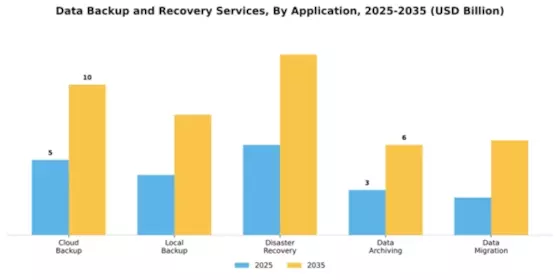
Cloud Backup (Dominant) vs. Data Migration (Emerging)
Cloud Backup emerges as the dominant player in the Data Backup and Recovery Services market, driven by its scalability, cost-effectiveness, and remote accessibility. Organizations are migrating to cloud solutions due to their ability to facilitate easy data restoration and management from anywhere. In contrast, Data Migration is an emerging segment, gaining attention as organizations transition their operations to the cloud and modernize infrastructures. While Data Migration involves significant planning and execution efforts, its necessity is underscored by the ongoing demands for efficiency and integration across multi-cloud environments, making it a critical consideration for businesses.
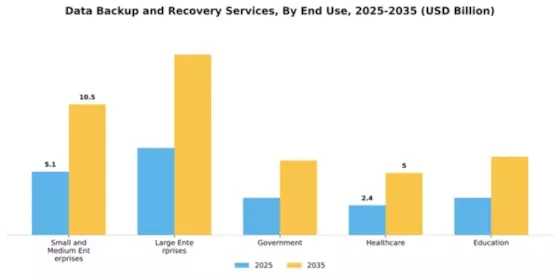
In the Data Backup and Recovery Services market, Small and Medium Enterprises (SMEs) hold the largest share, driven by their increasing reliance on digital solutions and need for cost-effective data protection. These businesses are prioritizing efficient recovery solutions to safeguard their valuable data. Meanwhile, Large Enterprises are emerging as the fastest-growing segment, as they require more complex and scalable solutions to manage vast amounts of data generated from diverse sources. The growth in the Large Enterprises segment can be attributed to factors like stringent compliance requirements and the increasing threat of cyber attacks. As these organizations adapt to hybrid and multi-cloud environments, the demand for robust data backup and recovery services is surging. Furthermore, government initiatives promoting digital transformation are also driving the adoption of these services among large corporations.
Small and Medium Enterprises: Dominant vs. Large Enterprises: Emerging
Small and Medium Enterprises (SMEs) are characterized by their agile approach to technology adoption, enabling them to implement data backup and recovery services that suit their operational needs. These businesses typically focus on affordability and ease of use, prioritizing cloud-based solutions for flexibility. In contrast, Large Enterprises represent the emerging force within this space, requiring sophisticated solutions due to their expansive data flows and regulatory obligations. They tend to invest in robust, enterprise-grade backup systems that not only secure data but also ensure rapid recovery, thus minimizing potential disruptions. This duality highlights the variance in market strategies; SMEs seek efficiency and cost-effectiveness while Large Enterprises pursue comprehensive, scalable solutions.
In the Data Backup and Recovery Services market, the distribution of deployment types showcases a clear preference for Cloud-Based solutions, which dominate the market share. This is largely due to their scalability, ease of access, and lower maintenance costs compared to On-Premises solutions. On-Premises deployments account for a significant minority, favored by enterprises with stringent data control requirements. Meanwhile, Hybrid solutions are gaining traction as organizations seek a balance between on-premises control and cloud flexibility, making them an attractive option for modern businesses. The growth trends are primarily driven by the increasing reliance on remote work and digital transformation initiatives across various sectors. The Cloud-Based segment continues to expand, benefitting from the growing adoption of Software as a Service (SaaS) applications. In contrast, the Hybrid deployment model is witnessing the fastest growth, appealing to businesses looking to optimize their data storage and recovery strategies while leveraging the strengths of both on-premises and cloud technologies.
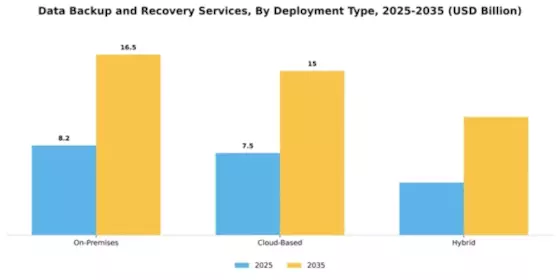
Cloud-Based (Dominant) vs. Hybrid (Emerging)
Cloud-Based data backup and recovery services stand out as the dominant force in the market, characterized by their flexibility, scalability, and cost-effectiveness. Organizations favor this deployment type due to its remote accessibility and reduced infrastructural burden, allowing for seamless integration with other cloud services. Additionally, Cloud-Based solutions offer robust security features, making them suitable for varying business sizes. On the other hand, Hybrid options, while emerging, appeal to businesses seeking a customized approach that combines the security of on-premises solutions with the innovative features of cloud services. This dual approach allows organizations to manage sensitive data locally while still enjoying the benefits of cloud capabilities, positioning Hybrid as a vital player in the evolution of data backup methodologies.
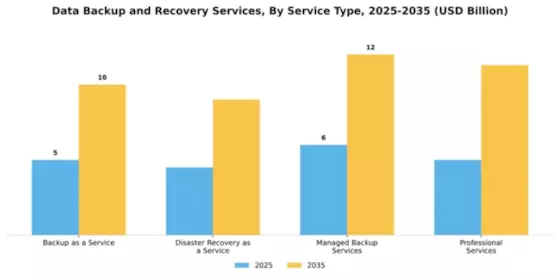
In the Data Backup and Recovery Services market, 'Backup as a Service' (BaaS) holds the largest share, driven by increasing reliance on cloud solutions for data storage. This segment's prominence is further bolstered by a robust demand from enterprises seeking efficient and scalable backup solutions, with many businesses migrating to cloud infrastructures. In contrast, 'Disaster Recovery as a Service' (DRaaS) is witnessing rapid adoption, thanks to heightened awareness of data loss risks and the imperative for businesses to have reliable recovery options in the event of disasters. This trend has accelerated the growth of DRaaS, making it a vital component of modern disaster recovery strategies.
Backup as a Service (Dominant) vs. Disaster Recovery as a Service (Emerging)
Backup as a Service (BaaS) provides businesses with cloud-based backup solutions that are scalable, cost-effective, and convenient. It offers automated features that simplify data protection, making it a preferred choice for companies of all sizes, particularly small to medium enterprises. On the other hand, Disaster Recovery as a Service (DRaaS) is emerging as a crucial service in the backup ecosystem, enabling organizations to maintain business continuity during crises. DRaaS extends beyond traditional backup by ensuring recoverability and resilience against unforeseen events, which is essential for organizations increasingly dependent on uninterrupted operations. Both services complement each other, with BaaS focusing on routine backup and DRaaS prioritizing recovery efficiency.
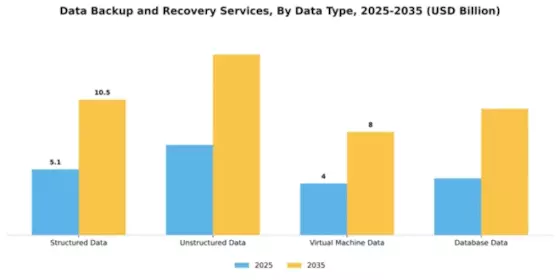
In the Data Backup and Recovery Services market, Structured Data accounts for the largest share, driven by its critical role in enterprise operations and regulatory compliance. This segment includes databases and organized information that is easily searchable, which makes it vital for companies looking to ensure data integrity and availability. Unstructured Data, while currently smaller in market share, is gaining traction due to the increasing need to store and analyze vast amounts of unstructured information, such as emails, documents, and multimedia files, which are often where valuable insights reside.
Data Storage: Structured Data (Dominant) vs. Unstructured Data (Emerging)
Structured Data remains the dominant segment within the Data Backup and Recovery Services market, characterized by its highly organized format that facilitates easy access and management. Businesses rely heavily on structured data for operations, compliance, and analytics, making it essential for maintaining continuity and reliability in data recovery efforts. In contrast, Unstructured Data is emerging as a significant player as organizations recognize the potential hidden within vast troves of unstructured information. Its growth is fueled by advancements in machine learning and AI, which enable businesses to extract actionable insights from data types that were previously considered less manageable. The ongoing digital transformation is reshaping how these two segments interact, leading to new strategies in data backup and recovery.
Get more detailed insights about Data Backup and Recovery Services Market Request Free Sample
North America continues to lead The Data Backup and Recovery Services, holding a significant share of 10.5 in 2024. The region's growth is driven by increasing data generation, stringent regulatory requirements, and a rising focus on data security. Organizations are investing heavily in advanced backup solutions to mitigate risks associated with data loss and cyber threats. The demand for cloud-based services is also on the rise, further propelling market growth. The competitive landscape in North America is robust, featuring key players such as Veeam Software, Commvault, and Dell Technologies. The U.S. stands out as the largest market, driven by technological advancements and a high adoption rate of innovative solutions. Companies are increasingly partnering with service providers to enhance their data management capabilities, ensuring compliance with regulations and improving operational efficiency.
Europe's data backup and recovery services market is poised for growth, with a market size of 5.5 in 2024. The region is witnessing a surge in demand for data protection solutions, driven by increasing regulatory pressures such as GDPR and a growing awareness of data privacy. Organizations are prioritizing investments in backup solutions to ensure compliance and safeguard sensitive information, which is crucial in today's digital landscape. Leading countries in Europe include Germany, the UK, and France, where major players like Acronis and Veritas Technologies are making significant inroads. The competitive landscape is characterized by a mix of established firms and emerging startups, all vying for market share. The European market is expected to see increased collaboration between technology providers and enterprises to enhance data resilience and recovery capabilities.
The Asia-Pacific region is rapidly emerging as a key player in the data backup and recovery services market, with a market size of 3.5 in 2024. The growth is fueled by the increasing adoption of cloud technologies, rising data generation, and a growing emphasis on data security. Governments in the region are also implementing regulations to enhance data protection, which is driving demand for reliable backup solutions among businesses of all sizes. Countries like China, India, and Japan are leading the charge, with significant investments in data infrastructure and technology. The competitive landscape features both global players and local firms, creating a dynamic environment for innovation. Companies are focusing on developing tailored solutions to meet the unique needs of diverse industries, ensuring robust data management and recovery strategies.
The Middle East and Africa region is gradually emerging in the data backup and recovery services market, with a market size of 1.0 in 2024. The growth is driven by increasing digital transformation initiatives and a rising awareness of data security among organizations. Governments are also playing a crucial role by implementing regulations that mandate data protection, which is fostering demand for backup solutions across various sectors. Leading countries in this region include South Africa and the UAE, where local and international players are establishing a presence. The competitive landscape is evolving, with companies focusing on providing customized solutions to cater to the unique challenges faced by businesses in this region. As the market matures, there is significant potential for growth and innovation in data management services.
The Data Backup and Recovery Services market is characterized by a dynamic competitive landscape, driven by the increasing demand for data protection and recovery solutions across various sectors. Key players such as Veeam Software (US), Acronis (CH), and Commvault (US) are strategically positioned to leverage innovations in cloud technology and artificial intelligence to enhance their service offerings. Veeam Software (US) focuses on providing comprehensive data management solutions, while Acronis (CH) emphasizes cybersecurity integration within its backup services. Commvault (US) has adopted a strategy of expanding its cloud capabilities, which collectively shapes a competitive environment that is increasingly reliant on technological advancements and customer-centric solutions.The market structure appears moderately fragmented, with numerous players vying for market share. Key business tactics include localizing service offerings to meet regional compliance requirements and optimizing supply chains to enhance service delivery. The collective influence of major players fosters a competitive atmosphere where innovation and customer service are paramount, as companies strive to differentiate themselves in a crowded marketplace.In November Veeam Software (US) announced a strategic partnership with a leading cloud provider to enhance its disaster recovery solutions. This collaboration is expected to bolster Veeam's market position by integrating advanced cloud capabilities, thereby providing customers with more robust and scalable backup options. The strategic importance of this partnership lies in its potential to attract new clients seeking comprehensive cloud-based solutions, reflecting a broader trend towards hybrid cloud environments.In October Acronis (CH) launched a new version of its backup software that incorporates AI-driven analytics to predict potential data loss scenarios. This innovation not only enhances the reliability of Acronis's offerings but also positions the company as a leader in proactive data protection. The strategic significance of this development is underscored by the growing need for businesses to adopt predictive technologies that mitigate risks associated with data management.In September Commvault (US) expanded its global footprint by acquiring a regional data management firm, which is anticipated to enhance its service capabilities in emerging markets. This acquisition reflects Commvault's commitment to growth through strategic mergers, allowing it to tap into new customer bases and diversify its service portfolio. The strategic importance of this move lies in its potential to strengthen Commvault's competitive edge in a rapidly evolving market.As of December current trends in the Data Backup and Recovery Services market are heavily influenced by digitalization, sustainability, and the integration of AI technologies. Strategic alliances are increasingly shaping the competitive landscape, as companies recognize the value of collaboration in enhancing service offerings. Looking ahead, competitive differentiation is likely to evolve from traditional price-based competition to a focus on innovation, technological advancements, and supply chain reliability. This shift underscores the necessity for companies to invest in cutting-edge solutions that not only meet customer needs but also anticipate future challenges.


The Data Backup and Recovery Services market is projected to grow at a 6.81% CAGR from 2025 to 2035, driven by increasing data volumes, regulatory compliance, and cloud adoption.
New opportunities lie in:
By 2035, the market is expected to be robust, reflecting substantial growth and innovation.
| MARKET SIZE 2024 | 20.5(USD Billion) |
| MARKET SIZE 2025 | 21.9(USD Billion) |
| MARKET SIZE 2035 | 42.3(USD Billion) |
| COMPOUND ANNUAL GROWTH RATE (CAGR) | 6.81% (2025 - 2035) |
| REPORT COVERAGE | Revenue Forecast, Competitive Landscape, Growth Factors, and Trends |
| BASE YEAR | 2024 |
| Market Forecast Period | 2025 - 2035 |
| Historical Data | 2019 - 2024 |
| Market Forecast Units | USD Billion |
| Key Companies Profiled | Veeam Software (US), Acronis (CH), Commvault (US), Dell Technologies (US), IBM (US), Veritas Technologies (US), Microsoft (US), Carbonite (US), Zerto (IL) |
| Segments Covered | Application, End Use, Deployment Type, Service Type, Data Type |
| Key Market Opportunities | Integration of artificial intelligence for enhanced data recovery and predictive analytics in Data Backup and Recovery Services. |
| Key Market Dynamics | Rising demand for data security drives innovation and competition in data backup and recovery services. |
| Countries Covered | North America, Europe, APAC, South America, MEA |
The projected market valuation for Data Backup and Recovery Services is expected to reach 42.3 USD Billion by 2035.
The overall market valuation for Data Backup and Recovery Services was 20.5 USD Billion in 2024.
The expected CAGR for Data Backup and Recovery Services during the forecast period 2025 - 2035 is 6.81%.
Key players in the Data Backup and Recovery Services market include Veeam Software, Acronis, Commvault, Dell Technologies, IBM, Veritas Technologies, Microsoft, Carbonite, and Zerto.
By 2035, Cloud Backup is projected to reach 10.0 USD Billion, while Local Backup is expected to reach 8.0 USD Billion.
In 2025, the market for Disaster Recovery is anticipated to be valued at 12.0 USD Billion, whereas Data Archiving is expected to be valued at 6.0 USD Billion.
The expected market size for Backup as a Service is projected to reach 10.0 USD Billion by 2035.
By 2035, the anticipated market value for Small and Medium Enterprises in the Data Backup market is expected to be 10.5 USD Billion.
The projected market size for Hybrid deployment type is expected to reach 10.8 USD Billion by 2035.
In 2025, the market for Unstructured Data is expected to be valued at 14.0 USD Billion, while Structured Data is anticipated to be valued at 10.5 USD Billion.


Kindly complete the form below to receive a free sample of this Report

“This is really good guys. Excellent work on a tight deadline. I will continue to use you going forward and recommend you to others. Nice job”


“Thanks. It’s been a pleasure working with you, please use me as reference with any other Intel employees.”


“Thanks for sending the report it gives us a good global view of the Betaïne market.”


“Thank you, this will be very helpful for OQS.”


“We found the report very insightful! we found your research firm very helpful. I'm sending this email to secure our future business.”


“I am very pleased with how market segments have been defined in a relevant way for my purposes (such as "Portable Freezers & refrigerators" and "last-mile"). In general the report is well structured. Thanks very much for your efforts.”


“I have been reading the first document or the study, ,the Global HVAC and FP market report 2021 till 2026. Must say, good info! I have not gone in depth at all parts, but got a good indication of the data inside!”


“We got the report in time, we really thank you for your support in this process. I also thank to all of your team as they did a great job.”


“The Automotive 48V ECU Components Procurement Intelligence Study” was a complex project, but the Market Research Future (MRFR) team handled it with quality, agility, and customer-centricity. They delivered all requested data on time and within the agreed scope. The team, including Shubhendra Anand and Rahul Gotadki, was always readily available to clarify questions and swiftly implement necessary adjustments, driving the project to a successful conclusion within a very demanding timeframe.
I would also like to specifically commend Akshay Agarwal for his responsiveness and support at every stage—from our initial inquiry on May 6th through to final delivery on June 18th. His dedication made the entire process seamless.”



