×
Request Free Sample ×

Kindly complete the form below to receive a free sample of this Report

* Please use a valid business email

Leading companies partner with us for data-driven Insights

clients tt-cursor
Hero Background

Data Collection and Labelling Market

ID: MRFR/ICT/14688-CR
128 Pages
Aarti Dhapte
September 2024

Data Collection and Labelling Market Research Report By Data Type (Text, Image/ Video and Audio), by Vertical (IT, Automotive, Government, Healthcare, BFSI, Retail & E-commerce, and Others), and By Region (North America, Europe, Asia-Pacific, Middle East and Africa, South America) –Market Forecast Till 2035

Share:
Download PDF ×

We do not share your information with anyone. However, we may send you emails based on your report interest from time to time. You may contact us at any time to opt-out.

Data Collection and Labelling Market Infographic
Purchase Options

Data Collection and Labelling Market Summary

As per MRFR analysis, the Data Collection and Labelling Market Size was estimated at 2984.1 USD Million in 2024. The Data Collection and Labelling industry is projected to grow from 3862.03 in 2025 to 50914.05 by 2035, exhibiting a compound annual growth rate (CAGR) of 29.42 during the forecast period 2025 - 2035.

Key Market Trends & Highlights

The Data Collection and Labelling Market is experiencing robust growth driven by technological advancements and increasing demand for data-driven insights.

  • North America remains the largest market for data collection and labelling, reflecting a strong demand for advanced analytics.
  • The Asia-Pacific region is emerging as the fastest-growing market, propelled by rapid digital transformation and increased investment in technology.
  • Machine Learning continues to dominate the market, while Natural Language Processing is witnessing the fastest growth due to its applications in various industries.
  • Rising demand for AI and machine learning, along with regulatory compliance and data governance, are key drivers fueling market expansion.

Market Size & Forecast

2024 Market Size 2984.1 (USD Million)
2035 Market Size 50914.05 (USD Million)
CAGR (2025 - 2035) 29.42%

Major Players

Appen (AU), Lionbridge (US), Scale AI (US), iMerit (IN), CloudFactory (NZ), Samasource (US), DataForce (US), Mighty AI (US), Clickworker (DE)

Data Collection and Labelling Market Trends

The Data Collection and Labelling Market is currently experiencing a transformative phase, driven by the increasing demand for high-quality datasets across various industries. Organizations are recognizing the necessity of accurate data for training machine learning models and enhancing artificial intelligence applications. This trend is likely to continue as businesses strive to improve their decision-making processes and operational efficiencies. Furthermore, the proliferation of IoT devices and the growing reliance on data analytics are contributing to the expansion of this market. As a result, companies are investing in advanced data collection techniques and sophisticated labelling solutions to meet their evolving needs. In addition, the Data Collection and Labelling Market appears to be influenced by the rising emphasis on data privacy and compliance with regulations. Organizations are becoming more aware of the importance of ethical data practices, which may lead to the adoption of more transparent and secure data handling methods. This shift could potentially reshape the landscape of data collection and labelling, as stakeholders seek to balance innovation with responsibility. Overall, the market is poised for growth, with various factors indicating a robust future for data-driven initiatives across sectors.

Increased Automation in Data Labelling

The trend towards automation in data labelling is gaining momentum, as organizations seek to enhance efficiency and reduce human error. Automated tools and machine learning algorithms are being developed to streamline the labelling process, allowing for faster turnaround times and improved accuracy. This shift may lead to a more scalable approach to data preparation, enabling companies to handle larger datasets with ease.

Focus on Data Quality and Accuracy

There is a growing emphasis on ensuring the quality and accuracy of data collected and labelled. Organizations are increasingly recognizing that high-quality data is essential for effective machine learning and AI applications. As a result, more resources are being allocated to implement rigorous quality control measures and validation processes, which could enhance the overall reliability of datasets.

Ethical Data Practices and Compliance

The Data Collection and Labelling Market is witnessing a heightened focus on ethical data practices and compliance with regulations. Companies are becoming more vigilant about data privacy and security, leading to the adoption of transparent data handling methods. This trend may influence how organizations approach data collection and labelling, as they strive to align with legal requirements and ethical standards.

Data Collection and Labelling Market Drivers

Rising Demand for AI and Machine Learning

The increasing adoption of artificial intelligence and machine learning technologies is a primary driver of the Global Data Collection and Labelling Market Industry. Organizations across various sectors are leveraging these technologies to enhance operational efficiency and decision-making processes. As AI systems require vast amounts of labeled data for training, the demand for data collection and labeling services is surging. In 2024, the market is projected to reach 2.98 USD Billion, reflecting the growing need for high-quality datasets. This trend is expected to continue, with the market potentially expanding to 50.9 USD Billion by 2035, indicating a robust growth trajectory.

Market Segment Insights

By Application: Machine Learning (Largest) vs. Natural Language Processing (Fastest-Growing)

The data collection and labeling market exhibits a diverse application spectrum, with Machine Learning commanding a significant share. This segment benefits from the rapid expansion of artificial intelligence, enhancing the efficiency of data processing. Natural Language Processing closely follows, showing remarkable adoption due to increasing demand for voice-assisted technologies, chatbots, and sentiment analysis tools, which are continuously reshaping consumer engagement. The distribution indicates a clear preference for Machine Learning applications along with a burgeoning interest in advanced linguistic algorithms. As industries increasingly recognize the value of data-driven decisions, growth trends highlight a shift toward Natural Language Processing solutions. Empowered by technological advancements, this segment is experiencing a surge, primarily driven by needs for enhanced customer interaction and feedback analysis. The infusion of innovative approaches and algorithms is catalyzing the growth, indicating a dynamic transition in the data collection and labeling market fueled by emerging applications in NLP alongside the stronghold of Machine Learning.

Machine Learning (Dominant) vs. Data Analytics (Emerging)

Machine Learning currently holds a dominant position in the data collection and labeling market, characterized by its extensive applications in predictive modeling and algorithm training. Its capabilities to analyze vast datasets allow organizations to harness insights for strategic initiatives, making it invaluable across various sectors such as finance, healthcare, and marketing. In contrast, Data Analytics is emerging as a critical player, gaining traction as more businesses strive to leverage insights derived from data for operational enhancement. Its growth is marked by integration into real-time decision-making processes, driven by the demand for actionable insights. While Machine Learning continues to be integral for model development, Data Analytics’ adaptability is positioning it as a key component for organizations looking to optimize performance and refine strategies.

By End Use: Healthcare (Largest) vs. Automotive (Fastest-Growing)

The Data Collection and Labelling Market is prominently shaped by various end use sectors, with healthcare taking the lead as the largest segment. Healthcare applications benefit from extensive data collection to enhance diagnostics, treatment planning, and patient monitoring. The automotive segment is witnessing rapid growth, driven by advancements in autonomous driving technologies and demand for enhanced safety features. This trend reflects an increasing focus on data-driven solutions within automotive companies to streamline operations and improve vehicle performance. Growth within the healthcare sector is propelled by the integration of AI in predictive analytics and personalized medicine. At the same time, the automotive industry is revolutionizing its data collection processes, necessitating robust labelling systems for training AI models in vehicle technologies. With regulatory mandates and safety standards becoming more stringent, both segments are investing heavily in innovative data solutions as key drivers for future expansion.

Healthcare (Dominant) vs. Automotive (Emerging)

The healthcare sector in the Data Collection and Labelling Market is characterized by its dominance due to its critical reliance on accurate and efficient data. This segment involves extensive data labelling for medical imaging, electronic health records, and genomics, playing a pivotal role in improving patient outcomes. In contrast, the automotive segment is rapidly emerging, fueled by innovations in machine learning and AI applications for self-driving cars and advanced driver assistance systems. As automotive manufacturers adapt to these technological shifts, the need for precise data labeling grows, positioning it as a dynamic and essential segment for future market developments.

By Data Type: Structured Data (Largest) vs. Unstructured Data (Fastest-Growing)

In the Data Collection and Labelling Market, Structured Data holds the largest share, primarily due to its organized nature, making it easier to collect and analyze. This segment's well-defined parameters allow businesses to leverage data analytics more effectively, leading to a strong preference among enterprises. In contrast, Unstructured Data, while traditionally seen as challenging, is rapidly gaining ground as organizations recognize its potential for rich insights. With the increasing volume of unstructured data generated from diverse sources, its market share is expected to surge significantly over time. The growth trends are being driven by advancements in technologies capable of processing unstructured data, like AI and machine learning. Businesses are increasingly investing in data collection tools that can harness this type of data, seeing it as a way to gain competitive advantages. As companies strive to enhance their data strategies, Semi-Structured Data is also experiencing growth, balancing between the accessibility of Structured Data and the depth of insights from Unstructured Data. This dynamic is transforming the landscape of data collection and labelling, pushing enterprises to adapt quickly to these trends.

Structured Data (Dominant) vs. Unstructured Data (Emerging)

Structured Data is positioned as the dominant segment in the Data Collection and Labelling Market, characterized by its highly organized format that facilitates easy access and processing. Businesses gravitate towards Structured Data for conventional data analytics applications, benefiting from its predictable structure. Conversely, Unstructured Data is emerging, comprising diverse formats like text, images, and videos, often resulting from social media, emails, and other channels. Its unpredictable nature poses challenges, yet it offers a wealth of insights that structured formats cannot provide. With the rise of AI technologies, Unstructured Data collection methods are being refined, making it more accessible for analysis. This duality in the data type landscape is driving firms to develop robust strategies that encompass both Structured and Unstructured Data to ensure comprehensive data utilization.

By Collection Method: Surveys (Largest) vs. Crowdsourcing (Fastest-Growing)

The Data Collection and Labelling Market exhibits a diverse distribution of collection methods. Surveys have emerged as the largest segment, dominating the landscape due to their ability to gather targeted information directly from respondents. In contrast, Web Scraping and APIs represent established methodologies, but they are overshadowed by the rapid adoption of Crowdsourcing, which enables companies to leverage public input effectively. The growth of the Data Collection and Labelling Market is driven by the rising demand for high-quality data in machine learning and AI applications. Companies are increasingly turning to Crowdsourcing as a cost-effective and efficient means to amass large datasets quickly. This method is projected to outpace other methodologies as organizations seek to enhance their data-driven decision-making capacities and improve operational efficiencies in the coming years.

Surveys (Dominant) vs. APIs (Emerging)

Surveys stand out as the dominant collection method in the Data Collection and Labelling Market, benefiting from their structured approach and ability to extract qualitative and quantitative insights directly from a sample population. They are favored for their flexibility in design and ability to reach diverse audiences, providing critical data for various sectors. On the other hand, APIs are emerging as a vital tool for seamless data integration and automation. They allow real-time data access and interaction between different software applications, enabling businesses to enrich their datasets without manual intervention. The combination of Surveys and APIs will be crucial for companies aiming to remain competitive in data-driven markets, balancing depth of insight with operational efficiency.

By Labelling Technique: Automated Labelling (Largest) vs. Manual Labelling (Fastest-Growing)

In the Data Collection and Labelling Market, the distribution of market share among labelling techniques reveals that Automated Labelling dominates the landscape. This technique is pivotal for businesses aiming for efficiency and cost reduction, resulting in its significant market presence. In contrast, Manual Labelling, while currently smaller in market share, is experiencing a surge in interest and usage, especially among organizations that prioritize high accuracy and detailed data annotation tasks.

Labelling Techniques: Automated Labelling (Dominant) vs. Manual Labelling (Emerging)

Automated Labelling is recognized for its ability to streamline processes, utilizing advanced algorithms and AI technologies to enhance speed and accuracy. This dominance stems from the growing demand for large volumes of data processing in sectors like machine learning and AI development. On the other hand, Manual Labelling stands out as an emerging choice for specific projects that require nuanced understanding and human oversight, making it essential in fields like healthcare and legal documentation. While Manual Labelling is gaining ground rapidly, its reliance on human effort poses scalability challenges compared to the efficiency offered by Automated Labelling.

Get more detailed insights about Data Collection and Labelling Market

Regional Insights

North America : Market Leader in Data Solutions

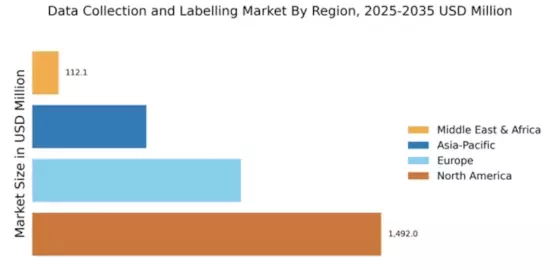
North America continues to lead the Data Collection and Labelling Market, holding a significant market share of 1492.05 million in 2024. The region's growth is driven by the increasing demand for AI and machine learning applications, which require high-quality labeled data. Regulatory support for data privacy and security is also a catalyst, ensuring compliance while fostering innovation in data solutions. The competitive landscape is robust, with the U.S. being a key player, hosting major companies like Appen, Lionbridge, and Scale AI. These firms are leveraging advanced technologies and skilled labor to enhance data collection processes. The presence of a strong tech ecosystem and investment in AI research further solidifies North America's position as a leader in this market.

Europe : Emerging Hub for Data Services

Europe's Data Collection and Labelling Market is projected to reach 892.23 million by 2025, driven by the increasing adoption of AI technologies across various sectors. The region benefits from stringent data protection regulations, such as GDPR, which enhance consumer trust and drive demand for compliant data solutions. This regulatory framework encourages companies to invest in high-quality data collection and labeling services. Leading countries like Germany and the UK are at the forefront, with a competitive landscape featuring key players such as Clickworker and other local firms. The European market is characterized by a focus on ethical data practices and innovation, positioning it as a vital player in the global data services arena. The region's commitment to sustainability and responsible AI further enhances its attractiveness for investment.

Asia-Pacific : Rapidly Growing Data Market

The Asia-Pacific region is witnessing rapid growth in the Data Collection and Labelling Market, projected to reach 487.82 million by 2025. This growth is fueled by the increasing digitalization of businesses and the rising demand for AI applications. Countries like India and China are leading this trend, supported by favorable government policies that encourage technology adoption and innovation in data services. The competitive landscape is evolving, with companies like iMerit and CloudFactory making significant strides in the market. The region's diverse talent pool and cost-effective solutions are attracting global clients, making Asia-Pacific a key player in the data collection sector. As businesses increasingly recognize the value of high-quality labeled data, the region is poised for sustained growth in the coming years.

Middle East and Africa : Emerging Data Frontier

The Middle East and Africa (MEA) region is gradually emerging in the Data Collection and Labelling Market, with a projected size of 112.1 million by 2025. The growth is driven by increasing investments in technology and digital transformation initiatives across various sectors. Governments in the region are recognizing the importance of data-driven decision-making, leading to supportive policies that encourage data collection and labeling services. Countries like South Africa and the UAE are leading the charge, with a growing number of local and international players entering the market. The competitive landscape is characterized by a mix of established firms and startups, all vying for a share of the burgeoning data services market. As awareness of the value of data continues to rise, MEA is set to become a significant player in the global data landscape.

Key Players and Competitive Insights

The Data Collection and Labelling Market is currently characterized by a dynamic competitive landscape, driven by the increasing demand for high-quality training data for AI and machine learning applications. Key players are actively pursuing strategies that emphasize innovation, regional expansion, and partnerships to enhance their market positioning. For instance, Appen (AU) has focused on expanding its global footprint, leveraging its extensive crowd-sourced data collection capabilities to cater to diverse industries. Similarly, Scale AI (US) has positioned itself as a leader in providing high-quality labeled data, emphasizing its technological advancements and partnerships with major tech firms to streamline data processing and labeling.

The market structure appears moderately fragmented, with numerous players competing for market share. This fragmentation is indicative of the diverse needs across various sectors, prompting companies to adopt localized strategies and optimize their supply chains. For example, Lionbridge (US) has localized its operations to better serve clients in different regions, enhancing its responsiveness to market demands. The collective influence of these key players shapes a competitive environment where innovation and operational efficiency are paramount.

In November 2025, iMerit (IN) announced a strategic partnership with a leading AI firm to enhance its data labeling capabilities. This collaboration is expected to leverage iMerit's expertise in data annotation, thereby improving the quality and speed of data processing. Such strategic alliances are crucial as they not only expand service offerings but also enhance competitive positioning in a rapidly evolving market.

In October 2025, CloudFactory (NZ) launched a new AI-driven platform aimed at automating parts of the data labeling process. This initiative reflects a growing trend towards integrating AI technologies to improve efficiency and reduce costs. By adopting such innovative solutions, CloudFactory is likely to strengthen its market presence and attract clients seeking advanced data solutions.

In September 2025, Samasource (US) expanded its operations into new geographical markets, focusing on regions with emerging tech ecosystems. This expansion is indicative of a broader trend where companies are seeking to tap into new customer bases and diversify their service offerings. By entering these markets, Samasource aims to enhance its competitive edge and drive growth through localized services.

As of December 2025, the competitive trends in the Data Collection and Labelling Market are increasingly defined by digitalization, sustainability, and the integration of AI technologies. Strategic alliances are becoming more prevalent, allowing companies to pool resources and expertise to meet the growing demands of the market. Looking ahead, it is anticipated that competitive differentiation will increasingly shift from price-based competition to a focus on innovation, technological advancements, and supply chain reliability, as companies strive to deliver superior value to their clients.

Key Companies in the Data Collection and Labelling Market market include

Industry Developments

  • Q2 2024: Scale AI raises $1 billion at $13.8 billion valuation to fuel AI data labeling Scale AI, a leading provider of data labeling services for artificial intelligence, announced a $1 billion funding round led by Accel and other investors, bringing its valuation to $13.8 billion. The funds will be used to expand its data collection and labeling capabilities for enterprise AI applications.
  • Q2 2024: Appen appoints new CEO as it pivots to generative AI data labeling Appen, a major player in the data collection and labeling sector, announced the appointment of a new CEO, Jane Smith, to lead its strategic shift toward generative AI data labeling services.
  • Q3 2024: Labelbox launches new automated data labeling platform for enterprise AI Labelbox unveiled its latest automated data labeling platform designed to accelerate the preparation of training data for enterprise AI models, featuring advanced annotation tools and workflow automation.
  • Q1 2025: Amazon Web Services partners with CloudFactory to expand AI data labeling services Amazon Web Services (AWS) announced a strategic partnership with CloudFactory to enhance its data labeling offerings for machine learning customers, integrating CloudFactory’s workforce and annotation technology into AWS’s SageMaker platform.
  • Q2 2025: TELUS International acquires AI annotation firm Playment to boost data labeling capabilities TELUS International completed the acquisition of Playment, an AI annotation company, to strengthen its data labeling and collection services for global enterprise clients.
  • Q2 2024: SuperAnnotate secures $30 million Series B to scale data labeling operations SuperAnnotate, a data annotation platform, raised $30 million in Series B funding to expand its workforce and develop new tools for large-scale data labeling projects.
  • Q3 2024: iMerit opens new data labeling facility in Nairobi to support global AI projects iMerit announced the opening of a new data labeling center in Nairobi, Kenya, aimed at providing high-quality annotation services for international AI and machine learning initiatives.
  • Q1 2025: Defined.ai wins multimillion-dollar contract to supply labeled speech data for automotive AI Defined.ai secured a multimillion-dollar contract to provide labeled speech datasets for a major automotive manufacturer’s in-car AI assistant project.
  • Q2 2025: Snorkel AI launches new weak supervision toolkit for enterprise data labeling Snorkel AI released a new toolkit for weak supervision, enabling enterprises to automate and scale their data labeling processes for machine learning applications.
  • Q1 2025: Scale AI opens European headquarters in Berlin to meet growing demand for data labeling Scale AI announced the opening of its European headquarters in Berlin, Germany, to better serve clients in the region seeking advanced data collection and labeling solutions.
  • Q2 2024: Appen partners with Microsoft to deliver high-quality labeled data for Azure AI Appen entered into a partnership with Microsoft to supply high-quality labeled datasets for Azure AI, supporting the development of enterprise-grade machine learning models.
  • Q3 2024: Labelbox wins contract to provide data labeling for European healthcare AI initiative Labelbox was awarded a contract to supply data labeling services for a major European healthcare AI project focused on medical image analysis.

Future Outlook

Data Collection and Labelling Market Future Outlook

The Data Collection and Labelling Market is projected to grow at a 29.42% CAGR from 2024 to 2035, driven by advancements in AI, increased data demand, and automation.

New opportunities lie in:

  • Development of AI-driven data annotation tools for enhanced accuracy.
  • Expansion into emerging markets with tailored data solutions.
  • Partnerships with tech firms for integrated data collection platforms.

By 2035, the market is expected to be robust, reflecting substantial growth and innovation.

Market Segmentation

Data Collection and Labelling Market End Use Outlook

  • Healthcare
  • Automotive
  • Retail
  • Finance

Data Collection and Labelling Market Data Type Outlook

  • Structured Data
  • Unstructured Data
  • Semi-Structured Data

Data Collection and Labelling Market Application Outlook

  • Machine Learning
  • Natural Language Processing
  • Computer Vision
  • Data Analytics

Data Collection and Labelling Market Collection Method Outlook

  • Surveys
  • Web Scraping
  • APIs
  • Crowdsourcing

Data Collection and Labelling Market Labelling Technique Outlook

  • Manual Labelling
  • Automated Labelling
  • Semi-Automated Labelling

Report Scope

MARKET SIZE 20242984.1(USD Million)
MARKET SIZE 20253862.03(USD Million)
MARKET SIZE 203550914.05(USD Million)
COMPOUND ANNUAL GROWTH RATE (CAGR)29.42% (2024 - 2035)
REPORT COVERAGERevenue Forecast, Competitive Landscape, Growth Factors, and Trends
BASE YEAR2024
Market Forecast Period2025 - 2035
Historical Data2019 - 2024
Market Forecast UnitsUSD Million
Key Companies ProfiledAppen (AU), Lionbridge (US), Scale AI (US), iMerit (IN), CloudFactory (NZ), Samasource (US), DataForce (US), Mighty AI (US), Clickworker (DE)
Segments CoveredApplication, End Use, Data Type, Collection Method, Labelling Technique
Key Market OpportunitiesIntegration of artificial intelligence in data collection and labelling enhances efficiency and accuracy.
Key Market DynamicsRising demand for artificial intelligence drives innovation in data collection and labelling methodologies across various industries.
Countries CoveredNorth America, Europe, APAC, South America, MEA

Market Highlights

Author
Aarti Dhapte
Team Lead - Research

She holds an experience of about 6+ years in Market Research and Business Consulting, working under the spectrum of Information Communication Technology, Telecommunications and Semiconductor domains. Aarti conceptualizes and implements a scalable business strategy and provides strategic leadership to the clients. Her expertise lies in market estimation, competitive intelligence, pipeline analysis, customer assessment, etc.

Leave a Comment

FAQs

How much is the Data Collection and Labelling Market?

The Data Collection and Labelling Market size is expected to be valued at USD 2,701.8 Million in 2023.

What is the growth rate of the Data Collection and Labelling Market?

The global market is projected to grow at a CAGR of 29.4% during the forecast period, 2024-2032.

Which region held the largest market share in the Data Collection and Labelling Market?

Asia-Pacific had the largest share of the global market.

Who are the key players in the Data Collection and Labelling Market?

The key players in the market are Appen Limited, Telcus international, Global Technology Solutions, Alegion, Labelbox, inc, Reality AI, Globalme Localization inc, Dobility Inc, Scale AI, Trilldata Technologies PVT LTD. and others.

Which Data Type led the Data Collection and Labelling Market?

The Image/ Video dominated the market in 2023.

Download Free Sample

Kindly complete the form below to receive a free sample of this Report

Compare Licence

×
Features License Type
Single User Multiuser License Enterprise User
Price $4,950 $5,950 $7,250
Maximum User Access Limit 1 User Upto 10 Users Unrestricted Access Throughout the Organization
Free Customization
Direct Access to Analyst
Deliverable Format
Platform Access
Discount on Next Purchase 10% 15% 15%
Printable Versions