Download Free Sample
Kindly complete the form below to receive a free sample of this Report
Data-Driven Marketing Services Market Size, Share and Trends Analysis Research Report Information By End Use (Retail, Healthcare, Financial Services, Telecommunications, Travel and Hospitality), By Application (Customer Relationship Management, Email Marketing, Social Media Marketing, Search Engine Marketing, Content Marketing), By Data Source (First-Party Data, Second-Party Data, Third-Party Data, Public Data), By Service Type (Consulting Services, Managed Services, Support Services), By Deployment Type (Cloud-Based, On-Premises, Hybrid), And By Region (North America, Europe, Asia-Pacific, And Rest Of The World) – Market Forecast Till 2035
As per MRFR analysis, the Data-driven Marketing Services Market was estimated at 60.0 USD Billion in 2024. The Data-driven Marketing Services industry is projected to grow from 64.37 USD Billion in 2025 to 130.0 USD Billion by 2035, exhibiting a compound annual growth rate (CAGR) of 7.28% during the forecast period 2025 - 2035.
The Data-driven Marketing Services Market is experiencing robust growth driven by technological advancements and evolving consumer expectations.
| 2024 Market Size | 60.0 (USD Billion) |
| 2035 Market Size | 130.0 (USD Billion) |
| CAGR (2025 - 2035) | 7.28% |
Acxiom (US), Oracle (US), Salesforce (US), Adobe (US), IBM (US), Market Research Future (US), Experian (GB), Criteo (FR), WPP (GB), Publicis Groupe (FR)
Our Impact
Enabled $4.3B Revenue Impact for Fortune 500 and Leading Multinationals
Partnering with 2000+ Global Organizations Each Year
30K+ Citations by Top-Tier Firms in the Industry
The Data-driven Marketing Services Market is currently experiencing a transformative phase, characterized by the integration of advanced analytics and artificial intelligence. This evolution appears to be driven by the increasing demand for personalized marketing strategies that resonate with consumers on a deeper level. Companies are leveraging vast amounts of data to gain insights into customer behavior, preferences, and trends, which in turn informs their marketing campaigns. As organizations strive to enhance customer engagement and optimize their return on investment, the reliance on data-driven methodologies seems to be more pronounced than ever. Furthermore, the rise of digital platforms has facilitated the collection and analysis of consumer data, enabling businesses to tailor their offerings more effectively. In addition to technological advancements, regulatory changes are also shaping the landscape of the Data-driven Marketing Services Market. With growing concerns regarding data privacy and security, companies are compelled to adopt more transparent practices in their marketing efforts. This shift not only fosters consumer trust but also encourages organizations to innovate in their data collection and utilization strategies. As the market continues to evolve, it is likely that the interplay between technology, consumer expectations, and regulatory frameworks will define the future trajectory of data-driven marketing services, creating both challenges and opportunities for businesses across various sectors.
The trend towards hyper-personalization is gaining momentum, as businesses seek to deliver tailored experiences to their customers. By utilizing advanced analytics, companies can segment their audiences more effectively and create customized marketing messages that resonate with individual preferences.
The incorporation of artificial intelligence and machine learning technologies is revolutionizing the Data-driven Marketing Services Market. These tools enable marketers to analyze vast datasets, predict consumer behavior, and automate various marketing processes, thereby enhancing efficiency and effectiveness.
As consumers become increasingly aware of data privacy issues, there is a growing emphasis on compliance with regulations. Organizations are adapting their marketing strategies to ensure transparency and build trust, which is essential for maintaining customer relationships in a data-driven environment.
Technological advancements in analytics are significantly influencing the Data-driven Marketing Services Market Industry. The proliferation of sophisticated analytics tools, including predictive analytics and real-time data processing, empowers marketers to derive actionable insights from vast datasets. In 2025, the analytics software market is projected to reach approximately 200 billion dollars, indicating a robust growth trajectory. These technologies facilitate the identification of consumer behavior patterns, enabling businesses to optimize their marketing strategies accordingly. Moreover, the integration of artificial intelligence and machine learning into analytics platforms enhances the accuracy and efficiency of data interpretation. As organizations increasingly adopt these advanced analytics solutions, the demand for data-driven marketing services is likely to escalate, positioning analytics as a pivotal driver in the industry.
The evolving landscape of regulatory compliance and data privacy is a significant driver in the Data-driven Marketing Services Market Industry. With increasing scrutiny on data usage and consumer privacy, businesses are compelled to adopt data-driven marketing services that adhere to stringent regulations. In 2025, it is anticipated that compliance-related expenditures will exceed 50 billion dollars, reflecting the growing importance of data governance. Organizations are investing in technologies and services that ensure compliance with regulations such as GDPR and CCPA, which not only protect consumer data but also enhance brand reputation. This focus on regulatory compliance is likely to drive demand for data-driven marketing services that prioritize ethical data usage and transparency, positioning compliance as a critical factor in the industry.
The Data-driven Marketing Services Market Industry is experiencing a notable surge in demand for targeted advertising solutions. As businesses increasingly recognize the importance of reaching specific consumer segments, the need for data-driven insights becomes paramount. In 2025, it is estimated that targeted advertising will account for over 60 percent of total advertising expenditures, reflecting a shift towards more personalized marketing strategies. This trend is driven by the growing availability of consumer data and advanced analytics tools that enable marketers to tailor their messages effectively. Consequently, companies are investing heavily in data-driven marketing services to enhance their advertising effectiveness and improve return on investment. The ability to leverage data for precise targeting not only increases engagement rates but also fosters brand loyalty, making it a critical driver in the Data-driven Marketing Services Market Industry.
The emphasis on customer experience is becoming a central tenet in the Data-driven Marketing Services Market Industry. Companies are increasingly aware that delivering exceptional customer experiences can lead to higher retention rates and increased customer lifetime value. In 2025, it is projected that businesses prioritizing customer experience will outperform their competitors by 80 percent in terms of revenue growth. This realization drives organizations to invest in data-driven marketing services that enhance customer interactions through personalized content and targeted messaging. By leveraging customer data, businesses can create tailored experiences that resonate with their audience, fostering deeper connections and brand loyalty. As the competition intensifies, the focus on customer experience is likely to remain a key driver in the Data-driven Marketing Services Market Industry.
The transition towards omnichannel marketing strategies is reshaping the Data-driven Marketing Services Market Industry. As consumers engage with brands across multiple platforms, businesses are recognizing the necessity of delivering a cohesive and integrated marketing experience. In 2025, it is projected that companies employing omnichannel strategies will achieve a 30 percent higher customer retention rate compared to those using single-channel approaches. This shift compels organizations to leverage data-driven marketing services that facilitate seamless interactions across various touchpoints. By utilizing data to understand customer preferences and behaviors, businesses can create unified marketing campaigns that resonate with their audience. The emphasis on omnichannel marketing is likely to continue driving growth in the Data-driven Marketing Services Market Industry, as companies strive to meet the evolving expectations of consumers.
The Data-driven Marketing Services Market showcases a diverse range of applications, with Customer Relationship Management (CRM) leading the pack in market share. As businesses increasingly recognize the importance of personalized customer interactions, CRM tools dominate the landscape, allowing companies to enhance customer engagement. On the other hand, Email Marketing stands out as the fastest-growing segment within this market, gaining traction due to its cost-effectiveness and ability to deliver targeted messages directly to consumers.
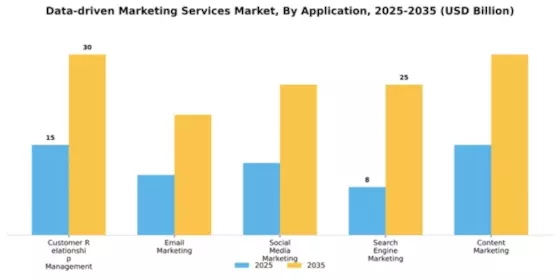
Customer Relationship Management (Dominant) vs. Email Marketing (Emerging)
Customer Relationship Management (CRM) tools empower businesses to understand their customers, streamline interactions, and improve retention rates, establishing themselves as the dominant application in the Data-driven Marketing Services Market. Conversely, Email Marketing has emerged as a rapidly growing application, driven by its ability to engage audiences through personalized campaigns. With developments in automation and analytics, Email Marketing is gaining significant attention as an effective strategy to reach target demographics. This segment thrives on its adaptability and the increasing reliance on digital communications, positioning itself as a key player in driving market growth.
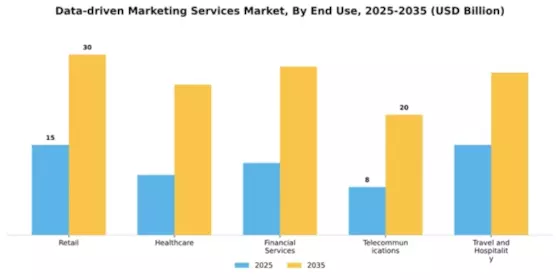
In the Data-driven Marketing Services Market, the end use segment is characterized by diverse applications across various industries. The retail sector commands the largest market share, leveraging data-driven strategies to enhance customer engagement and optimize inventory management. This stronghold is followed by healthcare, which, while smaller in comparison, is rapidly gaining traction as providers seek to utilize data analytics for targeted marketing and improved patient care services. The growth trends within the end use segment reveal that while retail continues to thrive, healthcare is emerging as the fastest-growing area. Factors such as increasing investments in technology, the rise of telemedicine, and the need for personalized marketing strategies are driving this growth. Additionally, sectors like financial services and telecommunications are also expanding their adoption of data-driven marketing, indicating a shift towards more informed decision-making across industries.
Retail: Dominant vs. Healthcare: Emerging
The retail sector stands as the dominant player in the Data-driven Marketing Services Market, capitalizing on the wealth of consumer data to craft personalized shopping experiences and run effective promotional campaigns. Retailers are increasingly turning to advanced analytics to understand purchasing behaviors and preferences, making data-driven insights essential for enhancing customer loyalty and maximizing sales. In contrast, the healthcare industry, while still emerging, is rapidly adopting data-driven marketing for its potential to improve patient outreach and engagement. With the rise of digital health platforms and the emphasis on personalized care, healthcare providers are starting to harness data analytics to target specific patient demographics effectively. This strategic focus is transforming traditional marketing approaches in healthcare, allowing for more precise and impactful communication.
In the Data-driven Marketing Services Market, the deployment type segment reveals a compelling distribution, with cloud-based solutions currently holding the largest share. This segment's popularity stems from their scalability, cost-effectiveness, and flexibility, which appeal to a wide range of businesses. On-premises deployments, while still significant, are gradually being overshadowed by the growth of cloud and hybrid models, as organizations increasingly look for solutions that allow for remote accessibility and real-time data analytics. Growing demand for agility and hybrid environments is driving rapid expansion in this segment. As data privacy concerns rise, businesses are drawn to hybrid solutions, allowing them to maintain sensitive information on-premises while leveraging cloud capabilities. The COVID-19 pandemic accelerated this shift, pushing companies to adapt and invest in robust, versatile marketing technologies. This not only enhances customer engagement but also supports data-driven decision-making, further fueling market growth.
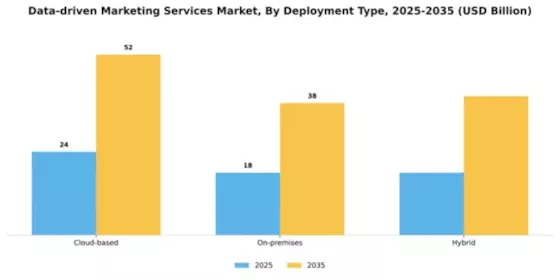
Cloud-based (Dominant) vs. On-premises (Emerging)
In the Data-driven Marketing Services Market, cloud-based deployment stands out as the dominant force, offering unparalleled ease of integration, scalability, and cost efficiency. These services enable companies to access vast amounts of data and advanced marketing tools without heavy upfront investments, significantly reducing operational burdens. On the other hand, on-premises deployment is considered emerging as businesses that prioritize data security and compliance still often prefer it; however, it comes with higher upfront costs and maintenance responsibilities. This duality represents a pivotal shift in the market, where cloud solutions continue to lead, while on-premises models adapt to evolving technological landscapes.
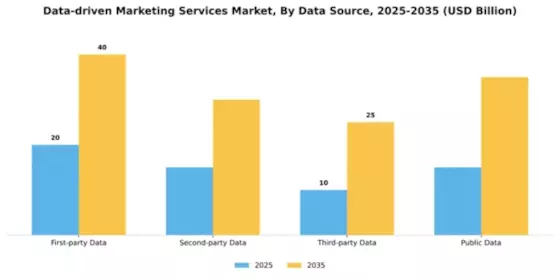
In the Data-driven Marketing Services Market, the market share distribution reveals that first-party data occupies the largest portion, driven by its high accuracy and direct relationship with customers. In contrast, third-party data, collected from external sources, is rapidly gaining traction due to the increasing need for broader audience insights and comprehensive targeting strategies. Public data and second-party data show smaller shares but play vital roles in specific applications and integrating diverse data types. As businesses increasingly prioritize data privacy and consumer trust, first-party data's dominance is expected to continue in the near future. Meanwhile, the growth of third-party data is significantly influenced by advancements in data analytics technologies and the rising demand for personalized marketing campaigns. Both data types are essential, but their growth trajectories reflect divergent strategies within the market as companies adapt to changing consumer behaviors and regulations.
First-party Data (Dominant) vs. Public Data (Emerging)
First-party data is characterized by its origin directly from the organization that collects it, ensuring high relevance and accuracy. It serves as a cornerstone for many businesses, providing insights into customer preferences and behavior patterns. In comparison, public data, while less personalized, offers broader demographic and socio-economic insights. It is seen as an emerging segment as organizations explore ways to integrate it into their marketing strategies. Public data enhances the scale of marketing campaigns, allowing data-driven marketers to complement their first-party insights with additional context. As such, these two data sources serve distinct yet complementary roles, with first-party data leading in trust and personalization, while public data provides scale and depth.
The Data-driven Marketing Services Market showcases a diverse distribution of service types, with Consulting Services leading as the largest segment. Its established reputation and comprehensive offerings provide businesses with strategic insights, allowing for informed decision-making and better engagement strategies. Managed Services follows closely, characterized by its rapid growth due to increasing demand for outsourced marketing operations, enabling firms to focus on core competencies. Support Services, while important, occupies a smaller share as organizations prioritize higher-value consulting and management solutions. In this evolving market, growth trends indicate a shift towards Managed Services as companies seek streamlined operations and advanced data analytics. The rising complexity of marketing challenges is driving organizations to adopt these services, leading to higher efficiency and cost-effectiveness. From startup growth to enterprise-level solutions, the focus on digital transformation and real-time data utilization is elevating the demand for comprehensive service packages, making this an exciting period for the sector's growth dynamics.
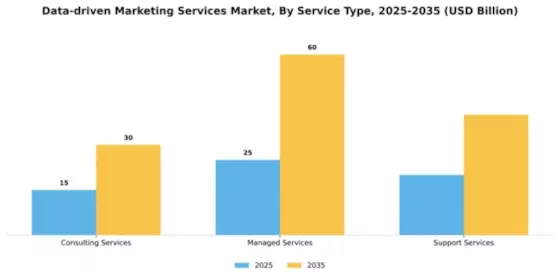
Consulting Services (Dominant) vs. Support Services (Emerging)
Consulting Services stands as the dominant force in the Data-driven Marketing Services Market, offering organizations critical strategic guidance in navigating the complexities of data-driven decisions. This segment is known for its comprehensive analysis, tailored strategies, and expertise in market trends, empowering businesses to enhance their marketing effectiveness. On the other hand, Support Services are emerging in importance as businesses recognize the need for ongoing assistance in implementing marketing strategies and managing customer relationships. Support Services complement the more strategic aspects of consulting, filling the gap for businesses eager to maintain engagement and optimize operational processes. As companies increasingly invest in support frameworks, this segment is poised for growth, driven by the need for effective customer communication and post-deployment assistance.
Get more detailed insights about Data-driven Marketing Services Market Request Free Sample
North America continues to lead the Data-driven Marketing Services market, holding a significant share of 36.0% in 2024. The region's growth is driven by rapid technological advancements, increasing digital ad spending, and a strong focus on data analytics. Regulatory frameworks supporting data privacy and consumer protection are also shaping market dynamics, encouraging businesses to adopt data-driven strategies. The competitive landscape is robust, with key players like Acxiom, Oracle, and Salesforce dominating the market. The U.S. remains the largest contributor, leveraging its technological infrastructure and innovation capabilities. Companies are increasingly investing in AI and machine learning to enhance customer engagement and optimize marketing strategies, ensuring North America's continued leadership in this sector.
Europe's Data-driven Marketing Services market is poised for growth, currently valued at €15.0 billion. The region is experiencing a surge in demand for personalized marketing solutions, driven by evolving consumer preferences and stringent data regulations like GDPR. These regulations not only protect consumer data but also encourage businesses to adopt transparent marketing practices, fostering trust and engagement. Leading countries such as the UK, Germany, and France are at the forefront of this market, with major players like Experian and Publicis Groupe actively expanding their services. The competitive landscape is characterized by a mix of established firms and innovative startups, all vying to capture market share. As businesses increasingly recognize the value of data-driven insights, Europe is set to become a significant player in the global market.
The Asia-Pacific region is witnessing rapid growth in the Data-driven Marketing Services market, currently valued at $7.5 billion. This growth is fueled by increasing internet penetration, mobile device usage, and a burgeoning middle class that demands personalized marketing experiences. Additionally, government initiatives promoting digital transformation are acting as catalysts for market expansion, encouraging businesses to leverage data analytics for better customer engagement. Countries like China, India, and Japan are leading the charge, with a mix of local and international players competing for market share. Companies are investing heavily in technology to enhance their marketing capabilities, with key players like Criteo and WPP establishing a strong presence. As the region continues to evolve, the demand for innovative data-driven solutions is expected to rise significantly, positioning Asia-Pacific as a key player in the global market.
The Middle East and Africa region is gradually emerging in the Data-driven Marketing Services market, currently valued at $1.5 billion. The growth is driven by increasing digital adoption, a young population, and rising investments in technology. Governments are also playing a crucial role by implementing policies that encourage digital marketing and data utilization, creating a conducive environment for market growth. Countries like South Africa and the UAE are leading the way, with a growing number of local and international firms entering the market. The competitive landscape is evolving, with companies focusing on innovative solutions to meet the unique needs of consumers in this region. As businesses recognize the importance of data-driven marketing, the Middle East and Africa are set to experience significant growth in the coming years.
The Data-driven Marketing Services Market is currently characterized by a dynamic competitive landscape, driven by rapid technological advancements and an increasing demand for personalized marketing solutions. Key players such as Acxiom (US), Oracle (US), and Salesforce (US) are strategically positioning themselves through innovation and partnerships. Acxiom (US) focuses on enhancing its data analytics capabilities, while Oracle (US) emphasizes integrating AI into its marketing solutions. Salesforce (US) is leveraging its extensive customer relationship management (CRM) platform to offer tailored marketing services, thereby shaping a competitive environment that prioritizes customer-centric approaches.The market structure appears moderately fragmented, with numerous players vying for market share. Key business tactics include localizing services to meet regional demands and optimizing supply chains to enhance service delivery. The collective influence of major players fosters a competitive atmosphere where agility and responsiveness to market trends are paramount. This fragmentation allows for niche players to emerge, further intensifying competition.In November Acxiom (US) announced a strategic partnership with a leading AI firm to enhance its data-driven marketing solutions. This collaboration aims to integrate advanced machine learning algorithms into Acxiom's existing platforms, potentially improving customer targeting and engagement. Such a move underscores Acxiom's commitment to innovation and its desire to remain at the forefront of the market.In October Oracle (US) launched a new suite of AI-powered marketing tools designed to streamline campaign management and optimize customer interactions. This initiative reflects Oracle's focus on digital transformation and its intent to provide clients with cutting-edge solutions that enhance marketing efficiency. The introduction of these tools may significantly bolster Oracle's competitive edge in the market.In September Salesforce (US) expanded its marketing cloud capabilities by acquiring a data analytics startup. This acquisition is likely to enhance Salesforce's ability to offer comprehensive data-driven insights, thereby enriching its service portfolio. The strategic importance of this move lies in Salesforce's aim to integrate advanced analytics into its marketing solutions, which could lead to improved customer experiences and increased client retention.As of December current trends in the Data-driven Marketing Services Market include a pronounced shift towards digitalization, sustainability, and the integration of AI technologies. Strategic alliances are increasingly shaping the competitive landscape, enabling companies to pool resources and expertise. Looking ahead, competitive differentiation is expected to evolve, with a greater emphasis on innovation and technology rather than price-based competition. Companies that prioritize supply chain reliability and technological advancements are likely to thrive in this rapidly changing environment.




The Data-driven Marketing Services Market is projected to grow at a 7.28% CAGR from 2025 to 2035, driven by technological advancements, increased data utilization, and evolving consumer preferences.
New opportunities lie in:
By 2035, the market is expected to be robust, driven by innovation and strategic growth initiatives.
| MARKET SIZE 2024 | 60.0(USD Billion) |
| MARKET SIZE 2025 | 64.37(USD Billion) |
| MARKET SIZE 2035 | 130.0(USD Billion) |
| COMPOUND ANNUAL GROWTH RATE (CAGR) | 7.28% (2025 - 2035) |
| REPORT COVERAGE | Revenue Forecast, Competitive Landscape, Growth Factors, and Trends |
| BASE YEAR | 2024 |
| Market Forecast Period | 2025 - 2035 |
| Historical Data | 2019 - 2024 |
| Market Forecast Units | USD Billion |
| Key Companies Profiled | Acxiom (US), Oracle (US), Salesforce (US), Adobe (US), IBM (US), Market Research Future (US), Experian (GB), Criteo (FR), WPP (GB), Publicis Groupe (FR) |
| Segments Covered | Application, End Use, Deployment Type, Data Source, Service Type |
| Key Market Opportunities | Integration of artificial intelligence enhances personalization in the Data-driven Marketing Services Market. |
| Key Market Dynamics | Rising demand for personalized marketing strategies drives innovation and competition in the Data-driven Marketing Services Market. |
| Countries Covered | North America, Europe, APAC, South America, MEA |
The projected market valuation for the Data-driven Marketing Services Market is expected to reach 130.0 USD Billion by 2035.
The overall market valuation of the Data-driven Marketing Services Market was 60.0 USD Billion in 2024.
The expected CAGR for the Data-driven Marketing Services Market during the forecast period 2025 - 2035 is 7.28%.
Key players in the Data-driven Marketing Services Market include Acxiom, Oracle, Salesforce, Adobe, IBM, Market Research Future, Experian, Criteo, WPP, and Publicis Groupe.
Main applications include Customer Relationship Management valued at 30.0 USD Billion, Email Marketing at 20.0 USD Billion, and Social Media Marketing at 25.0 USD Billion.
The market is segmented by end use, with Retail valued at 30.0 USD Billion and Financial Services at 28.0 USD Billion.
Deployment types include Cloud-based at 52.0 USD Billion and Hybrid at 40.0 USD Billion.
Data sources include First-party Data valued at 40.0 USD Billion and Public Data at 35.0 USD Billion.
Services offered include Managed Services valued at 60.0 USD Billion and Support Services at 40.0 USD Billion.
The market shows varied growth, with Social Media Marketing and Managed Services likely experiencing substantial increases in valuation.


Kindly complete the form below to receive a free sample of this Report

“This is really good guys. Excellent work on a tight deadline. I will continue to use you going forward and recommend you to others. Nice job”


“Thanks. It’s been a pleasure working with you, please use me as reference with any other Intel employees.”


“Thanks for sending the report it gives us a good global view of the Betaïne market.”


“Thank you, this will be very helpful for OQS.”


“We found the report very insightful! we found your research firm very helpful. I'm sending this email to secure our future business.”


“I am very pleased with how market segments have been defined in a relevant way for my purposes (such as "Portable Freezers & refrigerators" and "last-mile"). In general the report is well structured. Thanks very much for your efforts.”


“I have been reading the first document or the study, ,the Global HVAC and FP market report 2021 till 2026. Must say, good info! I have not gone in depth at all parts, but got a good indication of the data inside!”


“We got the report in time, we really thank you for your support in this process. I also thank to all of your team as they did a great job.”


“The Automotive 48V ECU Components Procurement Intelligence Study” was a complex project, but the Market Research Future (MRFR) team handled it with quality, agility, and customer-centricity. They delivered all requested data on time and within the agreed scope. The team, including Shubhendra Anand and Rahul Gotadki, was always readily available to clarify questions and swiftly implement necessary adjustments, driving the project to a successful conclusion within a very demanding timeframe.
I would also like to specifically commend Akshay Agarwal for his responsiveness and support at every stage—from our initial inquiry on May 6th through to final delivery on June 18th. His dedication made the entire process seamless.”



