Download Free Sample
Kindly complete the form below to receive a free sample of this Report
Data Privacy and Protection Services Market Research Report Information By End Use (Healthcare, Financial Services, Government, Retail, Telecommunications), By Application (Data Encryption, Identity Management, Access Control, Data Masking, Data Loss Prevention), By Service Type (Consulting Services, Managed Services, Training Services, Support Services), By Deployment Type (Cloud-Based, On-Premises, Hybrid), By Compliance Standards (General Data Protection Regulation, Health Insurance Portability And Accountability Act, California Consumer Privacy Act, Payment Card Industry Data Security Standard) And By Region (North America, Europe, Asia-Pacific, And Rest Of The World) – Market Forecast Till 2035.
As per MRFR analysis, the Data Privacy and Protection Services Market Size was estimated at 25.0 USD Billion in 2024. The Data Privacy and Protection Services industry is projected to grow from 26.62 USD Billion in 2025 to 50.0 USD Billion by 2035, exhibiting a compound annual growth rate (CAGR) of 6.5% during the forecast period 2025 - 2035.
The Data Privacy and Protection Services Market is experiencing robust growth driven by regulatory compliance and technological advancements.
| 2024 Market Size | 25.0 (USD Billion) |
| 2035 Market Size | 50.0 (USD Billion) |
| CAGR (2025 - 2035) | 6.5% |
IBM (US), Microsoft (US), Oracle (US), SAP (DE), Cisco (US), Symantec (US), McAfee (US), Palo Alto Networks (US), Trustwave (US)
Our Impact
Enabled $4.3B Revenue Impact for Fortune 500 and Leading Multinationals
Partnering with 2000+ Global Organizations Each Year
30K+ Citations by Top-Tier Firms in the Industry
The Data Privacy and Protection Services Market is currently experiencing a transformative phase, driven by the increasing awareness of data security among consumers and businesses alike. Organizations are recognizing the necessity of safeguarding sensitive information, which has led to a surge in demand for comprehensive privacy solutions. This market encompasses a wide array of services, including data encryption, compliance management, and risk assessment, all aimed at ensuring that personal and corporate data remains secure from unauthorized access and breaches. As regulatory frameworks evolve, companies are compelled to adapt their strategies to meet stringent compliance requirements, further fueling the growth of this sector. In December 2025, the landscape of the Data Privacy and Protection Services Market appears to be characterized by rapid technological advancements and a heightened focus on consumer rights. Emerging technologies, such as artificial intelligence and machine learning, are being integrated into privacy solutions, enhancing their effectiveness in detecting and mitigating threats. Additionally, the rise of remote work and digital transactions has prompted organizations to reassess their data protection strategies, leading to innovative approaches in safeguarding information. Overall, the market is poised for continued expansion as stakeholders prioritize data privacy and protection in an increasingly interconnected world.
The Data Privacy and Protection Services Market is witnessing a notable trend towards heightened regulatory compliance. Organizations are increasingly required to adhere to stringent data protection laws, which necessitates the implementation of robust privacy measures. This trend indicates a shift in focus towards ensuring that businesses not only protect consumer data but also align with legal frameworks, thereby fostering trust and accountability.
Another prominent trend within the Data Privacy and Protection Services Market is the integration of advanced technologies. Solutions incorporating artificial intelligence and machine learning are becoming more prevalent, as they offer enhanced capabilities for identifying and responding to potential threats. This technological evolution suggests a proactive approach to data security, allowing organizations to stay ahead of emerging risks.
The increasing awareness among consumers regarding data privacy is shaping the Data Privacy and Protection Services Market. As individuals become more informed about their rights and the implications of data breaches, they are demanding greater transparency and control over their personal information. This trend is prompting businesses to prioritize privacy initiatives, ultimately leading to a more secure digital environment.
The Data Privacy and Protection Services Market is also being driven by a growing consumer demand for privacy and data security. As individuals become more aware of their rights regarding personal data, they are increasingly seeking services that prioritize their privacy. Surveys indicate that over 80% of consumers are concerned about how their data is used by companies. This heightened awareness is prompting businesses to enhance their data protection measures to build trust and maintain customer loyalty. As a result, the demand for data privacy services is expected to rise, as organizations strive to meet consumer expectations and regulatory requirements.
The Data Privacy and Protection Services Market is experiencing a surge in demand due to the increasing frequency and sophistication of cyberattacks. Organizations are compelled to invest in robust data protection measures to safeguard sensitive information. In 2025, it is estimated that cybercrime will cost businesses over 10 trillion dollars annually, highlighting the urgent need for comprehensive data privacy solutions. As threats evolve, companies are seeking advanced services that not only protect data but also ensure compliance with stringent regulations. This trend indicates a growing recognition of the importance of data privacy, driving investments in protective services.
The Data Privacy and Protection Services Market is significantly influenced by the evolving landscape of data protection regulations. Governments and regulatory bodies are implementing stricter laws to protect consumer data, such as the General Data Protection Regulation (GDPR) and the California Consumer Privacy Act (CCPA). As of December 2025, organizations are required to comply with these regulations or face substantial penalties. This regulatory pressure is prompting businesses to adopt comprehensive data protection strategies, thereby fueling the demand for specialized services. The need for compliance is likely to remain a key driver in the market, as non-compliance can lead to severe financial repercussions.
The Data Privacy and Protection Services Market is witnessing growth due to the acceleration of digital transformation initiatives across various sectors. As organizations increasingly adopt cloud computing, artificial intelligence, and big data analytics, the volume of sensitive data being processed has surged. In 2025, it is projected that the global data sphere will reach 175 zettabytes, necessitating enhanced data privacy measures. Companies are recognizing that without adequate protection, the benefits of digital transformation could be overshadowed by data breaches and privacy violations. Consequently, there is a heightened demand for data protection services that can effectively manage and secure this vast amount of information.
The Data Privacy and Protection Services Market is benefiting from rapid technological advancements that enhance data protection capabilities. Innovations such as encryption, blockchain technology, and artificial intelligence are being integrated into data protection services, providing organizations with more effective tools to safeguard sensitive information. In 2025, the market for data encryption services alone is projected to exceed 10 billion dollars, reflecting the growing reliance on advanced technologies for data security. These advancements not only improve the efficacy of data protection measures but also help organizations comply with regulatory requirements, thereby driving further growth in the market.
In the Data Privacy and Protection Services Market, Data Encryption holds the largest share among various applications, signifying its critical role in safeguarding sensitive data across diverse industries. Following closely is Data Loss Prevention, recognized as the fastest-growing application, underlining the increasing emphasis on maintaining data integrity and security in response to rising cyber threats. Growth trends within this segment are influenced by the escalating incidents of data breaches and regulatory scrutiny, prompting organizations to adopt comprehensive data protection measures. Moreover, the proliferation of remote work and digital transformation has propelled the demand for robust identity management and access control solutions, while increased awareness about the importance of data privacy drives the implementation of data masking and protection strategies.
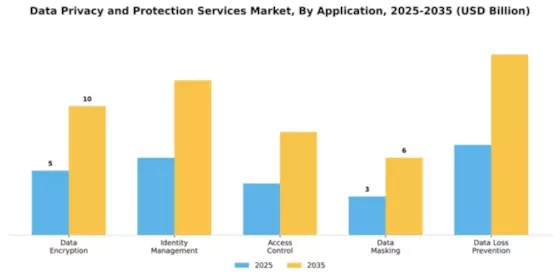
Data Encryption (Dominant) vs. Data Masking (Emerging)
Data Encryption is a dominant force in the market, providing a fundamental layer of security by transforming sensitive information into unreadable formats, thus protecting it from unauthorized access. Organizations implement encryption protocols to ensure compliance with stringent data protection regulations and boost user confidence. On the other hand, Data Masking is emerging as a vital application, especially in sectors handling sensitive information. It allows companies to obscure specific data within a database without altering its original purpose, thus facilitating safe data sharing for testing and analytics. As data privacy concerns heighten, both segmentation values play crucial roles in comprehensive data protection strategies, with encryption maintaining dominance and masking gaining traction.
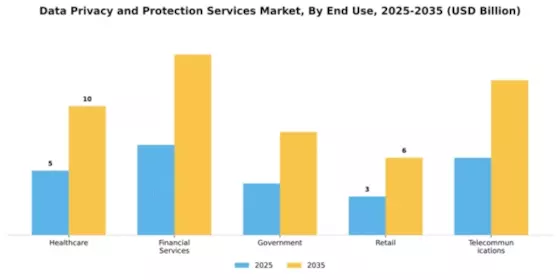
The Data Privacy and Protection Services Market has seen a varied distribution of market share among its end-use segments. Healthcare stands out as the largest segment, driven by stringent regulations and the critical need for safeguarding sensitive patient information. Financial Services follows closely, with heightened attention towards data privacy in the wake of increasing cyber threats. Government, Retail, and Telecommunications also play significant roles but occupy smaller shares due to diverse regulatory frameworks and market needs.
Healthcare: Dominant vs. Financial Services: Emerging
The healthcare sector is characterized by its extensive regulatory requirements and an ongoing commitment to protecting patient data, making it a dominant player in the data privacy and protection landscape. This segment tends to benefit from a variety of solutions tailored to meet compliance and security needs, including data encryption and access controls. On the other hand, the financial services sector is emerging rapidly, responding to the growing awareness of cybersecurity threats. It is adopting advanced technologies to enhance their data protection capabilities, including AI-driven analytics and multi-factor authentication, which contribute to its status as the fastest-growing segment in the market.
In the Data Privacy and Protection Services Market, the deployment type segment is primarily dominated by cloud-based solutions, which capture the largest share due to their flexibility and scalability. On-premises solutions follow closely, favored by organizations seeking enhanced control over their data security practices. The hybrid deployment model is gaining traction, offering a combination of both cloud and on-premises solutions, attracting a substantial user base for specific compliance needs.
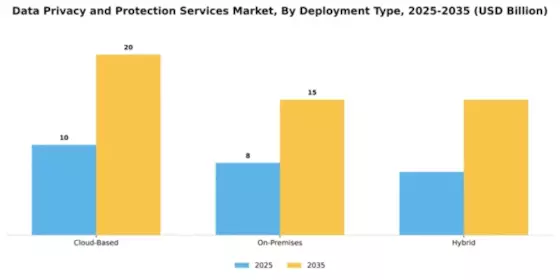
On-Premises (Dominant) vs. Hybrid (Emerging)
On-premises deployment remains a dominant force within the Data Privacy and Protection Services Market, as it provides organizations with complete control over their data management and security protocols. This model is especially favored by highly regulated industries where data sovereignty and compliance are paramount. In contrast, the hybrid deployment is emerging as a flexible solution, enabling organizations to combine the benefits of both on-premises and cloud-based services. This approach is appealing as it supports transitioning workloads to the cloud while retaining critical applications on-site, thereby reducing latency and enhancing data governance.
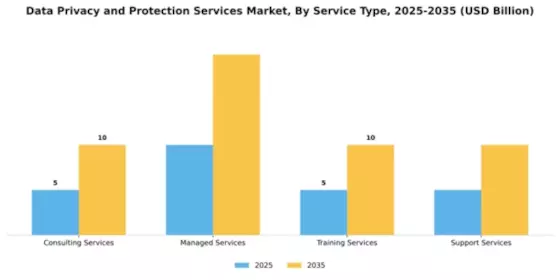
The Data Privacy and Protection Services Market is diverse, with consulting services dominating the landscape. Among these segments, consulting services hold a substantial share, driven by companies seeking expert guidance on compliance with data protection regulations. Managed services, on the other hand, are emerging as the fastest-growing segment, illustrated by the increasing demand for outsourced data privacy solutions that allow organizations to focus on their core competencies while mitigating risks associated with data breaches. As businesses continue to prioritize cybersecurity, the adoption of both consulting and managed services is expected to expand, reflecting the urgent need for comprehensive data protection strategies.
Consulting Services: Dominant vs. Managed Services: Emerging
Consulting services are characterized by their role in providing tailored advice and strategic guidance on data privacy issues, helping organizations to navigate complex regulatory environments and implement effective data protection frameworks. This segment is marked by an established presence in the market, with firms relying on the expertise of consultants to not only comply with legal requirements but also to build trust with their clients. In contrast, managed services have emerged as a dynamic and growing segment, recognized for their ability to deliver ongoing support and management of data protection solutions. This proactive service delivery model is appealing to organizations that lack the resources or expertise to manage their data privacy needs internally, thus driving rapid growth in this area.
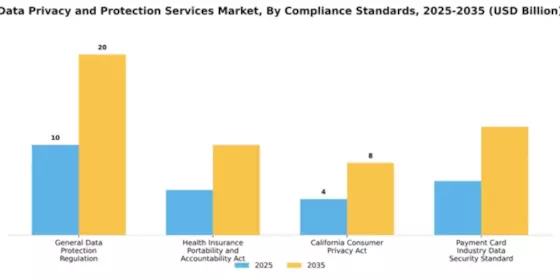
In the Data Privacy and Protection Services Market, the General Data Protection Regulation (GDPR) holds a significant market share due to its comprehensive framework for data privacy across Europe. Following closely, the Health Insurance Portability and Accountability Act (HIPAA) plays a crucial role in the health sector, while the California Consumer Privacy Act (CCPA) is progressively gaining traction, reflecting strong consumer demand for privacy rights. Moreover, the Payment Card Industry Data Security Standard (PCI DSS) serves as a critical compliance benchmark in the payment industry, ensuring secure transactions and protecting cardholder data.
General Data Protection Regulation (Dominant) vs. California Consumer Privacy Act (Emerging)
The General Data Protection Regulation (GDPR) remains the dominant force in the Data Privacy and Protection Services Market, setting a global standard for data protection and privacy. Its rigorous requirements have compelled organizations across various sectors to enhance their compliance frameworks. In contrast, the California Consumer Privacy Act (CCPA) is emerging rapidly as a significant influence, driven by increasing consumer awareness and demand for transparency in data usage. The CCPA's growing legislative footprint is shaping new privacy norms, making it essential for businesses operating in the Californian market to adopt robust privacy measures. Both regulations are pivotal in promoting accountability, but their differing scopes and objectives highlight the diverse needs in data privacy compliance.
Get more detailed insights about Data Privacy and Protection Services Market Request Free Sample
North America continues to lead the Data Privacy and Protection Services Market, holding a significant market share of 12.5 in 2024. The region's growth is driven by stringent regulations such as the CCPA and GDPR, which compel organizations to prioritize data protection. Additionally, the increasing frequency of cyber threats and data breaches has heightened demand for robust privacy solutions, making compliance a critical focus for businesses. The competitive landscape is characterized by the presence of major players like IBM, Microsoft, and Oracle, which dominate the market with innovative solutions. The U.S. remains a key player, supported by a strong technological infrastructure and a proactive regulatory environment. As organizations invest heavily in data privacy technologies, North America is expected to maintain its leadership position in the coming years.
Europe's Data Privacy and Protection Services Market is projected to grow significantly, with a market size of 7.5 in 2024. The region's growth is largely driven by the General Data Protection Regulation (GDPR), which mandates strict compliance for data handling and processing. This regulatory framework has created a heightened awareness among businesses regarding data privacy, leading to increased investments in protection services. Leading countries such as Germany, France, and the UK are at the forefront of this market, with a competitive landscape featuring key players like SAP and Cisco. The emphasis on data sovereignty and local compliance has spurred demand for tailored solutions. As organizations adapt to evolving regulations, the market is expected to see continued growth, driven by both compliance needs and consumer trust in data handling practices.
The Asia-Pacific region is witnessing a burgeoning Data Privacy and Protection Services Market, with a size of 4.5 in 2024. This growth is fueled by increasing digitalization, rising internet penetration, and a growing awareness of data privacy issues among consumers. Governments in countries like India and Australia are also implementing stricter regulations, which are driving demand for comprehensive data protection solutions. Countries such as Japan, China, and India are leading the charge in adopting data privacy measures. The competitive landscape is evolving, with both local and international players vying for market share. As organizations prioritize data security and compliance, the region is poised for significant growth, making it an attractive market for investment in data privacy services.
The Middle East and Africa (MEA) region is in the nascent stages of developing its Data Privacy and Protection Services Market, currently valued at 0.5 in 2024. The growth is driven by increasing digital transformation initiatives and a rising awareness of data privacy among consumers and businesses. However, the market faces challenges such as varying regulatory frameworks and limited infrastructure in some areas, which can hinder growth. Countries like South Africa and the UAE are leading the way in establishing data protection regulations, creating a more favorable environment for data privacy services. The competitive landscape is gradually evolving, with both local and international players entering the market. As awareness and regulatory frameworks improve, the MEA region presents significant growth opportunities for data privacy solutions.
The Data Privacy and Protection Services Market is currently characterized by a dynamic competitive landscape, driven by increasing regulatory requirements and heightened consumer awareness regarding data security. Major players such as IBM (US), Microsoft (US), and Oracle (US) are strategically positioning themselves through innovation and partnerships, which collectively shape the competitive environment. IBM (US) focuses on integrating AI-driven solutions to enhance data protection capabilities, while Microsoft (US) emphasizes its cloud-based services to provide comprehensive privacy solutions. Oracle (US) is leveraging its extensive database management expertise to offer tailored privacy services, indicating a trend towards specialization in service offerings.The market structure appears moderately fragmented, with a mix of established players and emerging startups. Key business tactics include localizing services to meet regional compliance requirements and optimizing supply chains to enhance service delivery. This fragmentation allows for diverse offerings, yet the influence of major players remains substantial, as they set benchmarks for service quality and innovation.In November IBM (US) announced a strategic partnership with a leading cybersecurity firm to enhance its data protection services. This collaboration aims to integrate advanced threat detection capabilities into IBM's existing offerings, thereby strengthening its market position. The strategic importance of this move lies in IBM's commitment to staying ahead of emerging threats, which is crucial in a landscape where data breaches are increasingly sophisticated.In October Microsoft (US) launched a new suite of privacy tools designed specifically for small and medium-sized enterprises (SMEs). This initiative reflects Microsoft's strategy to democratize access to advanced data protection technologies, enabling SMEs to better safeguard their information. The launch is significant as it not only expands Microsoft's customer base but also addresses a critical gap in the market, where SMEs often lack the resources to implement robust data privacy measures.In September Oracle (US) unveiled a new compliance framework aimed at helping organizations navigate the complexities of global data protection regulations. This framework is particularly relevant as businesses face increasing scrutiny from regulators worldwide. By providing a comprehensive solution, Oracle positions itself as a leader in compliance, which is likely to enhance its competitive edge in the market.As of December current trends in the Data Privacy and Protection Services Market include a strong emphasis on digitalization, AI integration, and sustainability. Strategic alliances are increasingly shaping the landscape, as companies recognize the need for collaborative approaches to tackle complex data privacy challenges. Looking ahead, competitive differentiation is expected to evolve, with a shift from price-based competition towards innovation and technology-driven solutions. The focus on supply chain reliability will also play a crucial role in determining market leaders, as organizations seek to ensure the integrity and security of their data.





The Data Privacy and Protection Services Market is projected to grow at a 6.5% CAGR from 2025 to 2035, driven by regulatory compliance, increasing cyber threats, and consumer awareness.
New opportunities lie in:
By 2035, the market is expected to be robust, reflecting heightened demand for data privacy solutions.
| MARKET SIZE 2024 | 25.0(USD Billion) |
| MARKET SIZE 2025 | 26.62(USD Billion) |
| MARKET SIZE 2035 | 50.0(USD Billion) |
| COMPOUND ANNUAL GROWTH RATE (CAGR) | 6.5% (2025 - 2035) |
| REPORT COVERAGE | Revenue Forecast, Competitive Landscape, Growth Factors, and Trends |
| BASE YEAR | 2024 |
| Market Forecast Period | 2025 - 2035 |
| Historical Data | 2019 - 2024 |
| Market Forecast Units | USD Billion |
| Key Companies Profiled | IBM (US), Microsoft (US), Oracle (US), SAP (DE), Cisco (US), Symantec (US), McAfee (US), Palo Alto Networks (US), Trustwave (US) |
| Segments Covered | Application, End Use, Deployment Type, Service Type, Compliance Standards |
| Key Market Opportunities | Growing regulatory frameworks and consumer demand drive innovation in the Data Privacy and Protection Services Market. |
| Key Market Dynamics | Rising regulatory scrutiny drives demand for comprehensive data privacy and protection services across various industries. |
| Countries Covered | North America, Europe, APAC, South America, MEA |
The market valuation was 25.0 USD Billion in 2024.
The market is projected to reach 50.0 USD Billion by 2035.
The expected CAGR for the market from 2025 to 2035 is 6.5%.
Key players include IBM, Microsoft, Oracle, SAP, Cisco, Symantec, McAfee, Palo Alto Networks, and Trustwave.
Primary applications include Data Encryption, Identity Management, Access Control, Data Masking, and Data Loss Prevention.
The market segments by end use include Healthcare, Financial Services, Government, Retail, and Telecommunications.
Deployment types include Cloud-Based, On-Premises, and Hybrid solutions.
Service types include Consulting Services, Managed Services, Training Services, and Support Services.
Relevant compliance standards include the General Data Protection Regulation, HIPAA, CCPA, and PCI DSS.
Data Encryption is expected to grow from 5.0 to 10.0 USD Billion during the forecast period.


Kindly complete the form below to receive a free sample of this Report

“This is really good guys. Excellent work on a tight deadline. I will continue to use you going forward and recommend you to others. Nice job”


“Thanks. It’s been a pleasure working with you, please use me as reference with any other Intel employees.”


“Thanks for sending the report it gives us a good global view of the Betaïne market.”


“Thank you, this will be very helpful for OQS.”


“We found the report very insightful! we found your research firm very helpful. I'm sending this email to secure our future business.”


“I am very pleased with how market segments have been defined in a relevant way for my purposes (such as "Portable Freezers & refrigerators" and "last-mile"). In general the report is well structured. Thanks very much for your efforts.”


“I have been reading the first document or the study, ,the Global HVAC and FP market report 2021 till 2026. Must say, good info! I have not gone in depth at all parts, but got a good indication of the data inside!”


“We got the report in time, we really thank you for your support in this process. I also thank to all of your team as they did a great job.”


“The Automotive 48V ECU Components Procurement Intelligence Study” was a complex project, but the Market Research Future (MRFR) team handled it with quality, agility, and customer-centricity. They delivered all requested data on time and within the agreed scope. The team, including Shubhendra Anand and Rahul Gotadki, was always readily available to clarify questions and swiftly implement necessary adjustments, driving the project to a successful conclusion within a very demanding timeframe.
I would also like to specifically commend Akshay Agarwal for his responsiveness and support at every stage—from our initial inquiry on May 6th through to final delivery on June 18th. His dedication made the entire process seamless.”



