Data Science Platform Market Summary
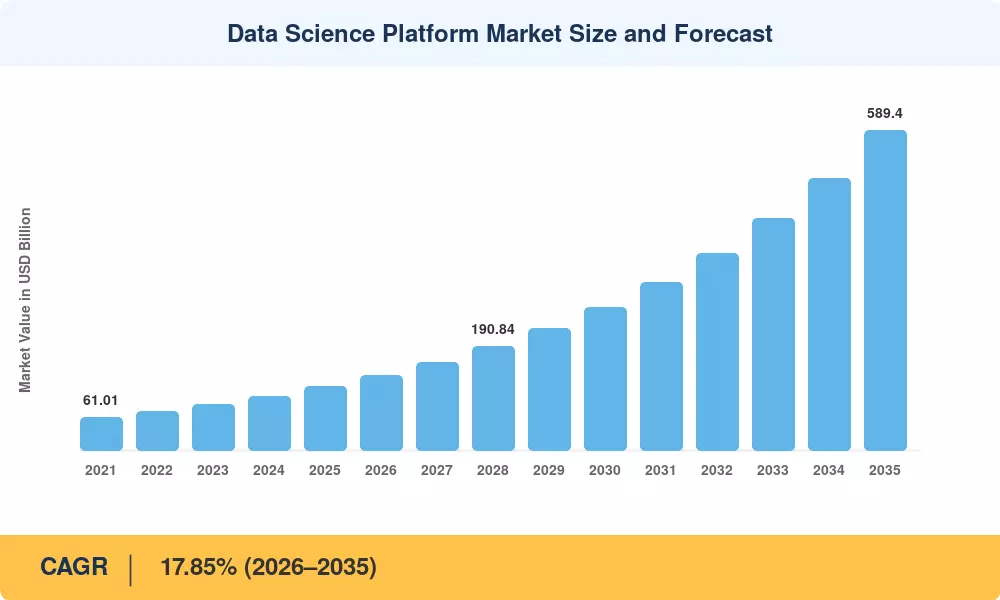
The Data Science Platform Market stood at an estimated USD 117.70 billion in 2025 and is projected to reach USD 142.86 billion in 2026 before climbing to USD 589.40 billion by 2035, registering a CAGR of 17.85% during the forecast period 2026–2035. This expansion is anchored in aggressive enterprise AI adoption mandates—exemplified by the U.S. Executive Order on Safe, Secure, and Trustworthy AI (October 2023) and the EU AI Act's phased enforcement beginning 2025—that compel organizations to adopt governed, end-to-end MLOps and data science platforms capable of meeting auditability and reproducibility requirements [1][2].
A decisive technology shift is underway: siloed Jupyter notebooks and standalone statistical packages are giving way to integrated data science workflow orchestration tools that unify data ingestion, feature engineering, model training, and deployment infrastructure, monitoring, and governance in a single control plane. Hyperscalers invested over USD 60 billion collectively in AI infrastructure during 2024 alone, bundling AutoML platforms for citizen data scientists into existing cloud contracts and accelerating migration from on-premise legacy stacks.
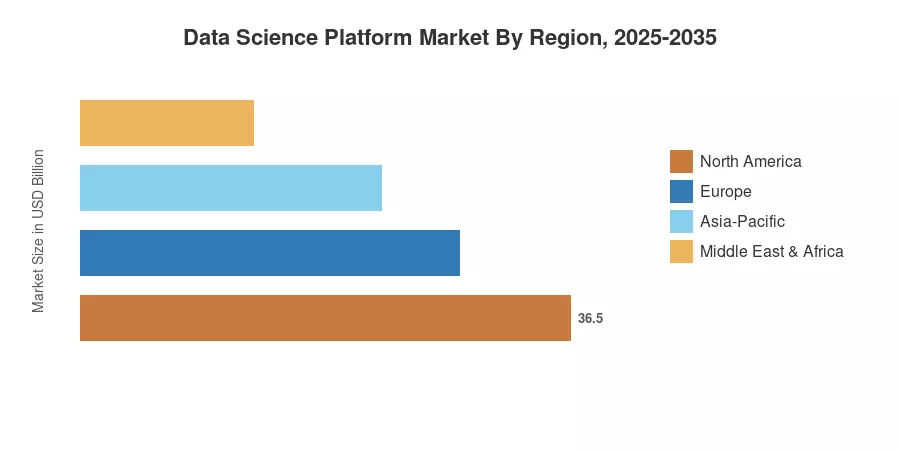
North America commanded approximately 43.80% of the Data Science Platform Market in 2025, underpinned by Silicon Valley R&D concentration and federal AI spending. Asia-Pacific is the fastest-growing region at a projected 18.40% CAGR, driven by India's Digital India program and China's New Generation AI Development Plan. Europe held the second-largest share at roughly 25.60%, propelled by GDPR-compliant analytics demand and the European Data Strategy's EUR 4.6 billion allocation[5]. As foundation-model economics reshape vendor positioning, the next decade will reward platforms that deliver seamless collaborative Jupyter notebook environments alongside enterprise-grade governance.
Key Report Takeaways
• By Product Offering
- Platforms captured 67.90% of the Data Science Platform Market revenue in 2025, reflecting enterprise preference for unified toolchains over point solutions
- Services are forecast to expand at an 18.95% CAGR through 2035, fueled by demand for consulting-led MLOps implementation
• By Deployment
- Cloud deployment held 62.70% of the Data Science Platform Market share in 2025, driven by elastic GPU provisioning and pay-as-you-go model training and deployment infrastructure
- By Enterprise Size
- SMEs are poised to grow at a 20.30% CAGR as no-code AutoML platforms for citizen data scientists lower adoption barriers
• By End-User Industry & Geography
- BFSI led end-user spending with 22.90% share of the Data Science Platform Market in 2025
- By Region
- Asia-Pacific is projected to post the highest regional CAGR of 18.40%, with healthcare and life sciences advancing fastest among verticals at 20.75% CAGR
MRFR's sizing model combines top-down revenue analysis of platform and services vendors with bottom-up deployment surveys across 42 countries, triangulated against hyperscaler disclosed AI revenue and third-party analyst benchmarks.





















.webp?v=1782888024)
