Download Free Sample
Kindly complete the form below to receive a free sample of this Report
Database Management Systems MRO Services Market Research Report By End Use (Healthcare, Finance, Retail, Telecommunications), By User Type (Small Enterprises, Medium Enterprises, Large Enterprises), By Application (Data Storage, Data Retrieval, Data Analysis, Data Security), By Service Type (Database Administration, Database Backup And Recovery, Database Migration, Database Performance Tuning), By Deployment Type (On-Premises, Cloud-Based, Hybrid) And By Region (North America, Europe, Asia-Pacific, And Rest Of The World) – Market Forecast Till 2035.
As per MRFR analysis, the Database Management Systems MRO Services Market was estimated at 5.5 USD Billion in 2024. The Database Management Systems MRO Services industry is projected to grow from 5.86 USD Billion in 2025 to 11.0 USD Billion by 2035, exhibiting a compound annual growth rate (CAGR) of 6.5% during the forecast period 2025 - 2035.
The Database Management Systems MRO Services Market is experiencing robust growth driven by technological advancements and increasing data management needs.
| 2024 Market Size | 5.5 (USD Billion) |
| 2035 Market Size | 11.0 (USD Billion) |
| CAGR (2025 - 2035) | 6.5% |
Oracle Corporation (US), Microsoft Corporation (US), IBM Corporation (US), SAP SE (DE), Amazon Web Services (US), Google LLC (US), Teradata Corporation (US), MariaDB Corporation (US), Couchbase Inc. (US)
Our Impact
Enabled $4.3B Revenue Impact for Fortune 500 and Leading Multinationals
Partnering with 2000+ Global Organizations Each Year
30K+ Citations by Top-Tier Firms in the Industry
The Database Management Systems MRO Services Market is currently experiencing a transformative phase, characterized by the increasing integration of advanced technologies. Organizations are increasingly recognizing the necessity of efficient data management and maintenance, which has led to a surge in demand for MRO services. This market appears to be driven by the need for enhanced operational efficiency, data security, and compliance with regulatory standards. As businesses continue to evolve, the focus on optimizing database performance and reliability becomes paramount. Furthermore, the growing complexity of data environments necessitates specialized services that can address unique organizational challenges. In addition, the market landscape is shifting towards cloud-based solutions, which offer scalability and flexibility. This trend suggests that organizations are moving away from traditional on-premises systems, opting instead for more agile and cost-effective alternatives. The emphasis on real-time data access and analytics is likely to further propel the adoption of MRO services. As the Database Management Systems MRO Services Market continues to expand, stakeholders must remain vigilant to emerging technologies and evolving customer needs, ensuring they adapt their strategies accordingly.
The shift towards cloud-based database management systems is becoming increasingly prevalent. Organizations are recognizing the benefits of scalability, flexibility, and cost-effectiveness that cloud solutions offer. This trend indicates a move away from traditional on-premises systems, as businesses seek to enhance their operational capabilities.
As data breaches and regulatory requirements become more stringent, there is a heightened emphasis on data security within the Database Management Systems MRO Services Market. Organizations are prioritizing services that ensure compliance with industry standards, thereby safeguarding sensitive information and maintaining customer trust.
The incorporation of advanced analytics into database management practices is gaining traction. This trend suggests that organizations are increasingly leveraging data insights to drive decision-making processes. By utilizing sophisticated analytical tools, businesses can enhance their operational efficiency and gain a competitive edge.
With the rise of data privacy regulations, organizations are compelled to ensure compliance with various legal frameworks. The Database Management Systems MRO Services Market is significantly influenced by the need for adherence to regulations such as GDPR and HIPAA. Companies are investing in MRO services to maintain compliance and avoid hefty fines associated with data breaches. The market for compliance-related database management solutions is expected to grow, as organizations prioritize data governance and risk management. This focus on regulatory compliance not only enhances data security but also fosters trust among customers, thereby driving the demand for MRO services in the database management sector.
The increasing reliance on data analytics for business intelligence is a key driver for the Database Management Systems MRO Services Market. Organizations are recognizing the value of data-driven insights in enhancing operational efficiency and customer engagement. As a result, there is a heightened demand for MRO services that facilitate the integration of advanced analytics into database systems. The market for data analytics tools is expected to expand significantly, with projections indicating a growth rate of over 15% annually. This trend underscores the necessity for organizations to invest in MRO services that ensure their database systems are equipped to handle complex analytical tasks, thereby driving the overall growth of the market.
The increasing volume of data generated by organizations necessitates robust data management solutions. As businesses strive to harness data for strategic decision-making, the Database Management Systems MRO Services Market is witnessing a surge in demand. According to recent estimates, the data management market is projected to grow at a compound annual growth rate of over 12% through 2026. This growth is driven by the need for efficient data storage, retrieval, and analysis, which are critical for operational efficiency. Organizations are increasingly investing in MRO services to ensure their database systems are optimized for performance and reliability. This trend indicates a strong correlation between data management needs and the expansion of the Database Management Systems MRO Services Market.
The transition to hybrid and multi-cloud environments is reshaping the landscape of the Database Management Systems MRO Services Market. Organizations are increasingly adopting these models to enhance flexibility, scalability, and cost-effectiveness. This shift necessitates robust MRO services that can manage databases across diverse cloud platforms. The market for cloud-based database management solutions is projected to grow substantially, driven by the need for seamless integration and management of data across multiple environments. As businesses seek to optimize their cloud strategies, the demand for MRO services that support hybrid and multi-cloud database management is likely to rise, indicating a transformative trend in the industry.
The rapid evolution of technology is reshaping the Database Management Systems MRO Services Market. Innovations such as artificial intelligence, machine learning, and automation are enhancing database management capabilities. These technologies enable organizations to streamline operations, reduce costs, and improve data accuracy. The integration of AI-driven analytics into database management systems is particularly noteworthy, as it allows for predictive maintenance and proactive issue resolution. As organizations seek to leverage these advancements, the demand for MRO services that support cutting-edge database technologies is likely to increase. This trend suggests a dynamic shift in how database management is approached, with a focus on efficiency and innovation.
In the Database Management Systems MRO Services Market, the Application segment showcases diverse functionalities with varying contributions to market share. Data Storage emerges as the largest segment, significantly dominating the landscape due to its essential role in managing vast quantities of structured and unstructured data. In contrast, Data Retrieval and Data Security collectively hold noteworthy shares, focusing on ensuring efficient access and safeguarding sensitive information, respectively. Meanwhile, Data Analysis, while currently smaller in share, reflects substantial growth potential as organizations increasingly prioritize analytics for informed decision-making. Growth trends within this Application segment are driven by technological advancements and the rising demand for data-driven insights. As businesses recognize the critical need for effective Data Storage solutions, investments in robust infrastructure are surging. Further, Data Analysis is rapidly becoming the fastest-growing area, propelled by the adoption of advanced analytical tools and methodologies. This trend aligns with the growing emphasis on big data and predictive analytics, compelling organizations to harness data not only for storage but also for strategic advantage.
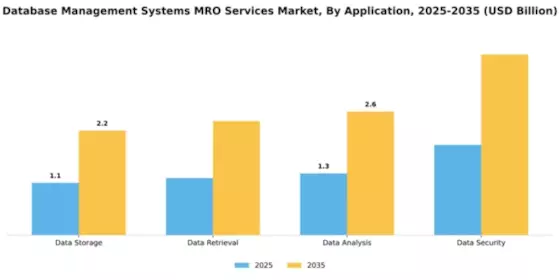
Data Storage (Dominant) vs. Data Analysis (Emerging)
In the Database Management Systems MRO Services Market, Data Storage stands out as the dominant segment, characterized by its capability to manage and store vast amounts of data efficiently and reliably. This segment is critical for organizations that require robust infrastructure to facilitate continuous data availability and quick retrieval processes. With advancements in storage technologies, organizations are increasingly moving towards cloud-based solutions, enhancing scalability and flexibility. On the other hand, Data Analysis is viewed as an emerging segment, gaining momentum as more companies adopt data-driven strategies. Organizations recognize the importance of leveraging data insights to shape business strategies and improve operational efficiency. As a result, investments in analytical tools and skilled personnel are on the rise, positioning Data Analysis as a key area for future growth alongside established storage solutions.
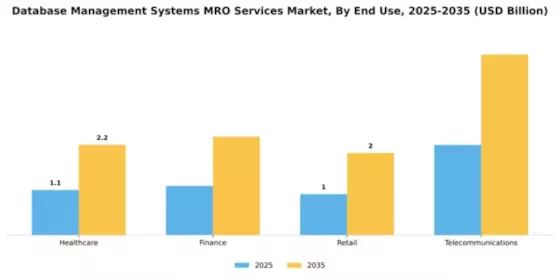
The Database Management Systems MRO Services Market is significantly influenced by various end-use industries. Among these, the healthcare sector is currently the largest segment, driven by the escalating need for efficient data management and regulatory compliance. It encompasses a wide range of services, including electronic health records, patient management systems, and more, which collectively create a robust demand for MRO services. Telecommunications, on the other hand, is emerging rapidly as a significant end-user, propelled by the ongoing digitization and demand for reliable data management solutions in managing massive volumes of data traffic and customer relationship management systems.
Healthcare (Dominant) vs. Telecommunications (Emerging)
In the Database Management Systems MRO Services Market, healthcare is recognized as the dominant segment due to its extensive reliance on data integrity and security. This sector prioritizes MRO services to enhance operational workflows, ensure compliance with health regulations, and improve patient outcomes. Conversely, telecommunications stands as an emerging segment that is swiftly gaining traction. This growth is attributed to the sector's need to handle vast datasets, support real-time communications, and maintain system uptime. The advancements in technology and increasing customer expectations make telecommunications a critical player in the MRO services realm, pushing providers to innovate and optimize their solutions.
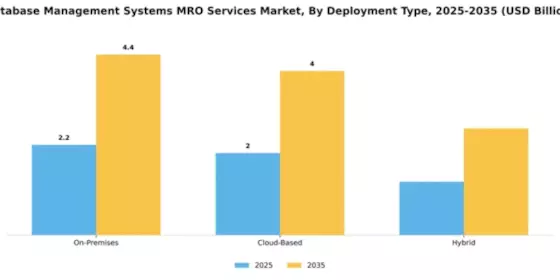
In the Database Management Systems MRO Services Market, the deployment type segments show a distinct distribution of market share. Cloud-Based solutions lead the segment, primarily due to their scalability, flexibility, and lower upfront costs. This segment includes services that store data off-site, allowing organizations to reduce their physical infrastructure investments. On-Premises deployment, while still significant, is experiencing a decline as organizations are increasingly shifting towards more flexible solutions. Hybrid deployment combines both on-premises and cloud-based solutions, providing a balance that caters to diverse business needs, although it currently holds a smaller share overall. The growth trends in this market segment are driven by a rapid digital transformation that encourages businesses to seek more robust and efficient data management solutions. The Cloud-Based segment benefits from technological advancements and a growing acceptance of remote access to data. In contrast, the Hybrid segment is emerging as organizations seek to leverage existing on-premises investments while gradually migrating to the cloud. Factors such as increased data security concerns, compliance requirements, and the demand for seamless data access further propel the growth of Hybrid solutions alongside the well-established Cloud-Based offerings.
Cloud-Based (Dominant) vs. Hybrid (Emerging)
Cloud-Based deployment has established itself as the dominant force in the Database Management Systems MRO Services Market. Characterized by its ability to provide scalable resources and cost-effectiveness, this deployment type enables organizations to manage large volumes of data without the overhead costs associated with physical infrastructure. Its growth is fueled by the demand for remote access and collaboration tools, appealing to businesses of all sizes. On the other hand, Hybrid deployment represents an emerging trend, allowing businesses to blend on-premises resources with cloud functionalities. This flexibility is particularly attractive for companies looking to enhance their data management strategies without abandoning existing systems. Users are increasingly recognizing the advantages of Hybrid deployment in balancing performance and security, marking it as a notable growth area in the market.
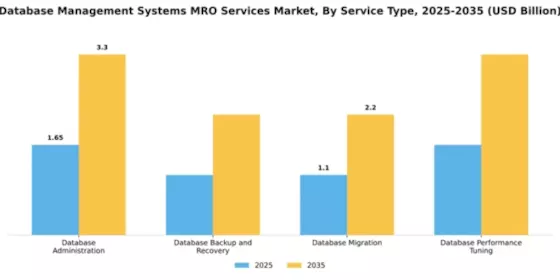
In the Database Management Systems MRO Services Market, Database Administration currently represents the largest share among service types. It is integral to the efficient operation and management of databases, ensuring data integrity, availability, and performance. Conversely, Database Backup and Recovery is rapidly gaining traction, driven by increasing concerns over data loss and the critical need for disaster recovery solutions. Companies are increasingly prioritizing robust backup strategies to safeguard their databases against unforeseen events.
Database Administration (Dominant) vs. Database Backup and Recovery (Emerging)
Database Administration plays a pivotal role in maintaining optimal database performance and user access, making it a dominant service in the MRO landscape. This service encompasses configured setups, security oversight, and routine maintenance tasks required to ensure databases function smoothly. In contrast, Database Backup and Recovery is emerging as a crucial service amid the growing prevalence of cyber threats and data loss incidents. Organizations are invested in implementing effective backup solutions that not only protect data but also ensure swift recovery processes, thus highlighting a shift towards more comprehensive data management strategies.
In the Database Management Systems MRO Services Market, the user type segment is characterized by a varied distribution of market share among small, medium, and large enterprises. Small enterprises currently hold the largest share, primarily due to their growing reliance on affordable and efficient database management solutions. Meanwhile, large enterprises are experiencing a surge in adoption rates, leveraging advanced tools for complex data management and analytics, as they seek to enhance operational efficiency and decision-making capabilities. The growth trends for the user type segment reflect a shift in the market dynamics as technology evolves. Small enterprises are increasingly embracing cloud-based database solutions, seeking scalable options that fit their budgets. Conversely, large enterprises are on the rise, driven by the demand for robust data solutions that support vast operations. Factors underwriting this trend include globalization, increased data generation, and the imperative for data-driven strategies across all business sizes.
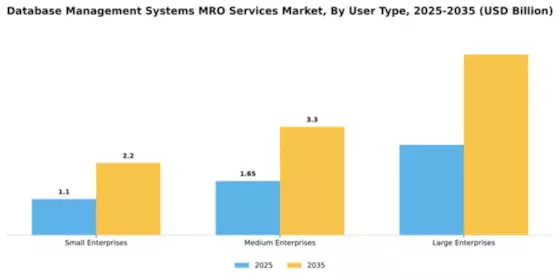
Small Enterprises (Dominant) vs. Large Enterprises (Emerging)
In the Database Management Systems MRO Services Market, small enterprises are regarded as a dominant force due to their established presence and affordability in database management solutions. These organizations often prioritize cost-effectiveness and ease of use, enabling them to swiftly adapt to evolving technological landscapes. On the other hand, large enterprises are emerging as pivotal players in this segment as they bolster their operations with sophisticated database management systems. Their focus on innovation, data analytics, and integration of advanced technologies enhances their market position, making large enterprises key contributors to the overall growth of MRO services within the database management domain.
Get more detailed insights about Database Management Systems MRO Services Market Request Free Sample
North America continues to lead the Database Management Systems MRO Services market, holding a significant share of 2.75B in 2024. The region's growth is driven by rapid technological advancements, increasing demand for data-driven decision-making, and robust regulatory frameworks that support innovation. Companies are investing heavily in cloud solutions and AI technologies, further propelling market expansion. The competitive landscape is characterized by the presence of major players such as Oracle, Microsoft, and IBM, which dominate the market with their comprehensive service offerings. The U.S. remains the largest contributor, supported by a strong IT infrastructure and a skilled workforce. As organizations increasingly prioritize data management, the market is expected to witness sustained growth, solidifying North America's position as a global leader.
Europe's Database Management Systems MRO Services market is valued at 1.5B, reflecting a growing demand for efficient data management solutions. The region is witnessing a shift towards digital transformation, driven by regulatory requirements such as GDPR, which emphasizes data protection and management. This regulatory landscape is fostering innovation and investment in MRO services, enhancing market growth. Leading countries like Germany, the UK, and France are at the forefront of this transformation, with significant contributions from local and international players. Companies such as SAP and IBM are expanding their offerings to meet the evolving needs of businesses. The competitive environment is intensifying as organizations seek to leverage data analytics for strategic advantages, positioning Europe as a key player in the global market.
The Asia-Pacific region, with a market size of 1.2B, is rapidly emerging as a significant player in the Database Management Systems MRO Services market. The growth is fueled by increasing digitalization, a surge in data generation, and a rising number of SMEs adopting cloud-based solutions. Governments are also promoting initiatives to enhance IT infrastructure, which is expected to further boost market demand. Countries like China, India, and Japan are leading the charge, with a growing number of local and international companies entering the market. Key players such as Oracle and Microsoft are expanding their presence, catering to the diverse needs of businesses in the region. The competitive landscape is evolving, with a focus on innovation and customer-centric solutions, making Asia-Pacific a vibrant market for MRO services.
The Middle East and Africa region, with a market size of 0.05B, is still in the nascent stages of developing its Database Management Systems MRO Services market. However, there is a growing recognition of the importance of data management, driven by increasing digital transformation initiatives across various sectors. Governments are investing in technology to enhance operational efficiencies, which is expected to catalyze market growth. Countries like South Africa and the UAE are leading the way, with efforts to improve IT infrastructure and attract foreign investment. Despite challenges such as limited awareness and resources, the presence of global players is gradually increasing, fostering a competitive environment. As the region continues to evolve, opportunities for growth in MRO services are becoming more apparent.
The Database Management Systems MRO Services Market is characterized by a dynamic competitive landscape, driven by rapid technological advancements and increasing demand for data management solutions. Key players such as Oracle Corporation (US), Microsoft Corporation (US), and IBM Corporation (US) are strategically positioned to leverage their extensive portfolios and innovative capabilities. Oracle Corporation (US) focuses on cloud-based solutions, enhancing its offerings through continuous innovation and strategic partnerships. Microsoft Corporation (US) emphasizes integration with its Azure platform, aiming to provide seamless data management services. Meanwhile, IBM Corporation (US) is concentrating on AI-driven analytics, which appears to be a significant differentiator in the market. Collectively, these strategies shape a competitive environment that is increasingly focused on technological innovation and customer-centric solutions.In terms of business tactics, companies are localizing their operations and optimizing supply chains to enhance efficiency and responsiveness. The market structure is moderately fragmented, with several players vying for market share. However, the collective influence of major companies like Amazon Web Services (US) and Google LLC (US) is notable, as they continue to expand their cloud services and data management capabilities, thereby intensifying competition.
In November Oracle Corporation (US) announced a strategic partnership with a leading AI firm to enhance its database management solutions. This collaboration is expected to integrate advanced AI capabilities into Oracle's offerings, potentially improving data processing speeds and analytics accuracy. Such a move underscores Oracle's commitment to innovation and positions it favorably against competitors.
In October Microsoft Corporation (US) launched a new feature within its Azure platform that allows for real-time data analytics across multiple databases. This enhancement is likely to attract businesses seeking to streamline their data management processes, thereby reinforcing Microsoft's competitive edge in the market. The integration of real-time analytics could significantly improve decision-making for enterprises, indicating a shift towards more agile data management solutions.
In September IBM Corporation (US) unveiled its latest AI-driven database management system, which is designed to optimize data storage and retrieval processes. This development is crucial as it aligns with the growing trend of AI integration in data management, suggesting that IBM is positioning itself as a leader in this niche. The emphasis on AI capabilities may enhance customer satisfaction and retention, further solidifying IBM's market presence.
As of December current competitive trends indicate a strong focus on digitalization, sustainability, and AI integration within the Database Management Systems MRO Services Market. Strategic alliances are increasingly shaping the landscape, as companies recognize the value of collaboration in driving innovation. The competitive differentiation is likely to evolve from traditional price-based competition to a more nuanced approach that prioritizes technological advancement, reliability in supply chains, and innovative solutions. This shift suggests that companies must continuously adapt to maintain their competitive edge in an ever-evolving market.



The Database Management Systems MRO Services Market is projected to grow at a 6.5% CAGR from 2025 to 2035, driven by increasing data management needs and technological advancements.
New opportunities lie in:
By 2035, the market is expected to be robust, reflecting substantial growth and innovation.
| MARKET SIZE 2024 | 5.5(USD Billion) |
| MARKET SIZE 2025 | 5.86(USD Billion) |
| MARKET SIZE 2035 | 11.0(USD Billion) |
| COMPOUND ANNUAL GROWTH RATE (CAGR) | 6.5% (2025 - 2035) |
| REPORT COVERAGE | Revenue Forecast, Competitive Landscape, Growth Factors, and Trends |
| BASE YEAR | 2024 |
| Market Forecast Period | 2025 - 2035 |
| Historical Data | 2019 - 2024 |
| Market Forecast Units | USD Billion |
| Key Companies Profiled | Oracle Corporation (US), Microsoft Corporation (US), IBM Corporation (US), SAP SE (DE), Amazon Web Services (US), Google LLC (US), Teradata Corporation (US), MariaDB Corporation (US), Couchbase Inc. (US) |
| Segments Covered | Application, End Use, Deployment Type, Service Type, User Type |
| Key Market Opportunities | Integration of artificial intelligence enhances efficiency in Database Management Systems MRO Services Market operations. |
| Key Market Dynamics | Rising demand for efficient data management drives innovation and competition in Database Management Systems Maintenance, Repair, and Overhaul Services. |
| Countries Covered | North America, Europe, APAC, South America, MEA |
The projected market valuation for the Database Management Systems MRO Services Market is expected to reach 11.0 USD Billion by 2035.
The overall market valuation was 5.5 USD Billion in 2024.
The expected CAGR for the Database Management Systems MRO Services Market during the forecast period 2025 - 2035 is 6.5%.
Key players in the market include Oracle Corporation, Microsoft Corporation, IBM Corporation, SAP SE, Amazon Web Services, Google LLC, Teradata Corporation, MariaDB Corporation, and Couchbase Inc.
The Data Security segment was valued at 1.9 USD Billion in 2024 and is projected to grow to 3.8 USD Billion by 2035.
The Telecommunications sector was valued at 2.2 USD Billion in 2024 and is expected to reach 4.4 USD Billion by 2035.
The On-Premises deployment type was valued at 2.2 USD Billion in 2024 and is anticipated to grow to 4.4 USD Billion by 2035.
Database Administration services were valued at 1.65 USD Billion in 2024 and are projected to reach 3.3 USD Billion by 2035.
Small enterprises were valued at 1.1 USD Billion in 2024 and are expected to grow to 2.2 USD Billion by 2035.
The Data Retrieval segment was valued at 1.2 USD Billion in 2024 and is projected to increase to 2.4 USD Billion by 2035.



Kindly complete the form below to receive a free sample of this Report

“This is really good guys. Excellent work on a tight deadline. I will continue to use you going forward and recommend you to others. Nice job”


“Thanks. It’s been a pleasure working with you, please use me as reference with any other Intel employees.”


“Thanks for sending the report it gives us a good global view of the Betaïne market.”


“Thank you, this will be very helpful for OQS.”


“We found the report very insightful! we found your research firm very helpful. I'm sending this email to secure our future business.”


“I am very pleased with how market segments have been defined in a relevant way for my purposes (such as "Portable Freezers & refrigerators" and "last-mile"). In general the report is well structured. Thanks very much for your efforts.”


“I have been reading the first document or the study, ,the Global HVAC and FP market report 2021 till 2026. Must say, good info! I have not gone in depth at all parts, but got a good indication of the data inside!”


“We got the report in time, we really thank you for your support in this process. I also thank to all of your team as they did a great job.”


“The Automotive 48V ECU Components Procurement Intelligence Study” was a complex project, but the Market Research Future (MRFR) team handled it with quality, agility, and customer-centricity. They delivered all requested data on time and within the agreed scope. The team, including Shubhendra Anand and Rahul Gotadki, was always readily available to clarify questions and swiftly implement necessary adjustments, driving the project to a successful conclusion within a very demanding timeframe.
I would also like to specifically commend Akshay Agarwal for his responsiveness and support at every stage—from our initial inquiry on May 6th through to final delivery on June 18th. His dedication made the entire process seamless.”



