×
Request Free Sample ×

Kindly complete the form below to receive a free sample of this Report

* Please use a valid business email

Leading companies partner with us for data-driven Insights

clients tt-cursor
Hero Background

Decentralized Electricity Generation Market

ID: MRFR/EnP/34075-HCR
100 Pages
Chitranshi Jaiswal
October 2025

Decentralized Electricity Generation Market Research Report By Technology (Solar Photovoltaic, Wind Turbines, Biomass, Micro Hydro, Fuel Cells), By Component (Inverters, Energy Storage Systems, Control Systems, Switchgear, Electrical Machines), By End Use (Residential, Commercial, Industrial, Utilities), By Fuel Type (Solar, Wind, Biomass, Natural Gas) and By Regional (North America, Europe, South America, Asia Pacific, Middle East and Africa) - Forecast to 2035

Share:
Download PDF ×

We do not share your information with anyone. However, we may send you emails based on your report interest from time to time. You may contact us at any time to opt-out.

Decentralized Electricity Generation Market Infographic
Purchase Options

Decentralized Electricity Generation Market Summary

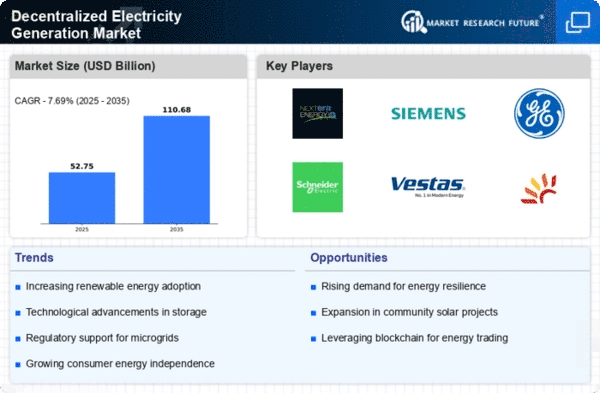
As per MRFR analysis, the Decentralized Electricity Generation Market Size was estimated at 48.98 USD Billion in 2024. The decentralized electricity generation industry is projected to grow from 52.75 USD Billion in 2025 to 110.68 USD Billion by 2035, exhibiting a compound annual growth rate (CAGR) of 7.69 during the forecast period 2025 - 2035.

Key Market Trends & Highlights

The Decentralized Electricity Generation Market is experiencing robust growth driven by renewable energy integration and technological advancements.

  • The market is witnessing a rise in renewable energy integration, particularly in North America, which remains the largest market.
  • Advancements in energy storage technologies are enhancing the efficiency and reliability of decentralized systems, especially in the Asia-Pacific region.
  • The residential segment continues to dominate the market, while the microgrid segment is emerging as the fastest-growing area of interest.
  • Increasing energy demand and supportive policy frameworks are key drivers propelling the market forward.

Market Size & Forecast

2024 Market Size 48.98 (USD Billion)
2035 Market Size 110.68 (USD Billion)
CAGR (2025 - 2035) 7.69%

Major Players

NextEra Energy (US), Siemens AG (DE), General Electric (US), Schneider Electric (FR), Vestas Wind Systems (DK), Enphase Energy (US), SMA Solar Technology (DE), Canadian Solar (CA), First Solar (US), Brookfield Renewable Partners (CA)

Decentralized Electricity Generation Market Trends

The Decentralized Electricity Generation Market is currently experiencing a transformative phase, characterized by a shift towards localized energy production. This trend is driven by a growing emphasis on sustainability and energy independence, as consumers and businesses alike seek to reduce reliance on traditional centralized power systems. The integration of renewable energy sources, such as solar and wind, into decentralized frameworks appears to be gaining traction, fostering innovation and investment in this sector. Furthermore, advancements in technology, including energy storage solutions and smart grid systems, are likely to enhance the efficiency and reliability of decentralized generation methods. In addition, regulatory frameworks are evolving to support the proliferation of decentralized electricity generation. Governments are increasingly recognizing the potential benefits of distributed energy resources, which may lead to favorable policies and incentives. This environment encourages the adoption of microgrids and community solar projects, which could empower local communities and promote energy resilience. As the Decentralized Electricity Generation Market continues to expand, it seems poised to play a crucial role in the global transition towards a more sustainable energy landscape, potentially reshaping how electricity is produced and consumed in the future.

Rise of Renewable Energy Integration

The integration of renewable energy sources into decentralized systems is becoming more prevalent. This trend reflects a broader commitment to sustainability and reducing carbon footprints, as communities and businesses adopt solar panels and wind turbines to generate their own electricity.

Advancements in Energy Storage Technologies

Innovations in energy storage are enhancing the viability of decentralized electricity generation. Improved battery technologies allow for better management of energy supply and demand, enabling users to store excess energy for later use, thus increasing reliability.

Supportive Regulatory Frameworks

Governments are increasingly implementing policies that favor decentralized electricity generation. These supportive frameworks may include incentives for renewable energy adoption and streamlined processes for connecting decentralized systems to the grid, fostering growth in this market.

Decentralized Electricity Generation Market Drivers

Rising Demand for Renewable Energy

The Global Decentralized Electricity Generation Market Industry is experiencing a notable surge in demand for renewable energy sources. As governments worldwide implement policies aimed at reducing carbon emissions, the shift towards solar, wind, and biomass energy is becoming increasingly pronounced. By 2024, the market is projected to reach 49.0 USD Billion, reflecting a growing preference for sustainable energy solutions. This trend is further supported by technological advancements that enhance the efficiency and affordability of renewable energy systems, making them more accessible to consumers and businesses alike.

Market Segment Insights

By Application: Residential (Largest) vs. Microgrid (Fastest-Growing)

In the Decentralized Electricity Generation Market, the application segments show a varied distribution of market share. The residential segment dominates the market, supported by increasing consumer demand for energy independence and sustainable energy solutions. Following closely is the commercial sector, leveraging decentralized systems to improve operational efficiency and reduce costs. The industrial segment, while significant, is typically more reliant on centralized solutions, though interest in change is growing given sustainability pressures. Meanwhile, utilities are adopting decentralized models to enhance grid resilience.

Residential (Dominant) vs. Microgrid (Emerging)

The residential segment stands out as the dominant force in the Decentralized Electricity Generation Market, driven by homeowners’ desire for energy self-sufficiency, reduced electricity bills, and environmental consciousness. With advancements in technologies such as solar panels and home batteries, this segment benefits from a range of financing options making it increasingly accessible. In contrast, the microgrid segment is emerging rapidly, seen as vital for enhancing energy resilience especially in remote or disaster-prone areas. Microgrids facilitate localized energy generation and storage, offering flexible solutions that can seamlessly integrate renewable sources, catering to regional energy needs while contributing to grid stability.

By Technology: Solar Photovoltaic (Largest) vs. Wind Turbine (Fastest-Growing)

In the Decentralized Electricity Generation Market, Solar Photovoltaic is the largest segment, accounting for a significant portion of overall market share. Its dominance is primarily fueled by decreasing installation costs and substantial government incentives aimed at promoting renewable energy sources. Wind Turbine also holds a notable position in the market, with a rapidly growing presence as technological advancements enhance its efficiency and output. The biomass, hydropower, and geothermal segments, while relevant, currently represent smaller fractions of market share.

Technology: Solar Photovoltaic (Dominant) vs. Wind Turbine (Emerging)

The Solar Photovoltaic segment is characterized by its widespread adoption and robust infrastructure, making it the dominant technology in decentralized electricity generation. Advances in solar panel efficiency and storage solutions continue to drive its relevance and appeal among consumers. Meanwhile, Wind Turbine technology is increasingly recognized as an emerging solution, rapidly gaining traction due to innovative designs and larger turbines that enhance energy capture. As global demand for clean energy rises, both segments are expected to play crucial roles in transforming energy landscapes, with solar leading in established use and wind catching up rapidly.

By End Use: Electricity Generation (Largest) vs. Backup Power (Fastest-Growing)

The decentralized electricity generation market is witnessing a significant distribution among various end use segments, with electricity generation holding the largest share. This segment encompasses renewable sources, such as solar and wind, which are rapidly integrating into the grid. Following electricity generation, backup power is emerging as a key player, driven primarily by increased demand for reliability and sustainability in energy solutions. As businesses and consumers alike prioritize energy independence, the competition among these segments intensifies.

Electricity Generation (Dominant) vs. Backup Power (Emerging)

Electricity generation remains the dominant end use segment in the decentralized electricity generation market, fueled by advancements in renewable technologies and a global shift towards clean energy. This segment not only supports grid stability but also caters to the growing need for sustainable power solutions. Conversely, the backup power segment is emerging rapidly, characterized by innovations in battery storage and microgrid systems. This growth is spurred by the rising frequency of power outages and the increasing importance of uninterrupted power supply in both residential and commercial sectors. As the market evolves, these segments will likely continue to play crucial roles in overall energy strategy.

Get more detailed insights about Decentralized Electricity Generation Market

Regional Insights

North America : Leading Market Innovators

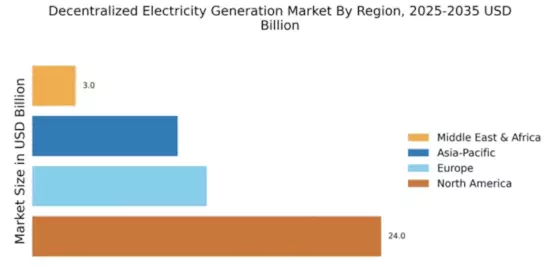
North America is poised to maintain its leadership in the Decentralized Electricity Generation Market, holding a market size of $20.0 billion in 2025. Key growth drivers include increasing demand for renewable energy, supportive government policies, and technological advancements in energy storage and management. The region's commitment to reducing carbon emissions and enhancing energy security further fuels this growth, making it a hub for innovation in decentralized energy solutions. The competitive landscape is characterized by major players such as NextEra Energy, General Electric, and Enphase Energy, which are at the forefront of technological advancements. The U.S. and Canada are leading countries, with significant investments in solar and wind energy projects. The presence of established companies and a growing number of startups contribute to a dynamic market environment, ensuring robust competition and innovation.

Europe : Sustainable Energy Transition

Europe is rapidly advancing in the Decentralized Electricity Generation Market, with a market size of $15.0 billion projected for 2025. The region's growth is driven by stringent environmental regulations, ambitious renewable energy targets, and increasing public awareness of sustainability. Governments are implementing policies that promote decentralized energy solutions, such as feed-in tariffs and subsidies for renewable energy installations, which are crucial for market expansion. Leading countries in this region include Germany, France, and the UK, where companies like Siemens AG and Schneider Electric are key players. The competitive landscape is marked by a mix of established firms and innovative startups, all vying for a share of the growing market. The European Union's commitment to achieving carbon neutrality by 2050 further enhances the attractiveness of decentralized energy solutions, fostering a vibrant ecosystem for investment and development.

Asia-Pacific : Emerging Market Potential

Asia-Pacific is witnessing significant growth in the Decentralized Electricity Generation Market, with a projected market size of $10.0 billion by 2025. The region's rapid urbanization, increasing energy demand, and government initiatives to promote renewable energy are key drivers of this growth. Countries are focusing on reducing reliance on fossil fuels and enhancing energy security, leading to a surge in decentralized energy projects, particularly in solar and wind sectors. China, India, and Japan are the leading countries in this market, with major players like Canadian Solar and Vestas Wind Systems actively participating. The competitive landscape is evolving, with both domestic and international companies investing heavily in renewable technologies. The region's diverse energy needs and regulatory support for decentralized solutions create a promising environment for market expansion and innovation.

Middle East and Africa : Resource-Rich Opportunities

The Middle East and Africa are emerging as a significant market for Decentralized Electricity Generation, with a market size of $3.98 billion anticipated by 2025. The region's abundant natural resources, coupled with increasing energy demands and a push for sustainable solutions, are driving interest in decentralized energy systems. Governments are beginning to recognize the importance of diversifying energy sources and investing in renewable technologies to enhance energy security and sustainability. Leading countries in this region include South Africa and the UAE, where initiatives to promote solar and wind energy are gaining momentum. The competitive landscape is characterized by a mix of local and international players, with companies like Brookfield Renewable Partners making strides in the market. As regulatory frameworks evolve to support decentralized solutions, the region is poised for growth in renewable energy investments and projects.

Key Players and Competitive Insights

The Decentralized Electricity Generation Market is currently characterized by a dynamic competitive landscape, driven by the increasing demand for renewable energy solutions and the need for energy independence. Key players such as NextEra Energy (US), Siemens AG (DE), and Enphase Energy (US) are strategically positioning themselves through innovation and partnerships. NextEra Energy (US) focuses on expanding its renewable energy portfolio, while Siemens AG (DE) emphasizes digital transformation and smart grid technologies. Enphase Energy (US) is enhancing its product offerings in solar energy management, which collectively shapes a competitive environment that prioritizes sustainability and technological advancement.

In terms of business tactics, companies are increasingly localizing manufacturing and optimizing supply chains to enhance efficiency and reduce costs. The market appears moderately fragmented, with a mix of established players and emerging startups. The collective influence of these key players is significant, as they drive innovation and set industry standards, thereby shaping the overall market structure.

In November 2025, NextEra Energy (US) announced a strategic partnership with a leading battery storage manufacturer to enhance its renewable energy storage capabilities. This move is likely to bolster its position in the market by providing more reliable energy solutions, addressing the intermittency issues associated with renewable sources. Such partnerships are crucial for integrating energy storage with decentralized generation, thereby improving overall system resilience.

In October 2025, Siemens AG (DE) launched a new digital platform aimed at optimizing energy management for decentralized systems. This initiative is indicative of the company's commitment to digitalization, allowing customers to monitor and manage their energy consumption more effectively. The platform's introduction may enhance Siemens' competitive edge by providing advanced analytics and real-time data, which are increasingly vital in today's energy landscape.

In September 2025, Enphase Energy (US) expanded its product line to include advanced microinverters designed for residential solar systems. This expansion is significant as it aligns with the growing trend towards residential energy independence and the increasing adoption of solar technologies. By diversifying its offerings, Enphase Energy (US) is likely to capture a larger market share and respond to the evolving needs of consumers seeking sustainable energy solutions.

As of December 2025, current competitive trends in the Decentralized Electricity Generation Market include a strong emphasis on digitalization, sustainability, and the integration of AI technologies. Strategic alliances are increasingly shaping the landscape, enabling companies to leverage complementary strengths and enhance their market positions. Looking ahead, competitive differentiation is expected to evolve from traditional price-based competition to a focus on innovation, technological advancements, and supply chain reliability, reflecting the industry's shift towards more sustainable and efficient energy solutions.

Key Companies in the Decentralized Electricity Generation Market market include

Industry Developments

Recent developments in the Decentralized Electricity Generation Market have shown significant activity, particularly among major players such as Schneider Electric, Tesla, Enphase Energy, Siemens Gamesa Renewable Energy, and NextEra Energy. Companies are increasingly focusing on renewable energy sources, enhancing their portfolios. Schneider Electric announced advancements in smart grid technologies, enhancing efficiency in energy consumption and generation. Tesla continues to push boundaries with its energy products, including innovative solar solutions and battery storage systems.

In the wind energy sector, Siemens Gamesa has expanded its offerings, targeting offshore projects to meet growing demand.Recent mergers and acquisitions in the market include First Solar acquiring a controlling stake in a solar technology company, strengthening its position in solar manufacturing. Additionally, Vestas Wind Systems is exploring partnerships to expand its renewable energy solutions on a global scale. The overall valuation of companies in this sector is on the rise, reflecting a strong shift toward decentralized energy solutions as more businesses and consumers seek to optimize energy production and reduce reliance on traditional energy grids.

This transition impacts market dynamics positively, leading to accelerated innovation and investor interest.

Future Outlook

Decentralized Electricity Generation Market Future Outlook

The Decentralized Electricity Generation Market is projected to grow at a 7.69% CAGR from 2024 to 2035, driven by technological advancements, regulatory support, and increasing energy demand.

New opportunities lie in:

  • Development of microgrid solutions for urban areas
  • Integration of energy storage systems with renewable sources
  • Expansion of virtual power plants leveraging IoT technology

By 2035, the market is expected to be robust, driven by innovation and increased adoption of decentralized solutions.

Market Segmentation

Decentralized Electricity Generation Market End Use Outlook

  • Electricity Generation
  • Heating
  • Cooling
  • Transportation
  • Backup Power

Decentralized Electricity Generation Market Technology Outlook

  • Solar Photovoltaic
  • Wind Turbine
  • Biomass
  • Hydropower
  • Geothermal

Decentralized Electricity Generation Market Application Outlook

  • Residential
  • Commercial
  • Industrial
  • Utility
  • Microgrid

Report Scope

MARKET SIZE 202448.98(USD Billion)
MARKET SIZE 202552.75(USD Billion)
MARKET SIZE 2035110.68(USD Billion)
COMPOUND ANNUAL GROWTH RATE (CAGR)7.69% (2024 - 2035)
REPORT COVERAGERevenue Forecast, Competitive Landscape, Growth Factors, and Trends
BASE YEAR2024
Market Forecast Period2025 - 2035
Historical Data2019 - 2024
Market Forecast UnitsUSD Billion
Key Companies ProfiledNextEra Energy (US), Siemens AG (DE), General Electric (US), Schneider Electric (FR), Vestas Wind Systems (DK), Enphase Energy (US), SMA Solar Technology (DE), Canadian Solar (CA), First Solar (US), Brookfield Renewable Partners (CA)
Segments CoveredApplication, Technology, End Use
Key Market OpportunitiesIntegration of advanced energy storage solutions enhances resilience in the Decentralized Electricity Generation Market.
Key Market DynamicsRising consumer demand for renewable energy sources drives innovation and competition in decentralized electricity generation.
Countries CoveredNorth America, Europe, APAC, South America, MEA

Leave a Comment

FAQs

What is the expected market size of the Decentralized Electricity Generation Market in 2034?

The Decentralized Electricity Generation Market is expected to be valued at 102.78 USD Billion in 2034.

What is the projected compound annual growth rate (CAGR) for the market from 2025 to 2034?

The projected CAGR for the Decentralized Electricity Generation Market from 2025 to 2034 is 7.69%.

Which region has the largest share in the Decentralized Electricity Generation Market in 2023?

In 2023, the APAC region held the largest share in the Decentralized Electricity Generation Market, valued at 15.3 USD Billion.

What is the market value for Solar Photovoltaic technology in 2032?

The market value for Solar Photovoltaic technology is expected to reach 30.0 USD Billion in 2032.

What are the top key players in the Decentralized Electricity Generation Market?

Top players include Schneider Electric, Tesla, Enphase Energy, Siemens Gamesa Renewable Energy, and NextEra Energy.

How much is the Wind Turbines segment projected to be worth in 2032?

The Wind Turbines segment is projected to be valued at 25.0 USD Billion in 2032.

What is the market growth expectation for North America by 2032?

The North American market is expected to grow to 20.5 USD Billion by 2032.

What is the estimated market size of the Biomass segment in 2023?

The Biomass segment is estimated to be valued at 8.0 USD Billion in 2023.

What growth opportunities exist within the Decentralized Electricity Generation Market?

There are significant growth opportunities due to rising renewable energy demand and technological advancements.

What is the expected value for the Fuel Cells segment in 2032?

The expected value for the Fuel Cells segment is 7.3 USD Billion in 2032.

Download Free Sample

Kindly complete the form below to receive a free sample of this Report

Compare Licence

×
Features License Type
Single User Multiuser License Enterprise User
Price $4,950 $5,950 $7,250
Maximum User Access Limit 1 User Upto 10 Users Unrestricted Access Throughout the Organization
Free Customization
Direct Access to Analyst
Deliverable Format
Platform Access
Discount on Next Purchase 10% 15% 15%
Printable Versions