×
Request Free Sample ×

Kindly complete the form below to receive a free sample of this Report

* Please use a valid business email

Leading companies partner with us for data-driven Insights

clients tt-cursor
Hero Background

Dedicated Outdoor Air System Market

ID: MRFR/SEM/28268-CR
361 Pages
Varsha More
August 2025

Dedicated Outdoor Air System (DOAS) Market Research Report Information By Technology (DX (Direct Expansion) Systems, Energy Recovery Ventilation (ERV) Systems, Enthalpy Wheels and Heat Recovery Ventilation (HRV) Systems), By Air flow strategy (Constant Air Volume (CAV), Variable Air Volume (VAV) and Displacement Ventilation (DV)), By camera type (DSLR, Mirrorless, Film Cameras, Action Cameras and Compact Digital Cameras) ,By System Architecture ( Packaged DOAS Units, Modular/Custom DOAS via Air Handling Units (AHUs) and Integrated Systems wi... read more

Share:
Download PDF ×

We do not share your information with anyone. However, we may send you emails based on your report interest from time to time. You may contact us at any time to opt-out.

Dedicated Outdoor Air System Market Infographic
Purchase Options

Dedicated Outdoor Air System Market Summary

As per MRFR analysis, the Dedicated Outdoor Air System Market (DOAS) Market Size was estimated at 4.05 USD Billion in 2024. The DOAS industry is projected to grow from 4.411 USD Billion in 2025 to 10.37 USD Billion by 2035, exhibiting a compound annual growth rate (CAGR) of 8.92 during the forecast period 2025 - 2035.

Key Market Trends & Highlights

The Dedicated Outdoor Air System Market (DOAS) market is poised for substantial growth driven by energy efficiency and technological advancements.

  • The market exhibits an increased focus on energy efficiency, reflecting a broader trend towards sustainable building practices.
  • Integration of smart technologies is becoming prevalent, enhancing system performance and user control.
  • North America remains the largest market, while the Asia-Pacific region is recognized as the fastest-growing area for DOAS adoption.
  • Rising demand for indoor air quality and increased regulatory focus on energy efficiency are key drivers propelling market expansion.

Market Size & Forecast

2024 Market Size 4.05 (USD Billion)
2035 Market Size 10.37 (USD Billion)
CAGR (2025 - 2035) 8.92%

Major Players

Trane Technologies (IE), Carrier Global Corporation (US), Daikin Industries, Ltd. (JP), Johnson Controls International plc (IE), LG Electronics (KR), Mitsubishi Electric Corporation (JP), Rheem Manufacturing Company (US), York International Corporation (US)

Dedicated Outdoor Air System Market Trends

The Dedicated Outdoor Air System Market (DOAS) Market is currently experiencing a notable transformation, driven by an increasing emphasis on energy efficiency and indoor air quality. As organizations and building owners become more aware of the importance of providing fresh air to occupants, the demand for DOAS solutions appears to be on the rise. This trend is further supported by regulatory frameworks that advocate for improved ventilation standards in commercial and residential buildings. Consequently, manufacturers are innovating to develop systems that not only meet these standards but also enhance overall energy performance. Moreover, the integration of advanced technologies such as IoT and smart controls into DOAS units is likely to redefine operational efficiency. These innovations may facilitate real-time monitoring and adjustments, thereby optimizing energy consumption and ensuring a healthier indoor environment. As sustainability becomes a core focus for many industries, the Dedicated Outdoor Air System Market (DOAS) Market is poised for growth, with stakeholders increasingly prioritizing solutions that align with environmental goals. The future landscape of this market seems promising, as it adapts to evolving consumer preferences and regulatory demands.

Increased Focus on Energy Efficiency

The Dedicated Outdoor Air System Market (DOAS) Market is witnessing a heightened emphasis on energy efficiency. Stakeholders are increasingly seeking solutions that minimize energy consumption while maintaining optimal indoor air quality. This trend is likely to drive innovation in system design and technology.

Integration of Smart Technologies

The incorporation of smart technologies into DOAS units is becoming more prevalent. These advancements may enable real-time monitoring and control, allowing for enhanced operational efficiency and improved user experience. Such integration could redefine how air quality is managed in various settings.

Regulatory Support for Improved Ventilation

Regulatory frameworks are increasingly supporting enhanced ventilation standards in buildings. This shift is likely to bolster the demand for Dedicated Outdoor Air Systems, as compliance with these regulations becomes essential for new constructions and renovations.

Dedicated Outdoor Air System Market Drivers

Growing Construction Activities

The surge in construction activities across various sectors is a crucial driver for the Dedicated Outdoor Air System Market (DOAS) Market. As urbanization continues to rise, there is a corresponding increase in the demand for new residential, commercial, and industrial buildings. This trend necessitates the incorporation of efficient ventilation systems, such as DOAS, to meet regulatory requirements and enhance occupant comfort. According to recent data, the construction industry is projected to grow at a steady rate, further fueling the need for advanced HVAC solutions. The integration of DOAS in new constructions not only ensures compliance with ventilation standards but also promotes energy efficiency, making it an attractive option for builders and developers. Consequently, the expanding construction sector is likely to bolster the DOAS market in the coming years.

Rising Demand for Indoor Air Quality

The increasing awareness regarding indoor air quality is a pivotal driver for the Dedicated Outdoor Air System Market (DOAS) Market. As individuals spend a significant portion of their time indoors, the demand for systems that ensure clean and fresh air is paramount. Studies indicate that poor indoor air quality can lead to various health issues, prompting both residential and commercial sectors to invest in advanced ventilation solutions. The DOAS technology, which provides a continuous supply of outdoor air while maintaining energy efficiency, is becoming increasingly popular. This trend is further supported by the growing number of building codes and standards that emphasize the importance of adequate ventilation. Consequently, the market for DOAS is likely to expand as more stakeholders recognize the necessity of maintaining high indoor air quality standards.

Technological Advancements in HVAC Systems

Technological innovations in heating, ventilation, and air conditioning (HVAC) systems are significantly influencing the Dedicated Outdoor Air System Market (DOAS) Market. The integration of advanced technologies such as variable refrigerant flow, energy recovery ventilators, and smart controls enhances the efficiency and performance of DOAS. These advancements not only improve energy efficiency but also facilitate better control over indoor environments. For instance, the implementation of IoT-enabled devices allows for real-time monitoring and adjustments, optimizing energy consumption. As a result, the market is witnessing a shift towards more sophisticated DOAS solutions that cater to the evolving needs of consumers. The increasing adoption of these technologies is expected to drive growth in the DOAS market, as stakeholders seek to leverage the benefits of modern HVAC systems.

Shift Towards Sustainable Building Practices

The ongoing shift towards sustainable building practices is a vital driver for the Dedicated Outdoor Air System Market (DOAS) Market. As environmental concerns gain prominence, builders and developers are increasingly prioritizing eco-friendly construction methods and materials. DOAS plays a crucial role in this transition by providing efficient ventilation solutions that reduce energy consumption and carbon footprints. The emphasis on sustainability is reflected in the growing number of green building certifications, which often require the implementation of advanced ventilation systems. This trend is likely to encourage the adoption of DOAS technologies, as stakeholders aim to meet sustainability goals while ensuring occupant comfort. The increasing alignment of the construction industry with sustainable practices is expected to significantly contribute to the growth of the DOAS market.

Increased Regulatory Focus on Energy Efficiency

The heightened regulatory focus on energy efficiency is a significant driver for the Dedicated Outdoor Air System Market (DOAS) Market. Governments and regulatory bodies are increasingly implementing stringent energy codes and standards aimed at reducing energy consumption in buildings. These regulations often mandate the use of energy-efficient ventilation systems, which positions DOAS as a favorable solution. The ability of DOAS to provide conditioned outdoor air while minimizing energy loss aligns well with these regulatory requirements. As a result, stakeholders in the construction and HVAC sectors are more inclined to adopt DOAS technologies to ensure compliance and enhance sustainability. This regulatory push is expected to propel the growth of the DOAS market, as more entities seek to align with energy efficiency goals.

Market Segment Insights

By Technology: Energy Recovery Ventilation (ERV) Systems (Largest) vs. Direct Expansion (DX) Systems (Fastest-Growing)

In the Dedicated Outdoor Air System Market (DOAS) market, Energy Recovery Ventilation (ERV) Systems hold the largest market share due to their efficiency in minimizing energy waste while providing fresh air. Direct Expansion (DX) Systems follow, showcasing notable potential for growth. Both systems significantly contribute to maintaining indoor air quality and optimal thermal comfort, appealing to commercial applications. Each system's adoption reflects growing environmental awareness and regulations directing energy efficiency, carving a solid position for both in the evolving market landscape. As the market trends shift toward sustainability, ERV Systems are rapidly becoming the preferred choice among architects and engineers due to their dual functionality of energy recovery and ventilation. On the other hand, the DX Systems are gaining traction in new construction projects as technology advances, enhancing their reliability and efficiency. The push for smarter, greener buildings bodes well for both systems, suggesting a balanced future distribution where older systems evolve with innovations while new entrants claim a significant portion of market preferences.

Technology: ERV Systems (Dominant) vs. DX Systems (Emerging)

Energy Recovery Ventilation (ERV) Systems are recognized as the dominant technology in the Dedicated Outdoor Air System Market (DOAS) market, effectively recycling energy and significantly improving air quality. Their design allows for simultaneous heating and cooling processes, thus addressing both temperature control and fresh air supply efficiently. In contrast, Direct Expansion (DX) Systems are emerging technologies characterized by their simplicity and effectiveness, particularly in smaller applications. They rely on refrigeration and are gaining traction due to lower upfront costs and advancements in HVAC technology. While ERV Systems focus on energy conservation and sustainability, DX Systems cater to immediate cooling needs, rendering both vital in a balanced approach to modern building requirements.

By Air Flow Strategy: Variable Air Volume (Largest) vs. Displacement Ventilation (Fastest-Growing)

In the Dedicated Outdoor Air System Market (DOAS) Market, the air flow strategies are categorized into Constant Air Volume (CAV), Variable Air Volume (VAV), and Displacement Ventilation (DV). Among these, Variable Air Volume (VAV) holds the largest market share, driven by its efficiency and adaptability in varying load conditions. CAV, while still relevant, is steadily losing ground as HVAC systems increasingly favor flexibility. Displacement Ventilation is emerging rapidly due to its ability to improve indoor air quality and reduce energy consumption, making it a key player in modern building designs. The growth trends in this segment are predominantly influenced by the increasing demand for energy-efficient solutions and the focus on enhancing indoor air quality. VAV systems continue to benefit from advancements in control technologies that allow for precise airflow management, catering to diverse applications. Meanwhile, Displacement Ventilation is gaining traction in commercial and institutional sectors, as it allows for better air distribution, leading to improved occupant comfort and productivity. As regulations around energy use tighten, these strategies are expected to witness substantial growth, with a clear shift towards more innovative and sustainable solutions.

Variable Air Volume (Dominant) vs. Displacement Ventilation (Emerging)

Variable Air Volume (VAV) systems are recognized as the dominant air flow strategy within the DOAS market due to their ability to adjust the volume of air supplied based on the real-time needs of the space. This adaptability makes VAV systems particularly efficient, resulting in energy savings and enhanced comfort levels for occupants. The technology has become crucial in applications that experience varying occupancy levels and load conditions. On the other hand, Displacement Ventilation (DV) represents an emerging strategy characterized by its unique approach to air distribution. DV systems deliver conditioned air at low velocities, allowing for natural buoyancy effects to facilitate better air movement. This not only improves indoor air quality by enhancing the removal of airborne contaminants but also significantly reduces energy usage. As familiarity with its benefits grows, DV is poised to capture a notable share of the market, particularly in sectors prioritizing sustainability.

By System Architecture: Packaged DOAS Units (Largest) vs. Modular/Custom DOAS via AHUs (Fastest-Growing)

In the Dedicated Outdoor Air System Market (DOAS) market, the distribution of system architecture types reveals Packaged DOAS Units as the dominant segment, holding a significant share due to their simplicity and ease of installation. Modular/Custom DOAS via Air Handling Units (AHUs) is quickly gaining traction as it allows for greater customization and adaptability in various applications, making it particularly appealing to builders and HVAC engineers looking for tailored solutions. The market dynamics indicate a shift towards Modular/Custom systems as the fastest-growing segment. This growth is driven by increasing demand for energy-efficient solutions and the capacity for integration with smart building technologies. As commercial and residential buildings increasingly focus on indoor air quality and energy saving, Modular solutions are expected to see accelerated adoption, leading to a more varied competitive landscape within the DOAS sector.

Packaged DOAS Units (Dominant) vs. Integrated Systems with Third-Party Components (Emerging)

Packaged DOAS Units serve as the backbone of the market, offering all-in-one solutions that are favored for their compact design and reliability. These systems are ideal for a wide range of applications due to their pre-engineered components, simplifying the installation and maintenance processes. On the other hand, Integrated Systems with Third-Party Components represent an emerging segment that allows for significant customization and scalability. This evolution meets the needs of specially designed systems that require synergy between various components, enabling maximum efficiency and flexibility. As they can incorporate advanced control strategies and integration with existing building management systems, Integrated Systems offer the potential for improved performance, making them attractive options for innovative projects.

By System Capacity: 5 to 15 Tons (Largest) vs. 15 to 30 Tons (Fastest-Growing)

In the Dedicated Outdoor Air System Market (DOAS) market, the system capacity segment is divided into four key categories based on tonnage and air handling capacity. The '5 to 15 Tons / 1,000 to 3,000 CFM' segment is the largest, capturing a significant share of the market, driven by the increasing demand for energy-efficient solutions in medium-sized commercial spaces. Meanwhile, the '15 to 30 Tons / 3,000 to 6,000 CFM' segment is gaining traction as the fastest-growing category, driven by larger installations and the push for enhanced indoor air quality compliance. Growth trends in this segment are primarily influenced by evolving regulations concerning air quality and the need for efficient HVAC systems. Businesses are increasingly adopting larger DOAS units to meet stringent ventilation standards, especially in urban settings. Furthermore, advancements in technology and rising energy costs emphasize the necessity for high-capacity systems that provide both efficiency and performance, positioning the '15 to 30 Tons' tier as a crucial player in the market.

5 to 15 Tons (Dominant) vs. More than 30 Tons (Emerging)

The '5 to 15 Tons / 1,000 to 3,000 CFM' segment stands out as the dominant choice in the Dedicated Outdoor Air System Market due to its balance of capacity and efficiency, serving a wide range of commercial applications, such as retail and office spaces. Its popularity is attributed to effective energy management solutions and cost savings in operations. In contrast, the 'More than 30 Tons / >6,000 CFM' segment is emerging, catering to larger facilities like industrial and manufacturing operations, where higher airflows are necessary. While still capturing a smaller market share, this segment is witnessing increased interest driven by technological innovations and a growing focus on improving air quality within expansive environments.

By System Integration Type: OEM-Integrated (Largest) vs. Third-Party Integrator Assembled Systems (Fastest-Growing)

In the Dedicated Outdoor Air System Market (DOAS) market, OEM-Integrated systems hold the largest share, primarily due to the high degree of customization and reliability they offer. Customers favor these systems for their integrated design, which ensures seamless operation and efficiency. In contrast, Third-Party Integrator Assembled Systems, while a smaller segment, are gaining traction as companies seek flexible and cost-effective solutions that can be tailored to specific needs without heavy investment in manufacturing processes. Growth trends indicate that Third-Party Integrator Assembled Systems are rapidly becoming the fastest-growing segment within the DOAS market. Factors driving this growth include a rise in demand for customization and the growing importance of energy-efficient systems. As businesses increasingly prioritize integration solutions that lower their carbon footprint and operating costs, Third-Party Integrator Assembled Systems are positioned to capitalize on these emerging trends.

OEM-Integrated (Dominant) vs. Third-Party Integrator Assembled Systems (Emerging)

OEM-Integrated systems are dominant in the Dedicated Outdoor Air System Market (DOAS) market due to their robust integration capabilities, offering superior reliability and performance tailored to meet specific customer needs. Manufacturers of these systems invest heavily in research and development to ensure optimal efficiency and compliance with evolving energy standards. On the other hand, Third-Party Integrator Assembled Systems are emerging as a viable alternative, providing clients with adaptability and cost savings. These systems often allow for easier upgrades and modifications, which appeals to businesses looking to innovate or expand without the need for a complete redesign. Together, these two segments reflect a dynamic shift in the market, catering to diverse customer preferences.

By Application: Commercial/ Comfort Applications (Largest) vs. Process/ Industrial Applications (Fastest-Growing)

The Dedicated Outdoor Air System Market (DOAS) market is experiencing a notable distribution of share among various application segments. Commercial and comfort applications, particularly in commercial buildings and education institutes, represent significant portions of the market. Retail spaces and healthcare facilities, such as hospitals, also show substantial presence, achieving a well-rounded market distribution. However, the process and industrial applications are equally vital, with segments like cleanrooms in pharmaceuticals and semiconductor fabs gaining traction due to rising demand for controlled environments.

Commercial Buildings (Dominant) vs. Cleanrooms (Emerging)

Commercial buildings are currently the dominant segment within the DOAS market, driven by the increasing emphasis on indoor air quality and ventilation standards in office environments. These applications require advanced air handling systems to maintain optimal conditions for comfort and productivity. Meanwhile, cleanrooms, particularly in pharmaceutical and biotech sectors, are emerging as a critical market, necessitated by stringent regulatory requirements and the need for contaminant-free environments. The growth of battery manufacturing facilities and semiconductor fabs adds to this, creating demand for robust DOAS solutions tailored to high-precision applications. As innovations in air treatment technology progress, the cleanroom segment is poised for significant expansion.

Get more detailed insights about Dedicated Outdoor Air System Market

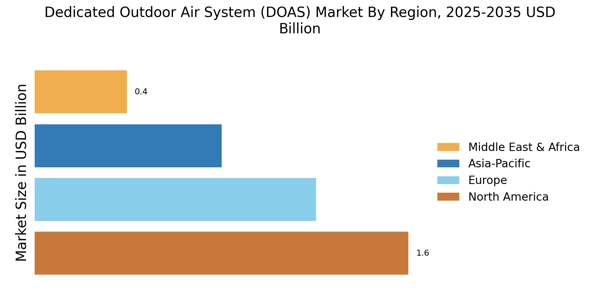
Regional Insights

North America : Leading Market for DOAS

North America is the largest market for Dedicated Outdoor Air Systems (DOAS), holding approximately 40% of the global market share. The growth is driven by increasing energy efficiency regulations and a rising demand for improved indoor air quality. The U.S. and Canada are the primary contributors, with significant investments in commercial and residential sectors. Regulatory frameworks, such as the Energy Policy Act, further catalyze market expansion by promoting energy-efficient technologies. The competitive landscape in North America is robust, featuring key players like Trane Technologies, Carrier Global Corporation, and Johnson Controls. These companies are focusing on innovation and sustainability to meet the growing demand. The presence of advanced manufacturing capabilities and a strong distribution network enhances their market position. Additionally, the trend towards smart building technologies is expected to further boost the adoption of DOAS in the region.

Europe : Regulatory-Driven Market Growth

Europe is the second-largest market for Dedicated Outdoor Air Systems (DOAS), accounting for approximately 30% of the global market share. The region's growth is significantly influenced by stringent environmental regulations and a strong commitment to sustainability. The European Union's Green Deal and various national policies are driving investments in energy-efficient HVAC systems, thereby enhancing the demand for DOAS solutions. Leading countries in this region include Germany, France, and the UK, where major players like Daikin Industries and Johnson Controls are actively expanding their market presence. The competitive landscape is characterized by innovation and collaboration among manufacturers to meet regulatory standards. The focus on reducing carbon footprints and improving indoor air quality is shaping the future of the DOAS market in Europe.

Asia-Pacific : Emerging Market Potential

The Asia-Pacific region is witnessing rapid growth in the Dedicated Outdoor Air Systems (DOAS) market, holding approximately 20% of the global market share. The increasing urbanization and industrialization in countries like China and India are driving the demand for advanced HVAC solutions. Additionally, government initiatives aimed at improving energy efficiency and indoor air quality are acting as catalysts for market growth in this region. China is the largest market in Asia-Pacific, followed by Japan and India. Key players such as LG Electronics and Mitsubishi Electric are investing heavily in research and development to introduce innovative DOAS solutions. The competitive landscape is evolving, with local manufacturers also entering the market, thereby intensifying competition. The focus on smart city initiatives and sustainable building practices is expected to further propel the adoption of DOAS in the region.

Middle East and Africa : Untapped Market Opportunities

The Middle East and Africa region is gradually emerging in the Dedicated Outdoor Air Systems (DOAS) market, currently holding about 10% of the global market share. The growth is primarily driven by increasing investments in infrastructure and a rising awareness of energy-efficient solutions. Countries like the UAE and South Africa are leading the way, with government initiatives aimed at enhancing energy efficiency in buildings and promoting sustainable practices. In this region, the competitive landscape is still developing, with key players like Rheem Manufacturing and York International Corporation making strides. The market is characterized by a mix of international and local companies, focusing on innovative solutions tailored to regional needs. As urbanization continues and the demand for improved indoor air quality rises, the DOAS market in the Middle East and Africa is poised for significant growth.

Dedicated Outdoor Air System Market Regional Image

Key Players and Competitive Insights

The Dedicated Outdoor Air System (DOAS) Market is currently characterized by a dynamic competitive landscape, driven by increasing demand for energy-efficient HVAC solutions and stringent regulations regarding indoor air quality. Major players such as Trane Technologies (Ireland), Carrier Global Corporation (United States), and Daikin Industries, Ltd. (Japan) are at the forefront, each adopting distinct strategies to enhance their market positioning. Trane Technologies (Ireland) emphasizes innovation in energy-efficient systems, while Carrier Global Corporation (United States) focuses on expanding its digital capabilities and smart building technologies. Daikin Industries, Ltd. (Japan) is leveraging its global footprint to enhance product offerings and customer service, collectively shaping a competitive environment that prioritizes technological advancement and sustainability.

In terms of business tactics, companies are increasingly localizing manufacturing to reduce lead times and optimize supply chains. The market structure appears moderately fragmented, with a mix of established players and emerging companies vying for market share. This fragmentation allows for diverse offerings, yet the collective influence of key players like Johnson Controls International plc (Ireland) and LG Electronics (South Korea) is significant, as they drive innovation and set industry standards.

In August 2025, Johnson Controls International plc (Ireland) announced a strategic partnership with a leading technology firm to integrate AI-driven analytics into their DOAS solutions. This move is likely to enhance operational efficiency and provide customers with real-time data insights, thereby improving indoor air quality management. Such partnerships indicate a trend towards leveraging advanced technologies to meet evolving customer needs.

In September 2025, LG Electronics (South Korea) launched a new line of energy-efficient DOAS units designed specifically for commercial applications. This product line aims to address the growing demand for sustainable HVAC solutions in urban environments. The introduction of these units reflects LG's commitment to innovation and positions the company as a key player in the sustainable building sector.

In October 2025, Carrier Global Corporation (United States) unveiled a comprehensive digital platform that integrates its DOAS products with smart building technologies. This platform is expected to enhance user experience and operational efficiency, showcasing Carrier's focus on digital transformation. The integration of smart technologies into traditional HVAC systems signifies a pivotal shift in how companies approach product development and customer engagement.

As of October 2025, the competitive trends in the DOAS market are increasingly defined by digitalization, sustainability, and the integration of artificial intelligence. Strategic alliances are becoming more prevalent, as companies recognize the need to collaborate to enhance their technological capabilities. Looking ahead, competitive differentiation is likely to evolve from traditional price-based competition to a focus on innovation, technology integration, and supply chain reliability, underscoring the importance of adaptability in a rapidly changing market.

Key Companies in the Dedicated Outdoor Air System Market market include

Future Outlook

Dedicated Outdoor Air System Market Future Outlook

The Dedicated Outdoor Air System Market (DOAS) Market is projected to grow at an 8.92% CAGR from 2024 to 2035, driven by increasing energy efficiency demands and stringent regulations.

New opportunities lie in:

  • Integration of smart building technologies for enhanced energy management.
  • Development of modular DOAS units for rapid deployment in new constructions.
  • Expansion into emerging markets with tailored solutions for local climates.

By 2035, the DOAS market is expected to achieve substantial growth, reflecting evolving industry standards and consumer preferences.

Market Segmentation

Dedicated Outdoor Air System Market Technology Outlook

  • Direct Expansion (DX) Systems
  • Energy Recovery Ventilation (ERV) Systems
  • Enthalpy Wheels
  • Heat Recovery Ventilation (HRV) Systems

Dedicated Outdoor Air System Market Application Outlook

  • Commercial/ Comfort Applications
  • Commercial Buildings
  • Education Institutes
  • Retail Spaces
  • Hospitals & Healthcare Facilities
  • Process/ Industrial Applications
  • Industrial Facilities
  • Cleanrooms (Pharmaceuticals, Biotech)
  • Semiconductor Fabs
  • Battery Manufacturing Facilities

Dedicated Outdoor Air System Market System Capacity Outlook

  • Less than 5 Tons / 1,000 CFM
  • 5 to 15 Tons / 1,000 to 3,000 CFM
  • 15 to 30 Tons / 3,000 to 6,000 CFM
  • More than 30 Tons / >6,000 CFM

Dedicated Outdoor Air System Market Air Flow Strategy Outlook

  • Constant Air Volume (CAV)
  • Variable Air Volume (VAV)
  • Displacement Ventilation (DV)

Dedicated Outdoor Air System Market System Architecture Outlook

  • Packaged DOAS Units
  • Modular/Custom DOAS via Air Handling Units (AHUs)
  • Integrated Systems with Third-Party Components

Dedicated Outdoor Air System Market System Integration Type Outlook

  • OEM-Integrated (Built by Customer)
  • Third-Party Integrator Assembled Systems

Report Scope

MARKET SIZE 20244.05(USD Billion)
MARKET SIZE 20254.411(USD Billion)
MARKET SIZE 203510.37(USD Billion)
COMPOUND ANNUAL GROWTH RATE (CAGR)8.92% (2024 - 2035)
REPORT COVERAGERevenue Forecast, Competitive Landscape, Growth Factors, and Trends
BASE YEAR2024
Market Forecast Period2025 - 2035
Historical Data2019 - 2024
Market Forecast UnitsUSD Billion
Key Companies ProfiledMarket analysis in progress
Segments CoveredMarket segmentation analysis in progress
Key Market OpportunitiesGrowing demand for energy-efficient ventilation solutions in commercial buildings drives the Dedicated Outdoor Air System (DOAS) Market.
Key Market DynamicsRising demand for energy-efficient solutions drives innovation and competition in the Dedicated Outdoor Air System market.
Countries CoveredNorth America, Europe, APAC, South America, MEA

Leave a Comment

FAQs

What is the projected market valuation of the Dedicated Outdoor Air System (DOAS) market by 2035?

The Dedicated Outdoor Air System (DOAS) market is projected to reach a valuation of 10.37 USD Billion by 2035.

What was the market valuation of the DOAS market in 2024?

In 2024, the overall market valuation of the Dedicated Outdoor Air System (DOAS) market was 4.05 USD Billion.

What is the expected CAGR for the DOAS market during the forecast period 2025 - 2035?

The expected CAGR for the Dedicated Outdoor Air System (DOAS) market during the forecast period 2025 - 2035 is 8.92%.

Which companies are considered key players in the DOAS market?

Key players in the Dedicated Outdoor Air System (DOAS) market include Trane Technologies, Carrier Global Corporation, Daikin Industries, and Johnson Controls International.

What are the main technology segments in the DOAS market and their valuations?

The main technology segments in the DOAS market include Direct Expansion (DX) Systems valued at 2.56 USD Billion and Energy Recovery Ventilation (ERV) Systems valued at 2.83 USD Billion.

How does the system architecture segment perform in the DOAS market?

In the system architecture segment, Packaged DOAS Units are projected to reach 3.95 USD Billion by 2035.

Download Free Sample

Kindly complete the form below to receive a free sample of this Report

Compare Licence

×
Features License Type
Single User Multiuser License Enterprise User
Price $4,950 $5,950 $7,250
Maximum User Access Limit 1 User Upto 10 Users Unrestricted Access Throughout the Organization
Free Customization
Direct Access to Analyst
Deliverable Format
Platform Access
Discount on Next Purchase 10% 15% 15%
Printable Versions