×
Request Free Sample ×

Kindly complete the form below to receive a free sample of this Report

* Please use a valid business email

Leading companies partner with us for data-driven Insights

clients tt-cursor
Hero Background

Dental Biomaterials Market

ID: MRFR/HC/6057-HCR
110 Pages
Rahul Gotadki
October 2025

Dental Biomaterials Market Research Report By Material Type (Ceramics, Polymers, Metals, Composites), By Application (Dentistry Implants, Restorative Dentistry, Orthodontics, Endodontics), By End Use (Hospitals, Dental Clinics, Research Laboratories), By Product Form (Consumables, Equipment, Implants) and By Regional (North America, Europe, South America, Asia Pacific, Middle East and Africa) - Forecast to 2035

Share:
Download PDF ×

We do not share your information with anyone. However, we may send you emails based on your report interest from time to time. You may contact us at any time to opt-out.

Dental Biomaterials Market Infographic
Purchase Options

Dental Biomaterials Market Summary

As per MRFR analysis, the Dental Biomaterials Market Size was estimated at 6.16 USD Billion in 2024. The Dental Biomaterials industry is projected to grow from 6.53 USD Billion in 2025 to 11.58 USD Billion by 2035, exhibiting a compound annual growth rate (CAGR) of 5.9% during the forecast period 2025 - 2035.

Key Market Trends & Highlights

The Dental Biomaterials Market is poised for substantial growth driven by technological advancements and increasing consumer demand for aesthetic solutions.

  • Sustainability in dental materials is becoming a prominent trend, reflecting a shift towards eco-friendly practices in the industry.
  • Technological advancements are enhancing the performance and application of dental biomaterials, particularly in North America.
  • The growing demand for aesthetic solutions is evident, especially in the dental implants segment, which remains the largest market segment.
  • Key market drivers include the increasing prevalence of dental disorders and rising aesthetic consciousness among consumers, particularly in the Asia-Pacific region.

Market Size & Forecast

2024 Market Size 6.16 (USD Billion)
2035 Market Size 11.58 (USD Billion)
CAGR (2025 - 2035) 5.9%

Major Players

Dentsply Sirona (US), 3M (US), Henry Schein (US), Straumann (CH), Nobel Biocare (CH), GC Corporation (JP), Kuraray Noritake Dental (JP), Ivoclar Vivadent (LI), Coltene Holding (CH)

Dental Biomaterials Market Trends

The Dental Biomaterials Market is currently experiencing a dynamic evolution, driven by advancements in technology and increasing demand for innovative dental solutions. The integration of biocompatible materials in dental procedures has gained traction, as practitioners seek to enhance patient outcomes and improve the longevity of dental restorations. This market appears to be influenced by a growing awareness of oral health, prompting both consumers and professionals to prioritize high-quality materials that ensure safety and efficacy. Furthermore, the rise in cosmetic dentistry and restorative procedures is likely to propel the demand for diverse biomaterials, including ceramics, polymers, and metals, which are essential for various applications such as implants, crowns, and fillings. In addition, the Dental Biomaterials Market seems to be shaped by ongoing research and development efforts aimed at creating more effective and sustainable materials. Innovations in nanotechnology and regenerative medicine are paving the way for the next generation of dental products, which may offer enhanced properties such as improved strength, reduced wear, and better aesthetic outcomes. As the market continues to expand, collaboration between manufacturers, dental professionals, and research institutions appears crucial for fostering innovation and addressing the evolving needs of patients. Overall, the Dental Biomaterials Market is poised for growth, reflecting a broader trend towards personalized and effective dental care solutions.

Sustainability in Dental Materials

There is a noticeable shift towards sustainable practices within the Dental Biomaterials Market. Manufacturers are increasingly focusing on eco-friendly materials that minimize environmental impact while maintaining performance standards. This trend reflects a broader societal push for sustainability, influencing product development and consumer preferences.

Technological Advancements

The integration of advanced technologies, such as 3D printing and digital dentistry, is transforming the Dental Biomaterials Market. These innovations enable more precise and efficient production of dental products, enhancing customization and reducing waste. As technology continues to evolve, it is likely to further streamline processes and improve patient outcomes.

Growing Demand for Aesthetic Solutions

The rising interest in cosmetic dentistry is driving demand for high-quality dental biomaterials that offer superior aesthetic properties. Patients are increasingly seeking materials that not only function well but also provide natural-looking results. This trend is prompting manufacturers to develop biomaterials that cater to aesthetic preferences while ensuring durability.

Dental Biomaterials Market Drivers

Market Growth Projections

The Global Dental Biomaterials Market Industry is projected to experience substantial growth over the next decade. With a market value expected to reach 3.57 USD Billion in 2024 and further expand to 7.8 USD Billion by 2035, the industry is on a promising trajectory. This growth is underpinned by a compound annual growth rate of 7.36% from 2025 to 2035, indicating a robust demand for dental biomaterials. Factors such as technological advancements, increasing awareness of oral health, and a growing geriatric population contribute to this upward trend. The market dynamics suggest a vibrant future for dental biomaterials.

Increasing Geriatric Population

The Global Dental Biomaterials Market Industry is poised for growth due to the increasing geriatric population worldwide. As individuals age, they often experience dental issues that require restorative treatments, including implants and dentures. The demand for biomaterials that cater to this demographic is rising, as older adults seek solutions that enhance their quality of life. This demographic shift is expected to drive market expansion, with a projected compound annual growth rate of 7.36% from 2025 to 2035. Consequently, manufacturers are likely to focus on developing materials specifically designed for the unique needs of older patients.

Growing Awareness of Oral Health

The Global Dental Biomaterials Market Industry benefits from a growing awareness of oral health among consumers. Educational initiatives and public health campaigns emphasize the importance of maintaining good oral hygiene, leading to increased dental visits and procedures. This heightened awareness encourages individuals to invest in preventive and restorative dental care, thereby boosting the demand for various biomaterials. As consumers become more informed about the options available, the market is likely to see a rise in the adoption of advanced materials that offer better performance and longevity. This trend suggests a positive outlook for the industry in the coming years.

Rising Demand for Aesthetic Dentistry

The Global Dental Biomaterials Market Industry experiences a notable surge in demand for aesthetic dentistry. Patients increasingly seek procedures that enhance their smiles, driving the adoption of biomaterials such as ceramics and composites. These materials not only provide functional benefits but also improve the aesthetic appeal of dental restorations. As a result, the market is projected to reach 3.57 USD Billion in 2024, reflecting the growing consumer preference for visually pleasing dental solutions. This trend indicates a shift towards more personalized dental care, where aesthetics play a crucial role in treatment decisions.

Regulatory Support and Standards Development

Regulatory support plays a crucial role in shaping the Global Dental Biomaterials Market Industry. Governments and health organizations are increasingly establishing standards and guidelines for the use of dental biomaterials, ensuring safety and efficacy. This regulatory framework fosters innovation and encourages manufacturers to invest in research and development. As a result, the market is likely to witness the introduction of new and improved biomaterials that meet stringent safety requirements. Such developments not only enhance consumer confidence but also contribute to market growth, as dental professionals are more inclined to adopt materials that comply with established standards.

Technological Advancements in Dental Materials

Technological innovations significantly influence the Global Dental Biomaterials Market Industry. Advances in material science have led to the development of superior biomaterials that offer enhanced properties such as biocompatibility, strength, and durability. For instance, the introduction of 3D printing technology allows for the precise fabrication of dental implants and prosthetics, improving patient outcomes. These advancements not only streamline the production process but also reduce costs, making dental treatments more accessible. As the industry evolves, it is likely that these technologies will further propel market growth, contributing to an anticipated market value of 7.8 USD Billion by 2035.
Market Segment Insights

By Application: Dental Implants (Largest) vs. Bone Grafts (Fastest-Growing)

In the Dental Biomaterials Market, the application segment is primarily dominated by Dental Implants, which hold the largest market share due to their widespread adoption and increasing preference among dental professionals. Bone Grafts are emerging rapidly as a fast-growing segment, driven by advancements in technology and increasing demands for reconstructive dental procedures. Other key contributors include Restorative Dentistry and Orthodontics, though they represent smaller shares compared to the leading segments.

Dental Implants (Dominant) vs. Bone Grafts (Emerging)

Dental Implants are the dominant force in the Dental Biomaterials Market, characterized by their high success rates and patient satisfaction. They are extensively utilized for restoring missing teeth, benefiting from technological improvements in implant design and materials. In contrast, Bone Grafts represent an emerging segment, gaining attention owing to their critical role in regenerative dentistry. With an increase in procedures such as sinus lifts and ridge augmentation, the demand for high-quality bone grafts continues to rise, positioning them as a vital component for future growth in the market.

By Material Type: Ceramics (Largest) vs. Polymers (Fastest-Growing)

The Dental Biomaterials Market is primarily segmented into Ceramics, Polymers, Metals, and Composites, each contributing uniquely to the overall landscape. Ceramics hold the largest share in this market due to their excellent aesthetics, biocompatibility, and mechanical properties, making them highly favored for dental crowns and bridges. Polymers, while currently sharing a smaller portion of the market, are quickly gaining traction due to their flexibility and ease of use in various dental applications, indicating a dynamic shift in preferences towards more versatile materials.

Ceramics (Dominant) vs. Polymers (Emerging)

Ceramics are established as the dominant material in the Dental Biomaterials Market, known for their strength and aesthetic appeal. Commonly utilized in restorations like crowns and veneers, ceramics offer superior biocompatibility, ensuring they harmonize well with dental tissues. On the other hand, polymers are emerging as a vital player, particularly in applications where flexibility and ease of processing are needed. The growing trend towards less invasive dental procedures is propelling polymers forward, as their adaptability makes them suitable for innovative dental applications such as 3D printing and regenerative dentistry.

By End Use: Dental Clinics (Largest) vs. Dental Laboratories (Fastest-Growing)

The dental biomaterials market exhibits a diverse distribution across various end-use segments, with dental clinics holding the largest share. Their prevalence is largely driven by the continuous demand for dental services, minimally invasive procedures, and increasing patient awareness about oral health. In contrast, dental laboratories are steadily gaining traction as the fastest-growing segment due to the rising volume of dental prosthetics and the integration of advanced technologies such as CAD/CAM processes which enhance efficiency and precision. Additionally, hospitals, while significant, follow closely behind in terms of market share and growth potential, highlighting a competitive landscape in the dental sector.

End Use: Dental Clinics (Dominant) vs. Dental Laboratories (Emerging)

Dental clinics serve as the dominant end-use segment within the dental biomaterials market, driven by a constant flow of patients seeking restorative and cosmetic dental procedures. Clinics benefit from direct patient relationships and often utilize a wide range of biomaterials, including implants, composites, and bonding agents that cater to various dental needs. On the other hand, dental laboratories are emerging as a crucial player, propelled by innovations in technology and increased outsourcing from dental clinics. They focus on producing customized dental solutions, including crowns, bridges, and dentures, utilizing high-quality materials. As the demand for precision and rapid turnaround grows, dental laboratories are adapting quickly to market needs, highlighting their potential for significant growth in the coming years.

Get more detailed insights about Dental Biomaterials Market

Regional Insights

North America : Market Leader in Dental Biomaterials

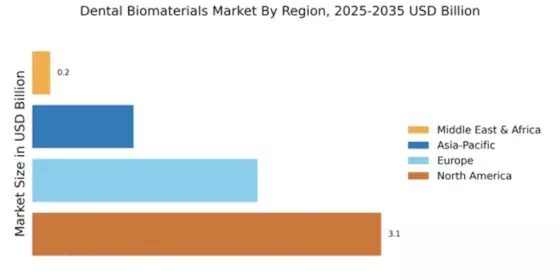
North America is poised to maintain its leadership in the dental biomaterials market, holding a significant share of 3.1 billion. The region's growth is driven by increasing dental procedures, rising awareness of oral health, and advancements in dental technology. Regulatory support and favorable reimbursement policies further catalyze market expansion, making it a hub for innovation and investment in dental solutions. The competitive landscape is robust, with key players like Dentsply Sirona, 3M, and Henry Schein leading the charge. The U.S. remains the largest market, supported by a well-established healthcare infrastructure and high consumer spending on dental care. The presence of major manufacturers and continuous R&D efforts contribute to a dynamic market environment, ensuring North America's dominance in the global dental biomaterials sector.

Europe : Emerging Market with Growth Potential

Europe's dental biomaterials market is valued at €2.0 billion, reflecting a growing demand for innovative dental solutions. Factors such as an aging population, increased dental awareness, and advancements in biomaterials technology are driving this growth. Regulatory frameworks in the EU promote high standards for dental products, ensuring safety and efficacy, which further boosts consumer confidence and market expansion. Leading countries in this region include Germany, France, and the UK, where significant investments in dental research and development are evident. Major players like Straumann and Nobel Biocare are at the forefront, contributing to a competitive landscape. The European market is characterized by a mix of established companies and emerging startups, fostering innovation and collaboration in dental biomaterials.

Asia-Pacific : Rapidly Growing Dental Market

The Asia-Pacific dental biomaterials market, valued at $0.9 billion, is experiencing rapid growth driven by rising disposable incomes, increasing dental awareness, and expanding healthcare access. Countries like China and India are witnessing a surge in dental procedures, supported by government initiatives aimed at improving oral health. The region's regulatory environment is evolving, promoting the adoption of advanced dental technologies and materials. China and Japan are leading the market, with significant contributions from local manufacturers and international players like GC Corporation and Kuraray Noritake Dental. The competitive landscape is dynamic, with a mix of established companies and new entrants focusing on innovation. As the region continues to develop, the demand for high-quality dental biomaterials is expected to rise, positioning Asia-Pacific as a key player in the global market.

Middle East and Africa : Emerging Market with Untapped Potential

The Middle East and Africa dental biomaterials market is valued at $0.16 billion, reflecting significant growth potential. Factors such as increasing urbanization, rising disposable incomes, and a growing awareness of dental health are driving demand for dental biomaterials. Regulatory bodies in the region are beginning to implement standards that encourage the use of advanced dental technologies, which is expected to further stimulate market growth. Countries like South Africa and the UAE are leading the market, with a growing number of dental clinics and increased investment in healthcare infrastructure. The competitive landscape is evolving, with both local and international players seeking to establish a foothold in this emerging market. As the region continues to develop, the demand for innovative dental solutions is anticipated to rise, presenting numerous opportunities for growth.

Key Players and Competitive Insights

The Dental Biomaterials Market is characterized by a dynamic competitive landscape, driven by innovation, technological advancements, and increasing demand for dental procedures. Key players such as Dentsply Sirona (US), 3M (US), and Straumann (CH) are at the forefront, each adopting distinct strategies to enhance their market presence. Dentsply Sirona (US) focuses on integrating digital solutions into its product offerings, thereby streamlining workflows for dental professionals. Meanwhile, 3M (US) emphasizes sustainability in its manufacturing processes, aiming to reduce environmental impact while maintaining product quality. Straumann (CH) has been actively pursuing strategic partnerships to expand its product portfolio and enhance its research capabilities, which collectively shapes a competitive environment that is increasingly reliant on innovation and collaboration.

The business tactics employed by these companies include localizing manufacturing to reduce costs and optimize supply chains. The market structure appears moderately fragmented, with several players vying for market share. However, the collective influence of major companies like Nobel Biocare (CH) and GC Corporation (JP) suggests a trend towards consolidation, as these firms leverage their resources to enhance operational efficiencies and market reach.

In November 2025, Dentsply Sirona (US) announced a partnership with a leading software company to develop an AI-driven platform aimed at improving patient outcomes in dental procedures. This strategic move is likely to position Dentsply Sirona as a pioneer in integrating artificial intelligence into dental practices, potentially setting new standards for patient care and operational efficiency.

In October 2025, 3M (US) launched a new line of bioactive dental materials designed to promote remineralization of tooth enamel. This innovation not only addresses the growing consumer demand for preventive dental care but also reinforces 3M's commitment to sustainability by utilizing eco-friendly materials. Such advancements may enhance the company's competitive edge in a market increasingly focused on health and environmental consciousness.

In September 2025, Straumann (CH) acquired a smaller dental technology firm specializing in regenerative biomaterials. This acquisition is indicative of Straumann's strategy to bolster its product offerings and enhance its research capabilities, thereby positioning itself as a leader in innovative dental solutions. The integration of new technologies could significantly enhance Straumann's competitive positioning in the market.

As of December 2025, current trends in the Dental Biomaterials Market include a pronounced shift towards digitalization, sustainability, and the integration of AI technologies. Strategic alliances are becoming increasingly vital, as companies recognize the need for collaboration to drive innovation and enhance product offerings. The competitive differentiation is likely to evolve from traditional price-based competition to a focus on technological advancements, product innovation, and supply chain reliability, suggesting a transformative phase for the market.

Key Companies in the Dental Biomaterials Market market include

Industry Developments

Recent developments in the Dental Biomaterials Market have showcased an impressive growth trajectory, especially with advancements in nanotechnology and biocompatible materials enhancing product performance. Major companies such as Kuraray Noritake Dental, Bisco, and Ivoclar Vivadent are expanding their portfolios, driven by an increasing demand for aesthetically pleasing and durable dental solutions.

In April 2025, Ivoclar Vivadent introduced IPS e.max ZirCAD Prime 2.0, a next-generation multilayer zirconia block that is optimal for posterior dental restorations. This block boasts high translucency and enhanced strength.

In March 2025, Dentsply Sirona introduced a chairside millable lithium silicate that is optimized for veneers and crowns, thereby expanding the Celtra Duo product line. This addition enhances the aesthetic and functional aspects of chairside solutions.

Future Outlook

Dental Biomaterials Market Future Outlook

The Dental Biomaterials Market is projected to grow at a 5.9% CAGR from 2024 to 2035, driven by technological advancements, increasing dental procedures, and rising consumer awareness.

New opportunities lie in:

  • Development of bioactive glass materials for enhanced dental restorations.
  • Expansion of digital dentistry solutions integrating biomaterials.
  • Investment in sustainable biomaterials to meet eco-friendly consumer demands.

By 2035, the Dental Biomaterials Market is expected to achieve substantial growth and innovation.

Market Segmentation

Dental Biomaterials Market End Use Outlook

  • Dental Clinics
  • Dental Laboratories
  • Hospitals

Dental Biomaterials Market Application Outlook

  • Dental Implants
  • Bone Grafts
  • Restorative Dentistry
  • Orthodontics

Dental Biomaterials Market Material Type Outlook

  • Ceramics
  • Polymers
  • Metals
  • Composites

Report Scope

MARKET SIZE 2024 6.16(USD Billion)
MARKET SIZE 2025 6.53(USD Billion)
MARKET SIZE 2035 11.58(USD Billion)
COMPOUND ANNUAL GROWTH RATE (CAGR) 5.9% (2024 - 2035)
REPORT COVERAGE Revenue Forecast, Competitive Landscape, Growth Factors, and Trends
BASE YEAR 2024
Market Forecast Period 2025 - 2035
Historical Data 2019 - 2024
Market Forecast Units USD Billion
Key Companies Profiled Dentsply Sirona (US), 3M (US), Henry Schein (US), Straumann (CH), Nobel Biocare (CH), GC Corporation (JP), Kuraray Noritake Dental (JP), Ivoclar Vivadent (LI), Coltene Holding (CH)
Segments Covered Application, Material Type, End Use
Key Market Opportunities Advancements in biocompatible materials enhance treatment outcomes in the Dental Biomaterials Market.
Key Market Dynamics Rising demand for biocompatible materials drives innovation and competition in the Dental Biomaterials Market.
Countries Covered North America, Europe, APAC, South America, MEA

Market Highlights

Author
Rahul Gotadki
Assistant Manager

He holds an experience of about 7+ years in Market Research and Business Consulting, working under the spectrum of Life Sciences and Healthcare domains. Rahul conceptualizes and implements a scalable business strategy and provides strategic leadership to the clients. His expertise lies in market estimation, competitive intelligence, pipeline analysis, customer assessment, etc. In addition to the above, his other responsibility includes strategic tracking of high growth markets & advising clients on the potential areas of focus they could direct their business initiatives

Leave a Comment

FAQs

What is the projected growth of the Dental Biomaterials market?

The Dental Biomaterials market is the expected increase in total market value of 11.58 USD billion over a defined forecast period 2025–2035. It is driven by factors such as demand trends, technological advances, regulatory changes, and geographic expansion.

What is the size of the Dental Biomaterials market?

Dental Biomaterials market size was valued at approximately 6.16 billion USD in 2024. This figure will reach 11.58 billion USD covering all regions (America, Europe, Asia, MEA and ROW), focusing its segments / services / distribution channels till 2035.

What is the CAGR of the Dental Biomaterials market?

Dental Biomaterials market is expected to grow at a CAGR of 5.9% between 2025 and 2035.

How much will the Dental Biomaterials market be worth by 2035?

Dental Biomaterials market is expected to be worth of 11.58 billion USD, reflecting growth driven by usage, technology and global demands by the end of 2035.

How will the Dental Biomaterials market perform over the next 10 years?

Over the next 10 years the Dental Biomaterials market is expected to shift from usd billion 6.16 to 11.58 billion USD, led by adoption of advanced tech, demographic trends, regulatory approvals, with potential headwinds from 2025 to 2035.

Which region has the largest market share in the Dental Biomaterials Market?

North America holds the largest market share, valued at 1.25 USD billion in 2024.

What is the projected market value for Europe in 2035?

Europe is expected to have a market value of 1.99 USD billion by 2035.

Who are the major players in the Dental Biomaterials Market?

Key players include Kuraray Noritake Dental, Bisco, Ivoclar Vivadent, and Dentsply Sirona.

What are the market values for different material types in 2024?

In 2024, ceramics will be 1.08 USD billion, polymers 0.99 USD billion, metals 0.89 USD billion, and composites 0.61 USD billion.

What challenges might impact the Dental Biomaterials Market?

Challenges include regulatory hurdles and competition in product innovation.

Download Free Sample

Kindly complete the form below to receive a free sample of this Report

Compare Licence

×
Features License Type
Single User Multiuser License Enterprise User
Price $4,950 $5,950 $7,250
Maximum User Access Limit 1 User Upto 10 Users Unrestricted Access Throughout the Organization
Free Customization
Direct Access to Analyst
Deliverable Format
Platform Access
Discount on Next Purchase 10% 15% 15%
Printable Versions