Dental Practice Management Software market (2026 - 2035)

Dental Practice Management Software Market Research Report: Size, Share, Trend Analysis By Applications (Appointment Scheduling, Billing and Invoicing, Patient Management, Charting, Reporting), By Deployment Type (On-Premise, Cloud-Based, Web-Based), By Practice Size (Solo Practices, Small Practices, Medium Practices, Large Practices), By End Users (Dentists, Dental Clinics, Dental Hospitals, Dental Labs) and By Regional (North America, Europe, South America, Asia-Pacific, Middle East and Africa) - Growth Outlook & Industry Forecast 2025 To 2035

Forecast Period
2026-2035
CAGR
11.8%
2025 Market Size
USD 2.49 Billion
Healthcare Services โ— Updated August 25, 2026 Report ID: MRFR/HS/5045-HCR | Pages: 100 | Author: Rahul Gotadki, Satyendra Maurya

Dental Practice Management Software market Summary

The Dental Practice Management Software Market reached USD 2.49 Billion in 2025 and enters the forecast window at USD 2.78 Billion in 2026, climbing to USD 7.59 Billion by 2035 at an 11.8% CAGR. Two catalysts anchor that trajectory. First, dental service organization (DSO) consolidation โ€” roughly a quarter of U.S. dentists now practice inside a group affiliation, up sharply from a decade ago [1]. Second, federal interoperability rules under HTI-2 pushed certified health IT vendors toward standards-based data exchange, dragging dentistry into a compliance perimeter it previously sat outside [3].

Legacy replacement is the operational story. Server-closet installations of Dentrix, Eaglesoft and Open Dental โ€” many running on hardware bought before 2015 โ€” are being retired for browser-native platforms with multi-location tenancy, automated eligibility checks and API access. Private equity poured well over USD 1.4 billion into dental technology platforms between 2023 and 2025, and KLAS ranked cloud-native suites ahead of incumbents on satisfaction for the second consecutive cycle [8].

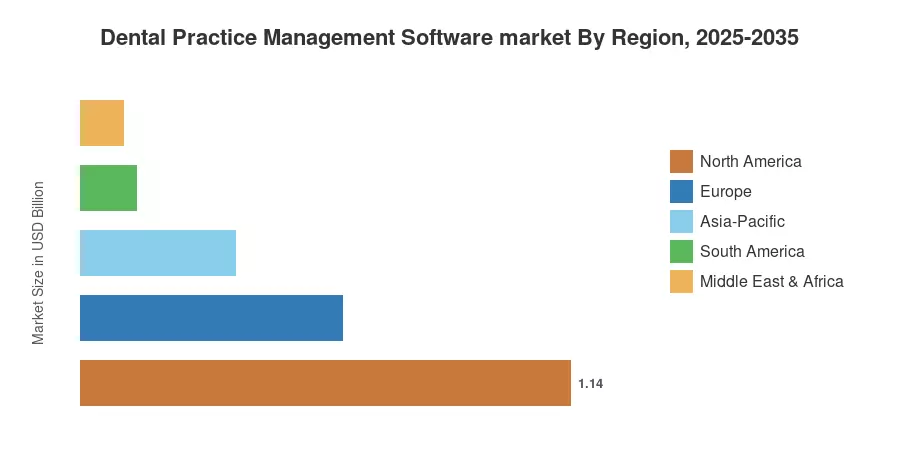
Regionally, North America controls 45.8% of the Dental Practice Management Software Market, supported by insurance-claim complexity that makes automation economically obvious. Asia-Pacific expands fastest at a 14.6% CAGR, propelled by India's Ayushman Bharat Digital Mission and Japan's Medical DX roadmap [13][14]. Europe holds second position at 24.6%, where the European Health Data Space regulation now sets a hard interoperability deadline [9]. Buyers who defer replacement past 2028 will likely face migration under regulatory duress rather than on their own timeline.

ย 

Key Report Takeaways

โ€ข By Technology (Delivery & Subscription)

  • Cloud-based deployment commands 58.4% of the Dental Practice Management Software Market in 2025, and the gap widens every year
  • Perpetual-license revenue amounts to USD 0.90 Billion in 2025, a shrinking but still-material installed base
  • Subscription/SaaS contracts grow at a 13.9% CAGR through 2035

โ€ข By Sector (Functionality & Practice Size)

  • Practice and clinic management modules hold 31.5% share within the Dental Practice Management Software Market
  • Billing, claims, and revenue-cycle functionality generates USD 0.64 billion in 2025
  • Large DSOs (16+ operatories) account for 26.4% of spend despite representing a small fraction of practice counts

โ€ข By Region

  • North America leads with 45.8% share
  • Asia-Pacific posts the fastest regional CAGR at 14.6%
  • Middle East & Africa contributes USD 0.10 Billion in 2025, small but structurally underpenetrated

ย 

Market Size and Forecast (2021โ€“2035)

Figures below blend vendor revenue disclosures from public filings [5][6][7], practice-count baselines from national dental associations [1][21], insurance-claim volume data [2], and primary interviews with group-practice technology buyers. Historical years are reconstructed from reported segment revenue; forecast years apply adoption-curve modelling calibrated against cloud migration rates observed in adjacent ambulatory specialties [17].

Dental Practice Management Software market Size and Forecast
Our Impact
Enabled $4.3B Revenue Impact for Fortune 500 and Leading Multinationals
Partnering with 2000+ Global Organizations Each Year
30K+ Citations by Top-Tier Firms in the Industry

Driver Impact Analysis

Driver ~% Impact on CAGR Geographic Relevance Impact Timeline
Cloud migration from server-based installs ~2.4 pp Global Short-term (โ‰ค2 yr)
DSO consolidation and multi-location roll-ups ~2.1 pp North America, Europe Medium-term (2โ€“4 yr)
Insurance claim automation and real-time eligibility ~1.8 pp North America Short-term (โ‰ค2 yr)
Government digital health and interoperability mandates ~1.6 pp Europe, Asia-Pacific Medium-term (2โ€“4 yr)
AI-assisted radiographic charting and coding ~1.5 pp Global Long-term (โ‰ฅ4 yr)
Patient self-service booking and recall automation ~1.3 pp Global Short-term (โ‰ค2 yr)
Teledentistry reimbursement expansion ~0.9 pp North America, Asia-Pacific Long-term (โ‰ฅ4 yr)

ย 

Cloud Migration From Server-Based Installations

On a global basis, cloud migration from server-based installations now drives an estimated ~2.4 percentage point impact on CAGR, particularly over a short-term horizon of two years or fewer [8]. Moving away from outdated, localized infrastructure is now essential for scalability, remote data access, and smooth multi-site administration; it is no longer merely an IT upgrade. Modern cloud architecture supports the digital transformation required to promote wider industry growth as businesses progressively decentralize activities while requiring unified control.

ย 

DSO Consolidation and Multi-Location Roll-Ups

Group affiliation now covers approximately 24% of practising U.S. dentists, and the figure exceeds 40% among dentists under 35 [1]. Acquirers cannot run twelve locations on twelve disconnected databases, so consolidated dental EHR software with centralised reporting becomes a condition of the transaction rather than a discretionary upgrade. Average per-location software spend inside a DSO runs roughly 2.3ร— that of an independent practice.

Insurance Claim Automation

U.S. national health expenditure projections put dental services near USD 202 billion annually by 2027, with claim denial and rework consuming a meaningful slice of practice margin [2]. Real-time eligibility verification and automated attachment submission cut average days-in-AR from the mid-thirties into the low twenties for practices that implement them fully โ€” a direct cash-flow argument that closes deals faster than any clinical feature.

Interoperability Mandates

Europe's Health Data Space regulation obliges member states to enable structured electronic health record exchange, and dentistry is not carved out [9]. NHS England's dental recovery programme separately tied activity reporting to digital submission [10]. Vendors without FHIR-capable interfaces face a hard commercial ceiling in EU tenders after 2028.

ย 

Restraints Impact Analysis

Restraint weightings below are directional drags on the headline CAGR, estimated from deal-cycle slippage, churn observations, and procurement interviews. They are not additive and should not be subtracted sequentially from the growth rate.

Restraint ~% Impact on CAGR Geographic Relevance Impact Timeline
Data-migration risk and switching costs ~-1.4 pp Global Short-term (โ‰ค2 yr)
HIPAA/GDPR breach liability and cyber-insurance cost ~-1.1 pp North America, Europe Medium-term (2โ€“4 yr)
Solo-practice price sensitivity ~-0.9 pp Asia-Pacific, South America Medium-term (2โ€“4 yr)
Fragmented imaging and hardware integration standards ~-0.8 pp Global Long-term (โ‰ฅ4 yr)
Clinical and administrative staffing shortages ~-0.6 pp North America, Europe Short-term (โ‰ค2 yr)

ย 

Data-Migration Risk and Switching Costs

Twenty years of charts, radiographs, perio measurements, and ledger history do not move cleanly. Practices routinely budget four to nine weeks of parallel running, and conversion quotes of USD 3,000โ€“9,000 are common for a single-location office [8]. Migration horror stories circulate quickly through study clubs, and one botched conversion in a local network suppresses purchase intent across dozens of neighbouring practices.

Breach Liability and Cyber-Insurance Economics

Proposed strengthening of the HIPAA Security Rule would make encryption, multifactor authentication and asset inventory explicit requirements rather than addressable ones [4]. Small dental practices report cyber-insurance premium increases in the 30โ€“60% range following the rule's publication, and insurers increasingly demand vendor attestations before binding coverage. That cost lands on the same budget line the software occupies.

Solo-Practice Price Sensitivity

Solo and two-operatory practices still constitute the majority of clinics worldwide, and in price-elastic markets a USD 400 monthly subscription competes directly against a hygienist's hours [20]. Vendors have responded with stripped tiers, but discounting compresses average revenue per practice and slows aggregate value growth even as unit adoption rises.

ย 

Dental Practice Management Software market Opportunities

Embedded Payments and Financing

A software vendor becomes a transaction participant through payment processing linked to the practice ledger. Within three years, take rates of 20โ€“45 basis points on card volume + revenue sharing on patient financing can surpass subscription revenue per location. This is the most obvious way to increase margins in the near future.

ย 

AI-Assisted Charting and Coding

The documentation time per operative visit is now reduced by several minutes due to the direct integration of caries detection and bone-level measurement models into charting workflows. Dental imaging AI has simpler regulatory clearance processes than the majority of medical specialties, which shortens time-to-revenue.

ย 

Emerging-Market Greenfield Adoption

India, Indonesia, Vietnam and Nigeria collectively add tens of thousands of new dental chairs annually with no legacy software to displace. Ayushman Bharat Digital Mission health IDs give vendors a national identity rail to build against [13]. Localised, mobile-first, low-ARPU products can win share here that will be very difficult to dislodge later.

De-Identified Data Monetisation

For dental manufacturers, insurance companies, and clinical researchers, aggregated treatment-outcome and materials-usage records are extremely valuable. Under GDPR and HIPAA safe-harbor regimes, vendors sitting on millions of longitudinal charts can license de-identified cohorts, establishing a revenue stream completely independent of seat counts.

ย 

Insurer-Adjacent Revenue Cycle Services

Moving beyond software into managed claim submission and denial appeals converts a licence relationship into a percentage-of-collections engagement. Practices facing administrative staffing shortages are increasingly willing to outsource, and the addressable spend is several times the software line item.

ย 

Dental Practice Management Software market Future Outlook

Autonomous Revenue Cycle

By the early 2030s, claim submission, denial triage and appeal drafting will run largely without human touch for routine procedure codes. Practices reporting the highest clean-claim rates already automate eligibility and attachment handling end to end, and the remaining manual work concentrates in edge cases [2]. Expect the value proposition to shift from "faster billing" to "no billing department."

Platform Economics and the Attach-Rate Race

Software subscription revenue increasingly functions as a customer-acquisition cost for higher-margin adjacencies โ€” payments, financing, supplies ordering, insurance verification. Vendors with three or more attached services report per-location revenue several multiples above licence-only peers, which explains the acquisition appetite visible across the sector [5][6].

Clinical AI Moving From Assist to Record

Imaging AI outputs are migrating from advisory overlays into the permanent chart, which raises documentation, liability and audit questions that current software architectures handle poorly. Vendors that build model-versioning and provenance tracking now will avoid an expensive retrofit when regulators formalise expectations [3][17].

Oral Health Equity and Public Programme Integration

The World Health Organization estimates that oral diseases affect roughly 3.5 billion people globally, and public programmes expanding coverage need reporting infrastructure to function [12]. Software vendors positioned to serve community clinics and public schemes โ€” thin margins, high volume, government-funded โ€” will capture a growth pool that private-practice-focused competitors ignore entirely.

ย 

Dental Practice Management Software market Segmentation

By Delivery Mode

Segment Metric Primary Demand Driver
Cloud-Based / Web-Based 58.4% share (2025) Multi-location access, no server capex
On-Premises USD 1.04 Billion (2025) Installed-base inertia, data-residency preference

ย 

Cloud crossed the majority share in the Dental Practice Management Software Market during 2024 and has not looked back. The tipping point was not feature parity โ€” it was ransomware. On-premises revenue persists mainly through support contracts on mature products, and a meaningful share of that base belongs to practices within five years of retirement, where the owner has no incentive to migrate.

By Subscription Model

Segment Metric Primary Demand Driver
Subscription / SaaS 63.7% share (2025) Predictable opex, bundled updates
Perpetual License USD 0.90 Billion (2025) Legacy contracts, capital-budget preference

ย 

Subscription and SaaS models have decisively captured the market, claiming a 63.7% share as clinics increasingly favor predictable operating expenses and bundled, automated updates. Conversely, the remaining USD 0.90 billion tied to perpetual licenses is propped up by legacy contracts and institutional preferences for capital-budget structures, though this base continues to shrink as recurring models become the industry standard.

ย 

By Functionality

Segment Metric Primary Demand Driver
Practice / Clinic Management & Scheduling 31.5% share (2025) Chair utilisation and recall discipline
Billing, Claims & Revenue Cycle USD 0.64 Billion (2025) Denial reduction, days-in-AR compression
Patient Communication & Engagement 19.2% share (2025) No-show reduction, review generation
Clinical Charting & Imaging 12.9% CAGR (2026โ€“2035) AI-assisted detection, integration depth
Analytics & Reporting 8.2% share (2025) Multi-location performance benchmarking

ย 

Scheduling and operational management remain the backbone of the Dental Practice Management Software Market because chair time is the asset being optimised โ€” a single percentage point of utilisation improvement outweighs most other software returns. Revenue-cycle functionality grows faster in value terms, and dental office billing software increasingly ships as a standalone module that practices buy before they replace the core platform, creating a beachhead for competitive displacement.

By Practice Size

Segment Metric Primary Demand Driver
Solo Practices (1โ€“2 Ops) 28.9% share (2025) Volume of practices, low ARPU
Small Group Practices (3โ€“5 Ops) USD 0.60 Billion (2025) Shared scheduling and provider coverage
Mid-Size Group Practices (6โ€“15 Ops) 12.6% CAGR (2026โ€“2035) Standardisation before further roll-up
Large DSOs (16+ Ops) 26.4% share (2025) Centralised reporting and procurement leverage

ย 

Solo practices drive volume with a 28.9% share (2025) despite lower ARPU, while small groups (3โ€“5 ops) represent USD 0.60 billion for shared scheduling. Mid-size groups (6โ€“15 ops) lead growth at a 12.6% CAGR (2026โ€“2035), prioritizing standardization, closely mirroring large DSOs commanding 26.4% share via centralized reporting and procurement leverage.

By End User

Segment Metric Primary Demand Driver
Dental Clinics 71.3% share (2025) Core installed base
Hospitals USD 0.36 Billion (2025) Oral surgery and hospital dentistry integration
Dental Academic & Research Institutes 13.4% CAGR (2026โ€“2035) Teaching-clinic digitisation grants
Others 5.4% share (2025) Mobile, military and community programmes

ย 

Dental clinics form the core installed base with a 71.3% share (2025), while hospitals represent USD 0.36 billion (2025) driven by oral surgery integration. Meanwhile, academic and research institutes lead growth at a 13.4% CAGR (2026โ€“2035) fueled by teaching-clinic digitization grants, alongside niche mobile and military programs capturing a 5.4% share (2025).

ย 

Regional Market Share Analysis

Region Metric (2025 unless noted) Primary Investment Themes
North America 45.8% share DSO platform standardisation, embedded payments
Europe USD 0.61 Billion EHDS compliance, cross-border record portability
Asia-Pacific 14.6% CAGR (2026โ€“2035) Greenfield digitisation, mobile-first deployment
South America 5.3% share Claim-standard compliance, group-practice formation
Middle East & Africa USD 0.10 Billion Health information exchange mandates, medical tourism
Total USD 2.49 Billion โ€”

Regional distribution within the Dental Practice Management Software Market reflects insurance complexity more than dentist density โ€” markets with intricate third-party reimbursement automate first.

ย 

North America

Country Metric Key Driver
US 87.2% of region Claim automation economics and DSO scale [2]
Canada USD 0.09 Billion Connected Care interoperability roadmap [22]
Mexico 13.9% CAGR Cross-border dental tourism corridors [11]

ย 

American demand is driven by administrative burden rather than clinical need. With dental spending on track toward USD 202 billion annually and denial rework consuming staff hours that practices cannot easily staff for, automation carries a payback measurable in months [2]. Canada's provincial dental care plan expansion added claim volume that manual workflows absorbed badly, accelerating replacement cycles [22].

Europe

Country Metric Key Driver
Germany 22.4% of region Statutory insurance e-billing requirements [9]
UK USD 0.11 Billion NHS dental activity reporting [10]
France 12.1% CAGR Carte Vitale digital integration [11]
Italy 9.6% of region Regional health authority digitisation
Spain 8.1% of region Corporate dental chain expansion
Nordic Countries USD 0.05 Billion Mature national e-health infrastructure
Russia 4.7% of region Domestic vendor substitution
Rest of Europe 14.7% of region EHDS harmonisation runway [9]

ย 

Europe's buying behaviour is compliance-led. The Health Data Space regulation sets structured-exchange obligations that oblige vendors to expose standards-based interfaces, and procurement teams have begun writing FHIR conformance into tender criteria [9]. Britain's dental recovery programme layered activity-reporting requirements onto practices already juggling mixed NHS and private ledgers [10].

Asia-Pacific

Country Metric Key Driver
China 26.8% of region Private dental chain scale-up
India 17.9% CAGR Ayushman Bharat Digital Mission health IDs [13]
Japan USD 0.10 Billion Medical DX Promotion Roadmap [14]
South Korea 10.3% of region National insurance claim digitisation
ASEAN 12.7% of region Medical tourism quality accreditation
Rest of Asia-Pacific 13.6% of the region My Health Record sharing rules [18]

ย 

Asia-Pacific is where the Dental Practice Management Software Market changes shape rather than merely growing. India's digital mission has issued health IDs at national scale, giving vendors a patient-identity foundation that took Western markets decades to approximate [13]. Japan's roadmap ties electronic prescribing and standardised records to a firm timeline, pulling dental clinics into a programme originally framed around physician practices [14].

South America

Country Metric Key Driver
Brazil 52.6% of region TISS claim standard enforcement [19]
Argentina 18.4% of region Prepaid health plan network requirements
Rest of South America USD 0.04 Billion Urban group-practice formation

ย 

Brazil anchors the region because its supplementary health regulator mandates a standardised electronic claim format, and practices submitting to multiple operators cannot manage it on spreadsheets [19]. Currency volatility keeps buyers on local vendors and monthly billing, which suppresses average contract value but improves adoption velocity.

Middle East & Africa

Country Metric Key Driver
Saudi Arabia 27.3% of region Health Sector Transformation Program [15]
UAE 16.4% CAGR Nabidh and Malaffi health information exchanges [16]
South Africa 18.7% of region Private hospital group dental units
Egypt 11.2% of region Universal health insurance rollout
Rest of MEA 22.0% of region Medical tourism infrastructure

ย 

Gulf states buy differently: mandated exchange participation arrives before market demand does. Dubai's health information exchange policy requires licensed facilities โ€” dental clinics included โ€” to submit structured encounter data, which effectively rules out paper and unsupported legacy systems [16]. Saudi transformation spending has funded clinic-level IT alongside hospital programmes [15].

ย 

Dental Practice Management Software market By Region, 2025-2035

Competitive Benchmarking

Concentration sits in the medium band. Market Research Future estimates a Herfindahl-Hirschman Index near 1,020 with the top five vendors holding roughly 52% of global revenue โ€” enough for two clear leaders to shape pricing, but with a long tail of regional and specialty vendors that keeps the segment contestable. Cloud-native challengers have taken share disproportionately from mid-size group practices, where switching pain is manageable, and reporting needs are acute.

Company Est. Revenue Share Range Key Offerings for Dental Practice Management Software Market Strategic Positioning
Henry Schein One ~18โ€“22% Dentrix, Dentrix Ascend, Dentally, Jarvis Analytics Scale incumbent leveraging distribution reach [5]
Patterson Companies ~12โ€“15% Eaglesoft, Fuse, Patterson Advantage Distribution-anchored, migrating base to cloud [6]
Carestream Dental ~7โ€“10% Sensei Cloud, CS Imaging integration Imaging-first platform convergence [7]
Planet DDS ~5โ€“7% Denticon, Cloud 9 Ortho, Apteryx imaging DSO and multi-location specialist
Curve Dental ~4โ€“6% Curve Hero, Curve GRO Cloud-native, independent-practice focus
Open Dental Software ~4โ€“6% Open Dental, eServices Open-architecture, low-cost, high loyalty
CareStack ~3โ€“5% Unified clinical, billing, and engagement suite All-in-one consolidation pitch
NextGen Healthcare ~2โ€“4% NextGen Dental, ambulatory interoperability stack Medical-dental integration play
tab32 ~1โ€“3% One-patient-one-record cloud platform Data-centric, community health strength
Adit ~1โ€“2% Practice growth and engagement platform Front-office automation entry point
Practice-Web ~1โ€“2% PW Cloud, integrated claims Value-tier independent practices

ย 

ย 

Recent News & Developments

  • Henry Schein One (March 2024): Expanded Dentrix Ascend into additional European markets, signalling that the cloud line โ€” not the perpetual product โ€” carries the growth mandate [5].

ย 

  • Planet DDS (September 2024): Acquired imaging and analytics assets to close the clinical gap against distribution-backed incumbents.

ย 

  • HHS Office for Civil Rights (January 2025): Proposed a substantially strengthened HIPAA Security Rule mandating encryption and multifactor authentication, reshaping vendor security roadmaps [4].
  • CareStack (June 2025): Raised growth capital to expand revenue-cycle services, illustrating the shift from licence revenue toward percentage-of-collections models.

ย 

  • National Health Authority, India (April 2025): Reported cumulative health-ID issuance surpassing 700 million under the digital mission, creating national patient-identity rails for clinic software [13].

ย 

Dental Practice Management Software market Report Scope

Parameter Detail
Market Scope Global Dental Practice Management Software Market, segmented by delivery mode, subscription model, functionality, practice size, end user, and geography
Study Period 2021โ€“2035 (Historical 2021โ€“2024; Base Year 2025; Forecast 2026โ€“2035)
CAGR 11.8% (2026โ€“2035)
Market Size Checkpoints USD 2.49 Billion (2025) ยท USD 2.78 Billion (2026) ยท USD 4.86 Billion (2031) ยท USD 7.59 Billion (2035)
Fastest Growing Segments Clinical Charting & Imaging (functionality); Dental Academic & Research Institutes (end user); Asia-Pacific (geography)
Companies Profiled Henry Schein One, Patterson Companies, Carestream Dental, Planet DDS, Curve Dental, Open Dental Software, CareStack, NextGen Healthcare, tab32, Adit, Practice-Web
Valuation Currency USD, at constant 2025 exchange rates

FAQs

What contract length should buyers negotiate when entering the Dental Practice Management Software Market?
Three-year terms typically unlock 15โ€“25% discounts, but lock in pricing before AI modules mature. Single-year agreements with capped renewal escalators preserve leverage at a modest premium [8].
Who actually owns practice data under a typical subscription agreement?
The practice owns the clinical record; the vendor controls the schema. Insist on contractual export rights in a documented, non-proprietary format with a defined delivery window at termination [4].
How should a buyer evaluate integration risk within the Dental Practice Management Software Market?
Verify certified integrations with your existing sensor, cone-beam, and payment hardware before signing. Bridge middleware works but introduces latency and a second support relationship [17].
Are open-architecture platforms safer bets than closed suites?
Open database access enables third-party analytics and custom reporting, which mid-size groups value highly. The tradeoff is thinner vendor accountability when something breaks across integrated components.
What does a realistic implementation timeline look like?
Single-location conversions run four to nine weeks, including parallel operation. Multi-location DSO deployments typically stage over six to twelve months, one region at a time [8].
Which pricing models dominate the Dental Practice Management Software Market today?
Per-provider and per-location monthly fees are standard, increasingly paired with transaction-based payment revenue. Percentage-of-collections pricing is emerging in bundled revenue-cycle offerings [6].
Does medical-dental integration change vendor selection?
For hospital-affiliated and community health settings, yes โ€” FHIR-capable platforms that exchange with ambulatory systems avoid duplicate charting. Standalone private practices rarely need it before 2028 [3]. ย  ย  ย 
Author
Author
Author Profile
Rahul Gotadki LinkedIn
Research Manager
He holds an experience of about 9+ years in Market Research and Business Consulting, working under the spectrum of Life Sciences and Healthcare domains. Rahul conceptualizes and implements a scalable business strategy and provides strategic leadership to the clients. His expertise lies in market estimation, competitive intelligence, pipeline analysis, customer assessment, etc.
Co-Author
Co-Author Profile
Satyendra Maurya LinkedIn
Research Analyst
An accomplished research analyst with high proficiency in market forecasting, data visualization, competitive benchmarking, and others. He holds a pronounced track record in research and consulting projects for sectors such as life sciences, medical devices, and healthcare IT. His capabilities in qualitative and quantitative analysis have resulted in positive client outcomes. Working on niche market trends, opportunities, sales, and forecasted value is part of his skill set.
Share::
Request Free Sample

Research Approach

Research Methodology on Dental Practice Management Software Market

1. Introduction

This study is based on the report, โ€œDental Practice Management Software Marketโ€ (MRFR, 2023), which analyzed the impact of the global dental practice management software market. It focuses on the market size, industry trends, and growth opportunities. The study examined the market dynamics, such as drivers, opportunities, threats, and challenges. The research used both primary and secondary sources including journal articles, surveys, interviews, and various industry associations for the data collection.

2. Objectives

The primary objective of this study is to assess the market size and industry trends of the global dental practice management software market. The secondary objectives of this study are to understand the industry dynamics and market trends, identify key players, and analyze the market potential.

3. Research Methodology

The research methodology adopted for this study involves a wide range of data collection and analysis techniques. The data was collected and analyzed from both primary and secondary sources. Primary sources included interviews with industry experts, market surveys, and customer feedback. The secondary sources included industry publications, magazines, and online databases. The data was further analyzed and interpreted to identify market trends and derive conclusions.

4. Data Sources

The data sources used for this study included both primary and secondary sources. The primary sources included interviews with industry experts, surveys, customer feedback, and market research reports. The secondary sources included industry journals, magazines, news articles, and online databases.

5. Market Estimation and Forecasting

Market estimation and forecasting were done using various statistical and analytical tools such as regression analysis and forecasting models. The data was broken down into segments and further sub-segments to understand the market size, market share, and industry trends. The data was also tested for accuracy and reliability.

6. Data Validation

Data validation was conducted by comparing the primary and secondary sources for proper data accuracy and reliability. The data was also cross-checked with existing industry data sources to ensure accuracy.

8. Conclusion

This study was conducted to assess the size, industry trends, and growth potential of the global dental practice management software market. The research methodology adopted for this study included data collection, market estimation, and forecasting. The data was sourced from both primary and secondary sources. The data validation ensured the accuracy and reliability of the data. The research adopted showed a comprehensive assessment of the market size, market structure, industry trends, and growth potential.

Share::
Request Free Sample
Download Free Sample

Kindly complete the form below to receive a free sample of this Report

* Please use a valid business email

Share::
Request Free Sample
Download PDF ×

We do not share your information with anyone. However, we may send you emails based on your report interest from time to time. You may contact us at any time to opt-out.
















