×
Hero Background
English
Chinese
French
Japanese
Korean
German
Spanish

Diabetes Pen Market Size

ID: MRFR/MED/0146-HCR
105 Pages
Rahul Gotadki
October 2025

Americas Diabetes Pen Market Research Report Information By Type, By Route, By Therapy, And By Region (North America, Europe, Asia-Pacific, And Rest Of The World) – Market Forecast Till 2035

Share:
Download PDF ×

We do not share your information with anyone. However, we may send you emails based on your report interest from time to time. You may contact us at any time to opt-out.

Diabetes Pen Market Infographic
Purchase Options

Diabetes Pen Size

Diabetes Pen Market Growth Projections and Opportunities

The Americas Diabetes Pen Market is influenced by a myriad of factors that collectively define its growth and dynamics. One of the primary drivers is the increasing prevalence of diabetes in the Americas. As the number of individuals diagnosed with diabetes continues to rise, there is a growing demand for convenient and effective insulin delivery methods, driving the adoption of diabetes pens. These devices offer a user-friendly alternative to traditional insulin injections, allowing patients to manage their diabetes more comfortably and with greater precision, contributing to the expansion of the market.

Research and development activities play a crucial role in shaping the Americas Diabetes Pen Market. Ongoing advancements in medical technology and pharmaceutical formulations drive innovation in diabetes pens. Companies invest in developing pens with enhanced features, improved insulin delivery mechanisms, and smart technologies that facilitate better diabetes management. Continuous research efforts contribute to the availability of a diverse range of diabetes pens, meeting the evolving needs of patients and healthcare providers.

Government regulations and healthcare policies significantly impact the Americas Diabetes Pen Market. Regulatory approvals are essential for the introduction of new diabetes pens and related technologies. Compliance with regulatory standards ensures the safety and efficacy of these devices, instilling confidence among healthcare professionals and patients. Government policies related to diabetes management, reimbursement for insulin pens, and initiatives promoting the use of advanced technologies influence market dynamics, affecting the adoption and utilization of diabetes pens.

The role of healthcare infrastructure and access to diabetes care services is pivotal in the Americas Diabetes Pen Market. Well-established healthcare facilities, diabetes clinics, and trained healthcare professionals support the integration of diabetes pens into routine diabetes management. Accessibility to diabetes care services influences the adoption of diabetes pens, with improved infrastructure contributing to the overall growth of the market.

Market competition is a significant factor driving innovation in the Americas Diabetes Pen Market. The presence of various pharmaceutical and medical device companies fosters competition, leading to the development of diverse diabetes pen technologies and products. Companies strive to offer pens that provide accurate dosing, ease of use, and enhanced portability, addressing the preferences of patients and healthcare professionals. The competitive landscape encourages continuous improvement in diabetes pen features, benefiting the field of diabetes care.

Public awareness and changing trends in diabetes management contribute to the dynamics of the Americas Diabetes Pen Market. With a growing emphasis on personalized and convenient diabetes care, patients and healthcare providers are increasingly aware of the benefits of using diabetes pens. Educational initiatives by medical professionals and industry stakeholders further drive awareness, highlighting the role of pens in simplifying insulin administration and improving adherence to treatment regimens.

Global economic conditions and healthcare spending patterns influence the Americas Diabetes Pen Market. Economic factors impact funding for research and development, market access, and affordability of diabetes pens. As healthcare budgets vary across countries in the Americas, economic considerations play a role in shaping the adoption and utilization of diabetes pens in different healthcare settings.

The ongoing COVID-19 pandemic has presented challenges and opportunities for the Americas Diabetes Pen Market. While the pandemic has strained healthcare resources and shifted priorities, it has also highlighted the importance of remote and self-administered diabetes care. The adaptability of diabetes pens in home-based settings may position them favorably as healthcare systems evolve to accommodate changing healthcare needs.

Diabetes Pen Market Size Graph
Author
Rahul Gotadki
Assistant Manager

He holds an experience of about 7+ years in Market Research and Business Consulting, working under the spectrum of Life Sciences and Healthcare domains. Rahul conceptualizes and implements a scalable business strategy and provides strategic leadership to the clients. His expertise lies in market estimation, competitive intelligence, pipeline analysis, customer assessment, etc. In addition to the above, his other responsibility includes strategic tracking of high growth markets & advising clients on the potential areas of focus they could direct their business initiatives

Leave a Comment

Market Summary

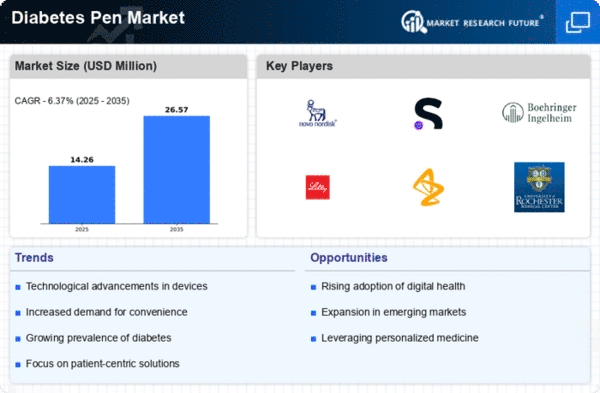
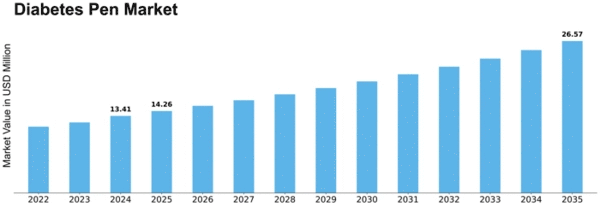
As per MRFR analysis, the Diabetes Pen Market Size was estimated at 13.41 USD Million in 2024. The Diabetes Pen industry is projected to grow from 14.42 USD Million in 2025 to 26.57 USD Million by 2035, exhibiting a compound annual growth rate (CAGR) of 6.37 during the forecast period 2025 - 2035.

Key Market Trends & Highlights

The Diabetes Pen Market is experiencing robust growth driven by technological advancements and increasing patient-centric care.

  • North America remains the largest market for diabetes pens, driven by high diabetes prevalence and advanced healthcare infrastructure.
  • The Asia-Pacific region is emerging as the fastest-growing market, fueled by rising awareness and increasing healthcare access.
  • The insulin delivery segment continues to dominate the market, while the glucose monitoring segment is witnessing rapid growth.
  • Key market drivers include the rising prevalence of diabetes and technological innovations in diabetes management.

Market Size & Forecast

2024 Market Size 13.41 (USD Million)
2035 Market Size 26.57 (USD Million)
CAGR (2025 - 2035) 6.37%
Largest Regional Market Share in 2024 North America

Major Players

<p>Novo Nordisk (DK), Sanofi (FR), Boehringer Ingelheim (DE), Roche (CH), Eli Lilly (US), AstraZeneca (GB), Medtronic (US), Ypsomed (CH), Insulet Corporation (US)</p>

Market Trends

The Diabetes Pen Market is currently experiencing a notable transformation, driven by advancements in technology and increasing awareness of diabetes management. The rise in the prevalence of diabetes globally has led to a growing demand for efficient and user-friendly insulin delivery systems. As patients seek more convenient options, diabetes pens are becoming increasingly popular due to their ease of use and portability. Furthermore, the integration of smart technology into these devices appears to enhance patient adherence to treatment regimens, potentially improving overall health outcomes. In addition to technological innovations, the Diabetes Pen Market is influenced by changing demographics and lifestyle factors. An aging population, coupled with rising obesity rates, suggests a continued increase in diabetes cases. This trend may lead to a greater emphasis on personalized medicine, where diabetes pens are tailored to meet individual patient needs. Moreover, the ongoing development of biosimilar insulin products could further diversify the market, providing patients with more choices and potentially lowering costs. Overall, the Diabetes Pen Market seems poised for growth as it adapts to the evolving landscape of diabetes care.

Technological Advancements

The integration of smart technology into diabetes pens is reshaping the market. These innovations may include features such as connectivity to mobile applications, which allow for better tracking of insulin doses and glucose levels. Such advancements could enhance patient engagement and adherence to treatment.

Personalized Medicine

There is a growing trend towards personalized medicine in diabetes management. This approach may involve customizing diabetes pens to suit individual patient profiles, thereby improving treatment efficacy. Tailored solutions could lead to better health outcomes and increased patient satisfaction.

Biosimilar Insulin Products

The emergence of biosimilar insulin products is likely to impact the Diabetes Pen Market significantly. These alternatives may provide patients with more options and potentially lower costs, fostering competition and driving innovation within the market.

Diabetes Pen Market Market Drivers

Market Segment Insights

By Application: Insulin Delivery (Largest) vs. Glucose Monitoring (Fastest-Growing)

<p>The Diabetes Pen Market is primarily segmented into Insulin Delivery, Glucose Monitoring, Patient Education, and Data Management. Among these, Insulin Delivery holds the largest market share owing to its established use in diabetes management. Glucose Monitoring is gaining traction and is increasingly recognized for its critical role in patient care, reflecting a notable shift in consumer preferences towards proactive health management.</p>

<p>Insulin Delivery (Dominant) vs. Glucose Monitoring (Emerging)</p>

<p>Insulin Delivery remains the dominant application in the Diabetes Pen Market, largely due to its essential function in administering insulin to diabetic patients efficiently. This application includes various types of insulin pens that offer convenience, ease of use, and precise dosage delivery. On the other hand, Glucose Monitoring is an emerging segment that is rapidly gaining popularity as patients seek integrated health solutions. Continuous glucose monitoring systems are at the forefront of this trend, driving awareness and adoption. Both segments complement each other, as effective insulin delivery relies on accurate glucose monitoring, highlighting the interdependent dynamics within the diabetes management landscape.</p>

By Type: Prefilled Pen (Largest) vs. Smart Pen (Fastest-Growing)

<p>In the Diabetes Pen Market, the distribution of market share among segment values reveals that prefilled pens hold the largest share, owing to their ease of use and convenience for patients managing diabetes. Prefilled pens are favored by a significant portion of users, making them a staple in diabetes management, while reusable pens offer an appealing alternative for their cost-effectiveness over time. Smart pens are emerging as a strong contender, gaining traction among tech-savvy patients who prioritize advanced features and connectivity.</p>

<p>Prefilled Pen (Dominant) vs. Smart Pen (Emerging)</p>

<p>Prefilled pens dominate the Diabetes Pen Market due to their user-friendly design and the convenience they offer for patients requiring insulin delivery. These pens eliminate the need for users to measure doses, providing a straightforward experience particularly beneficial for those who may be inexperienced with diabetes management. Conversely, smart pens are emerging with a unique position in this market, equipped with features like dose reminders and data tracking capabilities. These technological advancements make smart pens attractive to younger patients seeking integration with digital health solutions. As the market evolves, the competition between these two segments drives innovation and enhanced user experiences.</p>

By End User: Hospitals (Largest) vs. Homecare (Fastest-Growing)

<p>The Diabetes Pen Market is characterized by a diverse range of end users, with hospitals holding the largest share. This segment primarily benefits from the high volume of diabetic patients seeking immediate care and the increased adoption of diabetes management solutions. In contrast, the homecare segment, while smaller, is witnessing rapid growth as more patients prefer managing their diabetes from the comfort of their homes, supported by advancements in technology and home healthcare systems. As the healthcare landscape evolves, the demand for diabetes pens among hospitals and homecare settings is influenced by changing patient behaviors and technological innovations. The growing emphasis on patient-centered care and the convenience of at-home treatment options are driving the expansion of the homecare segment, making it one of the fastest-growing areas in the market. Healthcare providers are adapting their strategies to accommodate this shift, further boosting growth in both segments.</p>

<p>Hospitals (Dominant) vs. Pharmacies (Emerging)</p>

<p>Hospitals remain the dominant end-user segment in the Diabetes Pen Market due to their comprehensive healthcare services and a large patient turnover. They are equipped with professionals who are trained to manage complex cases, thus consistently warranting the need for diabetes pens. Additionally, hospitals often make bulk purchases, providing them significant leverage in negotiations with suppliers. Meanwhile, pharmacies are emerging as a key player in the distribution of diabetes pens, catering to outpatients looking for accessible diabetes management tools. This segment is rapidly gaining traction as pharmacies expand their diabetes care offerings, including patient education and support services. The growth of pharmacies is driven by their convenience and the increasing prescription rates of diabetes pens as part of routine diabetes management.</p>

By Distribution Channel: Online Retail (Largest) vs. Pharmacy (Fastest-Growing)

<p>The Diabetes Pen Market exhibits a diverse distribution channel structure, primarily dominated by online retail, which accounts for a substantial share of the market. This channel benefits from the growing trend of e-commerce and increasing consumer preference for the convenience of online shopping. In contrast, the pharmacy segment plays a crucial role in ensuring accessibility and immediate availability of diabetes pens, positioning it as the fastest-growing distribution channel. Its growth is fueled by an increase in health consciousness and the rising prevalence of diabetes worldwide, driving demand for easily accessible medication. One of the main drivers for the growth of the online retail segment is the expanding digital landscape, which encourages manufacturers and retailers to invest more in e-commerce platforms. Additionally, the pharmacy segment is increasingly integrating digital tools to streamline purchasing and patient education. Overall, both channels offer unique advantages, but the trend of convenience and rapid access is elevating the pharmacy segment as an essential player in the diabetes pen distribution landscape.</p>

<p>Online Retail (Dominant) vs. Pharmacy (Emerging)</p>

<p>The online retail segment of the Diabetes Pen Market represents the dominant distribution channel, characterized by an extensive range of product offerings and enhanced consumer accessibility. This channel benefits from the rise of e-commerce, allowing consumers to order diabetes pens from the comfort of their homes with ease. Moreover, online platforms often provide competitive pricing and convenient delivery options, which attract a growing number of customers. On the other hand, the pharmacy segment is emerging rapidly, characterized by immediate access to diabetes pens and personalized consultation services. Pharmacies are adapting to meet new consumer needs, enhancing their offerings with services such as medication synchronization and patient education, making them a vital resource for individuals managing diabetes.</p>

Get more detailed insights about Americas Diabetes Pen Market Research Report - Forecast 2035

Regional Insights

Key Players and Competitive Insights

The Diabetes Pen Market is characterized by a dynamic competitive landscape, driven by innovation, strategic partnerships, and a growing emphasis on patient-centric solutions. Key players such as Novo Nordisk (DK), Sanofi (FR), and Eli Lilly (US) are at the forefront, each adopting distinct strategies to enhance their market presence. Novo Nordisk (DK) focuses on continuous innovation in insulin delivery systems, while Sanofi (FR) emphasizes strategic collaborations to expand its product offerings. Eli Lilly (US) is increasingly investing in digital health solutions, indicating a shift towards integrating technology with diabetes management. Collectively, these strategies not only enhance their competitive positioning but also contribute to a more robust market environment.

In terms of business tactics, companies are increasingly localizing manufacturing to reduce costs and optimize supply chains. The market structure appears moderately fragmented, with several players vying for market share. However, the influence of major companies is substantial, as they leverage their resources to drive innovation and improve patient access to diabetes management solutions. This competitive structure fosters an environment where smaller players can also thrive, albeit with challenges in scaling operations and maintaining competitive pricing.

In November 2025, Sanofi (FR) announced a strategic partnership with a leading digital health company to develop an integrated diabetes management platform. This collaboration aims to enhance patient engagement and improve health outcomes through personalized treatment plans. The strategic importance of this move lies in Sanofi's recognition of the growing need for digital solutions in diabetes care, positioning the company as a leader in the integration of technology and healthcare.

In October 2025, Eli Lilly (US) launched a new smart insulin pen that features advanced connectivity options, allowing users to track their insulin usage via a mobile app. This innovation not only addresses the increasing demand for user-friendly diabetes management tools but also aligns with the broader trend of digitalization in healthcare. The launch signifies Eli Lilly's commitment to enhancing patient experience and adherence to treatment regimens.

In December 2025, Novo Nordisk (DK) unveiled a new initiative aimed at sustainability in its manufacturing processes, focusing on reducing carbon emissions by 30% by 2030. This initiative reflects a growing trend among major players to incorporate sustainability into their business models, which is increasingly becoming a competitive differentiator in the market. Novo Nordisk's proactive approach may set a benchmark for others in the industry, emphasizing the importance of environmental responsibility.

As of December 2025, current competitive trends in the Diabetes Pen Market are heavily influenced by digitalization, sustainability, and the integration of artificial intelligence (AI) in product development. Strategic alliances are shaping the landscape, enabling companies to pool resources and expertise to innovate more effectively. Looking ahead, competitive differentiation is likely to evolve from traditional price-based competition to a focus on innovation, technological advancements, and supply chain reliability. This shift underscores the necessity for companies to adapt and innovate continuously to meet the changing needs of patients and healthcare providers.

Key Companies in the Diabetes Pen Market market include

Industry Developments

Future Outlook

Diabetes Pen Market Future Outlook

<p>The Diabetes Pen Market is projected to grow at a 6.37% CAGR from 2024 to 2035, driven by technological advancements, increasing diabetes prevalence, and enhanced patient compliance.</p>

New opportunities lie in:

  • <p>Development of smart insulin pens with connectivity features</p>
  • <p>Expansion into emerging markets with tailored pricing strategies</p>
  • <p>Partnerships with telehealth platforms for remote patient monitoring</p>

<p>By 2035, the Diabetes Pen Market is expected to achieve substantial growth and innovation.</p>

Market Segmentation

Diabetes Pen Market Type Outlook

  • Prefilled Pen
  • Reusable Pen
  • Smart Pen

Diabetes Pen Market End User Outlook

  • Hospitals
  • Homecare
  • Diabetes Clinics
  • Pharmacies

Diabetes Pen Market Application Outlook

  • Insulin Delivery
  • Glucose Monitoring
  • Patient Education
  • Data Management

Diabetes Pen Market Distribution Channel Outlook

  • Online Retail
  • Pharmacy
  • Hospital Supply

Report Scope

MARKET SIZE 202413.41(USD Million)
MARKET SIZE 202514.42(USD Million)
MARKET SIZE 203526.57(USD Million)
COMPOUND ANNUAL GROWTH RATE (CAGR)6.37% (2024 - 2035)
REPORT COVERAGERevenue Forecast, Competitive Landscape, Growth Factors, and Trends
BASE YEAR2024
Market Forecast Period2025 - 2035
Historical Data2019 - 2024
Market Forecast UnitsUSD Million
Key Companies ProfiledNovo Nordisk (DK), Sanofi (FR), Boehringer Ingelheim (DE), Roche (CH), Eli Lilly (US), AstraZeneca (GB), Medtronic (US), Ypsomed (CH), Insulet Corporation (US)
Segments CoveredApplication, Type, End User, Distribution Channel
Key Market OpportunitiesIntegration of smart technology in Diabetes Pen Market enhances user experience and adherence to treatment.
Key Market DynamicsRising demand for user-friendly diabetes pens drives innovation and competition among manufacturers in the market.
Countries CoveredNorth America, Europe, APAC, South America, MEA

FAQs

  1. SECTION I: EXECUTIVE SUMMARY AND KEY HIGHLIGHTS
    1. EXECUTIVE SUMMARY
      1. Market Overview
      2. Key Findings
      3. Market Segmentation
      4. Competitive Landscape
      5. Challenges and Opportunities
      6. Future Outlook 2
  2. SECTION II: SCOPING, METHODOLOGY AND MARKET STRUCTURE
    1. MARKET INTRODUCTION
      1. Definition
      2. Scope of the study
    2. RESEARCH METHODOLOGY
      1. Overview
      2. Data Mining
      3. Secondary Research
      4. Primary Research
      5. Forecasting Model
      6. Market Size Estimation
      7. Data Triangulation
      8. Validation 3
  3. SECTION III: QUALITATIVE ANALYSIS
    1. MARKET DYNAMICS
      1. Overview
      2. Drivers
      3. Restraints
      4. Opportunities
    2. MARKET FACTOR ANALYSIS
      1. Value chain Analysis
      2. Porter's Five Forces Analysis
      3. COVID-19 Impact Analysis
  4. SECTION IV: QUANTITATIVE ANALYSIS
    1. Healthcare, BY Type (USD Billion)
      1. Reusable Pens
      2. Disposable Pens
      3. Smart Pens
    2. Healthcare, BY Delivery Method (USD Billion)
      1. Subcutaneous Injection
      2. Intramuscular Injection
      3. Intravenous Injection
    3. Healthcare, BY Therapeutic Area (USD Billion)
      1. Type 1 Diabetes
      2. Type 2 Diabetes
      3. Gestational Diabetes
    4. Healthcare, BY End User (USD Billion)
      1. Hospitals
      2. Homecare Settings
      3. Diabetes Clinics
    5. Healthcare, BY Region (USD Billion)
      1. North America
      2. Europe
      3. APAC
      4. South America
      5. MEA
  5. SECTION V: COMPETITIVE ANALYSIS
    1. Competitive Landscape
      1. Overview
      2. Competitive Analysis
      3. Market share Analysis
      4. Major Growth Strategy in the Healthcare
      5. Competitive Benchmarking
      6. Leading Players in Terms of Number of Developments in the Healthcare
      7. Key developments and growth strategies
      8. Major Players Financial Matrix
    2. Company Profiles
      1. Novo Nordisk (DK)
      2. Sanofi (FR)
      3. Boehringer Ingelheim (DE)
      4. Roche (CH)
      5. Eli Lilly (US)
      6. AstraZeneca (GB)
      7. Ypsomed (CH)
      8. Medtronic (US)
      9. Insulet (US)
    3. Appendix
      1. References
      2. Related Reports 6 LIST OF FIGURES
    4. MARKET SYNOPSIS
    5. NORTH AMERICA MARKET ANALYSIS
    6. US MARKET ANALYSIS BY TYPE
    7. US MARKET ANALYSIS BY DELIVERY METHOD
    8. US MARKET ANALYSIS BY THERAPEUTIC AREA
    9. US MARKET ANALYSIS BY END USER
    10. CANADA MARKET ANALYSIS BY TYPE
    11. CANADA MARKET ANALYSIS BY DELIVERY METHOD
    12. CANADA MARKET ANALYSIS BY THERAPEUTIC AREA
    13. CANADA MARKET ANALYSIS BY END USER
    14. EUROPE MARKET ANALYSIS
    15. GERMANY MARKET ANALYSIS BY TYPE
    16. GERMANY MARKET ANALYSIS BY DELIVERY METHOD
    17. GERMANY MARKET ANALYSIS BY THERAPEUTIC AREA
    18. GERMANY MARKET ANALYSIS BY END USER
    19. UK MARKET ANALYSIS BY TYPE
    20. UK MARKET ANALYSIS BY DELIVERY METHOD
    21. UK MARKET ANALYSIS BY THERAPEUTIC AREA
    22. UK MARKET ANALYSIS BY END USER
    23. FRANCE MARKET ANALYSIS BY TYPE
    24. FRANCE MARKET ANALYSIS BY DELIVERY METHOD
    25. FRANCE MARKET ANALYSIS BY THERAPEUTIC AREA
    26. FRANCE MARKET ANALYSIS BY END USER
    27. RUSSIA MARKET ANALYSIS BY TYPE
    28. RUSSIA MARKET ANALYSIS BY DELIVERY METHOD
    29. RUSSIA MARKET ANALYSIS BY THERAPEUTIC AREA
    30. RUSSIA MARKET ANALYSIS BY END USER
    31. ITALY MARKET ANALYSIS BY TYPE
    32. ITALY MARKET ANALYSIS BY DELIVERY METHOD
    33. ITALY MARKET ANALYSIS BY THERAPEUTIC AREA
    34. ITALY MARKET ANALYSIS BY END USER
    35. SPAIN MARKET ANALYSIS BY TYPE
    36. SPAIN MARKET ANALYSIS BY DELIVERY METHOD
    37. SPAIN MARKET ANALYSIS BY THERAPEUTIC AREA
    38. SPAIN MARKET ANALYSIS BY END USER
    39. REST OF EUROPE MARKET ANALYSIS BY TYPE
    40. REST OF EUROPE MARKET ANALYSIS BY DELIVERY METHOD
    41. REST OF EUROPE MARKET ANALYSIS BY THERAPEUTIC AREA
    42. REST OF EUROPE MARKET ANALYSIS BY END USER
    43. APAC MARKET ANALYSIS
    44. CHINA MARKET ANALYSIS BY TYPE
    45. CHINA MARKET ANALYSIS BY DELIVERY METHOD
    46. CHINA MARKET ANALYSIS BY THERAPEUTIC AREA
    47. CHINA MARKET ANALYSIS BY END USER
    48. INDIA MARKET ANALYSIS BY TYPE
    49. INDIA MARKET ANALYSIS BY DELIVERY METHOD
    50. INDIA MARKET ANALYSIS BY THERAPEUTIC AREA
    51. INDIA MARKET ANALYSIS BY END USER
    52. JAPAN MARKET ANALYSIS BY TYPE
    53. JAPAN MARKET ANALYSIS BY DELIVERY METHOD
    54. JAPAN MARKET ANALYSIS BY THERAPEUTIC AREA
    55. JAPAN MARKET ANALYSIS BY END USER
    56. SOUTH KOREA MARKET ANALYSIS BY TYPE
    57. SOUTH KOREA MARKET ANALYSIS BY DELIVERY METHOD
    58. SOUTH KOREA MARKET ANALYSIS BY THERAPEUTIC AREA
    59. SOUTH KOREA MARKET ANALYSIS BY END USER
    60. MALAYSIA MARKET ANALYSIS BY TYPE
    61. MALAYSIA MARKET ANALYSIS BY DELIVERY METHOD
    62. MALAYSIA MARKET ANALYSIS BY THERAPEUTIC AREA
    63. MALAYSIA MARKET ANALYSIS BY END USER
    64. THAILAND MARKET ANALYSIS BY TYPE
    65. THAILAND MARKET ANALYSIS BY DELIVERY METHOD
    66. THAILAND MARKET ANALYSIS BY THERAPEUTIC AREA
    67. THAILAND MARKET ANALYSIS BY END USER
    68. INDONESIA MARKET ANALYSIS BY TYPE
    69. INDONESIA MARKET ANALYSIS BY DELIVERY METHOD
    70. INDONESIA MARKET ANALYSIS BY THERAPEUTIC AREA
    71. INDONESIA MARKET ANALYSIS BY END USER
    72. REST OF APAC MARKET ANALYSIS BY TYPE
    73. REST OF APAC MARKET ANALYSIS BY DELIVERY METHOD
    74. REST OF APAC MARKET ANALYSIS BY THERAPEUTIC AREA
    75. REST OF APAC MARKET ANALYSIS BY END USER
    76. SOUTH AMERICA MARKET ANALYSIS
    77. BRAZIL MARKET ANALYSIS BY TYPE
    78. BRAZIL MARKET ANALYSIS BY DELIVERY METHOD
    79. BRAZIL MARKET ANALYSIS BY THERAPEUTIC AREA
    80. BRAZIL MARKET ANALYSIS BY END USER
    81. MEXICO MARKET ANALYSIS BY TYPE
    82. MEXICO MARKET ANALYSIS BY DELIVERY METHOD
    83. MEXICO MARKET ANALYSIS BY THERAPEUTIC AREA
    84. MEXICO MARKET ANALYSIS BY END USER
    85. ARGENTINA MARKET ANALYSIS BY TYPE
    86. ARGENTINA MARKET ANALYSIS BY DELIVERY METHOD
    87. ARGENTINA MARKET ANALYSIS BY THERAPEUTIC AREA
    88. ARGENTINA MARKET ANALYSIS BY END USER
    89. REST OF SOUTH AMERICA MARKET ANALYSIS BY TYPE
    90. REST OF SOUTH AMERICA MARKET ANALYSIS BY DELIVERY METHOD
    91. REST OF SOUTH AMERICA MARKET ANALYSIS BY THERAPEUTIC AREA
    92. REST OF SOUTH AMERICA MARKET ANALYSIS BY END USER
    93. MEA MARKET ANALYSIS
    94. GCC COUNTRIES MARKET ANALYSIS BY TYPE
    95. GCC COUNTRIES MARKET ANALYSIS BY DELIVERY METHOD
    96. GCC COUNTRIES MARKET ANALYSIS BY THERAPEUTIC AREA
    97. GCC COUNTRIES MARKET ANALYSIS BY END USER
    98. SOUTH AFRICA MARKET ANALYSIS BY TYPE
    99. SOUTH AFRICA MARKET ANALYSIS BY DELIVERY METHOD
    100. SOUTH AFRICA MARKET ANALYSIS BY THERAPEUTIC AREA
    101. SOUTH AFRICA MARKET ANALYSIS BY END USER
    102. REST OF MEA MARKET ANALYSIS BY TYPE
    103. REST OF MEA MARKET ANALYSIS BY DELIVERY METHOD
    104. REST OF MEA MARKET ANALYSIS BY THERAPEUTIC AREA
    105. REST OF MEA MARKET ANALYSIS BY END USER
    106. KEY BUYING CRITERIA OF HEALTHCARE
    107. RESEARCH PROCESS OF MRFR
    108. DRO ANALYSIS OF HEALTHCARE
    109. DRIVERS IMPACT ANALYSIS: HEALTHCARE
    110. RESTRAINTS IMPACT ANALYSIS: HEALTHCARE
    111. SUPPLY / VALUE CHAIN: HEALTHCARE
    112. HEALTHCARE, BY TYPE, 2024 (% SHARE)
    113. HEALTHCARE, BY TYPE, 2024 TO 2035 (USD Billion)
    114. HEALTHCARE, BY DELIVERY METHOD, 2024 (% SHARE)
    115. HEALTHCARE, BY DELIVERY METHOD, 2024 TO 2035 (USD Billion)
    116. HEALTHCARE, BY THERAPEUTIC AREA, 2024 (% SHARE)
    117. HEALTHCARE, BY THERAPEUTIC AREA, 2024 TO 2035 (USD Billion)
    118. HEALTHCARE, BY END USER, 2024 (% SHARE)
    119. HEALTHCARE, BY END USER, 2024 TO 2035 (USD Billion)
    120. BENCHMARKING OF MAJOR COMPETITORS 7 LIST OF TABLES
    121. LIST OF ASSUMPTIONS
    122. North America MARKET SIZE ESTIMATES; FORECAST
      1. BY TYPE, 2025-2035 (USD Billion)
      2. BY DELIVERY METHOD, 2025-2035 (USD Billion)
      3. BY THERAPEUTIC AREA, 2025-2035 (USD Billion)
      4. BY END USER, 2025-2035 (USD Billion)
    123. US MARKET SIZE ESTIMATES; FORECAST
      1. BY TYPE, 2025-2035 (USD Billion)
      2. BY DELIVERY METHOD, 2025-2035 (USD Billion)
      3. BY THERAPEUTIC AREA, 2025-2035 (USD Billion)
      4. BY END USER, 2025-2035 (USD Billion)
    124. Canada MARKET SIZE ESTIMATES; FORECAST
      1. BY TYPE, 2025-2035 (USD Billion)
      2. BY DELIVERY METHOD, 2025-2035 (USD Billion)
      3. BY THERAPEUTIC AREA, 2025-2035 (USD Billion)
      4. BY END USER, 2025-2035 (USD Billion)
    125. Europe MARKET SIZE ESTIMATES; FORECAST
      1. BY TYPE, 2025-2035 (USD Billion)
      2. BY DELIVERY METHOD, 2025-2035 (USD Billion)
      3. BY THERAPEUTIC AREA, 2025-2035 (USD Billion)
      4. BY END USER, 2025-2035 (USD Billion)
    126. Germany MARKET SIZE ESTIMATES; FORECAST
      1. BY TYPE, 2025-2035 (USD Billion)
      2. BY DELIVERY METHOD, 2025-2035 (USD Billion)
      3. BY THERAPEUTIC AREA, 2025-2035 (USD Billion)
      4. BY END USER, 2025-2035 (USD Billion)
    127. UK MARKET SIZE ESTIMATES; FORECAST
      1. BY TYPE, 2025-2035 (USD Billion)
      2. BY DELIVERY METHOD, 2025-2035 (USD Billion)
      3. BY THERAPEUTIC AREA, 2025-2035 (USD Billion)
      4. BY END USER, 2025-2035 (USD Billion)
    128. France MARKET SIZE ESTIMATES; FORECAST
      1. BY TYPE, 2025-2035 (USD Billion)
      2. BY DELIVERY METHOD, 2025-2035 (USD Billion)
      3. BY THERAPEUTIC AREA, 2025-2035 (USD Billion)
      4. BY END USER, 2025-2035 (USD Billion)
    129. Russia MARKET SIZE ESTIMATES; FORECAST
      1. BY TYPE, 2025-2035 (USD Billion)
      2. BY DELIVERY METHOD, 2025-2035 (USD Billion)
      3. BY THERAPEUTIC AREA, 2025-2035 (USD Billion)
      4. BY END USER, 2025-2035 (USD Billion)
    130. Italy MARKET SIZE ESTIMATES; FORECAST
      1. BY TYPE, 2025-2035 (USD Billion)
      2. BY DELIVERY METHOD, 2025-2035 (USD Billion)
      3. BY THERAPEUTIC AREA, 2025-2035 (USD Billion)
      4. BY END USER, 2025-2035 (USD Billion)
    131. Spain MARKET SIZE ESTIMATES; FORECAST
      1. BY TYPE, 2025-2035 (USD Billion)
      2. BY DELIVERY METHOD, 2025-2035 (USD Billion)
      3. BY THERAPEUTIC AREA, 2025-2035 (USD Billion)
      4. BY END USER, 2025-2035 (USD Billion)
    132. Rest of Europe MARKET SIZE ESTIMATES; FORECAST
      1. BY TYPE, 2025-2035 (USD Billion)
      2. BY DELIVERY METHOD, 2025-2035 (USD Billion)
      3. BY THERAPEUTIC AREA, 2025-2035 (USD Billion)
      4. BY END USER, 2025-2035 (USD Billion)
    133. APAC MARKET SIZE ESTIMATES; FORECAST
      1. BY TYPE, 2025-2035 (USD Billion)
      2. BY DELIVERY METHOD, 2025-2035 (USD Billion)
      3. BY THERAPEUTIC AREA, 2025-2035 (USD Billion)
      4. BY END USER, 2025-2035 (USD Billion)
    134. China MARKET SIZE ESTIMATES; FORECAST
      1. BY TYPE, 2025-2035 (USD Billion)
      2. BY DELIVERY METHOD, 2025-2035 (USD Billion)
      3. BY THERAPEUTIC AREA, 2025-2035 (USD Billion)
      4. BY END USER, 2025-2035 (USD Billion)
    135. India MARKET SIZE ESTIMATES; FORECAST
      1. BY TYPE, 2025-2035 (USD Billion)
      2. BY DELIVERY METHOD, 2025-2035 (USD Billion)
      3. BY THERAPEUTIC AREA, 2025-2035 (USD Billion)
      4. BY END USER, 2025-2035 (USD Billion)
    136. Japan MARKET SIZE ESTIMATES; FORECAST
      1. BY TYPE, 2025-2035 (USD Billion)
      2. BY DELIVERY METHOD, 2025-2035 (USD Billion)
      3. BY THERAPEUTIC AREA, 2025-2035 (USD Billion)
      4. BY END USER, 2025-2035 (USD Billion)
    137. South Korea MARKET SIZE ESTIMATES; FORECAST
      1. BY TYPE, 2025-2035 (USD Billion)
      2. BY DELIVERY METHOD, 2025-2035 (USD Billion)
      3. BY THERAPEUTIC AREA, 2025-2035 (USD Billion)
      4. BY END USER, 2025-2035 (USD Billion)
    138. Malaysia MARKET SIZE ESTIMATES; FORECAST
      1. BY TYPE, 2025-2035 (USD Billion)
      2. BY DELIVERY METHOD, 2025-2035 (USD Billion)
      3. BY THERAPEUTIC AREA, 2025-2035 (USD Billion)
      4. BY END USER, 2025-2035 (USD Billion)
    139. Thailand MARKET SIZE ESTIMATES; FORECAST
      1. BY TYPE, 2025-2035 (USD Billion)
      2. BY DELIVERY METHOD, 2025-2035 (USD Billion)
      3. BY THERAPEUTIC AREA, 2025-2035 (USD Billion)
      4. BY END USER, 2025-2035 (USD Billion)
    140. Indonesia MARKET SIZE ESTIMATES; FORECAST
      1. BY TYPE, 2025-2035 (USD Billion)
      2. BY DELIVERY METHOD, 2025-2035 (USD Billion)
      3. BY THERAPEUTIC AREA, 2025-2035 (USD Billion)
      4. BY END USER, 2025-2035 (USD Billion)
    141. Rest of APAC MARKET SIZE ESTIMATES; FORECAST
      1. BY TYPE, 2025-2035 (USD Billion)
      2. BY DELIVERY METHOD, 2025-2035 (USD Billion)
      3. BY THERAPEUTIC AREA, 2025-2035 (USD Billion)
      4. BY END USER, 2025-2035 (USD Billion)
    142. South America MARKET SIZE ESTIMATES; FORECAST
      1. BY TYPE, 2025-2035 (USD Billion)
      2. BY DELIVERY METHOD, 2025-2035 (USD Billion)
      3. BY THERAPEUTIC AREA, 2025-2035 (USD Billion)
      4. BY END USER, 2025-2035 (USD Billion)
    143. Brazil MARKET SIZE ESTIMATES; FORECAST
      1. BY TYPE, 2025-2035 (USD Billion)
      2. BY DELIVERY METHOD, 2025-2035 (USD Billion)
      3. BY THERAPEUTIC AREA, 2025-2035 (USD Billion)
      4. BY END USER, 2025-2035 (USD Billion)
    144. Mexico MARKET SIZE ESTIMATES; FORECAST
      1. BY TYPE, 2025-2035 (USD Billion)
      2. BY DELIVERY METHOD, 2025-2035 (USD Billion)
      3. BY THERAPEUTIC AREA, 2025-2035 (USD Billion)
      4. BY END USER, 2025-2035 (USD Billion)
    145. Argentina MARKET SIZE ESTIMATES; FORECAST
      1. BY TYPE, 2025-2035 (USD Billion)
      2. BY DELIVERY METHOD, 2025-2035 (USD Billion)
      3. BY THERAPEUTIC AREA, 2025-2035 (USD Billion)
      4. BY END USER, 2025-2035 (USD Billion)
    146. Rest of South America MARKET SIZE ESTIMATES; FORECAST
      1. BY TYPE, 2025-2035 (USD Billion)
      2. BY DELIVERY METHOD, 2025-2035 (USD Billion)
      3. BY THERAPEUTIC AREA, 2025-2035 (USD Billion)
      4. BY END USER, 2025-2035 (USD Billion)
    147. MEA MARKET SIZE ESTIMATES; FORECAST
      1. BY TYPE, 2025-2035 (USD Billion)
      2. BY DELIVERY METHOD, 2025-2035 (USD Billion)
      3. BY THERAPEUTIC AREA, 2025-2035 (USD Billion)
      4. BY END USER, 2025-2035 (USD Billion)
    148. GCC Countries MARKET SIZE ESTIMATES; FORECAST
      1. BY TYPE, 2025-2035 (USD Billion)
      2. BY DELIVERY METHOD, 2025-2035 (USD Billion)
      3. BY THERAPEUTIC AREA, 2025-2035 (USD Billion)
      4. BY END USER, 2025-2035 (USD Billion)
    149. South Africa MARKET SIZE ESTIMATES; FORECAST
      1. BY TYPE, 2025-2035 (USD Billion)
      2. BY DELIVERY METHOD, 2025-2035 (USD Billion)
      3. BY THERAPEUTIC AREA, 2025-2035 (USD Billion)
      4. BY END USER, 2025-2035 (USD Billion)
    150. Rest of MEA MARKET SIZE ESTIMATES; FORECAST
      1. BY TYPE, 2025-2035 (USD Billion)
      2. BY DELIVERY METHOD, 2025-2035 (USD Billion)
      3. BY THERAPEUTIC AREA, 2025-2035 (USD Billion)
      4. BY END USER, 2025-2035 (USD Billion)
    151. PRODUCT LAUNCH/PRODUCT DEVELOPMENT/APPROVAL
    152. ACQUISITION/PARTNERSHIP

Americas Diabetes Pen Market Segmentation

Market Segmentation Overview

  • Detailed segmentation data will be available in the full report
  • Comprehensive analysis by multiple parameters
  • Regional and country-level breakdowns
  • Market size forecasts by segment
Infographic

Free Sample Request

Kindly complete the form below to receive a free sample of this Report

Get Free Sample

Customer Strories

Compare Licence

×
Features License Type
Single User Multiuser License Enterprise User
Price $4,950 $5,950 $7,250
Maximum User Access Limit 1 User Upto 10 Users Unrestricted Access Throughout the Organization
Free Customization
Direct Access to Analyst
Deliverable Format
Platform Access
Discount on Next Purchase 10% 15% 15%
Printable Versions