Diesel Common Rail Injection System Market (2026 - 2035)

Diesel Common Rail Injection System Market Research Report By Vehicle Type (Passenger Cars, Light Commercial Vehicles, Heavy Commercial Vehicles), By Fuel Injector Type (Conventional Solenoid Injector, Piezoelectric Injector) and By Regional (North America, Europe, South America, Asia Pacific, Middle East and Africa) - Forecast to 2035
ID: MRFR/Equip/1605-HCR
100 Pages
Snehal Singh
Last Updated: August 24, 2026
Diesel Common Rail Injection System Market
Market Size
Forecast Period2026-2035
CAGR (2026-2035)4.9%
2025 Market SizeUSD 30.82 Billion
2035 Market SizeUSD 49.72 Billion
Key Players
Robert Bosch GmbH
Denso Corporation
Delphi Technologies
Continental AG
Liebherr
Woodward Inc.
Opportunities
  • Off-Highway and Industrial Diesel Applications
  • Aftermarket Digitization and Predictive Maintenance
  • Emerging Market Fleet Modernization

Diesel Common Rail Injection System Market Summary

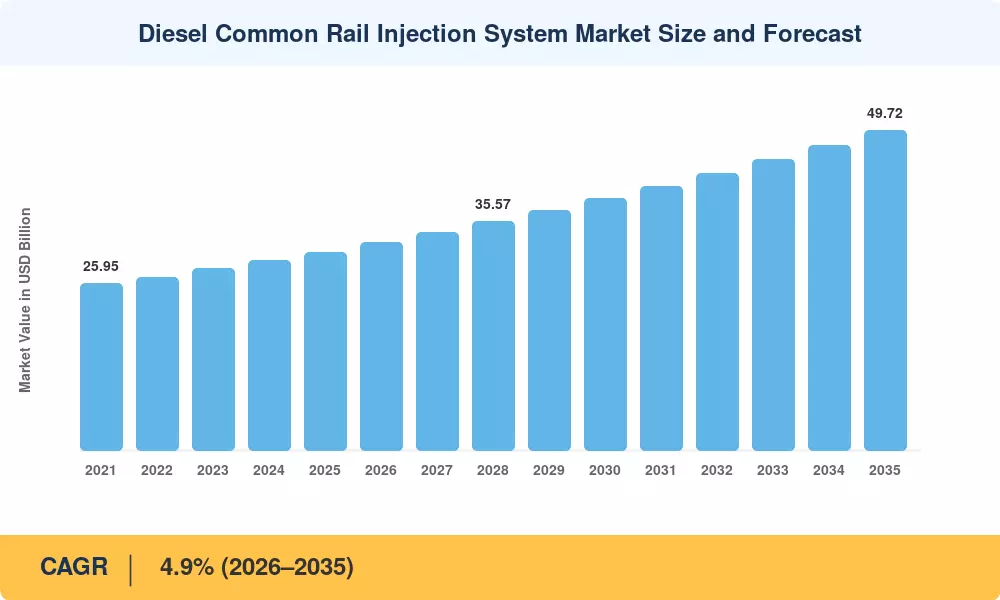
The Diesel Common Rail Injection System Market was valued at USD 30.82 billion in 2025 and is projected to grow from USD 32.33 billion in 2026 to USD 49.72 billion by 2035, registering a CAGR of 4.9% during the forecast period. This expansion is anchored in the tightening of global vehicular emission standards — from Euro 7 timelines in Europe to India's Bharat Stage VI real-driving-emission mandates — and the sustained demand for diesel powertrains across commercial transport, agriculture, and off-highway applications. Government-backed green freight corridors and retrofit programs are channeling billions into cleaner diesel technologies, keeping the Diesel Common Rail Injection System Market firmly on an upward trajectory [1].

The technology landscape is shifting rapidly. Legacy mechanical and rotary pump injection architectures are giving way to electronically controlled systems capable of multiple injection events per combustion cycle. Tier-1 suppliers have collectively committed over USD 4.5 billion in R&D spending between 2023 and 2027 toward next-generation rail platforms operating at pressures exceeding 2,500 bar, with the goal of squeezing peak thermal efficiency above 50% while cutting particulate and NOx outputs to near-zero levels [2]. This transition is not optional — it is regulation-driven and capital-intensive.

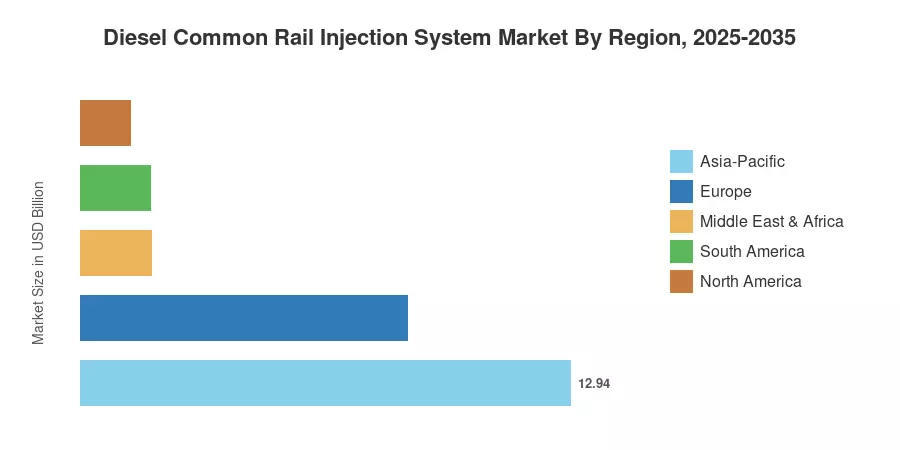
Asia-Pacific commands roughly 42% of the global Diesel Common Rail Injection System Market, led by China and India's massive commercial vehicle fleets. The Middle East & Africa region stands as the fastest-growing geography, posting an anticipated CAGR of 6.1% through 2035 as infrastructure investment and fleet modernization programs accelerate. Europe holds the second-largest share at approximately 28%, underpinned by stringent Euro emission norms and a robust heavy-duty truck manufacturing base. As the decade unfolds, the interplay between diesel efficiency gains and electrification timelines will shape competitive dynamics across every region.


Key Report Takeaways

• By Vehicle Type

  • Passenger cars accounted for the largest share of the Diesel Common Rail Injection System Market in 2025, holding approximately 44% of total revenue — driven by diesel sedan and SUV demand in Europe and South Asia.
  • Heavy commercial vehicles are poised to register the fastest segment CAGR at 5.6% through 2035, as logistics fleet operators prioritize fuel economy and emission compliance.
  • Light commercial vehicles contributed an estimated USD 8.7 billion in 2025, reflecting steady last-mile delivery and urban freight activity.

• By Fuel Injector Type

  • Conventional solenoid injectors retained a dominant position in the Diesel Common Rail Injection System Market with roughly 62% revenue share in 2025, owing to proven reliability and lower unit costs.
  • Piezoelectric injectors are expanding at a CAGR of 5.8%, favored for their faster response times and precision in multi-injection strategies demanded by advanced emission architectures.

• By Region

  • Asia-Pacific is the largest regional contributor to the Diesel Common Rail Injection System Market, generating an estimated USD 12.94 billion in 2025.
  • Middle East & Africa is the fastest-growing region at a 6.1% CAGR, while North America holds approximately 18% of global share.


Diesel Common Rail Injection System Market Size and Forecast (2021–2035)

Market sizing draws on a triangulated approach combining OEM production data, Tier-1 component shipment records, aftermarket channel surveys, and customs trade databases across 42 countries. Historical values (2021–2024) reflect actuals; the 2025 base-year estimate is validated against company filings and industry association reports. The forecast period (2026–2035) applies a constant CAGR of 4.9%, adjusted for anticipated regulatory inflection points.
Diesel Common Rail Injection System Market Size and Forecast
Our Impact
Enabled $4.3B Revenue Impact for Fortune 500 and Leading Multinationals
Partnering with 2000+ Global Organizations Each Year
30K+ Citations by Top-Tier Firms in the Industry

Driver Impact Analysis

Driver ~% Impact on CAGR Geographic Relevance Impact Timeline
Tightening emission standards (Euro 7, BS-VI RDE) +1.2% Global Medium-term
Diesel cost advantage over gasoline +0.8% Asia-Pacific, Africa Long-term
Heavy-duty commercial vehicle fleet expansion +0.9% Asia-Pacific, MEA Long-term
Off-highway and agricultural diesel demand +0.5% South America, ASEAN Medium-term
Aftermarket replacement cycle acceleration +0.4% Europe, North America Short-term
Government green freight incentive programs +0.6% Europe, North America Medium-term
Advanced combustion R&D investment +0.3% Global Long-term


Emission Standards as the Primary Growth Engine

Heavy-duty diesel cars must reduce NOx to 200 mg/kWh in real-driving conditions by 2027, a 56% decrease from Euro VI norms, according to the European Commission's Euro 7 plan [1]. Injection systems that can accurately perform pilot, main, and post-injection activities at pressures higher than 2,200 bar are practically necessary to reach these criteria. Nearly 85% of new diesel platforms have already been upgraded to modern common rail architectures by OEMs as a result of India's BS-VI Phase-2 real-driving pollution standards, which went into effect in April 2023. This upgrade cycle is anticipated to be worth USD 2.1 billion yearly throughout the subcontinent [5].


Diesel Cost Advantage and Commercial Vehicle Demand

In most Asian and African economies, diesel fuel is 10–20% less expensive than gasoline, and diesel engines use 25–30% less fuel per liter [7]. This efficiency gap directly translates into operating-cost savings of USD 6,000–9,000 per vehicle annually for fleet operators operating long-haul trucks throughout Africa's developing trade corridors or India's 67,000-km national highway network. Every new diesel commercial vehicle that comes off the assembly line is equipped with a common rail system, which directly boosts the market for diesel common rail injection systems.


Aftermarket Replacement Cycles

Europe alone has an installed base of over 72 million diesel passenger cars and 12 million diesel commercial vehicles, many with injection systems approaching their 150,000-km service life [10]. Independent aftermarket channels now account for roughly 18% of total common rail system revenue globally, and this share is climbing as aging fleets in Eastern Europe, Latin America, and Southeast Asia drive replacement demand.

Green Freight Programs and Policy Incentives

The U.S. EPA's Clean Trucks Plan and the EU's Greening Freight Package each allocate multi-billion-dollar funding pools for cleaner diesel technology adoption [11]. Germany's KsNI program alone has disbursed EUR 1.6 billion in subsidies for clean commercial vehicles since 2021, much of it flowing to diesel trucks equipped with state-of-the-art injection and exhaust aftertreatment systems.


Restraints Impact Analysis

Restraint ~% Impact on CAGR Geographic Relevance Impact Timeline
EV penetration in passenger segment –0.9% Europe, China Long-term
Diesel bans in urban zones –0.5% Europe Medium-term
Raw material and supply-chain volatility –0.3% Global Short-term
Declining diesel passenger car share in Europe –0.4% Europe Medium-term
Hydrogen and alternative fuel R&D diversion –0.2% Global Long-term


Electric Vehicle Penetration

Daimler, Volvo, and PACCAR's launches of battery-electric trucks indicate that the heavy-duty market is rapidly changing. In 2024, EV passenger car sales in Europe accounted for 23% of new registrations, directly displacing diesel take-rates, which for the first time dropped below 14% [12]. The Diesel Common Rail Injection System Market loses an estimated USD 340 million every year for every percentage point of diesel share lost in the European passenger market.


Urban Diesel Restrictions

Low-emission zones that prohibit older diesel vehicles have been established or announced in more than 320 European cities [13]. By 2030, all diesel passenger cars will be phased out of city centers in Paris, Brussels, and London. These regulations lower customer confidence in new diesel purchases and decrease OEM investment in diesel passenger platforms, even though they mainly target pre-Euro 6 vehicles.


Raw Material and Supply-Chain Pressures

Common rail injectors rely on specialty steels, piezoelectric ceramics, and precision-machined components sourced from concentrated supplier bases. The 2021–2023 semiconductor shortage exposed fragilities, adding 8–12 weeks to OEM delivery timelines [14]. Rare-earth price fluctuations and logistics bottlenecks continue to pressure component costs, compressing margins for Tier-2 suppliers in the Diesel Common Rail Injection System Market.


Diesel Common Rail Injection System Market Opportunities

Off-Highway and Industrial Diesel Applications

Mining, construction, and marine diesel engines represent a USD 5.8 billion addressable opportunity for common rail system suppliers by 2030 [9]. These sectors face their own tightening emission rules — the EU's Stage V off-road regulation and EPA Tier 4 Final — and are transitioning from mechanical injection to electronically controlled rail platforms at an adoption rate roughly five years behind on-highway vehicles.

Aftermarket Digitization and Predictive Maintenance

Tier-1 players are embedding pressure and flow sensors into injector assemblies, enabling cloud-connected diagnostics that predict injector failure 10,000 km before occurrence. This data-as-a-service model opens recurring revenue streams — Bosch's Mobility Solutions division reported that connected-component services generated EUR 420 million in 2024, a 31% year-on-year increase.

Emerging Market Fleet Modernization

Sub-Saharan Africa and Southeast Asia collectively operate over 28 million diesel commercial vehicles, with average fleet ages exceeding 14 years [8]. As these regions enforce tighter import standards and scrappage incentives, millions of vehicles will require modern common rail systems, creating a replacement wave that could sustain the Diesel Common Rail Injection System Market well into the 2030s.

Dual-Fuel and Gas-Diesel Hybrid Injection Platforms

LNG–diesel and hydrogen–diesel dual-fuel engines use common rail systems for diesel pilot injection. The global LNG truck market is projected to reach 450,000 units annually by 2030, and every dual-fuel truck still requires a high-precision diesel rail system — extending the relevance of current injection technology.

Remanufactured Injector Ecosystem

A growing circular-economy mandate in Europe (EU End-of-Life Vehicle Regulation revision, 2023) is opening the remanufactured injector segment, valued at approximately USD 1.9 billion globally. Reman injectors sell at 40–60% of new-unit prices while delivering comparable performance, providing a margin-rich channel for established players in the Diesel Common Rail Injection System Market.


Diesel Common Rail Injection System Market Future Outlook

Ultra-High-Pressure Injection and Combustion Optimization

Rail pressures are expected to reach 3,000 bar commercially by 2030, enabling injection droplet sizes below 10 micrometers. This atomization leap will allow diesel engines to meet post-Euro 7 targets without relying solely on exhaust aftertreatment, reducing system cost and weight. Bosch and Denso have both announced pilot-production programs targeting 2,800-bar systems for heavy-duty applications by 2028 [2].

Digital Twins and AI-Driven Calibration

OEMs are adopting digital-twin models to simulate millions of injection-timing combinations, cutting physical calibration cycles from 18 months to under 6 months. AI-optimized injection maps tailored to altitude, ambient temperature, and fuel quality will become standard in the Diesel Common Rail Injection System Market, enabling real-time adaptive combustion across operating conditions [17].

Diesel–Electric Hybrid Integration

Mild-hybrid 48V diesel powertrains combine electric torque-fill with optimized diesel combustion, achieving fuel savings of 12–15% over conventional diesel alone. Continental and ZF project that 35% of new European heavy commercial vehicles will adopt diesel-hybrid architectures by 2032, sustaining demand for advanced injection systems even as partial electrification advances [18].

Sustainability and Renewable Diesel Compatibility

Hydrotreated vegetable oil (HVO) and Fischer-Tropsch synthetic diesel fuels are chemically compatible with existing common rail hardware but require injector calibration adjustments. The IEA projects renewable diesel production to exceed 30 billion liters annually by 2030 [7]. Injection system suppliers that certify their products for 100% renewable-diesel operation will capture a strategic advantage in the Diesel Common Rail Injection System Market.


Diesel Common Rail Injection System Market Segmentation

By Vehicle Type

Segment Key Metric Primary Demand Driver
Passenger Cars ~44% share (2025) Diesel SUV and sedan demand in Europe and India
Light Commercial Vehicles USD 8.70 B (2025) Urban logistics and last-mile delivery
Heavy Commercial Vehicles CAGR 5.6% Long-haul freight and emission compliance


Passenger cars anchor the Diesel Common Rail Injection System Market by volume, though growth is tempered by the European shift toward electrification. India and parts of Southeast Asia continue to see diesel passenger car sales rise — diesel SUVs accounted for 38% of India's UV segment in 2024. Manufacturer strategies center on multi-injection combustion refinement to meet real-driving emission limits without sacrificing the driving dynamics consumers expect.

Heavy commercial vehicles represent the most dynamic growth segment. Global freight ton-kilometers are projected to increase 40% by 2035 according to the International Transport Forum [8], and diesel remains the dominant energy carrier for long-haul trucking. Each Class 8 truck uses injection components valued at 2–3 times those in a passenger car, making this a high-value segment for Tier-1 suppliers.

By Fuel Injector Type

Segment Key Metric Primary Demand Driver
Conventional Solenoid Injector ~62% share (2025) Cost efficiency and proven durability
Piezoelectric Injector CAGR 5.8% Precision injection for low-emission calibration


Solenoid injectors dominate the Diesel Common Rail Injection System Market on the strength of lower manufacturing costs and a mature global supply chain. They perform reliably across the temperature and altitude extremes encountered in commercial trucking and off-highway applications, and most aftermarket channels carry comprehensive solenoid-injector inventories.

Piezoelectric injectors are gaining ground in premium passenger and heavy-duty platforms where tighter emission margins demand sub-microsecond injection timing. Their ability to execute up to nine injection events per combustion cycle allows engineers to shape the combustion flame front with a precision that solenoid designs cannot match. European and Japanese OEMs are leading adoption, with piezoelectric penetration in new Euro 7 truck programs expected to exceed 30% by 2029.


Regional Market Share Analysis

Region Key Metric Primary Investment Themes
Asia-Pacific ~42% market share Commercial vehicle production scale; BS-VI compliance
Europe ~28% market share Euro 7 readiness; aftermarket replacement
North America CAGR 4.3% EPA clean truck mandates; Class 8 fleet renewal
South America USD 1.85 B (2025) Agricultural mechanization; import standards
Middle East & Africa CAGR 6.1% Infrastructure build-out; fleet modernization
Total USD 30.82 B (2025)

The Diesel Common Rail Injection System Market displays distinct regional dynamics shaped by emission regulation maturity, diesel vehicle penetration rates, and infrastructure investment cycles. Asia-Pacific remains the dominant region, while the Middle East & Africa shows the strongest growth momentum.


North America

Country Key Metric Key Driver
United States ~72% of regional share EPA Phase 3 GHG standards for HD trucks
Canada CAGR 4.1% Oil-sands fleet diesel demand
Mexico USD 0.48 B (2025) Growing HD truck assembly base


The United States anchors North American demand through its massive Class 6–8 truck fleet, which remains overwhelmingly diesel-powered. The EPA's finalized 2027 NOx rule for heavy-duty engines mandates a 75% cut from current levels, compelling OEMs to specify latest-generation injection systems. Canada's resource extraction sector and Mexico's expanding truck manufacturing corridor round out regional demand.

Europe

Country Key Metric Key Driver
Germany ~26% of regional share Daimler/MAN truck OEM production
United Kingdom CAGR 3.7% Retrofit and aftermarket programs
France USD 1.14 B (2025) PSA/Renault diesel platform investment
Italy ~11% of regional share Iveco HD vehicle exports
Spain CAGR 4.0% Commercial vehicle corridor growth
Nordic Countries USD 0.52 B (2025) Cold-climate diesel preference
Russia ~8% of regional share KAMAZ fleet expansion
Rest of Europe CAGR 4.2% Eastern European fleet renewal


Europe's role in the Diesel Common Rail Injection System Market remains substantial despite declining diesel passenger car sales. The region's heavy commercial vehicle segment is resilient — diesel powers 96% of trucks over 3.5 tonnes, and Euro 7 compliance will trigger a multi-billion-euro upgrade cycle across the OEM supply chain starting 2027.

Asia-Pacific

Country Key Metric Key Driver
China ~38% of regional share National VI emission standard enforcement
India CAGR 5.9% BS-VI Phase 2; commercial vehicle boom
Japan USD 1.53 B (2025) Denso/Bosch R&D and export hub
South Korea ~7% of regional share Hyundai/Kia diesel powertrain exports
ASEAN CAGR 5.4% Euro 4/5 transition in key markets
Rest of Asia-Pacific USD 0.78 B (2025) Agricultural diesel mechanization


Asia-Pacific's dominance in the Diesel Common Rail Injection System Market is rooted in China's position as the world's largest commercial vehicle producer — over 4.2 million units annually — and India's rapidly expanding truck fleet. Both countries enforced stringent emission norms (China National VI, India BS-VI) that made advanced common rail systems mandatory for new diesel vehicles.

South America

Country Key Metric Key Driver
Brazil ~58% of regional share PROCONVE P8 emission standards
Argentina CAGR 4.7% Agricultural equipment demand
Rest of South America USD 0.39 B (2025) Mining and logistics fleet growth


Brazil's PROCONVE P8 regulations, aligned with Euro VI, took full effect in 2023 and pushed the majority of new diesel trucks and buses toward advanced common rail injection platforms. The agricultural sector — Brazil is the world's largest soybean and sugarcane producer — sustains heavy diesel equipment demand across harvesting and transport fleets.

Middle East & Africa

Country Key Metric Key Driver
Saudi Arabia ~28% of regional share Vision 2030 infrastructure projects
UAE CAGR 6.4% Logistics hub expansion
South Africa USD 0.42 B (2025) Mining fleet modernization
Egypt CAGR 5.8% Suez corridor transport demand
Rest of MEA ~30% of regional share Cross-border trade corridor development


The Middle East & Africa region's rapid growth in the Diesel Common Rail Injection System Market is driven by large-scale construction and logistics projects under Saudi Vision 2030 and similar national development agendas. Fleet modernization in sub-Saharan Africa, where average vehicle ages exceed 15 years, is creating a significant replacement market for injection systems.


Diesel Common Rail Injection System Market By Region, 2025-2035

Competitive Benchmarking

The Diesel Common Rail Injection System Market exhibits medium concentration, with the top five players collectively holding an estimated 68–73% revenue share. The Herfindahl-Hirschman Index (HHI) sits in the moderately concentrated range (~1,800–2,200), reflecting Bosch's clear leadership alongside several strong challengers. Barriers to entry remain high due to precision-manufacturing tolerances (sub-micron), lengthy OEM qualification cycles (18–36 months), and extensive patent portfolios.

Company Est. Revenue Share Range Key Offerings Strategic Positioning
Robert Bosch GmbH ~26–30% CRS3 platform, CRIN injectors Global technology leader; broadest OEM coverage
Denso Corporation ~14–17% G4 common rail system, i-ART injectors Preferred Toyota/Hino supplier; precision focus
Delphi Technologies (BorgWarner) ~9–12% Multec series, DFI 21 injector Strong European and Indian OEM partnerships
Continental AG ~7–9% IPS series fuel-injection systems Integration with hybrid powertrain electronics
Liebherr ~4–6% CRS systems for off-highway Mining and construction specialization
Woodward Inc. ~3–5% HPCR systems for industrial engines Power-generation and marine focus
Stanadyne ~3–4% GDi and diesel injection assemblies Aftermarket strength in North America
Cummins Inc. ~3–5% XPI fuel system Vertically integrated engine-to-injector supply
Heinzmann GmbH ~2–3% CRSevo common rail systems Niche off-highway and genset applications
Weifu High-Technology Group ~3–5% CRS2/CRS3 injectors (Bosch license) China market dominance; cost leadership


Recent News & Developments


  • Denso Corporation (January 2025): Expanded piezoelectric injector production capacity at its Aichi, Japan plant by 20%, investing JPY 18 billion to meet Euro 7 and Japan Post-New Long-Term demand [19].
  • BorgWarner (Delphi Technologies) (October 2024): Signed a five-year supply agreement with Ashok Leyland for BS-VI Phase 2 common rail systems covering 350,000 trucks annually [20].
  • Continental AG (July 2024): Launched its next-generation IPS 3.0 injection control unit integrating 48V mild-hybrid interface, targeting European HCV OEMs [18].


  • Weifu High-Technology Group (May 2024): Opened a second common rail injector production line in Wuxi, doubling capacity to 8 million units per year and strengthening supply to FAW and Dongfeng [22].
  • Indian Ministry of Road Transport (August 2023): Mandated on-board diagnostics II (OBD-II) for all new BS-VI diesel vehicles, increasing the complexity and value of injection electronic control modules [5].


Diesel Common Rail Injection System Market Report Scope

Parameter Detail
Market Scope Diesel common rail injection systems for on-highway, off-highway, and industrial diesel engines globally
Study Period 2021–2035
CAGR (Forecast) 4.9% (2026–2035)
Base Year Market Size USD 30.82 Billion (2025)
Forecast End-Point USD 49.72 Billion (2035)
Fastest Growing Segments Heavy Commercial Vehicles (by vehicle type); Piezoelectric Injectors (by injector type); Middle East & Africa (by region)
Companies Profiled 10 (Robert Bosch, Denso, BorgWarner/Delphi, Continental, Liebherr, Woodward, Stanadyne, Cummins, Heinzmann, Weifu)
Valuation Currency USD (constant 2025 dollars)

FAQs

How does common rail injection compare with unit injector systems for fleet buyers?
Common rail systems offer lower noise, smoother idle, and multi-injection flexibility that unit injectors cannot match. Fleet buyers also benefit from broader OEM support and lower per-unit aftermarket parts costs [10].
What rail pressure level should procurement teams prioritize when specifying new trucks?
Systems rated at 2,200 bar or above provide sufficient atomization for Euro 7 and BS-VI Phase 2 compliance. Specifying this threshold future-proofs fleets against upcoming regulations [1].
How are remanufactured injectors affecting competitive dynamics?
Reman programs by Bosch, Denso, and Delphi capture 40–60% lower price points while maintaining OEM tolerances. They are intensifying price competition in the European aftermarket [10].
What role does the Diesel Common Rail Injection System Market play in dual-fuel engine adoption?
Every LNG–diesel and hydrogen–diesel dual-fuel engine requires a precision common rail pilot-injection system. Rising dual-fuel truck sales directly sustain injector demand [21].
How are tariff and trade policies influencing the Diesel Common Rail Injection System Market?
U.S. Section 301 tariffs on Chinese injector components have raised import costs 15–25%, prompting Tier-1 suppliers to diversify manufacturing toward India and Mexico [14].
What is the typical qualification timeline for a new injector supplier at a major OEM?
OEM qualification cycles range from 18 to 36 months, including bench durability, engine-level calibration, and vehicle-level emission certification. This timeline creates a significant moat for incumbent suppliers [6].
How does the Diesel Common Rail Injection System Market address renewable diesel compatibility?
Leading suppliers now validate injectors for 100% HVO and paraffinic fuels. Material and seal upgrades are minimal, making common rail hardware inherently renewable-fuel-ready [21].    
Author
Author
Author Profile
Snehal Singh LinkedIn
Manager - Research
High acumen in analyzing complex macro & micro markets with more than 6 years of work experience in the field of market research. By implementing her analytical skills in forecasting and estimation into market research reports, she has expertise in Packaging, Construction, and Equipment domains. She handles a team size of 20-25 resources and ensures smooth running of the projects, associated marketing activities, and client servicing.

Research Approach


Secondary Research

The secondary research process involved comprehensive analysis of automotive regulatory databases, technical engineering publications, industry standards documentation, and authoritative transportation organizations. Key sources included the US Environmental Protection Agency (EPA), California Air Resources Board (CARB), European Commission Transport & Mobility Directorate, European Automobile Manufacturers' Association (ACEA), International Council on Clean Transportation (ICCT), Society of Automotive Engineers (SAE International), International Organization of Motor Vehicle Manufacturers (OICA), Diesel Technology Forum, Japan Automobile Manufacturers Association (JAMA), China Association of Automobile Manufacturers (CAAM), International Energy Agency (IEA) Transport Division, US Department of Transportation (DOT), National Highway Traffic Safety Administration (NHTSA), EU Eurostat Transport Database, and national automotive ministry reports from Germany (KBA), India (Ministry of Road Transport and Highways), and Brazil (ANFAVEA). These sources were utilized to collect vehicle production statistics, emission compliance data (Euro 6/7, EPA Tier 3, BS-VI), fuel injection technology adoption rates, commercial vehicle sales trends, and aftermarket service data for solenoid and piezoelectric injector systems across OEM and aftermarket channels.

Technical literature review encompassed SAE Technical Papers database, IEEE Xplore Digital Library, and peer-reviewed journals including International Journal of Engine Research, Fuel, and Journal of Automobile Engineering to validate injection pressure capabilities, fuel efficiency metrics, and nitrogen oxide (NOx) reduction performance claims associated with common rail direct injection (CRDI) technology evolution from traditional diesel systems.


Primary Research

To gather qualitative and quantitative information about technology migration trends, the effect of electrification on diesel R&D investment, and regional compliance strategies, supply-side and demand-side stakeholders were interviewed as part of the primary research process. Powertrain system divisional presidents, diesel engineering heads, fuel injection technology directors, and commercial directors from Tier 1 injection system manufacturers, Tier 2 component suppliers (such as high-pressure pumps and ECU manufacturers), as well as aftermarket remanufacturing experts, were examples of supply-side sources. Chief procurement officers from commercial vehicle manufacturers, fleet management directors of logistics companies, heads of engine development at passenger car manufacturers, and technical directors from manufacturers of off-highway equipment (construction, agricultural, and marine) were examples of demand-side sources.

Primary research validated market segmentation across vehicle categories, confirmed Euro 7 and EPA 2027 regulatory timeline impacts, and gathered insights on piezoelectric injector adoption rates, pricing strategies for solenoid vs. piezoelectric systems, and aftermarket service network expansion in emerging economies.

Primary Respondent Breakdown:

By Designation: C-level Primaries (28%), Director Level (42%), Others (30%)

By Region: North America (28%), Europe (33%), Asia-Pacific (34%), Rest of World (5%)


Market Size Estimation

Global market valuation was derived through production volume mapping and technology penetration analysis. The methodology included:

Identification of 60+ key manufacturers and component suppliers across North America, Europe, Asia-Pacific, and Latin America specializing in high-pressure common rail systems, electronic control units (ECUs), and injector technologies

Product mapping across solenoid injectors, piezoelectric injectors, high-pressure pumps, and rail assemblies for passenger cars, light commercial vehicles (LCVs), and heavy commercial vehicles (HCVs)

Analysis of reported and modeled annual revenues specific to diesel fuel injection portfolios, distinguishing OEM fitment from aftermarket replacement demand

Coverage of manufacturers representing 75-80% of global market share in 2024, including Bosch, Denso, Continental, Delphi (BorgWarner), Cummins, and Magneti Marelli

Extrapolation using bottom-up approach (regional vehicle production volume × diesel engine penetration rate × common rail adoption rate × average selling price by injector type) and top-down approach (manufacturer revenue validation and supply chain bill-of-materials analysis) to derive segment-specific valuations for OEM and aftermarket channels

Cross-validation against OICA vehicle production statistics, IHS Markit powertrain forecasts, and regional emission regulation implementation timelines to adjust for electrification impact on diesel demand projections through 2032

Download Free Sample

Kindly complete the form below to receive a free sample of this Report

* Please use a valid business email

Download PDF ×

We do not share your information with anyone. However, we may send you emails based on your report interest from time to time. You may contact us at any time to opt-out.
















