×
Request Free Sample ×

Kindly complete the form below to receive a free sample of this Report

* Please use a valid business email

Leading companies partner with us for data-driven Insights

clients tt-cursor
Hero Background

Dimethyl Disulphide Market

ID: MRFR/CnM/8402-HCR
111 Pages
Priya Nagrale
October 2025

Dimethyl Disulphide (DMDS) Market Research Report By Application (Agriculture, Chemicals, Food Industry, Pharmaceuticals, Cosmetics), By Form (Liquid, Gas), By Purity Level (High Purity (98%), Standard Purity (90%)), By Production Method (Natural Gas Processing, Laboratory Synthesis, Recycling Processes) and By Region (North America, Europe, South America, Asia Pacific, Middle East and Africa)- Forecast to 2035

Share:
Download PDF ×

We do not share your information with anyone. However, we may send you emails based on your report interest from time to time. You may contact us at any time to opt-out.

Dimethyl Disulphide Market Infographic
Purchase Options

Dimethyl Disulphide Market Summary

As per MRFR analysis, the Dimethyl Disulphide Market Size was estimated at 382.59 USD Million in 2024. The Dimethyl Disulphide industry is projected to grow from 397.94 USD Million in 2025 to 589.72 USD Million by 2035, exhibiting a compound annual growth rate (CAGR) of 4.01 during the forecast period 2025 - 2035.

Key Market Trends & Highlights

The Dimethyl Disulphide Market is poised for growth driven by sustainability and innovation.

  • North America remains the largest market for Dimethyl Disulphide, primarily due to its extensive agricultural applications.
  • The Asia-Pacific region is emerging as the fastest-growing market, fueled by increasing demand in chemical synthesis.
  • In the agriculture segment, Dimethyl Disulphide is widely utilized in pesticide formulations, highlighting its importance in sustainable farming practices.
  • Rising demand in agriculture and regulatory support for chemical innovations are key drivers propelling market expansion.

Market Size & Forecast

2024 Market Size 382.59 (USD Million)
2035 Market Size 589.72 (USD Million)
CAGR (2025 - 2035) 4.01%

Major Players

BASF SE (DE), Eastman Chemical Company (US), Huntsman Corporation (US), Chevron Phillips Chemical Company (US), Arkema S.A. (FR), SABIC (SA), Mitsubishi Gas Chemical Company, Inc. (JP), Tosoh Corporation (JP), Solvay S.A. (BE)

Dimethyl Disulphide Market Trends

The Dimethyl Disulphide Market is currently experiencing a notable evolution, driven by various factors that influence its demand and supply dynamics. This compound, recognized for its applications in agriculture, petrochemicals, and food processing, appears to be gaining traction due to its effectiveness as a pesticide and a flavoring agent. The increasing focus on sustainable agricultural practices may further bolster its usage, as farmers seek environmentally friendly alternatives to traditional chemicals. Additionally, the growing interest in the petrochemical sector, particularly in the production of lubricants and solvents, suggests a potential rise in the consumption of dimethyl disulphide in these applications. Moreover, the Dimethyl Disulphide Market seems to be shaped by regulatory frameworks that govern chemical usage across various industries. As governments worldwide implement stricter regulations on chemical substances, manufacturers are likely to adapt their production processes to comply with these standards. This adaptation may lead to innovations in the synthesis and application of dimethyl disulphide, enhancing its market appeal. Furthermore, the ongoing research into the compound's properties and potential new applications could open up additional avenues for growth, indicating a promising future for the market as it navigates these evolving trends.

Sustainable Agricultural Practices

The increasing emphasis on sustainable farming methods is likely to drive demand for dimethyl disulphide as a natural pesticide. Its effectiveness in pest control without harming the environment positions it as a favorable alternative to synthetic chemicals.

Regulatory Compliance and Innovation

As regulatory bodies impose stricter guidelines on chemical usage, manufacturers in the Dimethyl Disulphide Market may innovate their production techniques. This compliance could lead to enhanced product quality and new applications, fostering market growth.

Expansion in Petrochemical Applications

The growing petrochemical industry appears to be a significant driver for dimethyl disulphide, particularly in the production of solvents and lubricants. This trend suggests a potential increase in demand as industries seek efficient chemical solutions.

Dimethyl Disulphide Market Drivers

Rising Demand in Agriculture

The Global Dimethyl Disulphide Market (DMDS) Market Industry is experiencing a surge in demand driven by its application as a soil fumigant and pesticide. Farmers are increasingly adopting DMDS for its effectiveness in controlling nematodes and other soil-borne pests, which enhances crop yields. As agricultural practices evolve, the need for effective pest management solutions becomes paramount. This trend is expected to contribute significantly to the market's growth, with projections indicating that the market could reach 450 USD Million in 2024. The agricultural sector's reliance on DMDS is likely to bolster its position within the global market.

Industrial Applications and Growth

The Global Dimethyl Disulphide Market (DMDS) Market Industry is witnessing robust growth due to its diverse industrial applications, particularly in the petrochemical sector. DMDS serves as a crucial intermediate in the production of various chemicals, including sulfur compounds and lubricants. As industries continue to expand and innovate, the demand for DMDS is projected to increase significantly. The market is anticipated to grow at a compound annual growth rate of 9.33% from 2025 to 2035, potentially reaching 1200 USD Million by 2035. This growth trajectory underscores the importance of DMDS in supporting industrial processes and chemical manufacturing.

Emerging Markets and Global Expansion

The Global Dimethyl Disulphide Market (DMDS) Market Industry is expanding into emerging markets, where industrialization and agricultural development are accelerating. Regions such as Asia-Pacific and Latin America are witnessing increased investments in agriculture and chemical manufacturing, creating new opportunities for DMDS. As these markets develop, the demand for effective pest control and chemical intermediates is likely to rise. This expansion into new geographical areas may contribute to the overall growth of the market, with projections indicating a significant increase in market size over the coming years. The global reach of DMDS is expected to enhance its market presence.

Environmental Regulations Favoring DMDS

The Global Dimethyl Disulphide Market (DMDS) Market Industry is positively influenced by stringent environmental regulations that promote the use of less harmful chemicals. DMDS is recognized for its relatively low toxicity compared to traditional fumigants, making it a preferred choice for environmentally conscious agricultural practices. Governments worldwide are increasingly advocating for sustainable farming solutions, which may lead to a shift towards DMDS as a viable alternative. This regulatory support is likely to enhance the market's growth prospects, as more stakeholders seek to comply with environmental standards while maintaining agricultural productivity.

Technological Advancements in Production

The Global Dimethyl Disulphide Market (DMDS) Market Industry benefits from ongoing technological advancements in production processes. Innovations in synthesis methods and purification techniques are enhancing the efficiency and cost-effectiveness of DMDS production. As manufacturers adopt these new technologies, the supply of DMDS is expected to increase, meeting the growing demand from various sectors. This improvement in production capabilities may lead to a more competitive market landscape, potentially driving down prices and making DMDS more accessible to end-users. Consequently, the market is poised for growth as production becomes more streamlined and efficient.
Market Segment Insights

By Application: Agriculture (Largest) vs. Chemical Synthesis (Fastest-Growing)

In the Dimethyl Disulphide Market, the application segment showcases a diverse distribution among key areas, with Agriculture leading in market share. This sector relies heavily on dimethyl disulphide for its efficacy as a pesticide and soil fumigant, driving its prominence. The Chemical Synthesis application also plays a crucial role, utilizing this compound in the production of various chemicals, although it currently holds a smaller market share compared to Agriculture. Growth trends indicate a significant rise in the Chemical Synthesis application, fueled by increasing demand for specialty chemicals and advanced materials. Additionally, the Agriculture segment is expected to maintain its growth trajectory due to the rising global population and the need for enhanced agricultural productivity. These factors together position Agriculture and Chemical Synthesis as pivotal applications in the overall market landscape.

Agriculture (Dominant) vs. Pharmaceuticals (Emerging)

The Agriculture segment remains the dominant force in the Dimethyl Disulphide Market, attributed to its pivotal role in pest control and crop protection. It caters to a wide range of agricultural applications, ensuring food security and sustainability. With increasing investments in agricultural technologies and practices, demand for dimethyl disulphide as a safe and effective solution continues to rise. On the other hand, the Pharmaceuticals application is emerging, leveraging dimethyl disulphide for its unique properties in synthesis processes. While currently smaller in market share, the pharmaceutical sector is exploring innovative applications, driven by research and development into new therapeutic agents and formulations. This contrast highlights the stability of Agriculture against the dynamic growth potential of Pharmaceuticals.

By End Use: Pesticides (Largest) vs. Flavors and Fragrances (Fastest-Growing)

In the Dimethyl Disulphide Market, the end-use segment shows significant diversification, with pesticides leading as the largest contributor due to their extensive application in agricultural practices. Pesticides account for a substantial part of the market as they provide essential protection for crops, thereby ensuring higher yield and quality. On the other hand, flavors and fragrances are witnessing increased consumption, propelled by the growing demand from food and beverage industries and personal care products, which further enhances their market share.

Pesticides (Dominant) vs. Flavors and Fragrances (Emerging)

The Pesticides segment remains a dominant force in the Dimethyl Disulphide Market, driven by the escalating need for effective agricultural solutions to enhance crop production amidst changing weather conditions and pest invasions. This segment benefits from established usage patterns and regulatory frameworks that support its application in numerous regions. Conversely, the Flavors and Fragrances segment is emerging rapidly, fueled by evolving consumer preferences for natural and synthetic fragrances. This growth is supported by innovations in product formulations and an increasing emphasis on sensory experiences in consumer goods, positioning it as a rising star in the market.

By Form: Liquid (Largest) vs. Gas (Fastest-Growing)

In the Dimethyl Disulphide Market, the liquid form has established itself as the largest segment, primarily due to its versatile applications in various industries such as agriculture and chemical production. The gas form, although currently smaller in terms of market share, is rapidly gaining traction due to its growing adoption in specialty applications and emerging technologies that favor gaseous forms for enhanced efficiency. The growth trends observed in the Dimethyl Disulphide Market indicate a significant shift towards the gas segment as industries harness the benefits of gaseous dimethyl disulphide for innovations in chemical synthesis and other applications. Factors such as technological advancements and increasing demand for environmentally friendly solutions are propelling this segment forward, positioning gas as the fastest-growing form in the market.

Liquid (Dominant) vs. Gas (Emerging)

The liquid form of dimethyl disulphide remains dominant in the market due to its broad applicability and ability to be easily handled and transported, making it a preferred choice for many end-users. On the other hand, the gas form, while still emerging, is gaining popularity for its advantages in specific applications where vaporization is beneficial, such as in certain chemical processes and as a reactive agent. The transition towards gas is facilitated by the ongoing research aimed at enhancing process efficiencies and environmental compliance. As industries seek to optimize operations and reduce carbon footprints, the gas segment is expected to play a critical role in the future landscape of the Dimethyl Disulphide Market.

By Purity Level: High Purity (Largest) vs. Technical Grade (Fastest-Growing)

The Dimethyl Disulphide Market is segmented by purity levels, where the High Purity segment dominates the market, accounting for a significant portion of the overall volume. This segment is preferred across various applications due to its superior quality standards, particularly in industries such as pharmaceuticals and agriculture. In contrast, the Technical Grade segment is rapidly gaining traction, offering a more cost-effective option for numerous industrial applications, thereby appealing to a broader customer base.

High Purity (Dominant) vs. Technical Grade (Emerging)

High Purity Dimethyl Disulphide is regarded as the dominant segment due to its essential role in high-end applications requiring stringent quality specifications. Its extensive use in the production of specialty chemicals, coupled with rigorous quality assurance practices, positions this segment favorably in the market. On the other hand, the Technical Grade segment represents an emerging market opportunity, driven by increasing demand from industries seeking cost-effective solutions without compromising substantial quality. This segment is seen as vital for applications in agrochemicals and solvents, thus broadening its appeal in various sectors.

By Distribution Channel: Direct Sales (Largest) vs. Online Sales (Fastest-Growing)

The Dimethyl Disulphide market showcases a diverse distribution channel landscape, with Direct Sales commanding a significant portion of the market share. This traditional approach remains favored by many producers and consumers due to established relationships and trust in personal transactions. In contrast, Online Sales are gaining traction, driven by an increasing preference for convenience and the ability to reach a wider audience, thus supplementing traditional methods effectively. Growth trends indicate that while Direct Sales maintain their dominance, Online Sales are rapidly expanding, characteristic of the shifting purchasing behavior in various industries. Factors such as the global push for digitalization, coupled with advancements in e-commerce platforms, are paving the way for this transformation. Moreover, the demand for faster delivery and accessibility is propelling Online Sales as a vital channel in the Dimethyl Disulphide market and adding competitiveness to the overall landscape.

Direct Sales (Dominant) vs. Online Sales (Emerging)

Direct Sales in the Dimethyl Disulphide market represent a longstanding and trusted channel that caters primarily to established clients, often within specific industrial applications. This segment thrives on relationship-building and personalized service, which are critical for bulk purchases. However, it faces the challenge of evolving consumer preferences. On the other hand, Online Sales are emerging as a game-changer, offering accessibility and efficiency that appeal to both businesses and individual users. As technological infrastructure improves, the volume of transactions via digital platforms is increasing, attracting newer brands and enhancing competition. The interplay between these two channels indicates a market poised for innovation, where traditional methods align with modern capabilities to meet diverse consumer requirements.

Get more detailed insights about Dimethyl Disulphide Market

Regional Insights

North America : Market Leader in Dimethyl Disulphide

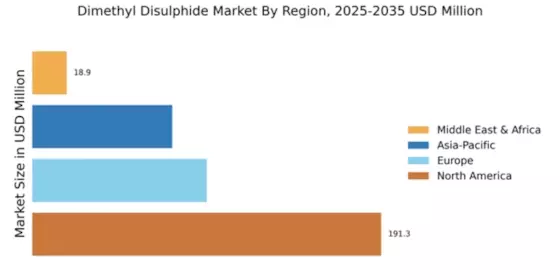
North America is poised to maintain its leadership in the Dimethyl Disulphide market, holding a significant market share of 191.3 million. The region's growth is driven by increasing demand in various applications, including agriculture and petrochemicals. Regulatory support for chemical manufacturing and environmental compliance is also a catalyst for market expansion, ensuring sustainable practices are prioritized. The competitive landscape in North America is robust, featuring key players such as BASF SE, Eastman Chemical Company, and Huntsman Corporation. These companies are investing in innovation and capacity expansion to meet the rising demand. The U.S. remains the largest market, supported by advanced manufacturing capabilities and a strong focus on research and development in chemical processes.

Europe : Emerging Market with Growth Potential

Europe's Dimethyl Disulphide market is valued at 95.65 million, reflecting a growing interest in sustainable chemical solutions. The region is witnessing increased demand driven by stringent environmental regulations and a shift towards greener alternatives in various industries. The European Union's commitment to reducing carbon emissions is a significant regulatory catalyst, promoting the use of eco-friendly chemicals. Leading countries in this market include Germany, France, and the UK, where major players like Arkema S.A. and Solvay S.A. are actively involved. The competitive landscape is characterized by innovation and strategic partnerships aimed at enhancing product offerings. The presence of established chemical manufacturers positions Europe as a key player in The Dimethyl Disulphide.

Asia-Pacific : Rapid Growth in Emerging Economies

The Asia-Pacific region, with a market size of 76.78 million, is experiencing rapid growth in the Dimethyl Disulphide sector. This growth is fueled by increasing industrialization and urbanization, particularly in countries like China and India. The demand for Dimethyl Disulphide in agriculture and chemical manufacturing is on the rise, supported by favorable government policies and investments in infrastructure. China is the leading country in this market, with significant contributions from local manufacturers and multinational corporations. Key players such as Mitsubishi Gas Chemical Company and Tosoh Corporation are expanding their operations to capitalize on the growing demand. The competitive landscape is evolving, with a focus on innovation and sustainability to meet the needs of diverse industries.

Middle East and Africa : Emerging Market with Untapped Potential

The Middle East and Africa region, with a market size of 18.86 million, is an emerging player in the Dimethyl Disulphide market. The growth is driven by increasing industrial activities and a focus on diversifying economies away from oil dependency. Regulatory frameworks are gradually evolving to support chemical manufacturing, which is expected to boost market growth in the coming years. Countries like Saudi Arabia and South Africa are leading the way, with investments in chemical production facilities. The competitive landscape is characterized by a mix of local and international players, including SABIC, which is focusing on expanding its product portfolio. The region's potential for growth is significant, as it seeks to establish itself as a key player in The Dimethyl Disulphide.

Key Players and Competitive Insights

The Dimethyl Disulphide Market is currently characterized by a competitive landscape that is both dynamic and multifaceted. Key growth drivers include the increasing demand for agricultural chemicals, particularly in the production of pesticides and herbicides, alongside the rising utilization of dimethyl disulphide in the petrochemical sector. Major players such as BASF SE (Germany), Eastman Chemical Company (US), and Huntsman Corporation (US) are strategically positioned to leverage these trends. BASF SE (Germany) focuses on innovation and sustainability, investing heavily in R&D to develop eco-friendly applications of dimethyl disulphide. Meanwhile, Eastman Chemical Company (US) emphasizes regional expansion, particularly in Asia-Pacific, to tap into emerging markets. Huntsman Corporation (US) adopts a digital transformation strategy, enhancing operational efficiencies through advanced technologies, which collectively shapes a competitive environment that is increasingly reliant on innovation and strategic partnerships.

In terms of business tactics, companies are localizing manufacturing to reduce costs and optimize supply chains, which is particularly crucial in a moderately fragmented market. The competitive structure is influenced by the collective actions of these key players, who are not only vying for market share but also striving to establish a foothold in new regions. This localized approach allows for greater responsiveness to market demands and enhances customer satisfaction, thereby solidifying their positions in the market.

In November 2025, BASF SE (Germany) announced a partnership with a leading agricultural firm to develop sustainable agricultural solutions utilizing dimethyl disulphide. This strategic move is significant as it aligns with global trends towards sustainability and positions BASF as a leader in eco-friendly agricultural chemicals. The collaboration is expected to enhance product offerings and expand market reach, thereby reinforcing BASF's competitive edge.

In October 2025, Eastman Chemical Company (US) launched a new line of dimethyl disulphide derivatives aimed at the Asian market. This initiative is crucial as it not only diversifies Eastman's product portfolio but also capitalizes on the growing demand in the region. By tailoring products to local needs, Eastman is likely to strengthen its market presence and foster customer loyalty.

In September 2025, Huntsman Corporation (US) implemented a new digital supply chain management system designed to improve efficiency and reduce lead times. This strategic action is indicative of a broader trend towards digitalization within the industry, allowing Huntsman to respond more swiftly to market changes and customer demands. The integration of advanced technologies is expected to enhance operational performance and provide a competitive advantage in a rapidly evolving market.

As of December 2025, current competitive trends are increasingly defined by digitalization, sustainability, and the integration of AI technologies. Strategic alliances are becoming more prevalent, as companies recognize the need to collaborate to enhance innovation and market responsiveness. The competitive differentiation is likely to evolve from traditional price-based competition towards a focus on technological advancements, supply chain reliability, and sustainable practices. This shift suggests that companies that prioritize innovation and strategic partnerships will be better positioned to thrive in the future.

Key Companies in the Dimethyl Disulphide Market market include

Industry Developments

Recent developments in the market have highlighted significant trends and emerging opportunities. The market is increasingly influenced by the growing demand for sulfur-based chemicals in various industries, particularly agriculture, where DMDS is utilized as a soil fumigant and nematicide. The ongoing emphasis on sustainable agricultural practices is driving research and innovation, enhancing DMDS applications. In addition, the rise in bio-based products is shaping the market, with companies investing in greener alternatives to traditional chemicals.

Regulatory changes are also impacting the market landscape, as governments worldwide enforce stricter environmental regulations, prompting manufacturers to adapt to safer production processes. Furthermore, geopolitical factors and supply chain disruptions attributed to recent events have also led companies to reassess their sourcing strategies, impacting availability and pricing of DMDS. As the market approaches a projected valuation of USD 0.5 billion by 2032, ongoing developments will be crucial for stakeholders aimed at navigating this evolving market environment, supported by a compound annual growth rate of 4.01% from 2024 onwards.

Future Outlook

Dimethyl Disulphide Market Future Outlook

The Dimethyl Disulphide Market is projected to grow at a 4.01% CAGR from 2024 to 2035, driven by increasing demand in agriculture and chemical industries.

New opportunities lie in:

  • Expansion into emerging markets with tailored formulations.
  • Development of eco-friendly production processes to attract sustainability-focused clients.
  • Investment in advanced distribution networks to enhance supply chain efficiency.

By 2035, the Dimethyl Disulphide Market is expected to achieve robust growth and increased market penetration.

Market Segmentation

Dimethyl Disulphide Market Form Outlook

  • Liquid
  • Gas
  • Solid

Dimethyl Disulphide Market End Use Outlook

  • Pesticides
  • Flavors and Fragrances
  • Solvents
  • Intermediate Chemicals

Dimethyl Disulphide Market Application Outlook

  • Agriculture
  • Chemical Synthesis
  • Food Industry
  • Pharmaceuticals

Dimethyl Disulphide Market Purity Level Outlook

  • High Purity
  • Technical Grade
  • Industrial Grade

Dimethyl Disulphide Market Distribution Channel Outlook

  • Direct Sales
  • Online Sales
  • Distributors

Report Scope

MARKET SIZE 2024382.59(USD Million)
MARKET SIZE 2025397.94(USD Million)
MARKET SIZE 2035589.72(USD Million)
COMPOUND ANNUAL GROWTH RATE (CAGR)4.01% (2024 - 2035)
REPORT COVERAGERevenue Forecast, Competitive Landscape, Growth Factors, and Trends
BASE YEAR2024
Market Forecast Period2025 - 2035
Historical Data2019 - 2024
Market Forecast UnitsUSD Million
Key Companies ProfiledBASF SE (DE), Eastman Chemical Company (US), Huntsman Corporation (US), Chevron Phillips Chemical Company (US), Arkema S.A. (FR), SABIC (SA), Mitsubishi Gas Chemical Company, Inc. (JP), Tosoh Corporation (JP), Solvay S.A. (BE)
Segments CoveredApplication, End Use, Form, Purity Level, Distribution Channel
Key Market OpportunitiesGrowing demand for sustainable agricultural practices enhances opportunities in the Dimethyl Disulphide Market.
Key Market DynamicsRising demand for dimethyl disulphide in agriculture and petrochemical industries drives market growth and innovation.
Countries CoveredNorth America, Europe, APAC, South America, MEA

Leave a Comment

FAQs

What is the projected CAGR for the Dimethyl Disulphide (DMDS) Market from 2025 to 2034?

Dimethyl Disulphide Market is projected to grow at a CAGR of 4.01% during the forecast period, 2025-2035

Which is the dominant application area for DMDS?

The chemical industry primarily utilizes DMDS, with an expected valuation of 0.22 billion USD in 2035.

What is the scope for Dimethyl Disulphide use in Agriculture by 2035?

Expected to reach 0.12 billion USD in 2035, agriculture provides substantial scope for DMDS use.

Which region holds the largest market share in the DMDS Market in 2035?

North America is expected to hold the largest share, valued at 0.16 billion USD in 2035.

What is the value for the Dimethyl Disulphide Market in Asia Pacific by 2035?

The market for dimethyl disulphide in the Asia Pacific is poised to yield 0.14 billion USD in 2035.

Who are the key players in the Dimethyl Disulphide (DMDS) Market?

Key players in the market include Merck KGaA, Nippon Chemical Industrial, and Kronos Worldwide.

What is the expected market size for the Food Industry application segment in 2035?

The food industry application segment is expected to grow to 0.07 billion USD by 2035.

What is the anticipated market value for the Pharmaceuticals segment in 2035?

The pharmaceuticals segment is expected to be valued at 0.09 billion USD in 2035.

Download Free Sample

Kindly complete the form below to receive a free sample of this Report

Compare Licence

×
Features License Type
Single User Multiuser License Enterprise User
Price $4,950 $5,950 $7,250
Maximum User Access Limit 1 User Upto 10 Users Unrestricted Access Throughout the Organization
Free Customization
Direct Access to Analyst
Deliverable Format
Platform Access
Discount on Next Purchase 10% 15% 15%
Printable Versions