Dimethylaminopropylamine Market (2026 - 2035)

ID: MRFR/CnM/1853-HCR
135 Pages
Priya Nagrale
Last Updated: July 02, 2026
Dimethylaminopropylamine (DMAPA) Market Research Report Information by Application (Personal Care, PU Catalyst, Pharmaceuticals, Lubricant Additives, Water Treatment, Resins, Agrochemicals, and Others), and Region (North America, Asia-Pacific, Europe, Latin America, and Middle East & Africa)—Forecast till 2035
Dimethylaminopropylamine Market

Market Size

Forecast Period2026-2035
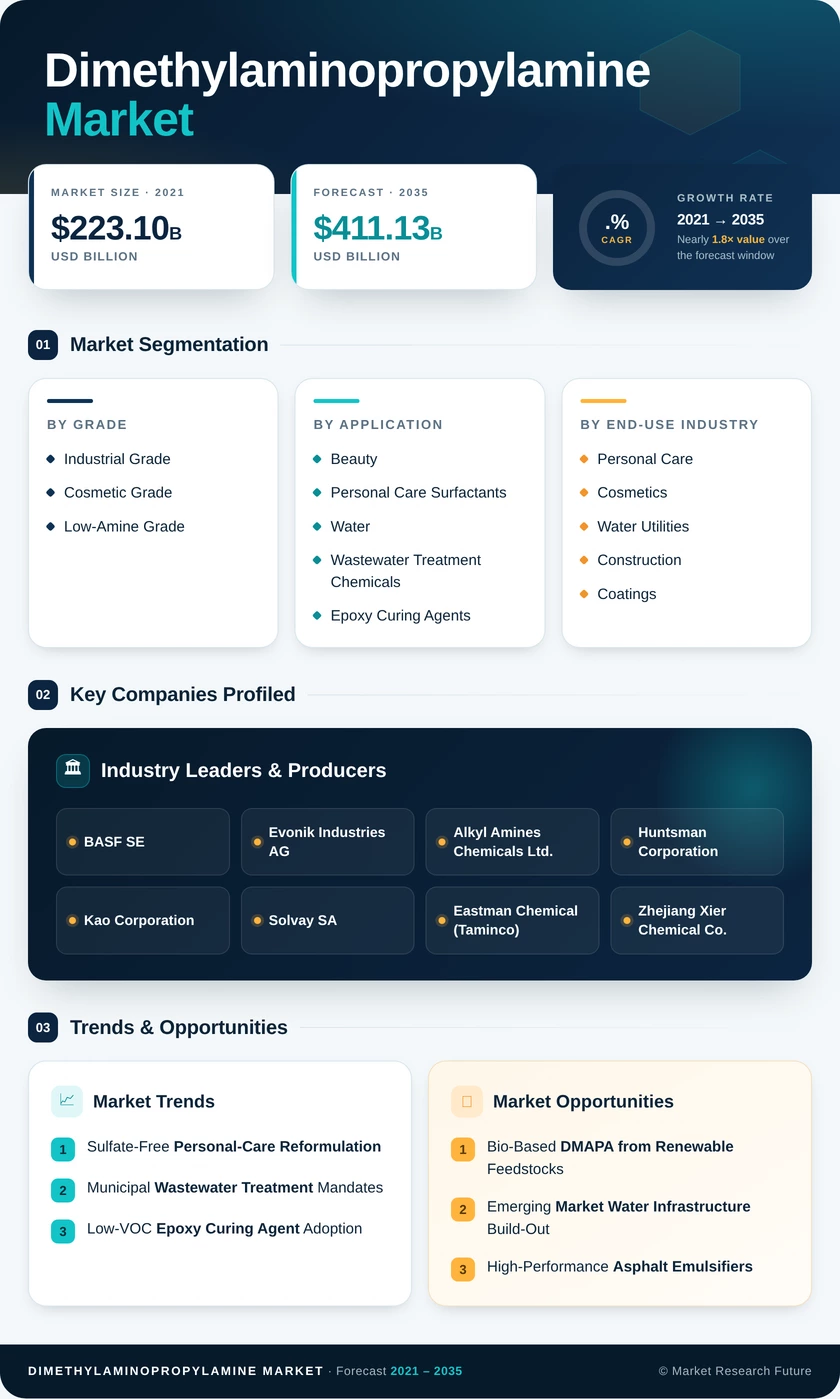
CAGR (2026-2035)4.85%
2035 Market Size411.13 Kilotons

Key Players

BASF SE
Evonik Industries AG
Alkyl Amines Chemicals Ltd.
Huntsman Corporation
Kao Corporation
Solvay SA
Opportunities
  • Bio-Based DMAPA from Renewable Feedstocks
  • Emerging Market Water Infrastructure Build-Out
  • High-Performance Asphalt Emulsifiers
  1. 1 Market Overview |
    1. 1.1 Study Assumptions & Market Definition |
    2. 1.2 Scope of the Study |
    3. 1.3 Research Methodology
  2. 2 Market Summary & Key Takeaways
  3. 3 Market Dynamics |
    1. 3.1 Market Drivers Analysis | |
      1. 3.1.1 Sulfate-Free Personal-Care Reformulation | |
      2. 3.1.2 Municipal Wastewater Treatment Mandates | |
      3. 3.1.3 Low-VOC Epoxy Curing Agent Adoption | |
      4. 3.1.4 Capacity Expansion in China and India | |
      5. 3.1.5 Agrochemical Intermediate Demand Growth | |
      6. 3.1.6 Renewable Energy-Driven Cost Reduction | |
      7. 3.1.7 Fabric Softener Premiumization |
    2. 3.2 Market Restraints Analysis | |
      1. 3.2.1 Acrylonitrile Feedstock Price Volatility | |
      2. 3.2.2 Tightening Nitrosamine Limits on Cosmetic-Grade DMAPA | |
      3. 3.2.3 Competition from Glucoside-Based Surfactants | |
      4. 3.2.4 Environmental Scrutiny of Amine Manufacturing Emissions | |
      5. 3.2.5 Trade Barriers and Anti-Dumping Duties |
    3. 3.3 Market Opportunity Analysis | |
      1. 3.3.1 Bio-Based DMAPA from Renewable Feedstocks | |
      2. 3.3.2 Emerging Market Water Infrastructure Build-Out | |
      3. 3.3.3 High-Performance Asphalt Emulsifiers | |
      4. 3.3.4 Digital Supply-Chain Monetization | |
      5. 3.3.5 Oilfield Corrosion Inhibitor Expansion in the Middle East |
    4. 3.4 Industry Value Chain Analysis |
    5. 3.5 Porter's Five Forces Analysis
  4. 4 Global Dimethylaminopropylamine Market Size & Forecast (2021–2035) |
    1. 4.1 Historical Market Size (2021–2025) |
    2. 4.2 Current & Forecast Market Size (2026–2035) |
    3. 4.3 Market Size by Volume (Kilotons) |
    4. 4.4 Year-over-Year Growth Analysis
  5. 5 Segmentation Analysis |
    1. 5.1 By Grade | |
      1. 5.1.1 Industrial Grade | |
      2. 5.1.2 Cosmetic Grade | |
      3. 5.1.3 Low-Amine Grade |
    2. 5.2 By Application | |
      1. 5.2.1 Beauty and Personal Care Surfactants | |
      2. 5.2.2 Water and Wastewater Treatment Chemicals | |
      3. 5.2.3 Epoxy Curing Agents | |
      4. 5.2.4 Fabric Care Additives | |
      5. 5.2.5 Oilfield Chemicals | |
      6. 5.2.6 Other Applications |
    3. 5.3 By End-Use Industry | |
      1. 5.3.1 Personal Care and Cosmetics | |
      2. 5.3.2 Water Utilities | |
      3. 5.3.3 Construction and Coatings | |
      4. 5.3.4 Oil and Gas | |
      5. 5.3.5 Textiles and Home Care | |
      6. 5.3.6 Other Industries
  6. 6 Regional Analysis |
    1. 6.1 North America | |
      1. 6.1.1 United States | |
      2. 6.1.2 Canada | |
      3. 6.1.3 Mexico |
    2. 6.2 Europe | |
      1. 6.2.1 Germany | |
      2. 6.2.2 United Kingdom | |
      3. 6.2.3 France | |
      4. 6.2.4 Italy | |
      5. 6.2.5 Spain | |
      6. 6.2.6 Nordic Countries | |
      7. 6.2.7 Russia | |
      8. 6.2.8 Rest of Europe |
    3. 6.3 Asia-Pacific | |
      1. 6.3.1 China | |
      2. 6.3.2 India | |
      3. 6.3.3 Japan | |
      4. 6.3.4 South Korea | |
      5. 6.3.5 ASEAN | |
      6. 6.3.6 Rest of Asia-Pacific |
    4. 6.4 South America | |
      1. 6.4.1 Brazil | |
      2. 6.4.2 Argentina | |
      3. 6.4.3 Rest of South America |
    5. 6.5 Middle East & Africa | |
      1. 6.5.1 Saudi Arabia | |
      2. 6.5.2 UAE | |
      3. 6.5.3 South Africa | |
      4. 6.5.4 Egypt | |
      5. 6.5.5 Rest of MEA
  7. 7 Competitive Landscape |
    1. 7.1 Market Share Analysis (2025) |
    2. 7.2 Competitive Benchmarking Matrix |
    3. 7.3 Company Profiles | |
      1. 7.3.1 BASF SE | |
      2. 7.3.2 Evonik Industries AG | |
      3. 7.3.3 Alkyl Amines Chemicals Ltd. | |
      4. 7.3.4 Huntsman Corporation | |
      5. 7.3.5 Kao Corporation | |
      6. 7.3.6 Solvay SA | |
      7. 7.3.7 Eastman Chemical (Taminco) | |
      8. 7.3.8 Zhejiang Xier Chemical Co. | |
      9. 7.3.9 Indo Amines Ltd. | |
      10. 7.3.10 LANXESS AG
  8. 8 Future Outlook & Strategic Recommendations (2026–2035) |
    1. 8.1 AI-Enabled Process Optimization |
    2. 8.2 Circular Chemistry and Carbon Accounting |
    3. 8.3 Electrification and Battery Material Adjacency |
    4. 8.4 ESG-Driven Supplier Qualification
  9. 9 Recent Developments & News
  10. 10 Frequently Asked Questions (FAQs)
  11. 11 Report Scope & Methodology |
    1. 11.1 Study Period & Base Year |
    2. 11.2 Data Sources & Citations |
    3. 11.3 Abbreviations
  12. 1 LIST OF TABLES
  13. 2 LIST OF FIGURES

Segmentation Quick Reference

DimensionSub-SegmentsDominant SegmentFastest Growing Segment
By GradeIndustrial Grade, Cosmetic Grade, Low-Amine GradeIndustrial GradeCosmetic Grade
By ApplicationBeauty and Personal Care Surfactants, Water and Wastewater Treatment Chemicals, Epoxy Curing Agents, Fabric Care Additives, Oilfield Chemicals, Other ApplicationsBeauty and Personal Care SurfactantsBeauty and Personal Care Surfactants
By End-Use IndustryPersonal Care and Cosmetics, Water Utilities, Dimethylaminopropylamine Market and Coatings, Oil and Gas, Textiles and Home Care, Other IndustriesPersonal Care and CosmeticsWater Utilities
By RegionAsia-Pacific, North America, Europe, South America, the Middle East & AfricaAsia-PacificAsia-Pacific


Market Segmentation Overview

By Grade

Sub-SegmentKey Trend
Industrial GradeSteady demand from water-treatment flocculant and bulk epoxy hardener applications
Cosmetic GradeRapid growth driven by EU Annex III nitrosamine compliance and clean-beauty reformulation
Low-Amine GradeNiche pharmaceutical and electronic-grade specification demand


Industrial grade remains the volume backbone of the market, consumed in applications where secondary amine tolerances are permissive. Cosmetic grade is emerging as the premium growth vector, with capacity investments in high-purity distillation expanding across both European and Indian production sites.

By Application

Sub-SegmentKey Trend
Beauty and Personal Care SurfactantsSulfate-free shampoo and body-wash reformulation, accelerating betaine consumption.
Water and Wastewater Treatment ChemicalsMunicipal infrastructure mandates in the EU and India are driving polyamine flocculant uptake.
Epoxy Curing AgentsLow-VOC amidoamine hardeners replacing aliphatic polyamines in coatings.
Fabric Care AdditivesPremium fabric softener formulations incorporating cationic DMAPA derivatives
Oilfield ChemicalsImidazoline corrosion inhibitors for sour-gas and high-CO₂ production environments
Other ApplicationsAgrochemical adjuvants, mining flotation reagents, and specialty catalyst synthesis


Beauty and personal care surfactants lead both in absolute volume and growth rate, reflecting the structural shift toward amphoteric surfactant systems. Water treatment chemicals provide a stable, infrastructure-driven demand that is less sensitive to consumer-trend volatility.

By End-Use Industry

Sub-SegmentKey Trend
Personal Care and CosmeticsDominant end-use vertical driven by clean-beauty and regulatory compliance
Water UtilitiesFastest-growing end-use industry on municipal modernization mandates
Dimethylaminopropylamine Market and CoatingsLow-emission epoxy primer specifications from automotive and industrial OEMs
Oil and GasUpstream corrosion management and enhanced oil recovery formulations
Textiles and Home CarePremiumization in laundry care and textile finishing auxiliaries
Other IndustriesElectronics encapsulation, mining, and agrochemical formulation


Personal care and cosmetics accounts for the largest share of end-use consumption, channeling DMAPA through betaine and sultaine synthesis routes. Water utilities represent the fastest-growing end-use vertical, propelled by a decade-long infrastructure upgrade cycle spanning both developed and developing economies.


Download PDF ×

We do not share your information with anyone. However, we may send you emails based on your report interest from time to time. You may contact us at any time to opt-out.