×
Request Free Sample ×

Kindly complete the form below to receive a free sample of this Report

* Please use a valid business email

Leading companies partner with us for data-driven Insights

clients tt-cursor
Hero Background

Drinking Water Adsorbents Market

ID: MRFR/CnM/8424-HCR
111 Pages
Priya Nagrale
October 2025

Drinking Water Adsorbents Market Research Report By Adsorbent Type (Carbon, Activated Carbon, Activated Alumina, Silica Gel, Ion Exchange Resins), By Application (Point-of-Use (POU) Water Filtration Systems, Industrial Water Treatment, Municipal Water Treatment), By Form Factor (Granular, Powdered, Extruded, Impregnated), By Purification Purpose (Removal of Impurities, Color Removal, Odor Removal, Taste Removal) and By Regional (North America, Europe, South America, Asia Pacific, Middle East and Africa) - Forecast to 2035

Share:
Download PDF ×

We do not share your information with anyone. However, we may send you emails based on your report interest from time to time. You may contact us at any time to opt-out.

Drinking Water Adsorbents Market Infographic
Purchase Options

Drinking Water Adsorbents Market Summary

As per MRFR analysis, the Drinking Water Adsorbents Market Size was estimated at 3576.81 USD Million in 2024. The Drinking Water Adsorbents industry is projected to grow from 3747.5 in 2025 to 5973.04 by 2035, exhibiting a compound annual growth rate (CAGR) of 4.77 during the forecast period 2025 - 2035.

Key Market Trends & Highlights

The Drinking Water Adsorbents Market is poised for growth driven by sustainability and technological advancements.

  • The market is increasingly leaning towards sustainability in adsorbent materials, reflecting a broader environmental consciousness.
  • Technological innovations are enhancing the efficiency and effectiveness of adsorbents, particularly in water treatment applications.
  • North America remains the largest market, while the Asia-Pacific region is emerging as the fastest-growing area for drinking water adsorbents.
  • Rising water quality concerns and consumer demand for sustainable solutions are key drivers propelling market expansion.

Market Size & Forecast

2024 Market Size 3576.81 (USD Million)
2035 Market Size 5973.04 (USD Million)
CAGR (2025 - 2035) 4.77%

Major Players

Calgon Carbon Corporation (US), BASF SE (DE), Evoqua Water Technologies LLC (US), KX Technologies LLC (US), AquaSorb (US), AdEdge Water Technologies (US), Haycarb PLC (LK), Carbotech AC (DE)

Drinking Water Adsorbents Market Trends

The Drinking Water Adsorbents Market is currently experiencing a notable transformation, driven by increasing awareness regarding water quality and safety. As consumers become more informed about the potential contaminants in their drinking water, the demand for effective adsorbents is rising. This shift is further supported by regulatory frameworks that emphasize the necessity for clean water, prompting both residential and industrial sectors to seek advanced solutions. Innovations in material science are also contributing to the development of more efficient adsorbents, which may enhance the overall effectiveness of water purification processes. Moreover, the market landscape is evolving with the introduction of sustainable and eco-friendly adsorbent materials. Stakeholders are increasingly focusing on products that not only meet performance standards but also align with environmental sustainability goals. This trend suggests a growing preference for natural and biodegradable options, which could reshape consumer choices in the coming years. As the Drinking Water Adsorbents Market continues to expand, it appears poised for further advancements, potentially leading to enhanced purification technologies and broader applications across various sectors.

Sustainability in Adsorbent Materials

There is a noticeable trend towards the use of sustainable materials in the production of drinking water adsorbents. Manufacturers are exploring biodegradable and eco-friendly options, which may appeal to environmentally conscious consumers. This shift could lead to a broader acceptance of adsorbents that not only purify water but also minimize ecological impact.

Technological Innovations

The Drinking Water Adsorbents Market is witnessing a surge in technological advancements. Innovations in material science are enabling the development of more efficient adsorbents, which might improve the effectiveness of water treatment processes. These advancements could potentially enhance the performance and longevity of adsorbent materials.

Regulatory Influence on Market Dynamics

Regulatory frameworks are playing a crucial role in shaping the Drinking Water Adsorbents Market. Stricter guidelines regarding water quality are prompting both consumers and industries to invest in advanced purification solutions. This regulatory influence may drive demand for high-performance adsorbents, thereby impacting market growth.

Drinking Water Adsorbents Market Drivers

Market Growth Projections

The Global Drinking Water Adsorbents Market Industry is projected to experience substantial growth in the coming years. With an estimated market value of 3.58 USD Billion in 2024, it is anticipated to reach 5.97 USD Billion by 2035. This growth trajectory indicates a compound annual growth rate of 4.76% from 2025 to 2035. The increasing demand for effective water treatment solutions, driven by factors such as contamination, regulatory pressures, and technological advancements, underscores the market's potential. These projections highlight the importance of adsorbents in ensuring safe drinking water for a growing global population.

Growing Awareness of Water Quality

Public awareness regarding the importance of water quality is a key driver for the Global Drinking Water Adsorbents Market Industry. As consumers become more informed about the health risks associated with contaminated water, they are increasingly seeking products that ensure safe drinking water. This trend is reflected in the rising sales of water purification systems that utilize adsorbents for contaminant removal. Educational campaigns and advocacy for clean water initiatives further amplify this awareness, leading to a heightened demand for effective adsorbent solutions. Consequently, the market is poised for growth as consumers prioritize water safety in their purchasing decisions.

Rising Population and Urbanization

The Global Drinking Water Adsorbents Market Industry is also propelled by the rising global population and rapid urbanization. As more individuals migrate to urban areas, the demand for clean drinking water intensifies. Urban centers often face challenges related to water supply and quality, necessitating the implementation of effective treatment solutions. Adsorbents play a crucial role in addressing these challenges by providing efficient methods for removing contaminants from water sources. This trend is expected to contribute to the market's expansion, as urban populations continue to grow and the need for reliable water treatment solutions becomes increasingly critical.

Regulatory Frameworks and Standards

The Global Drinking Water Adsorbents Market Industry is significantly influenced by stringent regulatory frameworks aimed at ensuring safe drinking water. Governments worldwide are implementing regulations that mandate the reduction of specific contaminants in drinking water. For example, the U.S. Environmental Protection Agency has established guidelines for maximum contaminant levels, driving the need for effective adsorbents. Compliance with these regulations often requires the use of advanced treatment technologies, including adsorbents, to meet safety standards. This regulatory pressure is likely to propel the market towards an estimated value of 5.97 USD Billion by 2035, reflecting a compound annual growth rate of 4.76% from 2025 to 2035.

Increasing Water Contamination Levels

The Global Drinking Water Adsorbents Market Industry is experiencing growth due to rising levels of water contamination. Industrial activities, agricultural runoff, and urbanization contribute to the presence of harmful pollutants in drinking water sources. For instance, heavy metals and organic compounds are increasingly detected in water supplies, necessitating effective treatment solutions. Adsorbents such as activated carbon and zeolites are employed to mitigate these contaminants, enhancing water quality. As public awareness of water safety grows, the demand for adsorbents is expected to rise, contributing to the market's projected value of 3.58 USD Billion in 2024.

Technological Advancements in Adsorbent Materials

Innovations in adsorbent materials are shaping the Global Drinking Water Adsorbents Market Industry. The development of advanced materials, such as nanomaterials and bio-based adsorbents, enhances the efficiency of contaminant removal from water. These innovations not only improve adsorption capacity but also reduce the environmental impact of adsorbent production. For instance, researchers are exploring the use of agricultural waste as a sustainable source for adsorbents. As these technologies become more commercially viable, they are expected to attract investment and drive market growth, aligning with the increasing demand for effective water treatment solutions.
Market Segment Insights

By Application: Water Treatment (Largest) vs. Wastewater Treatment (Fastest-Growing)

In the Drinking Water Adsorbents Market, water treatment stands as the largest application segment, leveraging a significant share of the overall market. This segment primarily addresses the need for effective removal of contaminants to ensure safe drinking water, which is a critical demand across various regions. On the other hand, wastewater treatment is identified as the fastest-growing segment, driven by increasing regulatory pressure to ensure environmentally sustainable practices and to recycle water effectively, thereby addressing the global water scarcity issue.

Water Treatment (Dominant) vs. Wastewater Treatment (Emerging)

Water treatment remains to be the dominant application in the Drinking Water Adsorbents Market, characterized by its essential role in purifying drinking water for public health benefits. This segment is often seen as the backbone of the market, with robust demand stemming from municipalities and industries seeking compliance with strict water quality regulations. Conversely, the wastewater treatment segment is emerging as a vital area due to the growing emphasis on sustainability. Innovations and advancements in adsorbent materials are fostering rapid growth in this segment, catering to increasing industrial and residential needs for effective wastewater management. The focus on reducing pollution and developing recycling technologies positions wastewater treatment as a key growth driver moving forward.

By Type: Activated Carbon (Largest) vs. Ion Exchange Resins (Fastest-Growing)

In the Drinking Water Adsorbents Market, Activated Carbon currently leads with the largest market share, primarily due to its widespread use in various applications such as water purification and toxic substance removal. It is favored for its high adsorption capacity and effectiveness in eliminating organic compounds. Ion Exchange Resins hold the fastest-growing position in this market segment, gaining traction due to their efficiency in removing specific ions and providing superior results in water softening.

Activated Carbon (Dominant) vs. Ion Exchange Resins (Emerging)

Activated Carbon has established itself as the dominant player in the Drinking Water Adsorbents Market, renowned for its versatility and high performance in multiple water treatment applications. It excels in removing pollutants and improving water taste and odor. In contrast, Ion Exchange Resins, although currently an emerging trend, are rapidly gaining ground with advancements in their design and functionality. They are particularly effective for deionization and selective ion removal, making them invaluable in specific applications. The market is witnessing an increasing shift towards Ion Exchange Resins as they offer tailored solutions for complex water purification needs.

By End Use: Municipal Water Supply (Largest) vs. Household Water Purification (Fastest-Growing)

In the Drinking Water Adsorbents Market, the Municipal Water Supply segment holds the largest market share, driven by the need to provide safe and clean drinking water to urban populations. This segment benefits from large-scale investments by governments and municipalities to meet water quality regulations and ensure public health. On the other hand, the Household Water Purification segment is rapidly gaining traction, as more consumers become aware of water quality and seek effective solutions to filter their home water supply, highlighting a significant shift towards personalized water treatment solutions.

Municipal Water Supply (Dominant) vs. Household Water Purification (Emerging)

The Municipal Water Supply segment is characterized by its extensive infrastructure and regulatory support, making it the dominant force in the Drinking Water Adsorbents Market. Utilities are continuously upgrading their systems to improve water quality, which relies heavily on effective adsorbent technologies to remove contaminants. In contrast, the Household Water Purification segment represents an emerging trend with a growing consumer interest in health and wellness. This segment is marked by innovations in compact and efficient filtration systems that cater to individual household needs, driving a surge in demand for advanced adsorbent materials that enhance drinking water quality on a personal level.

Get more detailed insights about Drinking Water Adsorbents Market

Regional Insights

North America : Market Leader in Adsorbents

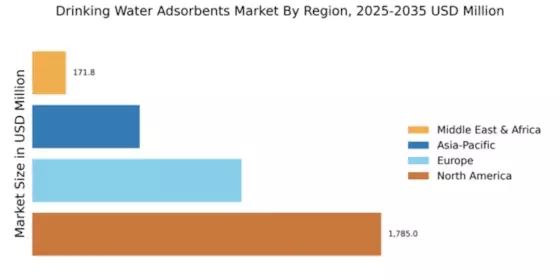
North America is poised to maintain its leadership in the Drinking Water Adsorbents Market, holding a significant market share of $1785.0M in 2024. The region's growth is driven by stringent regulations on water quality and increasing consumer awareness regarding safe drinking water. The demand for advanced filtration technologies is also on the rise, supported by government initiatives aimed at improving water infrastructure and sustainability. The United States stands out as the leading country in this market, with major players like Calgon Carbon Corporation and Evoqua Water Technologies LLC driving innovation and competition. The presence of established companies ensures a robust supply chain and a variety of product offerings. As the market evolves, investments in research and development are expected to enhance the effectiveness of adsorbents, further solidifying North America's position as a market leader.

Europe : Growing Market with Regulations

Europe's Drinking Water Adsorbents Market is projected to reach $1070.0M, driven by increasing regulatory frameworks aimed at ensuring water safety and quality. The European Union's stringent directives on water treatment and environmental sustainability are key growth catalysts. Additionally, rising public awareness about contaminants in drinking water is fueling demand for effective adsorbent solutions, making the region a focal point for innovation in water treatment technologies. Germany and the UK are leading countries in this market, with companies like BASF SE and Haycarb PLC playing pivotal roles. The competitive landscape is characterized by a mix of established firms and emerging players, all striving to meet the growing demand for high-quality adsorbents. The emphasis on sustainable practices and eco-friendly products is shaping the market dynamics, encouraging investments in advanced technologies and solutions.

Asia-Pacific : Emerging Market with Potential

The Asia-Pacific region is witnessing significant growth in the Drinking Water Adsorbents Market, projected to reach $550.0M. This growth is primarily driven by increasing urbanization, industrialization, and a rising population, leading to heightened demand for clean drinking water. Governments are implementing various initiatives to improve water quality, which is further propelling the market. The region's diverse climatic conditions also necessitate tailored solutions for effective water treatment. Countries like China and India are at the forefront of this market, with a growing number of local and international players entering the landscape. Companies such as KX Technologies LLC and AquaSorb are expanding their operations to cater to the increasing demand. The competitive environment is becoming more dynamic, with innovations in adsorbent materials and technologies aimed at enhancing efficiency and effectiveness in water purification processes.

Middle East and Africa : Developing Market with Challenges

The Middle East and Africa region, with a market size of $171.81M, is increasingly focusing on solutions for water scarcity and quality issues. The region faces unique challenges, including limited freshwater resources and growing populations, which drive the demand for effective drinking water adsorbents. Governments are prioritizing investments in water treatment technologies to address these challenges, supported by international aid and partnerships aimed at improving water access and quality. Countries like South Africa and the UAE are leading the charge in adopting advanced water treatment solutions. The competitive landscape includes both local and international players, with companies like AdEdge Water Technologies making significant contributions. As the market evolves, there is a growing emphasis on sustainable practices and innovative technologies to enhance water purification processes, ensuring safe drinking water for the population.

Key Players and Competitive Insights

The Drinking Water Adsorbents Market is currently characterized by a dynamic competitive landscape, driven by increasing regulatory pressures and a growing emphasis on water quality. Key players such as Calgon Carbon Corporation (US), BASF SE (DE), and Evoqua Water Technologies LLC (US) are strategically positioned to leverage innovation and sustainability in their operations. Calgon Carbon Corporation (US) focuses on enhancing its product portfolio through advanced filtration technologies, while BASF SE (DE) emphasizes sustainable solutions that align with global environmental standards. Evoqua Water Technologies LLC (US) is actively pursuing partnerships to expand its service offerings, thereby enhancing its competitive edge in the market. Collectively, these strategies indicate a shift towards more sustainable practices and technological advancements, shaping the competitive environment significantly.

In terms of business tactics, companies are increasingly localizing manufacturing and optimizing supply chains to enhance operational efficiency. The market appears moderately fragmented, with several players vying for market share. This fragmentation allows for diverse strategies, as companies seek to differentiate themselves through innovation and customer-centric solutions. The collective influence of these key players is substantial, as they drive trends that prioritize sustainability and technological integration in water treatment processes.

In November 2025, Calgon Carbon Corporation (US) announced the launch of a new line of adsorbents designed specifically for emerging contaminants in drinking water. This strategic move is significant as it positions the company at the forefront of addressing regulatory challenges and consumer demands for cleaner water. By focusing on innovative solutions, Calgon Carbon aims to capture a larger market share and enhance its reputation as a leader in water treatment technologies.

In October 2025, BASF SE (DE) entered into a strategic partnership with a leading technology firm to develop AI-driven solutions for water treatment processes. This collaboration is likely to enhance BASF's capabilities in predictive maintenance and operational efficiency, thereby reducing costs and improving service delivery. The integration of AI into their operations suggests a forward-thinking approach that could redefine competitive dynamics in the market.

In September 2025, Evoqua Water Technologies LLC (US) expanded its operations in Europe by acquiring a regional water treatment company. This acquisition is indicative of Evoqua's strategy to strengthen its market presence and diversify its service offerings. By enhancing its geographical footprint, Evoqua is poised to capitalize on the growing demand for advanced water treatment solutions in Europe, further solidifying its competitive position.

As of December 2025, current trends in the Drinking Water Adsorbents Market are heavily influenced by digitalization, sustainability, and the integration of advanced technologies. Strategic alliances are becoming increasingly important, as companies recognize the value of collaboration in driving innovation and enhancing service capabilities. The competitive landscape is likely to evolve, with a shift from price-based competition to a focus on technological differentiation and supply chain reliability. This transition underscores the importance of innovation and sustainability as key drivers of competitive advantage in the market.

Key Companies in the Drinking Water Adsorbents Market market include

Industry Developments

The Drinking Water Adsorbents Market is anticipated to reach a valuation of USD 5.70 billion by 2034, expanding at a CAGR of 4.77% from 2025 to 2034. Increasing concerns over water contamination, growing demand for clean and safe drinking water, and stringent government regulations are driving market growth. Activated carbon holds the largest market share due to its high adsorption capacity and cost-effectiveness. Asia-Pacific dominates the market due to rapid industrialization and urbanization, leading to increased water pollution. Key players include Adsorbent Media, Calgon Carbon Corporation, and Jacobi Carbons.

Recent developments include the launch of innovative adsorbents with enhanced adsorption capacities and the growing adoption of point-of-use water treatment systems.

Future Outlook

Drinking Water Adsorbents Market Future Outlook

The Drinking Water Adsorbents Market is projected to grow at a 4.77% CAGR from 2024 to 2035, driven by increasing water quality regulations and technological advancements.

New opportunities lie in:

  • Development of advanced composite adsorbents for enhanced contaminant removal.
  • Expansion into emerging markets with tailored product offerings.
  • Integration of IoT technology for real-time water quality monitoring solutions.

By 2035, the market is expected to be robust, driven by innovation and strategic expansions.

Market Segmentation

Drinking Water Adsorbents Market Type Outlook

  • Activated Carbon
  • Ion Exchange Resins
  • Natural Adsorbents
  • Synthetic Adsorbents

Drinking Water Adsorbents Market End Use Outlook

  • Municipal Water Supply
  • Industrial Water Supply
  • Household Water Purification

Drinking Water Adsorbents Market Application Outlook

  • Water Treatment
  • Wastewater Treatment
  • Industrial Applications
  • Residential Use

Report Scope

MARKET SIZE 20243576.81(USD Million)
MARKET SIZE 20253747.5(USD Million)
MARKET SIZE 20355973.04(USD Million)
COMPOUND ANNUAL GROWTH RATE (CAGR)4.77% (2024 - 2035)
REPORT COVERAGERevenue Forecast, Competitive Landscape, Growth Factors, and Trends
BASE YEAR2024
Market Forecast Period2025 - 2035
Historical Data2019 - 2024
Market Forecast UnitsUSD Million
Key Companies ProfiledCalgon Carbon Corporation (US), BASF SE (DE), Evoqua Water Technologies LLC (US), KX Technologies LLC (US), AquaSorb (US), AdEdge Water Technologies (US), Haycarb PLC (LK), Carbotech AC (DE)
Segments CoveredApplication, Type, End Use
Key Market OpportunitiesEmerging technologies in adsorbent materials enhance efficiency in contaminant removal for the Drinking Water Adsorbents Market.
Key Market DynamicsRising regulatory pressures drive innovation and demand for advanced drinking water adsorbents in purification technologies.
Countries CoveredNorth America, Europe, APAC, South America, MEA

Leave a Comment

FAQs

What is the market size of the Drinking Water Adsorbents Market?

Drinking Water Adsorbents Market is projected to grow at a CAGR of 4.77% during the forecast period, 2025-2035

Which region is expected to dominate the Drinking Water Adsorbents Market?

North America region is expected to dominate the Drinking Water Adsorbents Market, accounting for the largest market share during the forecast period.

What are the key growth drivers of the Drinking Water Adsorbents Market?

The increasing demand for clean and safe drinking water, growing awareness about waterborne diseases, and stringent government regulations regarding water quality are the key growth drivers of the Drinking Water Adsorbents Market.

Who are the key competitors in the Drinking Water Adsorbents Market?

Some of the key competitors in the Drinking Water Adsorbents Market include Jacobi Carbons, Calgon Carbon Corporation, Kuraray Co., Ltd., Cabot Corporation, and Donau Carbon GmbH.

What are the major applications of Drinking Water Adsorbents?

Drinking Water Adsorbents are primarily used in water treatment applications, including the removal of contaminants such as chlorine, pesticides, heavy metals, and organic compounds.

What are the challenges faced by the Drinking Water Adsorbents Market?

The high cost of Drinking Water Adsorbents and the availability of alternative water treatment technologies pose challenges to the growth of the Drinking Water Adsorbents Market.

What are the opportunities for the Drinking Water Adsorbents Market?

The growing demand for clean water in developing countries and the increasing adoption of advanced water treatment technologies present opportunities for the Drinking Water Adsorbents Market.

What are the key trends in the Drinking Water Adsorbents Market?

The key trends in the Drinking Water Adsorbents Market include the development of new and innovative adsorbent materials, the integration of adsorbents with other water treatment technologies, and the increasing focus on sustainability.

What is the impact of COVID-19 on the Drinking Water Adsorbents Market?

The COVID-19 pandemic had a moderate impact on the Drinking Water Adsorbents Market. While the demand for drinking water adsorbents increased in the healthcare sector, the overall market growth was affected by supply chain disruptions and economic slowdown.

What is the future outlook of the Drinking Water Adsorbents Market?

The future outlook of the Drinking Water Adsorbents Market is positive, with the market expected to grow at a steady pace over the next decade. The increasing concerns about water quality and the growing adoption of advanced water treatment technologies will drive market growth.

Download Free Sample

Kindly complete the form below to receive a free sample of this Report

Compare Licence

×
Features License Type
Single User Multiuser License Enterprise User
Price $4,950 $ $7,250
Maximum User Access Limit 1 User Upto 10 Users Unrestricted Access Throughout the Organization
Free Customization
Direct Access to Analyst
Deliverable Format
Platform Access
Discount on Next Purchase 10% 15% 15%
Printable Versions