×
Request Free Sample ×

Kindly complete the form below to receive a free sample of this Report

* Please use a valid business email

Leading companies partner with us for data-driven Insights

clients tt-cursor
Hero Background

Drive Shaft Market

ID: MRFR/Equip/6277-HCR
100 Pages
Pradeep Nandi
October 2025

Drive Shaft Market Research Report Information By Vehicle Type (Passenger Cars, Light Commercial Vehicle, and Heavy Commercial Vehicle), By Design (Front Drive Shaft and Rear Drive Shaft), And By Region (North America, Europe, Asia-Pacific, And Rest Of The World) – Market Forecast Till 2035

Share:
Download PDF ×

We do not share your information with anyone. However, we may send you emails based on your report interest from time to time. You may contact us at any time to opt-out.

Drive Shaft Market Infographic
Purchase Options

Drive Shaft Market Summary

As per Market Research Future analysis, the Drive Shaft Market Size was estimated at 44200.4 USD Million in 2024. The Drive Shaft industry is projected to grow from 46446.68 USD Million in 2025 to 76249.84 USD Million by 2035, exhibiting a compound annual growth rate (CAGR) of 5.08% during the forecast period 2025 - 2035.

Key Market Trends & Highlights

The Drive Shaft Market is poised for substantial growth driven by technological advancements and a shift towards electrification.

  • North America remains the largest market for drive shafts, driven by robust automotive production and technological innovations.
  • The Asia-Pacific region is emerging as the fastest-growing market, fueled by increasing demand for electric vehicles and sustainable practices.
  • Passenger vehicles dominate the drive shaft segment, while agricultural equipment is witnessing the fastest growth due to rising mechanization in farming.
  • Key market drivers include the increasing demand for lightweight materials and the rising popularity of electric vehicles, which are reshaping design and production strategies.

Market Size & Forecast

2024 Market Size 44200.4 (USD Million)
2035 Market Size 76249.84 (USD Million)
CAGR (2025 - 2035) 5.08%

Major Players

GKN (GB), Dana Incorporated (US), American Axle & Manufacturing (US), Magna International (CA), ZF Friedrichshafen AG (DE), JTEKT Corporation (JP), AAM (US), Schaeffler AG (DE), NSK Ltd. (JP), Hyundai Wia Corporation (KR)

Drive Shaft Market Trends

The Drive Shaft Market is currently experiencing a dynamic evolution, driven by advancements in automotive technology and increasing demand for efficient power transmission systems. As vehicles become more sophisticated, the need for high-performance drive shafts that can withstand greater torque and provide enhanced durability is paramount. This market is characterized by a diverse range of applications, including passenger cars, commercial vehicles, and industrial machinery, each requiring tailored solutions to meet specific performance criteria. Furthermore, the growing emphasis on fuel efficiency and emissions reduction is prompting manufacturers to innovate and develop lightweight materials, which could potentially reshape the competitive landscape. In addition to technological advancements, the Drive Shaft Market is influenced by shifting consumer preferences towards electric and hybrid vehicles. This transition necessitates the adaptation of drive shaft designs to accommodate new powertrains, which may lead to the emergence of novel materials and manufacturing techniques. Moreover, the global push for sustainability is likely to valve driver the adoption of eco-friendly practices within the industry. As the market continues to evolve, stakeholders must remain vigilant to emerging trends and adapt their strategies accordingly to maintain a competitive edge.

Technological Advancements

The Drive Shaft Market is witnessing rapid technological innovations, particularly in materials and manufacturing processes. These advancements aim to enhance performance, reduce weight, and improve overall efficiency, catering to the evolving demands of modern vehicles.

Shift Towards Electrification

The increasing adoption of electric and hybrid vehicles is reshaping the Drive Shaft Market. Manufacturers are focusing on developing drive shafts that are compatible with new powertrains, which may lead to innovative designs and materials.

Sustainability Initiatives

There is a growing emphasis on sustainability within the Drive Shaft Market. Companies are exploring eco-friendly materials and practices, aligning with global trends towards reducing environmental impact and promoting greener manufacturing processes.

Drive Shaft Market Drivers

Market Growth Projections

The Global Drive Shaft Market Industry is projected to experience substantial growth over the coming years. With a market value anticipated to reach 44.2 USD Billion in 2024 and further expand to 76.2 USD Billion by 2035, the industry is on a promising trajectory. The compound annual growth rate (CAGR) of 5.08% from 2025 to 2035 underscores the increasing demand for drive shafts across various automotive applications. This growth is driven by factors such as technological advancements, rising electric vehicle production, and a heightened focus on fuel efficiency. The market's expansion reflects the evolving landscape of the automotive industry and the critical role of drive shafts within it.

Growth of the Automotive Sector

The Global Drive Shaft Market Industry is closely linked to the overall growth of the automotive sector. As global vehicle production continues to rise, the demand for drive shafts is expected to follow suit. Factors such as urbanization, increasing disposable incomes, and a growing middle-class population contribute to higher vehicle ownership rates. This trend is particularly evident in emerging markets, where automotive sales are surging. The market is projected to grow at a CAGR of 5.08% from 2025 to 2035, reflecting the robust demand for drive shafts in new vehicle models and aftermarket applications.

Rising Focus on Fuel Efficiency

The Global Drive Shaft Market Industry is influenced by the increasing focus on fuel efficiency among consumers and manufacturers alike. As fuel prices fluctuate and environmental concerns rise, automotive companies are compelled to develop vehicles that maximize fuel economy. Drive shafts play a crucial role in enhancing vehicle efficiency by reducing weight and improving power transfer. This trend is expected to drive innovation in drive shaft design and materials, further propelling market growth. The emphasis on fuel efficiency aligns with global regulatory standards aimed at reducing emissions, thereby creating a favorable environment for the drive shaft market.

Expansion of Aftermarket Services

The Global Drive Shaft Market Industry is benefiting from the expansion of aftermarket services. As vehicle ownership increases, the demand for replacement and performance-enhancing drive shafts is also on the rise. Consumers are increasingly seeking high-quality aftermarket products to improve vehicle performance and longevity. This trend is particularly strong in regions with a growing automotive service sector. The aftermarket segment is expected to contribute significantly to the overall market growth, as more consumers opt for upgrades and replacements. This shift indicates a robust opportunity for manufacturers to innovate and cater to diverse consumer needs.

Increasing Demand for Electric Vehicles

The Global Drive Shaft Market Industry is experiencing a notable shift due to the rising demand for electric vehicles (EVs). As automakers pivot towards sustainable mobility solutions, the need for lightweight and efficient drive shafts becomes paramount. Electric vehicles often require specialized drive shafts that can handle high torque and provide optimal performance. This trend is expected to contribute significantly to the market's growth, with projections indicating that the industry could reach 44.2 USD Billion in 2024. The transition to EVs not only enhances the demand for innovative drive shaft designs but also aligns with global sustainability goals.

Technological Advancements in Manufacturing

Technological advancements in manufacturing processes are driving the Global Drive Shaft Market Industry forward. Innovations such as computer-aided design (CAD) and automated production techniques enhance precision and efficiency in drive shaft production. These advancements enable manufacturers to produce lightweight, durable, and high-performance drive shafts that meet the evolving demands of various automotive applications. As a result, the market is poised for growth, with an anticipated increase to 76.2 USD Billion by 2035. The integration of advanced materials and manufacturing technologies is likely to redefine industry standards and improve product offerings.
Market Segment Insights

By Application: Passenger Vehicle (Largest) vs. Agricultural Equipment (Fastest-Growing)

In the Drive Shaft Market, the application of drive shafts is predominantly seen in passenger vehicles, holding the largest share. Passenger vehicles account for a significant portion of the market, driven by the growing demand for personal transportation and the increasing production of automobiles globally. In contrast, while agricultural equipment currently holds a smaller market share, it is rapidly gaining traction as the fastest-growing segment due to the rising mechanization in agriculture equipment and the need for efficient farming solutions.

Passenger Vehicle (Dominant) vs. Agricultural Equipment (Emerging)

Passenger vehicles remain the dominant application segment in the Drive Shaft Market, primarily due to their extensive use in personal and commercial transportation. As the automotive industry evolves with advancements in technology and design, the need for lightweight and efficient drive shafts has become crucial. On the other hand, agricultural equipment is emerging as a noteworthy segment, buoyed by the growing focus on automation and modernization in farming practices. This segment is increasingly recognizing the need for robust and reliable drive shafts that can withstand heavy-duty operations and adverse conditions, positioning itself favorably in the market.

By Material Type: Steel (Largest) vs. Composite (Fastest-Growing)

In the Drive Shaft Market, Steel holds the largest share, primarily due to its strength, durability, and cost-effectiveness which makes it a preferred choice for many manufacturers. Aluminum follows as a strong competitor, appreciated for its lightweight characteristics, reducing overall vehicle weight, which in turn enhances fuel efficiency. Composite materials are gaining traction due to their ability to provide significant weight reduction while maintaining strength, and Carbon Fiber, although more niche, showcases remarkable resistance and performance characteristics that appeal to high-performance applications.

Material Preference: Steel (Dominant) vs. Composite (Emerging)

Steel remains the dominant material in the Drive Shaft Market, favored for its robust properties that ensure longevity and reliability in demanding environments. This preference is particularly evident in traditional automotive applications where strength and resistance to deformation are critical. On the other hand, Composite materials are emerging as a viable alternative, especially in the racing and high-performance segments, where their lightweight nature provides a significant advantage in terms of performance and energy efficiency. These composites offer an advanced manufacturing process that can deliver custom solutions, making them increasingly desirable among innovators seeking to push the boundaries of vehicle design and performance.

By Drive Type: Front Wheel Drive (Largest) vs. All Wheel Drive (Fastest-Growing)

The Drive Shaft Market is characterized by a diverse distribution of drive types, with Front Wheel Drive (FWD) asserting itself as the largest segment. This dominance can be attributed to the widespread adoption of FWD in passenger cars, providing efficient handling and fuel economy. Following closely are Rear Wheel Drive (RWD) and All Wheel Drive (AWD), each catering to specific consumer needs, while Four Wheel Drive (4WD) is also a notable contributor, particularly in off-road vehicles and performance cars.

Front Wheel Drive (Dominant) vs. All Wheel Drive (Emerging)

Front Wheel Drive stands out as the dominant segment in the Drive Shaft Market due to its advantages in fuel efficiency and space optimization. This drive type is prevalent among compact and mid-size vehicles, appealing to a broad consumer base. In contrast, All Wheel Drive is emerging rapidly, driven by increasing consumer demand for enhanced traction and stability in diverse driving conditions. It is particularly favored in regions with challenging weather, making it an attractive option for urban and adventure vehicles. The shift towards electric and hybrid vehicles is further propelling the growth of AWD systems, creating new opportunities within the market.

By Design Type: Single Piece (Largest) vs. Multi Piece (Fastest-Growing)

In the Drive Shaft Market, the Single Piece design type holds the largest market share due to its simplicity and durability. This design is favored for its ability to provide a seamless connection between components, which enhances the overall performance and reliability of vehicles. Following this, Multi Piece drive shafts are gaining traction, appealing particularly to the growing segment of performance vehicles that require flexibility and adaptability for dynamic driving conditions. Growth trends indicate a gradual shift towards Multi Piece drive shafts, driven by the increasing demand for customizability and performance optimization in automotive applications. Furthermore, advancements in manufacturing technologies have facilitated the production of more intricate Multi Piece designs, catering to diverse market demands. The shift towards electric vehicles is also influencing design trends, leading to a re-evaluation of traditional drive shaft structures.

Single Piece (Dominant) vs. Flexible (Emerging)

The Single Piece drive shaft is considered dominant in the market due to its robust construction, which is ideal for high-torque applications. Its integration reduces the chances of misalignment and increases overall efficacy in power transmission. Conversely, the Flexible drive shaft represents an emerging segment that offers adaptability to complex vehicle designs, often seen in modern vehicles requiring enhanced maneuverability. While the Single Piece design provides reliability, the Flexible option caters to niche markets seeking innovative solutions for variable terrain and performance requirements. As automotive technologies advance, the balance between these two design types will be critical in meeting evolving consumer preferences and engineering challenges.

Get more detailed insights about Drive Shaft Market

Regional Insights

North America : Market Leader in Drive Shafts

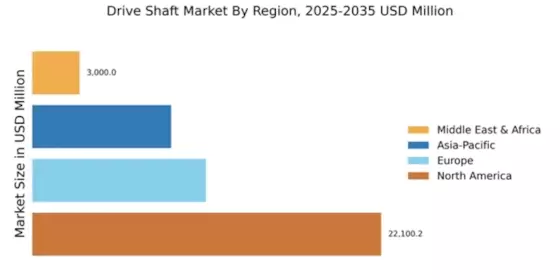
North America is poised to maintain its leadership in the drive shaft market, holding a significant share of 22100.2. The region's growth is driven by increasing automotive production, technological advancements, and a shift towards electric vehicles. Regulatory support for emissions reduction and fuel efficiency is further propelling demand for high-performance drive shafts. The United States and Canada are the leading countries in this market, with major players like GKN, Dana Incorporated, and American Axle & Manufacturing establishing a strong presence. The competitive landscape is characterized by innovation and strategic partnerships, ensuring that North America remains at the forefront of drive shaft technology.

Europe : Emerging Market with Growth Potential

Europe's drive shaft market, valued at 11000.1, is experiencing robust growth driven by increasing vehicle production and a focus on sustainability. The region is witnessing a shift towards lightweight materials and advanced manufacturing techniques, which are essential for meeting stringent EU regulations on emissions and fuel efficiency. This regulatory environment is a key catalyst for market expansion. Germany, France, and the UK are the leading countries in this sector, with key players like ZF Friedrichshafen AG and Schaeffler AG driving innovation. The competitive landscape is marked by collaborations and investments in R&D, positioning Europe as a significant player in The Drive Shaft.

Asia-Pacific : Rapid Growth in Automotive Sector

The Asia-Pacific drive shaft market, valued at 8800.0, is witnessing rapid growth fueled by increasing automotive production and rising consumer demand for vehicles. Countries like China and India are at the forefront, with government initiatives promoting electric vehicles and sustainable transportation. This regulatory support is enhancing the market's growth potential. China is the largest market in the region, with significant contributions from local manufacturers and global players like JTEKT Corporation and NSK Ltd. The competitive landscape is evolving, with a focus on technological advancements and cost-effective solutions, ensuring a dynamic market environment.

Middle East and Africa : Emerging Market with Untapped Potential

The Middle East and Africa drive shaft market, valued at 3000.0, is emerging as a region with significant growth potential. The increasing demand for vehicles, coupled with infrastructural developments, is driving market expansion. Regulatory frameworks are gradually evolving to support automotive growth, which is expected to catalyze demand for drive shafts. Countries like South Africa and the UAE are leading the market, with a growing presence of international players. The competitive landscape is characterized by a mix of local and global manufacturers, focusing on adapting to regional needs and enhancing product offerings to capture market share.

Key Players and Competitive Insights

The Drive Shaft Market is currently characterized by a dynamic competitive landscape, driven by technological advancements and increasing demand for efficient automotive components. Key players such as GKN (GB), Dana Incorporated (US), and ZF Friedrichshafen AG (DE) are actively shaping the market through strategic initiatives. GKN (GB) has positioned itself as a leader in innovation, focusing on lightweight materials and advanced manufacturing techniques to enhance performance and fuel efficiency. Meanwhile, Dana Incorporated (US) emphasizes its commitment to sustainability, integrating eco-friendly practices into its production processes, which resonates well with the growing consumer preference for environmentally responsible products. ZF Friedrichshafen AG (DE) is also notable for its digital transformation efforts, leveraging data analytics and AI to optimize product development and supply chain management, thereby enhancing its competitive edge.

The business tactics employed by these companies reflect a concerted effort to localize manufacturing and optimize supply chains, which is crucial in a moderately fragmented market. This competitive structure allows for a diverse range of offerings, yet the influence of major players remains significant. Their ability to adapt to regional demands and streamline operations positions them favorably against emerging competitors, thereby reinforcing their market presence.

In November 2025, GKN (GB) announced a strategic partnership with a leading electric vehicle manufacturer to develop next-generation drive shafts tailored for electric drivetrains. This collaboration is expected to enhance GKN's product portfolio and align with the industry's shift towards electrification, potentially increasing its market share in the burgeoning EV segment. The strategic importance of this partnership lies in GKN's ability to leverage its expertise in lightweight materials, which is critical for improving the efficiency of electric vehicles.

In October 2025, Dana Incorporated (US) unveiled a new line of drive shafts designed specifically for hybrid vehicles, showcasing its commitment to innovation in response to evolving market demands. This launch not only reinforces Dana's position as a key player in the hybrid segment but also highlights its proactive approach to addressing the growing need for versatile automotive components. The introduction of these products is likely to enhance Dana's competitive positioning as the automotive industry increasingly shifts towards hybrid technologies.

In September 2025, ZF Friedrichshafen AG (DE) completed the acquisition of a software company specializing in AI-driven manufacturing solutions. This acquisition is poised to significantly enhance ZF's capabilities in smart manufacturing, allowing for greater efficiency and precision in drive shaft production. The strategic importance of this move lies in ZF's commitment to integrating advanced technologies into its operations, which could lead to improved product quality and reduced production costs, thereby strengthening its competitive advantage.

As of December 2025, the Drive Shaft Market is witnessing a pronounced shift towards digitalization, sustainability, and AI integration. These trends are reshaping competitive dynamics, with strategic alliances becoming increasingly vital for companies seeking to enhance their market positions. The focus is shifting from traditional price-based competition to a landscape where innovation, technology, and supply chain reliability are paramount. This evolution suggests that companies that prioritize these aspects will likely emerge as leaders in the Drive Shaft Market, setting new benchmarks for performance and efficiency.

Key Companies in the Drive Shaft Market market include

Industry Developments

February 2021: Ram's heavy-duty pick-up truck axle and driveshaft program has been secured by American Axle Manufacturing (AAM) through 2030.

August 2021: Wanxiang Qianchao announced the beginning of production of high-speed ball cage driveshafts for a van model manufactured by the Russian company GAZ International LL through its subsidiary Wanxiang Qianchao Transmission Shaft Co. (GAZ).

February 2022: Drive shafts have been added as a new product vertical, according to Endurance Technologies. The driveshaft is a high-tech, proprietary product used in the automotive industry. Three-wheelers and four-wheelers, including some light commercial vehicles, are eligible for the application. For EVs as well, the driveshaft is a necessary component.

Future Outlook

Drive Shaft Market Future Outlook

The Drive Shaft Market is projected to grow at a 5.08% CAGR from 2024 to 2035, driven by advancements in automotive technology, increasing demand for electric vehicles, and rising global transportation needs.

New opportunities lie in:

  • Expansion into electric vehicle drive shaft manufacturing.
  • Development of lightweight composite drive shafts for improved fuel efficiency.
  • Implementation of predictive maintenance solutions for drive shaft performance monitoring.

By 2035, the Drive Shaft Market is expected to achieve robust growth, reflecting evolving industry demands.

Market Segmentation

Drive Shaft Market Drive Type Outlook

  • Front Wheel Drive
  • Rear Wheel Drive
  • All Wheel Drive
  • Four Wheel Drive

Drive Shaft Market Application Outlook

  • Passenger Vehicle
  • Commercial Vehicle
  • Industrial Equipment
  • Agricultural Equipment

Drive Shaft Market Design Type Outlook

  • Single Piece
  • Multi Piece
  • Flexible
  • Rigid

Drive Shaft Market Material Type Outlook

  • Steel
  • Aluminum
  • Composite
  • Carbon Fiber

Report Scope

MARKET SIZE 2024 44200.4(USD Million)
MARKET SIZE 2025 46446.68(USD Million)
MARKET SIZE 2035 76249.84(USD Million)
COMPOUND ANNUAL GROWTH RATE (CAGR) 5.08% (2024 - 2035)
REPORT COVERAGE Revenue Forecast, Competitive Landscape, Growth Factors, and Trends
BASE YEAR 2024
Market Forecast Period 2025 - 2035
Historical Data 2019 - 2024
Market Forecast Units USD Million
Key Companies Profiled GKN (GB), Dana Incorporated (US), American Axle & Manufacturing (US), Magna International (CA), ZF Friedrichshafen AG (DE), JTEKT Corporation (JP), AAM (US), Schaeffler AG (DE), NSK Ltd. (JP), Hyundai Wia Corporation (KR)
Segments Covered Application, Material Type, Drive Type, Design Type
Key Market Opportunities Integration of lightweight materials and advanced manufacturing techniques enhances efficiency in the Drive Shaft Market.
Key Market Dynamics Technological advancements in materials and manufacturing processes are reshaping the Drive Shaft Market landscape.
Countries Covered North America, Europe, APAC, South America, MEA

Market Highlights

Author
Pradeep Nandi
Senior Research Analyst

I have a bachelor's degree in mechanical engineering and an MBA. I have more than two years of expertise in the retail, food, and beverage, chemical, and material industries, and hence have developed a sound cross-domain expertise. A firm believer in lifelong learning and sharing of knowledge. Having a proclivity for hatching ideas and trying to absorb as much information as possible in a short amount of time. Introducing corporates to the data and insight, which enables them to move from probability to possibility, has been my key areas of interest. 

Leave a Comment

FAQs

How much is the drive shaft market?

The drive shaft market size was valued at USD 41,974.0 Million in 2023.

What is the growth rate of the drive shaft market?

The market is projected to register a CAGR of 5.08% during the forecast period 2024-2032.

Which region held the largest market share in the drive shaft market?

Asia-Pacific had the largest share of the market.

Who are the key players in the drive shaft market?

The key players in the market are GKN PLC (UK), Advanced Composite Products & Technology Inc., ACPT Inc. (US), American Axle & Manufacturing Holdings Inc. (US), Neapco Holdings LLC (US), Dana Holding Corporation (US), Yamada Manufacturing Co. Ltd. (Japan), Trelleborg AB (Sweden), NTN Corporation (Japan), Ifa Rotorion - Holding GmbH (Germany), and The Timken Company (US).

Which vehicle type led the drive shaft market?

The passenger cars category dominated the drive shaft industry in 2021.

Which design had the largest market share in the drive shaft market?

The rear drive shaft had the largest share in the drive shaft market.

Download Free Sample

Kindly complete the form below to receive a free sample of this Report

Compare Licence

×
Features License Type
Single User Multiuser License Enterprise User
Price $4,950 $5,950 $7,250
Maximum User Access Limit 1 User Upto 10 Users Unrestricted Access Throughout the Organization
Free Customization
Direct Access to Analyst
Deliverable Format
Platform Access
Discount on Next Purchase 10% 15% 15%
Printable Versions