Drone Logistics and Transportation Market (2025 - 2035)

ID: MRFR/AD/7089-HCR
168 Pages
Abbas Raut
Last Updated: June 25, 2026
Drone Logistics and Transportation Market Size, Share, Industry Trend & Analysis Research Report: By Service Type (Drone-as-a-Service (DaaS), On-Demand Delivery, Scheduled Delivery, Medical/Rescue Fleet Services), By Application (Retail and Logistics, Food Delivery, Medical Supply), By Payload Weight (Less Than 5 kg, More Than 5 kg), By Range (Short Range, Medium Range, Long Range), By Geography (North America, Europe, Asia-Pacific, South America, Middle East & Africa) - Forecast to 2035
Drone Logistics and Transportation Market
Market Size
Forecast Period2025-2035
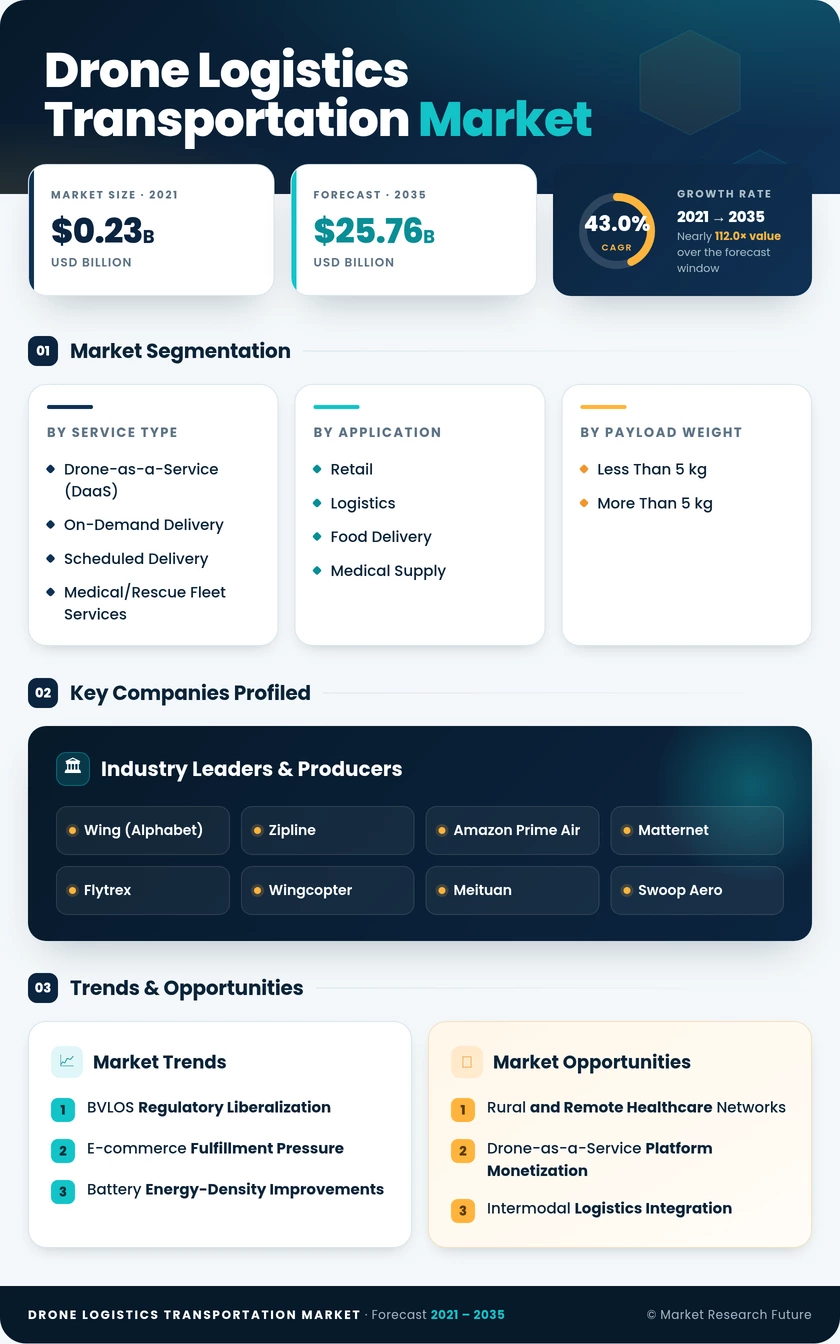
CAGR (2025-2035)43.0%
2025 Market SizeUSD 0.72 Billion
2035 Market SizeUSD 25.76 Billion
Key Players
Wing
Zipline
Amazon Prime Air
Matternet
Flytrex
Wingcopter
Opportunities
  • Rural and Remote Healthcare Networks
  • Drone-as-a-Service Platform Monetization
  • Intermodal Logistics Integration
  1. 1 Market Overview |
    1. 1.1 Study Assumptions & Market Definition |
    2. 1.2 Scope of the Study |
    3. 1.3 Research Methodology
  2. 2 Market Summary & Key Takeaways
  3. 3 Market Dynamics |
    1. 3.1 Market Drivers Analysis | |
      1. 3.1.1 BVLOS Regulatory Liberalization | |
      2. 3.1.2 E-Commerce Fulfillment Pressure | |
      3. 3.1.3 Battery Energy-Density Improvements | |
      4. 3.1.4 Healthcare and Humanitarian Cold-Chain Demand | |
      5. 3.1.5 UTM / U-Space Infrastructure Deployment | |
      6. 3.1.6 Autonomous Detect-and-Avoid AI Maturation | |
      7. 3.1.7 Carbon-Emission Reduction Mandates |
    2. 3.2 Market Restraints Analysis | |
      1. 3.2.1 Fragmented National Airspace Regulations | |
      2. 3.2.2 Noise and Community Acceptance | |
      3. 3.2.3 Cybersecurity and Counter-UAS Threats | |
      4. 3.2.4 Limited Ground Infrastructure for Recharging | |
      5. 3.2.5 Skilled Workforce Shortage for UTM Operations |
    3. 3.3 Market Opportunity Analysis | |
      1. 3.3.1 Rural and Remote Healthcare Networks | |
      2. 3.3.2 Drone-as-a-Service Platform Monetization | |
      3. 3.3.3 Intermodal Logistics Integration | |
      4. 3.3.4 Emerging-Market Leapfrog Potential | |
      5. 3.3.5 Carbon-Credit and ESG Revenue Streams |
    4. 3.4 Industry Value Chain Analysis |
    5. 3.5 Porter's Five Forces Analysis
  4. 4 Global Drone Logistics and Transportation Market Size & Forecast (2021–2035) |
    1. 4.1 Historical Market Size (2021–2025) |
    2. 4.2 Current & Forecast Market Size (2026–2035) |
    3. 4.3 Market Size by Revenue (USD Billion) |
    4. 4.4 Year-over-Year Growth Analysis
  5. 5 Segmentation Analysis |
    1. 5.1 By Service Type | |
      1. 5.1.1 Drone-as-a-Service (DaaS) | |
      2. 5.1.2 On-Demand Delivery | |
      3. 5.1.3 Scheduled Delivery | |
      4. 5.1.4 Medical/Rescue Fleet Services |
    2. 5.2 By Application | |
      1. 5.2.1 Retail and Logistics | |
      2. 5.2.2 Food Delivery | |
      3. 5.2.3 Medical Supply |
    3. 5.3 By Payload Weight | |
      1. 5.3.1 Less Than 5 kg | |
      2. 5.3.2 More Than 5 kg |
    4. 5.4 By Range | |
      1. 5.4.1 Short Range (≤10 km) | |
      2. 5.4.2 Medium Range (10–50 km) | |
      3. 5.4.3 Long Range (>50 km)
  6. 6 Regional Analysis |
    1. 6.1 North America | |
      1. 6.1.1 United States | |
      2. 6.1.2 Canada | |
      3. 6.1.3 Mexico |
    2. 6.2 Europe | |
      1. 6.2.1 Germany | |
      2. 6.2.2 United Kingdom | |
      3. 6.2.3 France | |
      4. 6.2.4 Italy | |
      5. 6.2.5 Spain | |
      6. 6.2.6 Nordic Countries | |
      7. 6.2.7 Russia | |
      8. 6.2.8 Rest of Europe |
    3. 6.3 Asia-Pacific | |
      1. 6.3.1 China | |
      2. 6.3.2 India | |
      3. 6.3.3 Japan | |
      4. 6.3.4 South Korea | |
      5. 6.3.5 ASEAN | |
      6. 6.3.6 Rest of Asia-Pacific |
    4. 6.4 South America | |
      1. 6.4.1 Brazil | |
      2. 6.4.2 Argentina | |
      3. 6.4.3 Rest of South America |
    5. 6.5 Middle East & Africa | |
      1. 6.5.1 Saudi Arabia | |
      2. 6.5.2 UAE | |
      3. 6.5.3 South Africa | |
      4. 6.5.4 Egypt | |
      5. 6.5.5 Rest of MEA
  7. 7 Competitive Landscape |
    1. 7.1 Market Share Analysis (2025) |
    2. 7.2 Competitive Benchmarking Matrix |
    3. 7.3 Company Profiles | |
      1. 7.3.1 Wing (Alphabet) | |
      2. 7.3.2 Zipline | |
      3. 7.3.3 Amazon Prime Air | |
      4. 7.3.4 Matternet | |
      5. 7.3.5 Flytrex | |
      6. 7.3.6 Wingcopter | |
      7. 7.3.7 Meituan | |
      8. 7.3.8 Swoop Aero | |
      9. 7.3.9 UPS Flight Forward | |
      10. 7.3.10 Dronamics
  8. 8 Future Outlook & Strategic Recommendations (2026–2035) |
    1. 8.1 AI-Driven Autonomous Operations |
    2. 8.2 Platform Economics and Consolidation |
    3. 8.3 Electrification and Energy Infrastructure Build-Out |
    4. 8.4 ESG Integration and Sustainability Reporting
  9. 9 Recent Developments & News
  10. 10 Frequently Asked Questions (FAQs)
  11. 11 Report Scope & Methodology |
    1. 11.1 Study Period & Base Year |
    2. 11.2 Data Sources & Citations |
    3. 11.3 Abbreviations
  12. 1 LIST OF TABLES
  13. 2 LIST OF FIGURES

Segmentation Quick Reference

DimensionSub-SegmentsDominant Segment (2025)Fastest Growing Segment (2026–2035)
Drone Logistics Transportation Market TypeDrone-as-a-Drone Logistics Transportation Market (DaaS); On-Demand Delivery; Scheduled Delivery; Medical/Rescue Fleet Drone Logistics Transportation MarketsDaaS (45.1% share)On-Demand Delivery (45.6% CAGR)
ApplicationRetail and Logistics; Food Delivery; Medical SupplyRetail and Logistics (41.5% share)Medical Supply (46.7% CAGR)
Payload WeightLess Than 5 kg; More Than 5 kgLess Than 5 kg (43.2% share)More Than 5 kg (44.3% CAGR)
RangeShort Range; Medium Range; Long RangeShort Range (50.2% share)Long Range (44.7% CAGR)
GeographyNorth America; Europe; Asia-Pacific; South America; Middle East & AfricaNorth America (40.8% share)Asia-Pacific (47.2% CAGR)


Market Segmentation Overview

By Drone Logistics Transportation Market Type

Sub-SegmentKey Trend
Drone-as-a-Drone Logistics Transportation Market (DaaS)Enterprise adoption of capex-light fleet leasing accelerates multi-vertical penetration.
On-Demand DeliveryE-commerce instant gratification expectations drive sub-one-hour fulfillment via drones.
Scheduled DeliveryRecurring pharmaceutical and lab-sample routes establish predictable revenue streams.
Medical/Rescue Fleet Drone Logistics Transportation MarketsGovernment-contracted emergency logistics networks expand across underserved geographies.


The DaaS model dominates because it aligns operator incentives with shipper demand variability, enabling fleet utilization rates above 70% across seasonal cycles. On-demand delivery is converging with instant-commerce platforms, where integration with retail point-of-sale systems triggers autonomous dispatch within seconds of order confirmation.

By Application

Sub-SegmentKey Trend
Retail and LogisticsMajor retailers are deploying store-origination drone networks for parcel and grocery delivery.
Food DeliveryQuick-service restaurant chains are piloting drone fulfillment to bypass traffic congestion.
Medical SupplyCold-chain vaccine and blood-product delivery to rural clinics scales across Africa and South Asia


Retail and logistics anchors demand volume, but medical supply delivery commands premium per-flight pricing and benefits from expedited regulatory approvals in multiple jurisdictions, making it the fastest-growing application segment.

By Payload Weight

Sub-SegmentKey Trend
Less Than 5 kgDominant class aligned with current battery endurance and regulatory payload limits.
More Than 5 kgEmerging class driven by grocery, industrial spare parts, and middle-mile freight use cases


Sub-5 kg payloads represent the workhorse segment, encompassing pharmaceuticals, small electronics, and fast-food orders. Heavier payload operations are gaining traction as next-generation airframes accommodate 10–25 kg loads without proportional range penalties.

By Range

Sub-SegmentKey Trend
Short Range (≤10 km)Dense urban delivery corridors where battery and regulatory constraints are minimal
Medium Range (10–50 km)Suburban and peri-urban routes connecting micro-depots to residential zones
Long Range (>50 km)Rural healthcare, inter-depot freight, and island logistics enabled by Li-S / hydrogen propulsion


Short-range missions account for the bulk of current delivery volume, while long-range capabilities are unlocking entirely new route categories — including island-to-island transfers and rural medical logistics — that were previously uneconomical by surface transport.


Download PDF ×

We do not share your information with anyone. However, we may send you emails based on your report interest from time to time. You may contact us at any time to opt-out.