×
Request Free Sample ×

Kindly complete the form below to receive a free sample of this Report

* Please use a valid business email

Leading companies partner with us for data-driven Insights

clients tt-cursor
Hero Background

E Series Glycol Ether Market

ID: MRFR/CnM/8432-HCR
111 Pages
Priya Nagrale
October 2025

E Series Glycol Ether Market Research Report By Type (Ethylene Glycol Monobutyl Ether (EGBE), Ethylene Glycol Monoethyl Ether (EGEE), Ethylene Glycol Monomethyl Ether (EGME), Diethylene Glycol Monobutyl Ether (DGBE), Diethylene Glycol Monoethyl Ether (DGEE)), By Function (Coupling Agents, Co-solvents, Deicing Fluids, Degreasers, Emulsifiers, Extraction Agents, Humectants, Plasticizers, Solvents), By Industry (Automotive, Chemical, Construction, Electronics, Food & Beverage, Pharmaceutical, Textiles), By End Users (Commercial, Industrial,... read more

Share:
Download PDF ×

We do not share your information with anyone. However, we may send you emails based on your report interest from time to time. You may contact us at any time to opt-out.

E Series Glycol Ether Market Infographic
Purchase Options

E Series Glycol Ether Market Summary

As per MRFR analysis, the E Series Glycol Ether Market Size was estimated at 2705.45 USD Million in 2024. The E Series Glycol Ether industry is projected to grow from 2759.34 in 2025 to 3360.99 by 2035, exhibiting a compound annual growth rate (CAGR) of 1.99 during the forecast period 2025 - 2035.

Key Market Trends & Highlights

The E Series Glycol Ether Market is experiencing a notable shift towards sustainability and innovation.

  • The market is witnessing a significant shift towards sustainable solutions, driven by increasing environmental awareness.
  • North America remains the largest market, while Asia-Pacific is emerging as the fastest-growing region for E Series Glycol Ethers.
  • In the segment analysis, cleaning products dominate the market, whereas coatings are rapidly gaining traction due to their versatility.
  • Key market drivers include the rising demand in paints and coatings, alongside regulatory support for eco-friendly products.

Market Size & Forecast

2024 Market Size 2705.45 (USD Million)
2035 Market Size 3360.99 (USD Million)
CAGR (2025 - 2035) 1.99%

Major Players

Dow Chemical Company (US), BASF SE (DE), Eastman Chemical Company (US), Huntsman Corporation (US), SABIC (SA), LyondellBasell Industries N.V. (NL), Solvay S.A. (BE), AkzoNobel N.V. (NL), Mitsubishi Chemical Corporation (JP)

E Series Glycol Ether Market Trends

The E Series Glycol Ether Market is currently experiencing a dynamic phase characterized by evolving consumer preferences and regulatory frameworks. This market encompasses a range of solvents that are utilized in various applications, including paints, coatings, and cleaning products. The increasing demand for environmentally friendly and low-VOC (volatile organic compound) products appears to be influencing manufacturers to innovate and adapt their offerings. As sustainability becomes a focal point for industries, the E Series Glycol Ether Market is likely to witness a shift towards greener alternatives, which may enhance its growth prospects in the coming years. Moreover, the expansion of the construction and automotive sectors seems to be driving the demand for E Series Glycol Ethers. These solvents are valued for their ability to improve product performance and enhance the application process. Additionally, the rise of emerging economies is contributing to the market's growth, as industrialization and urbanization create new opportunities for the use of these solvents. Overall, the E Series Glycol Ether Market appears poised for continued development, with trends indicating a blend of innovation, sustainability, and increased application across various industries.

Shift Towards Sustainable Solutions

The E Series Glycol Ether Market is witnessing a notable shift towards sustainable and eco-friendly products. Manufacturers are increasingly focusing on developing low-VOC and biodegradable solvents to meet the growing consumer demand for environmentally responsible options. This trend is likely to reshape product offerings and influence purchasing decisions across various sectors.

Growth in Industrial Applications

There is a discernible increase in the utilization of E Series Glycol Ethers within industrial applications, particularly in the construction and automotive industries. These solvents are recognized for their effectiveness in enhancing product performance, which may lead to a broader acceptance and integration of E Series Glycol Ethers in diverse manufacturing processes.

Emerging Markets Driving Demand

Emerging economies are playing a pivotal role in the expansion of the E Series Glycol Ether Market. As these regions experience rapid industrialization and urban development, the demand for solvents in various applications is expected to rise. This trend suggests a potential for significant market growth as new opportunities arise in these developing markets.

E Series Glycol Ether Market Drivers

Market Growth Projections

The Global E Series Glycol Ether Market Industry is projected to experience notable growth over the coming years. The market is expected to reach a value of 2.71 USD Billion in 2024, with further growth anticipated to 3.37 USD Billion by 2035. This trajectory indicates a steady increase in demand, driven by various sectors such as paints, coatings, and personal care products. The compound annual growth rate (CAGR) of 1.99% from 2025 to 2035 underscores the market's potential for expansion as industries continue to adopt E Series Glycol Ethers for their diverse applications.

Growth in Personal Care Products

The Global E Series Glycol Ether Market Industry is significantly influenced by the expanding personal care sector. E Series Glycol Ethers are utilized in various formulations, including skin care, hair care, and cosmetics, due to their excellent solvency and compatibility with other ingredients. As consumer preferences shift towards high-quality personal care products, manufacturers are increasingly incorporating these glycol ethers to enhance product performance. This trend is expected to contribute to the market's growth, with projections indicating a rise to 3.37 USD Billion by 2035, reflecting a steady demand trajectory.

Rising Demand in Paints and Coatings

The Global E Series Glycol Ether Market Industry experiences a notable surge in demand from the paints and coatings sector. This growth is primarily driven by the increasing need for high-performance coatings that offer durability and aesthetic appeal. E Series Glycol Ethers serve as effective solvents in these applications, enhancing the overall quality of the products. As the global construction industry expands, particularly in emerging economies, the demand for advanced coatings is expected to rise. This trend is reflected in the market's projected value of 2.71 USD Billion in 2024, indicating a robust growth trajectory.

Technological Advancements in Production

The Global E Series Glycol Ether Market Industry benefits from ongoing technological advancements in the production processes of glycol ethers. Innovations in manufacturing techniques enhance the efficiency and quality of these solvents, leading to reduced production costs and improved product performance. As manufacturers adopt these advanced technologies, they can meet the growing demand for high-quality E Series Glycol Ethers across various applications. This trend is expected to further stimulate market growth, as companies seek to optimize their operations and deliver superior products to consumers.

Increasing Use in Industrial Applications

The Global E Series Glycol Ether Market Industry is bolstered by the rising utilization of these solvents in industrial applications. Industries such as automotive, electronics, and manufacturing leverage E Series Glycol Ethers for their solvent properties, which facilitate processes like cleaning, degreasing, and surface preparation. The versatility of these glycol ethers makes them suitable for a wide range of applications, thereby driving their demand. As industries continue to innovate and seek efficient solutions, the market is poised for growth, with a projected CAGR of 1.99% from 2025 to 2035.

Environmental Regulations and Sustainability

The Global E Series Glycol Ether Market Industry is increasingly shaped by stringent environmental regulations aimed at reducing volatile organic compounds (VOCs) in industrial processes. E Series Glycol Ethers are often favored for their lower VOC content compared to traditional solvents, making them a more sustainable choice for manufacturers. This shift towards environmentally friendly products aligns with global sustainability goals, prompting industries to adopt these glycol ethers in their formulations. As a result, the market is likely to witness sustained growth, driven by the demand for compliant and eco-friendly solutions.
Market Segment Insights

By Application: Cleaner (Largest) vs. Coating (Fastest-Growing)

In the E Series Glycol Ether Market, the application segment is prominently dominated by cleaners, which hold the largest market share due to their diverse usage in both household and industrial settings. Solvents and coatings also capture substantial portions of the market, reflecting their importance in various formulations. Adhesives and paints, though significant, contribute comparatively less to the overall market dynamics but still showcase essential applications in several industries.

Cleaner (Dominant) vs. Coating (Emerging)

The cleaner segment stands out as the dominant application of E Series Glycol Ethers, recognized for their ability to dissolve dirt and stain, making them favorites in both consumer and industrial cleaning products. In contrast, the coating segment is emerging rapidly, propelled by increased demand in automotive and construction sectors for high-performance coatings. The versatility of glycols in formulations enhances durability and finish quality, thus driving the growth of coatings. As manufacturers strive to meet eco-friendly standards, the coatings application is set to capture a larger share of the market, reflecting innovation in product development.

By End Use Industry: Automotive (Largest) vs. Electronics (Fastest-Growing)

In the E Series Glycol Ether Market, the distribution among end use industries prominently features automotive as the largest segment. The automotive sector utilizes glycol ethers for various applications, including paint thinners, coatings, and hydraulic fluids. Following closely are construction and electronics, which also play significant roles, while textiles and personal care represent smaller but notable segments. This diverse application of glycol ethers highlights their importance across multiple industries. Growth trends indicate a robust increase in the electronics sector, where glycol ethers are gaining traction for use in the manufacturing of electronics and semiconductors. The automotive industry, while currently dominant, is also adapting to new regulations and sustainability demands, potentially reshaping its future growth. Increased production and technological advancements are expected to drive demand in the electronics segment, making it the fastest-growing area in this market.

Automotive (Dominant) vs. Personal Care (Emerging)

The automotive sector stands as the dominant force in the E Series Glycol Ether Market, characterized by its extensive use in applications like coatings and cleaning agents that maintain vehicle aesthetics and performance. Glycol ethers provided critical solutions in manufacturing paints and coatings, improving durability and finish. On the other hand, the personal care segment is emerging with increasing adoption of glycol ethers in cosmetic formulations and personal hygiene products. This segment benefits from trends toward cleaner ingredients and multifunctional products that satisfy consumer health concerns, positioning personal care as a pivotal area for growth. The contrast between the established automotive segment and the burgeoning personal care market emphasizes a shift in consumer preferences and industry dynamics.

By Chemical Properties: Solubility (Largest) vs. Viscosity (Fastest-Growing)

In the E Series Glycol Ether Market, solubility emerges as the largest attribute, holding a significant share among key chemical properties. This dominance stems from its critical role in formulation processes across various applications, including coatings, cleaning agents, and personal care products. Viscosity, on the other hand, is witnessing rapid growth due to increasing demand for products requiring specific flow characteristics, particularly in industrial and consumer sectors. Growth trends indicate that solubility will continue to be crucial for manufacturers, adapting to evolving formulations and environmental regulations. Simultaneously, the increase in demand for low-viscosity solvents, spurred by industry trends favoring efficiency and performance, positions viscosity as a key focus area for innovation within the E Series Glycol Ether market. Manufacturers are striving to deliver products that meet these changing needs effectively.

Solubility (Dominant) vs. Density (Emerging)

Solubility stands as the dominant property in the E Series Glycol Ether Market, characterized by its essential function in enabling formulations to blend evenly and effectively, enhancing the performance of various products. It facilitates the use of glycol ethers in a breadth of applications, ensuring compatibility with multiple substances. In contrast, density is emerging as an important property, particularly in product formulation specifications, with formulators increasingly seeking to optimize the weight and concentration of their products. As industries like paints and coatings prioritize formulation efficiency, density's role is being recognized, driving innovation to adjust and enhance fluid formulation, which positions it to become a more significant player in the market.

By Formulation Type: Aqueous (Largest) vs. Non-Aqueous (Fastest-Growing)

In the E Series Glycol Ether Market, the formulation type segment showcases a diverse range of values, primarily comprising Aqueous, Non-Aqueous, Emulsion, Concentrate, and Ready-to-Use formulations. Aqueous formulations dominate the market share, reflecting their widespread applicability and preference across various end-user industries. Non-Aqueous formulations are also gaining traction, driven by their unique properties and versatility, allowing for innovation and newer applications within the market.

Aqueous (Dominant) vs. Non-Aqueous (Emerging)

Aqueous formulations are recognized as the dominant force in the E Series Glycol Ether Market, primarily due to their efficacy, environmental compliance, and compatibility with various applications. They play a crucial role in sectors such as coatings, cleaners, and personal care products. In contrast, Non-Aqueous formulations are emerging as a vital segment, gaining popularity for their effective performance in high-solvent systems and industrial applications. The rise in demand for innovative solvents and advanced formulations in specialty chemicals is propelling the growth of Non-Aqueous formulations, showcasing their promising potential in the market.

By Distribution Channel: Direct Sales (Largest) vs. Online Sales (Fastest-Growing)

In the E Series Glycol Ether Market, the distribution of market share among various channels reveals that Direct Sales remains the largest segment, capitalizing on established relationships with industrial clients and custom service offerings. Distributors closely follow, serving as intermediaries that help facilitate broader market reach. Online Sales are emerging as a significant contender, reflecting changing consumer preferences and increased digitalization across industries. Retail and Wholesale channels play supportive yet lesser roles, focusing on niche markets and localized demand.

Direct Sales (Dominant) vs. Online Sales (Emerging)

Direct Sales is entrenched as the dominant distribution method in the E Series Glycol Ether market, supported by face-to-face interactions and tailored solutions that cater to specific client needs. This method enables businesses to foster loyalty and ensure consistent supply to large-scale operations. In contrast, Online Sales are rapidly evolving, leveraging advancements in e-commerce to streamline the purchasing process. As manufacturers and consumers adapt to technological innovations, Online Sales are gaining traction, reflecting a shift towards convenience and efficiency. This emerging channel is particularly appealing to smaller businesses looking for flexible purchasing options, thus capturing a growing segment of the market.

Get more detailed insights about E Series Glycol Ether Market

Regional Insights

North America : Market Leader in Glycol Ethers

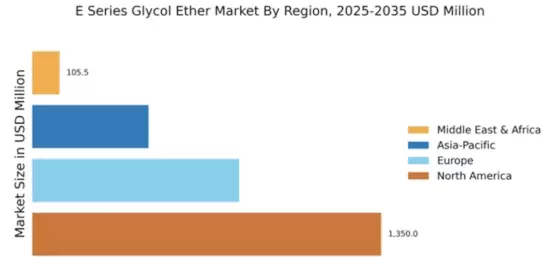
North America is poised to maintain its leadership in the E Series Glycol Ether market, holding a significant market share of $1350.0M in 2024. The region's growth is driven by robust demand from industries such as automotive, construction, and personal care, alongside favorable regulatory frameworks that promote the use of eco-friendly solvents. The increasing focus on sustainability and the shift towards low-VOC products are further propelling market expansion. The competitive landscape in North America is characterized by the presence of major players like Dow Chemical Company, Eastman Chemical Company, and Huntsman Corporation. These companies are investing heavily in R&D to innovate and enhance product offerings. The U.S. remains the leading country, supported by a strong manufacturing base and a growing emphasis on green chemistry, ensuring a vibrant market for E Series Glycol Ethers.

Europe : Emerging Market with Regulations

Europe's E Series Glycol Ether market is projected to reach $800.0M by 2025, driven by stringent environmental regulations and a growing demand for sustainable products. The European Union's REACH regulations are catalyzing the shift towards safer chemical alternatives, enhancing market growth. The increasing adoption of E Series Glycol Ethers in paints, coatings, and cleaning products is also contributing to this upward trend, as manufacturers seek to comply with eco-friendly standards. Leading countries in this region include Germany, France, and the UK, where key players like BASF SE and AkzoNobel N.V. are actively engaged in expanding their product lines. The competitive landscape is marked by innovation and collaboration among companies to meet regulatory requirements. The focus on sustainability and the circular economy is shaping the future of the E Series Glycol Ether market in Europe.

Asia-Pacific : Growing Demand in Emerging Markets

The Asia-Pacific region is witnessing significant growth in the E Series Glycol Ether market, projected to reach $450.0M by 2025. This growth is fueled by rapid industrialization, urbanization, and increasing demand from end-use sectors such as automotive and electronics. Countries like China and India are leading this surge, supported by government initiatives aimed at boosting manufacturing and infrastructure development, which are key drivers for the market. The competitive landscape in Asia-Pacific is evolving, with major players like Mitsubishi Chemical Corporation and LyondellBasell Industries N.V. expanding their operations. The region's market is characterized by a mix of local and international companies, all vying for a share in the growing demand for E Series Glycol Ethers. As environmental concerns rise, there is a shift towards adopting greener alternatives, further enhancing market prospects.

Middle East and Africa : Emerging Market with Potential

The Middle East and Africa (MEA) region is gradually emerging in the E Series Glycol Ether market, with a market size of $105.45M projected for 2025. The growth is primarily driven by increasing industrial activities and a rising demand for solvents in various applications, including paints and coatings. The region's economic diversification efforts are also contributing to the expansion of the chemical sector, creating opportunities for E Series Glycol Ethers. Key countries in this region include Saudi Arabia and South Africa, where local players are beginning to establish a foothold in the market. The competitive landscape is still developing, with international companies exploring partnerships and investments to tap into the region's potential. As the market matures, the focus on sustainable practices is expected to shape the future of E Series Glycol Ethers in MEA.

Key Players and Competitive Insights

The E Series Glycol Ether Market is currently characterized by a competitive landscape that is both dynamic and multifaceted. Key growth drivers include increasing demand from the paints and coatings industry, as well as the rising need for solvents in various applications. Major players such as Dow Chemical Company (US), BASF SE (DE), and Eastman Chemical Company (US) are strategically positioned to leverage their extensive product portfolios and innovative capabilities. Dow Chemical Company (US) focuses on sustainability and has been investing in bio-based alternatives, while BASF SE (DE) emphasizes digital transformation to enhance operational efficiency. Eastman Chemical Company (US) is actively pursuing partnerships to expand its market reach, collectively shaping a competitive environment that is increasingly focused on innovation and sustainability.

In terms of business tactics, companies are localizing manufacturing to reduce lead times and optimize supply chains. The market structure appears moderately fragmented, with several key players exerting considerable influence. This fragmentation allows for niche players to thrive, while larger companies consolidate their positions through strategic acquisitions and partnerships. The collective influence of these key players is significant, as they drive technological advancements and set industry standards.

In November 2025, Dow Chemical Company (US) announced a partnership with a leading renewable energy firm to develop bio-based glycol ethers. This strategic move is likely to enhance Dow's sustainability profile and cater to the growing demand for eco-friendly products. The collaboration may also position Dow as a leader in the transition towards greener alternatives in the chemical industry.

In October 2025, BASF SE (DE) launched a new digital platform aimed at optimizing its supply chain management for glycol ethers. This initiative is expected to streamline operations and improve customer engagement, reflecting BASF's commitment to digitalization. The platform could potentially enhance BASF's competitive edge by providing real-time data analytics and improving decision-making processes.

In September 2025, Eastman Chemical Company (US) expanded its production capacity for E Series Glycol Ethers in response to increasing global demand. This expansion is indicative of Eastman's proactive approach to market trends and its commitment to meeting customer needs. By increasing capacity, Eastman is likely to strengthen its market position and enhance its ability to serve diverse applications.

As of December 2025, current competitive trends in the E Series Glycol Ether Market are heavily influenced by digitalization, sustainability, and the integration of advanced technologies such as AI. Strategic alliances are becoming increasingly important, as companies seek to enhance their capabilities and market reach. The competitive differentiation is expected to evolve, shifting from price-based competition to a focus on innovation, technology, and supply chain reliability. This transition may redefine how companies position themselves in the market, emphasizing the importance of sustainable practices and technological advancements.

Key Companies in the E Series Glycol Ether Market market include

Industry Developments

The E Series Glycol Ether Market is projected to reach a value of USD 3.30 billion by 2034, exhibiting a CAGR of 1.99% during the forecast period 2025-2034. The E Series Glycol Ether Market is driven by the increasing demand for E series glycol ethers in various applications such as paints and coatings, adhesives, and cleaning products. Rising environmental concerns and stringent regulations on VOC emissions are also contributing to the growth of the E series glycol ether market.

Recent news developments in the E Series Glycol Ether Market include the launch of new products by key players such as BASF and Dow Chemical. These new products offer improved performance and environmental benefits, which are expected to drive demand in the coming years. The market is also witnessing the emergence of new applications for E-series glycol ethers, such as in the production of biofuels and pharmaceuticals.

Future Outlook

E Series Glycol Ether Market Future Outlook

The E Series Glycol Ether Market is projected to grow at 1.99% CAGR from 2024 to 2035, driven by increasing demand in coatings, cleaning products, and personal care applications.

New opportunities lie in:

  • Expansion into bio-based glycol ether formulations
  • Development of customized solvent blends for specific industries
  • Investment in advanced manufacturing technologies for cost efficiency

By 2035, the market is expected to achieve robust growth, reflecting evolving industry needs.

Market Segmentation

E Series Glycol Ether Market Application Outlook

  • Solvent
  • Cleaner
  • Coating
  • Paint
  • Adhesive

E Series Glycol Ether Market End Use Industry Outlook

  • Automotive
  • Construction
  • Electronics
  • Textiles
  • Personal Care

E Series Glycol Ether Market Formulation Type Outlook

  • Aqueous
  • Non-Aqueous
  • Emulsion
  • Concentrate
  • Ready-to-Use

E Series Glycol Ether Market Chemical Properties Outlook

  • Solubility
  • Volatility
  • Boiling Point
  • Viscosity
  • Density

E Series Glycol Ether Market Distribution Channel Outlook

  • Direct Sales
  • Distributors
  • Online Sales
  • Retail
  • Wholesale

Report Scope

MARKET SIZE 20242705.45(USD Million)
MARKET SIZE 20252759.34(USD Million)
MARKET SIZE 20353360.99(USD Million)
COMPOUND ANNUAL GROWTH RATE (CAGR)1.99% (2024 - 2035)
REPORT COVERAGERevenue Forecast, Competitive Landscape, Growth Factors, and Trends
BASE YEAR2024
Market Forecast Period2025 - 2035
Historical Data2019 - 2024
Market Forecast UnitsUSD Million
Key Companies ProfiledDow Chemical Company (US), BASF SE (DE), Eastman Chemical Company (US), Huntsman Corporation (US), SABIC (SA), LyondellBasell Industries N.V. (NL), Solvay S.A. (BE), AkzoNobel N.V. (NL), Mitsubishi Chemical Corporation (JP)
Segments CoveredApplication, End Use Industry, Chemical Properties, Formulation Type, Distribution Channel
Key Market OpportunitiesGrowing demand for eco-friendly solvents in the E Series Glycol Ether Market presents significant opportunities.
Key Market DynamicsRising demand for eco-friendly solvents drives innovation and competition in the E Series Glycol Ether Market.
Countries CoveredNorth America, Europe, APAC, South America, MEA

Leave a Comment

FAQs

What is the current market size of the E Series Glycol Ether Market?

E Series Glycol Ether Market is expected to grow with a CAGR of 1.99% in the period 2025-2035

Which region is expected to dominate the E Series Glycol Ether Market?

The Asia-Pacific region is expected to dominate the E Series Glycol Ether Market throughout the forecast period. The growth in this region can be attributed to the increasing demand from various end-use industries, such as paint coatings, pharmaceuticals, and cosmetics.

What are the key growth drivers for the E Series Glycol Ether Market?

The key growth drivers for the E Series Glycol Ether Market include the increasing demand for eco-friendly and sustainable solvents, the rising adoption of E Series Glycol Ethers in various industrial applications, and the growing awareness of the harmful effects of traditional solvents.

Who are the major players operating in the E Series Glycol Ether Market?

Major players operating in the E Series Glycol Ether Market include BASF SE, Dow, Eastman Chemical Company, INEOS, and Shell plc.

What are the key applications of E Series Glycol Ethers?

E Series Glycol Ethers find applications in a wide range of industries, including paints, coatings, pharmaceuticals, cosmetics, and personal care products. They are used as solvents, co-solvents, and coupling agents.

Download Free Sample

Kindly complete the form below to receive a free sample of this Report

Compare Licence

×
Features License Type
Single User Multiuser License Enterprise User
Price $4,950 $ $7,250
Maximum User Access Limit 1 User Upto 10 Users Unrestricted Access Throughout the Organization
Free Customization
Direct Access to Analyst
Deliverable Format
Platform Access
Discount on Next Purchase 10% 15% 15%
Printable Versions