×
Request Free Sample ×

Kindly complete the form below to receive a free sample of this Report

Leading companies partner with us for data-driven Insights

clients tt-cursor
Hero Background

Early Warning Radar Market

ID: MRFR/AD/8826-CR
174 Pages
Swapnil Palwe
September 2020

Early Warning Radar Market Research Report: By Application (Airborne, Ground-based, Naval), By Technology (Conventional Radar, Phased Array Radar, Pulse Doppler Radar, FMCW Radar), By End Use (Defense, Aerospace, Maritime, Homeland Security), By Platform (Military Vehicles, Marine Vessels, Aircraft, Unmanned Aerial Vehicles) and By Regional (North America, Europe, South America, Asia Pacific, Middle East and Africa) - Forecast to 2035

Share:
Download PDF ×

We do not share your information with anyone. However, we may send you emails based on your report interest from time to time. You may contact us at any time to opt-out.

Early Warning Radar Market Infographic
Purchase Options

Early Warning Radar Market Summary

As per MRFR analysis, the Early Warning Radar Market Size was estimated at 4.355 USD Billion in 2024. The Early Warning Radar industry is projected to grow from 4.453 USD Billion in 2025 to 5.557 USD Billion by 2035, exhibiting a compound annual growth rate (CAGR) of 2.24 during the forecast period 2025 - 2035.

Key Market Trends & Highlights

The Early Warning Radar Market is poised for substantial growth driven by technological advancements and increasing security concerns.

  • North America remains the largest market for early warning radar systems, reflecting a robust demand for advanced surveillance technologies.
  • The Asia-Pacific region is emerging as the fastest-growing market, fueled by rising investments in defense and security infrastructure.
  • Airborne radar systems dominate the market, while ground-based radar systems are experiencing rapid growth due to their versatility and cost-effectiveness.
  • Technological advancements in radar systems and an increased focus on national security are key drivers propelling market expansion.

Market Size & Forecast

2024 Market Size 4.355 (USD Billion)
2035 Market Size 5.557 (USD Billion)
CAGR (2025 - 2035) 2.24%

Major Players

Lockheed Martin (US), Northrop Grumman (US), Raytheon Technologies (US), Thales Group (FR), BAE Systems (GB), Leonardo S.p.A. (IT), Hensoldt (DE), Elbit Systems (IL), Saab AB (SE)

Early Warning Radar Market Trends

The Early Warning Radar Market is currently experiencing a dynamic evolution, driven by advancements in technology and increasing demand for enhanced surveillance systems. This market encompasses a range of applications, including military, meteorological, and disaster management sectors. The integration of artificial intelligence and machine learning into radar systems appears to enhance their predictive capabilities, thereby improving response times and accuracy. Furthermore, the growing emphasis on national security and disaster preparedness is likely to propel investments in radar technologies, as governments and organizations seek to mitigate risks associated with natural disasters and security threats. In addition, the market seems to be influenced by the rising need for real-time data and analytics. As environmental concerns escalate, the demand for sophisticated radar systems that can monitor weather patterns and detect anomalies is becoming increasingly apparent. This trend indicates a shift towards more proactive measures in disaster management and environmental monitoring. Overall, the Early Warning Radar Market is poised for substantial growth, as stakeholders recognize the critical role of advanced radar technologies in safeguarding lives and property against unforeseen events.

Technological Advancements

The Early Warning Radar Market is witnessing rapid technological advancements, particularly in the integration of artificial intelligence and machine learning. These innovations enhance the predictive capabilities of radar systems, allowing for more accurate and timely alerts. As a result, organizations are increasingly adopting these advanced systems to improve their operational efficiency and response strategies.

Increased Focus on National Security

There is a growing emphasis on national security, which significantly influences the Early Warning Radar Market. Governments are investing in advanced radar technologies to bolster their defense mechanisms and ensure public safety. This trend reflects a broader recognition of the importance of preparedness in the face of potential threats.

Demand for Real-Time Data

The demand for real-time data and analytics is shaping the Early Warning Radar Market. As environmental challenges become more pressing, the need for sophisticated radar systems that can monitor and analyze weather patterns is rising. This trend underscores a shift towards proactive disaster management and environmental monitoring strategies.

Early Warning Radar Market Drivers

Increased Focus on National Security

The Early Warning Radar Market is significantly influenced by the heightened focus on national security across various regions. Governments are increasingly prioritizing the development of robust defense mechanisms to counter potential threats, including missile attacks and natural disasters. This trend is reflected in the rising defense budgets, with many countries allocating substantial resources to enhance their surveillance and reconnaissance capabilities. For instance, the defense spending in several nations has seen an increase of over 10% in recent years, which directly correlates with the demand for advanced early warning radar systems. Consequently, this growing emphasis on national security is expected to drive the Early Warning Radar Market, as nations seek to bolster their defense infrastructures.

Demand for Real-Time Data and Analytics

The Early Warning Radar Market is witnessing a growing demand for real-time data and analytics, which are crucial for timely decision-making in critical situations. Organizations are increasingly recognizing the importance of immediate data access for effective disaster response and military operations. The integration of artificial intelligence and machine learning into radar systems is enhancing data processing capabilities, allowing for quicker analysis and response times. This trend is supported by the increasing number of natural disasters and geopolitical tensions, which necessitate rapid response mechanisms. As a result, the market for early warning radar systems is projected to expand, with an estimated growth rate of 6% annually, driven by the need for real-time data and analytics.

Strategic Partnerships and Collaborations

The Early Warning Radar Market is benefiting from strategic partnerships and collaborations among key stakeholders, including government agencies, defense contractors, and technology providers. These alliances are fostering innovation and facilitating the development of advanced radar systems that meet the evolving needs of various sectors. Collaborative efforts are often aimed at enhancing research and development capabilities, which can lead to the introduction of cutting-edge technologies in the market. For instance, partnerships between defense organizations and tech firms have resulted in the creation of integrated radar solutions that offer improved performance and reliability. This trend is likely to continue, as stakeholders recognize the value of collaboration in driving advancements in the Early Warning Radar Market.

Technological Advancements in Radar Systems

The Early Warning Radar Market is experiencing a surge in technological advancements, particularly in radar signal processing and sensor technologies. Innovations such as phased array radar systems and synthetic aperture radar are enhancing detection capabilities and accuracy. These advancements are likely to improve the operational efficiency of early warning systems, making them more reliable in various applications, including military and disaster management. The market is projected to grow at a compound annual growth rate of approximately 5.2% from 2025 to 2030, driven by these technological improvements. As nations invest in modernizing their defense systems, the demand for advanced radar technologies is expected to rise, further propelling the Early Warning Radar Market.

Rising Environmental Concerns and Disaster Management

The Early Warning Radar Market is also being shaped by rising environmental concerns and the need for effective disaster management systems. With the increasing frequency of extreme weather events, there is a pressing need for advanced radar systems that can provide early warnings for natural disasters such as hurricanes, floods, and wildfires. Governments and organizations are investing in radar technologies that can enhance their predictive capabilities and improve public safety. This trend is evident in the allocation of funds towards disaster preparedness initiatives, which have seen a rise of approximately 15% in recent years. Consequently, the demand for early warning radar systems is expected to grow, as they play a critical role in mitigating the impacts of natural disasters.

Market Segment Insights

Early Warning Radar Market Segment Insights:

Early Warning Radar Market Segment Insights:

Early Warning Radar Market Application Insights

Early Warning Radar Market Application Insights

The Early Warning Radar Market showcased a diverse range of applications that catered to various defense and surveillance needs. The growth trajectory was driven by increasing security threats and the necessity for timely detection and response systems. Within this market, the Application segment played a crucial role, with key categorizations including Airborne, Ground-based, and Naval applications.

The Airborne application, valued at 1.8 USD Billion in 2023, held a significant position due to its capability to provide extensive coverage and rapid deployment for surveillance missions, which was essential in modern warfare and defense strategies.

 It is anticipated to grow to 2.2 USD Billion by 2032, demonstrating its importance in tactical operations and intelligence gathering.

The Ground-based application followed closely, with a valuation of 1.4 USD Billion in 2023, and is slated to reach 1.75 USD Billion by 2032. Its significance lies in its ability to monitor vast land areas, offering robust defense capabilities against ground-based threats, making it a strategic asset for military and security organizations.

Early Warning Radar Market Technology Insights

Early Warning Radar Market Technology Insights

The Technology segment of the Early Warning Radar Market is a critical aspect that showcases various innovations driving market dynamics. The market encompasses several key modalities, including Conventional Radar, Phased Array Radar, Pulse Doppler Radar, and FMCW Radar, each serving unique purposes and applications. Conventional Radar continues to play a vital role due to its reliability and proven effectiveness in various sectors.

Phased Array Radar is gaining momentum for its ability to steer beams electronically, offering rapid scanning capabilities that enhance surveillance efficiency. Pulse Doppler Radar stands out for its accuracy in capturing velocity data, making it essential for air traffic control and military operations.

Meanwhile, FMCW Radar is significant in automotive and industrial applications, benefiting from its capability to operate effectively in challenging conditions. The diverse functionalities of these technologies not only contribute to the Early Warning Radar Market segmentation but also present ample opportunities for growth amid rising demand for advanced radar solutions across various industries.

Early Warning Radar Market End Use Insights

Early Warning Radar Market End Use Insights

The Early Warning Radar Market is mainly driven by its application across various end-use sectors, which include Defense, Aerospace, Maritime, and Homeland Security.

The Defense sector plays a pivotal role, utilizing early warning radar systems for surveillance and threat detection, while the Aerospace industry benefits from these technologies for air traffic management and safety. The Maritime segment has seen increased deployment as nations focus on securing their waters against potential threats.

Homeland Security also remains a significant area, emphasizing the need for enhanced border security and monitoring capabilities. These segments collectively showcase a strong market growth trajectory driven by advancements in technology and rising security concerns globally.

The Early Warning Radar Market data highlight the critical role these sectors play, with market growth supported by ongoing investments in defense upgrades and technological advancements across multiple domains.

Early Warning Radar Market Platform Insights

Early Warning Radar Market Platform Insights

The Platform segment of the Early Warning Radar Market has shown considerable potential, showcasing steady growth trends. This segment encompasses various applications, including Military Vehicles, Marine Vessels, Aircraft, and Unmanned Aerial Vehicles.

Military Vehicles hold significant importance due to their crucial role in national defense, where the use of early warning radars enhances situational awareness. Marine Vessels also play a vital role in securing maritime domains, contributing to safety and surveillance.

Aircraft equipped with early warning radar systems provide essential aerial monitoring capabilities, essential for comprehensive defense strategies. Unmanned Aerial Vehicles are emerging as a dominant force, offering flexibility and advanced reconnaissance capabilities for various missions.

The overall demand in the Early Warning Radar Market is influenced by modernization efforts in defense sectors and the increasing need for security solutions across different transportation platforms. As emerging technologies advance, the market is poised for growth, driven by innovation and the need for integrated defense systems, reinforcing the importance of these platforms in enhancing national security.

Get more detailed insights about Early Warning Radar Market

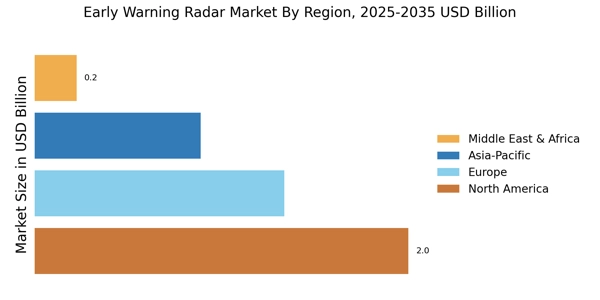
Regional Insights

North America : Defense Innovation Leader

North America is the largest market for Early Warning Radar Market systems, accounting for approximately 45% of the global market share. The region's growth is driven by increasing defense budgets, technological advancements, and a focus on national security. Regulatory support from government agencies, such as the Department of Defense, further catalyzes market expansion. The demand for advanced radar systems is also fueled by geopolitical tensions and the need for enhanced surveillance capabilities. The United States is the leading country in this market, with major players like Lockheed Martin, Northrop Grumman, and Raytheon Technologies dominating the landscape. These companies are at the forefront of innovation, developing cutting-edge radar technologies. Canada also plays a significant role, contributing to the market with its defense initiatives. The competitive landscape is characterized by strategic partnerships and collaborations among key players to enhance product offerings and market reach.

Europe : Emerging Defense Market

Europe is witnessing significant growth in the Early Warning Radar Market, holding approximately 30% of the global share. The region's expansion is driven by increasing defense spending among NATO countries and a focus on modernizing military capabilities. Regulatory frameworks, such as the European Defense Fund, are encouraging collaboration and innovation in defense technologies. The demand for advanced radar systems is also influenced by rising security threats and the need for enhanced situational awareness. Leading countries in this market include the United Kingdom, France, and Germany, with key players like Thales Group, BAE Systems, and Hensoldt leading the charge. The competitive landscape is marked by a mix of established defense contractors and emerging technology firms. These companies are investing heavily in R&D to develop next-generation radar systems, ensuring they remain competitive in a rapidly evolving market. The collaboration between governments and industry is fostering innovation and driving market growth.

Asia-Pacific : Rapidly Growing Defense Sector

Asia-Pacific is emerging as a significant player in the Early Warning Radar Market, accounting for approximately 20% of the global share. The region's growth is driven by increasing military expenditures, territorial disputes, and the modernization of defense forces. Countries like India and Japan are investing heavily in advanced radar technologies to enhance their defense capabilities. Regulatory support from governments is also facilitating market growth, as nations prioritize national security and defense readiness. China, India, and Japan are the leading countries in this market, with a competitive landscape featuring both domestic and international players. Companies like Elbit Systems and Saab AB are expanding their presence in the region, focusing on innovative radar solutions. The market is characterized by strategic partnerships and collaborations among defense contractors to leverage technological advancements and meet the growing demand for sophisticated radar systems.

Middle East and Africa : Emerging Defense Opportunities

The Middle East and Africa region is witnessing a gradual increase in the Early Warning Radar Market, holding approximately 5% of the global share. The growth is primarily driven by rising security concerns, geopolitical tensions, and the need for enhanced surveillance capabilities. Countries in the region are investing in modernizing their defense systems, supported by government initiatives and international collaborations. Regulatory frameworks are evolving to facilitate defense procurement and technology transfer, further boosting market potential. Leading countries in this region include the United Arab Emirates, Saudi Arabia, and South Africa, with a competitive landscape featuring both local and international defense contractors. Companies like Leonardo S.p.A. and Hensoldt are actively participating in the market, focusing on tailored radar solutions to meet regional needs. The presence of key players is fostering innovation and driving investments in advanced radar technologies, positioning the region for future growth.

Early Warning Radar Market Regional Image

Key Players and Competitive Insights

The Early Warning Radar Market is characterized by a dynamic competitive landscape driven by advancements in technology, increased demand for safety and security, and the growing need for enhanced surveillance capabilities. Various players in this sector focus on innovative solutions to cater to military, aerospace, and civilian applications. The market is influenced by factors such as government investments in defense systems, along with rising geopolitical tensions, which have resulted in strategic partnerships and collaborations among operators seeking to enhance their product offerings.

The presence of key industry players enhances competition as they aim to deliver cutting-edge radar technologies designed to improve detection capabilities, thereby providing critical real-time data to decision-makers.

Cohort plc stands out in the Early Warning Radar Market with its strong emphasis on research and development, allowing the company to create advanced radar systems that meet evolving customer needs. Its expertise in electronic systems and military technology enables it to engage effectively with defense organizations around the world.

Cohort plc leverages its experience and knowledge to deliver tailored solutions, thus enhancing its competitive advantage in providing high-quality radar systems. The organization's commitment to fostering innovation and maintaining robust industry partnerships solidifies its position, allowing it to respond swiftly to market demands and challenges effectively.

Thales Group maintains a significant presence within the Early Warning Radar Market by offering a comprehensive range of advanced radar solutions that cater to military and security applications. Renowned for its cutting-edge technology and extensive experience, Thales Group excels in providing radars designed for surveillance, reconnaissance, and air defense operations.

The company's significant investment in research and innovation empowers it to stay ahead of competitors by continuously enhancing the performance and reliability of its products. Thales Group's global reach and established footprint in critical markets position it strongly, enabling the organization to leverage alliances and strategic collaborations to further bolster its offerings in the early warning radar sector.

Key Companies in the Early Warning Radar Market market include

Industry Developments

Recent advancements in the Early Warning Radar Market have been significant, particularly surrounding the capabilities offered by companies like Thales Group and Raytheon, which have expanded their systems to enhance operational efficiency against emerging threats. The latest technological innovations are seeing investments from Lockheed Martin and Northrop Grumman, aiming to bolster their radar detection systems.

Acquisition activities have also been notable, with Cohort plc and L3Harris Technologies exploring collaborative ventures to integrate advanced radar technology, aiming to align closer with defense requirements globally. Reports indicate increased competition as General Dynamics and Boeing invest heavily in research and development to elevate their positions within the market, particularly given the growing demand for smarter surveillance systems.

Additionally, Honeywell and Elbit Systems are focusing on developing multifunctional radar solutions that address both military and civil applications, reflecting market expansion. The valuation of these companies continues to grow, with rising defense budgets worldwide catalyzing investments and innovations, thereby shaping the future landscape of the Early Warning Radar Market.

Future Outlook

Early Warning Radar Market Future Outlook

The Early Warning Radar Market is projected to grow at a 2.24% CAGR from 2024 to 2035, driven by technological advancements, increasing demand for safety, and government investments.

New opportunities lie in:

  • Integration of AI for predictive analytics in radar systems.
  • Development of compact, portable radar units for remote monitoring.
  • Expansion into emerging markets with tailored radar solutions.

By 2035, the Early Warning Radar Market is expected to achieve robust growth, reflecting evolving safety and security needs.

Market Segmentation

Early Warning Radar Market End Use Outlook

  • Defense
  • Aerospace
  • Maritime
  • Homeland Security

Early Warning Radar Market Platform Outlook

  • Military Vehicles
  • Marine Vessels
  • Aircraft
  • Unmanned Aerial Vehicles

Early Warning Radar Market Technology Outlook

  • Conventional Radar
  • Phased Array Radar
  • Pulse Doppler Radar
  • FMCW Radar

Early Warning Radar Market Application Outlook

  • Airborne
  • Ground-based
  • Naval

Report Scope

MARKET SIZE 20244.355(USD Billion)
MARKET SIZE 20254.453(USD Billion)
MARKET SIZE 20355.557(USD Billion)
COMPOUND ANNUAL GROWTH RATE (CAGR)2.24% (2024 - 2035)
REPORT COVERAGERevenue Forecast, Competitive Landscape, Growth Factors, and Trends
BASE YEAR2024
Market Forecast Period2025 - 2035
Historical Data2019 - 2024
Market Forecast UnitsUSD Billion
Key Companies ProfiledMarket analysis in progress
Segments CoveredMarket segmentation analysis in progress
Key Market OpportunitiesIntegration of artificial intelligence enhances predictive capabilities in the Early Warning Radar Market.
Key Market DynamicsTechnological advancements and regulatory changes drive growth in the Early Warning Radar Market, enhancing safety and efficiency.
Countries CoveredNorth America, Europe, APAC, South America, MEA

Market Highlights

Author
Swapnil Palwe
Team Lead - Research

With a technical background as Bachelor's in Mechanical Engineering, with MBA in Operations Management , Swapnil has 6+ years of experience in market research, consulting and analytics with the tasks of data mining, analysis, and project execution. He is the POC for our clients, for their consulting projects running under the Automotive/A&D domain. Swapnil has worked on major projects in verticals such as Aerospace & Defense, Automotive and many other domain projects. He has worked on projects for fortune 500 companies' syndicate and consulting projects along with several government projects.

Leave a Comment

FAQs

What is the projected market valuation of the Early Warning Radar Market by 2035?

The Early Warning Radar Market is projected to reach a valuation of 5.557 USD Billion by 2035.

What was the market valuation of the Early Warning Radar Market in 2024?

In 2024, the Early Warning Radar Market had a valuation of 4.355 USD Billion.

What is the expected CAGR for the Early Warning Radar Market during the forecast period 2025 - 2035?

The expected CAGR for the Early Warning Radar Market during the forecast period 2025 - 2035 is 2.24%.

Which companies are considered key players in the Early Warning Radar Market?

Key players in the Early Warning Radar Market include Lockheed Martin, Northrop Grumman, Raytheon Technologies, and Thales Group.

What are the projected valuations for the Airborne segment of the Early Warning Radar Market by 2035?

The Airborne segment is projected to grow from 1.5 USD Billion in 2024 to 1.9 USD Billion by 2035.

How does the Ground-based segment of the Early Warning Radar Market perform in terms of valuation?

The Ground-based segment is expected to increase from 1.2 USD Billion in 2024 to 1.5 USD Billion by 2035.

What is the projected growth for the Naval segment of the Early Warning Radar Market?

The Naval segment is anticipated to rise from 1.655 USD Billion in 2024 to 2.157 USD Billion by 2035.

What are the expected valuations for the Conventional Radar technology segment by 2035?

The Conventional Radar technology segment is projected to grow from 1.5 USD Billion in 2024 to 1.8 USD Billion by 2035.

What is the anticipated valuation for the Defense end-use segment of the Early Warning Radar Market?

The Defense end-use segment is expected to increase from 1.5 USD Billion in 2024 to 1.9 USD Billion by 2035.

How does the market for Military Vehicles as a platform segment evolve by 2035?

The Military Vehicles platform segment is projected to grow from 1.5 USD Billion in 2024 to 1.8 USD Billion by 2035.

Download Free Sample

Kindly complete the form below to receive a free sample of this Report

Compare Licence

×
Features License Type
Single User Multiuser License Enterprise User
Price $4,950 $5,950 $7,250
Maximum User Access Limit 1 User Upto 10 Users Unrestricted Access Throughout the Organization
Free Customization
Direct Access to Analyst
Deliverable Format
Platform Access
Discount on Next Purchase 10% 15% 15%
Printable Versions