×
Request Free Sample ×

Kindly complete the form below to receive a free sample of this Report

* Please use a valid business email

Leading companies partner with us for data-driven Insights

clients tt-cursor
Hero Background

Eco friendly Ink Market

ID: MRFR/CnM/8436-HCR
111 Pages
Priya Nagrale
October 2025

Eco-friendly Ink Market Research Report By Ink Type (Water-based Inks, Soy-based Inks, Vegetable-based Inks, UV-curable Inks), By Application (Printing, Packaging, Textile Printing, Labeling), By Substrate (Paper, Plastic, Metal, Glass), By End-User Industry (Publishing, Packaging and Labeling, Textiles and Apparel, Consumer Electronics) and By Regional (North America, Europe, South America, Asia-Pacific, Middle East and Africa) - Forecast to 2035

Share:
Download PDF ×

We do not share your information with anyone. However, we may send you emails based on your report interest from time to time. You may contact us at any time to opt-out.

Eco friendly Ink Market Infographic
Purchase Options

Eco friendly Ink Market Summary

As per MRFR analysis, the Eco friendly Ink Market Size was estimated at 11.8 USD Billion in 2024. The Eco friendly Ink industry is projected to grow from 13.13 USD Billion in 2025 to 38.38 USD Billion by 2035, exhibiting a compound annual growth rate (CAGR) of 11.32 during the forecast period 2025 - 2035.

Key Market Trends & Highlights

The Eco friendly Ink Market is experiencing robust growth driven by sustainability trends and technological innovations.

  • Rising consumer demand for sustainability is reshaping the Eco friendly Ink Market, particularly in North America.
  • Technological advancements in ink production are enhancing the performance and appeal of eco-friendly options, especially in the packaging segment.
  • Regulatory support for eco-friendly practices is fostering market growth, with Asia-Pacific emerging as the fastest-growing region.
  • Rising environmental awareness and corporate sustainability initiatives are key drivers propelling the demand for water-based inks in the printing segment.

Market Size & Forecast

2024 Market Size 11.8 (USD Billion)
2035 Market Size 38.38 (USD Billion)
CAGR (2025 - 2035) 11.32%

Major Players

Eco-Products Inc (US), Hewlett-Packard (US), Sappi Lanaken (BE), Sun Chemical (US), Inktec (KR), Epson (JP), Xerox (US), DuPont (US), Kao Corporation (JP)

Eco friendly Ink Market Trends

The Eco friendly Ink Market is currently experiencing a notable shift towards sustainable practices, driven by increasing environmental awareness among consumers and businesses alike. This market encompasses inks derived from renewable resources, such as plant-based materials, which are perceived as less harmful to the environment compared to traditional petroleum-based inks. As regulations tighten and eco-consciousness rises, manufacturers are compelled to innovate, leading to the development of new formulations that minimize environmental impact while maintaining performance standards. The demand for eco friendly inks is not only evident in printing applications but also in packaging, textiles, and other industries, suggesting a broadening scope of influence. Moreover, the Eco friendly Ink Market appears to be benefiting from advancements in technology that enhance the quality and versatility of these inks. Innovations in production processes and raw material sourcing are likely to improve the overall efficiency and reduce costs, making eco friendly options more accessible to a wider range of consumers. As businesses increasingly prioritize sustainability in their operations, the adoption of eco friendly inks is expected to grow, potentially reshaping industry standards and practices. This trend indicates a promising future for the Eco friendly Ink Market, as it aligns with global efforts to reduce carbon footprints and promote greener alternatives across various sectors.

Rising Consumer Demand for Sustainability

There is a growing preference among consumers for products that are environmentally friendly. This trend is influencing purchasing decisions, prompting manufacturers to adopt eco friendly inks in their offerings.

Technological Advancements in Ink Production

Innovations in production techniques are enhancing the quality and performance of eco friendly inks. These advancements are likely to make sustainable options more competitive with traditional inks.

Regulatory Support for Eco-Friendly Practices

Governments are increasingly implementing regulations that encourage the use of sustainable materials. This regulatory environment is fostering growth in the Eco friendly Ink Market, as companies seek compliance and consumer approval.

Eco friendly Ink Market Drivers

Regulatory Support

Government regulations promoting the use of eco-friendly materials significantly influence the Global Eco-friendly Ink Market Industry. Many countries are implementing stringent regulations to limit the use of hazardous substances in inks, thereby encouraging manufacturers to develop greener alternatives. For example, the European Union's REACH regulations have spurred innovation in eco-friendly ink formulations. As a result, the market is expected to grow substantially, with a projected value of 38.4 USD Billion by 2035. This regulatory landscape not only fosters a competitive environment for eco-friendly ink producers but also enhances consumer trust in sustainable products.

Sustainability Awareness

The increasing global awareness regarding environmental sustainability is a primary driver for the Global Eco-friendly Ink Market Industry. Consumers and businesses alike are becoming more conscious of their ecological footprint, leading to a heightened demand for sustainable products. This trend is reflected in the projected market value of 11.8 USD Billion in 2024, as companies strive to adopt eco-friendly practices. For instance, major printing firms are now prioritizing the use of vegetable-based inks, which are less harmful to the environment compared to traditional petroleum-based inks. This shift not only caters to consumer preferences but also aligns with global sustainability goals.

Market Growth Projections

The Global Eco-friendly Ink Market Industry is poised for substantial growth, with projections indicating a market value of 38.4 USD Billion by 2035. This growth is driven by various factors, including increasing sustainability awareness, regulatory support, and technological advancements. The anticipated compound annual growth rate (CAGR) of 11.32% from 2025 to 2035 reflects the industry's potential as businesses and consumers alike prioritize eco-friendly solutions. The market's expansion is likely to create opportunities for innovation and collaboration among stakeholders, further enhancing the development of sustainable ink products.

Technological Advancements

Technological innovations in ink formulation and production processes are pivotal to the growth of the Global Eco-friendly Ink Market Industry. Advances in digital printing technology and the development of bio-based inks are enabling manufacturers to produce high-quality, sustainable inks that meet diverse consumer needs. These innovations are likely to drive the market's compound annual growth rate (CAGR) of 11.32% from 2025 to 2035. Companies are increasingly investing in research and development to create inks that not only reduce environmental impact but also offer superior performance, thus expanding their market reach.

Consumer Demand for Green Products

The growing consumer preference for green products is a critical factor driving the Global Eco-friendly Ink Market Industry. As consumers become more environmentally conscious, they actively seek out products that align with their values, including inks that are free from harmful chemicals. This shift in consumer behavior is prompting manufacturers to innovate and offer a wider range of eco-friendly ink options. The market's growth trajectory, with a projected value of 11.8 USD Billion in 2024, underscores the importance of catering to this demand. Brands that successfully integrate eco-friendly inks into their offerings are likely to gain a competitive edge in this evolving marketplace.

Corporate Social Responsibility Initiatives

The rise of corporate social responsibility (CSR) initiatives among businesses is a significant driver for the Global Eco-friendly Ink Market Industry. Companies are increasingly adopting sustainable practices as part of their CSR strategies, which often include the use of eco-friendly inks in their operations. This trend is particularly evident in the packaging and publishing sectors, where brands are seeking to enhance their sustainability profiles. As a result, the demand for eco-friendly inks is expected to rise, contributing to the market's anticipated growth. This alignment of business practices with environmental stewardship resonates well with consumers, further propelling market expansion.
Market Segment Insights

By Application: Packaging (Largest) vs. Printing (Fastest-Growing)

In the Eco friendly Ink Market, the application segment is notably diverse with key categories such as packaging, printing, labeling, textiles, and stationery. Among these, packaging commands the largest market share, driven by a heightened demand for sustainable solutions across various industries. Printing, on the other hand, is recognized as the fastest-growing segment due to the increasing emphasis on environmentally-friendly practices in printing technologies and a shift towards digital printing methods that utilize eco-friendly inks.

Packaging: Dominant vs. Printing: Emerging

Packaging inks are characterized by their wide adoption in food and beverage industries, where safety and sustainability are paramount. These inks are often derived from plant-based materials, ensuring minimal environmental impact. In contrast, printing inks, although emerging, are experiencing rapid innovations with improved formulations that cater to sustainability goals. The demand for high-quality prints using eco-friendly inks in commercial and industrial sectors is propelling growth. This segment is also benefitting from regulatory pressures on traditional inks, positioning eco-friendly printing inks as a viable alternative.

By Type: Soy Ink (Largest) vs. Water-Based Ink (Fastest-Growing)

In the Eco friendly Ink Market, Soy Ink has established itself as the largest segment, reflecting its widespread adoption in various printing applications. Its popularity arises from its excellent print quality, cost-effectiveness, and sustainable sourcing of soybeans. On the other hand, Water-Based Ink is emerging as a popular choice due to its non-toxic nature and reduced environmental impact, appealing to eco-conscious consumers and businesses. This segment displays significant growth potential as advancements in formulation enhance performance while minimizing harm to the environment.

Soy Ink (Dominant) vs. Water-Based Ink (Emerging)

Soy Ink holds a dominant position in the Eco friendly Ink Market, characterized by its reliance on renewable resources and superior printing capabilities. Soy-based formulations offer vibrant colors and better gloss finishes compared to traditional inks, making them a preferred choice among printers aiming for eco-friendly practices. In contrast, Water-Based Ink represents an emerging category that is gaining traction due to evolving consumer preferences towards non-toxic and environmentally friendly solutions. These formulations, often used in packaging and labels, are safer for both users and the environment, driving their popularity in industries seeking to reduce their ecological footprint.

By End Use: Commercial Printing (Largest) vs. Consumer Products (Fastest-Growing)

In the Eco friendly Ink Market, the distribution among end-use segments reveals that commercial printing holds the largest share due to its widespread application across different industries. This segment continues to leverage eco-friendly inks as companies seek to meet sustainability goals and reduce their environmental impact. Following closely, consumer products are emerging as a prominent segment, fueled by the increasing demand for sustainable packaging and labeling solutions that resonate with environmentally conscious consumers.

Commercial Printing (Dominant) vs. Consumer Products (Emerging)

Commercial printing is perceived as the dominant segment in the Eco friendly Ink Market, driven by advancements in printing technologies and the growing emphasis on sustainability practices among businesses. Companies are increasingly adopting eco-friendly inks to reduce waste and enhance product appeal to environmentally aware consumers. On the other hand, consumer products signify an emerging trend, characterized by manufacturers integrating eco-friendly solutions into packaging designs. This shift not only reflects changing consumer preferences but also positions brands as leaders in sustainability, presenting opportunities for innovative product development in alignment with market demands.

Get more detailed insights about Eco friendly Ink Market

Regional Insights

North America : Innovation and Sustainability Leader

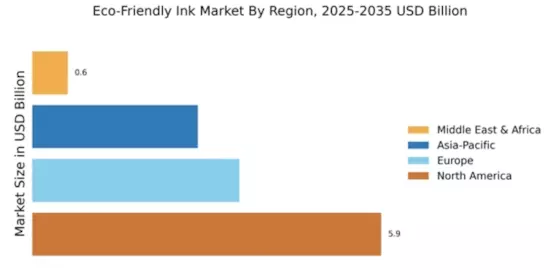
North America leads the eco-friendly ink market with a share of 5.9 in 2024, driven by increasing environmental regulations and consumer demand for sustainable products. The region's growth is fueled by innovations in ink formulations and a shift towards biodegradable materials. Companies are investing in R&D to enhance product performance while minimizing environmental impact, aligning with government initiatives promoting green technologies. The competitive landscape is robust, with key players like Eco-Products Inc, Hewlett-Packard, and Sun Chemical dominating the market. The U.S. is the primary contributor, supported by a strong manufacturing base and advanced technology. As companies focus on sustainability, partnerships and collaborations are becoming common, enhancing market penetration and product offerings. The presence of major firms ensures a dynamic market environment, fostering continuous growth and innovation.

Europe : Sustainable Practices in Focus

Europe's eco-friendly ink market is valued at 3.5, reflecting a strong commitment to sustainability and environmental protection. The region is witnessing a surge in demand for eco-friendly inks, driven by stringent regulations and consumer awareness regarding environmental issues. Initiatives by the European Union to promote sustainable practices are catalyzing market growth, encouraging manufacturers to adopt greener technologies and materials. Leading countries such as Germany, France, and the UK are at the forefront of this transition, with numerous companies investing in eco-friendly ink production. Key players like Sappi Lanaken and DuPont are innovating to meet the rising demand. The competitive landscape is characterized by a mix of established firms and emerging startups, all striving to capture market share through sustainable practices and innovative solutions. This dynamic environment is expected to drive further growth in the coming years.

Asia-Pacific : Emerging Market with Potential

The Asia-Pacific eco-friendly ink market, valued at 2.8, is rapidly expanding, driven by increasing industrialization and a growing awareness of environmental issues. Countries like China, Japan, and South Korea are leading this growth, with rising demand for sustainable printing solutions. Regulatory frameworks are evolving, encouraging manufacturers to adopt eco-friendly practices and materials, thus enhancing market potential. China is the largest market in the region, with significant investments in green technologies. Key players such as Inktec and Epson are focusing on innovation to meet the growing demand for eco-friendly inks. The competitive landscape is becoming increasingly dynamic, with both local and international companies vying for market share. As consumer preferences shift towards sustainability, the region is poised for substantial growth in the eco-friendly ink sector, supported by government initiatives and industry collaborations.

Middle East and Africa : Emerging Market Opportunities

The Middle East and Africa eco-friendly ink market is valued at 0.6, reflecting a nascent stage of development. However, there is a growing awareness of environmental issues, which is gradually driving demand for sustainable printing solutions. The region's growth is supported by increasing regulations aimed at reducing environmental impact and promoting sustainable practices in various industries. Countries like South Africa and the UAE are beginning to adopt eco-friendly inks, with local manufacturers exploring sustainable options. The competitive landscape is still developing, with few key players present. However, as awareness increases and regulations tighten, the market is expected to grow, providing opportunities for both local and international companies to invest in eco-friendly ink production and distribution.

Key Players and Competitive Insights

The Eco friendly Ink Market is currently characterized by a dynamic competitive landscape, driven by increasing environmental awareness and regulatory pressures. Key players are actively pursuing strategies that emphasize innovation and sustainability, which are becoming essential for maintaining market relevance. Companies such as Eco-Products Inc (US) and Sun Chemical (US) are focusing on developing bio-based inks and sustainable production processes, while others like Hewlett-Packard (US) are leveraging digital transformation to enhance their product offerings. This collective emphasis on eco-friendly solutions is reshaping the competitive environment, fostering a culture of collaboration and innovation among industry leaders.

In terms of business tactics, companies are increasingly localizing manufacturing to reduce carbon footprints and optimize supply chains. The market appears moderately fragmented, with several players vying for market share, yet the influence of major companies is palpable. This competitive structure allows for a diverse range of products and innovations, as smaller firms often drive niche developments that larger companies may adopt or integrate into their offerings.

In November 2025, Eco-Products Inc (US) announced the launch of a new line of plant-based inks designed for high-performance printing applications. This strategic move not only aligns with the growing demand for sustainable products but also positions the company as a leader in eco-innovation. The introduction of these inks is expected to enhance their market share and appeal to environmentally conscious consumers, thereby reinforcing their competitive edge.

In October 2025, Sun Chemical (US) unveiled a partnership with a leading packaging manufacturer to develop sustainable ink solutions tailored for the food packaging sector. This collaboration is significant as it highlights the increasing importance of sustainability in packaging, a sector that is under scrutiny for its environmental impact. By aligning with a key player in the packaging industry, Sun Chemical is likely to expand its reach and influence in the eco-friendly ink market.

In September 2025, Hewlett-Packard (US) launched an initiative aimed at integrating AI technologies into their ink production processes. This strategic action is indicative of a broader trend towards digitalization within the industry, as companies seek to enhance efficiency and reduce waste. The incorporation of AI could potentially streamline operations and improve product quality, thereby setting a new standard for competitors.

As of December 2025, the Eco friendly Ink Market is witnessing trends that emphasize digitalization, sustainability, and technological integration. Strategic alliances are increasingly shaping the competitive landscape, allowing companies to pool resources and expertise to drive innovation. Looking ahead, it appears that competitive differentiation will evolve from traditional price-based competition to a focus on innovation, technology, and supply chain reliability. This shift suggests that companies that prioritize sustainable practices and technological advancements are likely to thrive in the future.

Key Companies in the Eco friendly Ink Market market include

Industry Developments

  • Q2 2024: Sun Chemical Launches New Water-Based Ink Series for Flexible Packaging Sun Chemical introduced a new line of water-based, eco-friendly inks designed for flexible packaging applications, aiming to reduce volatile organic compound (VOC) emissions and support sustainability goals in the packaging sector.
  • Q2 2024: DIC Corporation Expands Eco-Friendly Ink Production Facility in Europe DIC Corporation announced the expansion of its European manufacturing facility to increase production capacity for its eco-friendly ink lines, responding to growing demand from packaging and commercial printing customers.
  • Q1 2024: Flint Group Unveils New Soy-Based Offset Ink for Commercial Printing Flint Group launched a new soy-based offset ink formulated to meet stringent environmental standards, targeting commercial printers seeking sustainable alternatives to petroleum-based inks.
  • Q2 2024: Sakata INX Partners with European Packaging Firm to Supply Water-Based Inks Sakata INX entered a strategic partnership with a major European packaging company to supply water-based, eco-friendly inks for use in food and beverage packaging.
  • Q1 2024: Hubergroup Announces New Plant-Based Ink Line for Food Packaging Hubergroup launched a new range of plant-based inks specifically formulated for food packaging, emphasizing compliance with food safety and environmental regulations.
  • Q2 2024: Toyo Ink SC Holdings Opens New R&D Center Focused on Sustainable Ink Technologies Toyo Ink SC Holdings inaugurated a new research and development center dedicated to advancing eco-friendly ink formulations, including water-based and bio-based products.
  • Q2 2024: Agfa-Gevaert Sells Offset Ink Business to Focus on Eco-Friendly Digital Inks Agfa-Gevaert divested its traditional offset ink business to concentrate resources on developing and marketing eco-friendly digital ink solutions for industrial and packaging applications.
  • Q1 2025: DIC Corporation Acquires Sustainable Ink Startup in North America DIC Corporation completed the acquisition of a North American startup specializing in biodegradable ink technologies, strengthening its portfolio of sustainable printing solutions.
  • Q2 2025: Flint Group Wins Major Contract to Supply Eco-Friendly Inks to Global Retailer Flint Group secured a multi-year contract to provide eco-friendly inks for packaging to a leading global retailer, supporting the retailer’s sustainability initiatives.
  • Q2 2025: Sun Chemical Appoints New Head of Sustainability to Drive Green Ink Initiatives Sun Chemical named a new executive to lead its sustainability division, with a mandate to accelerate the development and commercialization of eco-friendly ink products.
  • Q1 2025: Toyo Ink SC Holdings Launches Compostable Ink Series for Flexible Packaging Toyo Ink SC Holdings introduced a new compostable ink series designed for flexible packaging, enabling converters to meet growing demand for fully biodegradable packaging solutions.
  • Q2 2025: Siegwerk Opens New Eco-Ink Manufacturing Facility in India Siegwerk inaugurated a new manufacturing facility in India dedicated to the production of eco-friendly inks, aiming to serve the rapidly expanding sustainable packaging market in Asia.

Future Outlook

Eco friendly Ink Market Future Outlook

The Eco friendly Ink Market is projected to grow at 11.32% CAGR from 2024 to 2035, driven by sustainability trends, regulatory support, and technological advancements.

New opportunities lie in:

  • Expansion into biodegradable ink formulations for packaging applications.
  • Development of eco-friendly inkjet cartridges for consumer printers.
  • Partnerships with sustainable brands for co-branded ink products.

By 2035, the Eco friendly Ink Market is expected to achieve substantial growth, reflecting a strong commitment to sustainability.

Market Segmentation

Eco friendly Ink Market Type Outlook

  • Soy Ink
  • Vegetable Oil Ink
  • Water-Based Ink
  • UV-Curable Ink
  • Bio-Based Ink

Eco friendly Ink Market End Use Outlook

  • Commercial Printing
  • Consumer Products
  • Industrial Printing
  • Publishing
  • Advertising

Eco friendly Ink Market Application Outlook

  • Packaging
  • Printing
  • Labeling
  • Textiles
  • Stationery

Report Scope

MARKET SIZE 202411.8(USD Billion)
MARKET SIZE 202513.13(USD Billion)
MARKET SIZE 203538.38(USD Billion)
COMPOUND ANNUAL GROWTH RATE (CAGR)11.32% (2024 - 2035)
REPORT COVERAGERevenue Forecast, Competitive Landscape, Growth Factors, and Trends
BASE YEAR2024
Market Forecast Period2025 - 2035
Historical Data2019 - 2024
Market Forecast UnitsUSD Billion
Key Companies ProfiledEco-Products Inc (US), Hewlett-Packard (US), Sappi Lanaken (BE), Sun Chemical (US), Inktec (KR), Epson (JP), Xerox (US), DuPont (US), Kao Corporation (JP)
Segments CoveredApplication, Type, End Use
Key Market OpportunitiesGrowing demand for sustainable packaging solutions drives innovation in the Eco friendly Ink Market.
Key Market DynamicsRising consumer demand for sustainable products drives innovation and competition in the eco friendly ink market.
Countries CoveredNorth America, Europe, APAC, South America, MEA

Leave a Comment

FAQs

What is the expected market size of the Eco-friendly Ink Market in 2024?

The Eco-friendly Ink Market is expected to reach a valuation of USD 13.13 Billion in 2024.

What is the projected CAGR of the Eco-friendly Ink Market from 2025 to 2034?

Eco friendly Ink Market is projected to register a CAGR of 11.32% from 2025-2035

Which region is expected to hold the largest market share in the Eco-friendly Ink Market in 2024?

North America is expected to hold the largest market share in the Eco-friendly Ink Market in 2024.

Which application segment is expected to drive the growth of the Eco-friendly Ink Market?

The packaging segment is expected to drive the growth of the Eco-friendly Ink Market, owing to the increasing demand for sustainable packaging solutions.

Who are the key competitors in the Eco-friendly Ink Market?

Some of the key competitors in the Eco-friendly Ink Market include HP, Inc., Canon, Inc., Epson America, Inc., Flint Group, and TOYO INK SC Holdings Co., Ltd.

What are the major trends driving the growth of the Eco-friendly Ink Market?

The major trends driving the growth of the Eco-friendly Ink Market include the increasing demand for sustainable products, the growing awareness of environmental concerns, and the stringent government regulations on the use of hazardous chemicals.

What are the challenges faced by the Eco-friendly Ink Market?

The major challenges faced by the Eco-friendly Ink Market include the high cost of eco-friendly inks, the limited availability of raw materials, and the lack of standardization in the industry.

What is the outlook for the Eco-friendly Ink Market?

The outlook for the Eco-friendly Ink Market is positive, with the market expected to grow at a significant rate in the coming years. The increasing demand for sustainable products, the growing awareness of environmental concerns, and the stringent government regulations on the use of hazardous chemicals are expected to continue to drive the growth of the market.

What are the key growth opportunities for the Eco-friendly Ink Market?

The key growth opportunities for the Eco-friendly Ink Market include the development of new eco-friendly ink technologies, the expansion into new markets, and the development of strategic partnerships with key players in the industry.

What are the key recommendations for stakeholders in the Eco-friendly Ink Market?

The key recommendations for stakeholders in the Eco-friendly Ink Market include investing in research and development, expanding into new markets, and developing strategic partnerships with key players in the industry.

Download Free Sample

Kindly complete the form below to receive a free sample of this Report

Compare Licence

×
Features License Type
Single User Multiuser License Enterprise User
Price $4,950 $ $7,250
Maximum User Access Limit 1 User Upto 10 Users Unrestricted Access Throughout the Organization
Free Customization
Direct Access to Analyst
Deliverable Format
Platform Access
Discount on Next Purchase 10% 15% 15%
Printable Versions