Download Free Sample
Kindly complete the form below to receive a free sample of this Report
Eco-tourism Consulting Services Market Size, Share and Trends Analysis Research Report Information By Client Type (Government Agencies, Non-Governmental Organizations, Private Sector, Community-Based Organizations), By Market Focus (Adventure Tourism, Nature-Based Tourism, Cultural Tourism, Community-Based Tourism), By Project Type (Consultation Services, Training and Workshops, Technology Solutions, Assessment and Auditing), And By Region (North America, Europe, Asia-Pacific, And Rest Of The World) – Market Forecast Till 2035.
As per MRFR analysis, the Eco-tourism Consulting Services Market was estimated at 5.1 USD Billion in 2024. The Eco-tourism Consulting Services industry is projected to grow from 5.46 USD Billion in 2025 to 10.8 USD Billion by 2035, exhibiting a compound annual growth rate (CAGR) of 7.06% during the forecast period 2025 - 2035.
The Eco-tourism Consulting Services Market is experiencing a robust shift towards sustainability and technological integration.
| 2024 Market Size | 5.1 (USD Billion) |
| 2035 Market Size | 10.8 (USD Billion) |
| CAGR (2025 - 2035) | 7.06% |
Ecotourism Consultants (US), Sustainable Travel International (US), EcoTourism Australia (AU), Green Globe (AU), The International Ecotourism Society (US), Ecotourism and Conservation Society (US), Wildlife Conservation Society (US), Ecotourism Kenya (KE)
Our Impact
Enabled $4.3B Revenue Impact for Fortune 500 and Leading Multinationals
Partnering with 2000+ Global Organizations Each Year
30K+ Citations by Top-Tier Firms in the Industry
The Eco-tourism Consulting Services Market is currently experiencing a notable evolution, driven by a growing awareness of environmental sustainability and the increasing demand for responsible travel options. Stakeholders within this sector are recognizing the importance of integrating eco-friendly practices into tourism strategies, which not only enhances the visitor experience but also contributes positively to local ecosystems. As travelers become more discerning, they seek out experiences that align with their values, prompting consulting firms to adapt their services accordingly. This shift appears to be fostering a more profound connection between tourism and conservation efforts, suggesting a potential for long-term growth in this niche market. Moreover, the Eco-tourism Consulting Services Market is likely to benefit from advancements in technology and digital platforms that facilitate better communication and engagement with eco-conscious travelers. The rise of social media and online resources has empowered consumers to make informed choices, thereby influencing the strategies employed by consulting firms. As the market continues to evolve, it seems essential for these firms to remain agile and responsive to emerging trends, ensuring that they provide innovative solutions that meet the expectations of both clients and the environment. This dynamic landscape indicates a promising future for eco-tourism consulting, as it aligns with broader global sustainability goals.
There is a growing inclination among travelers towards sustainable tourism options. This trend compels consulting firms to develop strategies that prioritize environmental conservation and community engagement, thereby enhancing the overall travel experience.
The incorporation of technology into eco-tourism consulting is becoming more prevalent. Digital tools and platforms are being utilized to improve communication, streamline operations, and provide travelers with real-time information about eco-friendly practices.
Consulting services are increasingly emphasizing the importance of involving local communities in eco-tourism initiatives. This approach not only supports local economies but also fosters authentic experiences for travelers, creating a mutually beneficial relationship.
The Eco-tourism Consulting Services Market is experiencing a notable shift towards sustainable travel practices. As consumers increasingly prioritize environmental responsibility, the demand for eco-friendly travel options has surged. This trend is reflected in the growing number of travelers seeking experiences that minimize their ecological footprint. According to recent data, approximately 70 percent of travelers express a preference for sustainable travel options, indicating a significant market opportunity for eco-tourism consulting services. These services assist businesses in aligning their offerings with sustainable practices, thereby enhancing their appeal to environmentally conscious consumers. Furthermore, the rise of social media has amplified awareness of sustainable travel, prompting more individuals to seek guidance from eco-tourism consultants to ensure their travel choices are both enjoyable and responsible.
The Eco-tourism Consulting Services Market is bolstered by various government initiatives aimed at promoting sustainable tourism. Many governments are recognizing the economic potential of eco-tourism and are implementing policies that encourage responsible travel practices. For instance, funding programs and grants are often available to businesses that adopt eco-friendly practices, which can significantly enhance their operational capabilities. Additionally, regulatory frameworks are being established to ensure that eco-tourism activities do not harm local ecosystems. This supportive environment creates a fertile ground for eco-tourism consulting services, as businesses seek expert guidance to navigate these regulations and capitalize on available incentives. The collaboration between governments and eco-tourism consultants is likely to foster a more sustainable tourism landscape, benefiting both the environment and local economies.
The Eco-tourism Consulting Services Market is witnessing a growing interest in conservation efforts among travelers. As awareness of environmental issues rises, more individuals are seeking travel experiences that contribute to conservation initiatives. This trend is evident in the increasing number of eco-tourism projects that focus on wildlife preservation and habitat restoration. Eco-tourism consulting services are pivotal in guiding businesses to develop programs that not only attract tourists but also support local conservation efforts. Data indicates that travelers are more likely to choose eco-tourism options that directly contribute to environmental protection, with nearly 75 percent expressing a willingness to support businesses that prioritize conservation. This alignment between consumer values and eco-tourism initiatives presents a substantial opportunity for consulting services to help businesses create impactful conservation-oriented experiences.
The Eco-tourism Consulting Services Market is significantly influenced by the rising consumer demand for authentic travel experiences. Modern travelers are increasingly seeking immersive experiences that connect them with local cultures and natural environments. This shift in consumer preferences presents a unique opportunity for eco-tourism consultants to assist businesses in developing offerings that resonate with this desire for authenticity. Data suggests that over 60 percent of travelers are willing to pay more for experiences that provide genuine cultural interactions and environmental engagement. Consequently, eco-tourism consulting services play a crucial role in helping businesses design and market these authentic experiences, ensuring they meet the expectations of discerning travelers. By focusing on authenticity, businesses can differentiate themselves in a competitive market, thereby enhancing their appeal and profitability.
The Eco-tourism Consulting Services Market is increasingly shaped by technological advancements that enhance the travel experience while promoting sustainability. Innovations such as mobile applications, virtual reality, and online booking platforms are transforming how travelers engage with eco-tourism. These technologies not only streamline the booking process but also provide valuable information on sustainable practices and local ecosystems. As a result, eco-tourism consulting services are becoming essential for businesses looking to integrate these technologies into their operations. By leveraging technology, businesses can improve customer engagement and operational efficiency, ultimately leading to a more sustainable tourism model. Furthermore, the integration of technology allows for better tracking of environmental impacts, enabling businesses to make informed decisions that align with eco-tourism principles.
In the Eco-tourism Consulting Services Market, the Consultation segment holds the largest market share, reflecting its critical role in guiding eco-tourism initiatives. This service often includes strategic advice and operational support, catering to various stakeholders, including businesses and government entities. In contrast, the Training segment, while smaller, is the fastest-growing, driven by an increasing demand for skill development and knowledge enhancement in eco-tourism practices. The growth in the Training segment can be attributed to a rising awareness of sustainable practices among eco-tourists and businesses. Stakeholders are increasingly seeking training programs that empower staff with the necessary skills to promote sustainable tourism practices. Additionally, government support for eco-tourism education initiatives further propels this segment’s expansion, encouraging a cultural shift towards sustainability in the tourism industry.
Consultation (Dominant) vs. Sustainability Assessment (Emerging)
The Consultation segment remains dominant in the Eco-tourism Consulting Services Market, as it provides essential guidance to businesses navigating the complexities of eco-tourism. These services are often customized to address the unique challenges of each client, ensuring compliance with environmental regulations while maximizing tourist engagement. In contrast, the Sustainability Assessment segment is emerging, gaining traction among organizations committed to measuring and improving their sustainability practices. This service entails evaluating current operations against sustainability criteria, fostering continuous improvement. The increasing emphasis on corporate social responsibility has boosted the demand for sustainability assessments, compelling organizations to invest in these services to enhance their eco-friendly initiatives and report on their sustainability performance.
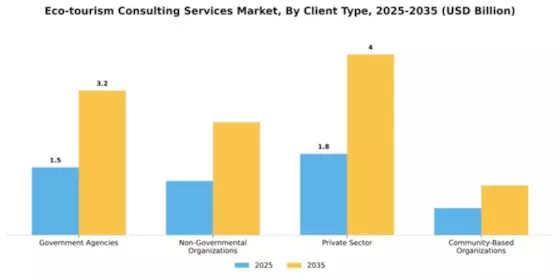
In the Eco-tourism Consulting Services Market, Government Agencies hold a significant share, leveraging their resources to promote sustainable practices and environmental protection. They often lead initiatives, fund projects, and implement regulations that contribute heavily to eco-tourism growth. On the other hand, the Private Sector is witnessing rapid growth as businesses increasingly recognize the benefits of sustainable tourism practices, attracting eco-conscious travelers and enhancing their brand image.
Government Agencies (Dominant) vs. Private Sector (Emerging)
Government Agencies play a pivotal role in the Eco-tourism Consulting Services Market, often dominating market share due to their extensive influence and funding capabilities. They establish regulations, offer grants, and support eco-tourism initiatives that encourage sustainability and conservation. Meanwhile, the Private Sector is emerging rapidly as more companies engage in eco-friendly practices. Driven by changing consumer preferences for responsible tourism, these organizations are leveraging eco-tourism consulting to improve their services and market positioning. This competition is leading to innovative solutions that cater to eco-conscious tourists, thereby shaping the future landscape of eco-tourism.
The Eco-tourism Consulting Services Market features diverse project types, with Ecotourism Development Planning holding the largest market share. This segment is primarily driven by increasing consumer demand for sustainable travel experiences and the need for comprehensive planning to maximize environmental benefits while catering to tourist interests. Conversely, Wildlife Conservation Projects, while currently a smaller segment, are rapidly gaining traction as governments and organizations focus on preserving biodiversity and natural habitats. This growing awareness is leading to a notable shift in investment and attention towards these initiatives. Growth trends indicate a favorable trajectory for both segments. Ecotourism Development Planning is augmented by rising investments in infrastructure that supports sustainable tourist activities. Moreover, public-private partnerships and increased funding for wildlife protection initiatives position Wildlife Conservation Projects as the fastest-growing segment. Factors such as the urgent need for climate action and enhanced emphasis on ethical tourism contribute significantly to this growth, driving more stakeholders to engage in eco-friendly practices.
Ecotourism Development Planning (Dominant) vs. Cultural Heritage Projects (Emerging)
Ecotourism Development Planning is recognized as the dominant force in the Eco-tourism Consulting Services Market due to its extensive application across various tourist destinations seeking to balance ecological integrity with economic viability. This segment encompasses a range of strategies aimed at enhancing visitor experiences while minimizing environmental footprint. Meanwhile, Cultural Heritage Projects are emerging as a significant segment, focusing on the preservation of local culture and history, which appeals to a growing demographic of tourists interested in authentic experiences. This intersection of culture and ecotourism presents opportunities for innovative consulting services that cater to the preservation and promotion of local heritage, ultimately fostering a more sustainable tourism landscape.
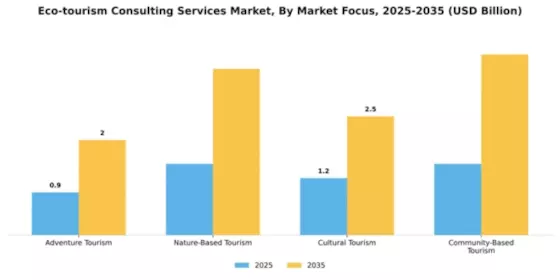
The Eco-tourism Consulting Services Market exhibits a diverse range of market focuses, with Adventure Tourism leading in market share. Adventure Tourism encompasses activities such as trekking, hiking, and water sports, appealing to a broad audience seeking thrilling experiences in nature. In contrast, Wildlife Tourism is gaining traction, emerging as the fastest-growing segment. This type of tourism engages travelers with nature and wildlife conservation efforts, making it increasingly popular among eco-conscious tourists.
Adventure Tourism (Dominant) vs. Wildlife Tourism (Emerging)
Adventure Tourism remains a dominant force in the Eco-tourism Consulting Services Market, characterized by its appeal to thrill-seekers and outdoor enthusiasts. It often includes activities like mountaineering, kayaking, and cultural immersion in remote locations, attracting a diverse demographic from young backpackers to luxury travelers seeking unique experiences. Meanwhile, Wildlife Tourism is an emerging segment that focuses on unique wildlife encounters and conservation initiatives, appealing particularly to environmentally aware travelers. It promotes sustainable practices and creates awareness of biodiversity, making it a strong contender for growth as travelers increasingly seek experiences that contribute positively to ecological preservation.
Get more detailed insights about Eco-tourism Consulting Services Market Request Free Sample
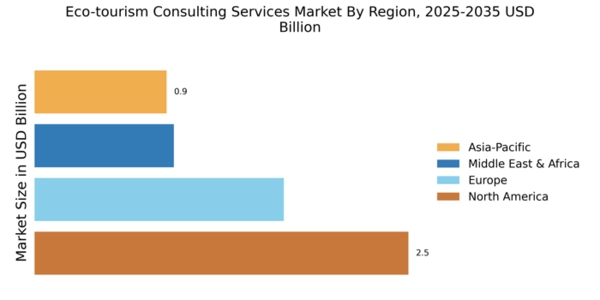
North America is poised to maintain its leadership in the Eco-tourism Consulting Services Market, holding a market size of $2.55 billion in 2025. The region benefits from a growing demand for sustainable travel options, driven by increasing environmental awareness and regulatory support for eco-friendly practices. Government initiatives aimed at promoting conservation and responsible tourism are key growth drivers, enhancing the market's appeal to both consumers and businesses. The competitive landscape in North America is robust, featuring key players such as Ecotourism Consultants and Sustainable Travel International. The U.S. leads the market, supported by a strong infrastructure for eco-tourism and a diverse range of natural attractions. The presence of organizations like The International Ecotourism Society further strengthens the region's position, fostering collaboration and innovation in sustainable travel practices.
Europe's Eco-tourism Consulting Services Market is projected to reach $1.7 billion by 2025, driven by a strong commitment to sustainability and environmental protection. The region's regulatory frameworks, such as the European Green Deal, promote eco-friendly tourism practices, encouraging businesses to adopt sustainable models. Increasing consumer preference for responsible travel options is also a significant demand driver, reflecting a broader trend towards environmental consciousness. Leading countries in this market include Germany, France, and the UK, where eco-tourism initiatives are gaining traction. The competitive landscape features organizations like EcoTourism Australia and Green Globe, which are instrumental in promoting sustainable practices. The presence of various eco-certification programs enhances market credibility, attracting both local and international travelers seeking authentic eco-friendly experiences.
The Asia-Pacific region is witnessing a burgeoning interest in eco-tourism, with a market size of $0.9 billion projected for 2025. Factors such as increasing disposable incomes, a growing middle class, and heightened awareness of environmental issues are driving demand for eco-friendly travel options. Governments are also implementing policies to support sustainable tourism, which is expected to catalyze market growth in the coming years. Countries like Australia and New Zealand are at the forefront of this trend, with established eco-tourism frameworks and a plethora of natural attractions. Key players such as EcoTourism Australia are actively promoting sustainable practices, while the competitive landscape is becoming increasingly diverse. The region's unique biodiversity and cultural heritage present significant opportunities for eco-tourism development, appealing to both domestic and international travelers.
The Middle East and Africa region is emerging as a promising market for eco-tourism consulting services, with a projected market size of $0.95 billion by 2025. The region's rich biodiversity and cultural heritage offer unique opportunities for eco-tourism development. Increasing awareness of environmental issues and the need for sustainable practices are driving demand for eco-tourism consulting services, supported by various government initiatives aimed at promoting responsible tourism. Countries like Kenya and South Africa are leading the charge, with established eco-tourism sectors that attract both local and international visitors. The presence of organizations such as Ecotourism Kenya highlights the region's commitment to sustainable practices. As the market matures, the competitive landscape is expected to evolve, with more players entering the space to capitalize on the growing demand for eco-friendly travel options.
The Eco-tourism Consulting Services Market is currently characterized by a dynamic competitive landscape, driven by increasing consumer awareness regarding sustainability and environmental conservation. Key players are actively engaging in strategic initiatives that emphasize innovation and regional expansion. For instance, Ecotourism Consultants (US) has positioned itself as a leader by focusing on sustainable practices and community engagement, which resonates well with eco-conscious travelers. Similarly, Sustainable Travel International (US) has adopted a strategy centered on partnerships with local governments and organizations to enhance its service offerings, thereby strengthening its market presence. These strategies collectively contribute to a moderately fragmented market structure, where the influence of major players is significant but not overwhelming, allowing for niche players to thrive.In terms of business tactics, companies are increasingly localizing their operations to better cater to regional demands and optimize their supply chains. This localization not only enhances service delivery but also aligns with the growing trend of supporting local economies. The competitive structure of the market appears to be moderately fragmented, with several key players exerting influence while allowing smaller firms to carve out their niches. This fragmentation fosters a diverse range of services and approaches, which can be beneficial for consumers seeking tailored eco-tourism experiences.In November EcoTourism Australia (AU) launched a new initiative aimed at promoting indigenous tourism experiences, which is expected to enhance cultural awareness and support local communities. This strategic move underscores the importance of integrating cultural elements into eco-tourism, potentially attracting a broader audience interested in authentic experiences. The initiative not only aligns with global sustainability goals but also positions EcoTourism Australia as a pioneer in culturally sensitive tourism practices.In October Green Globe (AU) announced a partnership with several international conservation organizations to develop a comprehensive certification program for eco-tourism operators. This program aims to set rigorous standards for sustainability practices, thereby enhancing the credibility of eco-tourism services. The strategic importance of this partnership lies in its potential to elevate industry standards and promote responsible tourism, which could lead to increased consumer trust and loyalty.In September The International Ecotourism Society (US) hosted a global summit focused on the integration of technology in eco-tourism. This event attracted stakeholders from various sectors, highlighting the growing trend of digital transformation within the industry. The summit's outcomes are likely to influence future strategies, as companies increasingly adopt technology to enhance customer experiences and operational efficiencies.As of December the competitive trends in the Eco-tourism Consulting Services Market are increasingly defined by digitalization, sustainability, and the integration of artificial intelligence (AI). Strategic alliances are becoming more prevalent, as companies recognize the value of collaboration in enhancing service offerings and expanding market reach. Looking ahead, competitive differentiation is expected to evolve, with a shift from price-based competition to a focus on innovation, technology, and supply chain reliability. This evolution suggests that companies that prioritize sustainable practices and technological advancements will likely emerge as leaders in the market.




The Eco-tourism Consulting Services Market is projected to grow at a 7.06% CAGR from 2025 to 2035, driven by increasing environmental awareness and sustainable travel demand.
New opportunities lie in:
By 2035, the market is expected to be robust, reflecting a strong commitment to sustainable tourism practices.
| MARKET SIZE 2024 | 5.1(USD Billion) |
| MARKET SIZE 2025 | 5.46(USD Billion) |
| MARKET SIZE 2035 | 10.8(USD Billion) |
| COMPOUND ANNUAL GROWTH RATE (CAGR) | 7.06% (2025 - 2035) |
| REPORT COVERAGE | Revenue Forecast, Competitive Landscape, Growth Factors, and Trends |
| BASE YEAR | 2024 |
| Market Forecast Period | 2025 - 2035 |
| Historical Data | 2019 - 2024 |
| Market Forecast Units | USD Billion |
| Key Companies Profiled | Ecotourism Consultants (US), Sustainable Travel International (US), EcoTourism Australia (AU), Green Globe (AU), The International Ecotourism Society (US), Ecotourism and Conservation Society (US), Wildlife Conservation Society (US), Ecotourism Kenya (KE) |
| Segments Covered | Service Type, Client Type, Project Type, Market Focus |
| Key Market Opportunities | Growing demand for sustainable travel solutions drives innovation in Eco-tourism Consulting Services Market. |
| Key Market Dynamics | Rising consumer demand for sustainable travel drives growth in eco-tourism consulting services and regulatory compliance. |
| Countries Covered | North America, Europe, APAC, South America, MEA |


Kindly complete the form below to receive a free sample of this Report

“This is really good guys. Excellent work on a tight deadline. I will continue to use you going forward and recommend you to others. Nice job”


“Thanks. It’s been a pleasure working with you, please use me as reference with any other Intel employees.”


“Thanks for sending the report it gives us a good global view of the Betaïne market.”


“Thank you, this will be very helpful for OQS.”


“We found the report very insightful! we found your research firm very helpful. I'm sending this email to secure our future business.”


“I am very pleased with how market segments have been defined in a relevant way for my purposes (such as "Portable Freezers & refrigerators" and "last-mile"). In general the report is well structured. Thanks very much for your efforts.”


“I have been reading the first document or the study, ,the Global HVAC and FP market report 2021 till 2026. Must say, good info! I have not gone in depth at all parts, but got a good indication of the data inside!”


“We got the report in time, we really thank you for your support in this process. I also thank to all of your team as they did a great job.”


“The Automotive 48V ECU Components Procurement Intelligence Study” was a complex project, but the Market Research Future (MRFR) team handled it with quality, agility, and customer-centricity. They delivered all requested data on time and within the agreed scope. The team, including Shubhendra Anand and Rahul Gotadki, was always readily available to clarify questions and swiftly implement necessary adjustments, driving the project to a successful conclusion within a very demanding timeframe.
I would also like to specifically commend Akshay Agarwal for his responsiveness and support at every stage—from our initial inquiry on May 6th through to final delivery on June 18th. His dedication made the entire process seamless.”



