×
Hero Background
English
Chinese
French
Japanese
Korean
German
Spanish

Elastomeric Coating Market Size

ID: MRFR/CnM/1167-HCR
119 Pages
Anshula Mandaokar
October 2025

Elastomeric Coatings Market Research Report Information by Type (Acrylic, Polyurethane, Silicone, and Others), Source (Water-Borne, and Solvent-Borne), Application (Wall, Roof, Floor, and Others), End-Use Industry (Automotive, Construction, Marine, Aerospace, and Others), and Region (North America, Latin America, Europe, Asia-Pacific, and Middle East & Africa) - Forecast till 2035

Share:
Download PDF ×

We do not share your information with anyone. However, we may send you emails based on your report interest from time to time. You may contact us at any time to opt-out.

Elastomeric Coating Market Infographic
Purchase Options

Elastomeric Coating Size

Elastomeric Coating Market Growth Projections and Opportunities

Different factors govern the Elastomeric Coatings Market's aspects and growth. The development industry's demand for tough and climate-safe coatings drives the Elastomeric Coatings Market. Outside wall coatings for residential, corporate, and modern buildings use elastomeric coatings due to their adaptability, elasticity, and ability to mend fractures. The global focus on foundation development and the need for protective and energy-efficient coatings drive market growth, highlighting elastomeric coatings' role in development.

Development affects the Elastomeric Coatings Market. Elastomeric coatings waterproof, prevent breakage, and strengthen patterns on cement, plaster, and stone surfaces. The market grows because people want coatings that can withstand extreme weather, UV radiation, and temperature changes. Elastomeric coatings' ability to expand and contract with building surfaces, allowing underlying developments, makes them ideal for lasting and affordable defensive coatings.

Energy efficiency and maintainability make elastomeric coatings popular. These coatings often contain intelligent qualities that reduce structure intensity, reducing cooling energy use. As energy-efficient development practices gain traction globally, the Elastomeric Coatings Market meets the growing need for coatings that offer warmth and energy reserve funds to structures.

Geological factors and environmental concerns shape the Elastomeric Coatings Market. Due to their ability to withstand temperature changes and protect structures from moisture, elastomeric coatings are more popular in areas with extreme weather. The market responds to local environmental, construction, and administrative conditions by fitting elastomeric covering details to meet ecological issues. Environmental standards and maintainability considerations shape the Elastomeric Coatings Market. Water-based and low-VOC elastomeric coatings are in demand as companies consider the environmental impact of coatings. Following strict criteria and researching eco-friendly strategies boosts the industry. Market responds to business' need to reduce natural impression and advance economic structure practices.

Buyer preferences and market trends also shape the Elastomeric Coatings Market. As customers and businesses grow more mindful of supportability, energy efficiency, and building exteriors, elastomeric coatings with defensive and decorative features are becoming more popular. The market adapts to engineering design trends that require elastomeric coatings for practical and aesthetic goals.
Elastomeric Coating Market Size Graph
Author
Anshula Mandaokar
Team Lead - Research

Anshula Mandaokar holds an academic degree in Chemical Engineering and has been contributing to the field for more than 5 years. She has expertise in Market Research and Business Consulting and serves as a Team Lead for a reputed Market Research firm under the Chemicals and Materials domain spectrum. She has worked on multiple projects, generating explicit results in a quick turnaround time. Her understanding of data interpretation justifies her role as a leader.

Leave a Comment

FAQs

What is the valuation of the Elastomeric Coatings Market?

Elastomeric Coatings Market is expected to reach a valuation of USD 16.6 billion by 2035.

What is the expected CAGR of the market?

elastomeric coatings market is expected to exhibit a solid 8.30% CAGR over the forecast period.

What is the leading end user of elastomeric coatings?

The construction industry is the leading end user of elastomeric coatings.

What is the leading regional market for elastomeric coatings?

Asia Pacific is the largest regional market for elastomeric coatings due to the growing construction industry in the region.

What is the major restraint on the market?

The high costs of elastomeric coatings and fluctuations in the prices of raw materials are the major restraints on the global elastomeric coatings market.

Market Summary

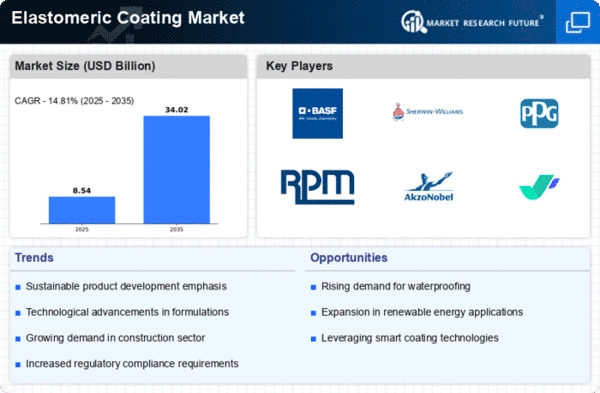
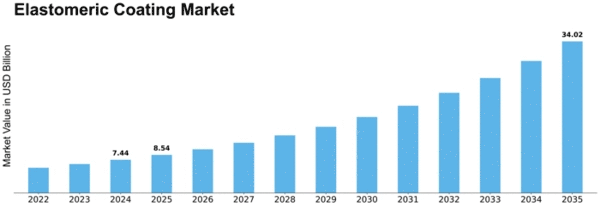
As per MRFR analysis, the Elastomeric Coating Market Size was estimated at 7.44 USD Billion in 2024. The Elastomeric Coating industry is projected to grow from 8.55 USD Billion in 2025 to 34.02 USD Billion by 2035, exhibiting a compound annual growth rate (CAGR) of 14.81 during the forecast period 2025 - 2035.

Key Market Trends & Highlights

The elastomeric coating market is poised for robust growth driven by sustainability and technological advancements.

  • The North American region remains the largest market for elastomeric coatings, driven by increasing construction activities.
  • Asia-Pacific is emerging as the fastest-growing region, reflecting a surge in demand for waterproofing solutions.
  • The roofing segment continues to dominate the market, while the industrial segment is witnessing rapid growth.
  • Rising demand for durable coatings and stringent environmental regulations are key drivers propelling market expansion.

Market Size & Forecast

2024 Market Size 7.44 (USD Billion)
2035 Market Size 34.02 (USD Billion)
CAGR (2025 - 2035) 14.81%
Largest Regional Market Share in 2024 North America

Major Players

<p>BASF (DE), Sherwin-Williams (US), PPG Industries (US), RPM International (US), Nippon Paint Holdings (JP), AkzoNobel (NL), Sika AG (CH), Henkel AG (DE), DuluxGroup (AU)</p>

Market Trends

The Elastomeric Coating Market is currently experiencing a notable transformation, driven by a combination of technological advancements and increasing demand for durable, flexible coatings. These coatings are widely recognized for their ability to provide superior protection against environmental factors, such as moisture and UV radiation. As industries seek to enhance the longevity and performance of their structures, the adoption of elastomeric coatings appears to be on the rise. Furthermore, the growing emphasis on sustainability and eco-friendly products is influencing manufacturers to innovate and develop formulations that align with environmental standards. This shift not only caters to consumer preferences but also positions companies favorably in a competitive landscape. In addition to sustainability, the Elastomeric Coating Market is witnessing a surge in applications across various sectors, including construction, automotive, and aerospace. The versatility of these coatings allows for their use in diverse environments, which may contribute to their increasing popularity. Moreover, advancements in application techniques, such as spray and roll-on methods, are enhancing the efficiency and effectiveness of elastomeric coatings. As the market evolves, it is likely that new formulations and technologies will emerge, further expanding the scope and potential of elastomeric coatings in various industries.

Sustainability Focus

The trend towards sustainability is becoming increasingly prominent within the Elastomeric Coating Market. Manufacturers are prioritizing the development of eco-friendly formulations that minimize environmental impact while maintaining performance. This shift aligns with global efforts to reduce carbon footprints and promote greener practices.

Technological Advancements

Innovations in application techniques and coating formulations are shaping the Elastomeric Coating Market. Enhanced methods, such as advanced spray technologies, are improving the efficiency and effectiveness of coatings. These advancements are likely to drive market growth by offering superior protection and durability.

Diverse Applications

The versatility of elastomeric coatings is leading to their adoption across various sectors, including construction and automotive. This trend indicates a growing recognition of the benefits these coatings provide, such as moisture resistance and flexibility, which are essential in diverse environments.

Elastomeric Coating Market Market Drivers

Market Growth Projections

The Global Elastomeric Coatings Market Industry is projected to experience robust growth over the next decade. With a market value expected to reach 10.3 USD Billion in 2024 and further expand to 24.7 USD Billion by 2035, the industry is on a promising trajectory. The anticipated compound annual growth rate of 8.28% from 2025 to 2035 indicates a strong demand for elastomeric coatings across various sectors. This growth is driven by factors such as increasing infrastructure projects, technological advancements, and a rising emphasis on sustainability. The market's expansion reflects the evolving needs of industries seeking durable and efficient coating solutions.

Infrastructure Development Initiatives

Infrastructure development initiatives worldwide significantly bolster the Global Elastomeric Coatings Market Industry. Governments are investing heavily in infrastructure projects, including roads, bridges, and buildings, which require protective coatings to enhance durability and longevity. Elastomeric coatings are particularly favored for their ability to withstand harsh weather conditions and provide waterproofing solutions. For example, in urban areas, the application of these coatings on structures helps mitigate water damage and prolong asset life. This trend is expected to contribute to the market's expansion, with projections indicating a growth to 24.7 USD Billion by 2035.

Rising Demand for Sustainable Solutions

The Global Elastomeric Coatings Market Industry experiences a notable surge in demand for sustainable and eco-friendly coatings. As industries increasingly prioritize environmental responsibility, elastomeric coatings, which are often water-based and low in volatile organic compounds, gain traction. This shift aligns with global sustainability initiatives, prompting manufacturers to innovate and develop greener products. For instance, the construction sector is adopting these coatings for their energy efficiency and durability, contributing to the projected market growth. The market is anticipated to reach 10.3 USD Billion in 2024, reflecting a growing preference for sustainable solutions.

Growing Awareness of Protective Coatings

Growing awareness of the benefits of protective coatings significantly influences the Global Elastomeric Coatings Market Industry. End-users across various sectors, including construction and automotive, are increasingly recognizing the importance of protective coatings in extending the lifespan of assets and reducing maintenance costs. Elastomeric coatings provide superior protection against moisture, chemicals, and physical wear, making them an attractive option for many applications. This heightened awareness is driving demand, as industries seek to invest in long-lasting solutions. Consequently, the market is poised for substantial growth as more stakeholders prioritize protective coatings in their projects.

Regulatory Support for Coating Standards

Regulatory support for coating standards enhances the credibility and growth potential of the Global Elastomeric Coatings Market Industry. Governments and regulatory bodies are establishing stringent guidelines to ensure the quality and safety of coatings used in various applications. These regulations often favor the use of elastomeric coatings due to their favorable environmental profiles and performance characteristics. Compliance with these standards not only boosts consumer confidence but also encourages manufacturers to innovate and improve their product offerings. As a result, the market is likely to benefit from increased adoption and investment in elastomeric coatings.

Technological Advancements in Coating Formulations

Technological advancements in coating formulations play a pivotal role in shaping the Global Elastomeric Coatings Market Industry. Innovations in polymer chemistry and application techniques enhance the performance characteristics of elastomeric coatings, such as adhesion, flexibility, and resistance to UV degradation. These advancements enable manufacturers to create products that meet diverse industry needs, from construction to automotive applications. As a result, the market is likely to witness increased adoption of high-performance coatings, further driving growth. The anticipated compound annual growth rate of 8.28% from 2025 to 2035 underscores the potential of these technological developments.

Market Segment Insights

By Application: Roofing (Largest) vs. Waterproofing (Fastest-Growing)

<p>The elastomeric coating market is witnessing a distinct distribution in application segments. Roofing applications hold the largest share due to their ability to provide long-lasting protection against weather elements, thus ensuring structural integrity and extending service life. Features like UV resistance and flexibility have made roofing coatings a preferred choice among manufacturers and consumers alike. On the other hand, waterproofing is gaining rapid traction, driven by a rising demand for sustainable construction practices and the need for prevention of moisture-related damages in buildings. Growth trends in the elastomeric coating market are significantly influenced by the rising urbanization and the expanding construction sector, particularly in developing regions. As builders focus on durability and sustainability, elastomeric coatings provide optimal solutions, ensuring product longevity and performance. Furthermore, increased awareness about energy efficiency and eco-friendly materials are spurring innovations in waterproofing technologies, thereby propelling its status as the fastest-growing application in the market.</p>

<p>Roofing (Dominant) vs. Waterproofing (Emerging)</p>

<p>Roofing elastomeric coatings stand out as the dominant application segment due to their essential role in protecting structures from harsh environmental factors. These coatings offer superior adhesion, flexibility, and resistance to water and UV rays, making them crucial for extending the life of roofs. The growing trend toward energy-efficient systems in construction has increased the emphasis on roofing applications, with customers seeking durable solutions that also reduce energy consumption. Conversely, waterproofing elastomeric coatings represent an emerging category, rapidly gaining footing within the market. Their ability to form seamless, waterproof barriers makes them indispensable in construction, particularly in basements and other moisture-prone areas. This segment is witnessing innovations aimed at enhancing application ease and durability, appealing to both commercial and residential clients.</p>

By End Use: Construction (Largest) vs. Industrial (Fastest-Growing)

<p>The elastomeric coating market exhibits a diverse distribution among various end-use segments. The construction sector holds the largest market share, driven by an increasing demand for durable and weather-resistant materials. With urbanization and infrastructure development projects on the rise, elastomeric coatings find extensive applications in buildings and protective structures. Other segments, such as automotive and aerospace, also contribute significantly to the overall market but fall behind construction in terms of size and penetration.</p>

<p>Construction: Dominant vs. Industrial: Emerging</p>

<p>The construction sector is a dominant force in the elastomeric coating market, primarily due to the critical need for protective coatings that enhance the durability of structures against environmental factors. Its applications range from roofing to floors, ensuring longevity and performance. In contrast, the industrial segment is emerging rapidly, fueled by advances in manufacturing technologies and the shift towards sustainable and resilient coatings. These industrial applications are gaining traction in sectors such as manufacturing and energy, where elastomeric coatings contribute to efficiency and longevity, signaling a growing trend in their adoption.</p>

By Type: Acrylic Elastomeric Coating (Largest) vs. Polyurethane Elastomeric Coating (Fastest-Growing)

<p>The elastomeric coating market is dominated by Acrylic elastomeric coatings, which capture a significant share due to their cost-effectiveness and versatility in various applications. These coatings are known for their excellent UV resistance and waterproofing properties, making them a preferred choice for both residential and commercial structures. Following closely is the Polyurethane elastomeric coating, which although smaller in market share, is witnessing rapid growth owing to its superior durability and flexibility, particularly in industrial applications.</p>

<p>Polyurethane Elastomeric Coating (Dominant) vs. Silicone Elastomeric Coating (Emerging)</p>

<p>Polyurethane elastomeric coatings are characterized by their high-performance attributes, including resistance to chemicals, abrasion, and extreme temperatures, making them a preferred choice in sectors requiring robust durability. They dominate the market due to their wide range of applications in both commercial and residential settings. In contrast, Silicone elastomeric coatings are emerging as a strong alternative as they offer exceptional weather resistance and long-lasting performance. With a growing interest in sustainable building practices, Silicone coatings are gaining traction for applications that require high elasticity and breathability, setting the stage for future growth.</p>

Get more detailed insights about Elastomeric Coatings Market Research Report - Forecast till 2035

Regional Insights

North America : Market Leader in Coatings

North America is poised to maintain its leadership in the elastomeric coating market, holding a significant market share of $3.73 B in 2024. The region's growth is driven by increasing construction activities, stringent environmental regulations, and a rising demand for durable and flexible coatings. The push for sustainable building materials further fuels this demand, as elastomeric coatings offer superior weather resistance and energy efficiency. The United States is the primary contributor to this market, with key players like Sherwin-Williams, PPG Industries, and RPM International leading the charge. The competitive landscape is characterized by innovation and strategic partnerships, as companies invest in R&D to enhance product performance. The presence of established manufacturers ensures a robust supply chain, catering to both residential and commercial sectors.

Europe : Emerging Market Dynamics

Europe's elastomeric coating market is projected to reach $2.0 B by 2025, driven by increasing demand for eco-friendly and high-performance coatings. Regulatory frameworks promoting sustainability and energy efficiency are key growth catalysts. The European Union's Green Deal emphasizes reducing carbon footprints, which aligns with the properties of elastomeric coatings, making them a preferred choice for construction and infrastructure projects. Germany and France are leading the market, with significant contributions from companies like BASF and AkzoNobel. The competitive landscape is marked by innovation, with firms focusing on developing advanced formulations that meet stringent environmental standards. The presence of a well-established manufacturing base further supports market growth, ensuring a steady supply of high-quality products.

Asia-Pacific : Rapid Growth Potential

The Asia-Pacific elastomeric coating market is expected to grow significantly, reaching $1.5 B by 2025. This growth is fueled by rapid urbanization, increasing infrastructure development, and a rising awareness of the benefits of elastomeric coatings. Countries like China and India are witnessing a surge in construction activities, which drives demand for durable and flexible coatings that can withstand diverse climatic conditions. China is the dominant player in this region, with major companies like Nippon Paint Holdings and Sika AG leading the market. The competitive landscape is evolving, with local manufacturers emerging to meet the growing demand. The presence of key players ensures a diverse product offering, catering to various applications in residential, commercial, and industrial sectors.

Middle East and Africa : Untapped Market Opportunities

The Middle East and Africa elastomeric coating market, valued at $0.21 B, is gradually gaining traction due to increasing construction and infrastructure projects. The region's growth is driven by a need for durable coatings that can withstand extreme weather conditions. Government initiatives aimed at enhancing infrastructure and urban development are also contributing to market expansion, creating opportunities for elastomeric coatings in various applications. Countries like the UAE and South Africa are at the forefront of this growth, with a rising number of construction projects. The competitive landscape is characterized by a mix of local and international players, ensuring a diverse range of products. As the market matures, the presence of key players will be crucial in driving innovation and meeting the evolving needs of the construction sector.

Key Players and Competitive Insights

The elastomeric coating market is currently characterized by a dynamic competitive landscape, driven by increasing demand for durable and flexible coatings across various applications, including construction, automotive, and industrial sectors. Key players such as BASF (DE), Sherwin-Williams (US), and PPG Industries (US) are strategically positioned to leverage innovation and sustainability as core components of their operational focus. These companies are actively investing in research and development to enhance product performance and environmental compliance, thereby shaping a competitive environment that emphasizes quality and sustainability.

In terms of business tactics, companies are increasingly localizing manufacturing to reduce lead times and optimize supply chains. The market structure appears moderately fragmented, with several players vying for market share. However, the collective influence of major companies like RPM International (US) and Nippon Paint Holdings (JP) is notable, as they engage in strategic partnerships and acquisitions to bolster their market presence and expand their product offerings.

In November 2025, Sherwin-Williams (US) announced the launch of a new line of eco-friendly elastomeric coatings designed to meet stringent environmental regulations. This strategic move not only aligns with the growing trend towards sustainability but also positions the company as a leader in environmentally responsible products, potentially attracting a broader customer base concerned with ecological impacts.

In October 2025, PPG Industries (US) expanded its manufacturing capabilities by investing in a new facility dedicated to elastomeric coatings in the Midwest. This expansion is significant as it enhances PPG's production capacity and allows for quicker response times to regional market demands, thereby strengthening its competitive edge in the North American market.

In September 2025, BASF (DE) entered into a strategic partnership with a leading technology firm to integrate AI-driven analytics into its product development processes. This collaboration is likely to enhance BASF's ability to innovate rapidly and respond to market trends, thereby reinforcing its position as a frontrunner in the elastomeric coating sector.

As of December 2025, current competitive trends indicate a pronounced shift towards digitalization, sustainability, and the integration of advanced technologies such as AI. Strategic alliances are increasingly shaping the landscape, enabling companies to pool resources and expertise. The competitive differentiation is expected to evolve from traditional price-based competition to a focus on innovation, technological advancements, and supply chain reliability, suggesting that companies that prioritize these areas will likely emerge as leaders in the elastomeric coating market.

Key Companies in the Elastomeric Coating Market market include

Industry Developments

Future Outlook

Elastomeric Coating Market Future Outlook

<p>The Elastomeric Coating Market is projected to grow at a 14.81% CAGR from 2024 to 2035, driven by increasing demand for durable and weather-resistant coatings.</p>

New opportunities lie in:

  • <p>Development of eco-friendly elastomeric formulations</p>
  • <p>Expansion into emerging markets with tailored solutions</p>
  • <p>Integration of smart technologies for real-time monitoring</p>

<p>By 2035, the market is expected to achieve substantial growth, driven by innovation and strategic expansion.</p>

Market Segmentation

Elastomeric Coating Market Type Outlook

  • Acrylic Elastomeric Coating
  • Polyurethane Elastomeric Coating
  • Silicone Elastomeric Coating
  • Polyurea Elastomeric Coating
  • Bituminous Elastomeric Coating

Elastomeric Coating Market End Use Outlook

  • Construction
  • Automotive
  • Aerospace
  • Marine
  • Industrial

Elastomeric Coating Market Application Outlook

  • Roofing
  • Waterproofing
  • Industrial Coatings
  • Marine Coatings
  • Flooring

Report Scope

MARKET SIZE 20247.44(USD Billion)
MARKET SIZE 20258.55(USD Billion)
MARKET SIZE 203534.02(USD Billion)
COMPOUND ANNUAL GROWTH RATE (CAGR)14.81% (2024 - 2035)
REPORT COVERAGERevenue Forecast, Competitive Landscape, Growth Factors, and Trends
BASE YEAR2024
Market Forecast Period2025 - 2035
Historical Data2019 - 2024
Market Forecast UnitsUSD Billion
Key Companies ProfiledBASF (DE), Sherwin-Williams (US), PPG Industries (US), RPM International (US), Nippon Paint Holdings (JP), AkzoNobel (NL), Sika AG (CH), Henkel AG (DE), DuluxGroup (AU)
Segments CoveredApplication, End Use, Type
Key Market OpportunitiesGrowing demand for sustainable construction materials drives innovation in the Elastomeric Coating Market.
Key Market DynamicsRising demand for sustainable construction materials drives innovation in elastomeric coating formulations and applications.
Countries CoveredNorth America, Europe, APAC, South America, MEA

FAQs

What is the valuation of the Elastomeric Coatings Market?

Elastomeric Coatings Market is expected to reach a valuation of USD 16.6 billion by 2035.

What is the expected CAGR of the market?

elastomeric coatings market is expected to exhibit a solid 8.30% CAGR over the forecast period.

What is the leading end user of elastomeric coatings?

The construction industry is the leading end user of elastomeric coatings.

What is the leading regional market for elastomeric coatings?

Asia Pacific is the largest regional market for elastomeric coatings due to the growing construction industry in the region.

What is the major restraint on the market?

The high costs of elastomeric coatings and fluctuations in the prices of raw materials are the major restraints on the global elastomeric coatings market.

  1. Executive Summary
  2. Scope of the Report
    1. Market Definition
    2. Scope of the
      1. Research Objectives
      2. Assumptions & Limitations
    3. Study
    4. Markets Structure
    5. Market Research Methodology
    6. Research
    7. Methodology
    8. Secondary Research
    9. Primary Research
    10. Forecast Model
  3. Market Landscape
    1. Supply Chain Analysis
      1. Manufacturers/Producers
      2. Distributors/Retailers/Wholesalers/E-Commerce
      3. End Users
      4. Bargaining
      5. Bargaining Power
      6. Threat of Substitutes
      7. Intensity of Competitive Rivalry
    2. Raw Source Suppliers
    3. Porter’s Five Forces Analysis
    4. Threat of New Entrants
    5. Power of Buyers
    6. of Suppliers
    7. Pricing Analysis
  4. Market Dynamics of
    1. the Global Elastomeric Coatings Market
    2. Introduction
    3. Drivers
    4. Restraints
    5. Opportunities
    6. Challenges
    7. Trends/Technology
  5. Global Elastomeric Coatings Market, by Type
    1. Introduction
    2. Acrylic
      1. Market Estimates & Forecast, 2020−2027
  6. Market Estimates & Forecast, by Region, 2020−2027
    1. Polyurethane
    2. & Forecast, 2020−2027
    3. Forecast, by Region, 2020−2027
    4. Market Estimates & Forecast, 2020−2027
  7. Market Estimates
  8. Market Estimates &
    1. Silicone
  9. Market Estimates & Forecast, by Region, 2020−2027
    1. Others
  10. Market Estimates & Forecast, 2020−2027
  11. Market Estimates & Forecast, by Region, 2020−2027
  12. Global Elastomeric Coatings Market, by Source
    1. Introduction
    2. Water-Borne
      1. Market Estimates & Forecast, 2020−2027
  13. Market Estimates & Forecast, by Region, 2020−2027
    1. Solvent-Borne
  14. Market Estimates & Forecast,
  15. Market Estimates & Forecast, by Region,
  16. Global Elastomeric Coatings Market, by
    1. Application
    2. Introduction
    3. Wall
      1. Market Estimates & Forecast, 2020−2027
  17. Market Estimates & Forecast, by Region, 2020−2027
    1. Roof
    2. Estimates & Forecast, 2020−2027
    3. & Forecast, by Region, 2020−2027
  18. Market Estimates & Forecast, 2020−2027
  19. Market Estimates & Forecast, by Region, 2020−2027
    1. Floor
      1. Market Estimates & Forecast,
      2. Market Estimates & Forecast, by Region,
    2. Others
      1. Market
      2. Market Estimates
  20. Global Elastomeric
  21. Coatings Market, by End-Use Industry
    1. Introduction
    2. Automotive
      1. Market Estimates
      2. Market Estimates & Forecast,
    3. & Forecast, 2020−2027
    4. by Region, 2020−2027
    5. Construction
      1. Market
    6. Market Estimates & Forecast, 2020−2027
    7. Estimates & Forecast, by Region, 2020−2027
    8. Marine
      1. Market Estimates & Forecast, 2020−2027
  22. Market Estimates & Forecast, by Region, 2020−2027
    1. Aerospace
  23. Market Estimates & Forecast, 2020−2027
  24. Market Estimates & Forecast, by Region, 2020−2027
    1. Others
      1. Market Estimates & Forecast,
      2. Market Estimates & Forecast, by Region,
  25. Global Elastomeric Coatings Market, by
    1. Region
    2. Introduction
    3. North
      1. Market Estimates & Forecast, 2020−2027
      2. Market Estimates & Forecast, by Type, 2020−2027
      3. Market Estimates & Forecast, by Source, 2020−2027
      4. Market Estimates & Forecast, by Application, 2020−2027
      5. Market Estimates & Forecast, by End-Use Industry,
      6. US
    4. America
    5. Estimates & Forecast, by Type, 2020−2027
    6. by Source, 2020−2027
    7. Estimates & Forecast, by End-Use Industry, 2020−2027
    8. Canada
    9. Market Estimates & Forecast, 2020−2027
    10. & Forecast, by Type, 2020−2027
  26. Market Estimates & Forecast, by Application, 2020−2027
    1. Estimates & Forecast, 2020−2027
    2. Estimates & Forecast, by Type 2020−2027
    3. Estimates & Forecast, by Source, 2020−2027
    4. Estimates & Forecast, by Application, 2020−2027
  27. Market Estimates & Forecast, by End-Use Industry,
    1. Europe
      1. Market
      2. Market
      3. Market
      4. Market
  28. Market Estimates & Forecast, by End-Use Industry, 2020−2027
    1. Estimates & Forecast, by Type, 2020−2027
    2. by Source, 2020−2027
    3. Estimates & Forecast, by End-Use Industry, 2020−2027
    4. France
    5. Market Estimates & Forecast, 2020−2027
    6. & Forecast, by Type, 2020−2027
    7. Source, 2020−2027
    8. Forecast, 2020−2027
    9. Estimates & Forecast, by Source, 2020−2027
    10. by Application, 2020−2027
    11. & Forecast, by End-Use Industry, 2020−2027
    12. Estimates & Forecast, 2020−2027
    13. by Type, 2020−2027
    14. Estimates & Forecast, by Application, 2020−2027
  29. Germany
  30. Market Estimates & Forecast, 2020−2027
  31. Market
  32. Market Estimates & Forecast,
  33. Market Estimates & Forecast, by Application, 2020−2027
  34. Market
  35. Market Estimates
  36. Market Estimates & Forecast, by
  37. Market Estimates & Forecast, by Application, 2020−2027
  38. Market Estimates & Forecast, by End-Use Industry,
  39. Italy
  40. Market Estimates &
  41. Market Estimates & Forecast, by Type, 2020−2027
  42. Market
  43. Market Estimates & Forecast,
  44. Market Estimates
  45. Spain
  46. Market
  47. Market Estimates & Forecast,
  48. Market Estimates & Forecast, by Source, 2020−2027
  49. Market
  50. Market Estimates & Forecast, by End-Use Industry, 2020−2027
    1. Market Estimates & Forecast, 2020−2027
    2. Forecast, by Type, 2020−2027
  51. UK
  52. Market Estimates &
  53. Market Estimates & Forecast, by Source,
  54. Market Estimates & Forecast, by Application, 2020−2027
    1. Estimates & Forecast, by Type, 2020−2027
    2. by Source, 2020−2027
  55. Market Estimates & Forecast, by End-Use Industry, 2020−2027
  56. Russia
  57. Market Estimates & Forecast, 2020−2027
  58. Market
  59. Market Estimates & Forecast,
  60. Market Estimates & Forecast, by Application, 2020−2027
  61. Market Estimates & Forecast, by End-Use Industry,
  62. Poland
  63. Market Estimates & Forecast,
  64. Market Estimates & Forecast, by Type, 2020−2027
    1. & Forecast, by Source, 2020−2027
    2. Application, 2020−2027
    3. Forecast, by End-Use Industry, 2020−2027
    4. Estimates & Forecast, 2020−2027
    5. Type, 2020−2027
    6. Estimates & Forecast, by Application, 2020−2027
  65. Market Estimates
  66. Market Estimates & Forecast, by
  67. Market Estimates &
  68. Rest of Europe
  69. Market
  70. Market Estimates & Forecast, by
  71. Market Estimates & Forecast, by Source, 2020−2027
  72. Market
  73. Market Estimates & Forecast, by End-Use Industry, 2020−2027
    1. Asia-Pacific
      1. Market
      2. Market
    2. Estimates & Forecast, 2020−2027
    3. Estimates & Forecast, by Type, 2020−2027
  74. Market Estimates & Forecast, by Source, 2020−2027
  75. Market Estimates & Forecast, by Application, 2020−2027
    1. Forecast, 2020−2027
    2. Estimates & Forecast by Source, 2020−2027
    3. by Application, 2020−2027
    4. Forecast, by End-Use Industry, 2020−2027
    5. India
    6. & Forecast, by Type, 2020−2027
  76. Market Estimates & Forecast, by End-Use Industry,
  77. China
  78. Market Estimates &
  79. Market Estimates & Forecast, by Type, 2020−2027
  80. Market
  81. Market Estimates & Forecast,
  82. Market Estimates &
  83. Market Estimates & Forecast, 2020−2027
  84. Market Estimates
  85. Market Estimates & Forecast, by Source,
  86. Market Estimates & Forecast, by Application, 2020−2027
    1. Estimates & Forecast, by Type, 2020−2027
    2. by Source, 2020−2027
    3. Zealand
    4. Market Estimates & Forecast, 2020−2027
    5. Forecast, by Type, 2020−2027
    6. Estimates & Forecast, 2020−2027
    7. Type, 2020−2027
    8. Estimates & Forecast, by Application, 2020−2027
  87. Market Estimates & Forecast, by End-Use Industry, 2020−2027
  88. Japan
  89. Market Estimates & Forecast, 2020−2027
  90. Market
  91. Market Estimates & Forecast,
  92. Market Estimates & Forecast, by Application, 2020−2027
  93. Market Estimates & Forecast, by End-Use Industry,
  94. Australia & New
  95. Market Estimates &
  96. Market Estimates & Forecast, by Source,
  97. Market Estimates & Forecast, by Application, 2020−2027
  98. Market Estimates & Forecast, by End-Use Industry,
  99. Rest of Asia-Pacific
  100. Market
  101. Market Estimates & Forecast, by
  102. Market Estimates & Forecast, by Source, 2020−2027
  103. Market
  104. Market Estimates & Forecast, by End-Use Industry, 2020−2027
    1. Middle East & Africa
    2. Market Estimates & Forecast, 2020−2027
  105. Market Estimates & Forecast, by Type, 2020−2027
  106. Market Estimates & Forecast, by Source, 2020−2027
  107. Market Estimates & Forecast, by Application, 2020−2027
    1. & Forecast, by Type, 2020−2027
  108. Market Estimates & Forecast, by End-Use Industry,
  109. GCC
  110. Market Estimates & Forecast, 2020−2027
  111. Market Estimates
  112. Market Estimates & Forecast, by Source,
  113. Market Estimates & Forecast, by Application, 2020−2027
  114. Market Estimates & Forecast, by End-Use Industry, 2020−2027
    1. & Forecast, by Type, 2020−2027
  115. Israel
  116. Market Estimates & Forecast, 2020−2027
  117. Market Estimates
  118. Market Estimates & Forecast, by Source,
  119. Market Estimates & Forecast, by Application, 2020−2027
  120. Market Estimates & Forecast, by End-Use Industry, 2020−2027
    1. & Forecast, by Type, 2020−2027
  121. North Africa
  122. Market Estimates & Forecast, 2020−2027
  123. Market Estimates
  124. Market Estimates & Forecast, by Source,
  125. Market Estimates & Forecast, by Application, 2020−2027
  126. Market Estimates & Forecast, by End-Use Industry, 2020−2027
    1. & Forecast, by Type, 2020−2027
  127. Turkey
  128. Market Estimates & Forecast, 2020−2027
  129. Market Estimates
  130. Market Estimates & Forecast, by Source,
  131. Market Estimates & Forecast, by Application, 2020−2027
  132. Market Estimates & Forecast, by End-Use Industry, 2020−2027
    1. & Forecast, 2020−2027
    2. Estimates & Forecast, by Source, 2020−2027
    3. Application, 2020−2027
    4. Forecast, by End-Use Industry, 2020−2027
    5. America
    6. & Forecast, 2020−2027
    7. Estimates & Forecast, by Source, 2020−2027
    8. by Application, 2020−2027
    9. & Forecast, by End-Use Industry, 2020−2027
    10. & Forecast, 2020−2027
    11. & Forecast, by Source, 2020−2027
    12. Industry, 2020−2027
    13. & Forecast, 2020−2027
    14. & Forecast, by Source, 2020−2027
    15. Industry, 2020−2027
    16. & Forecast, 2020−2027
    17. & Forecast, by Source, 2020−2027
    18. Industry, 2020−2027
  133. Rest of Middle East & Africa
  134. Market Estimates
  135. Market Estimates & Forecast, by Type, 2020−2027
  136. Market
  137. Market Estimates & Forecast, by
  138. Market Estimates &
    1. Latin
      1. Market Estimates & Forecast, 2020−2027
      2. Market Estimates & Forecast, by Type, 2020−2027
      3. Market Estimates & Forecast, by Source, 2020−2027
      4. Market Estimates & Forecast, by Application, 2020−2027
      5. Market Estimates & Forecast, by End-Use Industry,
      6. Brazil
      7. Mexico
      8. Argentina
      9. Rest of Latin America
  139. Company Landscape
    1. Introduction
    2. Market Key Strategies
    3. Key Development Analysis
    4. (Expansions/Mergers & Acquisitions/Joint Ventures/New Product Developments/Agreements/Investments)
  140. Company Profiles
    1. BASF
      1. Financial Updates
      2. Product/Business Segment Overview
      3. Key Strategies
      4. SWOT Analysis
    2. SE
    3. Company Overview
    4. Key Developments
    5. PPG Industries Inc.
      1. Company Overview
      2. Key
      3. Key Developments
    6. Financial Updates
    7. Product/Business Segment Overview
    8. Strategies
    9. SWOT Analysis
    10. Clariant
      1. Financial Updates
      2. Product/Business Segment Overview
      3. Key Strategies
      4. SWOT Analysis
    11. Company Overview
    12. Key Developments
    13. The Sherwin-Williams Company
      1. Company Overview
      2. Financial Updates
      3. Key Developments
      4. SWOT Analysis
    14. Product/Business Segment Overview
    15. Key Strategies
    16. Dulux
      1. Company Overview
      2. Key
      3. Key Developments
    17. Group
    18. Financial Updates
    19. Product/Business Segment Overview
    20. Strategies
    21. SWOT Analysis
    22. Nippon
      1. Financial Updates
      2. Product/Business Segment Overview
      3. Key Strategies
      4. SWOT Analysis
    23. Paints
    24. Company Overview
    25. Key Developments
    26. Jotun A/S
      1. Company Overview
      2. Key
      3. Key Developments
    27. Financial Updates
    28. Product/Business Segment Overview
    29. Strategies
    30. SWOT Analysis
    31. Progressive Painting Inc.
      1. Financial Updates
      2. Product/Business Segment Overview
      3. Key Strategies
      4. SWOT Analysis
    32. Company Overview
    33. Key Developments
    34. BEHR Process Corporation
      1. Company Overview
      2. Key
      3. Key Developments
    35. Financial Updates
    36. Product/Business Segment Overview
    37. Strategies
    38. SWOT Analysis
    39. Rodda Paints
      1. Company Overview
      2. Financial Updates
      3. Key Developments
      4. SWOT Analysis
    40. Product/Business Segment Overview
    41. Key Strategies
  141. Conclusion
  142. LIST OF TABLES
    1. Table 1
  143. Global Elastomeric Coatings Market, by Region, 2020−2027
  144. North America: Elastomeric Coatings Market,
    1. by Country, 2020−2027
  145. Europe: Elastomeric
  146. Coatings Market, by Country, 2020−2027
  147. Asia-Pacific:
  148. Elastomeric Coatings Market, by Country, 2020−2027
    1. Table 5
  149. Middle East & Africa: Elastomeric Coatings Market, by Country, 2020−2027
  150. Latin America: Elastomeric Coatings Market,
    1. by Country, 2020−2027
  151. Global Elastomeric
  152. Coatings by Type Market, by Regions, 2020−2027
    1. Table 8
  153. North America: Elastomeric Coatings by Type Market, by Country, 2020−2027
  154. Europe: Elastomeric Coatings by Type Market,
    1. by Country, 2020−2027
    2. Table10 Asia-Pacific:
  155. Elastomeric Coatings by Type Market, by Country, 2020−2027
    1. Table10
  156. Middle East & Africa: Elastomeric Coatings by Type Market, by Country,
    1. Table12 Latin America: Elastomeric
  157. Coatings by Type Market, by Country, 2020−2027
    1. Table12
  158. Global Elastomeric Coatings Source Market, by Regions, 2020−2027
    1. Table14 North America: Elastomeric Coatings Source Market, by
    2. Country, 2020−2027
    3. Table15 Europe: Elastomeric
  159. Coatings Source Market, by Country, 2020−2027
    1. Table16
  160. Asia-Pacific: Elastomeric Coatings Source Market, by Country, 2020−2027
    1. Table17 Middle East & Africa: Elastomeric Coatings
  161. Source Market, by Country, 2020−2027
    1. Table18 Latin
  162. America: Elastomeric Coatings Source Market, by Country, 2020−2027
  163. Table19 Global Elastomeric Coatings Application Market, by Regions,
    1. Table20 North America: Elastomeric Coatings
  164. Application Market, by Country, 2020−2027
    1. Table21 Europe:
  165. Elastomeric Coatings Application Market, by Country, 2020−2027
    1. Table22
  166. Asia-Pacific: Elastomeric Coatings Application Market, by Country, 2020−2027
    1. Table23 Middle East & Africa: Elastomeric Coatings
  167. Application Market, by Country, 2020−2027
    1. Table24
  168. Latin America: Elastomeric Coatings Application Market, by Country, 2020−2027
  169. Global Elastomeric Coatings End-Use Industry Market,
    1. by Regions, 2020−2027
  170. North America: Elastomeric
  171. Coatings End-Use Industry Market, by Country, 2020−2027
    1. Table
  172. Europe: Elastomeric Coatings End-Use Industry Market, by Country,
  173. Asia-Pacific: Elastomeric
  174. Coatings End-Use Industry Market, by Country, 2020−2027
    1. Table
  175. Middle East & Africa: Elastomeric Coatings End-Use Industry
  176. Market, by Country, 2020−2027
  177. Latin
  178. America: Elastomeric Coatings End-Use Industry Market, by Country, 2020−2027
  179. Global Type Market, by Region, 2020−2027
  180. Global Source Market, by Region, 2020−2027
  181. Global Application Market, by Region, 2020−2027
  182. Global End-Use Industry Market, by Region,
  183. North America: Elastomeric
  184. Coatings Market, by Country, 2020−2027
  185. North
  186. America: Elastomeric Coatings Market, by Type, 2020−2027
    1. Table 37
  187. North America: Elastomeric Coatings Market, by Source, 2020−2027
  188. North America: Elastomeric Coatings Market, by Application,
  189. North America: Elastomeric Coatings
  190. Market, by End-Use Industry, 2020−2027
  191. Europe:
  192. Elastomeric Coatings Market, by Country, 2020−2027
    1. Table 41
  193. Europe: Elastomeric Coatings Market, by Type, 2020−2027
    1. Table 42
  194. Europe: Elastomeric Coatings Market, by Source, 2020−2027
    1. Table
  195. Europe: Elastomeric Coatings Market, by Application, 2020−2027
  196. Europe: Elastomeric Coatings Market, by End-Use Industry,
  197. Asia-Pacific: Elastomeric Coatings
  198. Market, by Country, 2020−2027
  199. Asia-Pacific:
  200. Elastomeric Coatings Market, by Type, 2020−2027
    1. Table 47
  201. Asia-Pacific: Elastomeric Coatings Market, by Source, 2020−2027
  202. Asia-Pacific: Elastomeric Coatings Market, by Application,
  203. Asia-Pacific: Elastomeric Coatings
  204. Market, by End-Use Industry, 2020−2027
  205. Middle
  206. East & Africa: Elastomeric Coatings Market, by Country, 2020−2027
  207. Middle East & Africa: Elastomeric Coatings Market,
    1. by Type, 2020−2027
  208. Middle East & Africa:
  209. Elastomeric Coatings Market, by Source, 2020−2027
    1. Table 53
  210. Middle East & Africa: Elastomeric Coatings Market, by Application, 2020−2027
  211. Middle East & Africa: Elastomeric Coatings Market,
    1. by End-Use Industry, 2020−2027
  212. Latin America:
  213. Elastomeric Coatings Market, by Country, 2020−2027
    1. Table 56
  214. Latin America: Elastomeric Coatings Market, by Type, 2020−2027
    1. Table
  215. Latin America: Elastomeric Coatings Market, by Source, 2020−2027
  216. Latin America: Elastomeric Coatings Market, by Application,
  217. Latin America: Elastomeric Coatings
  218. Market, by End-Use Industry, 2020−2027
  219. LIST OF FIGURES
  220. Global Elastomeric Coatings Market Segmentation
  221. Forecast Research Methodology
    1. Figure 3
    2. Porter’s Five Forces Analysis of the Global Elastomeric Coatings
    3. Market
  222. Value Chain of the Global Elastomeric Coatings
    1. Market
  223. Share of the Global Elastomeric Coatings
  224. Market in 2020, by Country (%)
  225. Global Elastomeric
    1. Coatings Market, 2020−2027,
  226. Global Elastomeric
  227. Coatings Market Size, by Type, 2020
  228. Share of the
  229. Global Elastomeric Coatings Market, by Type, 2020−2027
    1. Figure 9
  230. Global Elastomeric Coatings Market Size, by Source, 2020
    1. Figure
  231. Share of the Global Elastomeric Coatings Market, by Source, 2020−2027
  232. Global Elastomeric Coatings Market Size, by Application,
  233. Share of the Global Elastomeric Coatings Market,
    1. by Application, 2020−2027
    2. Figure12 Global Elastomeric Coatings
  234. Market Size, by End-Use Industry, 2020
  235. Share of the
  236. Global Elastomeric Coatings Market, by End-Use Industry, 2020−2027

Elastomeric Coatings Market Segmentation

Market Segmentation Overview

  • Detailed segmentation data will be available in the full report
  • Comprehensive analysis by multiple parameters
  • Regional and country-level breakdowns
  • Market size forecasts by segment
Infographic

Free Sample Request

Kindly complete the form below to receive a free sample of this Report

Get Free Sample

Customer Strories

Compare Licence

×
Features License Type
Single User Multiuser License Enterprise User
Price $4,950 $5,950 $7,250
Maximum User Access Limit 1 User Upto 10 Users Unrestricted Access Throughout the Organization
Free Customization
Direct Access to Analyst
Deliverable Format
Platform Access
Discount on Next Purchase 10% 15% 15%
Printable Versions