×
Request Free Sample ×

Kindly complete the form below to receive a free sample of this Report

Leading companies partner with us for data-driven Insights

clients tt-cursor
Hero Background

Electrical Computer Aided Design Market

ID: MRFR/ICT/6763-CR
188 Pages
Ankit Gupta
November 2023

Electrical Computer-Aided Design (ECAD) Market Research Report Information by Component (Software, Services, Support, Training, Maintenance), Industry Type (Discrete, Process Industry), Application (Industrial Machine Control, Plant Design, Mining Equipment Control, Rail Signaling, Switchgear Design, Water Treatment & Distribution System Control), Industry Vertical (Automotive, Aerospace & Defense, Railway, Equipment and Machinery, Construction, Power Generation & Energy, Oil & Gas, Food & Beverages) Regions - Forecast Ti... read more

Share:
Download PDF ×

We do not share your information with anyone. However, we may send you emails based on your report interest from time to time. You may contact us at any time to opt-out.

Electrical Computer Aided Design Market Infographic
Purchase Options

Electrical Computer Aided Design Market Summary

As per MRFR analysis, the Electrical Computer-Aided Design (ECAD) Market Size was estimated at 2763.69 USD Million in 2024. The ECAD industry is projected to grow from 3005.02 in 2025 to 6940.99 by 2035, exhibiting a compound annual growth rate (CAGR) of 8.73 during the forecast period 2025 - 2035.

Key Market Trends & Highlights

The Electrical Computer-Aided Design (ECAD) Market is poised for substantial growth driven by technological advancements and increasing complexity in electronic systems.

  • The integration of AI and machine learning is transforming design processes, enhancing efficiency and accuracy.
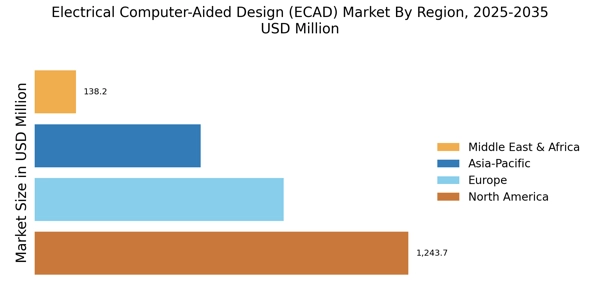
  • North America remains the largest market, while Asia-Pacific is emerging as the fastest-growing region in the ECAD landscape.
  • Software solutions dominate the market, yet services are rapidly gaining traction as the fastest-growing segment.
  • The increasing demand for automation and advancements in semiconductor technology are key drivers propelling market expansion.

Market Size & Forecast

2024 Market Size 2763.69 (USD Million)
2035 Market Size 6940.99 (USD Million)
CAGR (2025 - 2035) 8.73%

Major Players

Siemens (DE), Cadence Design Systems (US), Altium (AU), Mentor Graphics (US), Ansys (US), Keysight Technologies (US), Autodesk (US), Zuken (JP)

Electrical Computer Aided Design Market Trends

The Electrical Computer-Aided Design (ECAD) Market is currently experiencing a transformative phase, driven by advancements in technology and increasing demand for efficient design solutions. As industries evolve, the need for sophisticated design tools that enhance productivity and accuracy becomes paramount. This market encompasses a wide range of applications, including electronic design automation, circuit design, and simulation tools, which are essential for engineers and designers in various sectors. The integration of artificial intelligence and machine learning into ECAD tools is reshaping workflows, enabling faster design iterations and improved decision-making processes. Furthermore, the growing trend towards automation in manufacturing is likely to propel the adoption of ECAD solutions, as companies seek to streamline operations and reduce time-to-market for new products. In addition to technological advancements, the Electrical Computer-Aided Design (ECAD) Market is influenced by the increasing complexity of electronic systems. As devices become more intricate, the demand for robust design software that can handle multifaceted designs is on the rise. This complexity necessitates tools that not only facilitate design but also ensure compliance with industry standards and regulations. Moreover, the shift towards sustainable practices in engineering and design is prompting the development of eco-friendly ECAD solutions. As organizations prioritize sustainability, the market may see a surge in demand for tools that support green design initiatives, further shaping the future landscape of the Electrical Computer-Aided Design (ECAD) Market.

Integration of AI and Machine Learning

The incorporation of artificial intelligence and machine learning into ECAD tools is revolutionizing design processes. These technologies enhance automation, enabling designers to optimize workflows and reduce errors, thereby increasing overall efficiency.

Rising Complexity of Electronic Systems

As electronic devices grow more sophisticated, the need for advanced ECAD solutions becomes critical. Designers require tools that can manage intricate designs while ensuring compliance with various industry standards.

Focus on Sustainable Design Practices

The trend towards sustainability is influencing the ECAD Market, as organizations seek eco-friendly design solutions. This shift is likely to drive the development of tools that support environmentally responsible engineering practices.

Electrical Computer Aided Design Market Drivers

Emergence of 5G Technology

The emergence of 5G technology is poised to have a profound impact on the Electrical Computer-Aided Design (ECAD) Market. With the rollout of 5G networks, there is an increasing demand for advanced electronic components that can support higher data rates and lower latency. This technological shift necessitates the development of new design tools capable of handling the complexities associated with 5G applications. Market forecasts suggest that the demand for ECAD solutions tailored for 5G technology will grow significantly, potentially exceeding a growth rate of 12% in the coming years. As a result, the Electrical Computer-Aided Design (ECAD) Market is likely to evolve rapidly to meet the challenges posed by this next-generation technology.

Rising Adoption of IoT Devices

The proliferation of Internet of Things (IoT) devices is a significant driver for the Electrical Computer-Aided Design (ECAD) Market. As more devices become interconnected, the complexity of their design increases, necessitating advanced ECAD solutions. The IoT market is projected to grow exponentially, with estimates suggesting a compound annual growth rate of over 25% in the next few years. This rapid expansion creates a pressing need for ECAD tools that can efficiently manage the intricate designs associated with IoT applications. As a result, the Electrical Computer-Aided Design (ECAD) Market is likely to see a substantial increase in demand for specialized design software tailored to IoT requirements.

Increasing Demand for Automation

The Electrical Computer-Aided Design (ECAD) Market is experiencing a notable surge in demand for automation tools. As industries strive for efficiency, the integration of automated design processes is becoming essential. Automation not only accelerates the design cycle but also minimizes human error, which is critical in complex electronic systems. According to recent data, the automation segment within the ECAD market is projected to grow at a compound annual growth rate of over 10% in the coming years. This trend indicates a shift towards more sophisticated design tools that can handle intricate tasks with minimal manual intervention, thereby enhancing productivity and innovation in the Electrical Computer-Aided Design (ECAD) Market.

Advancements in Semiconductor Technology

The Electrical Computer-Aided Design (ECAD) Market is significantly influenced by advancements in semiconductor technology. As the demand for smaller, faster, and more efficient electronic devices increases, the need for advanced ECAD tools that can accommodate these innovations becomes paramount. The semiconductor sector is expected to witness a growth rate of approximately 8% annually, driving the need for enhanced design capabilities. This growth compels ECAD software developers to innovate continuously, ensuring that their tools can support the latest semiconductor technologies. Consequently, the Electrical Computer-Aided Design (ECAD) Market is poised for expansion as it adapts to these technological advancements.

Growing Focus on Electronic Design Automation

The Electrical Computer-Aided Design (ECAD) Market is witnessing a growing focus on electronic design automation (EDA) tools. As the complexity of electronic systems escalates, the need for robust EDA solutions becomes increasingly critical. These tools facilitate the design, simulation, and verification of electronic circuits, thereby streamlining the development process. Recent market analyses indicate that the EDA segment is expected to grow at a rate of around 9% annually, reflecting the industry's shift towards more automated and efficient design methodologies. This trend underscores the importance of EDA tools within the Electrical Computer-Aided Design (ECAD) Market, as they play a vital role in enhancing design accuracy and reducing time-to-market.

Market Segment Insights

By Component: Software (Largest) vs. Services (Fastest-Growing)

In the Electrical Computer-Aided Design (ECAD) Market, the Software segment holds a substantial share, reflecting its crucial role in facilitating design and simulation tasks. This segment is characterized by a diverse array of tools catering to various engineering needs, from basic schematic capture to advanced simulation capabilities. On the other hand, the Services segment, while smaller in market share, is witnessing an impressive growth trajectory as organizations increasingly seek customization and integration services. As a result, the distribution of market share is heavily tilted in favor of software, yet the demand for services is rising rapidly.

Software (Dominant) vs. Services (Emerging)

The Software segment in the ECAD market is distinguished by its wide array of offerings, which include traditional design tools, cloud-based applications, and integrated platforms that support collaboration among engineers. This dominance is primarily driven by the ongoing digital transformation in engineering processes, prompting widespread adoption of software solutions for enhanced productivity. In contrast, the Services segment is emerging rapidly, fueled by the necessity for specialized expertise and support in software implementation and maintenance. As companies increasingly focus on maximizing the potential of their ECAD tools, the demand for tailored services such as training, consulting, and ongoing technical support continues to grow. This dynamic relationship between software and services reflects a holistic approach to design excellence.

By Industry Type: Discrete Industry (Largest) vs. Process Industry (Fastest-Growing)

The Electrical Computer-Aided Design (ECAD) market exhibits a varied distribution of market share between the Discrete Industry and Process Industry segments. The Discrete Industry dominates the landscape, benefitting from sectors such as manufacturing and automotive, which have a high reliance on precise designs and simulations. In contrast, while the Process Industry holds a smaller share, it is witnessing rapid growth due to the increasing demand for automation and advanced design solutions in chemical processing, pharmaceuticals, and food production.

Industry Type: Discrete (Dominant) vs. Process (Emerging)

The Discrete Industry segment is characterized by its requirement for complex and highly detailed models, catering to sectors like electronics, machinery, and aerospace. This segment's dominance stems from the growing need for sophisticated designs that enhance product efficiency and reduce time-to-market. Conversely, the Process Industry is emerging rapidly, driven by the need for streamlined operations and regulatory compliance in industries such as oil and gas, chemicals, and food processing. This segment emphasizes the integration of design software with real-time data processing, leading to increased efficiency and safety in production workflows.

By Application: Industrial Machine Control (Largest) vs. Mining Equipment Control (Fastest-Growing)

In the Electrical Computer-Aided Design (ECAD) market, various applications play distinctive roles. Industrial Machine Control emerges as the largest application segment, capturing a significant portion of the market share through its extensive deployment in manufacturing processes. Following closely, Plant Design and Water Treatment & Distribution System Control are also noteworthy contributors, addressing complex system designs and optimizations in their respective fields. Mining Equipment Control, while smaller in comparison, is rapidly gaining ground, demonstrating strong demand dynamics that reflect industry trends and technological advancements. Moreover, Rail Signaling and Switchgear Design showcase competitiveness in specialized applications, supported by regulatory imperatives and the move towards smart infrastructure solutions. The varied applications highlight the diverse nature of the ECAD landscape, showcasing a rich portfolio of requirements and advancements in design technologies.

Industrial Machine Control (Dominant) vs. Mining Equipment Control (Emerging)

The Industrial Machine Control segment stands as a dominant force within the Electrical Computer-Aided Design market, characterized by its comprehensive integration in industrial automation processes. This segment leverages advanced design tools to optimize and streamline machine operations, enhancing efficiency and operational productivity. Conversely, the Mining Equipment Control segment is emerging as a significant player, driven by increased investment in mining technologies and smart control systems. Its focus on enhancing equipment reliability and safety through sophisticated ECAD tools positions it favorably for growth. As industries evolve toward automation and digital solutions, both segments cater to critical needs, reshaping efficiencies and capabilities within their operational frameworks.

By Industry Vertical: Automotive (Largest) vs. Aerospace & Defense (Fastest-Growing)

In the Electrical Computer-Aided Design (ECAD) market, the automotive sector holds the largest market share, attributed to the growing demand for innovative vehicle designs and advanced automation technologies. Following automotive, the aerospace & defense sector is experiencing rapid growth, driven by increased investments in aircraft design and military technology advancement. Other notable sectors include railway, equipment and machinery, and construction, each contributing to the diverse applications of ECAD solutions.

Automotive (Dominant) vs. Aerospace & Defense (Emerging)

The automotive sector in the ECAD market is characterized by its strong emphasis on design, efficiency, and compliance with industry standards. Automakers leverage ECAD tools for seamless integration of electronic systems, enhancing vehicle performance and safety. On the other hand, the aerospace & defense sector is emerging as a vital player, driven by technological innovations and stringent regulatory requirements. This sector demands highly specialized ECAD solutions to meet the needs for precision and reliability in aircraft and defense systems, indicating a trend toward enhanced simulation and modeling capabilities.

Get more detailed insights about Electrical Computer Aided Design Market

Regional Insights

North America : Innovation and Leadership Hub

North America is the largest market for Electrical Computer-Aided Design (ECAD), holding approximately 45% of the global market share. The region's growth is driven by rapid technological advancements, increasing demand for automation, and a strong focus on R&D. Regulatory support for innovation and sustainability further catalyzes market expansion, making it a key player in the global landscape. The United States leads the ECAD market, with significant contributions from Canada. Major players like Siemens, Cadence Design Systems, and Autodesk are headquartered here, fostering a competitive environment. The presence of advanced manufacturing sectors and a skilled workforce enhances the region's capability to innovate and meet the growing demand for ECAD solutions.

Europe : Regulatory Framework and Growth

Europe is the second-largest market for ECAD, accounting for around 30% of the global share. The region benefits from stringent regulations promoting energy efficiency and sustainability, which drive demand for advanced design solutions. The European Union's initiatives to support digital transformation in manufacturing further bolster market growth, creating a favorable environment for ECAD technologies. Germany, the UK, and France are the leading countries in this market, with a robust presence of key players like Siemens and Zuken. The competitive landscape is characterized by a mix of established firms and innovative startups, enhancing the region's capability to adapt to changing market needs. The focus on collaborative design and integration of AI technologies is shaping the future of ECAD in Europe.

Asia-Pacific : Emerging Market with Potential

Asia-Pacific is witnessing significant growth in the ECAD market, holding approximately 20% of the global share. The region's expansion is fueled by increasing investments in electronics and telecommunications, coupled with a rising demand for smart devices. Government initiatives aimed at boosting manufacturing capabilities and technological advancements are key drivers of this growth, making it a promising market for ECAD solutions. China, Japan, and India are the leading countries in this region, with a growing number of local and international players entering the market. Companies like Altium and Keysight Technologies are expanding their footprint, contributing to a competitive landscape. The focus on innovation and the integration of IoT technologies are expected to further enhance the adoption of ECAD solutions in the region.

Middle East and Africa : Resource-Rich and Developing Market

The Middle East and Africa (MEA) region is gradually emerging in the ECAD market, currently holding about 5% of the global share. The growth is driven by increasing investments in infrastructure and technology, particularly in the Gulf Cooperation Council (GCC) countries. Government initiatives aimed at diversifying economies and enhancing technological capabilities are pivotal in fostering demand for ECAD solutions. Countries like the UAE and South Africa are leading the charge, with a growing number of local firms and international players establishing a presence. The competitive landscape is evolving, with a focus on integrating advanced technologies into traditional sectors. As the region continues to develop, the demand for efficient design solutions is expected to rise significantly.

Electrical Computer Aided Design Market Regional Image

Key Players and Competitive Insights

The Electrical Computer-Aided Design (ECAD) Market is currently characterized by a dynamic competitive landscape, driven by rapid technological advancements and increasing demand for efficient design solutions across various industries. Key players such as Siemens (Germany), Cadence Design Systems (US), and Autodesk (US) are strategically positioning themselves through innovation and partnerships. Siemens (Germany) focuses on integrating its ECAD solutions with broader digital transformation initiatives, enhancing interoperability and user experience. Meanwhile, Cadence Design Systems (US) emphasizes AI-driven design tools, which are becoming increasingly vital in optimizing complex electronic systems. Autodesk (US) is leveraging its strong presence in the architectural and engineering sectors to expand its ECAD offerings, thereby shaping a competitive environment that prioritizes technological integration and user-centric solutions.

The market structure appears moderately fragmented, with a mix of established players and emerging startups. Key business tactics include localizing manufacturing and optimizing supply chains to enhance responsiveness to market demands. This fragmentation allows for diverse offerings, yet the collective influence of major players like Siemens (Germany) and Cadence Design Systems (US) tends to dominate market trends, particularly in innovation and customer engagement strategies.

In August 2025, Siemens (Germany) announced a strategic partnership with a leading cloud service provider to enhance its ECAD solutions through cloud-based collaboration tools. This move is significant as it aligns with the growing trend of remote collaboration in design processes, potentially increasing efficiency and reducing time-to-market for clients. By integrating cloud capabilities, Siemens aims to provide a more flexible and scalable solution, which could set a new standard in the industry.

In September 2025, Cadence Design Systems (US) unveiled a new AI-driven platform designed to streamline the design process for complex electronic systems. This platform is expected to significantly reduce design time and improve accuracy, reflecting the company's commitment to innovation. The introduction of such advanced tools not only strengthens Cadence's market position but also highlights the increasing importance of AI in the ECAD sector, suggesting a shift towards more intelligent design methodologies.

In July 2025, Autodesk (US) expanded its ECAD product line by acquiring a smaller firm specializing in simulation software. This acquisition is likely to enhance Autodesk's capabilities in providing comprehensive design solutions, integrating simulation with traditional ECAD tools. Such strategic moves indicate a trend towards consolidation in the market, where larger firms seek to bolster their offerings through targeted acquisitions, thereby enhancing their competitive edge.

As of October 2025, the ECAD market is witnessing trends that emphasize digitalization, sustainability, and AI integration. Strategic alliances are increasingly shaping the competitive landscape, as companies recognize the need for collaborative innovation to meet evolving customer demands. The shift from price-based competition to a focus on technological advancement and supply chain reliability is becoming evident. Moving forward, competitive differentiation will likely hinge on the ability to innovate and adapt to new technologies, ensuring that firms remain relevant in an ever-evolving market.

Key Companies in the Electrical Computer Aided Design Market market include

Industry Developments

In August 2022, Bureau of Industry and Security (BIS), a department of commerce in the United States, issued a proclamation prohibiting the export of electronic computer-aided design (ECAD) software created for integrated circuit development featuring a gate-all around field-effect transistor (GAAFET) structure.

Future Outlook

Electrical Computer Aided Design Market Future Outlook

The Electrical Computer-Aided Design (ECAD) Market is projected to grow at an 8.73% CAGR from 2024 to 2035, driven by technological advancements, increased automation, and rising demand for efficient design solutions.

New opportunities lie in:

  • Integration of AI-driven design tools for enhanced efficiency.
  • Development of cloud-based ECAD platforms for remote collaboration.
  • Expansion into emerging markets with tailored ECAD solutions.

By 2035, the ECAD market is expected to be robust, reflecting substantial growth and innovation.

Market Segmentation

Electrical Computer Aided Design Market Component Outlook

  • Software
  • Services

Electrical Computer Aided Design Market Application Outlook

  • Industrial Machine Control
  • Plant Design
  • Mining Equipment Control
  • Rail Signaling
  • Switchgear Design
  • Water Treatment & Distribution System Control
  • Others

Electrical Computer Aided Design Market Industry Type Outlook

  • Discrete Industry
  • Process Industry

Electrical Computer Aided Design Market Industry Vertical Outlook

  • Automotive
  • Aerospace & Defense
  • Railway
  • Equipment and Machinery
  • Construction
  • Power Generation & Energy
  • Oil & Gas
  • Food & Beverages
  • Others

Report Scope

MARKET SIZE 2024 2763.69(USD Million)
MARKET SIZE 2025 3005.02(USD Million)
MARKET SIZE 2035 6940.99(USD Million)
COMPOUND ANNUAL GROWTH RATE (CAGR) 8.73% (2024 - 2035)
REPORT COVERAGE Revenue Forecast, Competitive Landscape, Growth Factors, and Trends
BASE YEAR 2024
Market Forecast Period 2025 - 2035
Historical Data 2019 - 2024
Market Forecast Units USD Million
Key Companies Profiled Market analysis in progress
Segments Covered Market segmentation analysis in progress
Key Market Opportunities Integration of artificial intelligence in the Electrical Computer-Aided Design (ECAD) Market enhances design efficiency and accuracy.
Key Market Dynamics Rising demand for automation and integration in Electrical Computer-Aided Design tools drives competitive innovation and market evolution.
Countries Covered North America, Europe, APAC, South America, MEA

Market Highlights

Author
Ankit Gupta
Senior Research Analyst

Ankit Gupta is an analyst in market research industry in ICT and SEMI industry. With post-graduation in "Telecom and Marketing Management" and graduation in "Electronics and Telecommunication" vertical he is well versed with recent development in ICT industry as a whole. Having worked on more than 150+ reports including consultation for fortune 500 companies such as Microsoft and Rio Tinto in identifying solutions with respect to business problems his opinions are inclined towards mixture of technical and managerial aspects.

Leave a Comment

FAQs

What is the projected market valuation of the Electrical Computer-Aided Design (ECAD) Market by 2035?

The projected market valuation for the ECAD Market by 2035 is 6940.99 USD Million.

What was the overall market valuation of the ECAD Market in 2024?

The overall market valuation of the ECAD Market in 2024 was 2763.69 USD Million.

What is the expected CAGR for the ECAD Market during the forecast period 2025 - 2035?

The expected CAGR for the ECAD Market during the forecast period 2025 - 2035 is 8.73%.

Which companies are considered key players in the ECAD Market?

Key players in the ECAD Market include Siemens, Cadence Design Systems, Altium, Mentor Graphics, Ansys, Keysight Technologies, Autodesk, and Zuken.

What are the two main segments of the ECAD Market based on components?

The two main segments of the ECAD Market based on components are Software, valued at 4000.0 USD Million, and Services, valued at 2940.99 USD Million.

Download Free Sample

Kindly complete the form below to receive a free sample of this Report

Compare Licence

×
Features License Type
Single User Multiuser License Enterprise User
Price $4,950 $5,950 $7,250
Maximum User Access Limit 1 User Upto 10 Users Unrestricted Access Throughout the Organization
Free Customization
Direct Access to Analyst
Deliverable Format
Platform Access
Discount on Next Purchase 10% 15% 15%
Printable Versions