Download Free Sample
Kindly complete the form below to receive a free sample of this Report
Electronic Appliance Store Market Size, Share, Industry Trend & Analysis Research Report: By Product Category (Kitchen Appliances, Home Entertainment Systems, Laundry Appliances, Personal Care Appliances), By Distribution Channel (Online Retail, Brick-and-Mortar Stores, Multi-Channel Retailers), By End User (Residential, Commercial, Institutional), By Smart Technology Adoption (Smart Appliances, Traditional Appliances) andBy Regional (North America, Europe, South America, Asia-Pacific, Middle East and Africa)- Forecast to 2035.
As per Market Research Future analysis, the Electronic Appliance Store Market Size was estimated at 868.62 USD Billion in 2024. The Electronic Appliance Store industry is projected to grow from 894.5 USD Billion in 2025 to 1199.8 USD Billion by 2035, exhibiting a compound annual growth rate (CAGR) of 2.98% during the forecast period 2025 - 2035
The Electronic Appliance Store Market is experiencing a transformative shift towards smart technology and sustainability.
| 2024 Market Size | 868.62 (USD Billion) |
| 2035 Market Size | 1199.8 (USD Billion) |
| CAGR (2025 - 2035) | 2.98% |
Best Buy (US), Walmart (US), Amazon (US), MediaMarkt (DE), Currys (GB), Lowe's (US), Home Depot (US), Saturn (DE), Fnac (FR)
Our Impact
Enabled $4.3B Revenue Impact for Fortune 500 and Leading Multinationals
Partnering with 2000+ Global Organizations Each Year
30K+ Citations by Top-Tier Firms in the Industry
The Electronic Appliance Store Market is currently experiencing a dynamic evolution, driven by various factors that influence consumer behavior and technological advancements. As consumers increasingly prioritize convenience and efficiency, the demand for smart appliances is on the rise. Retailers are adapting to this shift by enhancing their online presence and offering a seamless shopping experience. This transformation is not merely a response to changing preferences but also reflects a broader trend towards sustainability and energy efficiency. Retailers are now more focused on providing eco-friendly options, which resonates with environmentally conscious consumers. Moreover, the competitive landscape of the Electronic Appliance Store Market is intensifying, with both established brands and new entrants vying for market share. This competition fosters innovation, leading to the introduction of cutting-edge products that cater to diverse consumer needs. As technology continues to advance, the integration of artificial intelligence and the Internet of Things into appliances is becoming commonplace. This trend not only enhances functionality but also improves user experience, making appliances more intuitive and user-friendly. Overall, the Electronic Appliance Store Market is poised for continued growth, driven by evolving consumer expectations and technological progress.
The demand for smart appliances is increasing as consumers seek convenience and efficiency in their daily lives. These devices, which often connect to the Internet, allow users to control and monitor their appliances remotely, enhancing the overall user experience.
There is a growing emphasis on sustainability within the Electronic Appliance Store Market. Retailers are increasingly offering eco-friendly products that appeal to environmentally conscious consumers, reflecting a shift towards energy-efficient solutions.
Retailers are investing in their online platforms to provide a seamless shopping experience. This trend includes improved website functionality, personalized recommendations, and enhanced customer service, catering to the evolving preferences of consumers.
The Electronic Appliance Store Market is witnessing a significant shift towards e-commerce, driven by changing consumer shopping behaviors. With the proliferation of online shopping platforms, consumers are increasingly opting to purchase electronic appliances online due to the convenience and variety offered. Recent statistics indicate that online sales of home appliances have seen a substantial increase, with many consumers preferring the ability to compare prices and read reviews before making a purchase. This trend compels traditional brick-and-mortar stores to enhance their online presence and develop robust e-commerce strategies. As a result, electronic appliance stores are investing in digital marketing and logistics to cater to the growing demand for online shopping, which is likely to reshape the competitive landscape of the industry.
The Electronic Appliance Store Market is benefiting from rising disposable incomes among consumers, particularly in emerging markets. As economic conditions improve, consumers are more willing to invest in high-quality electronic appliances that enhance their lifestyles. This trend is evident in the increasing sales of premium appliances, which often feature advanced technology and superior energy efficiency. Data indicates that households with higher disposable incomes are more likely to purchase smart appliances, further driving growth in the market. Consequently, electronic appliance stores are adapting their product offerings to include a wider range of premium options, catering to the evolving preferences of affluent consumers. This shift is likely to create new opportunities for growth within the industry.
The Electronic Appliance Store Market is experiencing a surge in technological advancements, which is reshaping consumer expectations and product offerings. Innovations such as artificial intelligence, Internet of Things (IoT), and smart home integration are becoming increasingly prevalent. These technologies not only enhance the functionality of appliances but also improve energy efficiency, which is a growing concern among consumers. According to recent data, the market for smart appliances is projected to grow significantly, indicating a shift in consumer preferences towards more connected and efficient products. As a result, electronic appliance stores are compelled to adapt their inventory and marketing strategies to align with these technological trends, ensuring they remain competitive in a rapidly evolving landscape.
The Electronic Appliance Store Market is experiencing a heightened focus on home improvement, as consumers invest in upgrading their living spaces. This trend is influenced by a growing desire for modern, efficient appliances that complement contemporary home designs. Data suggests that home improvement spending has increased significantly, with many consumers prioritizing renovations that include new electronic appliances. As a result, electronic appliance stores are capitalizing on this trend by offering promotions and packages that cater to home improvement projects. This strategic focus not only drives sales but also positions electronic appliance stores as essential partners in the home renovation process, potentially leading to increased customer loyalty and repeat business.
In the Electronic Appliance Store Market, there is a notable increase in consumer demand for energy-efficient appliances. This trend is driven by rising energy costs and heightened awareness of environmental issues. Consumers are increasingly seeking appliances that not only reduce energy consumption but also lower utility bills. Data suggests that energy-efficient appliances can lead to savings of up to 30% on energy costs, making them an attractive option for budget-conscious consumers. Consequently, electronic appliance stores are focusing on stocking a wider range of energy-efficient products, which not only meets consumer demand but also aligns with regulatory standards aimed at reducing carbon footprints. This shift is likely to influence purchasing decisions and drive sales in the industry.
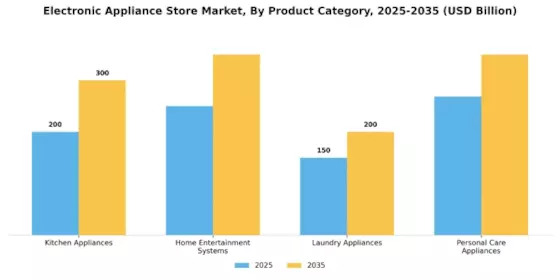
In the Electronic Appliance Store Market, the product category is prominently dominated by Kitchen Appliances, which account for a significant portion of market share. These devices are essential in every household, contributing to their large market presence. Home Entertainment Systems, on the other hand, are quickly gaining traction among consumers, highlighting a shift in market demands and preferences, particularly as more individuals invest in enhancing their home experiences with advanced audio and visual systems.
Kitchen Appliances: Major Player (Dominant) vs. Home Entertainment Systems: Innovator (Emerging)
Kitchen Appliances, including refrigerators, microwaves, and cooktops, represent a major player in the market, driven by the need for efficiency and convenience in food preparation. Features such as smart technology integration and energy-efficient designs further boost their appeal among consumers. Conversely, Home Entertainment Systems are emerging rapidly, fueled by the growing popularity of streaming services and the increasing demand for high-quality audio and visual experiences. With innovations in surround sound technology and smart home integration, these systems are transitioning from luxury to necessity, reflecting a shift in consumer entertainment consumption.
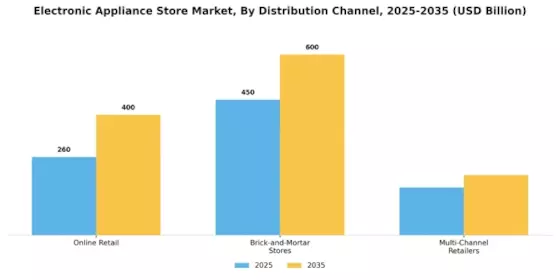
In the Electronic Appliance Store Market, the distribution channel landscape showcases the dominance of online retail, which captures the largest share of consumer purchases. Brick-and-mortar stores have been witnessing a gradual decline as consumers increasingly prefer the convenience of online shopping. However, multi-channel retailers are proving competitive by blending physical and digital spaces, allowing them to cater to a broader audience and capitalize on shifting consumer behaviors.
Online Retail (Dominant) vs. Brick-and-Mortar Stores (Emerging)
Online retail is at the forefront of the Electronic Appliance Store Market, primarily due to its unparalleled convenience and accessibility. The ability to browse a vast selection of products and read reviews instantly appeals to tech-savvy customers, driving sustained growth. On the other hand, brick-and-mortar stores, though still relevant, face challenges such as rising operational costs and decreasing foot traffic. They are adapting by enhancing customer experience and leveraging technology. Multi-channel retailers, employing a hybrid approach, rapidly gain traction as they combine the advantages of both online and offline shopping, addressing diverse consumer preferences and encouraging more interactive shopping experiences.
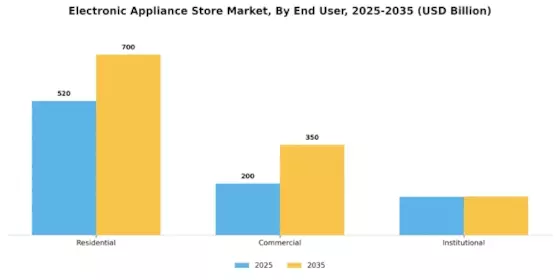
The Electronic Appliance Store Market is predominantly driven by the residential segment, which constitutes the largest share owing to the increasing demand for home appliances among consumers. This demand is fueled by trends such as home automation and an emphasis on energy-efficient appliances. In contrast, the commercial segment has been experiencing rapid growth, particularly within sectors such as hospitality and retail, where electronic appliances are imperative for operations.
Residential (Dominant) vs. Commercial (Emerging)
The residential segment is characterized by a broad array of electronic appliances, catering to everyday consumer needs. Brands are focusing on innovation and energy efficiency, which solidifies their dominance in this space, appealing to environmentally conscious consumers. Conversely, the commercial segment, while emerging, is rapidly gaining traction as businesses invest in advanced electronic solutions to enhance operational efficiency and customer experience. The adoption of smart appliances in commercial spaces is setting a new standard, enabling businesses to leverage technology for better service delivery.
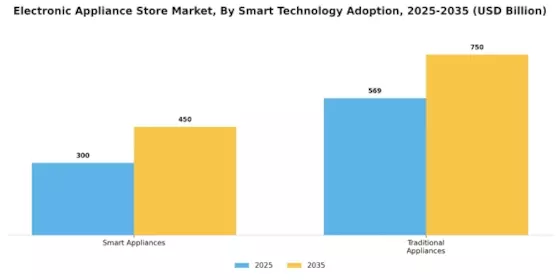
In the Electronic Appliance Store Market, smart appliances dominate the market share, attracting consumers with their advanced features and connectivity options. They comprise a significant portion of sales, indicating a strong preference among tech-savvy customers who seek convenience and efficiency. Conversely, traditional appliances, while currently smaller in market share, are experiencing a resurgence as consumers opt for reliability and simplicity in their purchasing decisions.
Smart Appliances (Dominant) vs. Traditional Appliances (Emerging)
Smart appliances represent the dominant segment within the Electronic Appliance Store Market, characterized by innovative technology integration, such as IoT connectivity and energy-efficient systems. These products not only enhance user convenience but also cater to a growing demand for sustainable living solutions. Traditional appliances, on the other hand, are emerging as a viable choice for budget-conscious consumers who value durability and performance over smart features. This segment is gradually gaining traction, particularly as manufacturers improve their offerings, making traditional options more appealing alongside advanced smart technologies.
Get more detailed insights about Electronic Appliance Store Market Request Free Sample
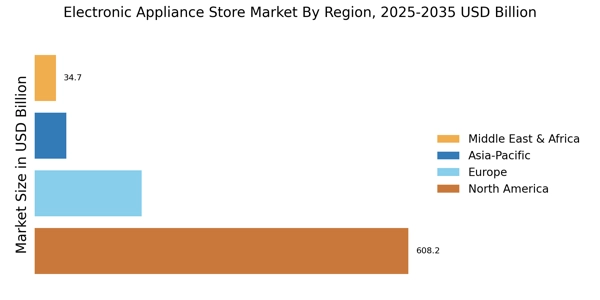
North America is the largest market for electronic appliances, driven by high consumer spending, technological advancements, and a robust retail infrastructure. The U.S. holds approximately 70% of the market share, followed by Canada at 15%. Regulatory support for e-commerce and consumer protection laws further stimulate growth, making it a favorable environment for electronic retailers. Key players like Best Buy, Walmart, and Amazon dominate the landscape, leveraging their extensive distribution networks and online platforms. The competitive environment is characterized by aggressive pricing strategies and promotional offers. The presence of major retailers ensures a wide range of products, catering to diverse consumer needs and preferences, thus solidifying North America's position as a leader in the electronic appliance market.
Europe is witnessing significant growth in the electronic appliance market, driven by increasing consumer demand for smart home devices and energy-efficient products. Germany and the UK are the largest markets, holding approximately 30% and 25% of the market share, respectively. Regulatory initiatives aimed at sustainability and energy efficiency are also propelling market growth, encouraging consumers to invest in modern appliances. Leading countries like Germany, the UK, and France host key players such as MediaMarkt, Currys, and Fnac. The competitive landscape is marked by a mix of established retailers and emerging online platforms. The presence of diverse brands and innovative products enhances consumer choice, while strategic partnerships and collaborations among retailers further strengthen market dynamics.
Asia-Pacific is rapidly emerging as a significant player in the electronic appliance market, fueled by urbanization, rising disposable incomes, and a growing middle class. China and Japan are the largest markets, accounting for approximately 40% and 20% of the market share, respectively. Government initiatives promoting digitalization and smart technologies are key drivers of this growth, creating a favorable environment for electronic retailers. Countries like China, Japan, and India are home to major players, including local and international brands. The competitive landscape is characterized by a mix of traditional retail and e-commerce platforms, with companies adapting to changing consumer preferences. The increasing penetration of smartphones and internet connectivity further enhances the market potential in this region, making it a hotspot for electronic appliance sales.
The Middle East and Africa region presents untapped opportunities in the electronic appliance market, driven by increasing urbanization and a young population. The UAE and South Africa are the largest markets, holding approximately 25% and 20% of the market share, respectively. Government initiatives aimed at improving infrastructure and promoting technology adoption are key factors contributing to market growth in this region. Leading countries like the UAE and South Africa are witnessing a rise in consumer electronics demand, with key players such as local retailers and international brands expanding their presence. The competitive landscape is evolving, with a focus on online retailing and innovative marketing strategies. As the region continues to develop, the electronic appliance market is expected to grow significantly, catering to the needs of a tech-savvy population.
The Global Electronic Appliance Store Market is a dynamic and competitive landscape characterized by diverse players vying for consumer attention and loyalty. This market segment encompasses a wide range of products, including household electronics, kitchen appliances, and personal gadgets, all of which cater to ever-evolving consumer preferences and technological advancements. As shoppers increasingly seek convenience, quality, and innovation, electronic appliance stores are adapting their strategies to remain relevant in a crowded marketplace. Key competition arises not only from brick-and-mortar stores but also from online retail giants, creating a pressure cooker environment where businesses must consistently enhance their offerings and customer service.Fnac Darty stands out in the Global Electronic Appliance Store Market with a formidable presence and a strong reputation for delivering quality products and exceptional customer experience. The company's extensive network of physical stores enables consumers to engage with products directly, fostering trust and satisfaction. Moreover, Fnac Darty has successfully integrated an omnichannel approach that combines their online platforms with in-store experiences, allowing customers to enjoy seamless shopping opportunities. This adaptability has solidified Fnac Darty's position as a leader in providing not just a wide variety of products but also personalized services that cater to a diverse customer base. Their commitment to after-sales support, knowledgeable staff, and a robust range of offerings in electronics give them a distinct advantage in this competitive landscape.On the other hand, Target presents a unique and relevant competitor within the Global Electronic Appliance Store Market, utilizing its well-known brand equity to attract a broad spectrum of customers. The retailer's approach strategically intertwines everyday essentials with a curated selection of electronic appliances, making it a go-to destination for consumers seeking convenience and affordability. Target is renowned for its aggressive pricing strategies, promotional offers, and loyalty programs, which resonate well with budget-conscious shoppers. The retailer's investments in digital transformation have enhanced its online presence, enabling smooth online ordering and efficient in-store pickup, thereby streamlining the shopping experience. Through a mix of exclusive partnerships and collaborations, Target continues to enrich its product portfolio, positioning itself effectively within the competitive realm of electronic appliance sales.




Recent developments in the Global Electronic Appliance Store Market showcase considerable activity among major players. Fnac Darty has been enhancing its product offerings and expanding its online presence to capture a larger share of the market, while Target is focusing on diversifying its electronic product range to attract tech-savvy customers. Amazon continues to innovate with its smart home products, further solidifying its position in the market. Home Depot is investing in home improvement appliances, aligning with growing customer preferences for efficiency and sustainability.
Companies like Walmart and Costco are enhancing their supply chain logistics to expedite delivery times, which has become increasingly essential in the current retail landscape. Notably, Best Buy has been working on partnerships to provide more exclusive products, aiming to strengthen customer loyalty. Recent news included the potential acquisition discussions involving Argos and Metro AG, which may reshape competitive dynamics in the sector. As growth in market valuation reflects the increasing consumer demand for electronic appliances, companies are examining strategic collaborations and investments that can further drive their expansion in a highly competitive environment.
The Electronic Appliance Store Market is projected to grow at a 2.98% CAGR from 2025 to 2035, driven by technological advancements, increasing consumer demand, and e-commerce expansion.
New opportunities lie in:
By 2035, the market is expected to be robust, reflecting sustained growth and innovation.
| MARKET SIZE 2024 | 868.62(USD Billion) |
| MARKET SIZE 2025 | 894.5(USD Billion) |
| MARKET SIZE 2035 | 1199.8(USD Billion) |
| COMPOUND ANNUAL GROWTH RATE (CAGR) | 2.98% (2025 - 2035) |
| REPORT COVERAGE | Revenue Forecast, Competitive Landscape, Growth Factors, and Trends |
| BASE YEAR | 2024 |
| Market Forecast Period | 2025 - 2035 |
| Historical Data | 2019 - 2024 |
| Market Forecast Units | USD Billion |
| Key Companies Profiled | Best Buy (US), Walmart (US), Amazon (US), MediaMarkt (DE), Currys (GB), Lowe's (US), Home Depot (US), Saturn (DE), Fnac (FR) |
| Segments Covered | Product Category, Distribution Channel, End User, Smart Technology Adoption, Regional |
| Key Market Opportunities | Integration of smart home technology enhances consumer engagement in the Electronic Appliance Store Market. |
| Key Market Dynamics | Technological advancements and shifting consumer preferences drive competitive dynamics in the electronic appliance retail sector. |
| Countries Covered | North America, Europe, APAC, South America, MEA |
As of 2024, the market valuation was 868.62 USD Billion.
The market is projected to reach 1199.8 USD Billion by 2035.
The expected CAGR during the forecast period 2025 - 2035 is 2.98%.
Home Entertainment Systems had a market value of 250.0 USD Billion in 2024, indicating strong consumer interest.
In 2024, brick-and-mortar stores generated 450.0 USD Billion, while online retail sales reached 260.0 USD Billion.
Smart Appliances, valued at 300.0 USD Billion in 2024, are likely to experience significant growth through 2035.
Key players include Best Buy, Walmart, Amazon, MediaMarkt, Currys, Lowe's, Home Depot, Saturn, and Fnac.
Residential end users accounted for a market value of 520.0 USD Billion in 2024.
In 2024, personal care appliances were valued at 268.62 USD Billion, surpassing laundry appliances, which were valued at 150.0 USD Billion.
The market value for commercial end users was 200.0 USD Billion in 2024.



Kindly complete the form below to receive a free sample of this Report

“This is really good guys. Excellent work on a tight deadline. I will continue to use you going forward and recommend you to others. Nice job”


“Thanks. It’s been a pleasure working with you, please use me as reference with any other Intel employees.”


“Thanks for sending the report it gives us a good global view of the Betaïne market.”


“Thank you, this will be very helpful for OQS.”


“We found the report very insightful! we found your research firm very helpful. I'm sending this email to secure our future business.”


“I am very pleased with how market segments have been defined in a relevant way for my purposes (such as "Portable Freezers & refrigerators" and "last-mile"). In general the report is well structured. Thanks very much for your efforts.”


“I have been reading the first document or the study, ,the Global HVAC and FP market report 2021 till 2026. Must say, good info! I have not gone in depth at all parts, but got a good indication of the data inside!”


“We got the report in time, we really thank you for your support in this process. I also thank to all of your team as they did a great job.”


“The Automotive 48V ECU Components Procurement Intelligence Study” was a complex project, but the Market Research Future (MRFR) team handled it with quality, agility, and customer-centricity. They delivered all requested data on time and within the agreed scope. The team, including Shubhendra Anand and Rahul Gotadki, was always readily available to clarify questions and swiftly implement necessary adjustments, driving the project to a successful conclusion within a very demanding timeframe.
I would also like to specifically commend Akshay Agarwal for his responsiveness and support at every stage—from our initial inquiry on May 6th through to final delivery on June 18th. His dedication made the entire process seamless.”



