Electronic Skin Patches Market Research Report By Application (Chronic Disease Management, Health Monitoring, Fitness Tracking, Medication Delivery), By Technology (Flexible Sensors, Wireless Communication, Microelectronics), By End Use (Healthcare, Sports, Wellness), By Sensor Type (Temperature Sensors, Electrochemical Sensors, Pressure Sensors) and By Region (North America, Europe, South America, Asia Pacific, Middle East and Africa) - Growth & Industry Forecast 2025 To 2035
As per MRFR analysis, the Electronic Skin Patches Market Size was estimated at 6.22 USD Billion in 2024. The Electronic Skin Patches industry is projected to grow from 6.86 USD Billion in 2025 to 18.46 USD Billion by 2035, exhibiting a compound annual growth rate (CAGR) of 10.4% during the forecast period 2025 - 2035.
Key Market Trends & Highlights
The Electronic Skin Patches Market is poised for substantial growth driven by technological advancements and increasing consumer demand.
Technological advancements are enhancing the functionality and comfort of electronic skin patches, making them more appealing to consumers.
North America remains the largest market for electronic skin patches, while Asia-Pacific is emerging as the fastest-growing region.
The chronic disease management segment dominates the market, whereas the fitness monitoring segment is experiencing rapid growth.
Rising demand for wearable health monitoring devices and increased investment in healthcare technology are key drivers propelling market expansion.
Enabled $4.3B Revenue Impact for Fortune 500 and Leading Multinationals
Partnering with 2000+ Global Organizations Each Year
30K+ Citations by Top-Tier Firms in the Industry
Electronic Skin Patches Market Trends
The Electronic Skin Patches Market is currently experiencing a transformative phase, driven by advancements in technology and increasing consumer demand for health monitoring solutions. These patches, which are designed to adhere to the skin and monitor various physiological parameters, are gaining traction in both medical and wellness sectors. The integration of sensors and wireless communication capabilities allows for real-time data collection, enhancing the ability to track health metrics conveniently. As a result, the market is witnessing a surge in innovation, with companies focusing on developing more sophisticated and user-friendly products. Moreover, the growing emphasis on preventive healthcare is propelling the adoption of electronic skin patches. Consumers are increasingly seeking solutions that enable proactive health management, which these patches can provide. The potential for remote patient monitoring and telehealth applications further amplifies their appeal, particularly in a world that values convenience and efficiency. As the Electronic Skin Patches Market evolves, it appears poised to play a crucial role in the future of personalized healthcare, offering a blend of technology and practicality that meets the needs of modern consumers.
Technological Advancements
The Electronic Skin Patches Market is witnessing rapid technological advancements, particularly in sensor technology and materials science. Innovations in flexible electronics are enabling the development of thinner, more comfortable patches that can accurately monitor a range of health metrics. This trend suggests a shift towards more sophisticated devices that not only track vital signs but also provide insights into overall health.
Increased Focus on Preventive Healthcare
There is a notable increase in the focus on preventive healthcare, which is driving demand for electronic skin patches. Consumers are becoming more health-conscious and are seeking tools that allow for continuous monitoring of their well-being. This trend indicates a broader societal shift towards proactive health management, where early detection and intervention are prioritized.
Integration with Digital Health Platforms
The integration of electronic skin patches with digital health platforms is becoming more prevalent. This trend highlights the growing importance of data connectivity and interoperability in healthcare. By linking patches to mobile applications and cloud-based systems, users can easily access and analyze their health data, enhancing the overall user experience and encouraging adherence to health monitoring.
Electronic Skin Patches Market Drivers
Increasing Prevalence of Chronic Diseases
The Global Electronic Skin Patches Market Industry is significantly influenced by the rising prevalence of chronic diseases such as diabetes, cardiovascular disorders, and respiratory conditions. These diseases necessitate continuous monitoring and management, which electronic skin patches can facilitate effectively. For instance, patches designed for glucose monitoring can provide diabetic patients with real-time insights, reducing the need for invasive procedures. This growing demand for chronic disease management solutions is expected to drive the market's growth, with a projected compound annual growth rate (CAGR) of 15.45% from 2025 to 2035, reflecting the increasing reliance on innovative health technologies.
Rising Demand for Remote Patient Monitoring
The Global Electronic Skin Patches Market Industry experiences a notable surge in demand for remote patient monitoring solutions. As healthcare systems increasingly prioritize telehealth and remote care, electronic skin patches offer a convenient method for continuous health monitoring. These patches can track vital signs such as heart rate, temperature, and glucose levels, providing real-time data to healthcare providers. This trend is expected to contribute to the market's growth, with projections indicating a market value of 1.03 USD Billion in 2024. The convenience and efficiency of these devices align with the global shift towards patient-centered care.
Regulatory Support and Innovation Incentives
Regulatory support and innovation incentives significantly impact the Global Electronic Skin Patches Market Industry. Governments and regulatory bodies are increasingly recognizing the potential of wearable health technologies to improve healthcare outcomes. Initiatives aimed at fostering innovation, such as grants and funding for research and development, encourage companies to invest in electronic skin patch technologies. This supportive environment is likely to accelerate the introduction of new products and solutions, contributing to market growth. As the industry evolves, regulatory frameworks are expected to adapt, ensuring safety and efficacy while promoting innovation.
Technological Advancements in Wearable Devices
Technological innovations play a pivotal role in the expansion of the Global Electronic Skin Patches Market Industry. Advances in materials science, such as the development of flexible and biocompatible materials, enhance the functionality and comfort of electronic skin patches. These improvements allow for more accurate data collection and user-friendly designs. As a result, the market is projected to grow significantly, with an anticipated value of 5 USD Billion by 2035. The integration of artificial intelligence and machine learning into these devices further enhances their capabilities, making them more appealing to consumers and healthcare providers alike.
Consumer Awareness and Acceptance of Wearable Health Technologies
Consumer awareness and acceptance of wearable health technologies are critical drivers for the Global Electronic Skin Patches Market Industry. As individuals become more health-conscious, the demand for devices that promote wellness and preventive care increases. Electronic skin patches, which offer non-invasive monitoring solutions, are gaining traction among consumers seeking to manage their health proactively. This trend is supported by educational initiatives and marketing efforts that highlight the benefits of these technologies. As a result, the market is poised for substantial growth, with projections indicating a market value of 1.03 USD Billion in 2024, reflecting the changing attitudes toward personal health management.
Market Segment Insights
By Application: Chronic Disease Management (Largest) vs. Fitness Monitoring (Fastest-Growing)
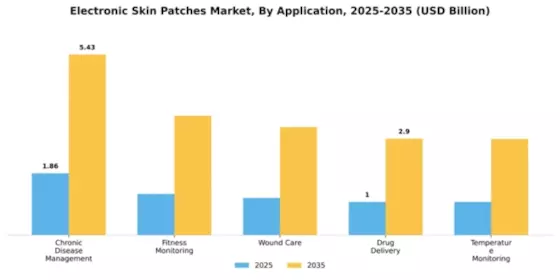
The Electronic Skin Patches Market showcases a diverse application spectrum, with Chronic Disease Management commanding a significant share due to the increasing prevalence of chronic illnesses worldwide. This segment has established itself as the leading application area, enabling continuous monitoring and management of conditions like diabetes and cardiovascular diseases effectively. Fitness Monitoring, on the other hand, has surfaced as a rapidly expanding segment, driven by a growing consumer focus on health and wellness, supported by advancements in wearable technology. The growth trends in this sector highlight a shift towards personalized healthcare solutions. Chronic Disease Management is benefiting from technological advancements in sensor technologies that allow for more precise health tracking. In contrast, Fitness Monitoring is propelled by the rising adoption of health and fitness applications among young consumers, indicating a strong inclination towards active lifestyles and preventive healthcare measures. Both segments reflect a promising future for electronic skin patches, shaped by a greater emphasis on proactive health management and innovation in medical technologies.
Chronic Disease Management (Dominant) vs. Drug Delivery (Emerging)
Chronic Disease Management has emerged as the dominant segment within the Electronic Skin Patches Market, owing to its crucial role in facilitating continuous health monitoring and treatment. This segment leverages advanced sensor technologies to deliver real-time data on patients' conditions, enabling timely interventions and enhancing overall healthcare outcomes. On the contrary, Drug Delivery represents an emerging application that is gaining traction due to its potential to revolutionize therapeutic delivery mechanisms. By utilizing electronic skin patches for drug administration, this segment aims to improve patient compliance and comfort, representing a significant innovation in the treatment of various chronic and acute conditions. As both segments continue to evolve, their intersection may lead to enhanced treatment solutions, driving further growth in the electronic skin patches market.
By End Use: Healthcare (Largest) vs. Sports (Fastest-Growing)
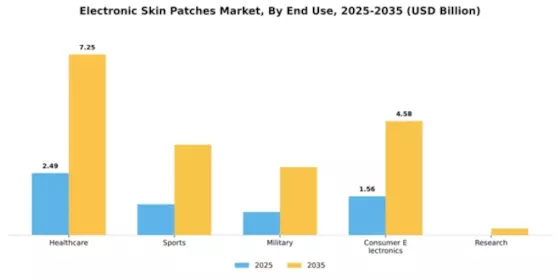
The Electronic Skin Patches Market is seeing a diverse distribution among its end-use segments: healthcare, sports, military, consumer electronics, and research. Healthcare is notably the largest segment, driven by the increasing demand for patient monitoring and chronic disease management. Sports, however, is rapidly catching up as a significant player due to rising interest in performance tracking and injury prevention, highlighting the adaptability of electronic skin patches to various health-related applications. In terms of growth trends, the healthcare segment experiences steady demand fueled by advancements in telemedicine, while the sports sector is characterized by innovation aimed at enhancing athletic performance. Factors such as increasing health consciousness, technological advances, and a surge in fitness activities among consumers contribute to the rapid growth in this segment, positioning it as the fastest-growing area within the market.
Healthcare (Dominant) vs. Sports (Emerging)
The healthcare segment of the Electronic Skin Patches Market remains dominant, focusing on applications such as continuous glucose monitoring, heart rate tracking, and medication adherence. This segment thrives on the integration of electronic patches with advanced sensors and wireless communication technologies, ensuring seamless data transmission for timely health insights. In contrast, the sports segment is emerging with products designed for fitness monitoring, injury analysis, and enhancing athletic performance. With growing investments in sports technology and the increasing popularity of wearables, sports electronic skin patches are becoming increasingly sophisticated, offering features like real-time biometric tracking, making them essential tools for both professional and amateur athletes.
By Technology: Flexible Sensors (Largest) vs. Wireless Communication (Fastest-Growing)
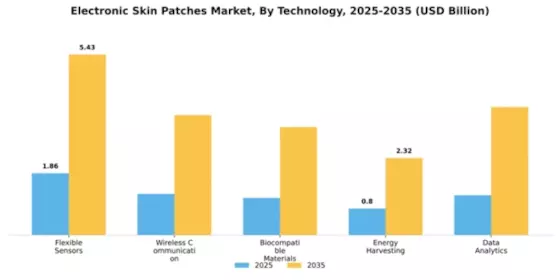
In the Electronic Skin Patches Market, the distribution of market share among technology segments reveals a clear dominance by Flexible Sensors, widely utilized for their adaptability and effectiveness in monitoring various health metrics. Wireless Communication follows closely, indicating a growing interest in remote patient monitoring solutions, accentuating the importance of connectivity in today's healthcare landscape. Both segments highlight the innovative advancements that are shaping the future of wearable technology.
Growth trends within this sector show a significant uptick in demand for Flexible Sensors as healthcare providers increasingly shift towards non-invasive monitoring technologies. The rapid evolution of Wireless Communication technologies is also propelling this segment, as it allows for real-time data transmission, vital for effective health management. As healthcare continues to digitize, investments in these technologies are anticipated to surge, reinforcing their market presence.
Flexible Sensors (Dominant) vs. Wireless Communication (Emerging)
Flexible Sensors stand out as the dominant technology in the Electronic Skin Patches Market due to their superior functionality and versatility in healthcare applications. These sensors provide highly accurate health monitoring capabilities, including vital signs tracking and biometric measurements, allowing for improved patient outcomes. In contrast, Wireless Communication is an emerging technology that facilitates the seamless transfer of health data from patches to devices or healthcare systems. Its development is driven by the increasing need for interoperability in medical devices, enabling timely interventions and enhancing patient engagement. Both technologies are crucial in defining the capabilities of electronic skin patches, shaping their role in modern healthcare.
By Material: Silicone (Largest) vs. Hydrogel (Fastest-Growing)
In the Electronic Skin Patches Market, the material segment showcases a diverse range of materials, primarily featuring Silicone, Polymer, Conductive Ink, Hydrogel, and Textile. Silicone holds the largest market share due to its biocompatibility and flexibility, making it a preferred choice for various applications. Meanwhile, Hydrogel is emerging as a significant player due to its moisture-retaining properties and comfort for the wearer. The presence of these materials creates a competitive landscape, with each offering unique characteristics and applications.
Silicone (Dominant) vs. Hydrogel (Emerging)
Silicone continues to dominate the Electronic Skin Patches Market, known for its durability, flexibility, and compatibility with electronic components. Its established presence in the market is bolstered by its use in various medical and consumer applications, which require reliable performance and flexibility. In contrast, Hydrogel is recognized as an emerging material poised for rapid growth, driven by its ability to mimic natural skin conditions and enhance comfort. Hydrogel patches are increasingly being utilized in therapeutic applications, improving wearability and user satisfaction. As demand for more advanced and user-friendly electronic skin patches rises, both materials are likely to evolve, with Silicone maintaining its dominant position while Hydrogel captures the attention of innovators in the sector.
By Type: Active Electronic Skin Patches (Largest) vs. Smart Electronic Skin Patches (Fastest-Growing)
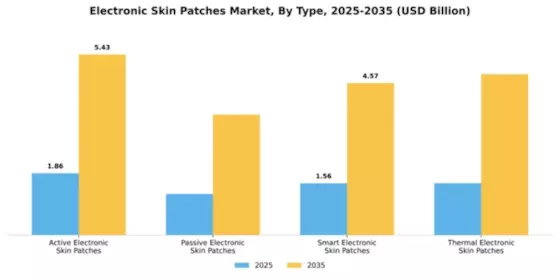
In the Electronic Skin Patches Market, Active Electronic Skin Patches hold the largest market share due to their advanced functionalities, which allow for real-time monitoring and data transmission. Passive Electronic Skin Patches follow as they serve basic health monitoring needs without active data transmission capabilities. Smart Electronic Skin Patches, with their integration of AI and connectivity features, are gaining traction rapidly, reflecting a growing consumer adoption and investments in technology-driven healthcare solutions.
Technological Functionality: Active Electronic Skin Patches (Dominant) vs. Smart Electronic Skin Patches (Emerging)
Active Electronic Skin Patches are at the forefront of the market, providing dynamic capabilities such as real-time health monitoring, which appeals to both consumers and healthcare professionals. These patches often include sensors and diagnostics that enhance patient care and data collection. In contrast, Smart Electronic Skin Patches are emerging as the trend with their focus on connectivity and integration with mobile health applications. This innovation enables users to manage their health better and provide critical data to healthcare providers in a user-friendly manner, making them an attractive option for the future.
Get more detailed insights about Electronic Skin Patches MarketRequest Free Sample
Regional Insights
North America : Market Leader in Innovation
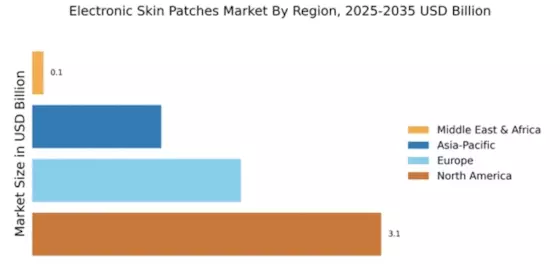
North America continues to lead the Electronic Skin Patches market, holding a significant share of 3.11 billion in 2024. The region's growth is driven by increasing healthcare expenditure, technological advancements, and a rising demand for remote patient monitoring solutions. Regulatory support from agencies like the FDA has further catalyzed innovation, allowing for rapid product development and market entry. The focus on chronic disease management and personalized healthcare is also propelling demand for these advanced medical devices. The competitive landscape in North America is robust, featuring key players such as Abbott, Medtronic, and iRhythm Technologies. These companies are at the forefront of developing innovative solutions that cater to diverse healthcare needs. The presence of established healthcare infrastructure and a high adoption rate of advanced technologies contribute to the region's market dominance. As the market evolves, partnerships and collaborations among these players are expected to enhance product offerings and expand market reach.
Europe : Emerging Market with Growth Potential
Europe's Electronic Skin Patches market is valued at 1.86 billion, showcasing significant growth potential driven by increasing health awareness and technological advancements. The region benefits from strong regulatory frameworks that encourage innovation and ensure product safety. Countries like Germany and the UK are leading the charge, with a growing emphasis on digital health solutions and remote monitoring. The European market is also witnessing a rise in investments aimed at enhancing healthcare delivery through advanced technologies. The competitive landscape in Europe is characterized by a mix of established players and emerging startups. Companies like Philips and Nemaura Medical are key contributors to market growth, focusing on innovative product development and strategic partnerships. The presence of a well-established healthcare system and supportive government policies further bolster the market. As the demand for personalized healthcare solutions rises, the European market is poised for continued expansion.
Asia-Pacific : Rapid Growth in Healthcare Technology
The Asia-Pacific region, valued at 1.15 billion, is experiencing rapid growth in the Electronic Skin Patches market, fueled by increasing healthcare investments and a rising prevalence of chronic diseases. Countries like China and Japan are at the forefront, with a growing focus on integrating technology into healthcare. The region's regulatory environment is evolving, supporting the introduction of innovative medical devices that cater to local healthcare needs. The demand for cost-effective healthcare solutions is also driving market growth in this region. The competitive landscape in Asia-Pacific is diverse, with both local and international players vying for market share. Companies such as Epicore Biosystems and Xsensio are making significant strides in product development, focusing on user-friendly and efficient solutions. The increasing adoption of telemedicine and remote monitoring technologies is further enhancing the market's growth prospects. As the region continues to invest in healthcare infrastructure, the Electronic Skin Patches market is expected to flourish.
Middle East and Africa : Emerging Market with Unique Challenges
The Middle East & Africa region, with a market size of 0.1 billion, presents unique challenges and opportunities in the Electronic Skin Patches market. The growth is primarily driven by increasing healthcare investments and a rising awareness of chronic diseases. However, the market faces hurdles such as regulatory complexities and varying healthcare infrastructure across countries. Despite these challenges, there is a growing interest in innovative healthcare solutions that can address local needs, supported by government initiatives aimed at improving healthcare access. Countries like South Africa and the UAE are leading the way in adopting advanced healthcare technologies. The competitive landscape is still developing, with a mix of local startups and international players exploring opportunities in this niche market. As the region continues to evolve, the demand for electronic skin patches is expected to grow, driven by the need for better healthcare solutions and improved patient monitoring capabilities.
Key Players and Competitive Insights
The Electronic Skin Patches Market is currently characterized by a dynamic competitive landscape, driven by advancements in wearable technology and increasing demand for remote health monitoring solutions. Key players such as Abbott (US), Medtronic (US), and Philips (NL) are strategically positioned to leverage their extensive research capabilities and established market presence. Abbott (US) focuses on innovation in glucose monitoring systems, while Medtronic (US) emphasizes its commitment to diabetes management through advanced patch technologies. Philips (NL) is enhancing its portfolio by integrating digital health solutions, thereby fostering a comprehensive approach to patient care. Collectively, these strategies contribute to a competitive environment that prioritizes technological advancement and patient-centric solutions.In terms of business tactics, companies are increasingly localizing manufacturing to enhance supply chain efficiency and reduce operational costs. The market structure appears moderately fragmented, with several players vying for market share. However, the influence of major companies is substantial, as they set industry standards and drive innovation. This competitive structure encourages smaller firms to adopt niche strategies, thereby enriching the overall market dynamics.In November Abbott (US) announced the launch of its latest electronic skin patch designed for continuous glucose monitoring, which integrates advanced sensor technology to provide real-time data to users. This strategic move not only reinforces Abbott's leadership in diabetes management but also highlights its commitment to enhancing user experience through innovative solutions. The introduction of this product is likely to strengthen Abbott's market position and attract a broader consumer base.In October Medtronic (US) unveiled a partnership with a leading tech firm to develop AI-driven analytics for its electronic skin patches. This collaboration aims to enhance data interpretation and improve patient outcomes through personalized health insights. The strategic importance of this partnership lies in its potential to revolutionize how patients interact with their health data, thereby positioning Medtronic at the forefront of digital health innovation.In September Philips (NL) expanded its electronic skin patch offerings by acquiring a startup specializing in biosensor technology. This acquisition is indicative of Philips' strategy to diversify its product range and integrate cutting-edge technology into its existing health solutions. By enhancing its capabilities in biosensing, Philips is likely to strengthen its competitive edge in the market, appealing to a growing segment of health-conscious consumers.As of December current competitive trends in the Electronic Skin Patches Market are increasingly defined by digitalization, sustainability, and the integration of AI technologies. Strategic alliances are becoming more prevalent, as companies recognize the value of collaboration in driving innovation and expanding market reach. Looking ahead, competitive differentiation is expected to evolve, shifting from price-based competition to a focus on technological innovation, reliability in supply chains, and enhanced user experiences. This transition underscores the importance of adaptability and forward-thinking strategies in maintaining a competitive advantage.
Key Companies in the Electronic Skin Patches Market include
Industry Developments
The Electronic Skin Patches Market has been experiencing dynamic developments with several key players making significant strides. Notably, VitalConnect and Verily Life Sciences are at the forefront, focusing on innovative health monitoring solutions. In recent months, companies like Medtronic, Siemens Healthineers, and Philips have expanded their product offerings in wearable health technologies, showcasing an increased emphasis on non-invasive health monitoring.
In terms of strategic movements, there has been notable buzz surrounding potential mergers and acquisitions, particularly involving companies such as iRhythm Technologies and Johnson & Johnson, as they seek to enhance their technological portfolios relevant to the electronic skin patch segment. The market valuation for electronic skin patches has seen robust growth due to the increasing demand for remote patient monitoring solutions, with expected rates of expansion influenced by advancements in sensor technologies and the integration of Artificial Intelligence into health applications.
Major events in the last 2-3 years, particularly in 2021 and 2022, have further amplified investment in Research and Development, owing to heightened consumer awareness and regulatory push for wearable healthcare solutions. The landscape continues to evolve rapidly, driving innovation and competitive dynamics across the globe.
Future Outlook
Electronic Skin Patches Market Future Outlook
The Electronic Skin Patches Market is projected to grow at a 10.4% CAGR from 2025 to 2035, driven by advancements in wearable technology, increasing health awareness, and demand for remote patient monitoring.
New opportunities lie in:
Development of integrated biosensors for real-time health monitoring Partnerships with telehealth platforms for enhanced patient engagement Expansion into emerging markets with tailored product offerings
By 2035, the market is expected to be robust, driven by innovation and strategic partnerships.
Market Segmentation
Electronic Skin Patches Market Type Outlook
Active Electronic Skin Patches
Passive Electronic Skin Patches
Smart Electronic Skin Patches
Thermal Electronic Skin Patches
Electronic Skin Patches Market End Use Outlook
Healthcare
Sports
Military
Consumer Electronics
Research
Electronic Skin Patches Market Material Outlook
Silicone
Polymer
Conductive Ink
Hydrogel
Textile
Electronic Skin Patches Market Technology Outlook
Flexible Electronics
Wearable Technology
Biometric Sensors
Telemedicine
Smart Textiles
Electronic Skin Patches Market Application Outlook
Chronic Disease Management
Fitness Monitoring
Wound Care
Drug Delivery
Temperature Monitoring
Report Scope
MARKET SIZE 2024
6.22(USD Billion)
MARKET SIZE 2025
6.86(USD Billion)
MARKET SIZE 2035
18.46(USD Billion)
COMPOUND ANNUAL GROWTH RATE (CAGR)
10.4% (2025 - 2035)
REPORT COVERAGE
Revenue Forecast, Competitive Landscape, Growth Factors, and Trends
What is the current market valuation of the Electronic Skin Patches Market?
As of 2024, the market valuation stands at 6.22 USD Billion.
What is the projected market size for the Electronic Skin Patches Market by 2035?
The market is expected to reach a valuation of 18.46 USD Billion by 2035.
What is the expected CAGR for the Electronic Skin Patches Market during the forecast period 2025 - 2035?
The market is anticipated to grow at a CAGR of 10.4% from 2025 to 2035.
Which applications are driving growth in the Electronic Skin Patches Market?
Key applications include Chronic Disease Management, Fitness Monitoring, and Wound Care, with valuations of 5.43, 3.59, and 3.25 USD Billion respectively by 2035.
What are the primary end-use segments for Electronic Skin Patches?
The main end-use segments are Healthcare, Sports, and Consumer Electronics, projected to reach 7.25, 3.63, and 4.58 USD Billion respectively by 2035.
Which technologies are contributing to the Electronic Skin Patches Market growth?
Technologies such as Flexible Sensors and Data Analytics are expected to drive growth, with projected valuations of 5.43 and 3.85 USD Billion by 2035.
Who are the key players in the Electronic Skin Patches Market?
Prominent players include Abbott, Medtronic, and iRhythm Technologies, among others.
How does the Electronic Skin Patches Market compare across different applications?
Chronic Disease Management leads with a projected valuation of 5.43 USD Billion, followed by Fitness Monitoring at 3.59 USD Billion by 2035.
What is the significance of biocompatible materials in the Electronic Skin Patches Market?
Biocompatible materials are crucial, with a projected market size of 3.25 USD Billion by 2035, indicating their importance in product development.
What trends are expected to shape the Electronic Skin Patches Market in the coming years?
Trends such as increased demand for remote health monitoring and advancements in wireless communication technologies are likely to shape the market through 2035.
Author
Author
Vikita Thakur
Senior Research Analyst
She holds an experience of about 5+ years in market research and business consulting projects for sectors such as life sciences, medical devices, and healthcare IT. She possesses a robust background in data analysis, market estimation, competitive intelligence, pipeline analysis market trend identification, and consumer behavior insights. Her expertise lies in technical Sales support, client interaction and project management, designing and implementing market research studies, conducting competitive analysis, and synthesizing complex data into actionable recommendations that drive business growth.
read more
Co-Author
Rahul Gotadki
Research Manager
He holds an experience of about 9+ years in Market Research and Business Consulting, working under the spectrum of Life Sciences and Healthcare domains. Rahul conceptualizes and implements a scalable business strategy and provides strategic leadership to the clients. His expertise lies in market estimation, competitive intelligence, pipeline analysis, customer assessment, etc.
The secondary research process involved comprehensive analysis of regulatory databases for medical wearables, peer-reviewed biomedical engineering journals, clinical publications on remote patient monitoring, and authoritative health technology organizations. Key sources included the US Food & Drug Administration (FDA) Center for Devices and Radiological Health (CDRH), European Medicines Agency (EMA) Medical Device Coordination Group, International Electrotechnical Commission (IEC) standards for wearable electronic devices, Institute of Electrical and Electronics Engineers (IEEE) Xplore Digital Library, International Society for Wearable Computing (ISWC), National Institutes of Health (NIH) National Institute of Biomedical Imaging and Bioengineering, National Center for Biotechnology Information (NCBI/PubMed), ClinicalTrials.gov registry, World Health Organization (WHO) Medical Device Information System, EU Medical Device Regulation (MDR) database (EUDAMED), and national medical device regulatory agencies from key markets. These sources were used to collect approval data for Class II/III wearable sensors, clinical validation studies on stretchable electronics, patient monitoring guidelines, reimbursement codes for remote therapeutic monitoring (RTM), and competitive landscape analysis for cardiac monitoring patches, diabetes management patches, temperature sensors, and other electronic skin patch modalities.
Primary Research
Qualitative and quantitative insights were obtained by interviewing supply-side and demand-side stakeholders during the primary research process. Supply-side sources comprised CEOs, Chief Technology Officers (CTOs), Vice Presidents of Bioelectronics Research and Development, regulatory affairs managers, and commercial directors from electronic skin patch manufacturers, flexible electronics OEMs, and sensor technology providers. Board-certified cardiologists, endocrinologists who specialize in diabetes technology, sleep medicine specialists, nursing directors, and procurement leaders from hospitals, ambulatory care centers, long-term care facilities, and home healthcare agencies comprised demand-side sources. Primary research has confirmed the product development timelines for next-generation flexible hybrid electronics, validated market segmentation across cardiovascular monitoring and diabetes management applications, and gathered insights on clinical adoption barriers, integration with EHR systems, pricing strategies for disposable vs. reusable patches, and reimbursement dynamics for remote patient monitoring (RPM) billing codes.
Primary Respondent Breakdown:
By Designation: C-level Primaries (30%), Director Level (32%), Others (38%)
By Region: North America (32%), Europe (30%), Asia-Pacific (28%), Rest of World (10%)
Market Size Estimation
Global market valuation was derived through revenue mapping and unit shipment analysis. The methodology included:
The identification of over 40 key manufacturers in North America, Europe, Asia-Pacific, and Latin America who specialize in medical devices and flexible electronics
Product mapping across cardiovascular monitoring patches, continuous glucose monitoring (CGM) adjunctive patches, temperature/respiratory monitors, motion sensing patches, and drug delivery skin interfaces
Analysis of reported and modeled annual revenues specific to electronic skin patch portfolios and wearable sensor divisions
Coverage of manufacturers representing 65-70% of global market share in 2024
Extrapolation using bottom-up (unit shipments × ASP by application and region) and top-down (manufacturer revenue validation and industry reported growth rates) approaches to derive segment-specific valuations for diagnostic monitoring versus therapeutic delivery applications
“This is really good guys. Excellent work on a tight deadline. I will continue to use you going forward and recommend you to others. Nice job”
Noah MalgeriCo-Founder
“Thanks. It’s been a pleasure working with you, please use me as reference with any other Intel employees.”
Joseph AguayoSales Operations & Pricing Manager
“Thanks for sending the report it gives us a good global view of the Betaïne market.”
Peter Groot koerkampAccount and Business Manager
“Thank you, this will be very helpful for OQS.”
La Terria DoddProgram Support Specialist
“We found the report very insightful! we found your research firm very helpful. I'm sending this email to secure our future business.”
Younghwan ChoiSenior Retail Manager
“I am very pleased with how market segments have been defined in a relevant way for my purposes (such as "Portable Freezers & refrigerators" and "last-mile").
In general the report is well structured. Thanks very much for your efforts.”
Mark IrwinManagement Consultant
“I have been reading the first document or the study, ,the Global HVAC and FP market report 2021 till 2026. Must say, good info! I have not gone in depth at all parts, but got a good indication of the data inside!”
Rob KooikerGroup Product Manager HVAC & Fire Protection GMA
“We got the report in time, we really thank you for your support in this process. I also thank to all of your team as they did a great job.”
Akif MorogluStrategy & Business Development Director
“The Automotive 48V ECU Components Procurement Intelligence Study” was a complex project, but the Market Research Future (MRFR) team handled it with quality, agility, and customer-centricity. They delivered all requested data on time and within the agreed scope. The team, including Shubhendra Anand and Rahul Gotadki, was always readily available to clarify questions and swiftly implement necessary adjustments, driving the project to a successful conclusion within a very demanding timeframe.
I would also like to specifically commend Akshay Agarwal for his responsiveness and support at every stage—from our initial inquiry on May 6th through to final delivery on June 18th. His dedication made the entire process seamless.”
Guilherme Gomes MartinsProduct Management Director