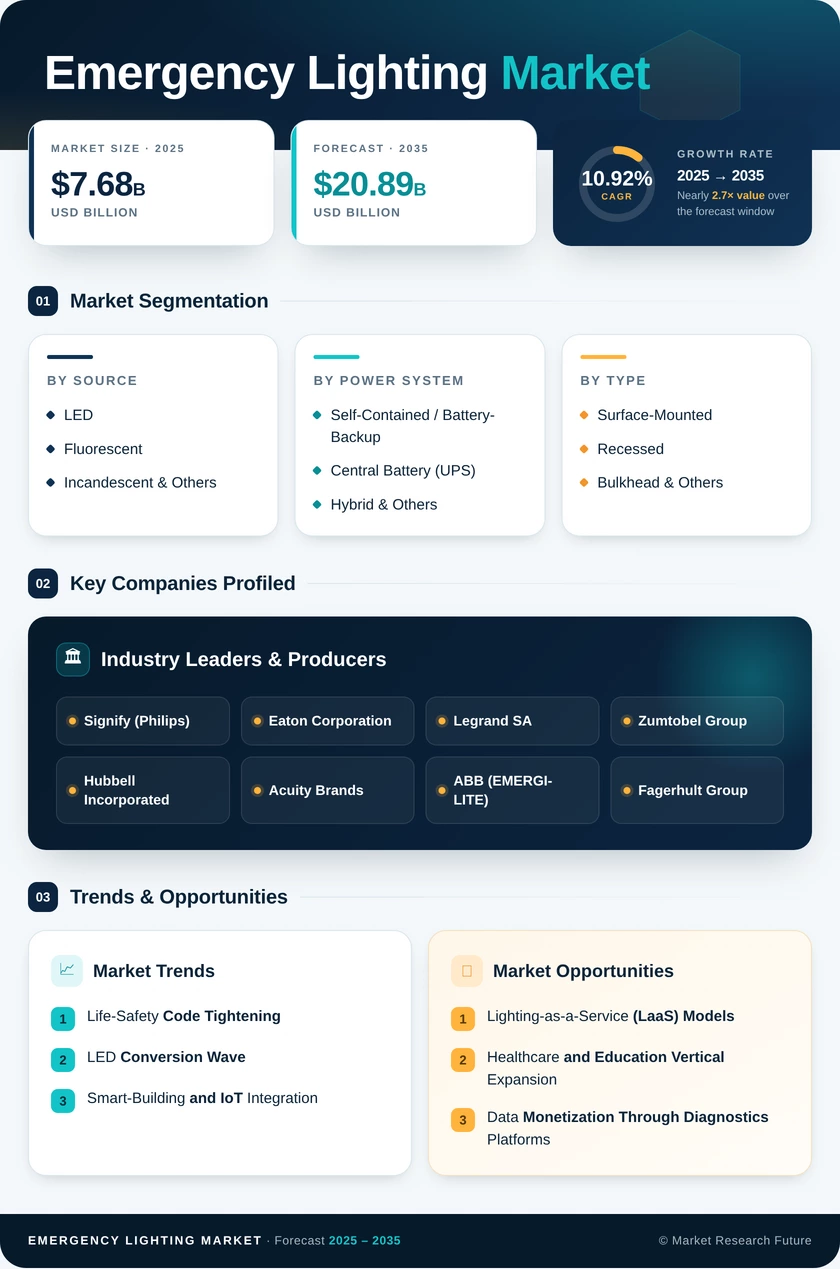
Segmentation Quick Reference
| Dimension | Sub-Segments | Dominant Segment | Fastest Growing Segment |
| Light Source | LED, Fluorescent, Incandescent & Others | LED (~61% share, 2025) | LED (volume); Fluorescent declining |
| Power System | Self-Contained / Battery-Backup, Central Battery (UPS), Hybrid & Others | Self-Contained (~69% share, 2025) | Central Battery (UPS) — 11.85% CAGR |
| Installation Type | Surface-Mounted, Recessed, Bulkhead & Others | Surface-Mounted (~49% share, 2025) | Recessed — 10.92% CAGR |
| Communication | Wired (DALI, Hardwired), Wireless (Zigbee, BLE Mesh, Wi-Fi) | Wired (~86% share, 2025) | Wireless — 14.08% CAGR |
| End User | Commercial Offices, Industrial, Public Infrastructure, Emergency Lighting Market, Residential, Education | Commercial Offices (~29.5% share, 2025) | Emergency Lighting Market — 11.52% CAGR |
Market Segmentation Overview
By Light Source
| Sub-Segment | Key Trend |
| LED | Regulatory mandates and 160 lm/W efficacy consolidate dominance; native self-test and dimming support |
| Fluorescent | Accelerating phase-out under EU Ecodesign (2027 ban); replacement cycle drives LED upgrade demand |
| Incandescent & Others | Residual installed base in developing regions; negligible new installations |
LED emergency exit lighting systems account for over three-fifths of the global Emergency Lighting Market and continue to absorb share from legacy fluorescent and incandescent technologies as efficacy improvements and code mandates converge.
By Power System
| Sub-Segment | Key Trend |
| Self-Contained / Battery-Backup | Dominant format; each fixture operates independently with integrated LFP or NiMH cells |
| Central Battery (UPS) | Gaining traction in healthcare, campus, and industrial applications with centralized monitoring |
| Hybrid & Others | Niche applications in data centers and long-tunnel installations requiring dual power feeds |
Battery backup emergency lighting for buildings remains the backbone of the sector, with self-contained units favored for their installation simplicity, while central battery systems grow in verticals demanding unified monitoring and extended-duration autonomy.
By Installation Type
| Sub-Segment | Key Trend |
| Surface-Mounted | Retrofit-friendly; dominant in exit signage and corridor applications |
| Recessed | Growing in premium commercial interiors and architectural lighting designs |
| Bulkhead & Others | Industrial, outdoor, and harsh-environment applications with IP65+ ratings |
Surface-mounted LED emergency exit lighting systems lead the Emergency Lighting Market in installation volume, though recessed formats are gaining specification preference in newly constructed Class A offices and hospitality environments.
By Communication
| Sub-Segment | Key Trend |
| Wired (DALI, Hardwired) | Established infrastructure; mandatory in many code frameworks |
| Wireless (Zigbee, BLE Mesh, Wi-Fi) | Fastest-growing; 40–60% cabling-cost savings drive retrofit adoption |
Self-testing emergency luminaire technology increasingly leverages wireless protocols to deliver automated compliance logging without the infrastructure cost of dedicated control wiring, reshaping the Emergency Lighting Market's communication landscape.
By End User
| Sub-Segment | Key Trend |
| Commercial Offices | Largest segment; LEED/BREEAM cycles drive regular upgrade demand |
| Industrial | ATEX/IECEx-rated fixtures for hazardous environments; process-safety mandates |
| Public Infrastructure | Airports, tunnels, transit stations with high-lumen, long-duration requirements |
| Emergency Lighting Market | Three-hour duration mandates; patient-evacuation safety; self-testing preference |
| Residential | Multi-family high-rise code requirements; cost-sensitive market |
| Education | Government-funded safety audits; growing adoption of self-testing emergency luminaire technology |
Emergency lighting for hospitals and schools represents a strategically important growth vertical within the Emergency Lighting Market, where compliance obligations intersect with public-safety imperatives and government funding availability.