Download Free Sample
Kindly complete the form below to receive a free sample of this Report
Employee Training and Development Services Market Size, Share and Trends Analysis Research Report Information By Content Type (Technical Skills, Soft Skills, Compliance, Leadership, Product Knowledge), By Industry Focus (IT, Healthcare, Manufacturing, Retail, Finance), By Target Audience (Corporate Employees, Small Businesses, Government, Non-Profits, Freelancers), By Training Methodology (On-the-Job, E-Learning, Instructor-Led, Blended, Simulation-Based), And By Region – Market Forecast Till 2035.
As per MRFR analysis, the Employee Training and Development Services Market was estimated at 400.0 USD Billion in 2024. The Employee Training and Development Services industry is projected to grow from 418.04 USD Billion in 2025 to 650.0 USD Billion by 2035, exhibiting a compound annual growth rate (CAGR) of 4.51% during the forecast period 2025 - 2035.
The Employee Training and Development Services Market is experiencing a transformative shift towards technology-driven solutions and a focus on soft skills.
| 2024 Market Size | 400.0 (USD Billion) |
| 2035 Market Size | 650.0 (USD Billion) |
| CAGR (2025 - 2035) | 4.51% |
Dale Carnegie Training (US), Skillsoft (US), LinkedIn Learning (US), Coursera (US), Udemy (US), Pluralsight (US), Korn Ferry (US), GP Strategies (US), FranklinCovey (US)
Our Impact
Enabled $4.3B Revenue Impact for Fortune 500 and Leading Multinationals
Partnering with 2000+ Global Organizations Each Year
30K+ Citations by Top-Tier Firms in the Industry
The Employee Training and Development Services Market is currently experiencing a transformative phase, driven by the increasing recognition of the value of continuous learning within organizations. Companies are increasingly investing in tailored training programs that align with their strategic goals, thereby enhancing employee skills and overall productivity. This shift reflects a broader understanding that a well-trained workforce is essential for maintaining competitive advantage in a rapidly evolving business landscape. Furthermore, the integration of technology into training methodologies, such as e-learning platforms and virtual reality simulations, appears to be reshaping how training is delivered, making it more accessible and engaging for employees. In addition, there is a growing emphasis on soft skills development alongside technical training. Organizations seem to recognize that interpersonal skills, emotional intelligence, and adaptability are crucial for fostering a collaborative work environment. This trend indicates a holistic approach to employee development, where both hard and soft skills are prioritized. As the Employee Training and Development Services Market continues to evolve, it is likely that companies will seek innovative solutions to meet the diverse needs of their workforce, ensuring that training remains relevant and impactful in the years to come.
The incorporation of advanced technologies into training programs is becoming increasingly prevalent. Organizations are leveraging e-learning platforms, mobile applications, and virtual reality to create immersive learning experiences. This trend not only enhances engagement but also allows for personalized learning paths that cater to individual employee needs.
There is a noticeable shift towards prioritizing soft skills development within training initiatives. Companies are recognizing the importance of skills such as communication, teamwork, and problem-solving in fostering a positive workplace culture. This trend suggests a more comprehensive approach to employee development.
Organizations are increasingly utilizing data analytics to inform their training strategies. By analyzing employee performance and feedback, companies can identify skill gaps and tailor training programs accordingly. This data-driven approach appears to enhance the effectiveness of training initiatives, ensuring they meet the specific needs of the workforce.
Employee engagement has emerged as a critical focus within the Employee Training and Development Services Market. Organizations are increasingly aware that engaged employees are more productive and committed to their roles. Research indicates that companies with high employee engagement levels experience 21 percent higher profitability. Consequently, businesses are investing in training programs that not only enhance skills but also promote a positive workplace culture. This shift towards engagement-driven training is likely to propel the Employee Training and Development Services Market forward, as organizations seek to create environments that foster collaboration, innovation, and overall employee satisfaction.
The Employee Training and Development Services Market is experiencing a notable surge in demand for upskilling initiatives. Organizations are increasingly recognizing the necessity of equipping their workforce with advanced skills to remain competitive. According to recent data, approximately 70 percent of employees believe they need to acquire new skills to adapt to evolving job requirements. This trend is driven by rapid technological advancements and changing market dynamics, compelling companies to invest in training programs that enhance employee capabilities. As a result, the Employee Training and Development Services Market is likely to witness substantial growth, with businesses allocating larger budgets towards comprehensive training solutions that address skill gaps and foster employee retention.
The rise of remote work has significantly influenced the Employee Training and Development Services Market. With a growing number of employees working from home, organizations are adapting their training methodologies to incorporate e-learning solutions. This shift allows for greater flexibility and accessibility, enabling employees to engage in training at their convenience. Data suggests that e-learning can increase retention rates by up to 60 percent compared to traditional training methods. Consequently, businesses are investing in digital training platforms that cater to remote work environments, thereby driving growth in the Employee Training and Development Services Market. The trend towards e-learning is likely to continue, as organizations seek to optimize training delivery and enhance employee learning experiences.
The necessity for regulatory compliance is a significant driver within the Employee Training and Development Services Market. Organizations are mandated to adhere to various industry standards and regulations, necessitating ongoing training for employees. This requirement is particularly pronounced in sectors such as healthcare, finance, and manufacturing, where compliance training is essential to mitigate risks and ensure operational integrity. As a result, companies are increasingly investing in specialized training programs that address compliance issues, thereby contributing to the growth of the Employee Training and Development Services Market. The focus on compliance training is expected to intensify, as organizations strive to avoid penalties and maintain their reputations.
The emphasis on diversity and inclusion has become a pivotal driver in the Employee Training and Development Services Market. Organizations are increasingly recognizing the importance of fostering inclusive workplaces that reflect diverse perspectives. Training programs aimed at promoting diversity and inclusion are being implemented to enhance team dynamics and improve overall organizational performance. Research indicates that companies with diverse teams are 35 percent more likely to outperform their competitors. As a result, businesses are allocating resources towards training initiatives that address unconscious bias and promote cultural competence. This focus on diversity and inclusion training is expected to significantly impact the Employee Training and Development Services Market, as organizations strive to create equitable environments that attract and retain top talent.
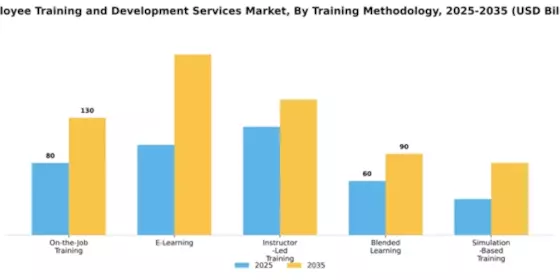
In the Employee Training and Development Services Market, e-learning has emerged as the largest segment, capturing significant market share due to its accessibility and scalability. On-the-job training and instructor-led training also hold notable portions, but e-learning stands out for its cost-effectiveness and flexibility, catering to diverse learning needs across various industries. The growth trends within this segment are primarily driven by technological advancements and a shift in organizational training strategies. As businesses increasingly adopt digital solutions, e-learning is gaining traction, while simulation-based training is rapidly becoming the fastest-growing method due to its immersive and interactive nature. This evolution reflects a broader trend towards personalized and engaging training environments that enhance employee performance and satisfaction.
E-Learning (Dominant) vs. Simulation-Based Training (Emerging)
E-learning, as the dominant training methodology, leverages technology to deliver content at scale while providing employees with the flexibility to learn at their own pace. Its effectiveness is enhanced by rich multimedia content that caters to different learning styles, making it a preferred choice for organizations aiming to upskill their workforce efficiently. On the other hand, simulation-based training is emerging quickly, characterized by its hands-on approach where learners engage in realistic scenarios to develop practical skills. This method is particularly valued in high-stakes industries, such as healthcare and aviation, where experiential learning can significantly enhance competency and confidence. Together, these methodologies highlight the diverse approaches businesses are taking to engage employees and foster continuous development.
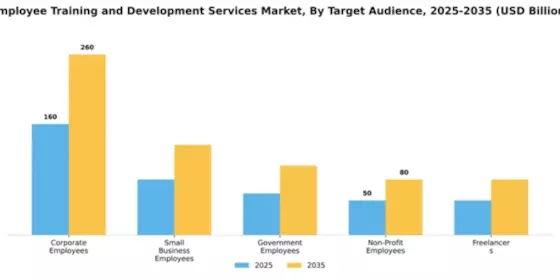
In the Employee Training and Development Services Market, the distribution of target audiences reveals that corporate employees constitute the largest segment. This demographic seeks comprehensive training programs that align with organizational goals and enhance workforce productivity. Conversely, freelancers, while smaller in market share, are rapidly emerging as a significant segment due to their unique needs for flexible, tailored training solutions that can adapt to varied client demands and project scopes. As businesses increasingly recognize the importance of initial and ongoing training, corporate employees will likely continue commanding the highest share. However, the freelance workforce is experiencing the fastest growth as self-directed learning gains prominence, driven by the gig economy, technological advancements, and an increasing emphasis on skills diversification. Adaptability and specific skill training are key drivers fueling this shift towards freelancers, positioning them as a pivotal focus for future service offerings.
Corporate Employees: Dominant vs. Freelancers: Emerging
Corporate employees represent a significant chunk of the Employee Training and Development Services Market due to their structured training needs and the emphasis placed on compliance and skill enhancement within organizations. Typically, this segment leverages corporate training programs that are methodically tailored to reinforce company values and enhance team efficiency. On the other hand, freelancers are emerging as a noteworthy segment, driven by a desire for personalized training that caters to the challenges of a diverse freelance career. They require training that is modular, on-demand, and focuses on advanced skills specific to their projects. The differentiation in their training needs showcases a growing trend towards flexibility and customization, pushing training providers to innovate and develop specialized offerings for this dynamic segment.
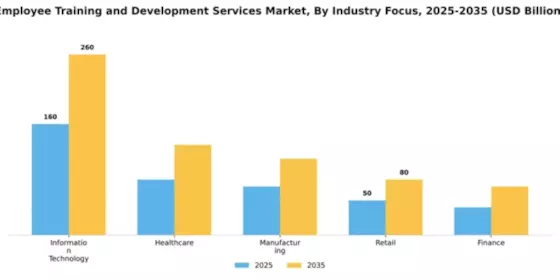
In the Employee Training and Development Services Market, the Information Technology sector holds the largest share, reflecting its pivotal role in driving workforce competency through continuous learning and certifications. This segment benefits from the rapid evolution of technology, necessitating ongoing employee training to maintain competitiveness. On the other hand, the Healthcare sector is recognized as the fastest-growing segment, fueled by increasing demand for skilled professionals and compliance requirements in a highly regulated environment.
Information Technology: Training Programs (Dominant) vs. Healthcare: Compliance Training (Emerging)
The Information Technology sector, as the dominant player in employee training and development, offers robust training programs that focus on technical skills, software proficiency, and cybersecurity knowledge. Companies invest heavily in these programs to enhance employee capabilities and adapt to new technologies. In contrast, the healthcare sector is emerging with a focus on compliance training, necessitated by stringent regulations and the need for continuously updated skills. This segment prioritizes training that addresses specific healthcare standards, patient care protocols, and the latest medical advancements, thereby creating a workforce that is not only qualified but also agile in responding to changes in healthcare practices.
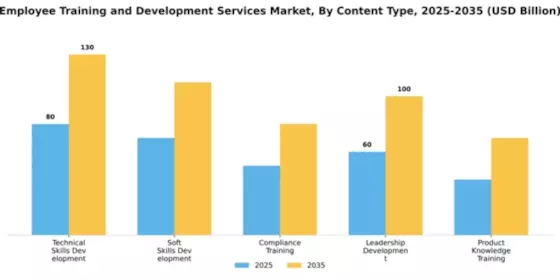
The Employee Training and Development Services Market showcases a diverse array of content types, prominently featuring Technical Skills Development as the largest segment. This segment captures a significant portion of market share, driven by the ever-evolving nature of technology and the increasing need for a skilled workforce. Additionally, Soft Skills Development is rapidly gaining traction, reflecting a growing recognition of the importance of interpersonal skills in the workplace. As organizations strive for comprehensive employee growth, these two segments exhibit noteworthy distinctions in their appeal and market presence. In recent years, the demand for Compliance Training has remained stable, as organizations prioritize regulatory requirements. However, Leadership Development is emerging as a critical focus area, with companies increasingly investing in programs that nurture future leaders. Product Knowledge Training continues to play a vital role, ensuring employees are well-informed about offerings. The growth trends are driven by the need to adapt to dynamic market conditions and the benefits of investing in comprehensive training solutions that cater to both hard and soft skills.
Technical Skills Development (Dominant) vs. Leadership Development (Emerging)
Technical Skills Development is a dominant segment in the Employee Training and Development Services Market, characterized by its focus on equipping employees with specific technical competencies required for their roles. It addresses the pressing need for skill enhancement in fields such as IT, engineering, and manufacturing. This segment has received widespread acceptance due to the continuous evolution of technologies, making it essential for professionals to stay updated. Conversely, Leadership Development is an emerging segment that has gained momentum as organizations recognize the importance of cultivating leadership qualities among employees. This initiative is driven by the realization that strong leaders can significantly influence team performance and organizational culture. As companies seek to prepare the next generation of leaders, they are channeling resources into tailored training programs that develop critical leadership skills and foster a culture of growth and innovation.
Get more detailed insights about Employee Training and Development Services Market Request Free Sample
North America leads the Employee Training and Development Services Market, holding a significant market share of 200.0. The region's growth is driven by a strong emphasis on workforce upskilling, technological advancements, and a competitive corporate environment. Companies are increasingly investing in training programs to enhance employee productivity and retention, supported by favorable regulations that promote continuous learning and development. The United States is the primary contributor to this market, with key players like Dale Carnegie Training, Skillsoft, and LinkedIn Learning dominating the landscape. The competitive environment is characterized by a mix of established firms and innovative startups, all vying to offer cutting-edge training solutions. This dynamic market is expected to continue its upward trajectory as organizations recognize the value of investing in their workforce.
Europe's Employee Training and Development Services Market is valued at 100.0, reflecting a growing recognition of the importance of skills development. The region is witnessing increased demand for training services driven by regulatory frameworks that encourage lifelong learning and workforce adaptability. Governments are investing in educational initiatives to enhance employability, which is further fueling market growth. Leading countries such as Germany, the UK, and France are at the forefront of this trend, with a competitive landscape featuring both local and international training providers. Companies like Coursera and Udemy are expanding their reach, offering diverse training solutions tailored to various industries. The emphasis on digital transformation and remote learning is reshaping the market, making it more accessible and flexible for organizations and employees alike.
The Asia-Pacific region, with a market size of 80.0, is rapidly evolving in the Employee Training and Development Services sector. The growth is driven by increasing investments in education and training, coupled with a rising demand for skilled labor in emerging economies. Countries are implementing policies to enhance workforce capabilities, which is creating a favorable environment for training service providers. Key players in this region include local firms and global giants like Pluralsight and Korn Ferry, which are adapting their offerings to meet the unique needs of diverse markets. Countries such as China and India are leading the charge, with significant investments in digital learning platforms. The competitive landscape is characterized by innovation and a focus on technology-driven solutions, making training more accessible to a broader audience.
The Middle East and Africa region, with a market size of 20.0, presents untapped potential in the Employee Training and Development Services Market. The growth is primarily driven by increasing awareness of the importance of workforce training and development, alongside government initiatives aimed at enhancing educational standards. The region is witnessing a gradual shift towards investing in human capital, which is essential for economic diversification and growth. Countries like South Africa and the UAE are leading the way, with a growing number of training providers entering the market. The competitive landscape is still developing, with both local and international players vying for market share. Key organizations are focusing on tailored training solutions that address specific regional needs, paving the way for future growth in this sector.
The Employee Training and Development Services Market is currently characterized by a dynamic competitive landscape, driven by the increasing demand for upskilling and reskilling in a rapidly evolving job market. Key players such as Dale Carnegie Training (US), Skillsoft (US), and LinkedIn Learning (US) are strategically positioning themselves through innovative digital solutions and partnerships. For instance, Dale Carnegie Training (US) emphasizes experiential learning and has recently expanded its offerings to include virtual reality training modules, enhancing engagement and retention. Meanwhile, Skillsoft (US) focuses on integrating AI-driven personalized learning paths, which appears to resonate well with organizations seeking tailored training solutions. LinkedIn Learning (US) leverages its vast user base to provide data-driven insights into learning trends, thereby shaping its content strategy to meet emerging skills demands.The market structure is moderately fragmented, with numerous players competing for market share. This fragmentation is indicative of a diverse range of training methodologies and delivery formats, from traditional classroom settings to fully online platforms. Key players are employing various business tactics, such as localizing content to cater to regional needs and optimizing their supply chains to enhance service delivery. The collective influence of these companies fosters a competitive environment where innovation and adaptability are paramount.In November Coursera (US) announced a strategic partnership with a leading technology firm to develop a new suite of AI-powered courses aimed at enhancing digital literacy among professionals. This move is significant as it not only broadens Coursera's course offerings but also positions the company at the forefront of the digital transformation trend, appealing to organizations eager to equip their workforce with essential tech skills. The partnership underscores the importance of collaboration in creating relevant and timely educational content.In October Udemy (US) launched a new initiative focused on corporate training solutions, which includes customizable learning paths for organizations. This initiative is particularly noteworthy as it reflects Udemy's commitment to addressing the specific needs of businesses, thereby enhancing its competitive edge in the corporate training segment. By offering tailored solutions, Udemy is likely to attract a broader clientele seeking effective training methodologies that align with their organizational goals.In September Korn Ferry (US) expanded its global reach by acquiring a regional training provider in Asia, thereby enhancing its service capabilities in that market. This acquisition is indicative of Korn Ferry's strategy to strengthen its position in emerging markets, where demand for employee development services is on the rise. Such strategic moves not only diversify their service offerings but also enable them to tap into new revenue streams.As of December the competitive trends in the Employee Training and Development Services Market are increasingly defined by digitalization, sustainability, and the integration of AI technologies. Strategic alliances are becoming more prevalent, as companies recognize the value of collaboration in enhancing their service offerings. Looking ahead, competitive differentiation is likely to evolve from traditional price-based competition to a focus on innovation, technology integration, and supply chain reliability. This shift suggests that companies that prioritize these aspects will be better positioned to thrive in an increasingly complex market.






The Employee Training and Development Services Market is projected to grow at a 4.51% CAGR from 2025 to 2035, driven by technological advancements, increasing workforce demands, and a focus on employee retention.
New opportunities lie in:
By 2035, the market is expected to be robust, reflecting evolving training needs and technological integration.
| MARKET SIZE 2024 | 400.0(USD Billion) |
| MARKET SIZE 2025 | 418.04(USD Billion) |
| MARKET SIZE 2035 | 650.0(USD Billion) |
| COMPOUND ANNUAL GROWTH RATE (CAGR) | 4.51% (2025 - 2035) |
| REPORT COVERAGE | Revenue Forecast, Competitive Landscape, Growth Factors, and Trends |
| BASE YEAR | 2024 |
| Market Forecast Period | 2025 - 2035 |
| Historical Data | 2019 - 2024 |
| Market Forecast Units | USD Billion |
| Key Companies Profiled | Dale Carnegie Training (US), Skillsoft (US), LinkedIn Learning (US), Coursera (US), Udemy (US), Pluralsight (US), Korn Ferry (US), GP Strategies (US), FranklinCovey (US) |
| Segments Covered | Training Methodology, Target Audience, Industry Focus, Content Type |
| Key Market Opportunities | Integration of artificial intelligence in personalized employee training programs enhances engagement and effectiveness. |
| Key Market Dynamics | Rising demand for digital learning solutions drives innovation and competition in the Employee Training and Development Services Market. |
| Countries Covered | North America, Europe, APAC, South America, MEA |
The projected market valuation for the Employee Training and Development Services Market in 2035 is 650.0 USD Billion.
The overall market valuation for the Employee Training and Development Services Market was 400.0 USD Billion in 2024.
The expected CAGR for the Employee Training and Development Services Market during the forecast period 2025 - 2035 is 4.51%.
In 2024, the Instructor-Led Training segment had the highest valuation at 120.0 USD Billion.
The projected valuation for the E-Learning segment is expected to reach 200.0 USD Billion by 2035.
The Information Technology industry is anticipated to invest the most, with a projected valuation of 260.0 USD Billion by 2035.
The valuation range for Corporate Employees is projected to be between 160.0 and 260.0 USD Billion.
Key players in the market include Dale Carnegie Training, Skillsoft, LinkedIn Learning, and Coursera.
The projected valuation for Soft Skills Development is expected to reach between 70.0 and 110.0 USD Billion by 2035.
In 2024, Simulation-Based Training had a valuation of 40.0 USD Billion, whereas Blended Learning was valued at 60.0 USD Billion.


Kindly complete the form below to receive a free sample of this Report

“This is really good guys. Excellent work on a tight deadline. I will continue to use you going forward and recommend you to others. Nice job”


“Thanks. It’s been a pleasure working with you, please use me as reference with any other Intel employees.”


“Thanks for sending the report it gives us a good global view of the Betaïne market.”


“Thank you, this will be very helpful for OQS.”


“We found the report very insightful! we found your research firm very helpful. I'm sending this email to secure our future business.”


“I am very pleased with how market segments have been defined in a relevant way for my purposes (such as "Portable Freezers & refrigerators" and "last-mile"). In general the report is well structured. Thanks very much for your efforts.”


“I have been reading the first document or the study, ,the Global HVAC and FP market report 2021 till 2026. Must say, good info! I have not gone in depth at all parts, but got a good indication of the data inside!”


“We got the report in time, we really thank you for your support in this process. I also thank to all of your team as they did a great job.”


“The Automotive 48V ECU Components Procurement Intelligence Study” was a complex project, but the Market Research Future (MRFR) team handled it with quality, agility, and customer-centricity. They delivered all requested data on time and within the agreed scope. The team, including Shubhendra Anand and Rahul Gotadki, was always readily available to clarify questions and swiftly implement necessary adjustments, driving the project to a successful conclusion within a very demanding timeframe.
I would also like to specifically commend Akshay Agarwal for his responsiveness and support at every stage—from our initial inquiry on May 6th through to final delivery on June 18th. His dedication made the entire process seamless.”



