×
Request Free Sample ×

Kindly complete the form below to receive a free sample of this Report

* Please use a valid business email

Leading companies partner with us for data-driven Insights

clients tt-cursor
Hero Background

Energy Harvesting Trees Market

ID: MRFR/EnP/2878-HCR
110 Pages
Priya Nagrale
October 2025

Energy Harvesting Trees Market Research Report Information Report By Component (Nano leaves, Long Tower, LEDs, Batteries and others), By Technology (Photovoltaic (PV), Thermovoltaics (TV) and Piezovoltaic (PZ)), By Application (Commercial and Residential) and by Region - Global Forecast to 2035

Share:
Download PDF ×

We do not share your information with anyone. However, we may send you emails based on your report interest from time to time. You may contact us at any time to opt-out.

Energy Harvesting Trees Market Infographic
Purchase Options

Energy Harvesting Trees Market Summary

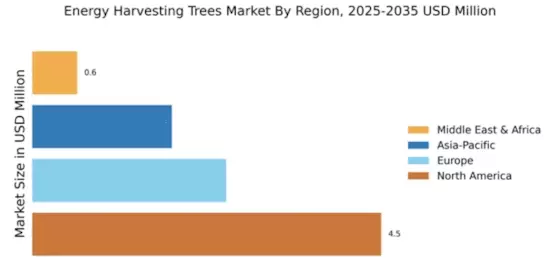
As per MRFR analysis, the Energy Harvesting Trees Market Size was estimated at 8.38 USD Million in 2024. The Energy Harvesting Trees industry is projected to grow from 9.28 USD Million in 2025 to 25.92 USD Million by 2035, exhibiting a compound annual growth rate (CAGR) of 10.82 during the forecast period 2025 - 2035.

Key Market Trends & Highlights

The Energy Harvesting Trees Market is poised for substantial growth driven by technological advancements and increasing urbanization.

  • The integration of energy harvesting trees with smart cities is becoming increasingly prevalent, enhancing urban sustainability.
  • Aesthetic design considerations are gaining traction, as consumers seek visually appealing energy solutions.
  • Collaboration with environmental initiatives is fostering innovation and promoting the adoption of energy harvesting technologies.
  • Technological advancements in energy harvesting and rising demand for renewable energy solutions are key drivers propelling market growth in North America and Asia-Pacific.

Market Size & Forecast

2024 Market Size 8.38 (USD Million)
2035 Market Size 25.92 (USD Million)
CAGR (2025 - 2035) 10.82%

Major Players

Tree Energy (US), Green Power Technologies (GB), EcoTree (FR), Harvest Energy Solutions (DE), Sustainable Energy Innovations (CA), Renewable Tree Systems (AU), Nature's Power (JP), BioEnergy Trees (IN)

Energy Harvesting Trees Market Trends

The Energy Harvesting Trees Market is currently experiencing a notable evolution, driven by the increasing demand for sustainable energy solutions. This market encompasses innovative technologies that harness energy from natural sources, particularly through the integration of tree-like structures equipped with energy-generating capabilities. As urbanization continues to rise, the need for eco-friendly energy alternatives becomes more pressing. Consequently, stakeholders are exploring various applications of energy harvesting trees, which may serve as both functional and aesthetic elements in urban landscapes. The potential for these systems to contribute to energy grids while enhancing green spaces is becoming increasingly recognized. Moreover, advancements in materials science and engineering are likely to play a pivotal role in the future of the Energy Harvesting Trees Market. Researchers are investigating new materials that could improve energy conversion efficiency and durability. This ongoing innovation suggests that the market may expand beyond traditional applications, potentially integrating with smart city initiatives and renewable energy projects. As environmental concerns gain prominence, the Energy Harvesting Trees Market appears poised for growth, with opportunities for collaboration among technology developers, urban planners, and environmental advocates. The intersection of technology and nature may redefine how energy is generated and consumed in urban settings, fostering a more sustainable future.

Integration with Smart Cities

The Energy Harvesting Trees Market is increasingly aligning with the development of smart cities. This trend indicates a growing recognition of the role that energy harvesting trees can play in urban infrastructure. By integrating these systems into smart city frameworks, municipalities may enhance energy efficiency and reduce reliance on conventional power sources.

Focus on Aesthetic Design

There is a noticeable shift towards incorporating aesthetic design in energy harvesting trees. This trend suggests that stakeholders are recognizing the importance of visual appeal in urban environments. By blending functionality with artistic elements, energy harvesting trees may attract greater public interest and acceptance.

Collaboration with Environmental Initiatives

The Energy Harvesting Trees Market is likely to see increased collaboration with various environmental initiatives. This trend indicates a potential synergy between energy harvesting technologies and conservation efforts. By working together, stakeholders may promote sustainability and raise awareness about the benefits of renewable energy sources.

Energy Harvesting Trees Market Drivers

Market Growth Projections

The Global Energy Harvesting Trees Market Industry is poised for substantial growth in the coming years. With a projected market value of 1.67 USD Billion in 2024, the industry is expected to expand significantly, reaching 7.05 USD Billion by 2035. This growth trajectory suggests a compound annual growth rate (CAGR) of 14.0% from 2025 to 2035. Such projections indicate a strong market potential driven by technological advancements, increasing urbanization, and supportive government policies. The anticipated growth reflects a broader shift towards sustainable energy solutions and the integration of innovative technologies into urban environments.

Growing Demand for Renewable Energy

The Global Energy Harvesting Trees Market Industry is experiencing a surge in demand for renewable energy solutions. As nations strive to meet their climate goals, the integration of energy harvesting technologies into urban landscapes becomes increasingly appealing. Energy harvesting trees, which convert kinetic energy from wind and solar energy into electricity, offer a sustainable alternative to traditional energy sources. This trend aligns with global efforts to reduce carbon emissions and promote sustainability. By 2024, the market is projected to reach 1.67 USD Billion, indicating a robust growth trajectory as more cities adopt these innovative solutions.

Government Initiatives and Incentives

Government policies and incentives are significantly influencing the Global Energy Harvesting Trees Market Industry. Many countries are implementing regulations that promote the use of renewable energy technologies, including energy harvesting trees. Financial incentives, such as grants and tax breaks, encourage municipalities to invest in these sustainable solutions. For example, various governments are allocating funds to support the installation of energy harvesting trees in public parks and transportation hubs. This proactive approach not only fosters innovation but also accelerates market growth, as evidenced by the anticipated increase in market value to 7.05 USD Billion by 2035.

Public Awareness and Environmental Concerns

Increasing public awareness regarding environmental issues is driving the Global Energy Harvesting Trees Market Industry. As communities become more conscious of their carbon footprints, there is a growing demand for sustainable energy solutions. Energy harvesting trees serve as a tangible representation of eco-friendly practices, appealing to environmentally conscious consumers and businesses alike. This heightened awareness is prompting local governments and organizations to invest in energy harvesting technologies, further propelling market growth. The combination of public interest and environmental advocacy is likely to contribute to a robust market expansion, with projections indicating a market size of 1.67 USD Billion by 2024.

Urbanization and Infrastructure Development

The rapid pace of urbanization is a key driver for the Global Energy Harvesting Trees Market Industry. As urban areas expand, the need for sustainable energy solutions becomes more pressing. Energy harvesting trees can be integrated into urban infrastructure, providing clean energy while enhancing the aesthetic appeal of public spaces. Cities are increasingly recognizing the dual benefits of these installations, which not only generate power but also contribute to urban greenery. This trend is likely to accelerate as urban populations continue to grow, with the market projected to expand at a CAGR of 14.0% from 2025 to 2035.

Technological Advancements in Energy Harvesting

Technological innovations play a pivotal role in the expansion of the Global Energy Harvesting Trees Market Industry. Recent advancements in materials science and energy conversion technologies have enhanced the efficiency and effectiveness of energy harvesting systems. For instance, the development of piezoelectric materials allows trees to generate electricity from vibrations caused by wind or human activity. These innovations not only improve energy output but also reduce costs, making energy harvesting trees more accessible to municipalities and private developers. As a result, the market is expected to grow significantly, with projections indicating a rise to 7.05 USD Billion by 2035.

Market Segment Insights

By Application: Energy Generation (Largest) vs. Smart Grid Integration (Fastest-Growing)

The Energy Harvesting Trees Market is segmented into various applications, notably energy generation, energy storage, smart grid integration, and environmental monitoring. Among these, energy generation captures the largest share of the market as it effectively converts natural resources into usable electrical energy. Smart grid integration, while smaller in market share, is recognized for its rapid growth as urbanized energy systems evolve to accommodate renewable resources.

Energy Storage (Dominant) vs. Environmental Monitoring (Emerging)

Energy storage solutions remain dominant within the energy harvesting trees applications, providing essential reliability and stability for renewable energy sources. In contrast, environmental monitoring is an emerging segment that leverages energy harvesting trees to collect important environmental data continuously. This segment is gaining traction due to increasing awareness surrounding sustainability and climate change. As these applications develop, they reflect a broader trend of integrating renewable energy solutions with innovative monitoring systems, making both sections vital to the future of the renewable energy landscape.

By Technology: Piezoelectric Technology (Largest) vs. Solar Technology (Fastest-Growing)

The Energy Harvesting Trees Market exhibits a diverse range of technologies, with Piezoelectric Technology currently holding the largest market share. This segment benefits from its reliable energy generation capabilities derived from mechanical stress, making it suitable for various applications. On the other hand, Solar Technology is emerging as a rapidly expanding segment, driven by increasing investments in renewable energy sources and the growing awareness of sustainable energy generation among consumers.

Technology: Piezoelectric (Dominant) vs. Solar (Emerging)

Piezoelectric Technology is the dominant force within the Energy Harvesting Trees Market due to its established application in providing energy from vibrations and movements. Its widespread integration in smart city infrastructure and IoT devices showcases the adaptability and efficiency of this technology. In contrast, Solar Technology represents the emerging trend, capitalizing on the vast potential of solar energy capture. With advancements in photovoltaic materials and declining costs of solar panels, this segment is witnessing accelerated growth, appealing to eco-conscious consumers and industries alike. As the market evolves, these technologies will play a critical role in pushing the boundaries of energy sustainability.

By End Use: Urban Infrastructure (Largest) vs. Agriculture (Fastest-Growing)

In the Energy Harvesting Trees Market, the distribution of market share among the end-use segments highlights the predominance of Urban Infrastructure, which stands out as the largest segment. This sector benefits from the increasing need for sustainable and renewable energy solutions in urban settings. On the other hand, while Urban Infrastructure holds the largest share, Agriculture is emerging as a rapidly growing sector, driven by innovations in agritech and the need for efficient energy use in farming practices. Growth trends in this market segment are significantly influenced by urbanization and the push for sustainable living. The Urban Infrastructure segment thrives due to ongoing developments in smart cities and green buildings, which emphasize energy efficiency. Meanwhile, the Agriculture segment is gaining traction as advancements in energy harvesting technologies are being integrated into agricultural practices, providing farmers with new tools to reduce energy costs and enhance productivity.

Urban Infrastructure (Dominant) vs. Agriculture (Emerging)

The Urban Infrastructure segment in the Energy Harvesting Trees Market is characterized by its substantial investment in the development of energy-efficient urban environments. This segment benefits from government initiatives that promote the integration of energy harvesting technologies into city planning, such as the installation of energy-producing trees along streets and public spaces. These innovations not only enhance the aesthetics of urban areas but also contribute to energy savings and sustainability goals. In contrast, the Agriculture segment is marked by its innovative approach to energy harvesting within farming operations. As energy costs rise, farmers are increasingly adopting energy harvesting trees to power equipment and reduce reliance on traditional energy sources. This segment is classified as emerging due to the growing interest from agribusinesses in implementing sustainable practices and the potential for significant energy savings.

By Material: Conductive Polymers (Largest) vs. Metals (Fastest-Growing)

The Energy Harvesting Trees Market showcases a diverse material segment, with conductive polymers emerging as the largest contributor due to their favorable properties, including high electrical conductivity and flexibility. Metals follow closely, with their traditional strength and durability being significant factors in their application, yet showcasing a more niche market share. Ceramics and composites, while important, occupy smaller shares, focusing on specific use cases within the industry. This distribution highlights the competitive landscape of materials where the adaptability of conductive polymers provides them an edge over metals and others, shaping the future of energy harvesting solutions.

Conductive Polymers (Dominant) vs. Metals (Emerging)

Conductive polymers have established themselves as the dominant material in the Energy Harvesting Trees Market due to their lightweight, flexible nature and excellent conductivity. Their ability to be easily integrated into various designs makes them attractive for innovative energy harvesting applications. On the other hand, metals are considered to be the emerging material owing to their reliability and efficiency in energy extraction, particularly in harsher environments where durability is critical. As technology advances, metals are evolving to incorporate new alloys and treatments, enhancing their performance and making them a significant contender in market adoption. Both materials reflect the evolving landscape of energy harvesting technology, where functionality and efficiency are key drivers.

By Deployment Type: Standalone Systems (Largest) vs. Integrated Systems (Fastest-Growing)

The Energy Harvesting Trees Market segment shows noteworthy distribution among three main deployment types: Standalone Systems, Integrated Systems, and Hybrid Systems. Standalone Systems lead the market, showcasing their robustness and reliability, attracting a significant customer base. Meanwhile, Integrated Systems are emerging rapidly, capitalizing on the growing demand for smarter, interconnected solutions. Hybrid Systems, although important, occupy a smaller share as the market evolves towards more integrated solutions that offer better efficiency and user experience.

Deployment Type: Standalone Systems (Dominant) vs. Integrated Systems (Emerging)

Standalone Systems stand out in the Energy Harvesting Trees Market due to their simplicity and effectiveness, making them popular among users who prefer low-maintenance solutions. They work independently, harnessing energy efficiently and ensuring a consistent power supply. Conversely, Integrated Systems are seen as the emerging force, gaining traction as industries lean towards interconnected systems that enhance operational efficiency. The shift towards smart technologies is propelling Integrated Systems forward, as they offer advanced features like real-time monitoring and control, making them an attractive option for businesses looking to innovate.

Get more detailed insights about Energy Harvesting Trees Market

Key Players and Competitive Insights

The Energy Harvesting Trees Market is currently characterized by a dynamic competitive landscape, driven by increasing demand for sustainable energy solutions and innovative technologies. Key players such as Tree Energy (US), Green Power Technologies (GB), and EcoTree (FR) are strategically positioning themselves through a combination of technological advancements and regional expansions. Tree Energy (US) focuses on integrating advanced energy harvesting technologies into urban forestry, while Green Power Technologies (GB) emphasizes partnerships with local governments to enhance community-based energy projects. EcoTree (FR) is leveraging its expertise in carbon offsetting to attract environmentally conscious consumers, thereby shaping a competitive environment that prioritizes sustainability and innovation.

In terms of business tactics, companies are increasingly localizing manufacturing and optimizing supply chains to enhance operational efficiency. The market appears moderately fragmented, with several players vying for market share. However, the collective influence of major companies is significant, as they drive innovation and set industry standards. This competitive structure fosters an environment where collaboration and strategic partnerships are essential for growth and market penetration.

In November 2025, Tree Energy (US) announced a groundbreaking partnership with a leading technology firm to develop smart energy harvesting systems that utilize IoT capabilities. This strategic move is likely to enhance their product offerings and position them as a leader in the integration of technology within the energy harvesting sector. The collaboration suggests a forward-thinking approach that aligns with current trends in digitalization and smart city initiatives.

Similarly, in October 2025, Green Power Technologies (GB) launched a new initiative aimed at expanding its energy harvesting solutions into emerging markets in Southeast Asia. This expansion is indicative of their strategy to tap into regions with growing energy needs, potentially increasing their market share and diversifying their revenue streams. Such initiatives reflect a broader trend of companies seeking growth opportunities in less saturated markets.

In September 2025, EcoTree (FR) secured a significant investment from a European venture capital firm to enhance its research and development capabilities. This funding is expected to accelerate the development of innovative energy harvesting technologies, reinforcing EcoTree's commitment to sustainability and positioning it favorably against competitors. The investment underscores the importance of continuous innovation in maintaining a competitive edge in this evolving market.

As of December 2025, the Energy Harvesting Trees Market is witnessing trends that emphasize digitalization, sustainability, and the integration of AI technologies. Strategic alliances are increasingly shaping the competitive landscape, enabling companies to leverage shared resources and expertise. Looking ahead, competitive differentiation is likely to evolve from traditional price-based competition to a focus on innovation, technological advancements, and supply chain reliability. This shift indicates a maturation of the market, where companies that prioritize sustainable practices and cutting-edge technology will likely emerge as leaders.

Key Companies in the Energy Harvesting Trees Market market include

Industry Developments

E-Peas SA and Energous Corporation have announced the introduction of a new Wireless Energy Harvesting Evaluation Kit in September 2022, designed for energy harvesting applications for smart buildings/smart homes, industrial IoT medical, and asset trackers for retail and warehouses. The kit comprises E-peas’ AEM30940 RF Evaluation Board as well as the EP112 Energy Harvesting Optimized Antenna Evaluation Board; it also comes with the company’s 1W WattUp PowerBridge transmitter that is designed to offer an over-the-air solution that supports wireless power and energy harvesting across various connected devices.

Powercast Corporation revealed in March 2022 that it had shipped ten million wireless RF Powerharvester PCC110 chips within the past two years. This was due to growing demand for wireless power-over-distance solutions that liberate devices from cords, batteries, and positioning limitations, such as needed by Qi wireless charging standard whereby one must place their device directly on a charging surface. When combined with Powercast’s technology, these are untethered devices that can be powered remotely (up to 80 feet away), thus reducing or even removing battery requirements/connections entirely while also improving their functionality/efficiency levels, making them more flexible when placing them.

In January of 2022 E-Peas SA announced that they were launching an Ultra-Compact Custom Power Management Solution for Cartier’s First Solar Energy Harvesting Watch -the Tank watch where. Its dimensions are just 2mm x 2mm, making the ultra-compact PMIC specially developed for Tank watch smaller than any other similar solutions available today. Some external components have been omitted from architecture so as to make it fit into the very confined space available.

Advanced Linear Devices, Inc.’s (ALD) portfolio of products in analog semiconductors has recently included nano-powder precision P-Channel EPAD MOSFET array, among them being published in January 2022. The matched pair MOSFET circuit is developed for low-power applications and mostly-on operation future generation products, thus aiding energy harvesting with the products’ efficiency, among other things. The MOSFET maximizes power efficiency by hydroponic bias circuitry. Mosfet array is used in automotive, medical, transportation, robotics and wireless product markets, including self-contained power circuits that need to operate at shallow power levels for long durations.

Future Outlook

Energy Harvesting Trees Market Future Outlook

The Energy Harvesting Trees Market is projected to grow at a 10.82% CAGR from 2024 to 2035, driven by technological advancements, increasing energy demands, and sustainability initiatives.

New opportunities lie in:

  • Development of integrated energy harvesting systems for urban environments.
  • Partnerships with municipalities for smart city energy solutions.
  • Innovative financing models for large-scale energy harvesting installations.

By 2035, the market is expected to be robust, driven by innovation and strategic partnerships.

Market Segmentation

Energy Harvesting Trees Market End Use Outlook

  • Urban Infrastructure
  • Transportation
  • Agriculture
  • Residential

Energy Harvesting Trees Market Material Outlook

  • Conductive Polymers
  • Metals
  • Ceramics
  • Composites

Energy Harvesting Trees Market Technology Outlook

  • Piezoelectric Technology
  • Electromagnetic Technology
  • Thermoelectric Technology
  • Solar Technology

Energy Harvesting Trees Market Application Outlook

  • Energy Generation
  • Energy Storage
  • Smart Grid Integration
  • Environmental Monitoring

Energy Harvesting Trees Market Deployment Type Outlook

  • Standalone Systems
  • Integrated Systems
  • Hybrid Systems

Report Scope

MARKET SIZE 20248.38(USD Million)
MARKET SIZE 20259.28(USD Million)
MARKET SIZE 203525.92(USD Million)
COMPOUND ANNUAL GROWTH RATE (CAGR)10.82% (2024 - 2035)
REPORT COVERAGERevenue Forecast, Competitive Landscape, Growth Factors, and Trends
BASE YEAR2024
Market Forecast Period2025 - 2035
Historical Data2019 - 2024
Market Forecast UnitsUSD Million
Key Companies ProfiledTree Energy (US), Green Power Technologies (GB), EcoTree (FR), Harvest Energy Solutions (DE), Sustainable Energy Innovations (CA), Renewable Tree Systems (AU), Nature's Power (JP), BioEnergy Trees (IN)
Segments CoveredApplication, Technology, End Use, Material, Deployment Type
Key Market OpportunitiesIntegration of advanced sensors and renewable energy technologies in urban environments enhances Energy Harvesting Trees Market potential.
Key Market DynamicsTechnological advancements drive competitive forces in the Energy Harvesting Trees Market, enhancing efficiency and sustainability.
Countries CoveredNorth America, Europe, APAC, South America, MEA

Market Highlights

Author
Priya Nagrale
Senior Research Analyst

With an experience of over five years in market research industry (Chemicals & Materials domain), I gather and analyze market data from diverse sources to produce results, which are then presented back to a client. Also, provide recommendations based on the findings. As a Senior Research Analyst, I perform quality checks (QC) for market estimations, QC for reports, and handle queries and work extensively on client customizations. Also, handle the responsibilities of client proposals, report planning, report finalization, and execution

Leave a Comment

FAQs

What is the capability of the energy harvesting trees market for CAGR in the forecast period?

A 14.0% CAGR is expected to aid in the consolidation of the market’s development.

What is the revenue level estimated in the energy harvesting trees market globally?

An income of USD 1668.21 Million is estimated to be perceived in the market.

Which regions are expected to have a notable influence on the energy harvesting trees market?

The Asia Pacific region is estimated to have a significant degree of control on the global market.

What segments are created in the energy harvesting trees market to better visualize growth?

Technology, application, component, and regions are assessed to define the growth trajectory of the market.

What factors are identified with a positive influence on the energy harvesting trees market?

The cost-effectiveness of photovoltaic panels is predicted to offer a significant advantage in market expansion.

Download Free Sample

Kindly complete the form below to receive a free sample of this Report

Compare Licence

×
Features License Type
Single User Multiuser License Enterprise User
Price $4,950 $5,950 $7,250
Maximum User Access Limit 1 User Upto 10 Users Unrestricted Access Throughout the Organization
Free Customization
Direct Access to Analyst
Deliverable Format
Platform Access
Discount on Next Purchase 10% 15% 15%
Printable Versions