Download Free Sample
Kindly complete the form below to receive a free sample of this Report
Enterprise Application Integration Services Market Research Report By End User (Large Enterprises, Small And Medium Enterprises, Government Organizations, Healthcare Institutions), By Technology (Middleware, Enterprise Service Bus, Message Brokers, Microservices), By Application (Data Integration, Process Integration, Api Management, Cloud Integration, B2B Integration), By Service Type (Consulting Services, Implementation Services, Support And Maintenance Services), By Deployment Model (On-Premises, Cloud-Based, Hybrid) And By Region (North America, Europe, Asia-Pacific, And Rest Of The World) – Market Forecast Till 2035.
As per MRFR analysis, the Enterprise Application Integration Services Market was estimated at 15.0 USD Billion in 2024. The Enterprise Application Integration Services industry is projected to grow from 15.97 USD Billion in 2025 to 30.0 USD Billion by 2035, exhibiting a compound annual growth rate (CAGR) of 6.5% during the forecast period 2025 - 2035.
The Enterprise Application Integration Services Market is poised for substantial growth driven by technological advancements and evolving business needs.
| 2024 Market Size | 15.0 (USD Billion) |
| 2035 Market Size | 30.0 (USD Billion) |
| CAGR (2025 - 2035) | 6.5% |
IBM (US), Microsoft (US), Oracle (US), SAP (DE), MuleSoft (US), TIBCO Software (US), Informatica (US), Dell Boomi (US), Software AG (DE)
Our Impact
Enabled $4.3B Revenue Impact for Fortune 500 and Leading Multinationals
Partnering with 2000+ Global Organizations Each Year
30K+ Citations by Top-Tier Firms in the Industry
The Enterprise Application Integration Services Market is currently experiencing a transformative phase, driven by the increasing need for organizations to streamline operations and enhance connectivity among disparate systems. As businesses continue to adopt cloud-based solutions, the demand for integration services that facilitate seamless data exchange and interoperability is becoming more pronounced. This trend is further fueled by the growing emphasis on digital transformation initiatives, which necessitate the integration of legacy systems with modern applications. Consequently, organizations are seeking robust integration solutions that can support their evolving technological landscape while ensuring data integrity and security. Moreover, the rise of advanced technologies such as artificial intelligence and machine learning is influencing the Enterprise Application Integration Services Market. These technologies are being leveraged to automate integration processes, thereby reducing manual intervention and improving efficiency. Additionally, the increasing focus on real-time data analytics is prompting businesses to invest in integration services that can provide timely insights and enhance decision-making capabilities. As the market continues to evolve, it appears poised for sustained growth, with service providers adapting to meet the diverse needs of their clients in an increasingly complex digital environment.
The shift towards cloud computing is reshaping the Enterprise Application Integration Services Market. Organizations are increasingly adopting cloud-based applications, necessitating integration solutions that can connect on-premises systems with cloud environments. This trend highlights the importance of hybrid integration platforms that facilitate seamless data flow across various deployment models.
As data breaches and cyber threats become more prevalent, the emphasis on security within the Enterprise Application Integration Services Market is intensifying. Organizations are prioritizing integration solutions that incorporate robust security measures, ensuring that sensitive information remains protected during data exchanges. This focus on security is likely to drive innovation in integration technologies.
The demand for real-time data access is influencing the Enterprise Application Integration Services Market. Businesses are increasingly seeking integration solutions that enable instantaneous data synchronization across applications. This trend is driven by the need for timely insights and agile decision-making, prompting service providers to enhance their offerings with real-time capabilities.
The demand for real-time data processing is reshaping the landscape of the Enterprise Application Integration Services Market. Businesses are increasingly recognizing the value of timely data insights for decision-making and operational efficiency. As a result, there is a growing need for integration solutions that facilitate real-time data exchange between disparate systems. This trend is particularly evident in sectors such as finance and retail, where timely information can significantly impact performance. The market for real-time integration solutions is anticipated to expand, driven by the necessity for organizations to remain competitive in a fast-paced environment, thus enhancing the Enterprise Application Integration Services Market.
In an era where data breaches are increasingly common, the focus on data security and compliance is intensifying within the Enterprise Application Integration Services Market. Organizations are compelled to implement stringent security measures to protect sensitive information during integration processes. This trend is further fueled by regulatory requirements such as GDPR and HIPAA, which mandate robust data protection strategies. As a result, integration service providers are enhancing their offerings to include advanced security features, thereby addressing the growing concerns of enterprises. The market for data security solutions is expected to witness substantial growth, which will likely benefit the Enterprise Application Integration Services Market as organizations prioritize secure integration.
The increasing adoption of cloud technologies is a primary driver for the Enterprise Application Integration Services Market. Organizations are migrating their operations to the cloud to enhance flexibility and scalability. This shift necessitates robust integration services to ensure seamless connectivity between on-premises and cloud applications. According to recent data, the cloud integration market is projected to grow at a compound annual growth rate of over 25 percent, indicating a strong demand for integration services. As businesses seek to optimize their cloud investments, the need for effective integration solutions becomes paramount, thereby propelling the Enterprise Application Integration Services Market forward.
The proliferation of Internet of Things (IoT) devices is significantly influencing the Enterprise Application Integration Services Market. As more devices become interconnected, the need for effective integration solutions to manage and analyze the vast amounts of data generated is becoming increasingly critical. Organizations are seeking integration services that can facilitate communication between IoT devices and existing enterprise applications. This trend is expected to drive substantial growth in the integration services market, as businesses aim to leverage IoT data for enhanced operational insights and efficiencies. The rise of IoT applications is thus a pivotal factor shaping the future of the Enterprise Application Integration Services Market.
The integration of artificial intelligence (AI) and automation technologies is emerging as a key driver in the Enterprise Application Integration Services Market. Organizations are increasingly leveraging AI to enhance integration processes, enabling smarter decision-making and improved operational efficiency. Automation tools streamline repetitive tasks, reducing the time and resources required for integration. This trend is supported by the growing recognition of AI's potential to transform business operations. As companies seek to harness the power of AI and automation, the demand for integration services that incorporate these technologies is likely to rise, thereby propelling the Enterprise Application Integration Services Market.
In the Enterprise Application Integration Services Market, the application segment showcases a diverse distribution of services. Data Integration remains the largest segment, as organizations increasingly rely on data-driven insights for decision-making. Concurrently, API Management is emerging as a vital component, allowing seamless integration across platforms and enhancing connectivity, leading to its accelerated growth. The growth trends illustrate a shift towards cloud-powered solutions, with Cloud Integration gaining prominence as businesses migrate to hybrid and multi-cloud environments. Process Integration is also becoming crucial as enterprises strive for automation and efficiency. The demand for B2B Integration is on the rise, driven by the need for enhanced supply chain collaboration and real-time data exchange among trading partners.
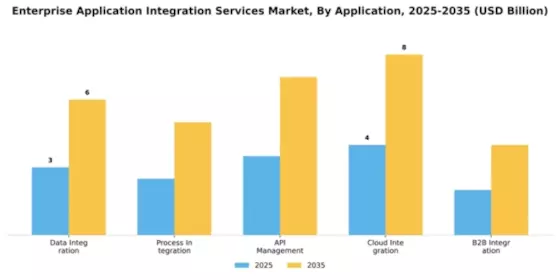
Data Integration (Dominant) vs. B2B Integration (Emerging)
Data Integration holds a dominant position in the Enterprise Application Integration Services Market, characterized by its ability to consolidate and synchronize data from various sources, enabling organizations to achieve a unified view of their data landscape. It plays a pivotal role in analytics, helping businesses derive actionable insights from their data. Conversely, B2B Integration, while emerging, focuses on facilitating transactions and information exchange between business partners, streamlining operational workflows. This segment is gaining traction as businesses increasingly look for real-time collaboration and data sharing capabilities to enhance their supply chain performance. Both segments underline the critical nature of connectivity and efficiency in the contemporary digital enterprise.
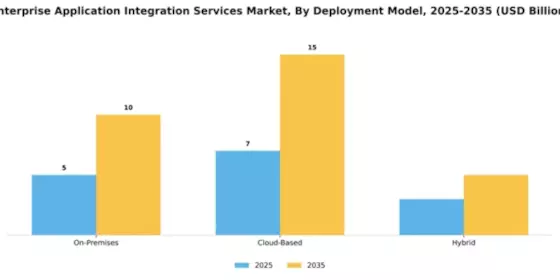
In the Enterprise Application Integration Services Market, the deployment model is characterized by three primary segments: On-Premises, Cloud-Based, and Hybrid. Currently, Cloud-Based solutions hold the largest market share, driven by the increasing demand for scalable and flexible integration options. Meanwhile, Hybrid deployment models are witnessing significant traction as businesses seek to harness the benefits of both on-premises and cloud-based solutions, thus creating a dynamic landscape where organizations can tailor their integration strategies according to specific needs. The growth trends in this segment are notably influenced by the rising shift towards digital transformation and the need for seamless connectivity between various applications. Cloud-Based integration services are favored for their ease of implementation and lower upfront costs, while Hybrid solutions are gaining popularity for their ability to address security concerns associated with sensitive data. This convergence of preferences illustrates an evolving market where adaptability is key to meeting diverse business requirements.
Cloud-Based (Dominant) vs. On-Premises (Emerging)
In the deployment model landscape of the Enterprise Application Integration Services Market, Cloud-Based solutions are firmly established as the dominant force due to their scalability, cost-effectiveness, and accessibility. These solutions enable organizations to integrate applications across diverse environments effortlessly, fostering collaboration and innovation. Conversely, On-Premises deployment, while labeled as emerging, remains vital for businesses with stringent data security and compliance requirements. Organizations opting for On-Premises solutions benefit from greater control over their IT infrastructure but face challenges related to management and scalability. As digital transformation accelerates, the push towards Cloud-Based services continues to gain momentum, positioning Cloud as the preferred choice for most organizations, while On-Premises integration is likely to evolve to meet specific demands.
In the Enterprise Application Integration Services Market, the distribution of market share among different end users is distinct. Large Enterprises dominate this segment, leveraging vast resources to implement advanced integration solutions that streamline operations and enhance connectivity across various business functions. Meanwhile, Small and Medium Enterprises are rapidly gaining ground, actively adopting these services to improve their operational efficiency and flexibility, thereby enhancing their competitive position in the market. Growth trends in this segment are driven by the increasing demand for streamlined operations and improved data connectivity. Large Enterprises are investing in comprehensive integration solutions to support their complex IT environments, while Small and Medium Enterprises are embracing cloud integration services that offer scalability and cost-effectiveness. The growing reliance on digital transformation across industries also significantly propels the adoption of integration services, highlighting a promising trend in this market.
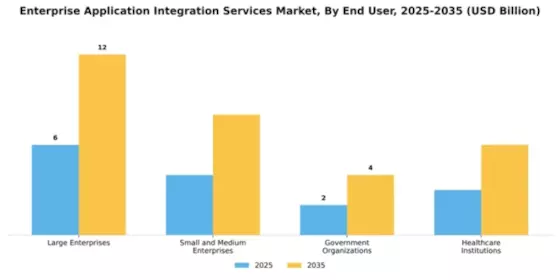
Large Enterprises (Dominant) vs. Small and Medium Enterprises (Emerging)
Large Enterprises in the Enterprise Application Integration Services Market are characterized by their significant investments in robust integration platforms. They utilize these platforms to facilitate complex data flows between diverse applications and systems, ensuring seamless operational efficiency. Their dominant position is attributed to their need for specialized services that can handle high volumes of data and support mission-critical processes. Conversely, Small and Medium Enterprises are emerging players in this space, recognizing the necessity of integrated solutions to remain competitive. They tend to favor cost-effective, scalable integration solutions that can grow with their business. This segment is witnessing rapid expansion as these enterprises increasingly look for tailored integration options that offer flexibility, responsiveness, and reduce the time to market.
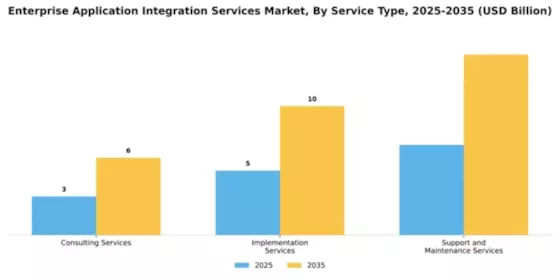
The Enterprise Application Integration Services Market has a diverse range of service types, including Consulting Services, Implementation Services, and Support and Maintenance Services. Among these, Consulting Services currently holds the largest market share, demonstrating its critical role in enabling organizations to assess their integration needs and craft tailored strategies. Implementation Services are gaining momentum as businesses increasingly seek to seamlessly integrate applications and systems, positioning them as a vital component of the market.
Consulting Services (Dominant) vs. Implementation Services (Emerging)
Consulting Services are regarded as the dominant segment within the Enterprise Application Integration Services Market, largely due to their extensive expertise and strategic guidance offered to organizations. These services help businesses identify their integration challenges and devise solutions that fit their unique environments. On the other hand, Implementation Services are emerging rapidly, driven by the rising adoption of cloud-based applications and digital transformation initiatives. As organizations prioritize agility and faster time-to-market, Implementation Services are essential in ensuring that integration solutions are effectively deployed and operational. Together, these segments cater to the evolving needs of enterprises aiming for robust integration strategies.
The Enterprise Application Integration Services Market showcases a diverse range of technologies, with middleware holding the largest share. Middleware facilitates communication and data management among disparate systems, establishing itself as a fundamental component in enterprise environments. Meanwhile, the enterprise service bus (ESB) is gaining traction as organizations seek to improve their integration strategies, leading to its rapid growth in adoption and usage. Message brokers and microservices also contribute to the market, although they currently represent smaller segments in comparison. In terms of growth trends, the demand for seamless data exchange between applications is driving an increased need for ESBs, enabling organizations to implement agile and flexible integration frameworks. The rise of cloud computing and the need for real-time data processing are other notable drivers, pushing enterprises to adopt modern integration technologies such as middleware and microservices. As businesses look to optimize their operations and enhance customer experiences, the integration services landscape will continue to evolve, with a marked shift towards more advanced and customizable solutions.
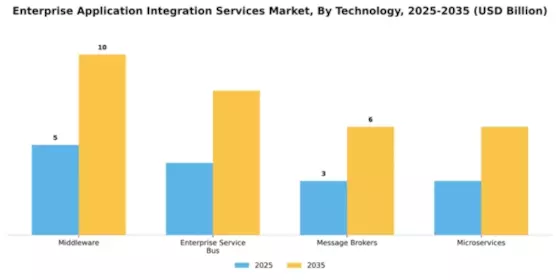
Technology: Middleware (Dominant) vs. Microservices (Emerging)
Middleware is a vital component of the Enterprise Application Integration Services Market, known for its robust capabilities in linking various applications and facilitating smooth data flows. It serves as a backbone for enterprise operations, providing essential services such as messaging, transaction management, and data replication. In contrast, microservices are an emerging trend, appealing to organizations looking to adopt a more modular approach to application development and integration. Microservices allow teams to build, deploy, and manage applications as independent services, promoting agility and faster time-to-market. As businesses progress in their digital transformation journeys, both middleware and microservices will play crucial roles in shaping the future of enterprise integration.
Get more detailed insights about Enterprise Application Integration Services Market Request Free Sample
North America continues to lead the Enterprise Application Integration Services market, holding a significant share of 7.5 in 2024. The region's growth is driven by rapid digital transformation, increasing demand for cloud-based solutions, and stringent regulatory requirements that promote data interoperability. Companies are investing heavily in integration services to streamline operations and enhance customer experiences, further propelling market expansion. The competitive landscape is robust, with key players like IBM, Microsoft, and Oracle dominating the market. The presence of advanced technological infrastructure and a skilled workforce supports innovation in integration solutions. As organizations increasingly adopt hybrid cloud environments, the demand for seamless application integration is expected to rise, solidifying North America's position as a market leader.
Europe's Enterprise Application Integration Services market is projected to reach 4.0 by 2025, driven by the increasing need for digital transformation across various sectors. Regulatory frameworks such as GDPR are catalyzing the demand for secure and compliant integration solutions. The region's focus on sustainability and innovation is also pushing organizations to adopt integrated systems that enhance operational efficiency and reduce costs. Leading countries like Germany, the UK, and France are at the forefront of this growth, with a competitive landscape featuring major players like SAP and Software AG. The European market is characterized by a mix of established firms and innovative startups, fostering a dynamic environment for integration services. As businesses seek to improve their digital capabilities, the demand for comprehensive integration solutions is expected to rise significantly.
The Asia-Pacific region is witnessing a burgeoning demand for Enterprise Application Integration Services, with a market size of 2.5 projected for 2025. Factors such as rapid urbanization, increasing internet penetration, and a growing emphasis on digital transformation are driving this growth. Governments in the region are also promoting initiatives to enhance digital infrastructure, which is crucial for seamless application integration. Countries like China, India, and Japan are leading the charge, with a competitive landscape that includes both global players and local firms. The presence of key players such as MuleSoft and TIBCO Software is enhancing the market's dynamism. As organizations in Asia-Pacific increasingly adopt cloud solutions, the need for effective integration services is expected to surge, positioning the region as a significant player in the global market.
The Middle East and Africa region is gradually emerging in the Enterprise Application Integration Services market, with a projected size of 1.0 by 2025. The growth is fueled by increasing investments in digital transformation initiatives and the rising adoption of cloud technologies. Governments are also implementing policies to enhance digital infrastructure, which is vital for effective application integration and interoperability across sectors. Countries like the UAE and South Africa are leading this growth, with a competitive landscape that includes both international and local players. The presence of companies like Informatica and Dell Boomi is helping to drive innovation in integration services. As businesses in the region seek to improve operational efficiency and customer engagement, the demand for integration solutions is expected to rise significantly.
The Enterprise Application Integration Services Market is characterized by a dynamic competitive landscape, driven by the increasing need for seamless connectivity among disparate systems and applications. Key players such as IBM (US), Microsoft (US), and Oracle (US) are at the forefront, leveraging their extensive portfolios to enhance operational efficiencies and drive digital transformation initiatives. IBM (US) focuses on innovation through its cloud-based integration solutions, while Microsoft (US) emphasizes its Azure platform to facilitate integration across various applications. Oracle (US) continues to strengthen its position by integrating advanced analytics into its services, thereby enhancing decision-making capabilities for enterprises. Collectively, these strategies foster a competitive environment that prioritizes technological advancement and customer-centric solutions.In terms of business tactics, companies are increasingly localizing their services to cater to regional demands, optimizing supply chains to enhance responsiveness, and investing in partnerships to expand their market reach. The market structure appears moderately fragmented, with a mix of established players and emerging startups. This fragmentation allows for diverse offerings, yet the influence of key players remains substantial, as they set benchmarks for service quality and innovation.In November IBM (US) announced a strategic partnership with a leading cloud provider to enhance its integration capabilities, aiming to deliver more robust solutions for hybrid cloud environments. This move is significant as it positions IBM to better serve enterprises looking to navigate complex cloud architectures, thereby reinforcing its competitive edge in the market. The partnership is expected to facilitate faster deployment of integration services, which is crucial in today’s fast-paced business landscape.In October Microsoft (US) launched a new suite of integration tools designed specifically for small to medium-sized enterprises (SMEs). This initiative reflects a strategic pivot towards capturing a broader customer base, as SMEs increasingly seek affordable yet effective integration solutions. By tailoring its offerings, Microsoft not only enhances its market penetration but also addresses the unique challenges faced by smaller organizations in the integration space.In September Oracle (US) unveiled an advanced AI-driven integration platform that automates data workflows across various applications. This development is pivotal, as it signifies a shift towards intelligent automation in integration services, allowing businesses to streamline operations and reduce manual intervention. The introduction of AI capabilities is likely to attract enterprises aiming for efficiency and cost reduction, thereby enhancing Oracle's competitive positioning.As of December the competitive trends in the Enterprise Application Integration Services Market are increasingly defined by digitalization, sustainability, and the integration of AI technologies. Strategic alliances are becoming more prevalent, as companies recognize the value of collaborative innovation in addressing complex integration challenges. Looking ahead, competitive differentiation is expected to evolve, with a marked shift from price-based competition to a focus on innovation, technological advancements, and supply chain reliability. This transition underscores the necessity for companies to not only offer competitive pricing but also to deliver superior value through cutting-edge solutions.


The Enterprise Application Integration Services Market is projected to grow at a 6.5% CAGR from 2025 to 2035, driven by digital transformation, cloud adoption, and the need for operational efficiency.
New opportunities lie in:
By 2035, the market is expected to be robust, reflecting substantial growth and innovation.
| MARKET SIZE 2024 | 15.0(USD Billion) |
| MARKET SIZE 2025 | 15.97(USD Billion) |
| MARKET SIZE 2035 | 30.0(USD Billion) |
| COMPOUND ANNUAL GROWTH RATE (CAGR) | 6.5% (2025 - 2035) |
| REPORT COVERAGE | Revenue Forecast, Competitive Landscape, Growth Factors, and Trends |
| BASE YEAR | 2024 |
| Market Forecast Period | 2025 - 2035 |
| Historical Data | 2019 - 2024 |
| Market Forecast Units | USD Billion |
| Key Companies Profiled | IBM (US), Microsoft (US), Oracle (US), SAP (DE), MuleSoft (US), TIBCO Software (US), Informatica (US), Dell Boomi (US), Software AG (DE) |
| Segments Covered | Application, Deployment Model, End User, Service Type, Technology |
| Key Market Opportunities | Integration of artificial intelligence enhances efficiency in the Enterprise Application Integration Services Market. |
| Key Market Dynamics | Rising demand for seamless integration solutions drives competition and innovation in the Enterprise Application Integration Services Market. |
| Countries Covered | North America, Europe, APAC, South America, MEA |
The projected market valuation is expected to reach 30.0 USD Billion by 2035.
The market valuation was 15.0 USD Billion in 2024.
The expected CAGR during this period is 6.5%.
Key players include IBM, Microsoft, Oracle, SAP, MuleSoft, TIBCO Software, Informatica, Dell Boomi, and Software AG.
The main segments by application include Data Integration, Process Integration, API Management, Cloud Integration, and B2B Integration.
The Cloud-Based deployment segment is projected to grow from 7.0 to 15.0 USD Billion, while On-Premises is expected to grow from 5.0 to 10.0 USD Billion.
The Healthcare Institutions segment is anticipated to grow from 3.0 to 6.0 USD Billion by 2035.
Services include Consulting Services, Implementation Services, and Support and Maintenance Services.
The Middleware technology segment is projected to grow from 5.0 to 10.0 USD Billion by 2035.
Large Enterprises are expected to grow from 6.0 to 12.0 USD Billion, while Small and Medium Enterprises are projected to grow from 4.0 to 8.0 USD Billion.


Kindly complete the form below to receive a free sample of this Report

“This is really good guys. Excellent work on a tight deadline. I will continue to use you going forward and recommend you to others. Nice job”


“Thanks. It’s been a pleasure working with you, please use me as reference with any other Intel employees.”


“Thanks for sending the report it gives us a good global view of the Betaïne market.”


“Thank you, this will be very helpful for OQS.”


“We found the report very insightful! we found your research firm very helpful. I'm sending this email to secure our future business.”


“I am very pleased with how market segments have been defined in a relevant way for my purposes (such as "Portable Freezers & refrigerators" and "last-mile"). In general the report is well structured. Thanks very much for your efforts.”


“I have been reading the first document or the study, ,the Global HVAC and FP market report 2021 till 2026. Must say, good info! I have not gone in depth at all parts, but got a good indication of the data inside!”


“We got the report in time, we really thank you for your support in this process. I also thank to all of your team as they did a great job.”


“The Automotive 48V ECU Components Procurement Intelligence Study” was a complex project, but the Market Research Future (MRFR) team handled it with quality, agility, and customer-centricity. They delivered all requested data on time and within the agreed scope. The team, including Shubhendra Anand and Rahul Gotadki, was always readily available to clarify questions and swiftly implement necessary adjustments, driving the project to a successful conclusion within a very demanding timeframe.
I would also like to specifically commend Akshay Agarwal for his responsiveness and support at every stage—from our initial inquiry on May 6th through to final delivery on June 18th. His dedication made the entire process seamless.”



