×
Request Free Sample ×

Kindly complete the form below to receive a free sample of this Report

* Please use a valid business email

Leading companies partner with us for data-driven Insights

clients tt-cursor
Hero Background

Enterprise Data Loss Prevention Software Market

ID: MRFR/ICT/2920-HCR
100 Pages
Aarti Dhapte
October 2025

Enterprise Data Loss Prevention Software Market Research Report By Deployment Type (On-Premises, Cloud-Based, Hybrid), By Component (Solutions, Services), By Enterprise Size (Small Enterprises, Medium Enterprises, Large Enterprises), By Industry Vertical (BFSI, Healthcare, Retail, Government, IT and Telecom) and By Regional (North America, Europe, South America, Asia Pacific, Middle East and Africa) - Forecast to 2035

Share:
Download PDF ×

We do not share your information with anyone. However, we may send you emails based on your report interest from time to time. You may contact us at any time to opt-out.

Enterprise Data Loss Prevention Software Market Infographic
Purchase Options

Enterprise Data Loss Prevention Software Market Summary

As per MRFR analysis, the Enterprise Data Loss Prevention Software Market Size was estimated at 3260.0 USD Million in 2024. The Enterprise Data Loss Prevention Software industry is projected to grow from 3620.0 in 2025 to 12070.0 by 2035, exhibiting a compound annual growth rate (CAGR) of 12.7 during the forecast period 2025 - 2035.

Key Market Trends & Highlights

The Enterprise Data Loss Prevention Software Market is poised for substantial growth driven by technological advancements and increasing regulatory demands.

  • Integration with cloud services is becoming a prevalent trend, enhancing data accessibility and security.
  • User behavior analytics is gaining traction, allowing organizations to proactively identify potential data loss risks.
  • The adoption of AI and machine learning technologies is transforming data protection strategies, making them more efficient and effective.
  • Increasing regulatory compliance requirements and the rising incidence of data breaches are key drivers propelling market growth, particularly in North America and the Asia-Pacific region.

Market Size & Forecast

2024 Market Size 3260.0 (USD Million)
2035 Market Size 12070.0 (USD Million)
CAGR (2025 - 2035) 12.7%

Major Players

Symantec (US), McAfee (US), Forcepoint (US), Digital Guardian (US), Microsoft (US), Trend Micro (JP), Check Point Software (IL), Broadcom (US), IBM (US)

Enterprise Data Loss Prevention Software Market Trends

The Enterprise Data Loss Prevention Software Market is currently experiencing a notable evolution, driven by the increasing need for organizations to safeguard sensitive information. As data breaches and cyber threats become more prevalent, businesses are prioritizing the implementation of robust data protection measures. This market appears to be characterized by a growing awareness of compliance requirements, as regulatory frameworks continue to tighten globally. Consequently, organizations are investing in advanced solutions that not only prevent data loss but also ensure adherence to legal standards. Moreover, the rise of remote work and cloud computing has further intensified the demand for effective data loss prevention strategies. Companies are recognizing that traditional security measures may no longer suffice in a landscape where data is accessed from various locations and devices. This shift suggests a potential for innovative technologies, such as artificial intelligence and machine learning, to play a pivotal role in enhancing data security protocols. As the Enterprise Data Loss Prevention Software Market evolves, it is likely to witness increased competition among vendors, leading to the development of more sophisticated and user-friendly solutions that cater to diverse organizational needs.

Integration with Cloud Services

The trend towards integrating Enterprise Data Loss Prevention Software with cloud services is becoming increasingly prominent. As organizations migrate to cloud environments, the need for seamless data protection across these platforms is essential. This integration allows for real-time monitoring and management of sensitive information, ensuring that data remains secure regardless of its location.

Focus on User Behavior Analytics

There is a growing emphasis on user behavior analytics within the Enterprise Data Loss Prevention Software Market. By analyzing user activities, organizations can identify potential risks and anomalies that may indicate data breaches. This proactive approach enables companies to implement targeted security measures, thereby enhancing their overall data protection strategies.

Adoption of AI and Machine Learning

The incorporation of artificial intelligence and machine learning technologies is transforming the landscape of data loss prevention. These advanced tools can analyze vast amounts of data to detect patterns and predict potential threats. As a result, organizations are likely to adopt these technologies to bolster their data security frameworks, making them more adaptive and responsive to emerging risks.

Enterprise Data Loss Prevention Software Market Drivers

Market Growth Projections

The Global Enterprise Data Loss Prevention Software Market Industry is projected to experience substantial growth over the coming years. In 2024, the market is anticipated to reach 3.26 USD Billion, with expectations of reaching 12.2 USD Billion by 2035. This growth trajectory indicates a robust CAGR of 12.71% from 2025 to 2035, reflecting the increasing importance of data protection in an increasingly digital landscape. The demand for DLP solutions is likely to be driven by various factors, including regulatory compliance, cybersecurity threats, and the adoption of cloud services. These projections underscore the dynamic nature of the Global Enterprise Data Loss Prevention Software Market Industry and its potential for continued expansion.

Adoption of Cloud Services

The shift towards cloud services is a pivotal factor driving the Global Enterprise Data Loss Prevention Software Market Industry. As organizations migrate their data to cloud environments, the need for effective data protection strategies becomes paramount. Cloud-based DLP solutions offer scalability and flexibility, enabling businesses to secure sensitive information across various platforms. This trend is likely to accelerate as more companies embrace digital transformation initiatives. The market is projected to grow at a CAGR of 12.71% from 2025 to 2035, reflecting the increasing reliance on cloud services and the corresponding demand for DLP solutions. Consequently, the Global Enterprise Data Loss Prevention Software Market Industry is poised for substantial growth.

Rising Cybersecurity Threats

The Global Enterprise Data Loss Prevention Software Market Industry is significantly influenced by the escalating cybersecurity threats that organizations face today. With the proliferation of sophisticated cyberattacks, businesses are increasingly recognizing the need for comprehensive data protection measures. The rise in data breaches and ransomware incidents has prompted organizations to adopt DLP solutions to safeguard sensitive information. This growing awareness is expected to contribute to the market's expansion, with projections indicating a growth trajectory that could see the market reach 12.2 USD Billion by 2035. The urgency to mitigate risks associated with data loss is a key driver of the Global Enterprise Data Loss Prevention Software Market Industry.

Increasing Regulatory Compliance

The Global Enterprise Data Loss Prevention Software Market Industry is experiencing heightened demand due to the increasing regulatory compliance requirements across various sectors. Organizations are compelled to adhere to stringent data protection regulations such as GDPR and HIPAA, which necessitate robust data loss prevention strategies. As a result, companies are investing in DLP solutions to avoid hefty fines and reputational damage. In 2024, the market is projected to reach 3.26 USD Billion, reflecting the urgency for compliance-driven investments. This trend is likely to continue as regulations evolve, further propelling the growth of the Global Enterprise Data Loss Prevention Software Market Industry.

Growing Awareness of Data Privacy

The Global Enterprise Data Loss Prevention Software Market Industry is benefiting from the growing awareness of data privacy among consumers and organizations alike. As individuals become more conscious of their personal information and its potential misuse, businesses are compelled to implement stringent data protection measures. This heightened awareness is driving the demand for DLP solutions, as organizations seek to build trust with their customers by safeguarding sensitive data. The market's growth is indicative of this trend, with projections suggesting a significant increase in investment in DLP technologies. Consequently, the Global Enterprise Data Loss Prevention Software Market Industry is likely to witness sustained growth as data privacy concerns continue to rise.

Integration of Advanced Technologies

The integration of advanced technologies such as artificial intelligence and machine learning is transforming the Global Enterprise Data Loss Prevention Software Market Industry. These technologies enhance the capabilities of DLP solutions, enabling organizations to detect and respond to potential data breaches more effectively. By leveraging AI and ML, businesses can analyze vast amounts of data in real-time, identifying anomalies and preventing data loss proactively. This technological advancement is expected to drive market growth, as organizations increasingly seek innovative solutions to combat evolving threats. The Global Enterprise Data Loss Prevention Software Market Industry is thus positioned for significant expansion as these advanced technologies become more prevalent.

Market Segment Insights

By Application: Data Discovery (Largest) vs. Data Protection (Fastest-Growing)

In the Enterprise Data Loss Prevention Software Market, the application segment consists of five key areas: Data Discovery, Data Monitoring, Data Protection, Incident Response, and Compliance Management. Among these, Data Discovery holds the largest market share, thanks to its critical role in identifying sensitive information across various data sources. Meanwhile, Data Protection is recognized as the fastest-growing area, driven by increasing concerns over data breaches and the need for organizations to safeguard their information assets effectively.

Data Discovery (Dominant) vs. Data Protection (Emerging)

Data Discovery is pivotal in the landscape of Enterprise Data Loss Prevention, serving as the foundation for organizations to understand where their sensitive data resides. This dominant segment uses advanced technologies to scan and classify data, enabling companies to implement proactive measures against data loss. On the other hand, Data Protection is an emerging segment that is gaining traction rapidly due to a growing emphasis on data integrity and security. It includes a variety of tools and methodologies designed to secure data in motion and at rest, making it essential for any data-centric business.

By Deployment Type: Cloud-Based (Largest) vs. Hybrid (Fastest-Growing)

The Enterprise Data Loss Prevention Software Market reflects a distinct distribution of deployment types among its segments. Currently, cloud-based solutions dominate the market, catering to organizations looking for scalability, accessibility, and simplified management. On-premises solutions, although providing robust control over data and compliance, have seen a decrease in preference due to the growing inclination towards cloud technology. Meanwhile, hybrid models are gaining traction as organizations strive for a balanced approach, combining the benefits of both cloud and on-premises systems.

Deployment Models: Cloud-Based (Dominant) vs. Hybrid (Emerging)

Cloud-based deployment has become the cornerstone of the Enterprise Data Loss Prevention Software Market due to its flexibility and ease of integration into existing workflows. Companies are increasingly adopting these solutions for their rapid deployment capabilities and lower upfront costs. In contrast, hybrid models are emerging as a critical solution for businesses that require both strong data control and the scalability of the cloud. This model appeals particularly to enterprises navigating strict regulatory environments where a portion of data needs to remain on-premises while still leveraging cloud technologies for other functions.

By End User: BFSI (Largest) vs. Healthcare (Fastest-Growing)

In the Enterprise Data Loss Prevention Software Market, the BFSI segment holds a significant share due to stringent regulatory requirements and the industry's focus on securing sensitive financial data. Following closely is the Healthcare sector, which is increasingly adopting data protection measures to adhere to privacy regulations and safeguard patient information. Other notable sectors include Government, Retail, and Telecommunications, each contributing to the market's diversity yet at a comparatively lower scale than BFSI and Healthcare.

BFSI: Dominant vs. Healthcare: Emerging

The BFSI segment is characterized by its robust demand for data security solutions, stemming from the need to protect sensitive customer information and comply with regulatory standards. This sector's established infrastructure and substantial investment in cybersecurity make it the dominant force in the Enterprise Data Loss Prevention Software Market. In contrast, the Healthcare sector, while currently emerging, is witnessing rapid growth driven by the digitalization of health records and the rising importance of protecting personal health information. As more healthcare entities recognize the value of safeguarding data against breaches, their adoption of advanced data loss prevention technologies is set to expand significantly, positioning them as a key player in the market.

By Organization Size: Large Enterprises (Largest) vs. Small Enterprises (Fastest-Growing)

The Enterprise Data Loss Prevention (DLP) Software Market exhibits a diverse distribution among different organization sizes. Large enterprises dominate the market due to their extensive data security needs and substantial IT infrastructure investments. They are more likely to adopt comprehensive DLP solutions to mitigate risks associated with data breaches and compliance failures. Conversely, small enterprises are emerging as a significant market segment, leveraging cloud-based solutions that offer flexible and cost-effective DLP services, making them increasingly relevant in today's security landscape.

Large Enterprises: (Dominant) vs. Small Enterprises: (Emerging)

Large enterprises are characterized by their complex IT environments and greater exposure to data loss incidents. They typically employ robust DLP solutions that encompass extensive policy management, incident response, and user training, positioning themselves as leaders in data protection. On the other hand, small enterprises are rapidly adopting DLP solutions tailored to their specific needs. These organizations often seek user-friendly, cost-effective solutions that allow them to implement effective data protection strategies without overwhelming their limited resources. This trend highlights the evolving market dynamics, as small enterprises increasingly recognize the importance of data security in safeguarding their business operations.

By Features: Content Inspection (Largest) vs. User Activity Monitoring (Fastest-Growing)

In the Enterprise Data Loss Prevention Software Market, the features segment is dominated by Content Inspection, which holds the largest market share among various functionalities offered by DLP solutions. This capability is essential for identifying sensitive information and preventing unauthorized sharing, thereby becoming integral to data protection strategies across organizations. User Activity Monitoring, on the other hand, is rapidly gaining traction, driven by the increasing demand for tracking employee activities to ensure compliance and mitigate insider threats. This feature has shown remarkable growth due to its relevance in real-time monitoring and risk assessment. Growth trends in this segment are being significantly influenced by heightened awareness around data privacy regulations and the escalating threat landscape. As organizations continue prioritizing data security, the demand for robust solutions that encompass comprehensive features like Encryption and Policy Enforcement is also rising. Additionally, advancements in Reporting and Analytics functionalities are enabling businesses to make data-driven decisions, further propelling the adoption of multifaceted DLP solutions. This dynamic environment is fostering innovations that cater to emerging needs in the enterprise sector, leading to steady growth in features like User Activity Monitoring and Encryption.

Content Inspection (Dominant) vs. Encryption (Emerging)

Content Inspection is the dominant feature in the Enterprise Data Loss Prevention Software Market, providing organizations with the ability to scan and analyze data both at rest and in transit. It plays a crucial role in identifying sensitive information and ensuring compliance with regulations by preventing unauthorized data movement. In contrast, Encryption is emerging as a significant capability, protecting sensitive data by rendering it unusable to unauthorized users. As cyber threats evolve, the necessity for Encryption is becoming increasingly apparent, especially in industries that handle highly confidential information. While Content Inspection relies heavily on predefined policies and sophisticated algorithms to detect vulnerabilities, Encryption is focused on safeguarding data integrity and confidentiality. The interplay between these features highlights the growing complexity and multifaceted nature of DLP strategies required to combat data loss effectively.

Get more detailed insights about Enterprise Data Loss Prevention Software Market

Regional Insights

North America : Market Leader in DLP Solutions

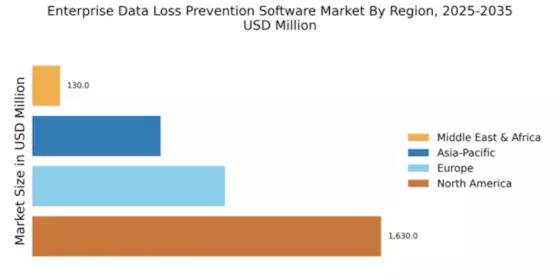
North America continues to lead the Enterprise Data Loss Prevention (DLP) Software Market, holding a significant market share of 1630.0M in 2024. The region's growth is driven by increasing regulatory requirements, rising cyber threats, and a growing emphasis on data privacy. Organizations are investing heavily in DLP solutions to safeguard sensitive information and comply with regulations such as GDPR and CCPA, which are pivotal in shaping market dynamics. The competitive landscape in North America is robust, featuring key players like Symantec, McAfee, and Microsoft. These companies are at the forefront of innovation, offering advanced DLP solutions tailored to various industries. The presence of a strong technology ecosystem, coupled with high adoption rates among enterprises, positions North America as a critical hub for DLP software development and deployment. The region's focus on enhancing cybersecurity measures further solidifies its market leadership.

Europe : Emerging DLP Market Growth

Europe's Enterprise Data Loss Prevention Software Market is projected to reach 900.0M by 2025, driven by stringent data protection regulations like GDPR. The increasing awareness of data breaches and the need for compliance are significant growth catalysts. Organizations are prioritizing DLP solutions to mitigate risks associated with data loss, ensuring they meet regulatory standards and protect customer information effectively. Leading countries in this region include Germany, the UK, and France, where the demand for DLP solutions is surging. The competitive landscape features prominent players such as Trend Micro and Check Point Software, who are innovating to meet the unique needs of European enterprises. The focus on data sovereignty and local compliance requirements is shaping the market, making Europe a dynamic environment for DLP software adoption.

Asia-Pacific : Rapidly Growing DLP Adoption

The Asia-Pacific region is witnessing a significant surge in the Enterprise Data Loss Prevention Software Market, projected to reach 600.0M by 2025. This growth is fueled by increasing digital transformation initiatives, rising cyber threats, and a growing emphasis on data privacy regulations. Countries like India and China are leading the charge, with businesses recognizing the importance of DLP solutions to protect sensitive data and comply with emerging regulations. The competitive landscape in Asia-Pacific is evolving, with both local and international players vying for market share. Companies such as Forcepoint and Digital Guardian are expanding their presence, offering tailored solutions to meet the diverse needs of the region. The increasing investment in cybersecurity infrastructure and awareness of data protection are key factors driving the adoption of DLP software across various industries in this region.

Middle East and Africa : Emerging DLP Market Potential

The Middle East and Africa (MEA) region is gradually emerging in the Enterprise Data Loss Prevention Software Market, with a projected size of 130.0M by 2025. The growth is primarily driven by increasing awareness of data security threats and the need for compliance with local regulations. Organizations are beginning to recognize the importance of DLP solutions to protect sensitive information and mitigate risks associated with data breaches. Countries like South Africa and the UAE are leading the way in adopting DLP solutions, supported by a growing number of cybersecurity initiatives. The competitive landscape is still developing, with both The Enterprise Data Loss Prevention Software. As businesses in MEA continue to invest in cybersecurity measures, the demand for DLP software is expected to rise significantly, presenting opportunities for growth in this emerging market.

Key Players and Competitive Insights

The Enterprise Data Loss Prevention Software Market is characterized by a dynamic competitive landscape, driven by the increasing need for organizations to safeguard sensitive data against breaches and unauthorized access. Key players such as Symantec (US), McAfee (US), and Microsoft (US) are at the forefront, each adopting distinct strategies to enhance their market positioning. Symantec (US) focuses on innovation through continuous product development, while McAfee (US) emphasizes strategic partnerships to expand its service offerings. Microsoft (US), leveraging its extensive cloud infrastructure, integrates advanced data protection features into its existing platforms, thereby enhancing its competitive edge. Collectively, these strategies contribute to a robust competitive environment, where innovation and strategic alliances are pivotal for success.

In terms of business tactics, companies are increasingly localizing their operations to better serve regional markets, optimizing supply chains to enhance efficiency. The market structure appears moderately fragmented, with several key players exerting considerable influence. This fragmentation allows for a diverse range of solutions, catering to various organizational needs, while also fostering competition that drives innovation and service improvement.

In November 2025, Symantec (US) announced a significant upgrade to its DLP solutions, incorporating AI-driven analytics to enhance threat detection capabilities. This strategic move is likely to position Symantec (US) as a leader in proactive data protection, addressing the evolving threat landscape and meeting the demands of organizations seeking advanced security measures. The integration of AI not only improves detection rates but also streamlines incident response, thereby enhancing overall operational efficiency.

In October 2025, McAfee (US) entered into a partnership with a leading cloud service provider to offer integrated DLP solutions tailored for cloud environments. This collaboration is indicative of McAfee's (US) strategy to adapt to the growing trend of cloud adoption among enterprises. By aligning its offerings with cloud services, McAfee (US) is likely to capture a larger share of the market, appealing to organizations that prioritize cloud security as part of their data protection strategies.

In September 2025, Microsoft (US) launched a new suite of DLP tools designed specifically for remote work environments. This initiative reflects Microsoft's (US) commitment to addressing the challenges posed by the shift to hybrid work models. By providing tailored solutions that cater to the unique needs of remote workers, Microsoft (US) is not only enhancing its product portfolio but also reinforcing its position as a trusted provider of comprehensive data protection solutions.

As of December 2025, the competitive trends within the Enterprise Data Loss Prevention Software Market are increasingly defined by digitalization, AI integration, and a focus on sustainability. Strategic alliances are shaping the landscape, enabling companies to leverage complementary strengths and enhance their service offerings. Looking ahead, competitive differentiation is expected to evolve, with a notable shift from price-based competition towards innovation, technology, and supply chain reliability. This transition underscores the importance of developing advanced solutions that not only meet regulatory requirements but also anticipate future data protection challenges.

Key Companies in the Enterprise Data Loss Prevention Software Market market include

Industry Developments

Recent developments in the Enterprise Data Loss Prevention Software Market have shown notable activity, with a growing focus on advanced security measures amidst increasing data breaches. Companies like McAfee and Symantec continue to enhance their offerings, integrating AI and machine learning capabilities for better data protection. The acquisition landscape has been dynamic, with Digital Guardian drawing attention to its strategic partnerships aimed at broadening its market reach. Meanwhile, Microsoft has been expanding its data loss prevention functionalities in Microsoft 365, responding to heightened demand for comprehensive security solutions.

Trend Micro and Egress are also positioning themselves in this evolving market by introducing innovative features. The overall growth in market valuations reflects heightened investment in cybersecurity measures, driven by the rising need for compliance and data protection across various sectors. Zscaler and Forcepoint are contributing to this growth by targeting hybrid work environments with scalable DLP solutions. As organizations prioritize safeguarding sensitive information, the global demand for DLP software is expected to rise, leading to further innovation and competitive strategies among key players such as Bitdefender, CloudLock, and Varonis.

Future Outlook

Enterprise Data Loss Prevention Software Market Future Outlook

The Enterprise Data Loss Prevention Software Market is projected to grow at a 12.7% CAGR from 2024 to 2035, driven by increasing regulatory compliance and rising cyber threats.

New opportunities lie in:

  • Integration of AI-driven analytics for real-time threat detection.
  • Development of customizable DLP solutions for diverse industries.
  • Expansion into emerging markets with tailored data protection strategies.

By 2035, the market is expected to be robust, reflecting substantial growth and innovation.

Market Segmentation

Enterprise Data Loss Prevention Software Market End User Outlook

  • BFSI
  • Healthcare
  • Government
  • Retail
  • Telecommunications

Enterprise Data Loss Prevention Software Market Features Outlook

  • Content Inspection
  • User Activity Monitoring
  • Encryption
  • Policy Enforcement
  • Reporting and Analytics

Enterprise Data Loss Prevention Software Market Application Outlook

  • Data Discovery
  • Data Monitoring
  • Data Protection
  • Incident Response
  • Compliance Management

Enterprise Data Loss Prevention Software Market Deployment Type Outlook

  • On-Premises
  • Cloud-Based
  • Hybrid

Enterprise Data Loss Prevention Software Market Organization Size Outlook

  • Small Enterprises
  • Medium Enterprises
  • Large Enterprises

Report Scope

MARKET SIZE 20243260.0(USD Million)
MARKET SIZE 20253620.0(USD Million)
MARKET SIZE 203512070.0(USD Million)
COMPOUND ANNUAL GROWTH RATE (CAGR)12.7% (2024 - 2035)
REPORT COVERAGERevenue Forecast, Competitive Landscape, Growth Factors, and Trends
BASE YEAR2024
Market Forecast Period2025 - 2035
Historical Data2019 - 2024
Market Forecast UnitsUSD Million
Key Companies ProfiledSymantec (US), McAfee (US), Forcepoint (US), Digital Guardian (US), Microsoft (US), Trend Micro (JP), Check Point Software (IL), Broadcom (US), IBM (US)
Segments CoveredApplication, Deployment Type, End User, Organization Size, Features
Key Market OpportunitiesIntegration of artificial intelligence enhances threat detection in the Enterprise Data Loss Prevention Software Market.
Key Market DynamicsRising regulatory compliance requirements drive demand for advanced Enterprise Data Loss Prevention Software solutions across various industries.
Countries CoveredNorth America, Europe, APAC, South America, MEA

Market Highlights

Author
Aarti Dhapte
Team Lead - Research

She holds an experience of about 6+ years in Market Research and Business Consulting, working under the spectrum of Information Communication Technology, Telecommunications and Semiconductor domains. Aarti conceptualizes and implements a scalable business strategy and provides strategic leadership to the clients. Her expertise lies in market estimation, competitive intelligence, pipeline analysis, customer assessment, etc.

Leave a Comment

FAQs

What is the projected market size of the Enterprise Data Loss Prevention Software Market in 2032?

The Enterprise Data Loss Prevention Software Market is expected to be valued at 8.5 USD Billion in 2032.

What is the expected CAGR for the Enterprise Data Loss Prevention Software Market from 2024 to 2032?

The expected CAGR for the Enterprise Data Loss Prevention Software Market from 2024 to 2032 is 12.68%.

Which region is expected to dominate the Enterprise Data Loss Prevention Software Market?

North America is expected to dominate the Enterprise Data Loss Prevention Software Market.

What is the anticipated market value for the Cloud-Based deployment type in 2032?

The anticipated market value for the Cloud-Based deployment type is 4.1 USD Billion in 2032.

What are the market sizes for On-Premises and Cloud-Based deployment types in 2023?

In 2023, the On-Premises deployment type is valued at 1.2 USD Billion, and the Cloud-Based deployment is valued at 1.4 USD Billion.

Who are the major players in the Enterprise Data Loss Prevention Software Market?

Major players in the market include Bitdefender, Safeguard, Zscaler, Egress, and Symantec.

What is the expected market growth for the APAC region by 2032?

The expected market value for the APAC region is projected to reach 1.623 USD Billion by 2032.

What was the market value for the Hybrid deployment type in 2023?

The market value for the Hybrid deployment type in 2023 was 0.3 USD Billion.

What will be the market size for South America by 2032?

The market size for South America is expected to reach 0.927 USD Billion by 2032.

What is the anticipated market size for the MEA region in 2032?

The anticipated market size for the MEA region is expected to reach 1.159 USD Billion by 2032.

Download Free Sample

Kindly complete the form below to receive a free sample of this Report

Compare Licence

×
Features License Type
Single User Multiuser License Enterprise User
Price $4,950 $5,950 $7,250
Maximum User Access Limit 1 User Upto 10 Users Unrestricted Access Throughout the Organization
Free Customization
Direct Access to Analyst
Deliverable Format
Platform Access
Discount on Next Purchase 10% 15% 15%
Printable Versions