Enterprise Key Management Market (2025 - 2035)

Enterprise Key Management Market Size, Share and Research Report By Deployment Type (Cloud, On-Premises), By Enterprise Size (Large Enterprises, Small & Medium Enterprises), By Application (Cloud Encryption, Disk Encryption, File and Folder Encryption, Other Applications), By End-User Vertical (BFSI, Healthcare, Government & Defense, IT & Telecom, Retail, Other End-User Verticals) and By Regional (North America, Europe, South America, Asia Pacific, Middle East and Africa) - Industry Forecast to 2035.
ID: MRFR/ICT/2395-HCR
100 Pages
Aarti Dhapte
Last Updated: June 23, 2026
Enterprise Key Management Market
Market Size
Forecast Period2025-2035
CAGR (2025-2035)20.0%
2025 Market SizeUSD 3.04 Billion
2035 Market SizeUSD 19.10 Billion
Key Players
AWS
Microsoft Corporation
Thales Group
IBM Corporation
Google Cloud
Entrust Corporation
Opportunities
  • KMS-as-a-Service for Small and Medium Enterprises
  • Post-Quantum Key Migration Consulting and Tooling
  • Emerging-Market Expansion in Southeast Asia and the Middle East

Enterprise Key Management Market Summary

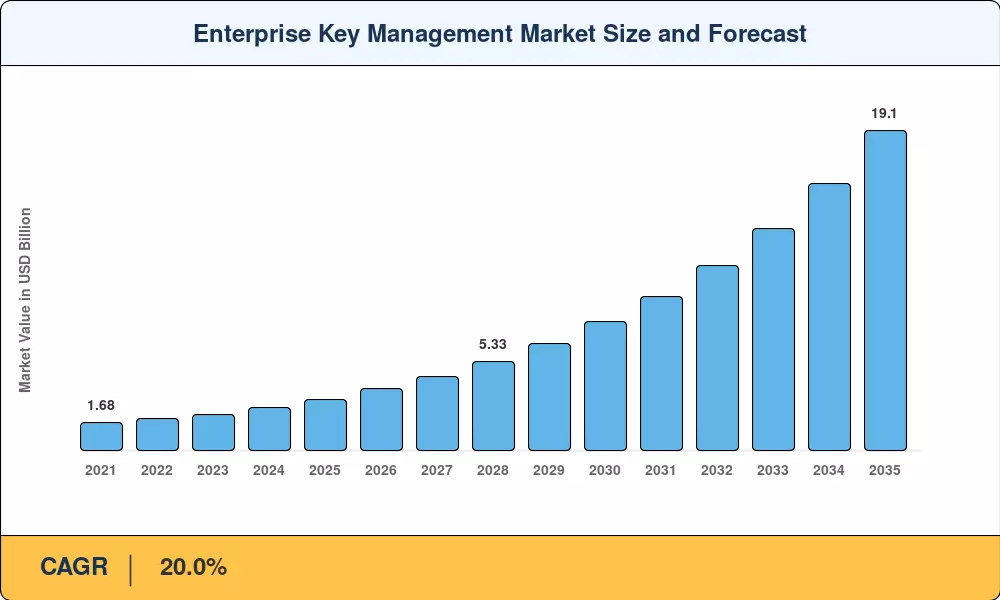
The Enterprise Key Management Market was valued at USD 3.04 Billion in 2025 and is projected to reach USD 3.70 Billion in 2026 before climbing to USD 19.10 Billion by 2035, registering a compound annual growth rate of 20.0% during the 2026–2035 forecast window. Regulatory pressure continues to act as the single largest catalyst — the European Union's revised NIS2 Directive now mandates cryptographic key governance for all essential-service operators, while the U.S. Executive Order 14028 on cybersecurity pushed federal agencies toward zero-trust architectures that depend on centralized encryption key lifecycle management [1]. These twin policy anchors converted what was discretionary security spending into board-level compliance line items.

Legacy, on-premises hardware security modules are giving way to cloud-native and hybrid key management platforms capable of orchestrating millions of cryptographic keys across multi-cloud environments. estimated that enterprises managing workloads on three or more public clouds doubled between 2022 and 2025, fueling demand for interoperable key governance [2]. The shift is not merely operational: organizations now treat encryption keys as strategic assets whose mismanagement can trigger data-breach penalties exceeding USD 20 million under GDPR alone.

North America commands roughly 36.0% of the Enterprise Key Management Market, anchored by concentrated financial-services and federal IT spending. Asia-Pacific is the fastest-growing region at an estimated 24.2% CAGR, driven by India's Digital Personal Data Protection Act and China's expanding Cybersecurity Law enforcement. Europe trails as the second-largest contributor, with approximately 27% share backed by DORA and post-quantum cryptography preparedness mandates [3]. As hybrid-cloud adoption accelerates globally, the Enterprise Key Management Market is poised to remain one of the fastest-expanding segments within the broader cybersecurity landscape through 2035.


Key Report Takeaways

• By Deployment Type

  • Cloud deployment accounted for an estimated 58.2% of the Enterprise Key Management Market in 2025, reflecting the rapid migration of encrypted workloads to public and hybrid environments.
  • On-premises deployment is forecast to grow at approximately 16.8% CAGR through 2035, sustained by defense and government buyers with air-gapped network requirements.

• By Enterprise Size & Application

  • Large enterprises held a 53.7% revenue share in 2025, driven by complex multi-cloud estates requiring unified key orchestration.
  • Cloud encryption led application segments with 35.7% share in 2025, while disk encryption is projected to reach a 21.8% CAGR over the forecast period.

• By End-User Vertical

  • Banking, financial services, and insurance captured 33.4% of the Enterprise Key Management Market in 2025, reflecting stringent PCI-DSS and SOX compliance mandates.


• By Region


  • Asia-Pacific is the fastest-expanding region at a projected 24.2% CAGR, while North America contributed 36.0% of global revenue in 2025.


Market Size and Forecast (2021–2035)

Market Research Future's proprietary estimation framework triangulates vendor revenues, enterprise IT security budgets, and regulatory-driven adoption curves to produce the year-by-year trajectory below. Historical values (2021–2024) rely on audited company filings and verified procurement databases; forecast values (2026–2035) apply the calibrated 20.0% CAGR with adjustments for anticipated regulatory inflections in 2028 and 2032.
Enterprise Key Management Market Size and Forecast
Our Impact
Enabled $4.3B Revenue Impact for Fortune 500 and Leading Multinationals
Partnering with 2000+ Global Organizations Each Year
30K+ Citations by Top-Tier Firms in the Industry

Driver Impact Analysis

Driver ~% Impact on CAGR Geographic Relevance Impact Timeline
Regulatory compliance mandates (GDPR, DORA, HIPAA) 25–30% Global Short-term
Multi-cloud and hybrid-cloud proliferation 20–25% North America, Europe Short-term
Post-quantum cryptography migration 15–20% North America, Asia-Pacific Medium-term
Zero-trust architecture adoption 12–15% Global Short-term
IoT and edge device encryption growth 8–12% Asia-Pacific, Europe Medium-term
Data sovereignty and localization laws 6–10% Asia-Pacific, MEA Long-term
Insurance underwriting requirements for cyber coverage 4–7% North America Long-term


Regulatory Compliance Mandates

The regulatory environment has shifted from voluntary best-practice frameworks to enforceable mandates with material penalties. DORA, effective January 2025, requires every EU financial entity to demonstrate cryptographic key governance across its entire ICT supply chain — a mandate affecting over 22,000 institutions [1]. In the United States, updated CMMC 2.0 requirements tie defense-contract eligibility to FIPS 140-3-validated key management, creating a spend floor across the defense industrial base [5]. Together, these regulations convert security budgets from discretionary to compliance-critical, sustaining demand irrespective of macroeconomic cycles.

Multi-Cloud and Hybrid-Cloud Proliferation

Enterprises operating across AWS, Azure, and Google Cloud simultaneously face a fragmented key ecosystem where each provider's native KMS cannot govern keys outside its own perimeter. Flexera's 2025 State of the Cloud report found that 89% of enterprises use at least two public clouds, yet only 34% have a unified key management policy [2]. That governance gap directly feeds the Enterprise Key Management Market, as buyers seek vendor-neutral platforms capable of abstracting key operations across heterogeneous environments.

Post-Quantum Cryptography Transition

NIST finalized its first four post-quantum cryptographic standards in 2024, and federal agencies face a 2030 deadline to inventory and migrate all cryptographic systems [7]. The migration affects every encryption key in the estate — from TLS certificates to database-encryption keys — creating a once-in-a-generation replacement cycle. Private-sector organizations with long data-retention horizons (healthcare records, financial archives) are beginning "harvest-now, decrypt-later" risk assessments that accelerate key-rotation platform investments within the Enterprise Key Management Market [10].

Zero-Trust Architecture Adoption

Zero-trust security models, where no user or device is trusted by default, depend on per-session encryption and granular key issuance. The U.S. OMB Memorandum M-22-09 set a September 2024 deadline for all federal agencies to adopt zero-trust principles, and estimates that 60% of Global 2000 firms had active zero-trust programs by mid-2025 [5]. Each zero-trust deployment multiplies the number of active keys by orders of magnitude, making automated key lifecycle management not optional but structural.


Restraints Impact Analysis

Restraint impact percentages are directional estimates reflecting observed deployment friction and are not directly subtractive from the headline CAGR.

Restraint ~% Negative Impact on CAGR Geographic Relevance Impact Timeline
Shortage of skilled cryptographers –8 to –12% Global Short-term
Legacy system integration complexity –6 to –10% Europe, North America Medium-term
Vendor lock-in concerns with hyperscaler KMS –5 to –8% Global Short-term
Budget constraints in SMEs –4 to –7% South America, MEA Long-term
Interoperability gaps between KMIP versions –3 to –5% Global Medium-term


Shortage of Skilled Cryptographers

ISC² estimated the global cybersecurity workforce gap at 4 million professionals in 2024, with cryptographic engineering identified as the hardest-to-fill subspecialty [15]. Enterprises that cannot recruit in-house talent face extended deployment timelines — sometimes exceeding 18 months for full key-management platform rollouts. This talent bottleneck disproportionately affects mid-market buyers who lack the compensation packages to compete with hyperscalers and financial institutions for scarce experts.

Legacy System Integration Complexity

Many organizations still rely on mainframe-era cryptographic infrastructure that predates modern KMIP or PKCS#11 standards. A 2024 Ponemon Institute survey found that 41% of enterprises maintain at least one key management silo that cannot communicate with their primary KMS platform [16]. Bridging these silos requires costly custom middleware, and the risk of key-synchronization failures during migration creates organizational inertia that slows adoption within the Enterprise Key Management Market.

Vendor Lock-In Concerns

While AWS KMS, Azure Key Vault, and Google Cloud KMS offer convenient native integration, keys generated within these services often cannot be exported without wrapping ceremonies that add operational overhead. flagged vendor lock-in as a top-three concern among enterprise CISO respondents in 2024 [2], and this wariness drives some buyers to delay platform commitments — a dynamic that constrains near-term growth despite strong underlying demand signals.


Enterprise Key Management Market Opportunities

KMS-as-a-Service for Small and Medium Enterprises

Managed security service companies are packaging key management as a subscription service, so in-house cryptography expertise is not needed. This SaaS delivery strategy could unlock the 46.3% of the Enterprise Key Management Market represented by SMEs, many of which identify complexity and talent constraints as the key impediments to adoption [15].


Post-Quantum Key Migration Consulting and Tooling

The NIST PQC standards will result in a multi-year migration cycle impacting billions of existing keys. Vendors providing automated cryptographic inventory, risk scoring, and phased migration planning will be well placed to take added income within the 2028–2033 timeframe — a time when federal deadlines will be putting pressure on public and private enterprises [7].


Emerging-Market Expansion in Southeast Asia and the Middle East

India’s DPDP Act, Saudi Arabia’s NDMO data-governance framework and Indonesia’s Personal Data Protection Law [9] would, for the first time, bring more than 1.5 billion users under explicit encryption obligations. The Enterprise Key Management Market in these geographies is still underpenetrated, providing providers ready to localize compliance mappings and create regional data-center presence with double-digit growth potential.


Data Monetization Through Confidential Computing

Confidential computing, which involves encrypting data during processing, needs real-time key provisioning at the hardware enclave level. Intel SGX, AMD SEV, and Arm CCA deployments are expanding at an estimated 35% per year, and every confidential-computing application creates a net-new need for corporate key orchestration [13]. Vendors that combine KMS with confidential-computing runtimes will command a premium tier of healthcare and financial services customers.


AI-Driven Key Lifecycle Automation

Machine-learning models can predict key-rotation failures, detect anomalous access patterns, and auto-remediate policy violations before they escalate into audit findings. Early adopters report 40% reductions in manual key-management overhead [11], and this automation narrative aligns with the broader enterprise push toward AIOps — positioning the Enterprise Key Management Market at the intersection of security and operational efficiency.


Enterprise Key Management Market Future Outlook

AI-Augmented Key Lifecycle Operations

By 2030, projects that 50% of large enterprises will use AI-driven policy engines to manage cryptographic key rotation, provisioning, and revocation without human intervention [11]. For the Enterprise Key Management Market, this shift converts key management from a staffed security function into an automated infrastructure layer — reducing operational costs while expanding total addressable use cases into areas like autonomous vehicle networks and smart-city infrastructure.

Post-Quantum Cryptography Supercycle

NIST's 2024 PQC standards mark the beginning, not the end, of a transition that will unfold over a decade. The World Economic Forum estimates that USD 3.5 Trillion worth of financial transactions will require quantum-safe key infrastructure by 2032 [7]. The Enterprise Key Management Market stands to capture a meaningful share of this migration spend, as every quantum-safe certificate and key pair requires lifecycle governance that existing platforms must upgrade or replace.

Confidential Computing and Data Clean Rooms

The convergence of confidential computing with privacy-preserving analytics creates a new category of key-management requirements. Data clean rooms — where multiple parties compute joint analytics without exposing raw data — rely on hardware-attested encryption keys managed by neutral third-party KMS platforms [13]. This architectural pattern is already active in advertising, pharmaceutical R&D, and financial-crime intelligence sharing, and each deployment adds recurring key-management revenue.

Sustainability and ESG-Driven Cryptographic Governance

ESG reporting frameworks increasingly demand verifiable data provenance, which in turn requires tamper-evident cryptographic signing and auditable key-management chains. The EU Corporate Sustainability Reporting Directive (CSRD) and the SEC's climate-disclosure rule both create indirect demand for the Enterprise Key Management Market, as enterprises must prove the integrity of emissions data and supply-chain disclosures through end-to-end cryptographic assurance [14].


Enterprise Key Management Market Segmentation

By Deployment Type

Segment Key Metric Primary Demand Driver
Cloud 58.2% share (2025) Hybrid/multi-cloud workload migration [2]
On-Premises 16.8% CAGR (2026–2035) Air-gapped defense and government networks [5]


Cloud deployment dominates the Enterprise Key Management Market as organizations shift encrypted workloads to public-cloud environments. AWS KMS, Azure Key Vault, and Google Cloud KMS have become default starting points, but enterprises with multi-cloud strategies increasingly layer third-party platforms on top for cross-environment policy enforcement. On-premises solutions, while smaller in absolute terms, maintain a dedicated buyer base among defense agencies, intelligence communities, and critical-infrastructure operators where data-sovereignty rules prohibit cloud-hosted key material.

By Enterprise Size

Segment Key Metric Primary Demand Driver
Large Enterprises 53.7% share (2025) Complex multi-cloud key estates [2]
Small & Medium Enterprises 25.1% CAGR (2026–2035) Managed KMS-as-a-Service adoption [8]


Large enterprises anchor the Enterprise Key Management Market today, but SMEs represent the faster-growing segment as managed-service delivery models lower the entry barrier. Subscription-based KMS offerings that bundle compliance templates, automated key rotation, and 24/7 monitoring are converting SMEs that previously relied on ad-hoc or manual encryption practices into recurring-revenue accounts.

By Application

Segment Key Metric Primary Demand Driver
Cloud Encryption 35.7% share (2025) Public-cloud data-protection mandates [1]
Disk Encryption 21.8% CAGR (2026–2035) Endpoint device fleet growth [12]
File and Folder Encryption USD 0.65 Billion (2025) Collaboration-platform security requirements [16]
Other Applications 16.2% share (2025) Database and application-layer encryption [18]


Cloud encryption's leading position reflects the structural reality that every cloud workload migration generates a corresponding key-management requirement. Disk encryption is accelerating as remote-work policies expand the endpoint fleet beyond traditional perimeter controls, and the Enterprise Key Management Market is seeing increased demand for unified platforms that manage both cloud and endpoint keys from a single console.

By End-User Vertical

Segment Key Metric Primary Demand Driver
BFSI 33.4% share (2025) PCI-DSS, SOX, DORA compliance [1]
Healthcare 20.3% CAGR (2026–2035) HIPAA encryption requirements; EHR digitization [15]
Government & Defense USD 0.52 Billion (2025) CMMC 2.0; classified-network key governance [5]
IT & Telecom 15.5% share (2025) 5G network encryption; SaaS provider compliance [12]
Retail 22.6% CAGR (2026–2035) PCI-DSS v4.0 enforcement; e-commerce growth [14]
Other Verticals USD 0.19 Billion (2025) Education, energy, transportation [17]


BFSI remains the anchor vertical for the Enterprise Key Management Market because financial regulators worldwide specify cryptographic key controls as audit-line items. Healthcare is the fastest-growing vertical as electronic health record systems expand in emerging economies and HIPAA's encryption safe-harbor provision incentivizes hospitals to invest in demonstrable key governance [15].


Regional Market Share Analysis

Region Key Metric Primary Investment Themes
North America 36.0% share (2025) Federal zero-trust mandates; CMMC compliance [5]
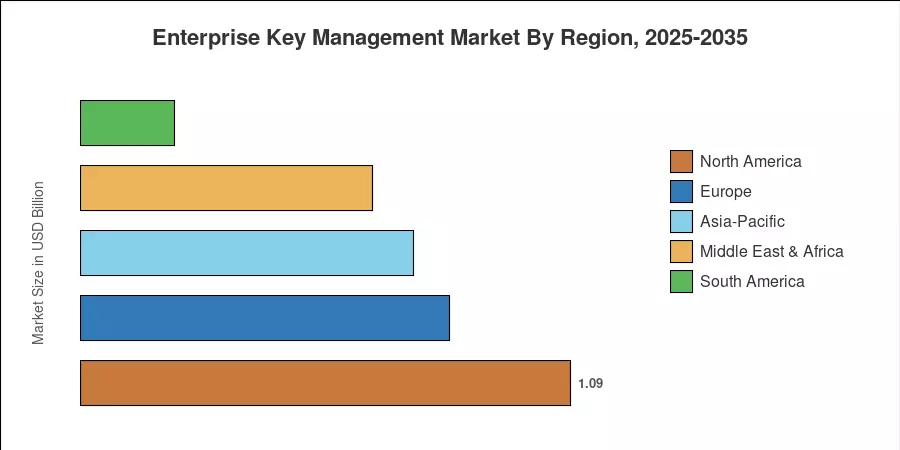
Europe USD 0.82 Billion (2025) DORA, NIS2, GDPR enforcement cycles [1]
Asia-Pacific 24.2% CAGR (2026–2035) DPDP Act (India); CSL expansion (China) [9]
South America USD 0.21 Billion (2025) LGPD enforcement; fintech encryption growth [17]
Middle East & Africa 21.5% CAGR (2026–2035) NDMO (Saudi Arabia); POPIA (South Africa) [9]
Total USD 3.04 Billion (2025)

The Enterprise Key Management Market exhibits a clear geographic hierarchy shaped by regulatory maturity, cloud-adoption rates, and financial-sector density. North America and Europe together account for nearly two-thirds of global spending, but the growth frontier has shifted decisively toward Asia-Pacific.


North America

Country Key Metric Key Driver
United States 78.5% of regional share Federal zero-trust and CMMC mandates [5]
Canada USD 0.13 Billion (2025) PIPEDA modernization; financial-sector compliance [14]
Mexico 18.4% CAGR (2026–2035) Banking digitization; nearshoring data-center expansion [17]


The United States remains the single largest country-level contributor to the Enterprise Key Management Market, propelled by defense-sector requirements under CMMC 2.0 and a healthcare industry spending an estimated USD 12 Billion annually on IT security. Canada's revised PIPEDA guidelines, expected to mandate explicit key-governance reporting by 2027, are pulling mid-market enterprises into the buyer pool ahead of schedule [14].

Europe

Country Key Metric Key Driver
Germany 23.4% of regional share Industry 4.0 encryption requirements [16]
United Kingdom USD 0.14 Billion (2025) Post-Brexit data-adequacy compliance [1]
France 17.8% CAGR (2026–2035) Government-mandated sovereign cloud adoption [3]
Italy USD 0.06 Billion (2025) Banking-sector NIS2 transposition [1]
Spain 19.2% CAGR (2026–2035) Digital Spain 2026 initiative [3]
Nordic Countries USD 0.07 Billion (2025) Financial-sector digitization leadership [14]
Russia 14.8% CAGR (2026–2035) Import-substitution driving domestic KMS demand [16]
Rest of Europe USD 0.09 Billion (2025) Cross-border data-transfer requirements [1]


DORA's January 2025 enforcement date created an immediate compliance wave across the EU banking sector, and the Enterprise Key Management Market in Europe is benefiting from mandatory third-party ICT risk-management audits that explicitly reference cryptographic key governance. Germany's automotive and manufacturing sectors add a unique demand layer as encrypted industrial IoT deployments scale under Industry 4.0 programs [16].

Asia-Pacific

Country Key Metric Key Driver
China 31.2% of regional share Cybersecurity Law and data-localization mandates [9]
India 26.8% CAGR (2026–2035) DPDP Act; UPI payments encryption requirements [9]
Japan USD 0.10 Billion (2025) ISMAP cloud-security compliance framework [18]
South Korea 22.5% CAGR (2026–2035) PIPA amendments; 5G edge encryption demand [12]
ASEAN USD 0.08 Billion (2025) Indonesia PDP Law; Singapore MAS TRM guidelines [9]
Rest of Asia-Pacific 20.1% CAGR (2026–2035) Broader digital-economy legislation rollout [17]


Asia-Pacific's trajectory within the Enterprise Key Management Market reflects an accelerating regulatory convergence. India's DPDP Act, which took enforcement effect in 2025, applies to every data fiduciary handling Indian citizens' personal data — a scope that encompasses multinational corporations and domestic startups alike. China's enforcement of cross-border data-transfer security assessments further pushes enterprises toward auditable key-management platforms [9].

South America

Country Key Metric Key Driver
Brazil 62.5% of regional share LGPD enforcement; Open Banking mandate [17]
Argentina 19.8% CAGR (2026–2035) Financial-sector digitization [17]
Rest of South America USD 0.04 Billion (2025) Emerging data-protection legislation [17]


Brazil dominates the South American Enterprise Key Management Market, where LGPD enforcement actions by the ANPD have tripled year-over-year since 2023 and increasingly target inadequate encryption practices. Open Banking Phase 4, requiring customer-data portability with end-to-end encryption, is creating direct procurement triggers for enterprise-grade key governance [17].

Middle East & Africa

Country Key Metric Key Driver
Saudi Arabia 28.3% of regional share NDMO framework; Vision 2030 digitization [9]
UAE USD 0.04 Billion (2025) DIFC/ADGM data-protection requirements [9]
South Africa 19.5% CAGR (2026–2035) POPIA enforcement; banking-sector compliance [17]
Egypt 21.0% CAGR (2026–2035) Digital Egypt strategy; fintech licensing [17]
Rest of MEA USD 0.03 Billion (2025) Nascent data-protection frameworks [9]


Saudi Arabia's NDMO published mandatory data-classification and encryption standards in 2024, instantly creating compliance-driven demand across government ministries and state-linked enterprises. The UAE's free-zone regulators (DIFC, ADGM) apply GDPR-equivalent standards, making the Enterprise Key Management Market in the Gulf region one of the most regulation-dense outside Europe [9].


Enterprise Key Management Market By Region, 2025-2035

Competitive Benchmarking

The Enterprise Key Management Market exhibits moderate concentration, with an estimated top-five vendor share of 40–48% and a Herfindahl-Hirschman Index in the 600–900 range. Cloud hyperscalers are consolidating share through native platform integration, but specialist vendors defend their positions by solving multi-cloud interoperability challenges and offering bring-your-own-key architectures. The competitive dynamic increasingly rewards vendors that can bridge cloud-native convenience with regulatory-grade auditability.

Company Est. Revenue Share Range Key Offerings for Enterprise Key Management Market Strategic Positioning
AWS (Amazon Web Services) ~9–13% AWS KMS, CloudHSM, External Key Store Platform-native; hyperscaler lock-in advantage
Microsoft Corporation ~8–12% Azure Key Vault, Managed HSM, Azure Confidential Ledger Deep enterprise-stack integration
Thales Group ~8–11% CipherTrust Manager, Luna HSMs, Data Protection on Demand Hardware-rooted trust; multi-cloud governance
IBM Corporation ~7–10% Guardium Key Lifecycle Manager, Hyper Protect Crypto Services Mainframe-to-cloud migration bridge
Google Cloud ~6–9% Cloud KMS, Cloud HSM, External Key Manager Open-source alignment; Confidential Computing
Entrust Corporation ~5–8% KeyControl, nShield HSMs, PKI-as-a-Service Certificate and key convergence
HashiCorp ~4–7% Vault Enterprise, Vault Secrets Operator DevOps-native; infrastructure-as-code ethos
Venafi (CyberArk) ~3–6% Machine Identity Management, CodeSign Protect Machine-identity lifecycle specialist
Fortanix ~2–4% Data Security Manager, Confidential Computing Manager Confidential computing integration
Utimaco ~2–4% u.trust, CryptoServer, Atalla HSM European sovereign-cloud positioning


Recent News & Developments

  • European Commission (January 2025): DORA entered full enforcement, requiring all EU-regulated financial entities to demonstrate cryptographic key lifecycle governance in third-party audits [1].

Enterprise Key Management Market Report Scope

Parameter Detail
Market Scope Enterprise Key Management Market — global, covering cloud and on-premises deployment
Study Period 2021–2035
CAGR (2026–2035) 20.0%
Market Size (2025, Base Year) USD 3.04 Billion
Market Size (2035, Forecast) USD 19.10 Billion
Fastest Growing Segment Small & Medium Enterprises (by enterprise size); Asia-Pacific (by region)
Companies Profiled 10 (AWS, Microsoft, Thales, IBM, Google Cloud, Entrust, HashiCorp, Venafi, Fortanix, Utimaco)
Valuation Currency USD Billion


FAQs

How should enterprises evaluate build-versus-buy decisions for key management infrastructure?
Most mid-market buyers find that commercial KMS platforms reach production readiness in weeks, while custom-built solutions typically require 12–18 months and dedicated cryptographic engineers [15]. The total cost of ownership for commercial platforms is generally 30–45% lower over a five-year horizon.
What role do hardware security modules play alongside cloud-based key management platforms?
HSMs provide a tamper-resistant root of trust that cloud-only KMS solutions cannot replicate for the highest-assurance workloads. Hybrid architectures that pair cloud KMS policy engines with on-premises or cloud-hosted HSMs are becoming the standard deployment pattern for regulated industries [6].
How does the Enterprise Key Management Market address multi-tenant SaaS provider requirements?
SaaS providers increasingly offer customer-managed encryption keys (CMEK) so each tenant controls its own key material. Enterprise KMS platforms support CMEK through dedicated key hierarchies and tenant-isolated namespaces [18].
What compliance certifications should buyers prioritize when selecting a key management vendor?
FIPS 140-3 Level 3 validation, SOC 2 Type II attestation, and Common Criteria EAL4+ are the three certifications most frequently required in regulated procurement processes [19]. PCI-DSS v4.0 compliance adds a fourth requirement for payment-processing environments.
How does the Enterprise Key Management Market differ from the broader encryption software market?
Key management focuses specifically on the lifecycle governance of cryptographic keys — generation, storage, rotation, and destruction — rather than the encryption algorithms themselves [4]. It is a specialized subsegment where operational controls matter more than cipher strength.
What integration challenges arise when migrating from legacy on-premises key management to cloud-native platforms?
Legacy systems often use proprietary key formats incompatible with KMIP or PKCS#11 standards, requiring format-conversion middleware during migration [16]. Enterprises should budget for a 6–12-month parallel-operation phase to validate key-synchronization integrity.
How are cyber insurance underwriting practices influencing Enterprise Key Management Market adoption?
Insurers now audit cryptographic key governance as part of policy-renewal questionnaires, and enterprises lacking automated key-rotation documentation face premium increases averaging 15–25% [14]. This financial pressure converts key management from a security choice into a cost-optimization decision.    
Author
Author
Author Profile
Aarti Dhapte LinkedIn
AVP - Research
A consulting professional focused on helping businesses navigate complex markets through structured research and strategic insights. I partner with clients to solve high-impact business problems across market entry strategy, competitive intelligence, and opportunity assessment. Over the course of my experience, I have led and contributed to 100+ market research and consulting engagements, delivering insights across multiple industries and geographies, and supporting strategic decisions linked to $500M+ market opportunities. My core expertise lies in building robust market sizing, forecasting, and commercial models (top-down and bottom-up), alongside deep-dive competitive and industry analysis. I have played a key role in shaping go-to-market strategies, investment cases, and growth roadmaps, enabling clients to make confident, data-backed decisions in dynamic markets.

Research Approach


Secondary Research

The secondary research process involved comprehensive analysis of cybersecurity regulatory databases, cryptographic standards publications, enterprise IT security research, and authoritative technology organizations. Key sources included the National Institute of Standards and Technology (NIST) Computer Security Resource Center, International Organization for Standardization (ISO/IEC 27001, ISO/IEC 27040), Cloud Security Alliance (CSA), International Association for Cryptologic Research (IACR), Payment Card Industry Security Standards Council (PCI SSC), SANS Institute, European Union Agency for Cybersecurity (ENISA), National Cybersecurity Center of Excellence (NCCoE), American Bankers Association (ABA) Cybersecurity Center, Information Systems Audit and Control Association (ISACA), CompTIA Cybersecurity Advisory Council, Internet Engineering Task Force (IETF) Security Standards, Open Web Application Security Project (OWASP), Center for Internet Security (CIS), and national cybersecurity agency reports from CISA (US), NCSC (UK), BSI (Germany), and ANSSI (France).

Statistics on encryption use, data on compliance frameworks, the growth of cryptographic standards, cybersecurity threat landscapes, and enterprise IT security trends across cloud-based, on-premises, and hybrid deployment architectures were gathered from these sources.


Primary Research

In order to gather both qualitative and quantitative insights, supply-side and demand-side stakeholders were interviewed during the primary research process. CEOs, vice presidents of product security, chief information security officers (CISOs), and enterprise sales directors from suppliers of encryption technology, cybersecurity OEMs, and key management solutions were examples of supply-side sources. CISOs, chief information officers (CIOs), IT security directors, cryptography architects, compliance officers from BFSI institutions, healthcare systems, government agencies, and cloud infrastructure teams from major corporations were examples of demand-side sources. In addition to gathering information on hybrid-cloud key orchestration patterns, Bring Your Own Key (BYOK) adoption tactics, and quantum-resistant cryptography migration plans, primary research verified deployment model preferences and product roadmap deadlines.

Primary Respondent Breakdown:

By Designation: C-level Primaries (38%), Director Level (32%), Others (30%)

By Region: North America (38%), Europe (25%), Asia-Pacific (27%), Rest of World (10%)


Market Size Estimation

Revenue mapping and enterprise adoption studies throughout encryption key lifecycle management were used to determine the global market valuation. The methodology comprised:

Finding more than forty major technological companies in North America, Europe, Asia-Pacific, and Latin America with a focus on managed encryption services, key management software, and hardware security modules (HSMs)

Product mapping with segmentation for Data Encryption, Secure Communication, Digital Signature, and Public Key Infrastructure applications across cloud-based, on-premises, and hybrid deployment types

Examination of reported and projected yearly income for enterprise key management portfolios, such as professional services, SaaS-based key management platforms, and HSM hardware

coverage of technological companies that will account for 75–80% of the worldwide market in 2024

Extrapolation of segment-specific valuations for Software, Hardware, and Services components across BFSI, IT & Telecom, Government, Healthcare, and Retail end-user verticals using top-down (vendor revenue validation against IT security spending surveys) and bottom-up (enterprise adoption rates × solution pricing by vertical/region) approaches

Download Free Sample

Kindly complete the form below to receive a free sample of this Report

Download PDF ×

We do not share your information with anyone. However, we may send you emails based on your report interest from time to time. You may contact us at any time to opt-out.