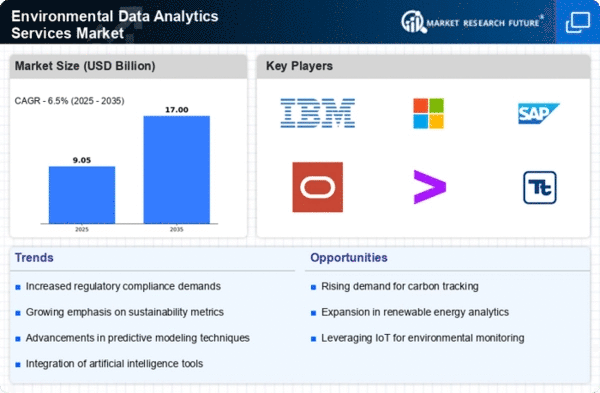
The Environmental Data Analytics Services Market is currently characterized by a dynamic competitive landscape, driven by increasing regulatory pressures and a growing emphasis on sustainability. Major players are actively engaging in strategic initiatives to enhance their market positioning. For instance, IBM (US) has been focusing on innovation through its AI-driven analytics solutions, which aim to provide actionable insights for environmental management. Similarly, Microsoft (US) is leveraging its cloud capabilities to offer scalable data analytics services that cater to diverse environmental needs. These strategies not only enhance operational efficiency but also foster a collaborative ecosystem among stakeholders, thereby shaping the competitive environment.In terms of business tactics, companies are increasingly localizing their operations to better serve regional markets, optimizing supply chains to reduce costs, and enhancing service delivery. The market appears moderately fragmented, with a mix of established players and emerging startups. The collective influence of key players, such as SAP (DE) and Oracle (US), is significant, as they continue to innovate and expand their service offerings, thereby intensifying competition.
In November Accenture (IE) announced a partnership with a leading environmental NGO to develop a new platform aimed at improving data transparency in environmental reporting. This strategic move is likely to enhance Accenture's credibility and expand its client base among organizations seeking to improve their sustainability practices. The collaboration underscores the importance of partnerships in driving innovation and addressing complex environmental challenges.
In October Tetra Tech (US) launched a new suite of data analytics tools designed specifically for water resource management. This initiative reflects Tetra Tech's commitment to addressing critical environmental issues through advanced technology. By focusing on water analytics, the company positions itself as a leader in a niche market, potentially attracting clients from both public and private sectors.
In September Envirosuite (AU) expanded its operations into the European market, establishing a new office in Germany. This expansion is indicative of the company's strategy to tap into the growing demand for environmental data analytics in Europe, where regulatory frameworks are becoming increasingly stringent. Such geographical diversification may enhance Envirosuite's competitive edge and market reach.
As of December the competitive trends in the Environmental Data Analytics Services Market are heavily influenced by digitalization, sustainability initiatives, and the integration of AI technologies. Strategic alliances are becoming increasingly vital, as they enable companies to pool resources and expertise to tackle environmental challenges more effectively. Looking ahead, it is anticipated that competitive differentiation will evolve, shifting from traditional price-based competition to a focus on innovation, technological advancements, and supply chain reliability. This transition may redefine how companies engage with clients and stakeholders, ultimately fostering a more sustainable and resilient market.