Europe 5G mm Wave Technology Market
Europe 5G mm Wave Technology Market Summary
As per Market Research Future analysis, the 5G mm-wave technology market size was estimated at 826.58 USD Million in 2024. The 5G Mm-wave-technology market is projected to grow from 950.65 USD Million in 2025 to 3850.0 USD Million by 2035, exhibiting a compound annual growth rate (CAGR) of 15.0% during the forecast period 2025 - 2035
Key Market Trends & Highlights
The Europe 5G mm-wave technology market is poised for substantial growth driven by infrastructure investments and innovative applications.
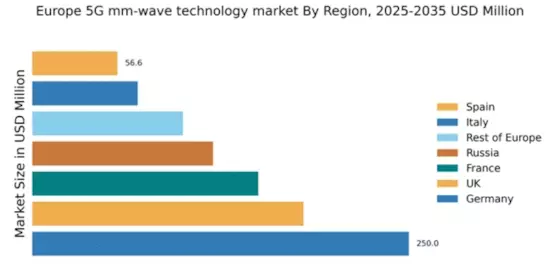
- Germany leads the Europe 5G mm-wave technology market, showcasing robust infrastructure investments.
- The UK emerges as the fastest-growing region, reflecting a surge in demand for high-speed connectivity.
- Innovative applications are increasingly being developed, enhancing the utility of 5G mm-wave technology across various sectors.
- Rising demand for high-speed connectivity and government initiatives are key drivers propelling market expansion.
Market Size & Forecast
| 2024 Market Size | 826.58 (USD Million) |
| 2035 Market Size | 3850.0 (USD Million) |
| CAGR (2025 - 2035) | 15.01% |
Major Players
Qualcomm (US), Samsung (KR), Nokia (FI), Ericsson (SE), Huawei (CN), ZTE (CN), Intel (US), Broadcom (US), Cisco (US)
Europe 5G mm Wave Technology Market Trends
The 5g mm-wave-technology market is currently experiencing a transformative phase, driven by the increasing demand for high-speed connectivity and enhanced mobile broadband services. This technology, characterized by its ability to deliver ultra-fast data rates and low latency, is becoming integral to various sectors, including telecommunications, automotive, and smart cities. As European nations invest heavily in infrastructure development, the deployment of 5g mm-wave-technology is expected to accelerate, fostering innovation and economic growth. Furthermore, regulatory frameworks are evolving to support the expansion of this technology, ensuring that it meets the needs of consumers and businesses alike. In addition, the competitive landscape of the 5g mm-wave-technology market is intensifying, with numerous players vying for market share. Telecommunications companies are collaborating with technology providers to enhance their service offerings, while startups are emerging with innovative solutions that leverage mm-wave capabilities. The focus on sustainability and energy efficiency is also shaping the market, as stakeholders seek to minimize environmental impact while maximizing performance. Overall, the 5g mm-wave-technology market is poised for substantial growth, driven by technological advancements and a supportive regulatory environment.
Increased Investment in Infrastructure
Investment in infrastructure for the 5g mm-wave-technology market is on the rise, as governments and private entities recognize the need for robust networks. This trend is likely to enhance connectivity across urban and rural areas, facilitating the adoption of advanced applications such as IoT and smart transportation.
Emergence of Innovative Applications
The 5g mm-wave-technology market is witnessing the emergence of innovative applications that leverage its high-speed capabilities. Industries such as healthcare, entertainment, and manufacturing are exploring new use cases, which may lead to increased efficiency and improved user experiences.
Regulatory Support and Standardization
Regulatory bodies are actively working to create a conducive environment for the 5g mm-wave-technology market. Efforts towards standardization and streamlined licensing processes are expected to accelerate deployment, ensuring that the technology can be effectively integrated into existing systems.
Europe 5G mm Wave Technology Market Drivers
Increased Adoption of IoT Devices
The rapid adoption of Internet of Things (IoT) devices in Europe is a significant driver for the 5g mm-wave-technology market. As more devices become interconnected, the demand for high-speed, low-latency communication increases. The mm-wave technology is particularly well-suited for IoT applications, enabling seamless connectivity for smart home devices, industrial automation, and healthcare monitoring systems. Recent statistics indicate that the number of IoT devices in Europe is expected to surpass 30 billion by 2025, creating a substantial need for robust network infrastructure. This surge in IoT adoption is likely to stimulate investments in mm-wave technology, thereby enhancing the overall market landscape.
Government Initiatives and Funding
Government initiatives and funding aimed at enhancing digital infrastructure are pivotal for the growth of the 5g mm-wave-technology market. European governments are increasingly recognizing the importance of advanced telecommunications for economic development and competitiveness. Initiatives such as the European Commission's Digital Compass plan aim to ensure that all European households have access to high-speed internet by 2030. This commitment is likely to result in substantial public and private investments in mm-wave technology. Furthermore, funding programs are being established to support research and development in this area, which could lead to breakthroughs that further stimulate market growth. As a result, government support is expected to play a crucial role in shaping the future of the 5g mm-wave-technology market.
Expansion of Smart City Initiatives
The expansion of smart city initiatives across Europe is significantly influencing the 5g mm-wave-technology market. As urban areas strive to enhance efficiency and sustainability, the integration of advanced technologies becomes crucial. The deployment of mm-wave technology facilitates the connectivity required for smart traffic management, public safety systems, and environmental monitoring. For instance, cities like Barcelona and Amsterdam are implementing smart solutions that rely on high-speed data transmission. This trend is expected to drive investments in mm-wave infrastructure, with estimates suggesting that smart city projects could reach a market value of €500 billion by 2025. Thus, the growth of smart cities is likely to be a key factor in the advancement of the 5g mm-wave-technology market.
Rising Demand for High-Speed Connectivity
The increasing demand for high-speed connectivity in Europe is a primary driver for the 5g mm-wave-technology market. As businesses and consumers alike seek faster internet speeds, the need for advanced telecommunications infrastructure becomes evident. According to recent data, the demand for mobile data traffic is projected to grow by over 50% annually, necessitating the deployment of mm-wave technology to meet these requirements. This technology offers enhanced bandwidth and lower latency, making it suitable for applications such as augmented reality and ultra-high-definition video streaming. Consequently, telecommunications providers are investing heavily in mm-wave infrastructure to cater to this growing demand, thereby propelling the 5g mm-wave-technology market forward.
Technological Advancements in Telecommunications
Technological advancements in telecommunications are driving the evolution of the 5g mm-wave-technology market. Innovations in antenna design, signal processing, and network architecture are enhancing the capabilities of mm-wave technology, making it more efficient and reliable. For example, advancements in beamforming techniques allow for improved signal quality and coverage, which are essential for urban environments. As European telecom operators upgrade their networks to support these advancements, the market for 5g mm-wave technology is expected to expand. Industry expert's suggest that the integration of these technologies could lead to a market growth rate of approximately 25% annually, underscoring the importance of continuous innovation in this sector.
Market Segment Insights
By Application: Enhanced Mobile Broadband (Largest) vs. Ultra-Reliable Low Latency Communications (Fastest-Growing)
In the Europe 5G mm wave technology market, the application segment is prominently led by Enhanced Mobile Broadband (eMBB), which captures a significant portion of market share. This application provides high-speed Internet connectivity, meeting the increasing demand for mobile data, especially with the proliferation of smart devices. Meanwhile, Ultra-Reliable Low Latency Communications (URLLC) is witnessing rapid adoption due to its critical applications in sectors such as healthcare and autonomous vehicles, marking it as the fastest-growing segment within this category. The growth trends within the application segment of the Europe 5G mm wave technology market are driven by escalating consumer demand for high-quality mobile services and new innovative applications requiring real-time connectivity. Enhanced Mobile Broadband continues to thrive as digitalization and remote working necessitate high-speed data services. On the other hand, the push for automation across industries and the necessity for reliable communication links emphasize the rapid growth of Ultra-Reliable Low Latency Communications, making it a crucial player in the technological advancement landscape.
Enhanced Mobile Broadband (Dominant) vs. Ultra-Reliable Low Latency Communications (Emerging)
Enhanced Mobile Broadband (eMBB) stands out as a dominant force in the Europe 5G mm wave technology market, providing unparalleled downloading speeds and improved user experience for mobile internet access. It serves as the cornerstone of modern connectivity, catering to consumer demands for seamless streaming, online gaming, and advanced mobile applications. In contrast, Ultra-Reliable Low Latency Communications (URLLC) is characterized by its ability to support mission-critical applications that require instant data transmission with minimal delay. This position allows URLLC to cater to industries such as healthcare, manufacturing, and transportation, where precision and reliability are paramount. As these sectors increasingly adopt IoT and smart technologies, URLLC is poised to emerge rapidly, creating a balanced landscape alongside the established eMBB.
By End Use: Telecommunications (Largest) vs. Automotive (Fastest-Growing)
In the Europe 5G mm wave technology market, the telecommunications segment holds the largest market share due to the extensive demand for high-speed connectivity and the proliferation of mobile devices. This segment benefits from the increasing need for faster internet services and improved network reliability, driven by the growth of data-intensive applications. In contrast, the automotive sector, while smaller in share, is emerging swiftly as a key player, driven by the demand for connected vehicles and autonomous driving technologies that require robust 5G connectivity.
Telecommunications: Dominant vs. Automotive: Emerging
The telecommunications segment is characterized by its substantial infrastructure investments and widespread adoption of 5G technology, making it a cornerstone for various digital services across Europe. It leverages advanced networking capabilities to meet the evolving demands of consumers and businesses alike. On the other hand, the automotive segment is rapidly gaining ground, fueled by advancements in vehicle-to-everything (V2X) communication technologies that enhance safety and efficiency. This segment is witnessing increased investments from automakers and tech firms, indicating a robust growth trajectory as more vehicles become equipped to utilize 5G mm wave technology.
By Technology: Optical Fiber (Largest) vs. Microwave (Fastest-Growing)
In the Europe 5G mm wave technology market, the distribution of market share among various technologies reveals a significant preference for Optical Fiber as the leading technology. Its robust infrastructure and high-speed connectivity make it a backbone for delivering 5G services. Conversely, Microwave technology, known for its flexibility and quick deployment capabilities, has emerged as a rapidly growing alternative, especially among urban deployments where traditional cabling may be prohibitively expensive or logistically challenging.
Technology: Optical Fiber (Dominant) vs. Microwave (Emerging)
Optical Fiber stands out in the Europe 5G mm wave technology market as the dominant player, with its superior bandwidth capacity and reliability in high-speed data transmission. This technology is favored for its ability to support seamless connectivity between various nodes in the 5G network, ensuring minimal latency and maximum performance. On the other hand, Microwave technology is gaining traction as an emerging solution, especially in areas where rapid installation is necessary. Its ease of deployment and cost-effectiveness makes it an attractive option for temporary or semi-permanent installations, allowing service providers to meet the increasing demand for high-speed internet access in densely populated urban centers.
By Deployment Type: Public Network (Largest) vs. Private Network (Fastest-Growing)
In the Europe 5G mm wave technology market, the deployment type segment is primarily composed of Public Networks, which hold the largest share due to their wide-scale adoption by telecommunications operators. Public Networks benefit from economies of scale, infrastructure investments, and institutional support, making them accessible and reliable solutions for urban and suburban areas. Meanwhile, Private Networks, although smaller in market share, are rapidly gaining traction as organizations seek tailored solutions for enhanced security and network performance. Recent trends indicate that Private Networks are the fastest-growing segment, fueled by increasing demand from enterprises needing secure and resilient connectivity. Hybrid Networks, combining both public and private infrastructures, are also emerging as a viable solution, bridging the gap between scalable public services and the specialized needs of private enterprises. These trends underscore a shift towards more flexible and adaptive network solutions in the European market.
Public Network (Dominant) vs. Hybrid Network (Emerging)
Public Networks dominate the Europe 5G mm wave technology landscape, offering extensive coverage and robust performance critical for both consumers and businesses. Designed for mass deployment, these networks leverage existing cellular infrastructure, thus ensuring quick and efficient service availability. On the other hand, Hybrid Networks represent an emerging segment that combines elements of both public and private deployments. They cater to the unique needs of organizations requiring customized connectivity solutions while also benefiting from the scale and accessibility of public networks. The flexibility of Hybrid Networks allows businesses to optimize their operations, making them an increasingly attractive option as more enterprises seek versatile and scalable network configurations.
By Frequency Band: 28 GHz (Largest) vs. 39 GHz (Fastest-Growing)
The 5G mm wave technology market in Europe is experiencing a dynamic distribution among its frequency bands. The 28 GHz band currently leads the segment due to its widespread adoption and compatibility with existing technology infrastructure. This frequency band is favored for urban deployments owing to its balance of range and capacity. In contrast, the 39 GHz band is gaining attention as an emerging choice for high-density areas, although it currently holds a smaller share in comparison to the dominant 28 GHz.
28 GHz (Dominant) vs. 39 GHz (Emerging)
The 28 GHz frequency band has established itself as the dominant force in the European 5G mm wave market, primarily due to its effective balance between performance and coverage. It is well-suited for a variety of applications, including mobile broadband and enhanced mobile services, making it a preferred choice among service providers. On the other hand, the 39 GHz band represents an emerging opportunity due to its superior bandwidth capabilities, particularly in urban environments. Its adoption is driven by the increasing demand for high-speed data services and its potential to support innovative applications such as augmented reality and smart city solutions, making it a crucial player for future 5G advancements.
Regional Insights
Germany : Strong Infrastructure and Innovation Hub
Key markets include Berlin, Munich, and Frankfurt, where major telecom operators like Deutsche Telekom and Vodafone are actively expanding their 5G networks. The competitive landscape features significant players such as Nokia and Ericsson, who are collaborating with local firms to enhance service delivery. The business environment is characterized by a strong emphasis on technology adoption in industries like automotive and logistics, making Germany a pivotal player in the European 5G landscape.
UK : Innovative Solutions and Competitive Edge
Key markets include London, Manchester, and Birmingham, where major players like BT and Vodafone are leading the charge in 5G deployment. The competitive landscape is vibrant, with companies like Huawei and Ericsson also making significant inroads. The UK’s business environment is conducive to tech startups, particularly in sectors like fintech and healthcare, which are leveraging 5G for enhanced service delivery.
France : Government Support and Market Growth
Key markets include Paris, Lyon, and Marseille, where major telecom operators like Orange and SFR are actively expanding their 5G networks. The competitive landscape features significant players such as Nokia and Ericsson, who are collaborating with local firms to enhance service delivery. The business environment is characterized by a strong emphasis on technology adoption in industries like automotive and logistics, making France a pivotal player in the European 5G landscape.
Russia : Government Initiatives and Infrastructure Growth
Key markets include Moscow and St. Petersburg, where major players like MTS and MegaFon are leading the 5G rollout. The competitive landscape is evolving, with local firms collaborating with international players like Huawei and Ericsson. The business environment is marked by a focus on technology adoption in sectors such as energy and transportation, positioning Russia as a growing player in the European 5G market.
Italy : Investment and Innovation Drive Market
Key markets include Milan, Rome, and Turin, where major telecom operators like TIM and Vodafone are actively expanding their 5G networks. The competitive landscape features significant players such as Ericsson and Nokia, who are collaborating with local firms to enhance service delivery. The business environment is characterized by a strong emphasis on technology adoption in industries like manufacturing and logistics, making Italy a pivotal player in the European 5G landscape.
Spain : Government Support and Market Dynamics
Key markets include Madrid and Barcelona, where major telecom operators like Telefonica and Vodafone are actively expanding their 5G networks. The competitive landscape features significant players such as Nokia and Ericsson, who are collaborating with local firms to enhance service delivery. The business environment is characterized by a strong emphasis on technology adoption in industries like automotive and logistics, making Spain a pivotal player in the European 5G landscape.
Rest of Europe : Regional Variations and Opportunities
Key markets include cities across Scandinavia, the Benelux countries, and Eastern Europe, where major players like Ericsson and Nokia are establishing a presence. The competitive landscape is diverse, with local firms collaborating with international players to enhance service delivery. The business environment is characterized by a focus on technology adoption in various sectors, making the Rest of Europe a dynamic player in the European 5G market.
Key Players and Competitive Insights
Key Companies in the Europe 5G mm Wave Technology Market include
Industry Developments
The Europe 5G Millimeter Wave Technology Market has witnessed significant developments recently, particularly with companies like Qualcomm, Cisco, and Nokia pushing advancements in bandwidth expansion and enhanced connectivity solutions. There has been a notable increase in investments, driven by ongoing demand from telecommunications and industry sectors, contributing to a robust market valuation. For instance, ZTE and Ericsson have collaborated to enhance network efficiency and drive the adoption of 5G technologies across Europe, especially in urban centers.
In terms of mergers and acquisitions, Broadcom announced its acquisition of a leading wireless technology firm in July 2023 to expand its portfolio in the European market.
Additionally, in August 2022, Intel reported a strategic partnership with several European telecom operators focusing on 5G deployment. The ongoing evolution of mmWave technology enhances mobile broadband experiences while enabling applications like IoT and smart city initiatives. The European Commission has also released guidelines to promote a favorable regulatory environment for the proliferation of 5G technologies, boosting investment avenues in this field. These collective efforts and strategic maneuvers reflect a vibrant and evolving landscape in the Europe 5G MM Wave Technology Market.
Future Outlook
Europe 5G mm Wave Technology Market Future Outlook
The 5G mm-wave-technology market is projected to grow at a 15.01% CAGR from 2025 to 2035, driven by increasing demand for high-speed connectivity and IoT applications.
New opportunities lie in:
- Development of advanced mm-wave antennas for urban environments.
- Integration of mm-wave technology in autonomous vehicle systems.
- Expansion of mm-wave infrastructure in smart city projects.
By 2035, the market is expected to achieve substantial growth, driven by technological advancements and increased adoption.
Market Segmentation
Europe 5G mm Wave Technology Market End Use Outlook
- Residential
- Commercial
- Industrial
Europe 5G mm Wave Technology Market Component Outlook
- Antennas
- Transceivers
- Amplifiers
- Filters
Europe 5G mm Wave Technology Market Application Outlook
- Telecommunications
- Automotive
- Healthcare
- Smart Cities
- Consumer Electronics
Europe 5G mm Wave Technology Market Frequency Band Outlook
- Millimeter Wave Frequency
- Sub-6 GHz Frequency
Report Scope
| MARKET SIZE 2024 | 826.58(USD Million) |
| MARKET SIZE 2025 | 950.65(USD Million) |
| MARKET SIZE 2035 | 3850.0(USD Million) |
| COMPOUND ANNUAL GROWTH RATE (CAGR) | 15.01% (2025 - 2035) |
| REPORT COVERAGE | Revenue Forecast, Competitive Landscape, Growth Factors, and Trends |
| BASE YEAR | 2024 |
| Market Forecast Period | 2025 - 2035 |
| Historical Data | 2019 - 2024 |
| Market Forecast Units | USD Million |
| Key Companies Profiled | Qualcomm (US), Samsung (KR), Nokia (FI), Ericsson (SE), Huawei (CN), ZTE (CN), Intel (US), Broadcom (US), Cisco (US) |
| Segments Covered | Application, End Use, Component, Frequency Band |
| Key Market Opportunities | Expansion of smart city infrastructure drives demand for 5g mm-wave-technology market solutions. |
| Key Market Dynamics | Intensifying competition drives innovation and regulatory adaptations in the 5G mm-wave-technology market. |
| Countries Covered | Germany, UK, France, Russia, Italy, Spain, Rest of Europe |
FAQs
What is the current valuation of the Europe 5G mm wave technology market?
As of 2024, the market valuation was 826.58 USD Million.
What is the projected market size for the Europe 5G mm wave technology market by 2035?
The market is expected to reach a valuation of 3846.3 USD Million by 2035.
What is the expected CAGR for the Europe 5G mm wave technology market during the forecast period?
The market is projected to grow at a CAGR of 15.0% from 2025 to 2035.
Which companies are the key players in the Europe 5G mm wave technology market?
Key players include Ericsson, Nokia, Huawei, ZTE, Qualcomm, Samsung, Intel, Cisco, and Broadcom.
What are the main application segments of the Europe 5G mm wave technology market?
The main application segments include Enhanced Mobile Broadband, Fixed Wireless Access, Massive Machine Type Communications, and Ultra-Reliable Low Latency Communications.
How does the telecommunications sector contribute to the Europe 5G mm wave technology market?
The telecommunications sector accounted for a valuation of 400.0 USD Million in 2024, with projections reaching 1800.0 USD Million by 2035.
What technologies are utilized in the Europe 5G mm wave technology market?
Technologies include Radio Frequency, Microwave, Optical Fiber, and Satellite, with Optical Fiber projected to grow from 300.0 to 1300.0 USD Million.
What are the deployment types in the Europe 5G mm wave technology market?
Deployment types include Private Network, Public Network, and Hybrid Network, with Public Network expected to grow from 500.0 to 2400.0 USD Million.
Which frequency bands are significant in the Europe 5G mm wave technology market?
Significant frequency bands include 24 GHz, 28 GHz, 39 GHz, and 60 GHz, with 39 GHz projected to grow from 300.0 to 1500.0 USD Million.
What role do smart cities play in the Europe 5G mm wave technology market?
Smart cities are projected to grow from 176.58 USD Million in 2024 to 846.3 USD Million by 2035.
Kindly complete the form below to receive a free sample of this Report
Customer Stories
“This is really good guys. Excellent work on a tight deadline. I will continue to use you going forward and recommend you to others. Nice job”
“Thanks. It’s been a pleasure working with you, please use me as reference with any other Intel employees.”
“Thanks for sending the report it gives us a good global view of the Betaïne market.”
“Thank you, this will be very helpful for OQS.”
“We found the report very insightful! we found your research firm very helpful. I'm sending this email to secure our future business.”
“I am very pleased with how market segments have been defined in a relevant way for my purposes (such as "Portable Freezers & refrigerators" and "last-mile"). In general the report is well structured. Thanks very much for your efforts.”
“I have been reading the first document or the study, ,the Global HVAC and FP market report 2021 till 2026. Must say, good info! I have not gone in depth at all parts, but got a good indication of the data inside!”
“We got the report in time, we really thank you for your support in this process. I also thank to all of your team as they did a great job.”