×
Request Free Sample ×

Kindly complete the form below to receive a free sample of this Report

* Please use a valid business email

Leading companies partner with us for data-driven Insights

clients tt-cursor
Hero Background

Europe Ai In Iot Market

ID: MRFR/ICT/63688-HCR
200 Pages
Aarti Dhapte
October 2025

Europe AI in IoT Market Research Report By Component (Platforms, Software Solutions, Services), By Technologies (ML and Deep Learning, NLP), By Vertical (Manufacturing, Energy and Utilities, Transportation and Mobility, BFSI, Government and Defense, Retail, Healthcare and Life Sciences, Telecom, Others), and By Regional (Germany, UK, France, Russia, Italy, Spain, Rest of Europe)- Forecast to 2035

Share:
Download PDF ×

We do not share your information with anyone. However, we may send you emails based on your report interest from time to time. You may contact us at any time to opt-out.

Europe Ai In Iot Market Infographic
Purchase Options

Europe Ai In Iot Market Summary

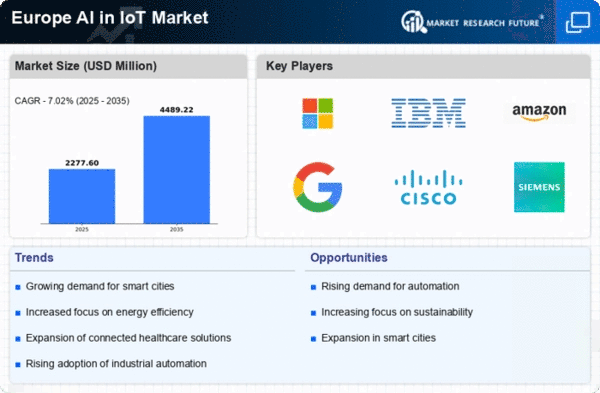
As per MRFR analysis, the ai in-iot market Size was estimated at 2128.2 USD Million in 2024. The ai in-iot market is projected to grow from 2277.6 USD Million in 2025 to 4489.22 USD Million by 2035, exhibiting a compound annual growth rate (CAGR) of 7.02% during the forecast period 2025 - 2035.

Key Market Trends & Highlights

The Europe AI in-IoT market is experiencing robust growth driven by technological advancements and increasing demand for smart solutions.

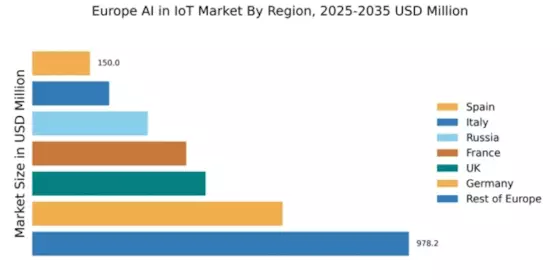
  • Germany remains the largest market for AI in-IoT, showcasing a strong commitment to integrating advanced technologies into infrastructure.
  • The UK is emerging as the fastest-growing region, reflecting a surge in investments and innovation in AI-driven IoT applications.
  • There is a notable emphasis on interoperability standards, which facilitates seamless integration across various IoT devices and platforms.
  • Key market drivers include rising demand for smart infrastructure and advancements in AI technologies, which are propelling market expansion.

Market Size & Forecast

2024 Market Size 2128.2 (USD Million)
2035 Market Size 4489.22 (USD Million)
CAGR (2025 - 2035) 7.02%

Major Players

Microsoft (US), IBM (US), Amazon (US), Google (US), Cisco (US), Siemens (DE), General Electric (US), Intel (US), Oracle (US)

Europe Ai In Iot Market Trends

The ai in-iot market is currently experiencing a transformative phase, driven by advancements in artificial intelligence and the proliferation of Internet of Things devices. In Europe, the integration of AI technologies into IoT systems is enhancing operational efficiency across various sectors, including manufacturing, healthcare, and smart cities. This synergy is fostering innovative applications that optimize resource management, improve predictive maintenance, and enable real-time data analytics. As organizations increasingly recognize the value of data-driven decision-making, the demand for sophisticated ai in-iot solutions is likely to escalate, prompting further investment in research and development. Moreover, regulatory frameworks in Europe are evolving to support the growth of the ai in-iot market. Initiatives aimed at promoting digital transformation and sustainability are encouraging businesses to adopt smart technologies. The European Union's commitment to fostering a digital economy is evident through various funding programs and strategic partnerships. These efforts not only aim to enhance competitiveness but also to ensure that ethical considerations are integrated into the deployment of AI and IoT technologies. As a result, the landscape for the ai in-iot market appears poised for substantial growth, with a focus on innovation, sustainability, and compliance with emerging regulations.

Increased Adoption of AI-Driven Analytics

Organizations are increasingly leveraging AI-driven analytics within IoT frameworks to derive actionable insights from vast data streams. This trend is particularly evident in sectors such as logistics and energy management, where predictive analytics can optimize operations and reduce costs.

Focus on Interoperability Standards

The push for interoperability among IoT devices is gaining momentum, as stakeholders recognize the need for seamless communication across platforms. Establishing common standards is crucial for enhancing the functionality and scalability of ai in-iot solutions.

Emphasis on Data Privacy and Security

As the ai in-iot market expands, concerns regarding data privacy and security are becoming more pronounced. Regulatory bodies are implementing stricter guidelines to protect user data, prompting companies to prioritize robust security measures in their ai in-iot deployments.

Europe Ai In Iot Market Drivers

Growing Cybersecurity Concerns

As the ai in-iot market in Europe expands, so do concerns regarding cybersecurity. The proliferation of connected devices increases the potential for cyber threats, prompting businesses to prioritize security measures. In 2025, it is estimated that cybersecurity spending in the IoT sector will reach €3 billion. Companies are investing in advanced security protocols and AI-driven threat detection systems to safeguard their networks. This heightened focus on cybersecurity is essential for building trust among consumers and businesses alike. As a result, the demand for secure ai in-iot solutions is likely to rise, positioning cybersecurity as a critical driver in the ai in-iot market.

Advancements in AI Technologies

Technological advancements in artificial intelligence are significantly influencing the ai in-iot market in Europe. Innovations in machine learning, natural language processing, and computer vision are enhancing the capabilities of IoT devices. These advancements enable more sophisticated data processing and predictive analytics, which are crucial for various applications, including smart homes, healthcare, and industrial automation. The European market is witnessing an increase in investments in AI research and development, with funding reaching approximately €1 billion in 2025. This influx of capital is likely to accelerate the deployment of AI-driven IoT solutions, thereby propelling growth in the ai in-iot market.

Increased Focus on Sustainability

The growing emphasis on sustainability is reshaping the ai in-iot market in Europe. As environmental concerns become more pressing, businesses and governments are seeking solutions that minimize ecological footprints. AI-driven IoT applications are being utilized to monitor and manage energy consumption, waste management, and resource allocation more effectively. For example, smart grids powered by AI can optimize energy distribution, reducing waste and enhancing efficiency. The European market is projected to see a 30% increase in the adoption of sustainable IoT solutions by 2026. This focus on sustainability not only aligns with regulatory requirements but also appeals to environmentally conscious consumers, making it a vital driver in the ai in-iot market.

Government Initiatives and Funding

Government initiatives aimed at promoting digital transformation are acting as a catalyst for the ai in-iot market in Europe. Various European nations are implementing policies to support the integration of AI and IoT technologies across sectors. For instance, the European Commission has allocated substantial funding to projects that enhance connectivity and innovation. In 2025, funding for digital infrastructure projects is expected to exceed €5 billion. These initiatives not only foster collaboration between public and private sectors but also create a conducive environment for startups and established companies to innovate. Consequently, this driver is crucial for the growth trajectory of the ai in-iot market.

Rising Demand for Smart Infrastructure

The ai in-iot market in Europe is experiencing a notable surge in demand for smart infrastructure solutions. This trend is driven by urbanization and the need for efficient resource management. According to recent estimates, the smart infrastructure sector is projected to grow at a CAGR of 25% through 2027. Cities are increasingly adopting ai in-iot technologies to enhance public services, optimize energy consumption, and improve transportation systems. The integration of ai with IoT devices allows for real-time data analysis, enabling municipalities to make informed decisions. This shift towards smart infrastructure not only enhances operational efficiency but also contributes to sustainability goals, making it a pivotal driver in the ai in-iot market.

Market Segment Insights

By Component: Software Solutions (Largest) vs. Platforms (Fastest-Growing)

In the Europe ai in-iot market, the market share distribution among component values reveals that Software Solutions holds a predominant position, catering to various applications and user needs. Platforms, while currently smaller in market share, are rapidly gaining traction, driven by increasing demand for integrated solutions and interoperability in ai and IoT technologies. Growth trends indicate a robust acceleration in the adoption of Platforms, fueled by the rise of smart infrastructure and the Internet of Everything (IoE). Enterprises are increasingly transitioning to more versatile platforms that enable scalability and flexibility. Meanwhile, Software Solutions continue to evolve with innovative features that enhance user experience and optimize processes, leading to sustained demand and a strong foothold in the market.

Software Solutions: Dominant vs. Platforms: Emerging

Software Solutions stand as the dominant component in the Europe ai in-iot market, characterized by their broad applicability across numerous sectors such as healthcare, manufacturing, and smart cities. They offer advanced analytics, real-time data processing, and enhanced decision-making capabilities. Platforms, on the other hand, are emerging rapidly, promoting faster deployment of ai and IoT capabilities. These platforms serve as foundational technologies that support a variety of applications and enable seamless integration of diverse devices and services. As organizations seek to harness the full potential of data and connectivity, the synergy between Software Solutions and Platforms will play a crucial role in driving innovation and enhancing operational efficiency.

By Technologies: ML and Deep Learning (Largest) vs. NLP (Fastest-Growing)

In the technologies segment, ML and Deep Learning hold a substantial share of the market, reflecting the preference of organizations for advanced data processing and predictive analytics. On the other hand, NLP is gaining traction as businesses look to enhance customer interactions through automated language understanding, showcasing its growing significance in various applications such as chatbots and sentiment analysis. Growth trends suggest a strong trajectory for both ML and Deep Learning alongside NLP. The increasing demand for intelligent automation and data-driven decisions in industries such as finance, healthcare, and retail propels the expansion of ML solutions. Meanwhile, the NLP market is rapidly evolving, with advancements in language models and applications that facilitate real-time language processing driving its growth dynamics.

Technology: ML and Deep Learning (Dominant) vs. NLP (Emerging)

ML and Deep Learning are characterized by their ability to analyze enormous datasets, enabling organizations to forecast trends and optimize processes efficiently. This dominant segment is widely adopted across various domains, significantly impacting operational effectiveness. In contrast, NLP is positioned as an emerging technology that focuses on human-computer interaction, facilitating seamless communication through language understanding. Innovations in this area are swiftly leading to the development of advanced applications, such as virtual assistants and translation services, highlighting its critical importance in enhancing user experiences and driving engagement in the digital landscape.

By Vertical: Manufacturing (Largest) vs. Healthcare and Life Sciences (Fastest-Growing)

In the Europe ai in-iot market, the manufacturing sector accounts for the largest share, driven by extensive automation and IoT adoption across production lines. This vertical leverages AI to enhance operational efficiency, predictive maintenance, and supply chain management, resulting in a significant contribution to market dynamics. Conversely, the healthcare and life sciences segment is emerging as the fastest-growing area, spurred by an increasing demand for AI-driven diagnostics, remote patient monitoring, and personalized medicine. The push for digital transformation in healthcare applications is fostering rapid innovation and adoption, setting the stage for robust growth in this vertical.

Manufacturing (Dominant) vs. Healthcare and Life Sciences (Emerging)

The manufacturing sector remains the dominant force within the ai in-iot landscape due to its early adoption of IoT technologies, facilitating enhanced productivity and reduced operational costs. Its reliance on AI for real-time data analytics and process optimization has solidified its leadership position. In stark contrast, the healthcare and life sciences sector is recognized as an emerging player in the market. It is increasingly utilizing AI for tasks such as predictive modeling, patient data management, and operational efficiencies. This shift is driven by regulatory support and a growing focus on improving patient outcomes, indicating a promising trajectory for innovation and growth in this domain.

Get more detailed insights about Europe Ai In Iot Market

Regional Insights

Germany : Strong industrial base drives growth

Key markets include cities like Munich, Berlin, and Stuttgart, which are hubs for technology and innovation. The competitive landscape features major players such as Siemens and IBM, alongside US giants like Microsoft and Amazon. The local business environment is characterized by a strong emphasis on R&D and collaboration between industry and academia. Specific applications are seen in smart factories and connected vehicles, driving further adoption of AI in IoT technologies.

UK : Innovation fuels market expansion

Key markets include London, Manchester, and Cambridge, known for their tech ecosystems. The competitive landscape features major players like IBM and Google, alongside local startups. The UK market is characterized by a vibrant entrepreneurial environment, with a focus on developing AI applications in healthcare, smart cities, and logistics. This dynamic landscape encourages collaboration between tech firms and public institutions, fostering innovation.

France : Government support drives innovation

Key markets include Paris, Lyon, and Toulouse, which are centers for technology and innovation. The competitive landscape features major players like IBM and local firms specializing in AI applications. The business environment is conducive to growth, with a focus on sustainable development and smart city initiatives. Specific applications are emerging in smart agriculture and connected transport systems, enhancing efficiency and productivity.

Russia : Investment drives technological adoption

Key markets include Moscow and St. Petersburg, which are at the forefront of technological development. The competitive landscape features both local and international players, including Siemens and Cisco. The business environment is evolving, with a focus on enhancing digital capabilities across various industries. Specific applications are being developed in smart energy management and industrial automation, driving further adoption of AI in IoT technologies.

Italy : Manufacturing sector leads adoption

Key markets include Milan, Turin, and Bologna, which are known for their industrial activities. The competitive landscape features major players like Siemens and local firms specializing in AI applications. The business environment is characterized by a focus on innovation and collaboration between industry and academia. Specific applications are emerging in smart manufacturing and supply chain optimization, enhancing operational efficiency.

Spain : Smart cities drive innovation

Key markets include Barcelona and Madrid, which are leading smart city initiatives. The competitive landscape features both local and international players, including Cisco and IBM. The business environment is conducive to innovation, with a focus on public-private partnerships. Specific applications are being developed in smart transportation and energy management, driving further adoption of AI in IoT technologies.

Rest of Europe : Varied markets foster innovation

Key markets include cities across Scandinavia, the Benelux countries, and Eastern Europe, each with unique characteristics. The competitive landscape features a mix of local and international players, including major tech firms and startups. The business environment varies significantly, with some regions focusing on sustainability and others on industrial automation. Specific applications are emerging in smart agriculture, healthcare, and logistics, driving further growth in the AI in IoT sector.


Europe Ai In Iot Market Regional Image

Key Players and Competitive Insights

The ai in-iot market is currently characterized by a dynamic competitive landscape, driven by rapid technological advancements and increasing demand for smart solutions across various sectors. Major players such as Microsoft (US), IBM (US), and Siemens (DE) are strategically positioning themselves through innovation and partnerships, which appear to be pivotal in shaping the market's trajectory. Microsoft (US) focuses on enhancing its Azure IoT platform, integrating advanced AI capabilities to provide comprehensive solutions for industries ranging from manufacturing to healthcare. Meanwhile, IBM (US) emphasizes its Watson IoT platform, leveraging AI to optimize operational efficiencies and drive digital transformation for enterprises. Siemens (DE) is also making strides by investing in smart infrastructure and automation technologies, which suggests a strong commitment to sustainability and efficiency in industrial applications.

The business tactics employed by these companies reflect a concerted effort to localize manufacturing and optimize supply chains, which may enhance their competitive edge. The market structure appears moderately fragmented, with a blend of established players and emerging startups vying for market share. This fragmentation allows for diverse offerings and innovation, although the influence of key players remains substantial, as they set benchmarks for technology and service delivery.

In October 2025, Microsoft (US) announced a strategic partnership with a leading European telecommunications provider to enhance IoT connectivity solutions. This collaboration is likely to bolster Microsoft's presence in the European market, enabling it to deliver more robust and scalable IoT solutions tailored to local needs. Such partnerships may facilitate faster deployment of services and improve customer engagement, thereby reinforcing Microsoft's competitive position.

In September 2025, IBM (US) unveiled a new AI-driven analytics tool designed specifically for the manufacturing sector, aimed at predictive maintenance and operational optimization. This tool's introduction signifies IBM's commitment to leveraging AI to address industry-specific challenges, potentially enhancing productivity and reducing downtime for manufacturers. The strategic importance of this development lies in its ability to provide actionable insights, which could lead to significant cost savings for clients.

In August 2025, Siemens (DE) launched a new initiative focused on integrating AI into its smart building solutions, aiming to enhance energy efficiency and occupant comfort. This initiative reflects Siemens' strategic focus on sustainability and innovation, aligning with broader market trends towards greener technologies. The implications of this move are profound, as it positions Siemens as a leader in the sustainable building sector, likely attracting environmentally conscious clients.

As of November 2025, the competitive trends in the ai in-iot market are increasingly defined by digitalization, sustainability, and the integration of AI technologies. Strategic alliances among key players are shaping the landscape, fostering innovation and enhancing service offerings. Looking ahead, it appears that competitive differentiation will evolve, shifting from price-based competition to a focus on innovation, technological advancement, and supply chain reliability. This transition may ultimately redefine how companies engage with customers and deliver value in an increasingly interconnected world.

Key Companies in the Europe Ai In Iot Market market include

Industry Developments

Siemens debuted AI agents for industrial automation at Hannover Messe in August 2025. Bosch declared in July 2025 that it would improve industrial and transportation solutions by investing more than €2.5 billion in AI by the end of 2027.In order to strengthen digital sovereignty and foster AI innovation, SAP extended its Sovereign Cloud solutions in September 2025 to offer European clients a full technology stack. The UK is leading Europe in the adoption of AI, workforce upskilling, and cybersecurity, according to Rockwell Automation's 10th annual State of Smart Manufacturing Report, released in June 2025.

With plans to train 230,000 people over the next three years, Cisco unveiled projects in France in May 2025 that center on energy-efficient AI-ready infrastructure, digital upskilling, and the AI startup ecosystem.Despite worries about possible obstacles to Europe's AI research, Google announced plans in August 2025 to sign the EU's AI code of practice, which is intended to assist businesses in adhering to the impending AI Act.IBM and BMW joined together in March 2025 to manage and integrate finance and procurement operations, utilizing AI to improve productivity and decision-making.

At Embedded World 2025 in March 2025, Intel demonstrated advancements in edge and 5G technology, emphasizing the use of AI solutions in industrial settings. In order to overcome the underrepresentation of Europe's 24 official and 250 indigenous languages in AI training data, Microsoft launched a major program in August 2025 to enhance multilingual large language models.

Europe AI in IoT

Future Outlook

Europe Ai In Iot Market Future Outlook

The ai in-iot market is projected to grow at a 7.02% CAGR from 2024 to 2035, driven by advancements in connectivity, data analytics, and automation technologies.

New opportunities lie in:

  • Development of AI-driven predictive maintenance solutions for industrial IoT devices.
  • Integration of smart sensors in supply chain logistics for real-time tracking.
  • Creation of AI-enhanced cybersecurity frameworks for IoT networks.

By 2035, the ai in-iot market is expected to achieve substantial growth and innovation.

Market Segmentation

Europe Ai In Iot Market Vertical Outlook

  • Manufacturing
  • Energy and Utilities
  • Transportation and Mobility
  • BFSI
  • Government and Defense
  • Retail
  • Healthcare and Life Sciences
  • Telecom
  • Others

Europe Ai In Iot Market Component Outlook

  • Platforms
  • Software Solutions
  • Services

Europe Ai In Iot Market Technologies Outlook

  • ML and Deep Learning
  • NLP

Report Scope

MARKET SIZE 2024 2128.2(USD Million)
MARKET SIZE 2025 2277.6(USD Million)
MARKET SIZE 2035 4489.22(USD Million)
COMPOUND ANNUAL GROWTH RATE (CAGR) 7.02% (2024 - 2035)
REPORT COVERAGE Revenue Forecast, Competitive Landscape, Growth Factors, and Trends
BASE YEAR 2024
Market Forecast Period 2025 - 2035
Historical Data 2019 - 2024
Market Forecast Units USD Million
Key Companies Profiled ["Microsoft (US)", "IBM (US)", "Amazon (US)", "Google (US)", "Cisco (US)", "Siemens (DE)", "General Electric (US)", "Intel (US)", "Oracle (US)"]
Segments Covered Component, Technologies, Vertical
Key Market Opportunities Integration of advanced artificial intelligence in Internet of Things devices enhances operational efficiency and data analytics.
Key Market Dynamics Rising demand for smart devices drives innovation and competition in the ai in-iot market.
Countries Covered Germany, UK, France, Russia, Italy, Spain, Rest of Europe

Leave a Comment

FAQs

What is the estimated market size of the Europe AI in IoT Market in 2024?

The estimated market size of the Europe AI in IoT Market in 2024 is valued at 2.13 USD Billion.

What is the projected market size of the Europe AI in IoT Market by 2035?

By 2035, the projected market size of the Europe AI in IoT Market is expected to reach 32.72 USD Billion.

What is the expected CAGR for the Europe AI in IoT Market from 2025 to 2035?

The expected CAGR for the Europe AI in IoT Market from 2025 to 2035 is 28.203%.

Which region in Europe is anticipated to have the largest market size in 2035?

In 2035, the UK is anticipated to have the largest market size in Europe with an estimated value of 7.21 USD Billion.

What is the market size for platforms in the Europe AI in IoT Market in 2024?

In 2024, the market size for platforms in the Europe AI in IoT Market is valued at 0.85 USD Billion.

Which major players are dominating the Europe AI in IoT Market?

Major players dominating the Europe AI in IoT Market include Siemens, Google, Accenture, and IBM among others.

What is the expected market size for services in the Europe AI in IoT Market in 2035?

The expected market size for services in the Europe AI in IoT Market in 2035 is projected to be 8.1 USD Billion.

What growth rate is anticipated for the Germany segment of the Europe AI in IoT Market by 2035?

By 2035, the Germany segment of the Europe AI in IoT Market is anticipated to grow to 6.82 USD Billion.

What is the market size for software solutions in the Europe AI in IoT Market in 2024?

In 2024, the market size for software solutions in the Europe AI in IoT Market is valued at 0.75 USD Billion.

What is driving the growth of the Europe AI in IoT Market?

The growth of the Europe AI in IoT Market is driven by increasing demand for automation, improved analytics, and enhanced connectivity.

Download Free Sample

Kindly complete the form below to receive a free sample of this Report

Compare Licence

×
Features License Type
Single User Multiuser License Enterprise User
Price $4,950 $5,950 $7,250
Maximum User Access Limit 1 User Upto 10 Users Unrestricted Access Throughout the Organization
Free Customization
Direct Access to Analyst
Deliverable Format
Platform Access
Discount on Next Purchase 10% 15% 15%
Printable Versions