Europe Biochar Market (2026 - 2035)

Europe Biochar Market Research Report Information By Technology (Pyrolysis, Gasification Systems, and Other Technologies), By Application (Animal Farming, Agriculture, Industrial Uses, and Other Applications) – Forecast Till 2035.
ID: MRFR/CnM/11168-HCR
111 Pages
Chitranshi Jaiswal
Last Updated: July 22, 2026
Europe Biochar Market
Market Size
Forecast Period2026-2035
CAGR (2026-2035)22.1%
2025 Market Size180.5 Kilotons
2035 Market Size1,338.3 Kilotons
Key Players
Pyreg GmbH
Carbofex Oy
Novocarbo GmbH
Carbon Gold Ltd
Swiss Biochar GmbH
Stockholm Biochar AB
Opportunities
  • Sewage-Sludge-to-Biochar Conversion
  • Carbon-Credit Marketplace Platforms
  • Cement and Steel Sector Substitution

Europe Biochar Market Summary

The Europe Biochar Market reached 180.5 kilotons in 2025 and is projected to expand from 222.0 kilotons in 2026 to approximately 1,338.3 kilotons by 2035, registering a CAGR of 22.1% across the forecast period. Two catalysts are shaping this trajectory: the European Union's inclusion of biochar under Component Material Category 14 (CMC14) of the revised Fertilising Products Regulation, which formalizes biochar as a legitimate agricultural input across all member states [1], and the expansion of the EU Emissions Trading System to recognize engineered carbon-removal certificates, unlocking demand from emitters in hard-to-abate sectors [2]. Together, these policy instruments are converting what was a fragmented landscape of pilot projects into an investable asset class.

Technology choice across the Europe Biochar Market has consolidated around modular pyrolysis reactors. Legacy batch kilns and open-pit carbonization methods—once dominant in small-holder contexts—are being displaced by continuous-feed systems that integrate directly with district-heating networks, sawmill residue lines, and sewage-sludge drying operations. Germany's Federal Ministry for Economic Affairs and Climate Action allocated EUR 120 million in 2024 toward biochar-linked carbon-removal demonstration plants, targeting a cumulative installed capacity of 200,000 tonnes per annum by 2028 [3].

Germany commands roughly 27.0% of the Europe Biochar Market, anchored by its ambitious industrial-heat integration programs and carbon-farming subsidy framework. Turkey is the fastest-growing country, driven by rising olive-pomace and hazelnut-shell feedstock availability. The United Kingdom holds the second-largest position, propelled by its sewage-sludge valorization roadmap and voluntary carbon-credit registries. As compliance markets tighten and agronomic guidelines mature, the region's production capacity is set to multiply nearly sixfold between 2026 and 2035.


Key Report Takeaways

• By Technology

  • Pyrolysis accounted for 69.8% of the Europe Biochar Market in 2025, reflecting the technology's compatibility with modular, heat-recovery configurations.
  • Gasification systems are projected to grow at a 25.2% CAGR through 2035, gaining traction in Nordic combined-heat-and-power (CHP) networks.

• By Application

  • Animal farming represented 70.1% of the Europe Biochar Market in 2025, with feed-additive and litter-management uses expanding rapidly.
  • Industrial uses are forecast to register a 24.1% CAGR to 2035 as cement, steel, and activated-carbon sectors adopt biochar as a substitute input.

• By Region

  • Germany led with a 27.0% share of the Europe Biochar Market in 2025, supported by federal carbon-removal funding and municipal heat-integration mandates.
  • Turkey is poised to post the highest country-level CAGR through 2035, driven by abundant agricultural residue feedstocks and new pyrolysis plant investments.


Market Size and Forecast (2021–2035)

Market Research Future's estimates synthesize bottom-up production data from European Biochar Certificate (EBC) registries, Eurostat biomass trade statistics, and proprietary capacity surveys across 14 countries. Historical figures reflect actual plant output, while forecast volumes incorporate announced capacity pipelines and regulatory demand signals.
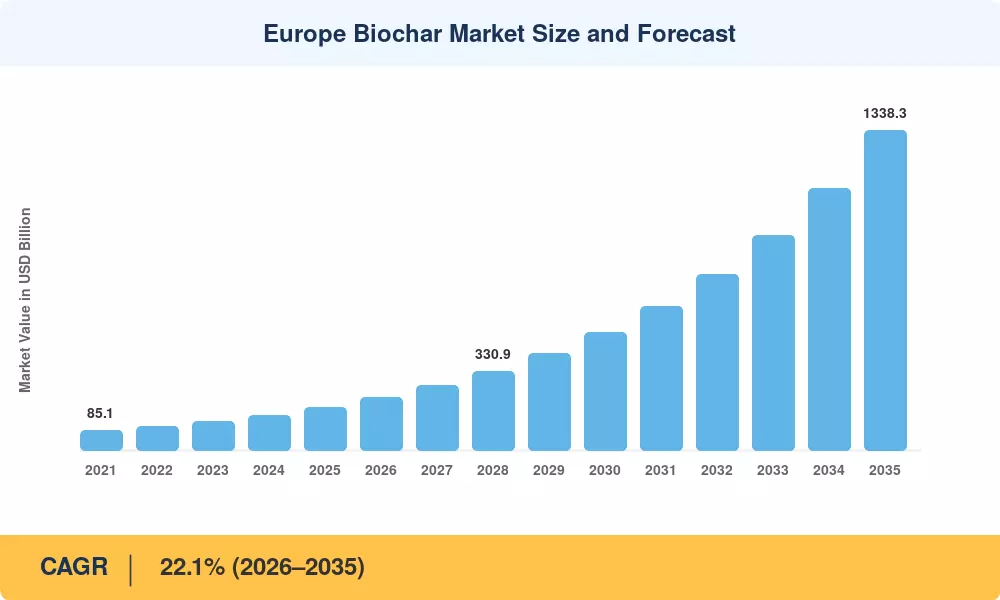
Europe Biochar Market Size and Forecast
Our Impact
Enabled $4.3B Revenue Impact for Fortune 500 and Leading Multinationals
Partnering with 2000+ Global Organizations Each Year
30K+ Citations by Top-Tier Firms in the Industry

Driver Impact Analysis

Driver ~% Impact on CAGR Geographic Relevance Impact Timeline
EU Fertilising Products Regulation CMC14 ~18% EU-wide Short-term (≤2 yr)
EU ETS carbon-removal certificates ~22% EU-wide Medium-term (2–4 yr)
District-heating biochar integration ~14% Germany, Nordics Medium-term (2–4 yr)
Corporate carbon-credit pre-purchases ~16% UK, France, Nordics Short-term (≤2 yr)
Sewage-sludge valorization mandates ~12% UK, Germany Long-term (≥4 yr)
Livestock feed-additive approvals ~10% France, Italy, Spain Medium-term (2–4 yr)
National carbon-farming subsidies ~8% Germany, France Long-term (≥4 yr)


CMC14 Regulatory Formalization

Biochar was shifted from the regulatory gray zone to an allowed input in all 27 member states by the EU Fertilising Products Regulation's Component Material Category 14. A single market for certified biochar will be created in 2026 when effective enforcement removes the patchwork of national end-of-waste regulations that previously limited cross-border commerce. According to the European Commission, producers will save 15–20% on compliance expenses as a result of this harmonization [1].


EU ETS Carbon-Removal Expansion

The updated EU ETS framework will incorporate biochar-based sequestration and other persistent carbon-removal units into its compliance architecture starting in 2026. Purchases of certified biochar can offset up to 5% of verified emissions in chemicals, steel, and cement installations. The financial incentive for emitters to pre-purchase biochar-linked removal credits is significant, with EU Allowance prices averaging EUR 85 per tonne of CO2 equivalent in early 2025 [2].


District-Heating Integration

Germany and the Nordic countries have pioneered the co-location of pyrolysis reactors alongside district-heating boilers, capturing waste heat from the biochar production process and feeding it directly into municipal heat networks. Stockholm's pilot plant displaces approximately 1,200 MWh of fossil-fuel heat annually while producing 500 tonnes of certified biochar, a dual-revenue model that is being replicated in Hamburg, Helsinki, and Copenhagen [6].

Corporate Pre-Purchase Agreements

A growing number of technology firms and consumer-goods companies are signing multi-year biochar offtake contracts to meet Scope 3 neutralization targets. Microsoft's 2024 agreement with a Swiss-based producer for 10,000 tonnes of certified removal credits over five years set a pricing benchmark that has since attracted additional capacity investment across France and the United Kingdom [7].


Restraints Impact Analysis

Restraint ~% Negative Impact Geographic Relevance Impact Timeline
Fragmented biomass logistics ~–20% Southern & Eastern Europe Medium-term (2–4 yr)
Absence of pan-EU agronomic field-rate guidance ~–18% EU-wide Long-term (≥4 yr)
High upfront capital for pyrolysis units ~–15% SME-heavy markets Short-term (≤2 yr)
Feedstock competition from bioenergy sector ~–12% Nordics, Germany Medium-term (2–4 yr)
Limited consumer awareness of biochar benefits ~–10% Southern Europe, Turkey Long-term (≥4 yr)


Fragmented Biomass Logistics

The aggregation infrastructure required to provide pyrolysis plants with reliable, year-round feedstock is lacking in Southern and Eastern Europe. Olive pomace, vineyard prunings, and sunflower husks are examples of agricultural wastes that vary seasonally and geographically. Producer margins are directly impacted by the 35–40% higher biomass collection and transportation costs in these areas compared to Northern Europe, according to a 2024 Joint Research Center research [10].


Absence of Pan-EU Agronomic Guidelines

No standardized EU guideline specifies application rates by crop, soil type, or climate zone, despite CMC14 regulating biochar as a fertilizing agent. Uptake in broadacre agriculture is limited because farmers are unsure of the best dosage. Standardized field-rate guidelines have been requested by the European Biochar Industry Consortium; however, the European Food Safety Authority has set a review deadline of at least 2028 [11].


Capital Intensity for Small Producers

A containerized pyrolysis unit with a 500-tonne annual capacity requires EUR 600,000–900,000 in upfront investment, a prohibitive threshold for many smallholder cooperatives and municipal waste operators. While grant programs exist in Germany and France, access in Spain, Italy, and Eastern Europe remains limited, creating a geographic concentration of installed capacity [12].


Europe Biochar Market Opportunities

Sewage-Sludge-to-Biochar Conversion

The United Kingdom's Environment Agency has signaled a phased ban on agricultural spreading of untreated sewage sludge by 2030, creating a multi-hundred-thousand-tonne feedstock opportunity for pyrolysis operators. Phosphorus-rich char derived from sludge carries dual value—as a fertilizer replacement and as a verified carbon sink. Water utilities in England and Wales have earmarked over GBP 400 million for sludge-treatment upgrades across the 2025–2030 asset management period [5].

Carbon-Credit Marketplace Platforms

Digital registries such as Puro.earth and the European Biochar Certificate now enable real-time verification, issuance, and trading of biochar-based removal credits. These platforms reduce transaction costs for producers and increase buyer confidence, accelerating the financialization of biochar output. Producers with EBC-certified operations command a 25–30% premium over uncertified peers [7].

Cement and Steel Sector Substitution

Activated biochar can replace a portion of calcined clay or slag in blended cements, reducing embodied carbon by up to 8% per cubic meter. Heidelberg Materials and Holcim have both initiated pilot programs incorporating biochar into low-carbon concrete mixes, signaling industrial-scale demand that could absorb 50,000–80,000 tonnes annually by 2030 across Europe [15].

Emerging Markets in Turkey and Eastern Europe

Turkey's hazelnut-shell and olive-pomace residues represent an estimated 2.5 million tonnes of underutilized pyrolysis feedstock annually. With labor and construction costs 40–50% below Western European averages, Turkey offers compelling production economics for export-oriented biochar operations [16].

Precision Agriculture Data Integration

Sensor-equipped biochar application systems that log soil-amendment data and link it to yield-monitoring platforms create a new recurring-revenue model. Producers who bundle biochar with agronomic advisory services can capture value beyond commodity pricing, shifting from a per-tonne transaction to a per-hectare subscription model [17].


Europe Biochar Market Future Outlook

Digitalization and Process Automation

The next decade will see biochar production shift toward fully automated, IoT-monitored reactor systems. Real-time control of pyrolysis temperature, residence time, and feedstock moisture—managed through cloud-based platforms—will improve product consistency and enable remote operation of distributed modular units. The IEA projects that digitalized biomass-to-char operations could reduce per-unit production costs by 15–20% by 2030 [18].

Carbon-Removal Certification at Scale

The EU's planned Carbon Removal Certification Framework (CRCF), expected to reach full legislative force by 2027, will create a standardized, MRV-backed (monitoring, reporting, verification) system for biochar-based sequestration. This framework will enable integration with the EU ETS compliance market and the voluntary carbon market simultaneously, unlocking dual-track revenue for certified producers across the Europe Biochar Market [2][19].

Circular-Economy Integration

Biochar is increasingly positioned at the nexus of waste management, energy production, and agricultural input supply chains. Phosphorus recovery from sewage-sludge char, nitrogen capture in animal-bedding biochar, and heat co-generation from pyrolysis off-gases represent a circular-economy logic that appeals to ESG-focused investors. The European Investment Bank's 2025 circular-economy lending facility allocated EUR 2.1 billion to bio-based processing, of which biochar projects are eligible recipients [20].

Cross-Sector Demand Diversification

Beyond agriculture and animal husbandry, biochar demand from construction materials, water filtration, and urban green infrastructure will accelerate. IRENA estimates that bio-based construction inputs, including biochar-amended concrete, could displace 12% of conventional binder demand in European construction by 2035. This cross-sector pull will reduce the Europe Biochar Market's dependence on agricultural seasonality and stabilize year-round capacity utilization [15][21].


Europe Biochar Market Segmentation

By Technology

Segment Key Metric Primary Demand Driver
Pyrolysis 69.8% share (2025) Modular reactor deployment, heat co-generation
Gasification Systems 25.2% CAGR (2026–2035) CHP integration in Nordic district heating
Other Technologies 17.5 KT (2025) Hydrothermal carbonization for wet feedstocks


Pyrolysis dominates the Europe Biochar Market because its modular, containerized formats fit existing biomass-processing infrastructure with minimal site modification. Continuous-feed slow-pyrolysis reactors operating at 450–650°C deliver consistent char quality while exporting 40–55% of feedstock energy as usable heat. Equipment manufacturers such as Pyreg GmbH and Carbofex Oy have standardized unit designs that cut commissioning timelines to under six months.

Gasification systems, while capital-intensive, offer superior syngas yields and are gaining ground in Nordic CHP networks where the heat-to-char ratio favors gasifier architectures. Hydrothermal carbonization (HTC) remains a niche technology, but its ability to process wet feedstocks such as food waste and sewage sludge without pre-drying gives it a distinct cost advantage in specific waste-stream applications [4][6].

By Application

Segment Key Metric Primary Demand Driver
Animal Farming 70.1% share (2025) Feed additives, bedding amendment, ammonia reduction
Agriculture 26.5 KT (2025) Soil conditioning, water retention, CMC14 compliance
Industrial Uses 24.1% CAGR (2026–2035) Cement substitution, activated carbon, steel inputs
Other Applications 9.4 KT (2025) Urban landscaping, green roofs, water filtration


Animal farming's outsized share in the Europe Biochar Market reflects livestock operators' adoption of biochar as a multi-functional input: mixed into feed at 1–2% inclusion rates, it reduces enteric methane and improves gut health; spread in bedding, it suppresses ammonia and extends litter life. Germany, France, and Italy account for the bulk of animal-farming biochar consumption, with poultry and dairy operations leading adoption [8].

Industrial applications represent the fastest-expanding frontier. Cement producers are blending biochar into clinker substitutes and geopolymer binders, while metallurgical operations use it as a renewable reductant. Activated-biochar production for water treatment and air filtration is also scaling, particularly in the United Kingdom and Germany [15].


Regional Market Share Analysis

Sub-Region Key Metric Primary Investment Themes
Germany 27.0% share (2025) Industrial heat integration, carbon farming
United Kingdom 15.5% share (2025) Sludge valorization, voluntary carbon markets
Nordic Countries 14.8% share (2025) Forestry residues, CHP co-location
France 12.3% share (2025) Vineyard-residue pyrolysis, CAP eco-schemes
Italy 8.5% share (2025) Olive-pomace processing, feed additives
Spain 6.2% share (2025) Almond-shell feedstock, export capacity
Russia 5.8% share (2025) Forestry biomass, domestic soil remediation
Turkey 5.4% share (2025) Hazelnut-shell pyrolysis, cost-advantaged capacity
Rest of Europe 4.5% share (2025) Emerging pilot programs
Total 100%


Germany

Country Key Metric Key Driver
Germany 27.0% of Europe Biochar Market (2025) Federal carbon-removal subsidies


Germany's leadership in the Europe Biochar Market rests on a trifecta of policy support, industrial infrastructure, and research depth. The Federal Ministry for Economic Affairs and Climate Action's EUR 120 million carbon-removal program, combined with municipal district-heating mandates in Hamburg, Munich, and Berlin, has attracted concentrated pyrolysis capacity. Over 35 certified production sites operate across Germany, more than any other European country, and domestic demand from both agricultural and industrial end users absorbs the vast majority of output [3][6].

United Kingdom & France

Country Key Metric Key Driver
United Kingdom 22.4% CAGR (2026–2035) Sewage-sludge ban and carbon registries
France 12.3% share (2025) CAP eco-schemes and vineyard residues


The UK's planned restrictions on untreated sludge spreading position it as a high-growth node within the Europe Biochar Market. France, meanwhile, benefits from abundant vineyard and orchard pruning residues, and its Common Agricultural Policy eco-scheme payments now incentivize biochar application as a recognized soil-improvement practice. French producers are also exploring biochar-enriched composts for premium viticulture markets [5][9].

Southern Europe

Country Key Metric Key Driver
Italy 21.8% CAGR (2026–2035) Olive-pomace feedstock, livestock feed
Spain 23.5% CAGR (2026–2035) Almond-shell processing capacity
Turkey 26.3% CAGR (2026–2035) Low-cost hazelnut-shell pyrolysis


Turkey's cost-advantaged production base and massive agricultural-residue availability make it the fastest-growing country in the Europe Biochar Market forecast period. Spain's Andalusia region hosts the continent's largest almond-processing cluster, generating residues that are increasingly diverted to biochar production. Italy's adoption is concentrated in the Po Valley, where livestock operators use biochar as a feed additive and bedding amendment to reduce ammonia emissions [16][8].

Nordic Countries & Eastern Europe

Country Key Metric Key Driver
Nordic Countries 14.8% share (2025) Forestry residues, CHP integration
Russia 38.7 KT volume (2035) Domestic soil remediation programs
Rest of Europe 4.5% share (2025) Early-stage policy development


The Nordic countries—Sweden, Finland, Norway, and Denmark—benefit from mature forestry supply chains and strong municipal climate commitments. Stockholm Biochar's integration into the city's heating network has become a blueprint replicated across Scandinavian municipalities. Russia's participation centers on Siberian forestry biomass, though geopolitical factors and limited carbon-pricing mechanisms constrain growth relative to EU peers [6].


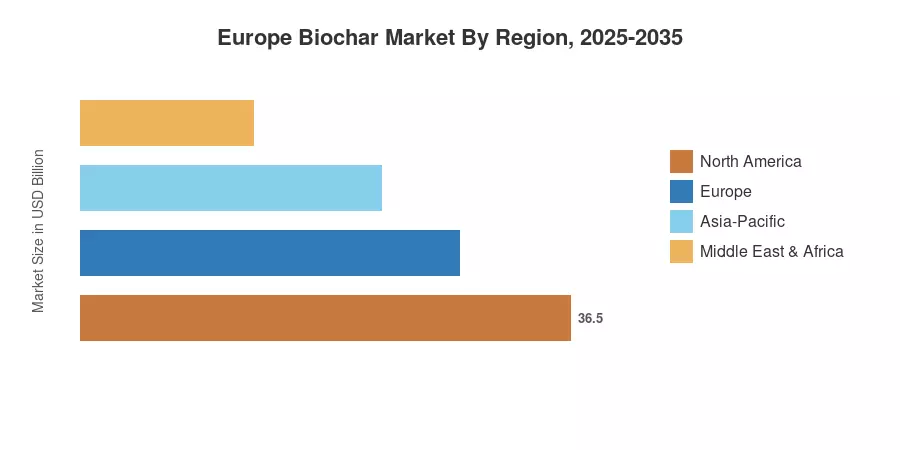
Europe Biochar Market By Region, 2025-2035

Competitive Benchmarking

The Europe Biochar Market exhibits medium concentration, with the top five producers holding an estimated 28–35% combined share. The competitive field spans technology-focused reactor manufacturers, vertically integrated producers, and carbon-credit-native start-ups. Fragmentation persists at the regional level, where small-scale operators serve local agricultural demand. Strategic differentiation centers on certification rigor (EBC vs. non-certified), heat-integration capability, and access to pre-purchased carbon-credit offtake agreements.

Company Est. Revenue Share Range Key Offerings Strategic Positioning
Pyreg GmbH ~5–8% Continuous-feed pyrolysis reactors, turnkey plants Technology licensor with 40+ installations
Carbofex Oy ~4–7% EBC-certified biochar, carbon-credit sales Nordic CHP co-location pioneer
Novocarbo GmbH ~4–6% Industrial-scale biochar, corporate removal credits Backed by pre-purchase deals with tech firms
Carbon Gold Ltd ~3–5% Horticultural biochar, enriched growing media Premium consumer-facing brand in UK
Swiss Biochar GmbH ~3–5% Puro.earth-certified removal credits, char production High-value voluntary-market positioning
Stockholm Biochar AB ~2–4% Municipal heat-integration biochar City-partnership model, Stockholm blueprint
NetZero SAS ~2–4% Agricultural biochar, French market distribution Vineyard and broadacre focus
Sonnenerde GmbH ~2–3% Terra preta substrates, soil amendments Austrian craft-producer niche
Carbon Terra GmbH ~2–3% Premium agricultural char, research partnerships Strong academic-collaboration network
Carbuna AG ~1–3% Feed-grade biochar, livestock applications German livestock-sector specialist


Recent News & Developments

  • Novocarbo GmbH (March 2025): Commissioned a 5,000-tonne-per-year production facility in Hamburg, Germany, backed by a five-year offtake agreement with a major technology company's carbon-removal portfolio [7].
  • European Commission (January 2025): Published implementing guidelines for CMC14 biochar classification under the Fertilising Products Regulation, enabling unrestricted cross-border trade of certified biochar within the EU [1].
  • Pyreg GmbH (November 2024): Delivered its 50th containerized pyrolysis reactor to a Finnish municipal energy company, expanding the firm's installed base across 12 European countries [4].
  • UK Environment Agency (September 2024): Released a consultation paper on restricting untreated sewage-sludge land-spreading by 2030, explicitly identifying pyrolysis-based sludge-to-char conversion as a preferred treatment pathway [5].
  • Stockholm Biochar AB (June 2024): Announced expansion of its district-heating biochar plant capacity to 3,000 tonnes per year, with heat output displacing 5,400 MWh of fossil-fuel consumption annually [6].
  • Microsoft Carbon Removal (April 2024): Signed a EUR 25 million multi-year biochar purchase agreement with Swiss Biochar GmbH, establishing a pricing benchmark for European durable-removal credits [7].
  • Carbofex Oy (January 2024): Received EUR 8 million in EU Innovation Fund co-financing for a new 4,000-tonne production line at its Tampere facility, targeting Nordic agricultural and industrial customers [20].
  • European Biochar Industry Consortium (October 2023): Submitted formal recommendations to the European Food Safety Authority for harmonized agronomic application-rate guidelines, initiating a review process expected to conclude by 2028 [11].


Europe Biochar Market Report Scope

Parameter Detail
Market Scope Europe Biochar Market — production, consumption, and trade volumes
Study Period 2021–2035
CAGR 22.1% (2026–2035)
Base Year Size 180.5 Kilotons (2025)
Forecast Endpoint 1,338.3 Kilotons (2035)
Fastest Growing Segment Industrial Uses (by application); Gasification Systems (by technology)
Companies Profiled 10
Valuation Unit Volume (Kilotons)


FAQs

What is the minimum EBC certification grade needed to sell biochar into EU-regulated agricultural channels?
EBC-Agro certification is the baseline for CMC14-compliant sales across the EU single market. It specifies polycyclic aromatic hydrocarbon limits below 6 mg/kg and mandates third-party laboratory verification [1].
How do pre-purchased carbon-credit contracts affect biochar producer cash flows?
Multi-year offtake agreements de-risk capital investment by guaranteeing revenue before plant commissioning. Typical contracts lock in prices 20–30% above spot removal-credit rates [7].
What distinguishes pyrolysis-grade biochar from gasification-grade biochar in industrial applications?
Pyrolysis char retains higher fixed-carbon content (80–90%), making it preferable for long-duration sequestration. Gasification char has greater surface area, suiting activated-carbon and filtration uses [4].
How does the Europe Biochar Market address feedstock seasonality risk?
Producers diversify across multiple biomass streams—forestry residues, agricultural waste, and sewage sludge—to maintain year-round throughput. Co-located storage facilities further buffer supply variability [10].
What role does the Europe Biochar Market play in phosphorus recovery from wastewater?
Sludge-derived biochar retains 60–70% of influent phosphorus in plant-available form. UK and German utilities view this as a dual solution for nutrient recycling and carbon removal [5].
Are there standardized pricing benchmarks for biochar across the Europe Biochar Market?
Puro.earth's registry publishes transaction-level data for certified removal credits. Agricultural-grade bulk biochar trades at EUR 400–700 per tonne, varying by certification and carbon content [22].
How does the Europe Biochar Market interact with voluntary versus compliance carbon markets?
Producers can sell into both channels simultaneously once CRCF legislation finalizes. Compliance-market credits command a 30–50% price premium over voluntary equivalents [2][19].    
Author
Author
Author Profile
Chitranshi Jaiswal LinkedIn
Team Lead - Research
Chitranshi is a Team Leader in the Chemicals & Materials (CnM) and Energy & Power (EnP) domains, with 6+ years of experience in market research. She leads and mentors teams to deliver cross-domain projects that equip clients with actionable insights and growth strategies. She is skilled in market estimation, forecasting, competitive benchmarking, and both primary & secondary research, enabling her to turn complex data into decision-ready insights. An engineer and MBA professional, she combines technical expertise with strategic acumen to solve dynamic market challenges. Chitranshi has successfully managed projects that support market entry, investment planning, and competitive positioning, while building strong client relationships. Certified in Advanced Excel & Power BI she leverages data-driven approaches to ensure accuracy, clarity, and impactful outcomes.
Download Free Sample

Kindly complete the form below to receive a free sample of this Report

Download PDF ×

We do not share your information with anyone. However, we may send you emails based on your report interest from time to time. You may contact us at any time to opt-out.