×
Request Free Sample ×

Kindly complete the form below to receive a free sample of this Report

* Please use a valid business email

Leading companies partner with us for data-driven Insights

clients tt-cursor
Hero Background

Europe Blockchain Iot Market

ID: MRFR/ICT/63506-HCR
200 Pages
Aarti Dhapte
October 2025

Europe Blockchain IoT Market Research Report By Application (Supply Chain Management, Healthcare, Smart Cities, Energy Management, Agriculture), By Technology (Public Blockchain, Private Blockchain, Hybrid Blockchain, Blockchain as a Service, Permissioned Blockchain), By End Use (Industrial, Commercial, Residential, Government, Transportation), By Connectivity (Wireless Connectivity, Wired Connectivity, Bluetooth Connectivity, Cellular Connectivity, LPWAN Connectivity), and By Regional (Germany, UK, France, Russia, Italy, Spain, Rest of Euro... read more

Share:
Download PDF ×

We do not share your information with anyone. However, we may send you emails based on your report interest from time to time. You may contact us at any time to opt-out.

Europe Blockchain Iot Market Infographic
Purchase Options

Europe Blockchain Iot Market Summary

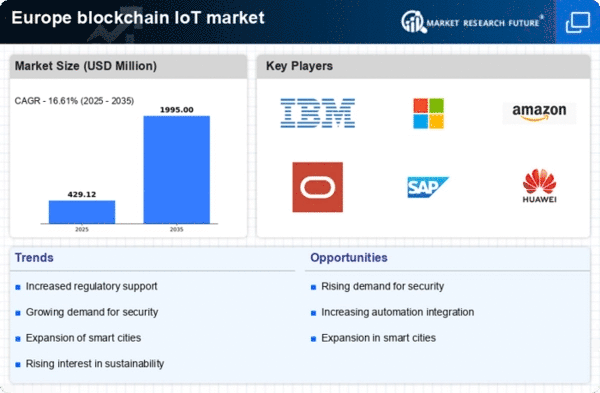
As per MRFR analysis, the Europe blockchain iot market Size was estimated at 368.0 USD Million in 2024. The Europe blockchain iot market is projected to grow from 429.12 USD Million in 2025 to 1995.0 USD Million by 2035, exhibiting a compound annual growth rate (CAGR) of 16.61% during the forecast period 2025 - 2035.

Key Market Trends & Highlights

The Europe blockchain IoT market is poised for substantial growth driven by security, interoperability, and sustainability.

  • Germany leads the Europe blockchain IoT market, showcasing robust demand for enhanced security protocols.
  • The UK emerges as the fastest-growing region, reflecting a strong focus on interoperability solutions.
  • Sustainability initiatives are increasingly influencing market dynamics across various sectors.
  • Rising demand for data integrity and government initiatives are key drivers propelling market expansion.

Market Size & Forecast

2024 Market Size 368.0 (USD Million)
2035 Market Size 1995.0 (USD Million)
CAGR (2025 - 2035) 16.61%

Major Players

IBM (US), Microsoft (US), Amazon (US), Oracle (US), SAP (DE), Huawei (CN), IOTA Foundation (DE), VeChain (SG), Waltonchain (CN)

Europe Blockchain Iot Market Trends

The blockchain iot market is currently experiencing a transformative phase, driven by the increasing demand for secure and efficient data management solutions. As organizations across various sectors recognize the potential of integrating blockchain technology with IoT devices, the landscape is evolving rapidly. This integration offers enhanced security, transparency, and traceability, which are crucial for industries such as manufacturing, logistics, and healthcare. The ability to securely share data among devices while maintaining integrity is becoming a priority, leading to innovative applications and business models. Furthermore, regulatory frameworks are gradually adapting to accommodate these advancements, fostering a conducive environment for growth. In addition, the blockchain iot market is witnessing a surge in investment and collaboration among technology providers, startups, and established enterprises. This collaborative approach is likely to accelerate the development of new solutions that address specific industry challenges. Moreover, the emphasis on sustainability and energy efficiency is prompting organizations to explore how blockchain can optimize resource management in IoT applications. As the market continues to mature, it appears poised for significant advancements, with potential implications for various sectors and the overall economy.

Enhanced Security Protocols

The integration of blockchain technology into IoT systems is likely to bolster security measures. By utilizing decentralized ledgers, organizations can mitigate risks associated with data breaches and unauthorized access. This trend is particularly relevant in sectors where data integrity is paramount, such as healthcare and finance.

Interoperability Solutions

As the blockchain iot market evolves, the need for interoperability among diverse IoT devices is becoming increasingly apparent. Solutions that facilitate seamless communication between different systems are expected to gain traction, enabling organizations to leverage the full potential of their IoT ecosystems.

Sustainability Initiatives

The focus on sustainability within the blockchain iot market is gaining momentum. Companies are exploring how blockchain can enhance energy efficiency and resource management in IoT applications. This trend reflects a broader commitment to environmental responsibility and the optimization of operational processes.

Europe Blockchain Iot Market Drivers

Advancements in Smart Contracts

The evolution of smart contracts is emerging as a pivotal driver for the blockchain IoT market in Europe. Smart contracts facilitate automated transactions and agreements between IoT devices, reducing the need for intermediaries. This automation not only streamlines processes but also enhances operational efficiency. Industries such as automotive and energy are increasingly exploring the potential of smart contracts to optimize resource allocation and reduce costs. With the European blockchain ecosystem maturing, the market for smart contracts is anticipated to grow by approximately 40% in the coming years. This growth reflects a broader trend towards automation and efficiency, positioning the blockchain IoT market as a key player in the digital economy.

Rising Demand for Data Integrity

The blockchain IoT market in Europe is experiencing a notable surge in demand for data integrity solutions. As industries increasingly rely on IoT devices for critical operations, the need for secure and tamper-proof data becomes paramount. Blockchain technology offers a decentralized framework that ensures data authenticity and traceability. According to recent estimates, the market for data integrity solutions is projected to grow by approximately 25% annually, driven by sectors such as manufacturing and logistics. This growth indicates a strong inclination towards adopting blockchain-based systems to enhance operational transparency and reduce fraud. Consequently, the blockchain IoT market is poised to benefit significantly from this trend, as organizations seek to leverage blockchain's capabilities to safeguard their data assets.

Government Initiatives and Support

In Europe, government initiatives aimed at promoting digital transformation are playing a crucial role in the blockchain IoT market. Various European governments are investing in research and development to foster innovation in blockchain technologies. For instance, the European Commission has allocated substantial funding to projects that integrate blockchain with IoT applications, particularly in sectors like healthcare and smart cities. This support not only accelerates technological advancements but also encourages collaboration between public and private sectors. As a result, the blockchain IoT market is likely to witness increased adoption rates, with projections indicating a potential market growth of 30% over the next five years, driven by favorable regulatory frameworks and financial incentives.

Growing Adoption of Edge Computing

The integration of edge computing with blockchain technology is becoming a significant driver for the blockchain IoT market in Europe. As IoT devices proliferate, the need for real-time data processing and analysis at the edge of networks is increasingly recognized. Edge computing reduces latency and bandwidth usage, enabling faster decision-making. When combined with blockchain, it enhances data security and integrity, as transactions can be verified locally before being recorded on the blockchain. This synergy is particularly beneficial for industries such as manufacturing and transportation, where timely data is crucial. Analysts predict that the adoption of edge computing in conjunction with blockchain could lead to a market growth of 35% over the next few years, underscoring its potential impact on the blockchain IoT market.

Increased Focus on Supply Chain Transparency

The blockchain IoT market in Europe is significantly influenced by the growing emphasis on supply chain transparency. Companies are increasingly adopting blockchain solutions to enhance visibility and traceability throughout their supply chains. This trend is particularly evident in the food and pharmaceutical sectors, where compliance with safety regulations is critical. By integrating IoT devices with blockchain technology, organizations can monitor product conditions in real-time, ensuring quality and safety. Recent studies suggest that the implementation of blockchain in supply chains could reduce operational costs by up to 20%, thereby driving efficiency. Consequently, the blockchain IoT market is expected to expand as businesses recognize the value of transparent supply chains in building consumer trust and meeting regulatory requirements.

Market Segment Insights

By Application: Supply Chain Management (Largest) vs. Healthcare (Fastest-Growing)

In the market distribution among segment values, Supply Chain Management holds the largest share due to its pivotal role in enhancing efficiency and transparency across the supply chains. Its ability to streamline operations using blockchain technology resonates well with businesses seeking to optimize their logistics and inventory management. Healthcare, while smaller compared to Supply Chain Management, is rapidly gaining traction as the fastest-growing segment, driven by the need for secure patient data management and innovative solutions for pharmaceutical supply chains. Growth trends indicate an increasing adoption of blockchain technology in healthcare applications, bolstered by regulatory support and a push for better data interoperability. The rise of smart contracts and decentralized applications also fuels growth in sectors like Smart Cities and Agriculture. Innovation in energy efficiency through blockchain further enhances its appeal, indicating a robust market trajectory across these diverse applications.

Supply Chain Management (Dominant) vs. Agriculture (Emerging)

Supply Chain Management stands as the dominant application segment, leveraging blockchain for improved traceability, reduced fraud, and enhanced operational efficiencies. This segment focuses on integrating various stakeholders to provide real-time insights and foster coordination in logistics. In contrast, Agriculture is emerging as a significant application area, utilizing blockchain to enhance food safety, traceability, and overall supply chain transparency. The adoption of smart farming techniques and the need for accountability in food production drive its growth. While Supply Chain Management capitalizes on well-established use cases, Agriculture presents opportunities for innovation and adoption of blockchain solutions, promising a future where sustainable practices can be effectively monitored and executed.

By Technology: Public Blockchain (Largest) vs. Private Blockchain (Fastest-Growing)

In the Europe blockchain IoT market, Public Blockchain holds the largest share among the segment values, reflecting its widespread adoption and community-driven nature. It allows for decentralized transactions and transparent operations, appealing to various industries seeking enhanced security and trust. Conversely, Private Blockchain is emerging rapidly, capturing attention due to its ability to provide confidentiality and control to organizations. As companies seek to leverage blockchain without losing privacy, Private Blockchain is seeing significant growth. The growth trends in these segment values are driven by the increasing need for secure data management and the desire for operational efficiency. Public Blockchain continues to benefit from the increasing acceptance of cryptocurrencies and decentralized applications, while Private Blockchain is gaining traction as businesses prioritize data privacy and regulatory compliance. Hybrid models and Blockchain as a Service (BaaS) are also contributing to this landscape, allowing organizations to customize solutions that blend the benefits of both public and private frameworks.

Technology: Public Blockchain (Dominant) vs. Private Blockchain (Emerging)

Public Blockchain stands as the dominant force in the Europe blockchain IoT market due to its inherent advantages of transparency and decentralization, making it preferred by developers and end-users alike. Its open nature fosters innovation and broad participation across industries, thus enhancing its relevance. On the other hand, Private Blockchain is emerging as a strong alternative, particularly within enterprises that prioritize control and confidentiality. This segment is characterized by tailored solutions that cater to specific organizational needs, allowing companies to benefit from blockchain technology while adhering to privacy regulations. The interplay between these segments shapes the future of blockchain innovation, with each serving distinct yet overlapping roles in an evolving digital landscape.

By End Use: Industrial (Largest) vs. Commercial (Fastest-Growing)

In the Europe blockchain IoT market, the distribution of market share among end-use segments reveals that the industrial sector has established itself as the largest segment. This dominance is driven by the growing need for automation and efficiency in manufacturing processes. Following closely is the commercial segment, which, while smaller in share, is rapidly gaining traction due to increased digital transformation initiatives by businesses to improve service delivery and operational efficiency. Growth trends indicate a significant upsurge in the adoption of blockchain IoT technologies across various sectors. The industrial segment is fueled by demands for enhanced supply chain transparency and real-time data access, whereas the commercial sector is buoyed by innovations in smart contracts and data security. The transportation and government sectors are also playing crucial roles, albeit at varying paces of development as they explore blockchain solutions for logistics and public services.

Industrial: Dominant vs. Commercial: Emerging

The industrial segment stands out as the dominant player in the Europe blockchain IoT market, characterized by extensive applications in manufacturing, logistics, and supply chain management. Its robust position is a result of ongoing digital transformation and the necessity for secure, decentralized systems to manage industrial operations efficiently. In contrast, the commercial segment is emerging, characterized by businesses increasingly adopting blockchain solutions to enhance customer experience and streamline operations. This segment is witnessing rapid growth as more commercial entities recognize the value of blockchain for securing transactions and ensuring transparency. The shift towards digital solutions in the commercial sector is expected to create new opportunities, making it a significant area of interest for future investments.

By Connectivity: Cellular Connectivity (Largest) vs. Bluetooth Connectivity (Fastest-Growing)

The connectivity segment is characterized by diverse value distributions, with Cellular Connectivity leading in market share due to its wide-ranging adoption across various IoT applications. Other segments like Wireless and Wired Connectivity also hold significant shares, but fall behind Cellular. Wireless Connectivity benefits from flexibility and scalability, while Wired Connectivity is preferred for stable, high-speed applications. Growth trends in this segment are primarily driven by advancements in technology and increasing IoT deployment across industries. Cellular Connectivity remains a staple due to its robust network infrastructure, while Bluetooth Connectivity is gaining traction as devices become more interconnected. The acceleration in smart devices and the push for enhanced connectivity solutions further fuel these growth trajectories, indicating vibrant market dynamics.

Connectivity: Cellular (Dominant) vs. Bluetooth (Emerging)

Cellular Connectivity occupies a dominant position in the market, catering to a wide array of IoT devices with its established and reliable infrastructure. It provides extensive coverage and high data transfer rates, making it ideal for applications ranging from smart cities to industrial automation. On the other hand, Bluetooth Connectivity is emerging as a vital player, particularly in personal and localized applications. As consumer demand for wireless gadgets increases, Bluetooth technology is evolving to support larger data transmissions and more complex applications, such as smart home devices and wearables. This trend signifies a shift towards more interconnected environments, with both Cellular and Bluetooth Connectivity complementing each other in the rapidly expanding IoT landscape.

Get more detailed insights about Europe Blockchain Iot Market

Regional Insights

Germany : Strong Market Share and Growth

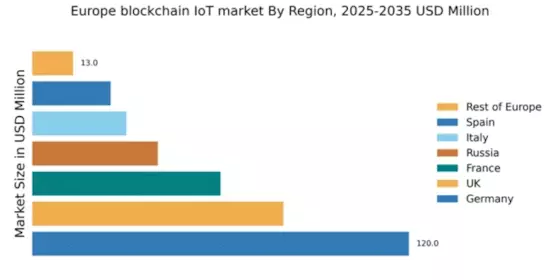
Germany holds a commanding market share of 120.0, representing a significant 30% of the European blockchain IoT market. Key growth drivers include robust industrial automation, a strong focus on R&D, and supportive government initiatives like the Digital Strategy 2025. Demand for IoT solutions is surging, particularly in manufacturing and logistics, driven by the need for enhanced efficiency and transparency. Regulatory frameworks are evolving to support blockchain integration, fostering a conducive environment for innovation and investment.

UK : Innovation and Investment Hub

The UK boasts a market share of 80.0, accounting for 20% of the European blockchain IoT market. Key growth drivers include a vibrant startup ecosystem, significant venture capital investment, and a strong focus on fintech applications. Demand is particularly high in sectors like healthcare and supply chain management, where IoT solutions enhance operational efficiency. The UK government has introduced initiatives like the UK Digital Strategy to promote blockchain adoption, creating a favorable regulatory environment.

France : Government Support and Innovation

France holds a market share of 60.0, representing 15% of the European blockchain IoT market. Growth is driven by government initiatives such as the France 2030 plan, which emphasizes digital transformation and innovation. Demand trends indicate a rising interest in smart city applications and energy management solutions. The regulatory landscape is supportive, with policies aimed at fostering blockchain technology adoption across various sectors, including transportation and energy.

Russia : Strategic Investments and Development

With a market share of 40.0, Russia accounts for 10% of the European blockchain IoT market. Key growth drivers include strategic investments in technology and a focus on enhancing cybersecurity measures. Demand is increasing in sectors like agriculture and logistics, where IoT solutions can optimize operations. The Russian government is actively promoting blockchain through initiatives like the National Technology Initiative, creating a supportive regulatory framework for innovation.

Italy : Cultural Heritage Meets Technology

Italy's market share stands at 30.0, making up 7.5% of the European blockchain IoT market. Growth is fueled by a focus on integrating blockchain in sectors like fashion and art, where authenticity and traceability are paramount. Demand trends show increasing interest in smart manufacturing and tourism applications. The Italian government is implementing policies to support digital innovation, including funding for blockchain projects, enhancing the overall business environment.

Spain : Focus on Sustainability and Efficiency

Spain has a market share of 25.0, representing 6.25% of the European blockchain IoT market. Key growth drivers include a strong emphasis on sustainability and smart city initiatives. Demand is particularly high in agriculture and renewable energy sectors, where IoT solutions can significantly enhance efficiency. The Spanish government is promoting blockchain through various initiatives, creating a favorable regulatory environment for technology adoption and innovation.

Rest of Europe : Fragmented Markets with Potential

The Rest of Europe holds a market share of 13.0, accounting for 3.25% of the European blockchain IoT market. Growth is driven by diverse local initiatives and varying levels of government support across countries. Demand trends indicate a rising interest in niche applications, particularly in logistics and healthcare. The competitive landscape is fragmented, with local players emerging alongside global giants like IBM and Microsoft, creating a dynamic business environment.


Europe Blockchain Iot Market Regional Image

Key Players and Competitive Insights

The blockchain IoT market is currently characterized by a dynamic competitive landscape, driven by rapid technological advancements and increasing demand for secure, efficient data management solutions. Key players such as IBM (US), Microsoft (US), and SAP (DE) are strategically positioning themselves through innovation and partnerships, which collectively shape the competitive environment. IBM (US) focuses on integrating blockchain with IoT to enhance supply chain transparency, while Microsoft (US) emphasizes its Azure platform to facilitate seamless IoT and blockchain integration. SAP (DE) is leveraging its enterprise resource planning (ERP) systems to incorporate blockchain capabilities, thereby enhancing operational efficiency for its clients.

The market structure appears moderately fragmented, with a mix of established players and emerging startups. Key business tactics include localizing manufacturing and optimizing supply chains to enhance responsiveness to market demands. The collective influence of these major players fosters a competitive atmosphere where innovation and strategic partnerships are paramount for success.

In October 2025, IBM (US) announced a collaboration with a leading European automotive manufacturer to develop a blockchain-based IoT solution aimed at improving vehicle supply chain transparency. This strategic move is significant as it not only showcases IBM's commitment to enhancing operational efficiencies but also positions the company as a leader in the automotive sector's digital transformation. The partnership is expected to streamline processes and reduce costs, thereby reinforcing IBM's competitive edge.

In September 2025, Microsoft (US) launched a new initiative aimed at integrating AI capabilities with its blockchain IoT solutions. This initiative is crucial as it enhances the analytical capabilities of IoT devices, allowing for real-time data processing and decision-making. By combining AI with blockchain, Microsoft (US) is likely to offer more robust solutions that address the growing need for intelligent automation in various industries, further solidifying its market position.

In August 2025, SAP (DE) expanded its blockchain offerings by introducing a new module within its ERP system that enables real-time tracking of goods through IoT devices. This development is particularly relevant as it aligns with the increasing demand for transparency and traceability in supply chains. By enhancing its ERP capabilities, SAP (DE) is poised to attract more clients seeking comprehensive solutions that integrate blockchain and IoT technologies.

As of November 2025, current trends in the blockchain IoT market include a strong emphasis on digitalization, sustainability, and AI integration. Strategic alliances are increasingly shaping the competitive landscape, as companies recognize the value of collaboration in driving innovation. Looking ahead, competitive differentiation is likely to evolve from traditional price-based competition to a focus on technological innovation and supply chain reliability. This shift underscores the importance of developing unique solutions that not only meet market demands but also enhance operational efficiencies.

Key Companies in the Europe Blockchain Iot Market market include

Industry Developments

OriginTrail was chosen by the European Blockchain Sandbox in June 2023 to improve supply chain data integrity. Accenture's "Innovate or Fade" report, which focused on blockchain's role in digital transformation, was released in July 2023.

Bitland launched a blockchain-based decentralized commercial real estate platform in 2022. In Europe, Modum offers supply chain monitoring systems based on the Internet of Things. Ambrosus specializes on supply chain solutions and is active in the European IoT blockchain sector.

The IOTA Foundation was chosen by the European Blockchain Sandbox in 2023 to provide digital identity solutions. Helium's decentralized wireless infrastructure was extended throughout Europe in 2024. In Europe, SAP provides blockchain solutions for business applications.

With an emphasis on supply chain solutions, VeChain is a player in the European IoT blockchain sector. Cisco Systems offers blockchain and IoT solutions to European businesses. With an emphasis on energy solutions, Grid+ is involved in the European IoT blockchain sector.

IBM provides blockchain solutions to European businesses. Microsoft offers blockchain solutions to European businesses. With an emphasis on supply chain solutions, Waltonchain is a player in the European IoT blockchain sector. European businesses can use blockchain solutions from Amazon Web Services.

Europe Blockchain IoT

Future Outlook

Europe Blockchain Iot Market Future Outlook

The blockchain IoT market is projected to grow at 16.61% CAGR from 2024 to 2035, driven by increased demand for secure data exchange and automation.

New opportunities lie in:

  • Development of decentralized identity management solutions for IoT devices.
  • Integration of blockchain with smart city infrastructure for enhanced security.
  • Creation of blockchain-based supply chain transparency platforms.

By 2035, the market is expected to be robust, driven by innovative applications and strategic partnerships.

Market Segmentation

Europe Blockchain Iot Market End Use Outlook

  • Industrial
  • Commercial
  • Residential
  • Government
  • Transportation

Europe Blockchain Iot Market Technology Outlook

  • Public Blockchain
  • Private Blockchain
  • Hybrid Blockchain
  • Blockchain as a Service
  • Permissioned Blockchain

Europe Blockchain Iot Market Application Outlook

  • Supply Chain Management
  • Healthcare
  • Smart Cities
  • Energy Management
  • Agriculture

Europe Blockchain Iot Market Connectivity Outlook

  • Wireless Connectivity
  • Wired Connectivity
  • Bluetooth Connectivity
  • Cellular Connectivity
  • LPWAN Connectivity

Report Scope

MARKET SIZE 2024 368.0(USD Million)
MARKET SIZE 2025 429.12(USD Million)
MARKET SIZE 2035 1995.0(USD Million)
COMPOUND ANNUAL GROWTH RATE (CAGR) 16.61% (2024 - 2035)
REPORT COVERAGE Revenue Forecast, Competitive Landscape, Growth Factors, and Trends
BASE YEAR 2024
Market Forecast Period 2025 - 2035
Historical Data 2019 - 2024
Market Forecast Units USD Million
Key Companies Profiled ["IBM (US)", "Microsoft (US)", "Amazon (US)", "Oracle (US)", "SAP (DE)", "Huawei (CN)", "IOTA Foundation (DE)", "VeChain (SG)", "Waltonchain (CN)"]
Segments Covered Application, Technology, End Use, Connectivity
Key Market Opportunities Integration of blockchain technology enhances security and transparency in IoT applications across various industries.
Key Market Dynamics Rising regulatory frameworks in Europe drive innovation and adoption of blockchain IoT solutions across various industries.
Countries Covered Germany, UK, France, Russia, Italy, Spain, Rest of Europe

Leave a Comment

FAQs

What is the market size of the Europe Blockchain IoT Market in 2024?

The Europe Blockchain IoT Market is expected to be valued at 780.0 million USD in 2024.

What is the projected market value of the Europe Blockchain IoT Market by 2035?

By 2035, the Europe Blockchain IoT Market is projected to reach a value of 5000.0 million USD.

What is the expected CAGR for the Europe Blockchain IoT Market from 2025 to 2035?

The expected CAGR for the Europe Blockchain IoT Market between 2025 and 2035 is 18.4%.

Which application segment holds the largest market share in 2024?

In 2024, the Smart Cities segment is expected to hold a significant market value of 200.0 million USD.

What is the market size of the Supply Chain Management application in 2035?

The Supply Chain Management application is projected to have a market size of 1000.0 million USD in 2035.

Which region is expected to dominate the Europe Blockchain IoT Market by 2035?

The UK region is expected to dominate the market with a value of 1200.0 million USD by 2035.

What is the market size of the Germany region in 2024?

Germany's Blockchain IoT Market is valued at 150.0 million USD in 2024.

Which key player is anticipated to have a significant impact on the market?

Key players such as IBM and Microsoft are anticipated to have a significant impact on the Europe Blockchain IoT Market.

What is the expected market value for the Agriculture application by 2035?

The Agriculture application is expected to reach a market value of 500.0 million USD by 2035.

How is the market for Smart Cities expected to grow from 2025 to 2035?

The Smart Cities application segment is expected to grow significantly from 200.0 million USD in 2024 to 1500.0 million USD by 2035.

Download Free Sample

Kindly complete the form below to receive a free sample of this Report

Compare Licence

×
Features License Type
Single User Multiuser License Enterprise User
Price $4,950 $5,950 $7,250
Maximum User Access Limit 1 User Upto 10 Users Unrestricted Access Throughout the Organization
Free Customization
Direct Access to Analyst
Deliverable Format
Platform Access
Discount on Next Purchase 10% 15% 15%
Printable Versions