Europe Cognitive Cloud Market
Europe Cognitive Cloud Market Summary
As per Market Research Future analysis, the Europe cognitive cloud market size was estimated at 12.5 USD Billion in 2024. The Europe cognitive cloud market is projected to grow from 14.89 USD Billion in 2025 to 86.0 USD Billion by 2035, exhibiting a compound annual growth rate (CAGR) of 19.1% during the forecast period 2025 - 2035
Key Market Trends & Highlights
The Europe cognitive cloud market is experiencing robust growth driven by technological advancements and regulatory compliance.
- Germany leads the Europe cognitive cloud market, showcasing a strong demand for AI-driven solutions.
- The UK emerges as the fastest-growing region, reflecting a heightened focus on data privacy and compliance.
- Collaboration among technology providers is becoming increasingly prevalent, fostering innovation and market expansion.
- Rising demand for advanced analytics and increased investment in cloud infrastructure are key drivers propelling market growth.
Market Size & Forecast
| 2024 Market Size | 12.5 (USD Billion) |
| 2035 Market Size | 86.0 (USD Billion) |
| CAGR (2025 - 2035) | 19.16% |
Major Players
IBM (US), Microsoft (US), Google (US), Amazon (US), Salesforce (US), Oracle (US), SAP (DE), Alibaba (CN), C3.ai (US)
Europe Cognitive Cloud Market Trends
The cognitive cloud market is currently experiencing a transformative phase, driven by advancements in artificial intelligence and machine learning technologies. Organizations across various sectors are increasingly adopting cognitive cloud solutions to enhance operational efficiency and improve decision-making processes. This trend is particularly evident in industries such as healthcare, finance, and manufacturing, where data-driven insights are becoming essential for maintaining competitive advantage. As businesses seek to leverage vast amounts of data, the demand for cognitive cloud services is expected to grow, fostering innovation and collaboration among technology providers and end-users. Moreover, the regulatory landscape in Europe is evolving, with governments emphasizing data privacy and security. This focus on compliance is influencing the adoption of cognitive cloud solutions, as organizations prioritize platforms that adhere to stringent regulations. The integration of cognitive capabilities into cloud services is likely to enhance data analytics, enabling organizations to derive actionable insights while ensuring compliance with local laws. As the cognitive cloud market continues to mature, it appears poised to play a pivotal role in shaping the future of digital transformation across various sectors in Europe.
Increased Adoption of AI-Driven Solutions
Organizations are increasingly integrating AI-driven cognitive cloud solutions to optimize processes and enhance customer experiences. This trend reflects a growing recognition of the value that intelligent systems can bring to business operations.
Focus on Data Privacy and Compliance
With stringent regulations in place, businesses are prioritizing cognitive cloud solutions that ensure data privacy and compliance. This focus is shaping the development of services that align with local laws and regulations.
Collaboration Among Technology Providers
There is a noticeable trend of collaboration among technology providers in the cognitive cloud market. Partnerships are forming to combine expertise and resources, leading to innovative solutions that address complex business challenges.
Europe Cognitive Cloud Market Drivers
Rising Demand for Advanced Analytics
The cognitive cloud market in Europe experiences a notable surge in demand for advanced analytics solutions. Organizations are increasingly recognizing the value of data-driven decision-making, which is facilitated by cognitive cloud technologies. According to recent estimates, the market for analytics in Europe is projected to grow at a CAGR of approximately 25% over the next five years. This growth is driven by the need for businesses to derive actionable insights from vast amounts of data. As companies seek to enhance operational efficiency and customer engagement, the cognitive cloud market is positioned to play a pivotal role in providing the necessary tools and frameworks for sophisticated data analysis. Furthermore, the integration of machine learning algorithms within cognitive cloud platforms enhances predictive capabilities, thereby attracting more enterprises to adopt these solutions.
Emergence of Edge Computing Solutions
The emergence of edge computing solutions is reshaping the cognitive cloud market in Europe. As the need for real-time data processing and low-latency applications increases, organizations are turning to edge computing to complement their cognitive cloud strategies. This trend is particularly relevant in sectors such as manufacturing, healthcare, and transportation, where immediate data analysis is crucial. The cognitive cloud market is adapting to this shift by developing hybrid models that integrate edge computing capabilities with cloud services. Recent forecasts indicate that the edge computing market in Europe could reach €15 billion by 2027, suggesting a significant opportunity for cognitive cloud providers. By leveraging edge computing, businesses can enhance operational efficiency and responsiveness, thereby driving further adoption of cognitive cloud solutions.
Enhanced Security Measures and Compliance
Security and compliance are paramount concerns for organizations operating within the cognitive cloud market in Europe. With increasing data breaches and stringent regulations such as GDPR, businesses are compelled to adopt robust security measures. The cognitive cloud market is evolving to address these challenges by integrating advanced security protocols and compliance frameworks into their offerings. Recent reports suggest that investments in cloud security solutions are expected to exceed €30 billion by 2025. This trend indicates a growing recognition of the importance of safeguarding sensitive data and ensuring regulatory compliance. As organizations prioritize security, the cognitive cloud market is likely to experience heightened demand for solutions that provide comprehensive security features, thereby fostering trust and reliability among users.
Growing Focus on Sustainability Initiatives
Sustainability initiatives are becoming increasingly relevant within the cognitive cloud market in Europe. Organizations are under pressure to reduce their carbon footprint and adopt environmentally friendly practices. The cognitive cloud market is responding to this demand by offering solutions that optimize resource usage and minimize waste. For instance, cognitive cloud platforms can analyze energy consumption patterns and suggest improvements, leading to more sustainable operations. Recent surveys indicate that over 60% of European companies are prioritizing sustainability in their strategic planning. This shift not only aligns with regulatory requirements but also enhances brand reputation and customer loyalty. As a result, the cognitive cloud market is likely to see a rise in demand for solutions that support sustainability goals, thereby driving innovation and growth.
Increased Investment in Cloud Infrastructure
Investment in cloud infrastructure is a critical driver for the cognitive cloud market in Europe. As organizations transition to cloud-based solutions, the demand for robust and scalable infrastructure intensifies. Recent data indicates that cloud spending in Europe is expected to reach €100 billion by 2026, reflecting a compound annual growth rate of around 20%. This influx of capital is likely to bolster the cognitive cloud market, as companies seek to leverage advanced technologies such as artificial intelligence and machine learning. Enhanced cloud infrastructure not only supports the deployment of cognitive applications but also ensures data security and compliance with stringent regulations. Consequently, the cognitive cloud market stands to benefit from this trend, as businesses prioritize investments in cloud capabilities to remain competitive in an increasingly digital landscape.
Market Segment Insights
By Deployment Model: Public Cloud (Largest) vs. Hybrid Cloud (Fastest-Growing)
The market share distribution for the deployment model segment is showing a significant preference towards Public Cloud solutions, which dominate the landscape owing to their extensive scalability and cost-effectiveness. In contrast, Hybrid Cloud is rapidly gaining traction, appealing to businesses that seek an optimal blend of both public and private resources while maintaining flexibility. Growth trends indicate that the Hybrid Cloud model is the fastest-growing deployment option, driven by organizations' increasing demand for hybrid capabilities that allow them to maximize their assets and ensure seamless data integration. This trend is fostering further innovation in cloud technologies, with providers focusing on offering advanced security features and customizable solutions to meet diverse customer needs.
Cloud Models: Public Cloud (Dominant) vs. Hybrid Cloud (Emerging)
Public Cloud services remain the dominant force in the deployment model segment due to their ability to provide on-demand resources and lower operational costs, making them a preferred choice for many businesses in the market. Meanwhile, Hybrid Cloud, representing an emerging trend, is appealing to enterprises looking for enhanced flexibility and control over their data environments. This allows businesses to leverage both on-premises and public cloud infrastructures, optimizing workloads accordingly. As organizations increasingly adopt digital transformation strategies, the Hybrid Cloud model is expected to play a crucial role in addressing specific regulatory and compliance requirements while still providing scalability and innovation.
By Application: Natural Language Processing (Largest) vs. Predictive Analytics (Fastest-Growing)
In the Application segment, Natural Language Processing (NLP) leads the market due to its wide-ranging applications in chatbots, sentiment analysis, and automated customer service. This dominance is reflected in the share distribution, with NLP capturing significant attention from enterprises aiming to enhance customer engagement. Meanwhile, Predictive Analytics, while currently a smaller segment, is experiencing rapid adoption across various industries, driven by its utility in data-driven decision making. The growth of these segments is propelled by advancements in artificial intelligence technologies and increasing demand for automation and efficiency. As organizations focus on data analysis and customer insights, the adoption of NLP and Predictive Analytics is expected to surge, with businesses seeking innovative solutions to stay competitive. The market is also benefiting from the rise of cloud computing, allowing for flexible deployment of cognitive applications.
Natural Language Processing (Dominant) vs. Predictive Analytics (Emerging)
Natural Language Processing (NLP) stands out as the dominant force in the Application segment, leveraging linguistic capabilities to interpret and generate human language. Its applications range from voice-activated personal assistants to sophisticated text analysis tools that enhance user interaction and satisfaction. Organizations are increasingly investing in NLP technologies to gain insights from unstructured data, enhancing operational efficiency. In contrast, Predictive Analytics is emerging as a valuable tool for forecasting trends and behaviors by analyzing historical data. This segment is gaining traction as businesses recognize the importance of proactive decision-making and customer profiling, making it a key player for future growth. The synergistic potential of these technologies is likely to shape competitive strategies in the cognitive landscape.
By Industry: Healthcare (Largest) vs. Financial Services (Fastest-Growing)
The market share distribution among the segments in the cognitive cloud space highlights Healthcare as the largest segment, driven by the demand for advanced data analytics, patient care improvements, and operational efficiencies. Conversely, Financial Services has emerged as a significant contributor, benefiting from the integration of AI and machine learning in risk management, compliance, and personalized customer offerings. Growth trends in the cognitive cloud sector reveal that Healthcare continues to innovate with digital solutions, increasingly adopting cloud technologies for electronic health records and patient management systems. Meanwhile, Financial Services is capitalizing on rapid digital transformation, with increasing investments in cognitive solutions aimed at enhancing decision-making processes, optimizing operations, and facilitating real-time data processing, making it the fastest-growing segment in this landscape.
Healthcare: Dominant vs. Financial Services: Emerging
The Healthcare segment remains dominant within the cognitive cloud environment, characterized by a strong focus on improving patient outcomes through data-driven insights and technology integration. Healthcare providers are leveraging cognitive cloud solutions to enhance diagnostics, streamline workflows, and ensure compliance with rigorous regulations. On the other hand, the Financial Services segment is emerging rapidly, driven by the need for innovative solutions in a competitive market. This segment is increasingly utilizing cognitive cloud technologies to improve fraud detection, automate trading processes, and personalize financial products and services, positioning itself for significant growth in conjunction with ongoing digital transformation efforts.
By Service Type: Managed Services (Largest) vs. Professional Services (Fastest-Growing)
In the cognitive cloud market, the distribution of market share among service types is significant, with Managed Services holding the largest portion due to their comprehensive and long-term offerings. These services provide clients with effective management of cloud solutions and analytics, allowing businesses to focus on their core operations. On the other hand, Professional Services are gaining traction as the fastest-growing segment, driven by an increasing need for tailored cognitive solutions that enhance business operations. Demand for cloud integration and strategic consulting is propelling this growth, as organizations look to leverage cognitive technology to gain competitive advantages and improve efficiency.
Managed Services (Dominant) vs. Professional Services (Emerging)
Managed Services are a dominant force in the cognitive cloud landscape, offering a wide range of solutions that include cloud management, maintenance, and support services. They enable organizations to outsource complex processes, thereby reducing operational burdens and allowing focus on strategic initiatives. Meanwhile, Professional Services represent an emerging segment that is experiencing rapid growth. This includes consulting, implementation, and advisory services that help clients integrate cognitive technologies effectively. As organizations navigate the complexities of cognitive solutions, the need for Professional Services is rising, highlighting their critical role in the digital transformation journey.
Regional Insights
Germany : Germany's Robust Market Growth
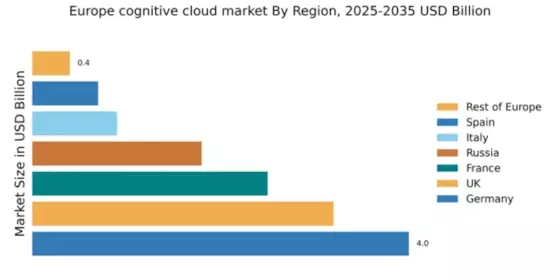
Germany holds a commanding 4.0% market share in the cognitive cloud sector, valued at approximately €1.2 billion. Key growth drivers include a strong emphasis on digital transformation, supported by government initiatives like the Digital Strategy 2025. Demand for AI-driven solutions is surging, particularly in manufacturing and automotive sectors, as companies seek to enhance operational efficiency. Regulatory frameworks are evolving to support innovation while ensuring data protection, fostering a conducive environment for cloud adoption.
UK : Innovation and Investment Drive Growth
The UK boasts a 3.2% market share in the cognitive cloud market, translating to around €960 million. The growth is fueled by significant investments in AI and cloud infrastructure, particularly in London and Manchester. Demand for cloud-based solutions is rising across finance and healthcare sectors, driven by the need for data analytics and improved customer experiences. Government policies, such as the UK AI Strategy, are enhancing the regulatory landscape, promoting innovation while addressing ethical concerns.
France : Strategic Investments in AI
France captures a 2.5% market share in the cognitive cloud market, valued at approximately €750 million. The growth is propelled by strategic investments in AI and cloud technologies, particularly in Paris and Lyon. Demand is increasing in sectors like retail and logistics, where companies are leveraging cloud solutions for enhanced operational efficiency. The French government is actively promoting digital transformation through initiatives like the France 2030 plan, which aims to boost innovation and competitiveness.
Russia : Expanding Market Opportunities
Russia holds a 1.8% market share in the cognitive cloud market, valued at around €540 million. Key growth drivers include increasing digitalization across various sectors, particularly in Moscow and St. Petersburg. Demand for cloud solutions is rising in telecommunications and energy sectors, as companies seek to optimize operations. Government initiatives, such as the Digital Economy Program, are fostering a supportive regulatory environment, encouraging investment in cloud technologies and infrastructure development.
Italy : Focus on Digital Transformation
Italy accounts for a 0.9% market share in the cognitive cloud market, valued at approximately €270 million. The growth is driven by a focus on digital transformation, particularly in cities like Milan and Rome. Demand for cloud solutions is increasing in sectors such as fashion and manufacturing, where companies are adopting AI for enhanced customer engagement. Government initiatives, including the National Plan for Digital Transformation, are promoting cloud adoption and innovation across industries.
Spain : Innovative Solutions for Growth
Spain has a 0.7% market share in the cognitive cloud market, valued at around €210 million. The growth is fueled by increasing adoption of cloud technologies, particularly in Barcelona and Madrid. Demand is rising in sectors like tourism and retail, where businesses are leveraging cloud solutions for improved customer experiences. The Spanish government is supporting digital initiatives through programs like the Digital Spain 2025 agenda, which aims to enhance the country's digital infrastructure and capabilities.
Rest of Europe : Emerging Markets and Trends
The Rest of Europe holds a 0.4% market share in the cognitive cloud market, valued at approximately €120 million. Growth is driven by emerging markets in Eastern Europe, where digital transformation is gaining momentum. Demand for cloud solutions is increasing across various sectors, including healthcare and education. Local governments are implementing supportive policies to encourage cloud adoption, fostering a favorable business environment for innovation and investment in technology.
Key Players and Competitive Insights
Key Companies in the Europe Cognitive Cloud Market include
Industry Developments
The Europe Cognitive Cloud Market has seen several significant developments recently, particularly driven by major players such as Oracle, Microsoft, Atos, and SAP. In October 2023, Microsoft announced an expansion of its cloud infrastructure in Europe, aiming to enhance its cognitive services and Artificial Intelligence capabilities to cater to the growing demand from sectors like finance and healthcare. In September 2023, Amazon unveiled new features in its Amazon Web Services platform focused on cognitive technology, aiming to attract European enterprises looking to leverage AI for data analysis.
Notably, in August 2023, Capgemini acquired a European digital consulting firm to bolster its cognitive cloud service offerings, emphasizing the trend of mergers and acquisitions in this space. Companies like IBM and Accenture are also investing significantly in Research and Development initiatives to advance their cognitive cloud solutions tailored to European regulations and security standards. Over the past couple of years, the cognitive cloud market has seen substantial growth with a notable increase in market valuation due to rising investments in AI and cloud services, transforming the digital landscape in Europe.
Cracking down on complex data privacy laws remains an ongoing challenge for these companies, impacting how they deploy cloud technologies across the region.
Future Outlook
Europe Cognitive Cloud Market Future Outlook
The cognitive cloud market is projected to grow at a 19.16% CAGR from 2025 to 2035, driven by advancements in AI, data analytics, and cloud computing technologies.
New opportunities lie in:
- Development of AI-driven analytics platforms for real-time decision-making.
- Integration of cognitive cloud solutions in IoT applications for enhanced data processing.
- Creation of tailored cloud services for specific industry verticals, such as healthcare and finance.
By 2035, the cognitive cloud market is expected to achieve substantial growth and innovation.
Market Segmentation
Europe Cognitive Cloud Market Industry Outlook
- Healthcare
- Financial Services
- Retail
- Manufacturing
- IT and Telecommunications
Europe Cognitive Cloud Market Application Outlook
- Natural Language Processing
- Image Recognition
- Predictive Analytics
- Machine Learning
- Speech Recognition
Europe Cognitive Cloud Market Service Type Outlook
- Managed Services
- Professional Services
- Cloud Integration Services
Europe Cognitive Cloud Market Deployment Model Outlook
- Public Cloud
- Private Cloud
- Hybrid Cloud
Report Scope
| MARKET SIZE 2024 | 12.5(USD Billion) |
| MARKET SIZE 2025 | 14.89(USD Billion) |
| MARKET SIZE 2035 | 86.0(USD Billion) |
| COMPOUND ANNUAL GROWTH RATE (CAGR) | 19.16% (2025 - 2035) |
| REPORT COVERAGE | Revenue Forecast, Competitive Landscape, Growth Factors, and Trends |
| BASE YEAR | 2024 |
| Market Forecast Period | 2025 - 2035 |
| Historical Data | 2019 - 2024 |
| Market Forecast Units | USD Billion |
| Key Companies Profiled | IBM (US), Microsoft (US), Google (US), Amazon (US), Salesforce (US), Oracle (US), SAP (DE), Alibaba (CN), C3.ai (US) |
| Segments Covered | Deployment Model, Application, Industry, Service Type |
| Key Market Opportunities | Integration of artificial intelligence in cognitive cloud solutions enhances data processing and decision-making capabilities. |
| Key Market Dynamics | Rising demand for advanced analytics drives innovation in cognitive cloud solutions across various sectors in Europe. |
| Countries Covered | Germany, UK, France, Russia, Italy, Spain, Rest of Europe |
FAQs
What was the market valuation of the cognitive cloud market in 2024?
The market valuation was $12.5 Billion in 2024.
What is the projected market valuation for the cognitive cloud market by 2035?
The projected valuation for 2035 is $86.0 Billion.
What is the expected CAGR for the cognitive cloud market during the forecast period 2025 - 2035?
The expected CAGR during this period is 19.16%.
Which deployment model had the highest valuation in 2024?
The Public Cloud deployment model had the highest valuation at $35.0 Billion.
What are the key applications driving the cognitive cloud market?
Key applications include Predictive Analytics, valued at $22.0 Billion, and Machine Learning, valued at $20.0 Billion.
Which industry segment is projected to grow the most by 2035?
The Financial Services industry segment is projected to grow the most, reaching $22.0 Billion.
What services are included in the cognitive cloud market?
Services include Managed Services, Professional Services, and Cloud Integration Services, with Professional Services valued at $35.0 Billion.
Who are the leading players in the cognitive cloud market?
Key players include IBM, Microsoft, Google, Amazon, Salesforce, Oracle, SAP, Alibaba, and C3.ai.
What was the valuation of the Hybrid Cloud deployment model in 2024?
The Hybrid Cloud deployment model was valued at $26.0 Billion in 2024.
How does the valuation of Natural Language Processing compare to other applications?
Natural Language Processing was valued at $18.0 Billion, making it one of the prominent applications alongside Predictive Analytics.
Kindly complete the form below to receive a free sample of this Report
Customer Stories
“This is really good guys. Excellent work on a tight deadline. I will continue to use you going forward and recommend you to others. Nice job”
“Thanks. It’s been a pleasure working with you, please use me as reference with any other Intel employees.”
“Thanks for sending the report it gives us a good global view of the Betaïne market.”
“Thank you, this will be very helpful for OQS.”
“We found the report very insightful! we found your research firm very helpful. I'm sending this email to secure our future business.”
“I am very pleased with how market segments have been defined in a relevant way for my purposes (such as "Portable Freezers & refrigerators" and "last-mile"). In general the report is well structured. Thanks very much for your efforts.”
“I have been reading the first document or the study, ,the Global HVAC and FP market report 2021 till 2026. Must say, good info! I have not gone in depth at all parts, but got a good indication of the data inside!”
“We got the report in time, we really thank you for your support in this process. I also thank to all of your team as they did a great job.”